Single Plane Golf Swing

Tough Love – I Better See You in February

It’s Coach Todd here. I have my coaching hat on. I’m not here to discuss your swing technique. I’m here to talk about you. We need to have a heart-to-heart.

I get worried this time of year because we plan our spring schedule, and our schools fill quickly. We have limited seats. Then I hear later in the year that students missed out, and they wait an entire year to come to a school. A whole year! That’s way too long.
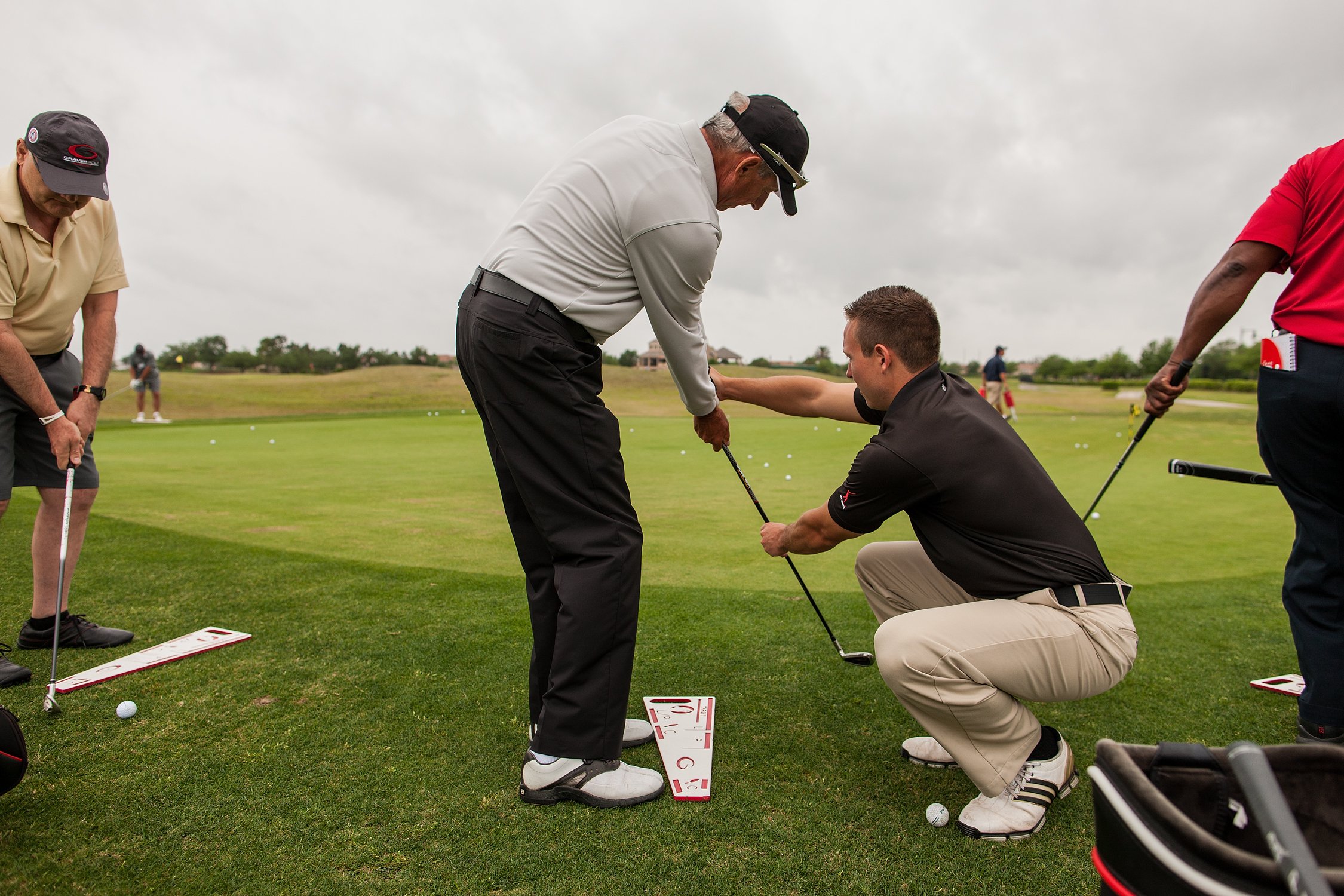
Single Plane Golf Schools
Graves Golf School Chipping Instruction

If you are planning on coming to a GGA school, you need to register now. Don’t wait. I don’t want you to miss out. If you haven’t made up your mind yet – I have some profound unsolicited advice for you. If you plan on attending a GGA School, we expect you to –

Raise your standard and your expectations about your golf swing.

That’s right. You need to stop accepting your current golf game. Right now you are taking it to easy on yourself. You agree to mediocrity. You complain that golf is hard and you struggle every year but you don’t do anything about it. It’s time to do something. You need to change. It’s time to get some real results. Now. Let me ask you.

If not now, when?

Look, you and I aren’t getting any younger. We are on the same trip – traveling on the same planet – our ship is headed in the same direction. The only opportunity we have is today. It takes time to make changes, and you need to start now.
Graves Golf Schools
Graves Golf School Notebook

By the way, this isn’t just my advice. This guidance was given to me by Tony Robbins a few years ago when I was sleeping through my life. His no B.S. approach woke me up, and he was right. I was accepting mediocrity and making dozens of excuses about why I wasn’t successful. I was telling myself lies, and I believed them. Things like “I don’t have the time” or “I’m just not strong enough.”

Today I am involved in one of the most successful golf schools on the planet – because I raised my expectations. I stopped making excuses. I raised my standards. Thank you, Tony.

He showed me that the things I was telling myself were B.S. I know because I went to work and overcame them. I realized that my beliefs, the stories I was telling myself, weren’t right. Once I realized this, my entire world changed.

Single Plane Golf Instruction

But, you know what the best thing about it was? It helped the people around me too. That’s right. When you raise your standards, the people around you grow their standards also. Their lives get better because I decided to stop suffering. It’s a win/win! But it only happened once I stopped telling myself lies.

I’m telling you that right now, at this exact moment, you are lying to yourself about your potential – and you are suffering because of it. I promise.

So what are you going to do about it? Here is an excellent place to start. Let’s find out what you are telling yourself about your golf game.

1. Old dogs can’t learn new tricks.

I’ve heard this one thousand times, and I’ve taught hundreds of old dog’s new golf swings. I witness hundreds of transformations at the schools. We get thousands of testimonials each year from golfers who were transformed from learning the Single Plane Swing. I promise that you will learn something new within the fifteen minutes of a golf school or I’ll give you your money back.

2. I don’t have the time.

You know it as well as I do, you always have time if you want to have time. I told this one to Tony, and he said that it wasn’t that I didn’t have the time it was that I didn’t want it bad enough. Heck, twenty-three years ago I drove across the United States to watch Moe hit balls so I could learn his swing. If you want something – you do it. It’s that simple.

3. I don’t want to change my swing – it will take too long.

This excuse makes no sense to me. Would you somewhat suffer forever than make a few changes? Do you want to look back at your life and say “I should have?”

4. I don’t like to practice

At one-point, practicing wasn’t fun anymore. Tony told me was asking the wrong question. He then asked – “What if you loved to practice. What if you couldn’t wait to get up every day and get to the golf course to practice?” What would your life be like? What would your golf game be like?

Not only do we lie to ourselves, we ask ourselves the wrong questions. Instead of saying “I can’t do something” ask yourself “What if you could? “. This simple change in how you frame things changes everything.

Graves Golf School
Bunker Instruction at the Graves Golf School

Here’s the deal. I want to help you. The entire GGA Team wants to help you and see you succeed. We will do everything in our power to help you – if you will raise your standards and see us.

I want to come to a school, and I want to be tough on you. Why? Because I want you to raise your standards, I want you to change and I want results.
The Single Plane Address

I’ve taught thousands of students the Single Plane Swing of Moe Norman. One thing that is consistently true about learning Moe’s swing is the importance of the Address position. Moe was right when he said:

“If you haven’t got a good address position, you haven’t got anything”.

– Moe Norman

Moe also said, “give yourself a chance“.

As I continue to research the swing, Moe’s comment is glaringly more exact. Why? Mostly because the effects of a bad address are now measurable. I can quantify the mistakes and find the causes. Many times the reasons are at the beginning of the swing – address position.

I hope that this article will help you understand that you must consistently check your address position. There are quite a few elements to it including the alignment of the feet, hand position, arm and leg position, spine tilt and bend and rotation. It can quickly get off track.

As usual, I don’t mean to overanalyze the address. It’s very simple. As I always say, just model Moe. But even modeling Moe can be tricky – because what you see can be deceiving. What you see is not still what you feel. Take for example the tilt and bend of the spine.

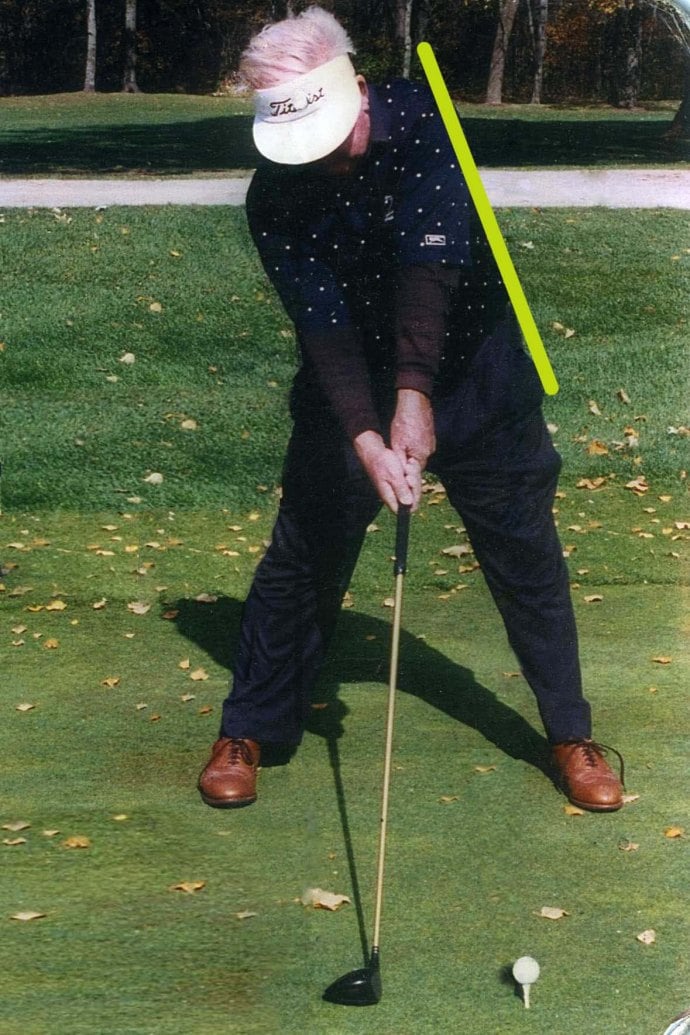
There are two tilts of the spine, the forward angle which is toward the golf ball and the side bend, which is the tilt away from the target. The trick is that you must have both inclinations to position the shoulders correctly so the arms can extend in the proper position.

Here is a picture of Moe at address – side bend (away from the target) is 20 degrees.

Moe Norman Address
Moe Norman side bend of twenty degrees at address

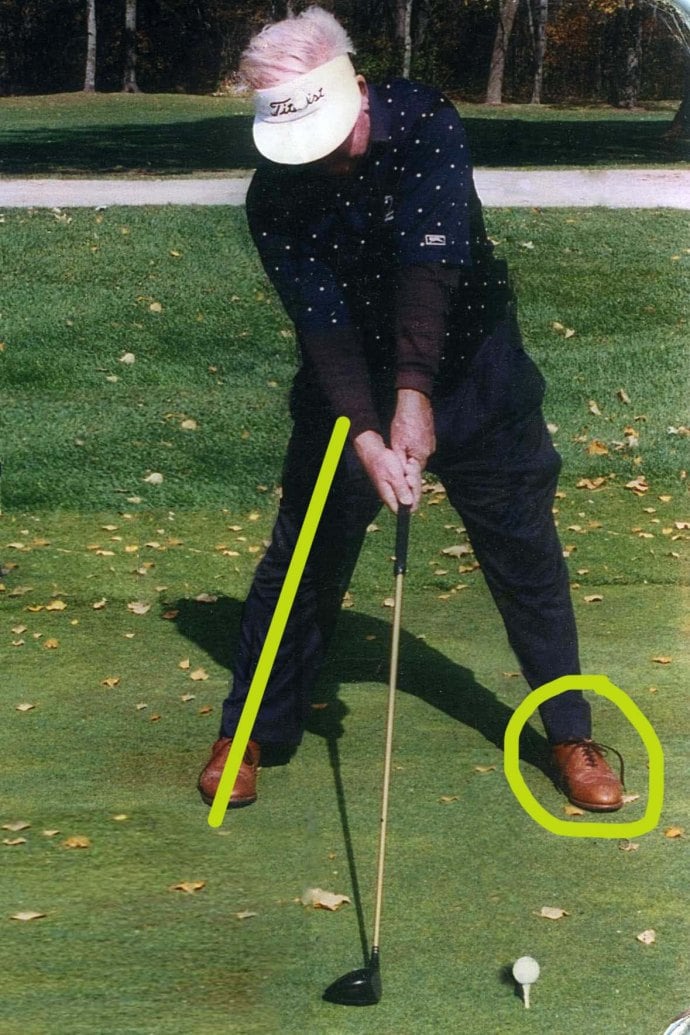
In my opinion, the side bend is the most difficult to feel and accomplish because it is entirely contrary to the conventional address position of having your arms hanging below your shoulders. With the proper side bend, you need a few other elements including the first foot rotation and trail leg braced.

Moe Norman Address
Moe Norman Braced Trail Leg and Rotated Lead Foot

Once you have the lead foot and trail leg in position, you can quickly align the club and first arm.

Moe Norman Address
Moe Norman – Alignment of Lead Arm and Club

In many ways, the grip is a function of this address position. When you have the body in the proper side-bend, the lead holder lifts. This raises the first arm. When you grip the club, the arm is higher and rotated, aligning the back of the hand and wrist to the target. The trail shoulder is lower. When you lift the side to the club, it is rotated under the organization – creating an alignment to the single plane where the trailing arm aligns with the shaft.

Moe Norman
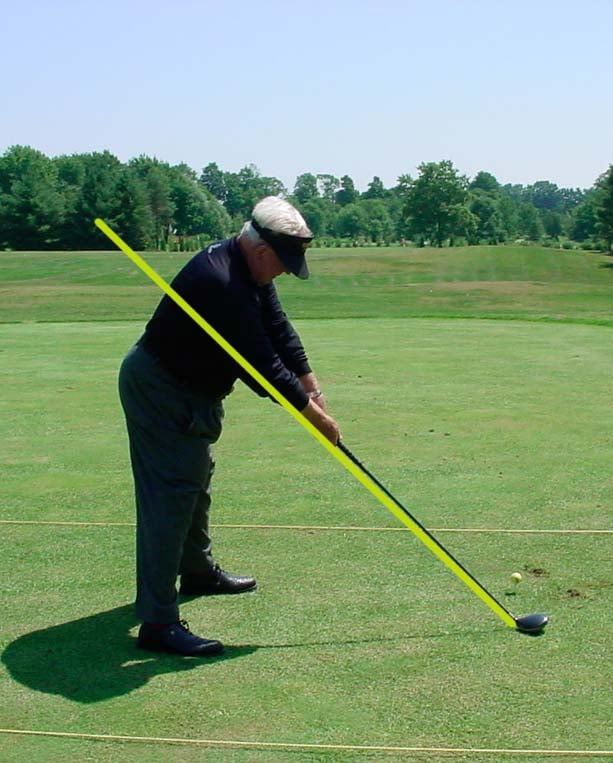
Moe Down the Line Address – Single Plane

You can see in the Down-the-line view what Moe’s legs are straight. His lead arm is higher than his trail arm – both essential variables to the ideal Single Plane Swing.

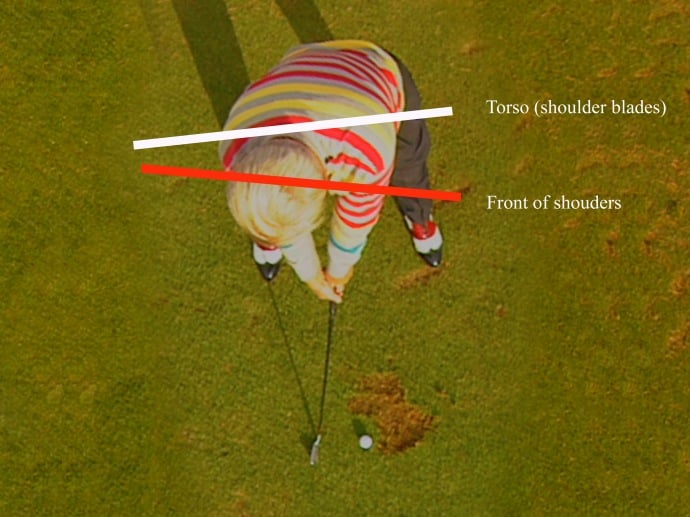
In this position, the shoulders appear to be “closed” or pointing to the right of his feet line. In actuality, his shoulders are open at address.

Moe Overhead Poster no lines copy

The fact that his body is open at speech is significant. At address, Moe’s shoulders are approximately 15 degrees open. When he rotates to the top of the backswing, he will turn about 65 degrees. Making the total turn 80 degrees. Why is this important?

When Moe returns to impact, his shoulders and hips will be 35 degrees open – 20 degrees more than at address. By opening the shoulders through impact, the hands can lead – give the club speed and proper angles into the ball to create compression.

My suggestion is that you consistently monitor and check your address position in a mirror or by using video. The address position sets up the golf swing, and as Moe mentioned, without it, you don’t have a chance.

The Single Plane Golf Swing

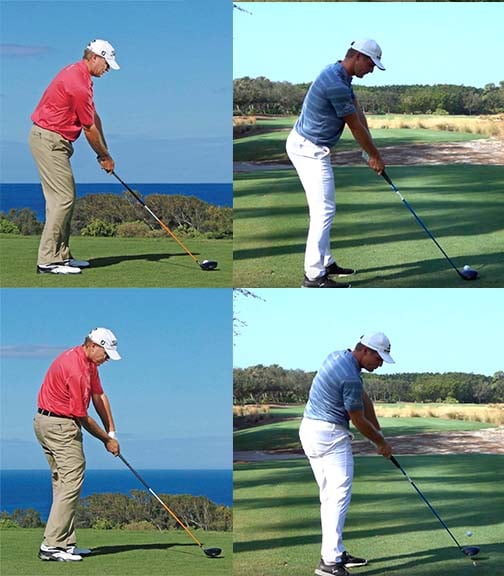
Moe isn’t the only player to swing on a Single Plane.Today, there are numerous players that I consider Single Plane Golfers. Bryson Dechambeau and Steve Stricker are the main players that resemble what I consider Single Plane golfers on tour while I find Moe Norman as the ideal Single Plane model.

Address To impact.jpg

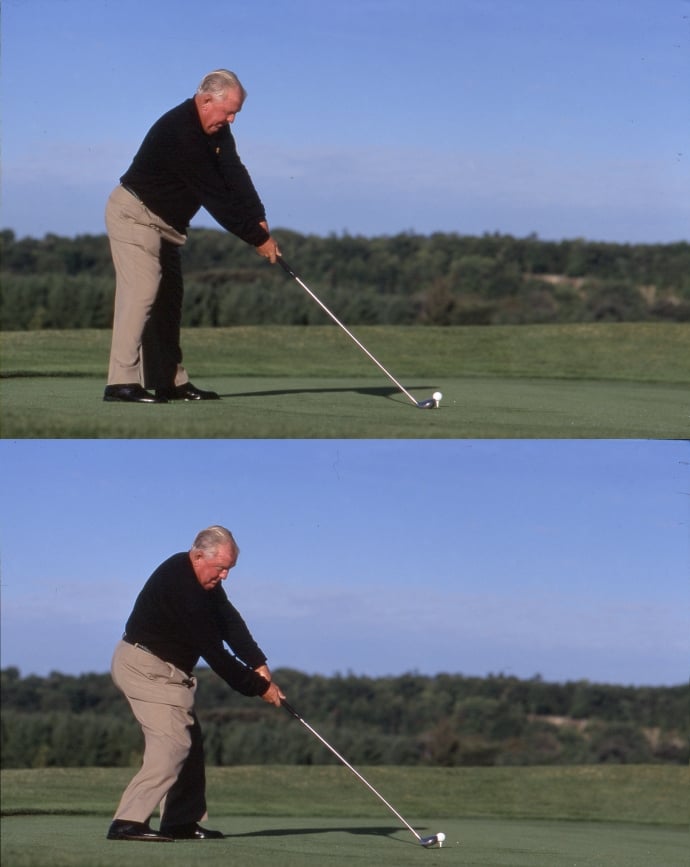
I find Moe Norman’s golf swing model. He simplified the Single Plane even further with a few changes in his address position. Moe adjusted his spine a bit more the address to resemble the spine angle at impact.

Moe address to impact.jpg

These placed the trail shoulder closer to the plane at address, removing rotation in the backswing and simplifying the entire swing. Notice that Moe stands a bit further from the ball. These allow him to move more downward to reach impact rather than a lifting action.

Here is Reed Howard, one of my students from address to impact.

Reed Address to impact.jpg

Reed has mastered Moe’s movement to keep the spine stable and reduce the stress on the back. When I met Reed, he had high rotations in his hand’s positions and over rotation of his body as a result.

Reed’s over-rotation of his body helped his hands lead through impact – however, the club lagged behind the rotation causing an extreme de-lofting of the golf club.  My first question was “Do you always hit it that little?”. The first thing I changed was to neutralize his lead hand position, making it neutral so he could place the club face. The swing starts from the grip. Your hands determine the rotation of the lead arm and clubface.  By changing Reed’s hand position, it simplified the motion of the first arm. From there, I could begin focusing on the rotation of his torso.

Due to his firm grip and over-rotation of his body, Reed had developed a “late hand action” in his backswing. Why is this a problem? The backswing also has a sequence where you turn your body and then the upper torso continues to turn as the lower body stabilizes. As you turn and the lower body stops, the hands hinge as the chest becomes. Having a late hook of his hands is usually a result of too much turn of the torso. Too much turn makes it difficult to time the downswing into impact.

Learning the Single Plane Golf Swing

I believe that with Bryson’s and Reed’s continued success, the light will begin to shine on the Single Plane swing mechanics. The Single Plane swing will become a household conversation and an accepted way to play golf. The golf world will analyze it and compare it to the tradition of conventional golfers.

The simplicity of the swing has its roots in biomechanics. When it comes to the Single Plane Swing, I claim and profess that the swing is easier than every method that exists and I feel compelled to prove it.

I am not saying that golf is easy nor am I saying that swinging the golf club is easy to learn.  What I am saying is that the Single Plane Golf Swing has fewer variables – making it an easier way to play golf.

Converting to a Single Plane Swing

For the past 50 years, the popularity of golf has built an industry of golf instructors. Instructors face the challenge of teaching human beings how to hit a golf ball, chip and putt so that others can enjoy the game. Or so they think.  Over one million golfers begin playing the game each year and 1.1 million gofers quit playing each year. The game has a tendency to be difficult and those of you who have played for a few years know how a walk in the park can easily become a stroll in hell.

As one of the many instructors who spends my energies helping others play golf (I actually consider myself more of a technical swing teacher than playing teacher, I leave that to my brother) I am often faced with “converting” golfers from a Conventional swing to the Single Plane Swing. So let’s talk about the main aspects of this “Conversion.

1) Major Grip and address position changes.  

The most significant change is how you address and establish your starting position. The hands are higher (on plane), the lead hand is neutral, trail hand is stronger, the shoulders (spine) is tilted more, the legs are straight and not bent.

2) On Plane backswing

The club often feels like it goes “inside” or on a flatter plane in the Single Plane swing. This is because you are starting “on Plane’ allowing the club to take its natural path in the backing – with no manipulation in the backswing.

3) Less Shoulder Turn and torque on back

The Single plane swing requires less turn and stress on the torso, shoulders and back than the conventional swing. Minimal hip turn and minimal shoulder turn get the club on plane and leveraged which is all you need to hit a ball long and straight.

4) Impact with flexed lead knee and feet on ground.

A significant aspect of the Single Plane Swing is that the you are returning the club to the same plane that you had at address. There is no need to lift he body at impact. The feet can say on the ground and the lead knee can stay flexed and not straighten as you see in a conventional impact position.

5) Release and follow through with feet on ground and club swings through on plane

This is almost a “result” of a pure Single Plane Swing – the feet can stay on the ground as the club fully releases its power through the ball into the finish. Because the movement of the club is on plane and easier on the body, there is less movement throughout the entire Single Plane Swing.

If you read the above paragraphs, follow the bolded text. Use these reminders as your keys on the driving range to convert your conventional golf swing into a pure Single Plane Swing.

Thank You Conventional Golf

What do I say to all of the teachers of conventional methods, and any golf instructor NOT teaching the Single Plane Swing?

I would say – thank you.  Thank you for the job security.

Your job is difficult because not matter what you do, you are at a disadvantage teaching a method that no matter what you do will be difficult for the average golfer to achieve. The conventional, arms hanging below the shoulders address position makes your job almost impossible.

You are also at a disadvantage because the amount of practice it takes to become skilled enough to achieve consistent swings to impact from the conventional address position takes extraordinary amounts of practice, timing and this still doesn’t guarantee success.

Golf is a difficult game – the goal should be to make it easier not more difficult.

The unfortunate part of this conversation is that you, the conventional student is the one who suffers. I see it every day – golfers who are frustrated because of disadvantaged mechanics.  They blame the instructors but it’s not really their fault. I Their instruction isn’t necessarily bad – just almost impossible for the average golfer to achieve.

Let me say first of all that, contrary to what many believe, the golf swing is NOT rocket science, even if it seems extremely difficult for many of you. It has become so difficult because you are at a fundamental disadvantage – which can easily be corrected. Here are some of the conventional to Single Plane adjustments that can transform your conventional swing into an easier Single Plane Swing.

1)   Move away from the ball and align the club with the arms – on the Single Plane.

This is the foundation of simplifying your swing because it sets the club on the same plane that you impact. It establishes a straight line to impact as opposed to starting on one plane and impacting on another.

2)   Tilt your spine away from the target so you trail shoulder (right if you are right handed is lower than the left)

By lowering the trail shoulder, your hands can lead into impact, eliminating the over the top and release early. The Tilt of the spine gets the lower body moving first in the downswing allowing the hands to lead into impact to compress the ball.

 3)   Rotate the hips but keep the feet on the ground.

Because you are on a Single Plane, you are now able to keep the spine in the same tilt from address, to backswing to impact. You no longer need to lift your body into impact as required in the conventional golf swing. By keeping the spine in the original “tilt” your feet will stay on the ground as you rotate your hips in the backswing and downswing.

Here are a couple of my keys to great Single Plane ball-striking:

 1)   Build an A-frame out of the legs at address.

2)   Brace around the trail leg in the backswing (do not let the knee move)

3)   Rotate the hips into the downswing into a flexed lead knee

4)   Keep the feet on the ground into impact

One of the “secrets” to the simplicity of the Single Plane Golf swing is how the back (spine) is being moved during the golf swing. The hips control the spine so as you rotate the hips in the backswing around a stable trail knee and then into a flexed lead knee, your spine moves forward but stays in the same tilt from start to release. I consider this “posture” where the spine tilt maintains throughout the swing.

By maintaining “posture” the shoulders also stay on plane where the trail shoulders position (lower than the lead shoulder) can get the hands leading to the left side of the body into impact.

As difficult as it is to describe the golf swing mechanics with words, you can understand that the goal of a golf swing is to achieve a perfect impact position. Therefore, simplifying your movement from address to impact is should be where you spend your time.

If you have learned a conventional method of golf instruction, consider this an invitation to help you simplify your movement and make golf easier. If you haven’t tried the Single Plane swing – give it a try. You might wonder why you haven’t tried it sooner and you might even say what many of our students say – “It just can be this easy”.

A Swing of Disastrous Distortions

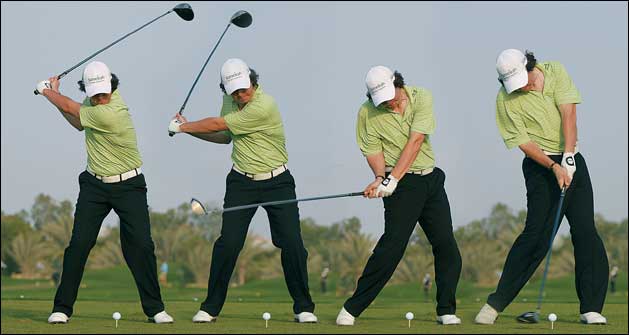
When I watch golf swings, even swings of great players such as Rory Mcilroy, it makes me cringe a bit inside my body. Don’t get me wrong, like everyone who loves golf, I enjoy watching him play golf, hit towering drives and win tournaments. I am a big fan of Rory.  But I don’t see how the average golfer can really look at Rory’s golf swing as a swing model. Rory is in his early 20’s. He’s young, flexible and fit.  He has hit thousands of golf balls to work through his swing movements and motions. His body has developed around his movements. Do I see some good things in his swing? Absolutely. But one thing that troubles me about paying too much attention to young tour players is that many people will try to model Rory – which can be a big mistake. Let’s look at some particulars.

Without going into a complete breakdown of Rory’s entire golf swing, it is interesting to look closely into his downswing move. Keep in mind that I am not looking for positions here, I am looking for the stress it places on the body in regards to the task of reaching impact. (Impact is the goal of all great ball strikers). The perspective I take is that all golf swings are to achieve a perfect strike on the golf ball. The ability to reach impact starts at address. In other words, if you start in a misaligned position you must adjust during your swing to make an impact. The more misaligned you start the more contorted you swing. The problem here is that contortions are not efficient, repeatable or consistent. And these contortions can be disastrous to good ball-striking. Even worse, they can be extremely painful if you are not a 20-something year old Rory.

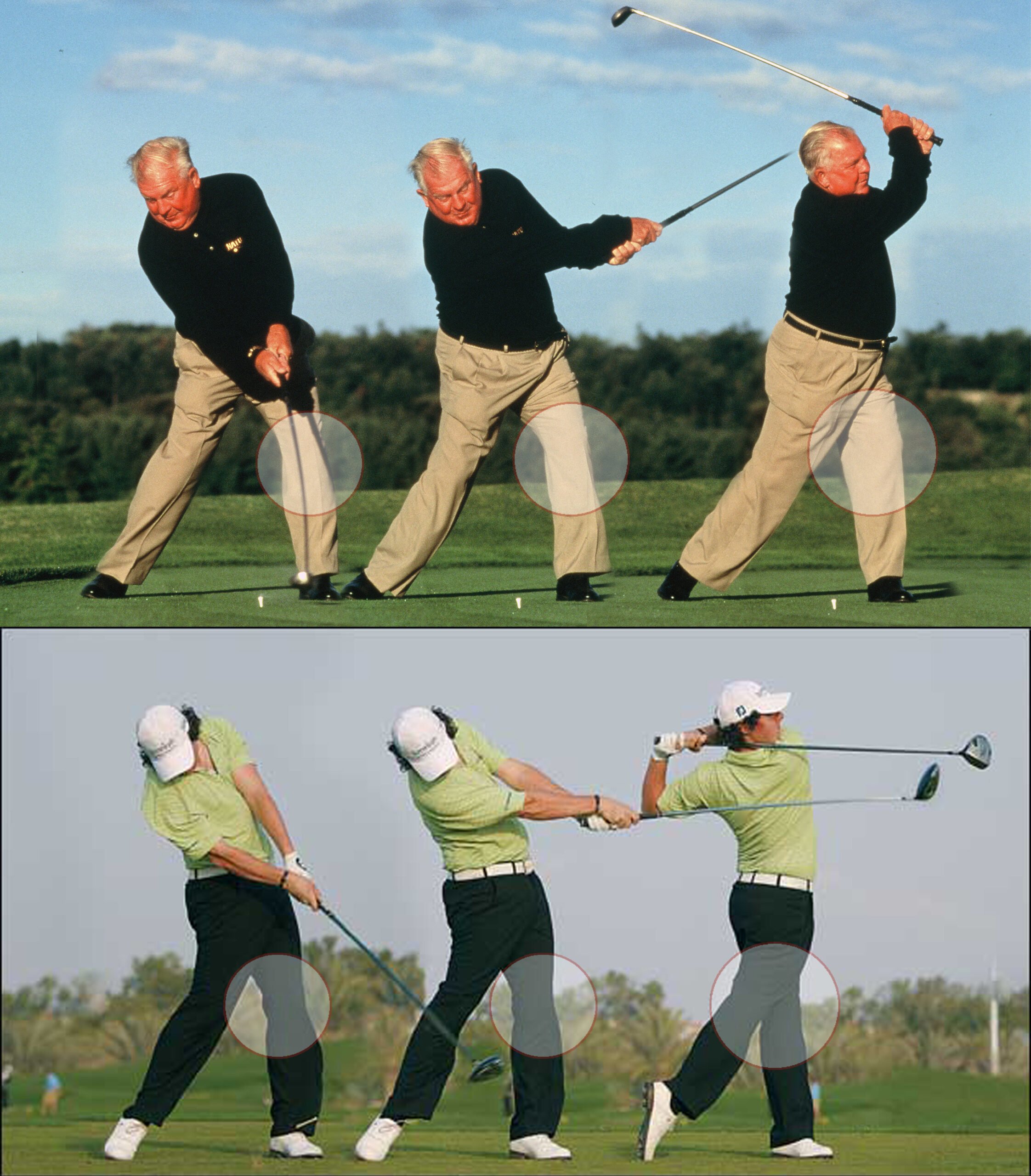
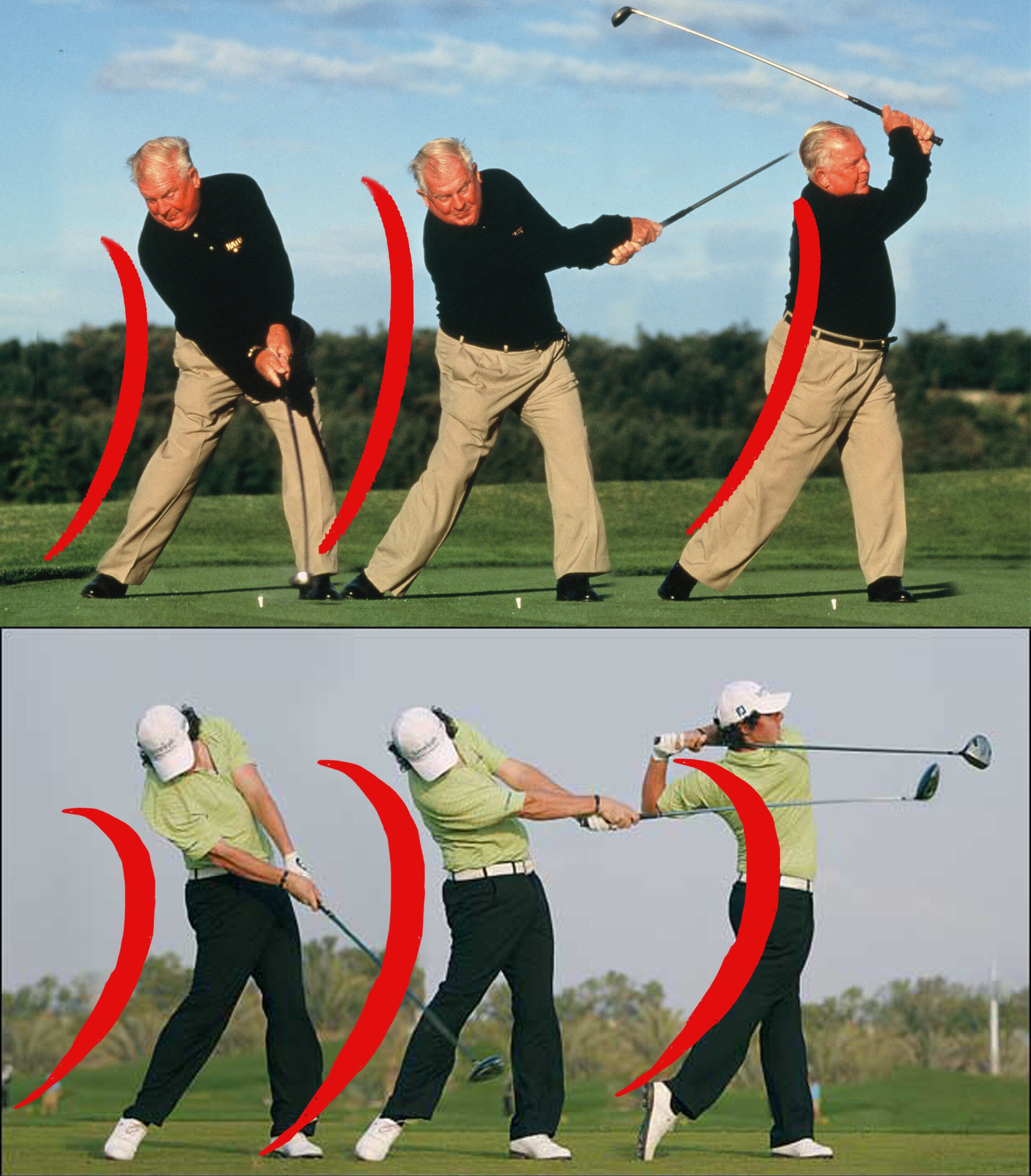
If you notice in the third picture in the sequence, you can see the crunched look of Rory’s right arm against his body. His right shoulder is jamming upward toward his head as his arms move downward. As the sequence continues, his lead leg straightens and his body move up as his arms move down – further crunching his shoulders against his torso that is moving upward due to his leg straightening. Once again, I am a huge fan of Rory, but I don’t think that this is the easiest way to get the job done for a 50 year old golfer. What I see here is a great athlete with mobility. Let me compare this with Moe Norman.

What you see from the movement forward is what I call “arm freedom”. You can see with Moe the arms have released as the lead knee has remained flexed. This shows that the arms have gone down with the body contrasting what you see with Rory where the lower body has lifted (straighten left leg) pushing the upper body up as the arms go down – crunching the shoulders and causing Rory to lean backward. This creates a reversing of the upper body or Reverse “C”.

One thing to note here is that Rory is a minimal example of this. He actually shows must less of this distortion than most conventional golfers. And as I have said in previous descriptions, this is all caused by an improper “two-plane” address position. The two plane swing comes in many forms, some more pronounced than others, sometimes in disastrous amounts. In all cases, however, the distortion of the upper body/lower body stress is a problem. I consider it a spatial problem where the conventional golfer is too close to the golf ball to start with. This results in stresses and problems reaching impact.

These things can be eliminated with the Single Plane golf swing of Moe Norman. And when they are eliminated, reaching impact is more consistent and repeatable resulting in better ball striking. The goal is to eliminate the lower body upward push. The way to do this is to get the appropriate distance from the golf ball where you start the club on the same plane at address as impact.

LEARN

THE

SWING

Join 1M+ Subscribers to get your FREE Video Quick Start Guide that reveals how to hit the ball farther and straighter more consistently from now on…

START YOUR NEW GOLF SWING