Ryder Cup Pressure

Ryder Cup Pressure

There is one thing for certain, golf is a difficult game no matter how good you are. Just ask Hunter Mahan where it became glaringly obvious during the final matches of the Ryder Cup where, when the entire Tournament seemed to come down to him flubbing a chip.

How could Hunter, who has hit that chip shot thousands of times, duff it like he had never chipped before? In my opinion, its easy. Its Golf.

Golf has the same qualities of a lie detector, revealing the untruths in everyone and their game. In Hunter’s situation, by flubbing a simple chip, he showed that the Ryder Cup meant so much to him that he couldn’t perform what would normally be routine. Golf is a truth serum.

Golf brings out the best and worst in all of us. I remember reading an article in a business magazine where the executives used golf as a way to measure attitude and personality as a way of screening potential clients. You can learn heaps about a person by watching them play a round of golf. We can also learn about our ourselves.

So what can we learn from Hunter’s experience?

First, we must realize that Golf is a game to be played but at a deeper level, it is a judge and a jury. We can’t fake a good round or pretend to be good. Second, we can use golf to master ourselves by letting it help us attain discipline where we overcome obstacles and move past failures. This is what great champions do and I am sure Hunter will do the same.

And Finally, we can learn that practice and experience do not always mean success. This is why we must always step further into the abyss of the unknown and practice more than we think necessary and try harder because, there most likely will be a time where you will need to be over-prepared and, most importantly, there is always risk involved.  You just never know if any of your work will have a “payday” but you must still persevere, practice and prepare.

Hunter will recover. All champions learn from their experiences and use them to bounce back. He will be better from the Ryder Cup just as you and I can learn that sometimes it takes a million mistakes to have one success. The answer is to always persevere, even when it seems impossible.

Perfect Practice – Moe Story

Hi Everyone,

One of the best times we have at our schools is having lunch with all our students. My staff and our students spend about 45 minutes each school day enjoying lunch (and a good break). It always seems the lunch talk turns to Moe and our stories about Moe.  This past weekend was no different – and it reminded me of a story I wanted to share with everyone and maybe it will help your practice a little.

A few years after Todd met Moe, we went back down to Orlando for a few weeks (in the winter) to work on our games for the upcoming golf season. Todd had scheduled some time in his schedule to meet with Moe at his home course in Titusville, FL (Royal Oaks) and continue his work on mastering Moe’s swing.

Early one morning – we traveled from Orlando to Titusville to meet Moe. Todd met Moe at the clubhouse and proceeded to go the range with Moe. This day Todd was working on proper impact with the driver, facing ball at impact and the proper release.

Moe showed Todd what he thought he was doing and they proceeded to practice. I remember hitting a few balls next to Moe and Todd, but was more interested in watching what they were doing.

First – as Todd and Moe practiced, Moe would show Todd his positions, but always referred to his positions very “slow” and seemed to exaggerate them when he showed them… Meaning, he would show the positions in slow motion and make a point to go “beyond” where you needed to in the swing.

Todd started to practice, and I remember Moe saying “Slow down. Bump the ball off the tee. Feel the positions – slow down.”

As most know, it is very difficult to not hit a driver hard… when you put the driver in your hands, most want to swing it hard… but Moe didn’t want any of that. He wanted Todd to slow down, hit it slow, feel the positions.

I remember about that time, I went to the putting green to hit a few putts/chips as we were going to play a few holes later… but I could still see Todd working with Moe from the green.

For the next hour, all Todd did was very short “bump drills/shots” with the driver in slow motion. Only taking the driver to waist high in the back swing and then “bumping” the golf ball off the tee and going to waist high in the through swing. And doing this in slow motion – VERY SLOW.

After an about an hour I went to Todd and asked if he wanted to go play a few holes… he said he was going to continue to practice… I went and played a couple of holes, came back and guess what Todd was still doing…… yup – the slow motion bump drill working on proper positions. Moe had gone in for a while, went to hit a few putts, and returned to watch Todd and make sure he was still working on proper positions…  I just remember him telling Todd – slow down, feel the positions… slow motion type of practice…..

Let’s discuss perfect practice a little… what is perfect practice to you?

For most, it is going to the range, hitting a few golf balls and hoping the figure something out.

How many of you practice in slow motion?

How many of you practice in slow motion to feel the positions?

How many of you are confident enough in your knowledge of the golf swing you would know what the perfect positions of the golf swing are?

It’s pretty interesting at our schools. We have our students work on the PVC drill the first day to work on the different positions of the golf swing. For most, it isn’t anything new as they have done the PVC drill many times at home. But to us (instructors), it is interesting as 9 out of 10 students don’t “hit” the different positions correct. In other words, they have been doing the PVC drill at home, but not correct…. what is this doing to their swing?

Perfect practice involves knowing what you are working on. Not guessing.

Perfect practice involves A LOT of slow-motion practice to make sure you are doing correct and allows you to “feel” the positions.

Perfect practice involves a “check system” that allows you to make sure you are doing it right. Maybe in front of a mirror, maybe videoing, maybe having someone else watch…

If you’re really serious about getting better – you will figure out how to practice perfect. Come find us – we’ll give you many things to work on, but more importantly we’ll show you how to practice. So that every time you practice, you will make sure and make yourself better.

Remember – Always Practice with a Purpose.

Do you Have Back Pain

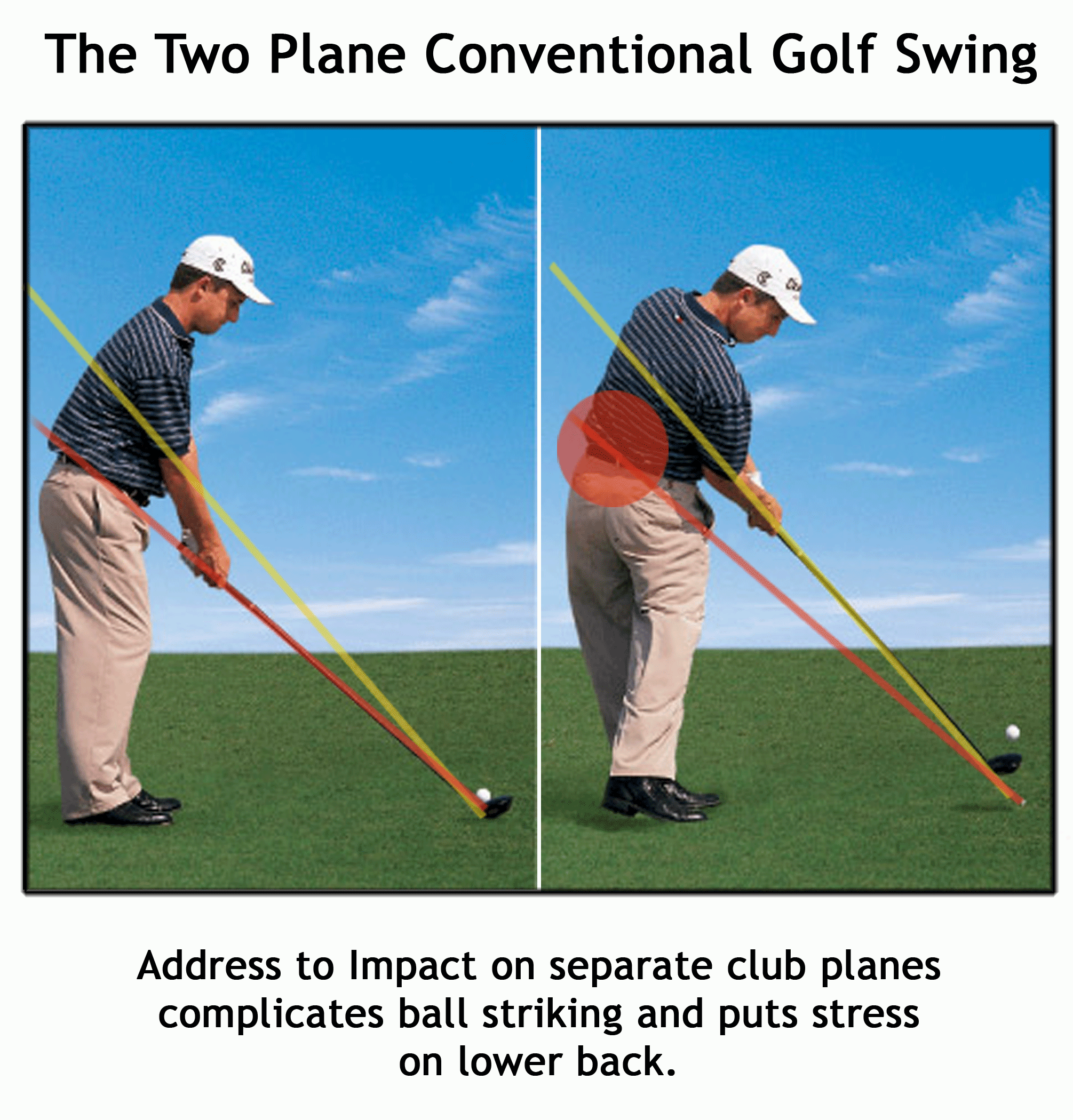
You’ve probably been taught by Conventional golf methods to lower your hand’s position at address where the shaft points through the pelvis area.  Because of this address position your standing too close to the golf ball. So when you swing, the club moves into a plane that aligns with the middle of the back, higher than the original address position you started at.

The movement from the lower pelvis plane to the upper spine shaft plane causes a twisting of the lower spine.  This causes a painful stress in the lower back.

If you draw a line on the spine, you can see that in order for the body to compensate for a low hands/close to the ball position at address, the spine must move painfully upward and backward and even curve during impact.

The Solution: Moe Norman’s Single Plane Golf Swing

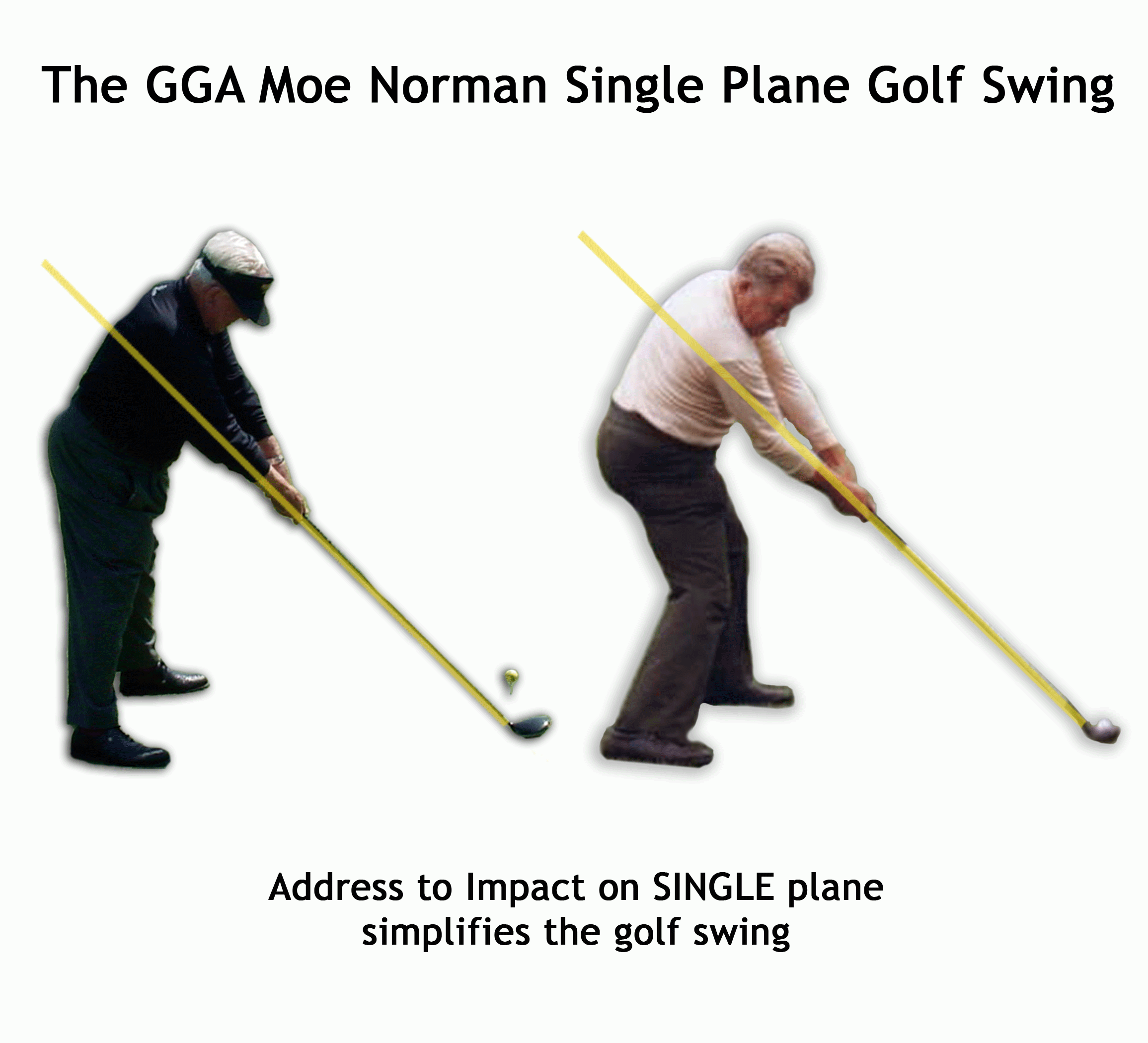
Moe Norman intuitively found a solution to this back problem by establishing the spine and shaft plane at address; we call these alignments the spine shaft intersect. The correct spine-shaft intersect creates the perfect amount of distance from the golf ball thus eliminating stress during the golf swing.

By drawing a line on the shaft, you can see that from address to impact, Moe Norman addressed and impacted on the same plane. This address/impact same plane position reduces stress on the back.

As you can see by drawing a line on the spine it remains in the exact same position from start to impact showing stress movement of the spine thus eliminating stress and compression on the lower back.

Moe Norman intuitively found the solution to your back pain.

Listen up. You can start launching laser straight, heart-stopping drives without any pain!   What’s more…

•    It doesn’t matter if you’re too short, too tall or too out of shape…
•    It doesn’t matter if you’ve got arthritis, a bad back or a bum knee…
•    It doesn’t matter if you’re a beginner, or have been struggling at golf for decades…
•    And… it doesn’t matter if you don’t think enjoying golf can be this easy…

The ONLY thing that matters… is your desire to start hitting the longest and most accurate tee shots of your life.

You bring the desire.  We’ll provide the simple, pain-free swing and your golfing life will change forever.

So, I know what you’re thinking, “What is the First Step?”

Enter your name and email address (Here) and we will send you a short instructional course on what steps you need to do RIGHT NOW, to start playing better, hitting straighter and enjoying golf without pain.

Why Handicap is NOT the best measure of a golfer’s skill

In the early 20th century, the USGA devised the handicap system to “level the playing field” to allow golfers of differing abilities to compete. The system was overhauled in the early 1980s to include the ‘slope rating’. For over 100 years, the USGA handicap system has been used by amateur golfers to compete with players better or worse than they are.

While the system does a good job of “leveling” the game, when it comes to the measure of a golfer’s skills and weaknesses in his/her game, the handicap system doesn’t provide much insight. Let’s take a look at an example:

Golfer A, a 15 handicap, is a fair ball striker. He hits nearly every fairway and nearly every green, rarely hitting a ball out of bounds. He is accurate with the longer clubs in his bag, having learned how to manage his normal ‘fade’ ball flight. Get him in a bunker, however, and the wheels fall off. He’s not much better with a putter, often 3 putting a green he hits in regulation.

Golfer B, also a 15 handicap, is an awful ball striker. He hits a HUGE banana slice with every full shot he takes. He loses 2 or 3 balls in a round by hitting them out of bounds. As bad as he is from tee to green, however, get a wedge or putter in his hands, and he’s magic. Bunker shots are no problem for him, he gets out of the bunker and near the hole every time, and with that magic flat stick, he doesn’t miss many putts under 10-12 feet.

According to the USGA, these golfers, both 15 handicaps are equal. But as you would agree from our example, they are only equal in the scores of their last 10 best rounds. Their games are completely different.

When it comes to improving your game, or as most of us put it, “lowering your handicap”, simply looking at the handicap isn’t an adequate measure of if you are improving. What’s needed is a system for evaluating each area of your game. What you need is the 7 Principles of Golf Improvement; the anatomy of a scratch golfer.

We developed the 7 Principles through years of playing competitive professional and amateur golf, learning from other touring pros, and learning that out on tour, and handicaps meant VERY little.

The 7 Principles are:

  1. Develop a Sound, Repeatable, Powerful swing of ease by modeling Moe Norman’s Single Plane swing.
  2. Develop an efficient Short Game (50% up & down with the wedges)
  3. Become a GOOD putter (Under 30 putts per round)
  4. Buy or build clubs that fit YOU and YOUR game
  5. Learn to play on the course using developed skills (Course Management)
  6. Learn how to Practice efficiently
  7. Learn how to Think (on the course)

A close look at the 7 Principles reveals that the game of golf is in reality 3 games in one; Long/Power Game, Short (Wedge) game, Putting game.

When it comes to improving the game, or “lowering the handicap”, a golfer must know which of the 3 games they need to improve on, and which areas they simply need to maintain.

To help our students in analyzing their own games, we have developed the following statistical table using USGA statistics:

Category Scratch Golfer 10 Handicap 20 Handicap 30 Handicap
Fairways Hit 65% 60% 55% 40%
Tee Shot Distance
(yards)
242 yds. 230 yds. 215 yds. 200 yds.
Green in Regulation
(GIR)
66% 50% 41% 25%
Pitch % Up & Down
(15 to 50 yds.)
50% 42% 33% 15%
Chip % Up & Down
(Edge of Green to < 15 yds.)
75% 60% 45% 30%
Putts per Round 30 34 39 45
Sand Save % (Out of bunker and 1 putt) 45% 35% 30% 15%
Penalty Shots per Round .5 1.6 4.5 6.0

If we go back to our example of Golfer A vs. Golfer B, you can see how Golfer A would be stronger in the long game statistics, Fairways Hit, Tee Shot Distance, Greens in Regulation. In fact, he may measure out as a 10 handicap in the long game or better. When it comes to the short game statistics, however, he may measure out as a 20+ handicap. And the inverse is true for Golfer B.

When it comes to golf improvement, “lowering the handicap”, you can see how using the 7 Principles table will allow you to gauge each area of your game, improving the weak areas and strengthening the areas you are most adept at.

To help you reach your goals, our entire teaching philosophy is built around these 7 Principles, starting with Principle #1, Developing a fundamentally sound golf swing modeled after Moe Norman’s Simple, Single Plane golf swing.

Connected to Moe

From Frustration to Simplicity

Todd’s Story

Todd Graves, protege of Moe NormanI often tell my students that no one has spent more time and money on golf instruction than me. This all started in 1991 when my golf game was desperate and I needed help. I had just returned from the Asian Professional Golf Tour competing against the likes of V.J Singh, David Toms and Todd Hamilton to name a few. After playing with some of the best in the world, I learned that I lacked consistency and I needed better ball striking abilities if I was to continue playing. After discussing my situation with some of my tour friends, I decided to search for an instructor who could help me understand the swing and help me become a better player.

After all, if I couldn’t beat the guys on the Asian Tour, how would I ever beat the guys on the U.S. Tour? So to get better, I began to travel around the United States spending time with the most well-known instructors; the guys you see on the covers of magazines and on the golf channel today. There is only one word for the results of my attempts to get better; confusion.

I finally moved to Dallas Texas to work with one of golf’s best instructors and finally, after two years of hard work and practice sometimes hitting 1000 balls in a day, I had become tired and frustrated frustration. That is what I was feeling in late 1993. There is no other word for it. And trust me, nobody was hitting more golf balls or practicing harder. But I had reached wit’s end. I felt as though I had absolutely no hope and after running out of sponsors, I didn’t have the money or the heart to continue and I quit playing golf.

Then one day, while living in Dallas, a friend from college came through town after competing on the Canadian PGA Tour. He had a tape of a mysterious Canadian who was known for his unique golf swing and somewhat odd personality. The man’s name was Moe Norman. As I watched the video, one thing, in particular, caught my attention; the people watching him hit balls. They were professional golfers that I knew in college. There were dozens of them, all watching this amazing Canadian Legend hit golf balls.

Now, before I continue with my story, let me ask you a question. Have you ever had any peculiar events occur in your life that kind of lead you in a direction? Things you might call coincidences or synchronicities? (I hate to call them coincidences because I think all things are purposeful), but have you ever had a series of events occur that kind of push you toward something? Well, during this period of my life, these types of events were spontaneously occurring in my life. Because at the same time I was visiting with my friend, there was a man named Jack Kuykendall demonstrating his Natural Golf Method at a driving range in Dallas that my professional golf sponsors owned.

These two events triggered a new hope in my thinking about golf. I thought, “Could there be an easier way to strike a golf ball?” Could Moe Norman have the answers? Maybe I had been searching in the wrong places for the answers to my game.

At that time, I began to look further into Moe Norman and Jack Kuykendall. What I found was that there were some differences between what Jack was demonstrating and what Moe Norman actually did. Jack discussed having the hands split apart on the club 3 inches, Moe had an overlapping grip. Jack had his own club design, Moe played with standard clubs that he altered for his swing. Also, Jack used a big grip and talked about hammering a nail while Moe had a slightly larger than normal but tapered grip on his clubs. But, even with the differences in technique, there was one thing in common, the single axis. Jack talked about the science of the Single Axis and Moe Norman was the living validation of possibly an easier way to hit a golf ball.

The Single Axis

These events lured me back to the driving range and back to the video room to study my swing mechanics. Could my new knowledge give me the results I was looking for? Could the answer to a simple way to hit a ball be in the Single Axis golf swing of Moe Norman?

I often utilized video often in my practice because I believed in modeling and not wasting time with poor technique. I had spent so much time looking at other players golf swings, it was easy for me to understand how helpful video analysis could be. I figured 10 perfect swings on video are a better use of time than 100 bad swings on the driving range. Besides, the driving range couldn’t tell me anything about my golf swing and I wanted to know more about the club movement. And now after seeing the video from Canada, I wanted to Model Moe Norman and I wanted to do it without wasting time.

So there I was, in my teacher’s studio about to defy all of his teachings and put myself in positions that would make him laugh. (I would later find a tape of Moe in my teacher’s office.) However, with the state of my current golf game, I had nothing to lose. So there I was, standing in front of the video cameras I address the ball on the video screen, lifted my hands into a straight line with the club shaft, widened my stance and looked down at the ball. I then made my first single-axis golf swing. Of course, I immediately ran to the video machine to play it back. As I played it back, I, for the first time in my life, found what I was looking for.

Impact Plane

Before I explain what I saw on video, let me explain my “conventional” golf swing. At address I hung my arms below my shoulders. When I did this the club is on a separate line than the arms which I now call a two-axis swing system where the arms are on one axis and the club is on another. My swing was a combination of arm movement on one plane, rotation on another, a hinging of the hands and turning of the body. And this was only my backswing. My downswing was a combination of re-rotating my body, arms, club and lifting of my body to impact where I could then try to finish in balance.

My practice consisted of videotaping my swing and drawing a line on the tv screen at address and then again at impact. As always, the impact line always appeared above the address line. In other words, it was higher than the original shaft line at address. This meant, in conventional terms, that the club was starting on one plane and impacting on another. The problem with this “two” plane type of swing is that because the club starts on a lower plane, it must lift into impact. This lifting of the club shaft meant that the upper body must also lift to allow for the higher impact plane. As I had learned, the upward and backward movement of the body is a difficult move and it takes coordination, timing and lots of practice. (I recently explained this in the July 2005 Golf Tips Magazine).

With all of this movement, consider the fact that it only takes ONE DEGREE of clubface error to hit a driver 30 yards off line. The conventional two-axis system makes it difficult to square the face at impact. With such a small room for error it would seem obvious that the goal is to create the least amount of deviation of the club plane between address and impact. It made sense to swing the club on a SINGLE plane.

What I saw on Video

So, when I went to my teacher’s studio for the first time to model Moe’s swing, by adjusting my grip, lining the club correctly with my arms, I had finally reached my goal. When I swung, the club impacted the golf ball on EXACTLY the same line as address. By modeling Moe, I had finally swung the club on the single plane. It was so simple. I then realized that Moe Norman, the mysterious Canadian who swung the club what he called “My Way”, had a secret. Moe had unknowingly uncovered the answer to a better ball striking technique.

When I realized how easy it was to swing the club on plane, I then realized that all of my conventional efforts were, to put it quite frankly, wrong. I don’t think they were a waste of time because without them I would not have searched for a simple way. But I knew that I had to learn a new IDEA of the golf swing. My concepts of how to swing the club had been drastically challenged. The conventional thoughts of arms hanging below the shoulder, lower body rotations, and shoulder turn were now dramatically altered. I knew that my understanding of Moe’s golf swing and the single plane was just a beginning of my learning process.

Meeting Moe

I must admit, after that first day in the video room, I was extremely excited. I felt as though I had discovered the Holy Grail of the golf swing. I realized that after reading all of the golf magazines, studying the best players in the world, playing on the Asian professional golf tour and then working with the best instructors in the world that I be making one very big mistake. I had been asking the wrong question. I had been searching for what works on tour however the tour is full of many swings that work. When I finally asked one simple question, “Who is the best in the world?” only one name emerged from even the best players on tour; his name was Murray ‘Moe’ Norman.

It was mid summer 1994 and Moe was performing a clinic in Chicago. I knew that if I was to take my learning to the next level I needed to meet the man behind the Single-Axis Golf Swing. I decided to drive to Chicago and meet Moe and watched Moe hit balls in person for the first time. His first three shots from 50 yards struck the target. The fourth shot wet directly under it. By the end of the clinic, Moe was striking drivers at a 250 yard post. I watched as about every 10th ball would strike the post. I can honestly say that I have never seen a greater display of control and accuracy of the golf club. I have never seen golf look so simple. It was the greatest ball striking I have ever seen.

After the clinic I approached Moe. We talked about his amazing display and I told him that I had never seen a better clinic. Moe’s first words to me were “I’m the best in the world”. “There is no doubt” I said “No doubt.” “Mind if I hit a few of your clubs” I asked. “Sure, but there too heavy for you” Moe said. They weighed a ton. Lead tape covered the heads. But as I swung the club, Moe watched as I hit his 7-iron and then his 5 iron. “Looks like me without a belly, looks like me without a belly” Moe said.

From that day Moe and I became friends. We played, practiced and performed clinics occasionally. I often visited Moe in Florida when I was either playing tournaments or working with Natural Golf. Our relationship became one of a student and teacher. Moe was extremely intuitive and played golf by feel. I learned the things that Moe himself could not explain. As I spent more time with Moe, I learned to “bridge the gap” between his feelings for the golf swing and the mechanical and physical reality. I could never express my appreciation for Moe’s kindness and generosity as I diligently learned to know what he knew. It was for that reason that I have acquired the nickname “Little Moe”.

The important part of this message is the promise I made to Moe during what would be my final round with him on July 4, 2004; 60 days before Moe’s death. He was excited about all that I was doing with my swing and commented to me that he never thought that he would see it but that I had “mastered” his move. That day, I promised Moe that I would continue to be his voice to tell people about his amazing swing no matter what the consequences. I promised him that I would show others how his simple technique could help them enjoy the game just as it helped me learn to love the game again.

Enjoy your journey!

ARE YOU FRUSTRATED

If you are frustrated with your ability to hit a golf ball you should know the Single Plane Golf swing of Moe Norman.

Why?

Because of Biomechanics and Science!

It’s all about the Single Plane! To hit a golf ball well and more importantly – straight – you must return the club to swing plane at impact. The better you impact, the better you hit a golf ball. It’s that simple.

To return the club to impact, and eliminate that slice or hook, you must simplify swing plane.

Moe Norman’s biomechanically perfect golf swing removes unnecessary movement and is your answer to simplifying your golf swing and eliminating your frustration.

You can see Moe from the Down the line view, by drawing a line on the club shaft at address, the club begins on plane swings on plane and impacts on the same line.

From a face on view, you can see that Moe has minimized major body rotations and moved the arms and hands into a leveraged speed producing position.

No more twisting and torque of the body, Moe’s Single Plane is the most efficient body position to produce natural speed and power with the least amount of unnecessary movement.

Isn’t it time you deserved to have fun playing golf?

This, finally, is the ONE simple secret to never slicing or hooking or muffing a tee shot again the rest of your life.

I don’t care how many other lessons you’ve had in your never-ending journey to good golf. THIS is the ONE swing that gets you smacking golf balls dead center in rich green Manicured fairways.

No more roughs and hazards! Imagine the relief and joy that would bring!

LEARN

THE

SWING

Join 1M+ Subscribers to get your FREE Video Quick Start Guide that reveals how to hit the ball farther and straighter more consistently from now on…

START YOUR NEW GOLF SWING