CLICK HERE FOR YOUR FREE SINGLE PLANE FIT

CLICK HERE FOR YOUR FREE SINGLE PLANE FIT

Whether looking to fit/replace a single club to an entire set, from a putter to a driver to your irons, wedges, etc.. it is ABSOLUTELY CRITICAL that the club(s) is fit to YOUR individualized swing and single plane specifications.

An UNfit club will hinder your improvement process, an UNfit club will hinder your golf game, an UNfit club will not allow you to reach your potential, an UNfit club can and many times will actually physical hurt you (tendonitis in elbows and wrists are many times causes and exaggerated by club with improper lie angles), and UNfit club is basically worthless to you. I don’t care how much you spent for the golf club(s) – if they are not individually fit to you – they are worthless to your game – and worse than that, can and many times will actually “hurt” you.

The Graves Golf Academy has custom fitting programs established with most major manufacturers in the golf industry. And many of the manufacturers install our grips in their custom department (no other instruction group can say that….). We have worked VERY HARD to set this customizing system up for our customers, students, etc. anyone interested in the single plane golf swing.

Also, because of the amount of equipment we sell from each manufacturer, we are many times offered equipment at a reduced rate for our customers. We are always able to match industry pricing and many times able to beat the pricing. We are also many times able to offer clubs at a significantly reduced price (last year’s models, etc. as these manufactures know how many clubs we sell and “hold some back” for us). Please watch our newsletters (bimonthly) for these specials – as they typically don’t last long as many are interested in these special pricings.

Customization done at the manufacturer (Callaway, Taylormade, Titleist, etc..) is free through the Graves Golf, there is no added cost for the GGA grips installed and customized at the manufacturers. Plus, there is no shipping charge (within US) and no tax (outside of OK) through Graves Golf.

To get a FREE individualized custom fitting please go to:  http://moenormangolf.com/clubs/free-club-fittings/


To View Single Plane Fitting Informational /

Instructional Webinar:   CLICK HERE

4 Cs of a Great Short Game

Got a lot of questions after last week’s webinar about what we (Todd and myself) discussed – the 4 Cs of the short game.

During all short game schools we discuss many principles and philosophies of the short game, such as the 4 Cs of the short game.

Wanted to remind everyone about my 4 Cs of a GREAT Short Game. These are/will be covered “in depth” during our short game school and covered in all different areas (putting, chipping, pitching, bunker, specialty shots… especially those specialty short game shots).

In our schools, camps, and clinics (and pretty much anytime you’re around me), you will continually hear how important the short game is for scoring. In this article, I’m going to compare the long game vs. short game then give you my 4 Cs that you must follow to have a great short game.

First, you must be convinced that the short game is the most important part of scoring. Here are a couple facts about the short game.

Fact: The difference between a 30 handicap golfer and a scratch golfer (0 handicaps) is associated with 7 to 10 shots in the long game (shots over 50 yards) and 20 to 23 shots in the short game (shots under 50 yards). Meaning, if you are a 30 handicap golfer and only work on your long game you will only improve 7 to 10 shots toward scratch golf. The best you will ever reach is a 20 handicap. The difference between a 15 handicap golfer and the scratch golfer is associated with 3 to 5 shots in the long game, and 10 to 12 shots in the short game. In other words, if you are a 15 handicap golfer wanting to reach scratch, if you only work on the long game, you will basically never improve beyond a 10 handicap.

Fact: No professional (or scratch golfer) has an advantage in their short game over yours. In other words, the short game is not associated with strength, working out or athletic ability. It is a part of the game that is associated with practicing the correct fundamentals and putting those fundamentals into play at the right time. Ever notice how many young players (talking about 10, 11, 12-year-old juniors) have a great short game. In fact, many compare to the professional’s short games. Don’t you wonder how someone who is 75 pounds soaking wet can compete with the best players in the world? This shows it is not strength, but rather what matters are things like finesse and feel. This is what I call the 4 Cs to the short game: Creativity, Confidence, Commitment, and Critique.

4 Cs

CREATIVITY: The first thing you must do when confronted with a short game shot (pitch, chip, etc.) is to create the shot. Part of the teaching we give our students during their short game instruction is to pick a shot around the green and ask the group to name 5 different ways to play the shot. Most of the time the group is able to name 2 or 3, but almost never 5. An example would be a shot that is 20 to 25 yards off the green with minimal rough between the ball and the hole.

You could:

  1. Pitch the shot to the hole,
  2. Chip the shot into the fringe around the green and roll to the hole,
  3. Putt through the entire rough and fringe,
  4. Hit a flop shot all the way to the hole, or
  5. Hit a 3 wood chip that will have moreover spin and roll to the hole???

The point here is you need to be creative over the shot. I like to call it the “artistic” part of the game.

A good rule of thumb: “Putt when you can, Chip when you can’t putt, Pitch when you have too…” (Aka – the “PCP Rule” – refer to past articles on the PCP Rule). Yes, this is a very basic “rule”, but a good one to fall back on.

COMMITMENT: Once you have created the shot, you must commit to the shot that is the lowest risk for error FOR YOU. If you have a good pitch shot and feel it is the most likely to get the ball close to the hole with the least room for error, hit the pitch shot. Many will feel the chip from the fringe or even the putt will be their lowest risk shot. DON’T think you have to hit a shot in a particular manner because the pros on TV hit it that way, but rather execute the shot YOU feel you can hit with the most confidence.

CONFIDENCE: So now that you have created and committed to the shot, you must play the shot with confidence. This means that if you have chosen to chip the shot, tell yourself you will chip it close, pick your spot you want to hit, use good fundamentals, and with 100% confidence, hit the shot. If you don’t feel confident over the shot, BACK OFF and commit to something different or swing a couple practice swings/chips until you have gained the confidence back. The last of the 4 Cs are:

CRITIQUE: You must critique your short game shots after you have executed them. This is not to say, “I can’t hit a particular shot”, but rather “I had 4 chip and run shots today and only hit 1 good. Therefore, I need to put more practice in the chip and run shot”. Look back at each shot and determine if you need more practice in that area. Here’s a question you can ask yourself and see how well you currently critique your short game: How many of you practice chipping short of the green (maybe into the fringe) and then roll the ball onto the green close to the hole or how many of you when practicing putting, putt balls from off the green (from the fringe or low rough) to the green? I believe that these are the shots that, after you critique your short game, will probably be the shots that need the most practice.

Finally, I believe that EVERYONE can have a GREAT short game. In fact, everyone can have a short game that is as good or better than any professional. But, to get this GREAT short game, you must first learn the proper fundamentals and practice these fundamentals. Then you can use the 4 Cs – Creativity, Commitment, and Confidence and then Critique to bring that short game to the course.

Good Luck and Remember – ALWAYS PRACTICE WITH A PURPOSE!

I learned Moe’s Single Plane Swing with a Broomstick

Perched on the driving range in Chicago, Illinois in 1994, with his clubs strewn about, I watched Moe Norman , the greatest ball striker of all time, strike shot after shot with effortless perfection.  I could hardly believe what I saw.  I was amazed at how simple his swing looked.

Intrigued and inspired, I quickly grabbed my video camera and recorded his swing.  I wanted to have something to study.  Something I could watch and mimic later.  (You can see that rare 1994 Video on this page).

With video in hand, I couldn’t wait to start my journey learning Moe’s Single Plane Swing.  I was determined to master his simple move.

Moe Norman’s swing is the perfect swing model.  All you have to do is master his “club to body” relationship and you master his Single Plane swing.  It’s that simple.

I studied the video.  All I could think about was “I need to learn to feel Moe’s swing.  If I could feel it, I can master it.” I thought it would be easy.  Just match what he was doing from the video, right? Thats where I started to have problems.

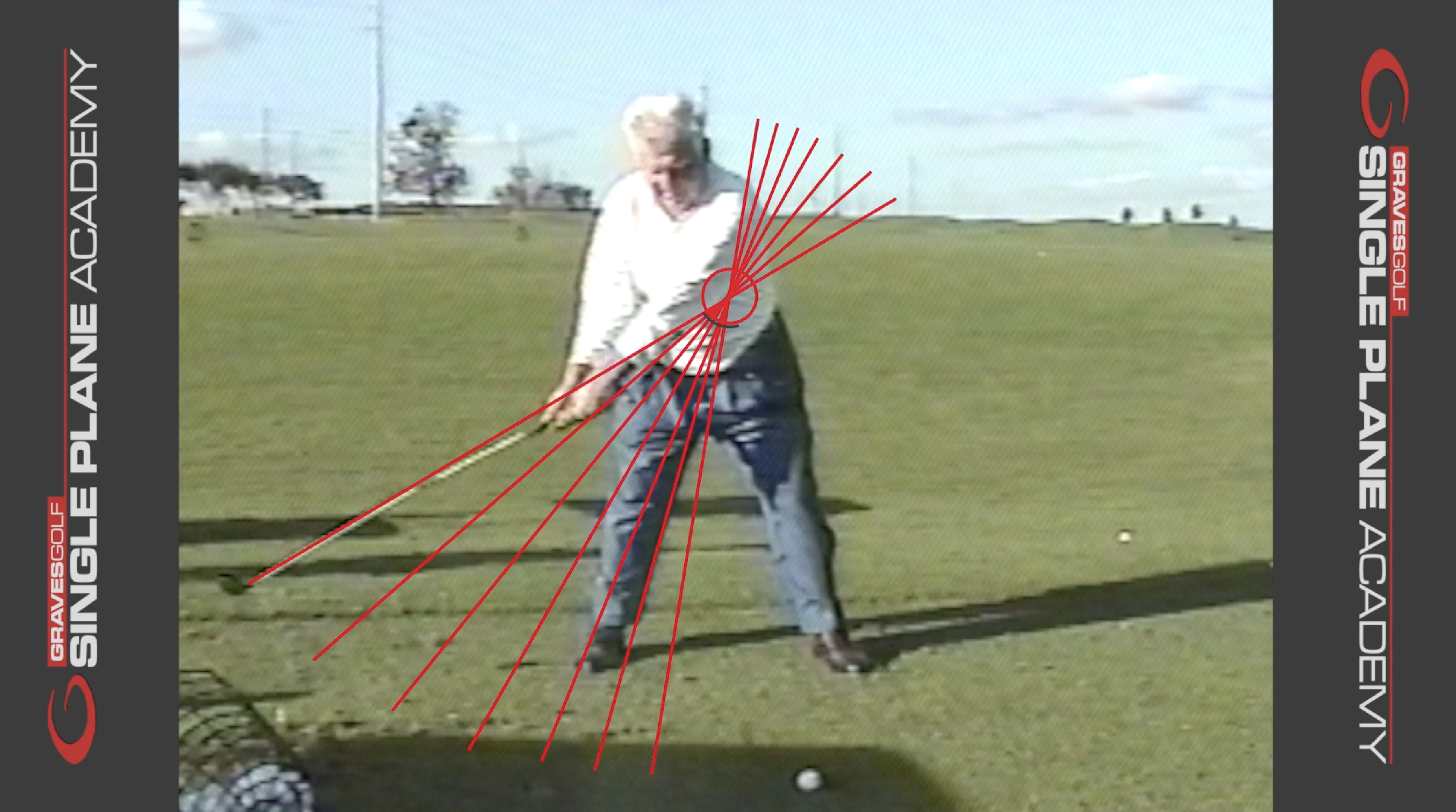
Then, started drawing lines on the tv screen and I noticed something that you might call a secret. As I studied Moe swing in slow motion, I started drawing lines on the TV screen. That’s when I made this amazing discovery.

The Pivot Point Relationship.

The lines I drew on the TV showed how the club points to the lead side.

When I saw how the club references a specific point, I was so excited I ran to my closet and grabbed the longest thing I could find that would attach to my lead side – a broom.

extended my hands down the broom until it touched my side, just above my hip.

It felt like the “club” was connected to me.  Then when I turned into the backswing, everything moved together in one piece.  Everything moved together. 

It had established what I now call the “Club to Body” relationship.  The broomstick helped me feel Moe’s lead-side “how to get to impact” relationship. This is how Moe did it!  This is how he simplified golf.  He discovered how to make impact easier. What could be more important than that?

I finally found a way to make the feeling of Moe’s swing understandable and achievable.  All I had to do was copy the movement. Discovering the pivot point was revolutionary but I started running into a problem with the broomstick.

Without the proper grip I couldn’t move my hands correctly to the top of the backswing.  The broomstick solved one problem but created another.  The Broomstick was too wide and made it impossible to correctly place my hands.   It didn’t feel like a golf club. It made it difficult to move the hands together.

That’s when I developed what students are calling “the most important tool for learning the Single Plane Golf Swing”: The Single Plane Position Trainer.

I engineered the Single Plane Position Trainer (SPPT) to be a simple, light weight training tool to feel the positions of the Single Plane Swing.  The SPPT allows you to  feel and train the Single Plane Swing anytime and anywhere.  You can carry it in your golf bag and take to the course or you can use it in your home or office.

The SPPT helps you “blend” the positions of the swing into and ideal on plane backswing, with the proper leverage, hand rotation and grip position.

Blending the Backswing with the SPPT

I consider the Single Plane Position Trainer the natural way of producing swing plane and simplifying impact.  What this means is that swing plane and impact are directly related.  To find out more about the most recent SPPT promotion and save a few bucks.

Go here: https://bit.ly/3lBWoUw​

Moe got mad, then I designed the ABT

Back in the late 90’s, I would often drive to Titusville, Florida and meet Moe Norman at Royal Oak golf club to practice. Tracking him down wasn’t difficult but talking to him was.  Moe didn’t have a phone so I would have to set up the meeting by calling Neil Hunt, the head pro in the Royal Oak shop. I asked Neil to tell Moe that I would be arriving at 10 O’clock.  Neil would then tell Moe when I would be arriving and, like clockwork (forgive the pun), Moe would always be there waiting.

Moe Norman Todd Graves
Moe Norman watching me hit balls.

From where I was staying in Orlando, it was a forty-five-minute drive which sometimes took over an hour.  On this particular day the drive took an hour and a half.  When I arrived, Moe was agitated.

“Ten O’clock, where have you been pal, where have you been?”  Moe asked.

“Traffic Moe.  Terrible traffic on the Bee-Line.” I answered.

The Bee-Line was highway 528 a stretch of road the East from Orlando  directly to the Florida coast.  Moe wasn’t satisfied with my excuse.

Moe mumbled as we walked into the clubhouse to get a coke. “Ten O’clock, Ten O’clock, you know the Bee-Line, always busy, always busy.”

 Moe had an affinity for time often wore two watches and sometimes three. (Thanks to my friend Larry Olson. I’ll save that story for another time).  He always became frustrated when I was even one minute late.

We drank a coke and to distract him I randomly chatted about how busy the world is getting. It took a few minutes to sidetrack him from obsessing on my lateness. Luckily, it worked.

As usual, our conversation hooked back to the golf swing and eventually we walked across the green to the range. Any golf swing discussions captured Moe’s attention.  He loved to talk about it, especially with me.  He knew how fanatical I was about his swing.

In typical fashion, I stood and watched as Moe started with wedge, crisply hitting perfectly straight shots painting a stripe in the sky.  Each ball on exactly the same trajectory.   He moved to a seven iron.  Now the line was lower. I remember the piercing snap of each strike.

After about the fourth shot Moe turned to me and said, “I don’t know how to swing it badly.  This is all I know”.  He immediately turned, with his club in his left hand, dragged another ball from the pile and “thwack” struck another one on a pipeline.

After knowing Moe for almost six years, this was just another display of incredible ballstriking.  I had become used to it, but I never got used to Moe’s definition of it.  He always had a way of describing the indescribable.

What Moe was describing was how he had grooved his swing to a level of consistency where, he had only one neurological pattern.  Like riding a bike.  He didn’t think about any of it.

I knew how Moe became a ball-striking machine.  That was easy to understand.  He hit millions of balls.  As Ben Hogan so eloquently put it “He dug it out of the dirt.”   What I wondered was; how can I do it without working so hard?  What could I do to make it easier?

What is the absolutely, without a doubt, one hundred percent effective, best way to practice?

Here’s the thing. We all know that we have to practice learning something. That is a given. But what is practice anyway? Isn’t practice for learning?  If so, then learning what? It was the “what” that had me asking Moe so many questions.

That’s when I asked, “How did you learn your swing so well that you don’t think about it Moe?”

Hit your positions, practice your positions” Moe said as he raked another ball from the pile – “thack”.

Not just your swing positions, but all positions”, Moe added.

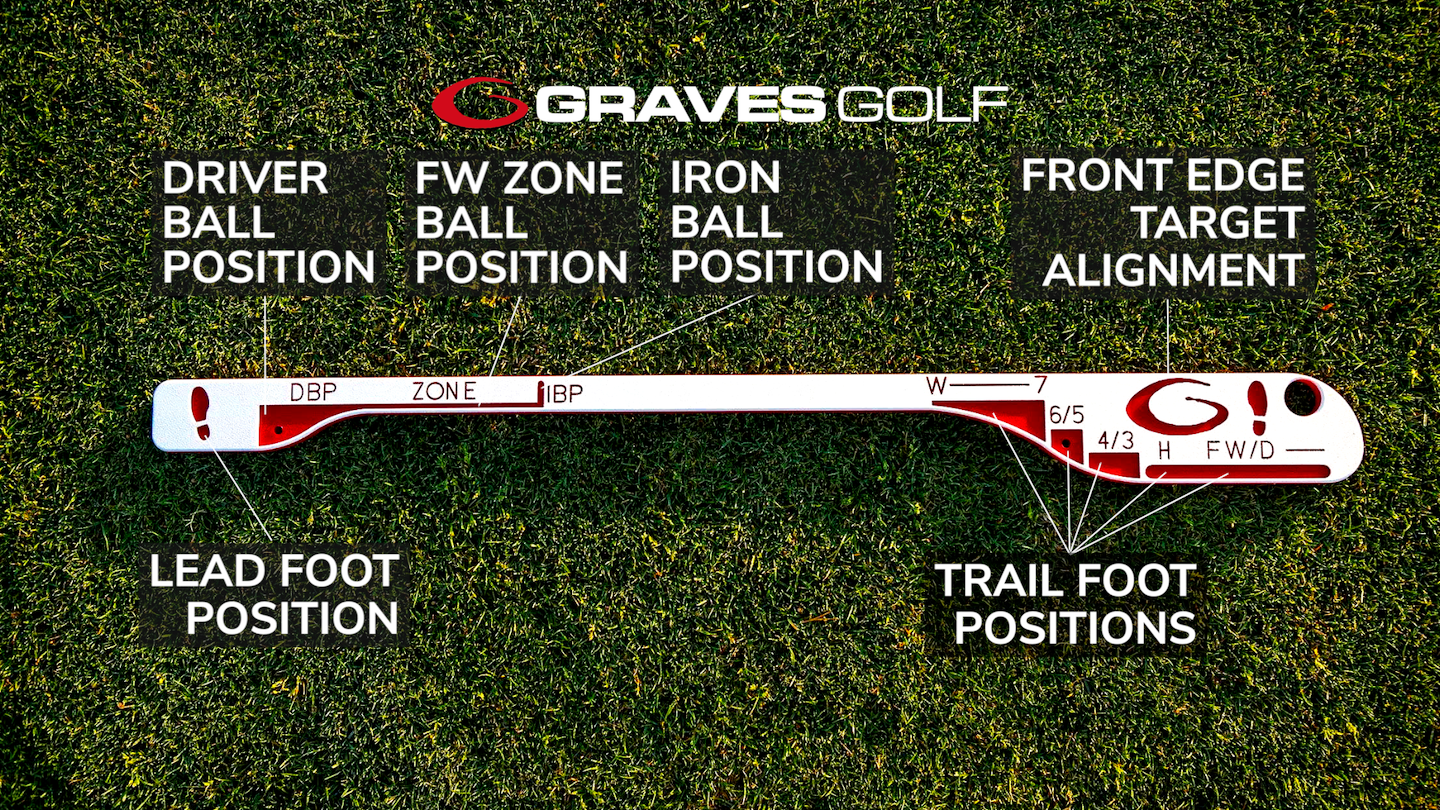
There it was.  Another subtly. Moe was talking about his address position. I was typically focusing on swing positions and Moe was referring to ball position and foot position.  Moe was referring to what I now call the “little-big” things that are so often ignored.

The main little-big things are ball position, foot position, stance width and distance from the ball.  The final little-big thing is to have the proper shaft lean (hands forward) at address.  This only works if you have all of the main things. There were many times when I have a bad round.  I used to blame my swing but soon realized that most of time it was because of an incorrect ball position.

Moe didn’t worry about these things anymore.  At some point, he figured out all of these “little” things when he “memorized” his swing.

This answered my question of what is the absolute best way to practice?  I realized that mastering the little things is exactly how you get better – faster.  When you can stop thinking about the little-big things, you are on your way to perfecting your swing, like Moe.

The day I was late with Moe was the day I realized that all I had to do was build something that would help me memorize the little-big things.  That was my inspiration to develop the alignment and ball position trainer, the ABT.  The ABT is designed to be positioned on the ground every time I practice so I could build consistency into my positions.  It helped me focus on my swing and not the little things.

Being late for my practice session with Moe was nerve racking.  Even though the day got off to a rough start, nothing was more fun that discussing the golf swing with Moe and watching him demonstrate ballstriking perfection. Best of all, it inspired the ABT which I still use today.

This week Graves Golf is running a promotion on the ABT.  You can find the special here:

https://learn.singleplaneacademy.com/op/abt-special-offer/?utm_source=ap&utm_medium=email&utm_campaign=ABTMarch2021&utm_content=Email3


Practice With a Purpose

Replay from a few years ago

For the past couple of weeks I (Tim) have been on a “golfing tour” of sorts.

First, I played in a Nationwide Event (now Korn Ferry) 2 weeks ago, then spent a couple of days teaching at the PGA Championship in Tulsa, then played in a PGA Pro-Am (was there with Jon Daly – some of you might have heard his interview today talking about Cherokee Hills – course he played yesterday for practice – was there with him…) and walked the PGA with Todd for a couple of days.

Needless to say, in the past couple of weeks, we have been around a lot of pretty good players. Okay, a little better than pretty good – the best players in the world… (I spent about 2 hours today with my son watching Tiger warm up and play a few holes…)

As I watched these players there were some very interesting points that came to my mind I wanted to share with all of you. Especially as we watched them practice for their tournaments (whether at the Nationwide Event or the PGA) … Not necessarily the practice just before they were about to play (warm up type practice – or as you have learned – Practice type A), but rather the practice they put in on Monday/Tuesday before their event (Practice type B).

1. Focus – It was amazing the focus the players put in their practice.

What do I mean by focus – give you an example.. Justin Rose was working on his takeaway – apparently, he (and his coach) felt like he was taking the club too far inside on his back swing. I watched him for about 15 minutes on the range. He would take 10 to 15 practice back swings (just back swings), looking at his back swing, trying to “feel” the correct move, performing it over and over and over again VERY slow – then he would hit a shot. I bet in 15 minutes, he only hit about 10 to 15 golf balls – all the rest of the time was spent “rehearsing/practicing” the correct move in his back swing. His focus on his practice was amazing. I saw this same type of practice in most every player on the practice tee…. when you could tell they were getting tired (100* temperatures will do that to you pretty fast) – they would walk away and take a break or quit for a while… it was very obvious… when they lost their focus, they walked away.

2. Rhythm – As always, the rhythm of good players is a lot of fun to watch.

What do I mean by rhythm? Good players NEVER try to force the ball – the “let it happen”. In other words, most use 80% or less of their energy when they are hitting shots. They understand a shot hit solid is MUCH better than a shot hit hard. It will be more consistent, controllable, and most importantly – repeatable.

3. Practice Stations – At least 9 out of 10 of the professionals on the range had at least an alignment type tool on the ground when they were practicing.

Some as simple as a golf club pointed to the target, some much more elaborate devices. Some had training type clubs (grips, etc..), some swing type jackets, and many other devices… Shingo Katayama had a hoop type device hanging from this neck with two golf gloves hooked onto the hoop – he put this gloves in his armpits (assume he was trying to keep his elbows in during his swing…) Needless to say – many, many different training aids were being used.

4. Time Spent Wisely – Maybe because it was 100* + or maybe because they knew where you score – but without exception – more time was spent on the short game practice area than the driving range.

Time was spent working on putting, chipping, pitching and bunker play. Was interesting watching the practice on the green – most had some type of practice station set up (as simple as two tees in the green – putting between, to using a string for alignment to as elaborate as mirrors and putting arcs, etc.)

So what can you do…

  1. Work on all the above. Set up your practice sessions so you can focus on getting better – focus on very specific areas of your swing/golf game. Don’t get “tied up” working on the “entire game” – the more specific you work, the better you will become. Use training type tools to help you practice, whether they are as simple as a string on the green, to as elaborate at our Training Grip Club – practicing with the “correct tools” will ALWAYS aid in improvement if done right.
  2. This past week I bet I answered 150 to 200 calls/emails relating to the golf swing other golf game issues. A lot of good questions – but I will be completely honest with you here – 95% of them could have been answered if they would have watched our instructional material – our Single Plane Solution Instruction. If you haven’t seen our instructional material you are “behind the 8 ball” – yes, we do have a lot of information on our website and now youtube – but it is NOTHING compared to our instructional material in our Single Plane Solution or our 7 Principles…

Good Luck, Tim

Remember – Always Practice with a Purpose

Learn more about the Coaching Program and Join HERE

Send us your questions or comments below.

Free Single Plane Fitting

Whether looking to fit/replace a single club to an entire set, from a putter to a driver to your irons, wedges, etc.. it is ABSOLUTELY CRITICAL that the club(s) is fit to YOUR individualized swing and single plane specifications.

An UNfit club will hinder your improvement process, an UNfit club will hinder your golf game, an UNfit club will not allow you to reach your potential, an UNfit club can and many times will actually physical hurt you (tendonitis in elbows and wrists are many times causes and exaggerated by club with improper lie angles), and UNfit club is basically worthless to you. I don’t care how much you spent for the golf club(s) – if they are not individually fit to you – they are worthless to your game – and worse than that, can and many times will actually “hurt” you.

The Graves Golf Academy has custom fitting programs established with most major manufacturers in the golf industry. And many of the manufacturers install our grips in their custom department (no other instruction group can say that….). We have worked VERY HARD to set this customizing system up for our customers, students, etc. anyone interested in the single plane golf swing.

Also, because of the amount of equipment we sell from each manufacturer, we are many times offered equipment at a reduced rate for our customers. We are always able to match industry pricing and many times able to beat the pricing. We are also many times able to offer clubs at a significantly reduced price (last year’s models, etc. as these manufactures know how many clubs we sell and “hold some back” for us). Please watch our newsletters (bimonthly) for these specials – as they typically don’t last long as many are interested in these special pricings.

Customization done at the manufacturer (Callaway, Taylormade, Titleist, etc..) is free through the Graves Golf, there is no added cost for the GGA grips installed and customized at the manufacturers. Plus, there is no shipping charge (within US) and no tax (outside of OK) through Graves Golf.

To get a FREE individualized custom fitting please go to:  http://moenormangolf.com/clubs/free-club-fittings/
 

To View Single Plane Fitting Informational / Instructional Webinar:   CLICK HERE

LEARN

THE

SWING

Join 1M+ Subscribers to get your FREE Video Quick Start Guide that reveals how to hit the ball farther and straighter more consistently from now on…

START YOUR NEW GOLF SWING