Moe Norman

Give Yourself the Best Chance in your “Scoring” Part of the Game

Hello Everyone, I thought I’d write a little about wedges, spin and the importance of having a good wedge game.

I know it’s the off-season or winter season for many, and most probably aren’t thinking about their wedge game this time of year, but with the new “groove rule” and all the questions/talk we are getting about wedges and the wedge game – thought I’d give a little information to help everyone.

First – as most of you have read from me before – the wedge game is a CRITICAL part of the golf game. When I am talking about wedges, I am basically talking about anything inside 100 yards for most.  (For some will be a little further, for some a little shorter). This is a part/large part of the “scoring” part of the game.

Second – Again – as most of you have heard me say before – no one should have an advantage over you in this part of the game. Meaning – it is not a strength issue, but rather a practice/technique, etc… issue. In other words, you can have a GREAT wedge game as long as you work on it properly and have the proper equipment to give you the best chance.

Third – You need to make sure your equipment allows you to maximize your wedge game. As I have come to find out, it seems a majority of golfers don’t understand wedges, how they can work for them and how to use them…

So, let’s talk about wedges and hopefully working with your equipment can help improve your game, or at least, give you the best chance to score your best.

  1. I believe you should carry the maximum amount of wedges “your bag” will let you carry. Meaning – as you can only carry 14 clubs – I would recommend carrying at least 3 wedges (including your pitching wedge). If possible, carry 4. (Pitching, Gap, Sand and Lob). Reason – the more wedges you carry the better your yardages will be between the wedges.  In other words, you will less gap in yardages between the wedges the more you carry.
  2. Different wedges are made to use for different shots. Let’s talk about the sand wedge first (typically 54 to 56 degrees).
    Most sand wedges have at least 10 degrees of bounce or more. The Bounce is the angle on the sole from the back of the club to the front. Every club in your bag has a little bounce, the sand wedge has increased bounce (typically 2 to 3 times as much) to help you keep the club from digging in the sand (soft surface) too much. Meaning, it is a very good bunker/sand or medium to high grass club, but not so good at hitting short shots from “tight” (minimal grass) or hard lies. The added bounce on the club will make the club skip/bounce on hard ground and will cause blade/thin type shots. Most see this when hitting chips/or shot shots off of tight lies. It is not recommending to chip or pitch with a sand wedge from tight/hard lies.
  3. The lob wedge (typically 58* +) is a great wedge for high pitch/lob type shots.  Reason – appropriate bounce, added loft and typically a little “wider” sole. Most lob wedges have a slightly wider sole which will help the lob wedge slide across the ground and get more weight on the ball to help get the ball up fast.
  4. It is recommending to have steel shafts in your wedges (gap, sand and lob).  Reason – you want the added weight in the clubs. These clubs are the shortest clubs in the bag (besides putter) and are often hit with 1/2 shots, out of rough, out of sand, etc. etc…  The added weight is a big advantage when hitting the clubs in these situations.  Makes it easier to hit out of rough, sand, etc. Don’t have to swing so hard, club head will get through grass, sand much easier with added weight. Graphite is a great material to protect the body when the club is being swung fast and allows you to hit the club further. No needed with the wedges – wedges are “control” type clubs – the added weight in steel is STRONGLY recommended in the wedges.

Last – let’s talk about spin. We all want to create spin on our wedges. Without spin, it is very difficult to get the ball close to the hole. Most won’t be able to create spin to stop the ball completely, but everyone can and should create spin to slow the ball down which helps get it close to the hole.

The primary variables of spin are angle of attack/speed, club type, and ball type. The more speed, the more spin you can create.  The softer (or more layers) the golf ball, the more spin you will create. Finally, the softer the metal of the club, the more spin you will/can create.

Another important variable and the one that is changing is the grooves on the wedges. The current groove (pre 2010) can create more spin then the one’s the USGA are requiring in the upcoming years.  (2014 for USGA amateur events, 2024 for everyone).

To make a “long story short” it is recommending everyone carry wedges that give them their best advantage in their scoring part of the game.

The recommended wedges are those that are a “forged” (soft metal) type, steel shafted, with pre-2010 grooves (maximum spin grooves).

Reason I bring all this up, is these wedges that will give you the maximum advantage around the green in your “scoring” game is quickly disappearing. Most major manufacturers are no longer going to produce the wedges with the pre-2010 grooves after the end of this year. Meaning – if you are considering getting some of these wedges – get them NOW – they are literally going to be gone in a few days….

If you have any additional questions about the wedges, groove rules, etc… please don’t hesitate to give us a call or email anytime.

If you would like to order new/additional wedges give us a call. All wedges need to be custom built to the golfer’s specifications – absolutely critical to have a proper fit.

Remember – Always Practice with a Purpose.

Also, Remember – A little improvement every time you practice adds up to a lot of improvement over time.

Are you a One-Percenter??

I attend a group called Strategic Coach – an organization to help assist entrepreneurs on making progress, expanding their businesses and building value in our perspective industries. Strategic Coach is about businesses and people, just like you and me, making a better world buy creating valuable companies and most of all valuable products that SERVE people. For what use is a business if it does not serve? I love the organization. I inspire me and my business to do and be better.  It also provides a fresh outlook at goals and progresses each quarter. It has become my way of refreshing my outlook at the golf business.

The “Coach” as we call it, consists of various business owners from numerous types of businesses. From accountants to restaurant owners and of course, a golf instructor. The “Coach” is a way of entrepreneurs helping each other.

While no business is easy, I am amused at how many people look at their business as “tough”. This especially holds true for the golf business. But in our coaching class, one thing is amazingly obvious. There are standouts – no matter how difficult their business is. And most of the Coach participants are standouts – these are people who take the extra steps, go the extra mile and believe in themselves. So much so that they invest substantial amounts of time and money to get do whatever they can to succeed. The “Coach” is about the successful people becoming more successful. It is about people helping themselves, expanding their awareness and developing their potential and then helping others.

It is the subject of “developing potential” that I want to explore – or what I want you to explore. What we have found in the “Coach” is that all of us, no matter what business we are in, have a 1-percent club. The 1-percent club is those of us, whether accountants or golfers, that exceed beyond the “average”. You know who I am talking about. These are the guys and gals that, while everyone is sleeping in bed, they are going to the gym, or hitting an extra 50 putts before dark. But what I have found, is that these 1-percenters have a particular mindset that sets them apart. This mindset allows them to see the world differently and because of it, expand their own worlds.

Without sounding too abstract, doesn’t it make sense that we are all a product of our decisions and thoughts – because we act upon these thoughts?

Let me take this concept directly to your golf game because, usually during a golf season, I see many of the 1-percenters at my golf schools. To put it another way, I don’t see the 99-percenters because they would never come to a golf school. Why? Because the 99 percenters don’t understand the importance of instruction or taking extra steps to achieve a goal.  So to better define the 1-percenters, let me start by defining the 99 percenters with one main attribute that they all seem to have in common – they complain about not being better than they currently are.

Why do I find complaining so interesting.  Because it’s not that the 1-percenters don’t complain. The difference is that the 1-percenters complain and then do something about it.  The 99-percenters don’t. I have found that one of the main differences between the 1-percenters and 99-percenters is simply taking action. The 1 percenters are always taking action. They are doers and changers. If something doesn’t work, they try again and again and again. The 99 percenters might try but then, if it doesn’t work the first time, they quit – complain and then blame someone or something for their failure.

I see every year – during schools as I watch students improve and progress. Just being at the school is a good start toward the 1-percent club however, it is the follow-through that gets you the merit badges. What do I mean by follow through? Follow through is what happens after the school in the following months and years.

Here is something that the 1-percenters know that the 99-percenters don’t.

Progress takes time

This is the toughest thing for golfers to accept. But here’s the problem: Golf swing progress should be measured by a technique not ball-striking results.

I have heard professionals say it numerous times – that you should improve in every lesson but this depends on what you call improvement. Personally, I have never seen anyone change their golf swing in ONE lesson. While I have seen dramatic progress the goal of a lesson is to get the proper feelings of what is correct.  Then you can go train.

To Train means to repeat feelings.

My love for teaching comes from helping people feel what is correct – and watching their light bulbs go off. Then, after training the feelings, results come in a huge way. I sometimes don’t get to see the ball-striking results but seeing the changes in student’s feelings during a school is what keeps me teaching.

As in my coaching class, we all strive to be in the 1-percent club. Or at least we would like to think that we are.  The question we must ask ourselves can be honest, is whether we deserve to be in the 1-percent club. Ben Hogan, when asked to give a lesson to a friend of mine said “no”.  He said “dig it out of the dirt”. Obviously, Hogan considered himself a member of the club. Digging it out of the dirt was Hogan’s way of saying that you have to work for it and when you do, it pays off.

We are heading into 2011 looking back at 2010 in our rear-view mirrors.  Can you honestly say that you were a 1-percenter las year.  No matter whether you answer yes or no, all you have is now, today. So what will you do today that can get you into the 1-percent club tomorrow.  I don’t know about you but I’m making a list of goals.  I’m headed for the 1-percent club. Why? Because I don’t really like complaining.

One thing that drives me crazy!

One thing that drives me crazy is this comment: “If Moe was so good, why didn’t he play on the PGA Tour?” Another form of this question is this: “If the Single Plane golf swing is so good, why isn’t there more tour players on tour using it?”.

Don’t get me wrong, I understand the question. As a matter of fact, I myself probably asked the question 20 years ago when I first heard of Moe (Although I doubt it).

There are a few things about this question that have me flummoxed.

First, the question implies that all that there is to play the game of golf, and winning on the PGA Tour is mostly about ball-striking. This is far from the truth. As a matter of fact, a friend of mine made me laugh this week when, after caddying for a tour player in the recent Orlando PGA event, said “You know that commercial that says ‘these guys are good’. The fact of the matter is that when it comes to ball-striking ‘These guys (PGA players) are NOT that good’”.

My friend is right. The PGA tour players are, at best, adequate ball-strikers.  And good players know this. There is so much to play a good round such as chipping, putting, course management, decision making, caddies, good and bad breaks….  The list goes on and on.  Ball-striking is just a piece of the puzzle.

The second frustrating part of this question is that, the person asking the question is usually 10,000 hours away from being a skilled golfer. As a matter of fact, the skilled golfers I know don’t often question Moe’s ball-striking ability because skilled golfers understand the importance of ball-striking as it relates to playing the game. Is an important part but not the total determinant of playing great rounds. Heck, Moe even knew this and started every clinic by talking about how important the wedges are.

If you want to truly understand how ball-striking helps you become a better golfer, the answer lies what great ball-striking actually does for your game – one word – Consistency.

Great golf is played because, because of great ball-striking (or adequate in the case of the PGA Tour), only if you are able to predict outcomes. For example, things such as where your drives will likely end up, or how far you hit a 5 iron or 8 iron no longer leave you guessing about whether you can get over a water hazard or bunker. Furthermore, adequate ball-striking can allow you to manage your game and strategize how you play certain shots or holes.

Without predictable skills in ball-striking, there is no real way to develop consistency in your scoring. One day you will play a golf course where driving accuracy is not a premium and you might score well due to the fact that all of your off-line drives end up in bounds with clear approaches to the greens where, on a difficult course, you would have found yourself penalized and replaying shots from the tee. I recall one student in particular who kept statistics on all of his rounds such as Fairways hit (FW), Greens in Regulation (GIR) and Putts (P). One statistic he tracked was what he called BUH – for “blow-up-holes”. Not a regular statistic on the PGA tour, but maybe it should be. My students BUH statistic was related to having an explosion and making a triple-bogey or worse on a hole.

Further investigation, however, showed that his BUH’s were mostly due to bad drives almost 95% of the time. What does this tell us? Those statistics are great if you look at them correctly and that scores, as in this student’s situation, were reflected in his ball-striking ability particular to his driver. This was definitely a case of ball-striking However, often students will blame their ball-striking when statistics show that their putting is the problem.

In one situation, after working with a student for almost 6 months and huge ball-striking improvements, he was still complaining about high scores. I offered to play around and observe the real problem. After the front 9, it was obvious that after working for months on his swing, he had neglected his short game – scoring 45 with four 3-putts and two 4-putts! I decided on the back-nine to let the student hit the shots and I would play against him, from his shots, from within 100 yards.  With my rusty short game, playing from my students’ shots, I scored 36, even par. My student shot 43. I beat him by 7 shots! A perfect example of adequate ball-striking is all you really need to play good golf.  Consistency and a having a short game are the main factors.

Furthermore, you can’t shoot 59 three times or score 61 as many times as Moe did without both, ball-striking, short-game AND putting. Nor can you win as many tournaments as Moe did without more than just ball-striking skills.

One writer friend of mine compared most golfers challenging of Moe’s swing similar to staying in a burning house because it might be raining outside. You will only reap the benefits of Moe’s swing, and the consistency it can bring, if you step out of your comfort zone and get wet. Then again, there was no better way to understand how great Moe was and why so many people considered him the greatest golfer the world never knew. Of course I understand it because I knew Moe and maybe, more importantly, was able to do what was more convincing that anything – watch him hit balls.

So for those of you who might still doubt Moe’s Single Plane Swing – I hope you at some point will come to find the true benefits of an easier swing. Until then stay dry and call 911.

Moe’s Swing Unusual?

‘Ignorance is bliss”. I don’t know who said it but in the case of Moe’s swing, nothing could be more true.

Two years ago at a “Top 100” golf instructor dinner, I will never forget the numerous conversations in which Moe’s name was mentioned. As a matter of face, I have never been to an instructor gathering where Moe’s swing wasn’t discussed. Now how could that be? Let’s do a bit of simple deduction. Let’s look at a few facts. Fact 1: Some of the greatest golfers talk about Moe as the best ball-striker who ever played the game. Fact 2: The best instructors, including many of the top 100 teachers, talk about and envy Moe’s ball-striking ability. Fact 3: The goal of a great golf swing is to swing the club on plane. Fact 4: Moe swung the club on plane better than anyone because he started and impacted on the same plane. Fact 5: Moe’s swing was considered unconventional.

Now, after looking at all of these facts, where swinging the club on plane is the goal and the greatest players and instructors consider Moe the best – wouldn’t it make more sense that Moe’s swing is considered a standard as opposed to unconventional. There is more to my argument. Consider that back pain is one of the leading causes of injury and is the most common problem for golfers of every level and golf continues to be one of the most difficult games to learn, master and play.

Wouldn’t you think, after considering these facts, that someone might look at Moe’s swing as a SOLUTION to these problems as opposed to unusual? Well, as you know, I do. I see Moe’s swing as THE solution. The problem is that most people have been convinced, by watching golf on television, that conventional golf is bio-mechanically correct. Could it be possible that the tour players are wrong? The answer is unbelievable, yes. The tour players, at least most of them, are starting their golf swings in a biomechanically inferior position at address. How could this possibly be?

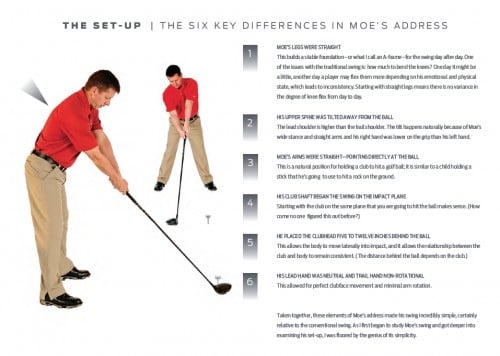
I call it the “One Mistake” where the players hang the arms directly below the shoulders – straight down- at address. Why do they do this? I really don’t know. But nobody else does either. I have talked to hundreds of instructors and nobody can explain why any player would hang the arms straight down. The only answer they can come up with is that “this is where they hang”. Logical? Not really. Because if your task is to strike a golf ball, with a golf club where the ball away from you – it makes no sense whatsoever to hang your arms in any direction other than one that is in alignment with the ball you are intending to strike.

So, logically, you should align your arms with the object you are intending to strike. So why is that so unusual?

The Evolution of Simple

Skills, such as playing a musical instrument or striking a golf ball are complicated tasks learned through repetition. The brain requires a certain amount of reinforcement and repetition to retain a sub-conscious – non-thinking action that we call “skill”. When it comes to the amount of reinforcement and repetition, there is no “simple” way to give the brain the number of experiences.  If it takes 100,000 repetitions, for example, you must put in the time to give ourselves at least this many experiences.  Even Moe, who I once asked why he kept practicing even at the age of 70, said “To make it (his swing) stronger.

Repetition of a task makes the skill stronger. This might seem a bit discouraging however, studies show that anyone who diligently practices two hours a day, can master any skill in five years. This evidence alone should be enough to get you off of your couch. But when you do, another question arises – “Where do I start?” And the answer to this question is the evolution of simple.

Simple is a term often used by the golf instruction industry to attract customers. Once the customer buys in, however, he often finds himself once again confounded by the amount of effort it really takes to achieve a good golf swing. To me, the golf swing is very simple however, my learning process was not. I put in many hours and I would be lying to you if I said that it was easy. When I asked Moe how he learned to hit a golf ball so well, he answered very profoundly, “hard work, it takes hard work”.

So if you understand at the outset that it is going to take time and effort, you are then ready to realize what it means to be simple. Simple, by this definition is the difference between easy and hard. In other words, there is an easy way to do something and a hard way to do something. The goal, therefore, is to use the easy way of striking a golf ball and in doing so, you will be able to achieve a lasting, pain-free, and maintenance-free way of playing golf. Simple means longevity and when compared to “conventional” methods, just makes sense.

Moe Norman’s golf swing is simple for a number of reasons often discussed in our teaching. It’s simplicity, we call the Single Plane, is founded on common sense – the common sense of starting the club on the same plane as impact. What could be more simple than that?  And because of the “start where you impact” Single Plane, there are stresses and rotations of the conventional swing are no longer necessary. But be careful. This does not mean that there aren’t any rotations in Single Plane Swing which is often the assumption of those who first observe Moe’s swing.

The fact is that there are the perfect amount of rotations in Moe’s swing. What we call bio-mechanical efficiency. Another way to look at bio-mechanical efficiency is the perfect amount of movement to achieve the task. In Moe’s case, the task was moving a golf club in such a way as to strike a golf ball with perfect backspin. When you look at the golf swing from this perspective, your task is to move the club – not strike the ball. From this perspective, simple becomes more easily understood. Simple means efficient.

With this in mind, you can now begin by modeling Moe’s Single Plane Golf swing and allow yourself to refine the movements necessary to achieve Moe like efficiencies. This means a bit of trial and error and much practice. So as I always recommend, start using video analysis to monitor your movements.  This is a sure way to keep on track and short-cut the process of learning a truly Simple Single Plane Golf Swing.

Perfect Practice – Moe Story

Hi Everyone,

One of the best times we have at our schools is having lunch with all our students. My staff and our students spend about 45 minutes each school day enjoying lunch (and a good break). It always seems the lunch talk turns to Moe and our stories about Moe.  This past weekend was no different – and it reminded me of a story I wanted to share with everyone and maybe it will help your practice a little.

A few years after Todd met Moe, we went back down to Orlando for a few weeks (in the winter) to work on our games for the upcoming golf season. Todd had scheduled some time in his schedule to meet with Moe at his home course in Titusville, FL (Royal Oaks) and continue his work on mastering Moe’s swing.

Early one morning – we traveled from Orlando to Titusville to meet Moe. Todd met Moe at the clubhouse and proceeded to go the range with Moe. This day Todd was working on proper impact with the driver, facing ball at impact and the proper release.

Moe showed Todd what he thought he was doing and they proceeded to practice. I remember hitting a few balls next to Moe and Todd, but was more interested in watching what they were doing.

First – as Todd and Moe practiced, Moe would show Todd his positions, but always referred to his positions very “slow” and seemed to exaggerate them when he showed them… Meaning, he would show the positions in slow motion and make a point to go “beyond” where you needed to in the swing.

Todd started to practice, and I remember Moe saying “Slow down. Bump the ball off the tee. Feel the positions – slow down.”

As most know, it is very difficult to not hit a driver hard… when you put the driver in your hands, most want to swing it hard… but Moe didn’t want any of that. He wanted Todd to slow down, hit it slow, feel the positions.

I remember about that time, I went to the putting green to hit a few putts/chips as we were going to play a few holes later… but I could still see Todd working with Moe from the green.

For the next hour, all Todd did was very short “bump drills/shots” with the driver in slow motion. Only taking the driver to waist high in the back swing and then “bumping” the golf ball off the tee and going to waist high in the through swing. And doing this in slow motion – VERY SLOW.

After an about an hour I went to Todd and asked if he wanted to go play a few holes… he said he was going to continue to practice… I went and played a couple of holes, came back and guess what Todd was still doing…… yup – the slow motion bump drill working on proper positions. Moe had gone in for a while, went to hit a few putts, and returned to watch Todd and make sure he was still working on proper positions…  I just remember him telling Todd – slow down, feel the positions… slow motion type of practice…..

Let’s discuss perfect practice a little… what is perfect practice to you?

For most, it is going to the range, hitting a few golf balls and hoping the figure something out.

How many of you practice in slow motion?

How many of you practice in slow motion to feel the positions?

How many of you are confident enough in your knowledge of the golf swing you would know what the perfect positions of the golf swing are?

It’s pretty interesting at our schools. We have our students work on the PVC drill the first day to work on the different positions of the golf swing. For most, it isn’t anything new as they have done the PVC drill many times at home. But to us (instructors), it is interesting as 9 out of 10 students don’t “hit” the different positions correct. In other words, they have been doing the PVC drill at home, but not correct…. what is this doing to their swing?

Perfect practice involves knowing what you are working on. Not guessing.

Perfect practice involves A LOT of slow-motion practice to make sure you are doing correct and allows you to “feel” the positions.

Perfect practice involves a “check system” that allows you to make sure you are doing it right. Maybe in front of a mirror, maybe videoing, maybe having someone else watch…

If you’re really serious about getting better – you will figure out how to practice perfect. Come find us – we’ll give you many things to work on, but more importantly we’ll show you how to practice. So that every time you practice, you will make sure and make yourself better.

Remember – Always Practice with a Purpose.

LEARN

THE

SWING

Join 1M+ Subscribers to get your FREE Video Quick Start Guide that reveals how to hit the ball farther and straighter more consistently from now on…

START YOUR NEW GOLF SWING