Purity of Technique

Purity of Technique

Golf teachers will often agree that there are many ways to hit a golf ball. Some swings are upright, and some are flat. Many will have the clubface closed or even open during the swing motion. Yes, all of these types of swings can, in some level of aptitude, strike a golf ball. Each of them, however, has built-in compensations for flaws.

Years ago a well-known teacher taught me that he shows swing flaw must have an accompanying flaw to fix it. What this means is that for every swing problem you must have a second flaw in make-up for the initial question. You can’t just have one swing fault – you must have at least two. Without the compensating correction, you can’t hit the ball.

For example, if you have a closed clubface during your backswing, you must have a movement to open the face in your downswing. One flaw always has an offsetting flaw.

In many ways, this is why golf lessons can make you worse before you get better. If you fix one flaw and the compensating flaw still exists, then you are caught in the dilemma of only having one swing problem resulting in lousy golf shots.

This is what initially attracted me to Moe’s swing. Not only did I recognize his abilities, but I saw a real swing motion – one without compensations.

I often call the address position of the conventional golf swing “The one mistake.” Why? Because it has a built-in problem – standing too close to the ball. The accompanying flaw/movement is to move the body upward to compensate.

The way I see it is that you have a choice to play golf.

You can use the grip it and rip it mentality and fight your way through your compensations OR you can build a swing that is pure technique. Of course, I prefer the Purity of Technique way for some reasons including the following:

  1. Pure technique without compensations allows you to have a better chance of your bad shots being good.
  2. without compensations, your swing becomes less maintenance.
  3. Timing elements of the compensations are not necessary
  4. It is easier on the body
  5. Easier to repeat

*************

Why is water wet? Why is the sky blue?  Moe would often ask me questions that seemed ambiguous. He would say “Once you know the answers to these questions, you will know.”

“Know what?” I asked.

‘The Secrets” he said.

The answer to Moe’s questions was not complicated. Water is wet because it is all that it can be. The sky is blue because it is what it is. Moe’s golf swing was simply because it was all that it could be. I call it mistake-proof.

Consider placing your body in a position where it has no choice but to move most efficiently. At address, your body position, arms, hands, and club extend so that when you turn, the club runs into a perfect backswing path. The “Sum” of your body position makes it the only place the club can go.

Moe would often say – “I can’t take the club outside “because the club was placed up to 12 inches behind the ball. Due to his spine position, club position and the relationship of the club to pointing to the lead hip, when Moe turned the club immediately when inside – back on the plane. It just couldn’t go anywhere else.
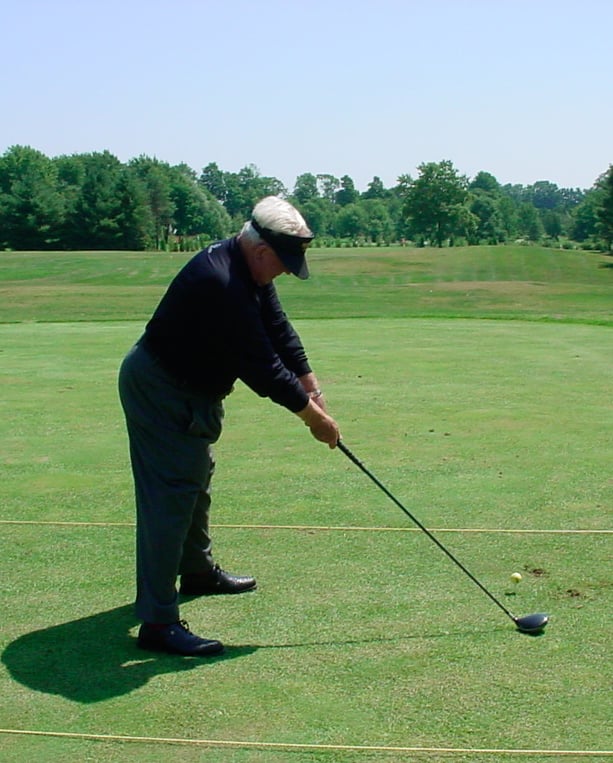
Moe at address DTL.jpg

Moe’s address position was the beginning of being “Mistake-proof” This included many things that some consider idiosyncratic, these are the elements of what I think the Purity of Technique?

  • Moe’s legs were straight
  • This builds a stable foundation for the swing day after day. One of the issues with the traditional swing is: how much to bend the knees? One day it might be a little, another day a player may flex them more depending on his emotional and physical state, which leads to inconsistency. Starting with straight legs means there is no variance in the degree of knee flex from day to day.
  • Moe’s arms were straight–pointing directly at the ball
  • There is a natural position for holding a club to hit a golf ball; it is similar to a child holding a stick that he’s going to use to run a rock on the ground.
  • His club shaft began the swing on the impact plane
  • Starting with the club on the same plane that you are going to hit the ball makes sense. (How come no one figures this out before?)
  • His upper spine was tilted away from the ball (the lead shoulder is higher than the trail shoulder)
  • The tilt happens naturally because of Moe’s wide stance, straight arms and his right hand was lower on the grip than his left side.
  • He placed the club head five to 12 inches behind the ball (depending on the club)
  • This allows the body to move laterally into impact.
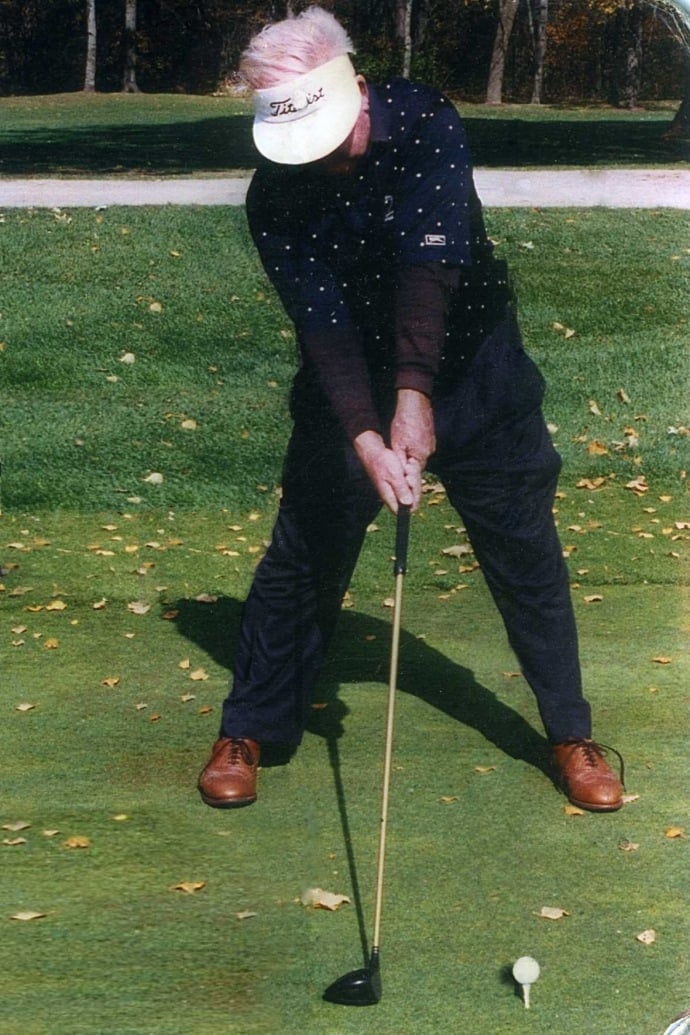
Moe at address

Taken together, these necessary elements of Moe’s address made his swing incredibly simple, certainly relative to the conventional swing. As I first began to study Moe’s swing and got deeper into examining his set-up, I was floored by the genius of its simplicity.

 

Practice Slower & Play Faster

By Paul Monahan, Graves Golf Mental Game Coach

Sounds like a directive. Right?

Actually I think of it as a mental game approach. Here’s why:

At almost every Graves Golf school I attend, lots and lots of students are doing their level-best to achieve the Single Plane Swing model. But many, if not most suffer because of two important missteps.

They practice too quickly. And they PLAY the game too slowly.

Interestingly, these are not execution missteps (caused by lack of focus or an inability to understand a strategy)…they are mental game failures.

Let me explain, first with the concept of Practicing Slower.

The Single Plane Swing curriculum that Todd and Tim Graves and their instruction team have refined over the years is based on the very latest in skill development research: that we learn best from slow, deliberate and proper practice movements. (Not beating balls over and over again.)

One simply cannot groove and assimilate new body positions without this kind of work.

Moe Norman famously said to Todd and Tim that he once spent an entire day holding what we call position five. Why? Moe said he wanted to “…make it stronger.”

Just last week I heard Todd tell the story that when one of their Master Instructors was converting from conventional to the Single Plane Swing, he was known to spend hours on the practice range working on one thing: perfecting his move into position one.

Why won’t most students spend their practice time like this? One word: Their EGO.

It’s more satisfying to the EGO to hit ONE great shot every once in a while rather than spend the time needed to master a position or two.

In other words, even though it is a rational-enough concept (practicing slowly during your swing development), it is much harder to do because a part of your brain wants to “show the world” what you are capable of.

The harsh reality in all of this is: Until you SLOW DOWN and develop a deliberate practice regimen that includes far MORE correct body movement and far LESS actual shots with a ball, you will continue to delay the mastery of the Single Plane Swing. (Sorry. That’s just the way it is.)

This requires cultivating the awareness that your EGO will try to sabotage a regimen like this. It requires that you learn to tune into your mental and emotional tendencies…and be disciplined enough to stay on track with the deliberate, deep practice that will yield the changes you are looking for.

Dan Coyle wrote about this in  The Talent Code…and Todd and Tim refer often to the research and insights from Coyle’s work. Skill development comes from deep, deliberate, proper practice.

Now let’s address Playing Faster:

When it comes to playing the game, most players play too slowly. Specifically, they tinker and hover too long over the ball when they are hitting their shots. This causes paralysis by analysis – and yes…this is an actual technical term.

Sian Beilock, in her book Choke chronicles the trouble we get into when we linger over a golf shot too long. Basically, she explains that the part of our brain that is responsible for moving the body in space (procedural memory) switches off in those moments, and then our working memory takes over. This causes over-thinking and less-than-optimal muscle movement. (And yes, often is causes: The Choke)

The antidote? Play faster. Stop lingering. Pull the trigger over your shots sooner. This will prevent over-thinking and will allow you to play golf more as a reactionary sport…and you will be able to execute shots up to your talent level, not BELOW your talent level.

So if you want to get better this year, do yourself a favor and tune up your Mental Game skills: create a discipline to practice slower when off the course, and to play faster when on it.

Have Fun!


GET YOUR FREE SINGLE PLANE FITTING HERE

Whether looking to fit/replace a single club to an entire set, from a putter to a driver to your irons, wedges, etc.. it is ABSOLUTELY CRITICAL that the club(s) is fit to YOUR individualized swing and single plane specifications.

An UNfit club will hinder your improvement process, an UNfit club will hinder your golf game, an UNfit club will not allow you to reach your potential, an UNfit club can and many times will actually physical hurt you (tendonitis in elbows and wrists are many times causes and exaggerated by club with improper lie angles), and UNfit club is basically worthless to you. I don’t care how much you spent for the golf club(s) – if they are not individually fit to you – they are worthless to your game – and worse than that, can and many times will actually “hurt” you.

The Graves Golf Academy has custom fitting programs established with most major manufacturers in the golf industry. And many of the manufacturers install our grips in their custom department (no other instruction group can say that….). We have worked VERY HARD to set this customizing system up for our customers, students, etc. anyone interested in the single plane golf swing.

Also, because of the amount of equipment we sell from each manufacturer, we are many times offered equipment at a reduced rate for our customers. We are always able to match industry pricing and many times able to beat the pricing. We are also many times able to offer clubs at a significantly reduced price (last year’s models, etc. as these manufactures know how many clubs we sell and “hold some back” for us). Please watch our newsletters (bimonthly) for these specials – as they typically don’t last long as many are interested in these special pricings.

Customization done at the manufacturer (Callaway, Taylormade, Titleist, etc..) is free through the Graves Golf, there is no added cost for the GGA grips installed and customized at the manufacturers. Plus, there is no shipping charge (within US) and no tax (outside of OK) through Graves Golf.

To get a FREE individualized custom fitting please go to:  http://moenormangolf.com/clubs/free-club-fittings/


To View Single Plane Fitting Informational /

Instructional Webinar:   CLICK HERE

Stop Guessing

Unfortunately, most people who practice rarely get better – and some even get worse.

Here’s the first problem: You can’t feel what you are doing wrong.

Here’s the second problem.  Since you don’t know what you are doing wrong, you will start guessing on how to fix yourself. 

Guessing is the problem with most golfers.  They are guessing wrong, practicing wrong and making learning more difficult than i needs to be.

As a side note: If you had plans on running to the range or the course, this might be a bit scary. In Dan Coyle’s book The Talent Code, he mentions that talent (skill) is earned.  This means that in order to earn a  good golf swing habit, you must repeat good swing motions until you have the motion engrained.  It might seem obvious but it can’t be overstated: Bad golf swings are bad habits, good golf swings are good habits.  Both good and bad swings are learned.


Why do you keep practicing?

I once asked Moe, who I considered perfect,  “Why do you keep practicing?”

To make it stronger“, he said.

“Make what stronger I asked again?”

Make my move so strong that I don’t know how to swing it badly.”

Even Moe realized the importance of perfect practice.

So Instead of worrying about getting worse, let’s ask a better question.

How can you improve and get better every time you practice?  How can you make your swing so strong that you are always getting better?


That’s a huge benefit of being around the Graves Golf team.  I’m lucky.  When I practice, I am surrounded by the best Single Plane teachers in the world including – Tim Graves, James Bell, Blade Cruickshank, Ross Smith, Trent White, Clay Farnsworth, Brock Elmore – to name a few.  When something feels “off” in my swing, I have one of them take a look.  The best part is that I never spend much time prancing incorrectly and because I have someone available, whenever I need them, and it keeps me from developing bad habits.

Since most of the time, you don’t know what is going wrong,  I believe that you must have a coach to keep you on track. The problem is that the coaches cant help you if we can’t see your swing.

So, Here’s the good news.

You have access to these coaches too!  They are in your back pocket.  All you have to do is start using them.  

Let me give you a quick example.

Maybe you are hitting behind the ball.  There could be a number of reasons for it.  You could be lifting your trial foot, sliding your hips or your ball position could be too far forward.  The problem is that you won’t know unless you get some help.  The other problem is that the GGA coaches cant help if they don’t see your swing.

If the GGA Coaches see your swing on video, it will stop you and them from guessing.  You can start practicing the solution.

So here is my recommendation to get you started and on track with the coaches:

Step 1: Master your Address and Grip.

Step 2:  Master from the Address to the Top of the backswing.

This is a great place to start with the coaches.  They will help you work on the correct swing positions in the correct order, keep you from guessing and speed up your mastery of the Single Plane Golf Swing.


Tips for Improving

Every so often we like to remind everyone… what we believe are CRITICAL for improving.

Don’t Waste Time Trying to Break Bad Habits – Instead Build New Ones

I bet I talk about this so many times in our schools, many of our students probably get “sick” of hearing it.

When it comes to dealing with bad habits, many of us attack the problem head-on, by trying to break the habit.  This tactic, of course, doesn’t work.  And we are left with the old truth – habits are tough (if not impossible) to break.  The blame lies with our brains.  While we are really good at building circuits (creating habits), we are awful at unbuilding them. Trying as you might to break a bad habit, it is still there, waiting patiently for a chance to be used.

So, what do we do?

The solution is to ignore the bad habit and put your energy toward building a new habit that will override the old/bad habit.

To build new habits, start slowly. Expect to feel stupid, clumsy, uncomfortable, and even frustrated at first…. after all, the new “wires” in your brain haven’t been built yet. Your brain still wants to follow the old “comfortable” pattern. Build the new habit by gradually increasing the difficulty, little by little. It takes time, but it’s the ONLY way new habits are created and grow.

To Learn it More Deeply, Teach It

I absolutely love this one.

Here is the issue. Every good golfer, every golfer who learns something new/reaches a goal, etc… must be their own best teacher. If you cannot teach yourself, your ability to make changes, create new habits, reach goals, etc. will occur in a much slower rate.

This is not saying you must create everything yourself, but it is saying you must take what you learn and translate into self-teaching.

Think about it – how much time to you spend practicing, and how much of that practice time is with someone teaching you?

If you are like most, 90% + of your practice time is on your own, trying to create new habits, etc. on your own. Meaning, you must be able to make sure you are doing things correct, must be able to make sure you are “going down the correct path”.

A great way to determine if you can teach yourself it ask yourself “Could I teach this (new habit I am trying to learn) to someone else?”

This works because when you communicate a skill to someone, you come to understand it more deeply yourself. Also, when you see someone struggle, and help them through it, you improve your ability to deal with your own struggles.

The saying “Those who can’t do, teach” should be rewritten as “Doers who teach do better!”

Give a New Skill a Minimum of Eight Weeks

When it comes to growing/creating/developing new skills, eight weeks seems to be an important threshold. It’s the length of many top-level training programs around the world, from the Navy Seals’ physical – conditioning program to the mission training for the Mercury astronauts. A recent study at Massachusetts General Hospital showed the practicing meditation for twenty-seven minutes a day created lasting brain changes in (you guessed it) eight weeks.

Of course, this doesn’t mean that you can be proficient in any skill in eight weeks. Rather, it underlines two more basic points:

1)  Constructing and honing new habits takes time, no matter who you are, and

2) Resilience and grit are vital tools, particularly in the early stages of learning. Don’t make judgements too early.

Keep at it, even if you don’t feel immediate improvement. Give your talent (your brain) the time it needs to grow and create new habits.

Please feel free to contact anytime – we are always happy to help and answer your questions.

Bill Murray is Serious

By Paul Monahan, GGA Mental Game Coach

Bill Murray is one funny guy. How many times have you seen him joking around and stirring up mayhem at the Pebble Beach Pro Am? Year after year everyone wants to see him show up, partly because of the outlandish outfits, but mostly because you just never know what that guy is going to do or say.

Dancing with fans in sand traps, posing for pictures, drinking beer with the gallery…nothing seems to be off limits for this wild fun-loving guy with a larger-than-life personality.

But Bill Murray has a profoundly serious side…one that – if you choose to explore it a little – may just help you think differently about your golf game.

The stories of Murray just showing up at parties un-invited, hanging out for hours singing and partying, and even staying late to do the dishes are legendary. What is this all about?

Turns out that Bill Murray has thought very deeply about how he wants to show up in his life…and perhaps the one way to describe that is this: he wants to play the game of life from a PRESENCE perspective. He wants to be present and in-the-moment as much as possible so that he can thoroughly enjoy what life has to offer. No matter what that might be.

With a little reflection, it becomes easy to see where his penchant for being present comes from: a life in improvisational comedy. As you may know, the one foundational rule of improv comedy is this:  ACCEPT what is given to you. So, if you and Bill Murray are “doing improv” and you say to Bill: “Hey Bill, how does that chocolate cake in your hand taste?”… Murray MUST proceed as if he actually has chocolate cake in his hand.

The cool thing – I imagine – of spending so much time operating from a perspective of acceptance  is that NOTHING throws you off. Why not? Because of two reasons: first, you have NO expectations about what will happen. Second, you have committed beforehand to managing (…moving through, around or past) whatever shows up.

Murray has NO expectation about what you will say to him, and he is FINE having to “play” with whatever you present to him because he has ALREADY COMMITTED to doing so.

The ancient philosophers defined Wisdom as one of the most important virtues…and within Wisdom, they identified CURIOSITY as one of its most important strengths. Why? When we operate with curiosity, we see things for what they are – and not worse than they are. And – perhaps, most important, we don’t get stuck in the disappointment of expectations unmet.

Murray’s zest for life – his willingness to be present and in the moment, and to play with whatever he is handed – creates an incredible ability to deal with life’s challenges in productive ways.

It turns out that Bill Murray is SERIOUS about his FUN. He is intentional about acceptance…and it helps him to experience the things in front of him – whatever they are – in amazingly meaningful ways. And it also helps him to stay connected to his full potential in any moment.

What would that look like if you showed up in your golf game with a little more acceptance instead of loads of expectation (and the disappointment that comes from expectations unmet)? What would it look like if you were more curious about your golf game, instead of demanding that the game GIVE you something?

I think you would enjoy the game more…and perhaps shoot lower scores. What do you think?

LEARN

THE

SWING

Join 1M+ Subscribers to get your FREE Video Quick Start Guide that reveals how to hit the ball farther and straighter more consistently from now on…

START YOUR NEW GOLF SWING