Putt Your Way to a Great Golf Swing – Indoor / Winter Training

Putt Your Way to a Great Golf Swing – Indoor / Winter Training

During a recent webinar I discussed how working on your short game (putting, chipping and pitching), if done properly, can and will dramatically improve your long game.

Had GREAT response during and after the webinar. To be honest, didn’t surprise me as it is the same response I get when I present this same topic during our schools and camps.

What does surprise me is how many don’t understand this concept – working on proper short game fundamentals will improve your long game.

Click HERE for your FREE PUTTER FITTING

So – thought would talk about the first (putting) and how working on putting can help your long game.

Fundamental #1 – Hands Leading

In every shot in golf – your hands should lead at impact. In other words, your hands will be ahead of the golf ball at impact including putting. Then why do most average golfers set up with their hands behind the ball when putting?

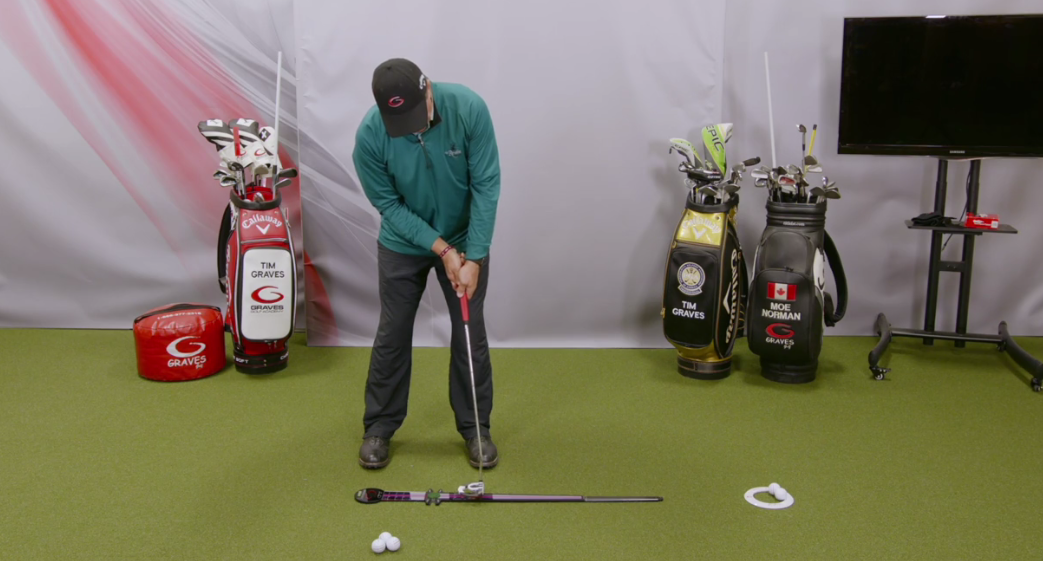
When you set up over a putt, your hands must be ahead of the golf ball. The butt end of your putter grip should be forward of your belly button.
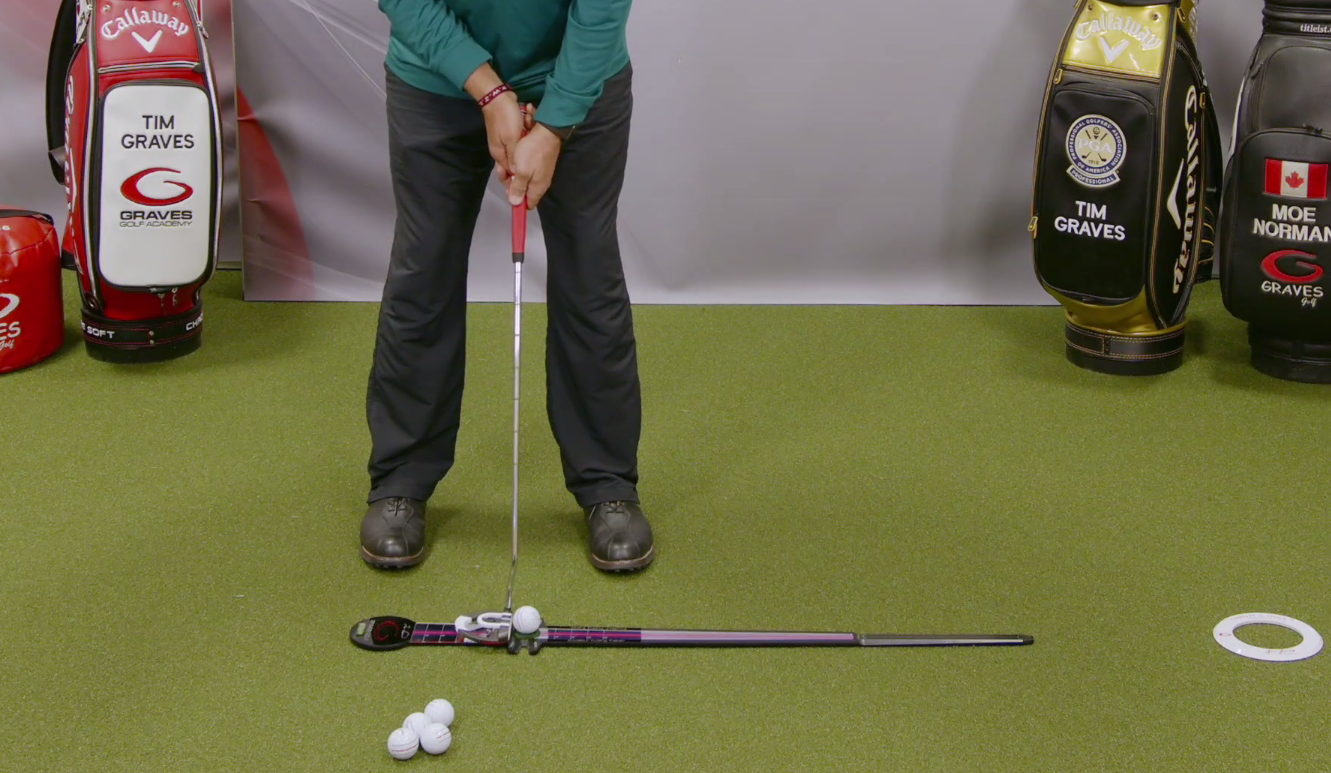
If your hands do not lead when you putt, it is guaranteed your hands will not be leading in your full swings. If your hands are not leading, you are training your body to make impact with the golf ball with the hands behind the ball. (Aka casting in the full swing).

Fundamental #2 – Face Square at set up and Impact

How are you checking to make sure your club face (putter face) is square at set up and impact?

It is strongly recommended you use a check system to make sure your putter is square at set up and impact (square to where you are trying to hit the ball).
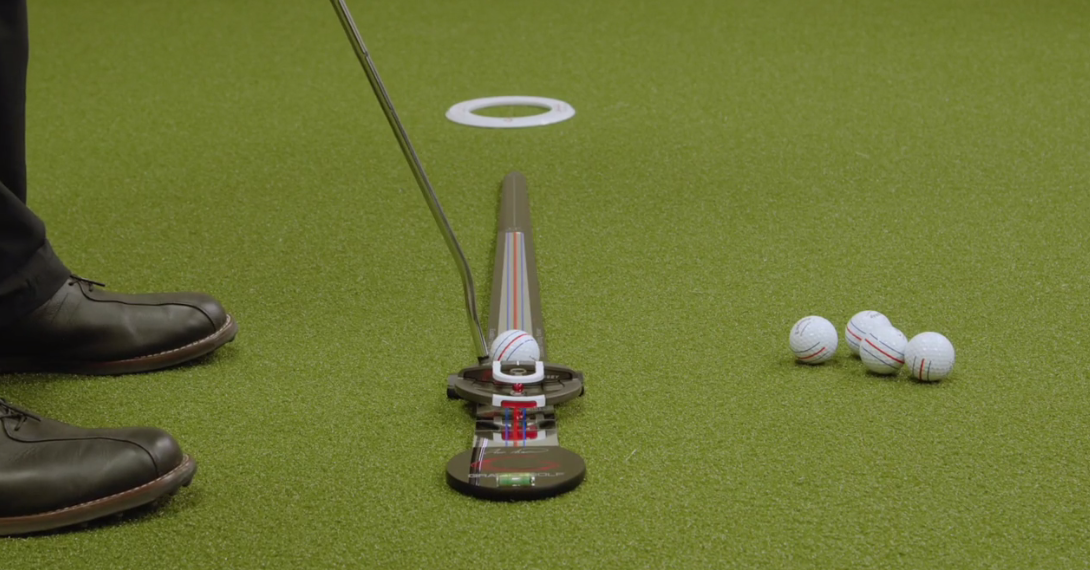
It is surprising how many golfers do not have a square face and compensate during the stroke.

The picture above shows using the Graves Golf Excalibur (Indoor / Outdoor Putter Training Aid) – checking the putter face angle.

And – can almost guarantee – problem squaring your putter face, same problem squaring any club face…

Fundamental # 3 – Hands Down the Line

How do you check to make sure your hands go “down the line” past impact?

Your hands should go down the line and toward the intended target through impact.

Most golfers struggle with this fundamental. Their hands go in and up through and past impact. Your hands should go down the line through impact. As you see in the picture below the putter face is still square past impact and down the line. This check will make sure your hands are going “down the line” toward your target.
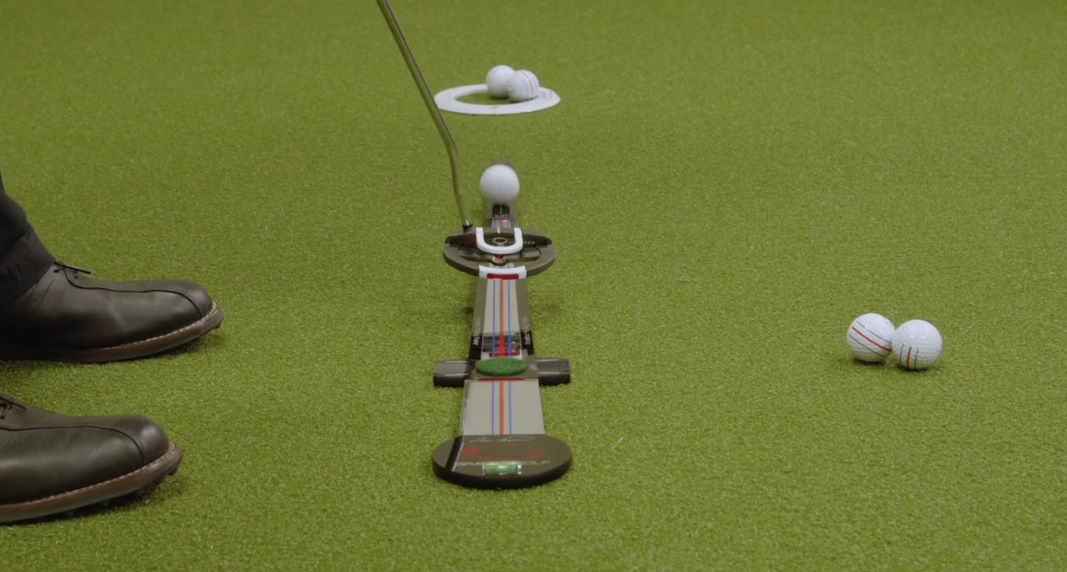
Here is another picture of the hands “down the target line”:
In the full swing, your hands must go down the line through impact. You can have an on plane golf swing – but if your hands do not go down the line, it will cause impact with a club face coming to impact at an angle (out to in, etc..). This is a start to working on getting your club face and hands down the line.

These are 3 putting fundamentals you can check that, if done correct, will not only greatly improve your putting, but will also help your full swing.

More information about our EXCALIBUR PUTTING TRAINER:  CLICK HERE

Possibility Thinking

Learning to master a musical instrument requires significant investments. A lot of people I know would LOVE to be able to play the guitar like Brad Paisley.  But the reality is – the personal costs required to accomplish something like that are just too high for them. They simply won’t invest the time and effort necessary.

A year ago, a young guitarist whom I know very well was invited to perform on Country Music’s most coveted stage – The Grand Ole Opry. He told me that his experience at The Opry was unbelievable, breathtaking and awe-inspiring…and that the effort and practice he put in the past ten years was totally worth it.

But it wasn’t an easy journey. And his vision for success was never guaranteed. There were times when he wasn’t sure that he had what it took to “make it.” And there were times when he wasn’t sure he wanted to do the work necessary to get there.

But he put his head down and powered through that uncertainty. In part because he had a passion for what he was doing (which allowed him to hold on to his vision.) And in part because he continued to show up and do the work.

My country-music version of the old Carnegie Hall joke:  Student: Can you tell me how to get to The Grand Ole Opry? Teacher: Practice. Practice. Practice.

Possibility: It lies on the other side of effort.

Where do YOU want to go with your golf game?

You may not have a goal to win your state amateur title. Or even your club championship. But you may be interested in achieving a vision that is bigger than where you are right now. And that’s terrific. It says to me that you believe in your own capacity for growth. (We call this a Growth Mindset!)

So – how do you get there? First, you MUST be intentional about where you want to go and the actions you are willing to take to get there. (The easy part) Second, you must commit to DOING THE WORK. (The hard part)

Here’s the thing: we all have a default future. A year from now will show up in exactly 12 months. It always does. If you hang out on the couch until then, it will still show up. I promise. The question is: will you be a better version of yourself by then? Will you be closer to your goals?

If in one year you want to BE different, PLAY better, SHOW UP more capably, PERFORM at a higher level or get DIFFERENT RESULTS on the course, you must gain new skills and knowledge. And you have to do the work. But sometimes you may question whether the investment required is worth it. And that can get you a little stuck.

For those moments, let me suggest this hack: Stop thinking about the costs…and instead, focus on POSSIBLITY. Think in terms of what you will GAIN –  the fulfillment from the accomplishment, or the growth and maturity you experience from the journey – instead of fixating on what you have to give up. (How hard it is, how much work it is…etc.)

In my experience, successful people who are growth-minded are also very possibility-oriented. They frame their challenges in terms of what lies on the other side of their efforts. This allows them to tune up their “Want to” (passion and desire)…and they inspire themselves to just go for it.

Their internal dialogue sounds like:

  • “What would be possible for me if I finally learned to play the piano this year…?”
  • “What if I finally wrote that book that I have been thinking about the past ten years?”
  • “How much more fun would golf be if I developed a world-class short game this year?”
  • “Imagine if I could hit a dozen fairways every time I played.”

As you consider your own Single Plane Swing journey, I encourage you to tune-in to any negative thinking you may have around personal costs…and then see if you can redirect that thinking toward possibility – and ways in which your life can be so much better once your visions are realized.

I think you will find that this kind of thinking will inspire a bias for action necessary for big accomplishments.

To possibility!!!

-Paul

Increasing Speed and Distance Over the Winter

As many of you know, we very seldom recommend training aids unless they are directly related to practicing Moe’s single plane swing and to be honest, most of those have been designed and produced by us. From the alignment and ball position trainer to the training grip club to the short game trainer to the perfect impact club, all our training aids have been designed to help you achieve your goals FASTER and MORE EFFICIENTLY. We have always designed our training aids to help all you improve more efficiently and keeping in mind, what will keep all our students on the “right path” during their practice.

One issue, we have dealt with since the start is how to create more distance. The answer has always been (and still is) – become more flexible, or at the least, maintain your flexibility and work on your fundamentals to hit the sweet spot on the club on the perfect plane more often. Ideal mechanics with good flexibility will get you maximum distance for your swing.

But, what can you do to increase distance?  To be honest, we have never had a “great” answer…. until now.

Long story made short…. I have a son who plays baseball and works with his traveling team everyday on fielding, pitching and hitting. A couple of practices ago, one of the dads showed me a new training device that his son was wearing to create bat speed. He told me this device was used by many professional athletes and Olympic athletes to create speed.

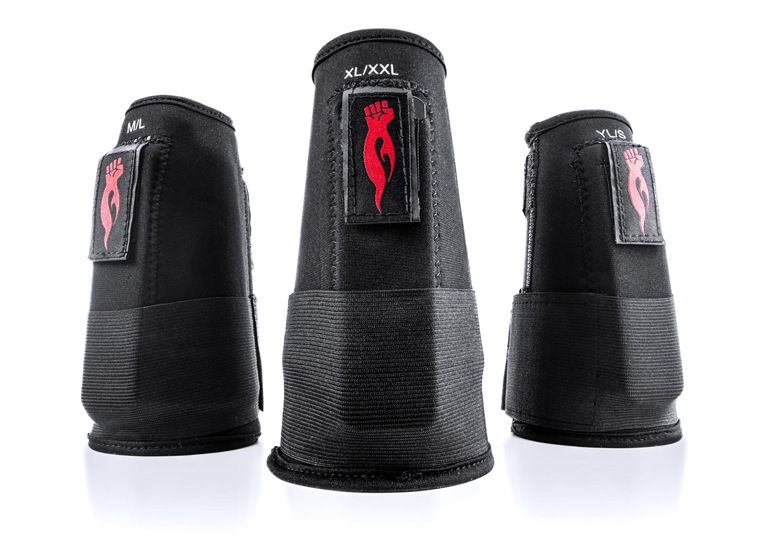
The Hand Speed Trainer™ was developed by US Bobsled Team Member and sports enthusiast Dave Owens.

While Dave was traveling, training and competing at sports venues all around the world, he had a vision, a foresight of a training device that was needed but not yet developed to aide in quickness, speed and strength…three key elements that enhance athletic performance. He designed this training device, created it and has now patented the “Hand Speed Trainer™.” The Hand Speed Trainer™, HST™, is like no other. It is a training device that fits securely on your forearm that allows you to accomplish resistance-type training with weights while not restricting any other movement to achieve top athletic performance. It can actually train your body to operate and accept a new level of performance. By keeping the weight closer to the center line of the body an athlete is able to maintain correct body mechanics without altering them. The HST™ allows you to train smarter and maximize your efforts.

The Hand Speed Trainer™, now will allow you to functionally strength train by performing work against resistance the right way. It is as critical to train the specific movement as it is to train the muscles involved in that movement. Your brain simply thinks in terms of whole movements not in terms of individual muscles. The exercises with the highest transfer effect are those that are essentially similar to the actual movement or activity of the skill that you want to perform in your sport.

For you to get optimal results in your sport repeated practice of the precise movement or skill is absolutely essential. It’s a must. It’s required. Because of the unique Hand Speed Trainer™ weighted system, you as an athlete are able to increase resistance in minimal increments in as little as 4 ounces. This prevents the bio-mechanics of the movements that you are focusing on from being compromised.

This allows complete focus for your neuromuscular system to specifically and functionally adapt the memorization of the specific movement needed for you to improve your overall athletic skills. Your body will adapt to the demands that are placed upon it. By wearing the Hand Speed Trainers™ as you repeat sport specific movements such as hitting a golf ball or performing drills you will see incremental improvements quickly.


Hand Speed Trainer

Hand Speed Trainer

In the past few weeks, Todd and I have used the hand speed trainer and it has shown positive results in increasing hand speed and distance. In fact, results faster than we thought would happen.

A golf study was performed and the following results were found:

Golf Study

Hand Speed Trainer Effects on Club Head Speed, Ball Speed, Total Distance and Swing Mechanics: Weighted Progression; 25 swings, 3x/Week for 4 weeks (Week 1 – 4oz, Week 2 – 8oz, Week 3 – 12oz, Week 4 – 16oz).

PURPOSE: To examine the effects of 4 weeks of weighted resistance training using the Hand Speed Trainer on club head velocity, ball speed and total distance as well as swing mechanics.

METHODS: Golfers of varying ages and handicaps wore Hand Speed Trainers for additional resistance while taking twenty-five swings, three times per week. Resistance began at 113.4 g (4 oz.) and increased by 113.4 g (4 oz.) every week for 4 weeks. By week 4 the resistance was 453.6 g (16 oz.).

Each golfer (ranging in age from 13 to 61) recorded 5 swings measuring club head velocity, ball speed and total distance before and after the four week testing.

RESULTS: Data from 50 swings were collected measuring club head velocity, ball speed and total distance pre and post 4 week Hand Speed Trainer testing. Participants used 6 and 7 irons during data collection.

Screen Shot 2016-11-07 at 7.57.02 PM

CONCLUSIONS: The data indicates that golfers using the Hand Speed Trainers 3x/week (75 swings) for 4 weeks (300 total swings) achieved an average increase in Club Head Speed (+3.50 MPH)Ball Speed (4.55 MPH) and Total Distance (+7.1 YDS) with their 6 or 7 irons. This correlates to 20 to 25 yards with their drivers.

To see more about Hand Speed Trainers:  CLICK HERE

To see Video on Training With Hand Speed Trainers:  CLICK HERE

FREE SINGLE PLANE CLUB FITTING

Whether looking to fit/replace a single club to an entire set, from a putter to a driver to your irons, wedges, etc.. it is ABSOLUTELY CRITICAL that the club(s) is fit to YOUR individualized swing and single plane specifications.

An UNfit club will hinder your improvement process, an UNfit club will hinder your golf game, an UNfit club will not allow you to reach your potential, an UNfit club can and many times will actually physical hurt you (tendonitis in elbows and wrists are many times causes and exaggerated by club with improper lie angles), and UNfit club is basically worthless to you. I don’t care how much you spent for the golf club(s) – if they are not individually fit to you – they are worthless to your game – and worse than that, can and many times will actually “hurt” you.

The Graves Golf Academy has custom fitting programs established with most major manufacturers in the golf industry. And many of the manufacturers install our grips in their custom department (no other instruction group can say that….). We have worked VERY HARD to set this customizing system up for our customers, students, etc. anyone interested in the single plane golf swing.

Also, because of the amount of equipment we sell from each manufacturer, we are many times offered equipment at a reduced rate for our customers. We are always able to match industry pricing and many times able to beat the pricing. We are also many times able to offer clubs at a significantly reduced price (last year’s models, etc. as these manufactures know how many clubs we sell and “hold some back” for us). Please watch our newsletters (bimonthly) for these specials – as they typically don’t last long as many are interested in these special pricings.

Customization done at the manufacturer (Callaway, Taylormade, Titleist, etc..) is free through the Graves Golf, there is no added cost for the GGA grips installed and customized at the manufacturers. Plus, there is no shipping charge (within US) and no tax (outside of OK) through Graves Golf.

To get a FREE individualized custom fitting please go to:  http://moenormangolf.com/clubs/free-club-fittings/


To View Single Plane Fitting Informational / Instructional Webinar:   CLICK HERE

The Perfect Student

We have just opened up our school schedule for 2021 and the schools are starting to fill very fast.

With all the students signing up for the schools, I like to review and article I wrote what makes a “perfect student”.

In this instructional article I want to write about the student … What do we expect / “hope” from our students. This includes students of our schools, camps, or maybe just students who are studying our video instruction and/or watching our webinars or maybe just reading these practice tips.

The first morning of our camps, I like to go around the room and ask our students what they want out of the week, the next 6 months of their golf game, and maybe the next year. What are their goals? What are their expectations?

We typically get the same responses… Wanting to improve their scores, cut their handicaps in half, learn fundamentals better, not have so many “blow up holes”, work on short game, etc.. etc…

After hearing their responses – it typically falls into about 3 catagories (all related):

  1. They want to learn how to improve (score better).
  2. They want to learn how to make less mistakes on the golf course.
  3. They want to be more consistent when they play golf.

What I hear is them saying “I want to learn how to practice and become a better student.”

With that being said – I want to describe the “perfect student” … or someone we believe has the best chance for improvement. The closer the student is to the “perfect student” the faster he/she will improve. This is no question there is a direct correlation in this area.

1. The student is open to EVERYTHING being said.

In other words, everything being taught, he/she is receptive too. Too many times, students have heard (or learned) things different before and they put up a mental “road block” when hearing something new. Playing good golf starts by understanding a method of solid fundamentals. The fundamentals don’t have to be complicated or difficult, but the student must learn the fundamentals within the method. Mixing and matching fundamentals of different methods does not work.

2.  The student understands is takes TIME to make changes.

This is a big one… To many want things too fast (me included). I once heard a saying, “If you get something fast, you’ll probably lose if fast”.  Cannot be more true when learning a new move, a new fundamental, etc… If you have patience, give it time, understand it will take a little while to figure out, etc. the change will “stick” and most of the time will be something you won’t have to consistently work on again and again. Rushing the process never works, or at least work for a period of time… Quick fixes are just those…. here today, gone tomorrow.

3.  The student understands you can not break a bad habit, but rather you CREATE a new habit.

This is a big one. I guarantee you if I interviewed golfers and asked them what they thought they needed to work on in their golf swing, a majority would say they need to break this habit, or that habit, etc… To start, it is basically impossible to “break” anything when it comes to a physical movement you have learned or acquired from the past. What is needed, is to determine what you need to work on and then work on doing it perfect (or as close to perfect) every time you practice. In other words, your body and brain are working together to create something that is good, it is not working “against” each other. How many times have you heard (or maybe said to yourself), “My brain says to do one thing, but my body does another”. We need to work on creating new/perfect habits that are much stronger than the old/bad habits which will in essence get our “body and brain to work together”.

4.  The “perfect” student will ASK questions.

This sounds like something you heard in school doesn’t it. But, you’d be surprised how many students will sit in a group, nod their head like they understand everything being said, and then after the presentation is over, will come up to the instructor and ask a “ton” of questions. We love the questions, problem is, if one student has a question, chances are, so do a majority of the other students. So, if you are sitting in one of our schools or camps, please don’t hesitate to ask any question ANY time. If you are watching our videos, webinars, reading e-tips, etc. email us with questions any time. We promise we will do our best to get back to you with answers asap. Please don’t go forward not knowing the answer or “confused” about something.


5. The student understands learning, especially an athletic move / moves, is a PROCESS.

It can be a fun process and the process can be sped up with proper practice, etc. but it is always a “process”. Enjoying the process is the key! Looking forward to making changes and working on those changes is a key! Ultimately understanding there really isn’t anything that is a “quick fix” (as stated before), but rather a process to change and a process to good and eventually, great golf. Understanding the process, looking forward to working through the process, getting help when necessary, will ultimately lead to the golf game the student wants.

Again – As the golf school season begins again (as many of you read this, my staff will be teaching at our academy in Orlando) – thought it would be a good time to list what we would love to see from every one of our students in order that they can improve their golf games to levels they can only imagine now.

Remember – Always Practice with a Purpose.

Remember – A little improvement every day, will lead to a lot of improvement over time.

Tim Graves, PGA

Tips for Improving Over the Fall / Winter

Thought it was about time to start talking about fall / winter practice. I know for most of us it is time we are inside, and when inside, some of us try to figure out ways to practice to get ready for the spring.

Before we get into any details – wanted to review a little about practice (especially when working on new habits over the fall / winter).

It is essentially impossible to break bad habits (our mind/body is not set up that way) … but we are set up to be able to create new habits and ultimately make changes/create new movements, etc.  we want.

Sustaining Progress

Developing your skills (and talent) is like taking a cross-country hike. You will encounter challenges, you will hit snags, plateaus and steep paths; motivation will ebb and flow. To sustain progress, it’s necessary to be FLEXIBLE one moment and STUBBORN the next, to deal with immediate obstacles while staying focused on the horizon (or your ultimate goals).

Don’t Waste Time Trying to Break Bad Habits – Instead Build New Ones

I bet I talk about this so many times in our schools, many of our students probably get “sick” of hearing it.

When it comes to dealing with bad habits, many of us attack the problem head-on, by trying to break the habit. This tactic, of course, doesn’t work. And we are left with the old truth – habits are tough (if not impossible) to break.  The blame lies with our brains.  While we are really good at building circuits (creating habits), we are awful at quitting them. Trying as you might to break a bad habit, it is still there, waiting patiently for a chance to be used.

So, what do we do?

The solution is to ignore the bad habit and put your energy toward building a new habit that will override the old/bad habit.

To build new habits, start slowly. Expect to feel stupid, clumsy, uncomfortable, and even frustrated at first…. after all, the new “wires” in your brain haven’t been built yet. Your brain still wants to follow the old “comfortable” pattern. Build the new habit by gradually increasing the difficulty, little by little. It takes time, but it’s the ONLY way new habits are created and grow.

To Learn It More Deeply, Teach It

Here is the issue. Every good golfer, every golfer who learns something new/reaches a goal, etc… must be their own best teacher. If you cannot teach yourself, your ability to make changes, create new habits, reach goals, etc… will occur in a much slower rate.

This is not saying you must create everything yourself, but it is saying you must take what you learn and translate into self-teaching.

Think about it – how much time to you spend practicing, and how much of that practice time is with someone teaching you?

If you are like most, 90% + of your practice time is on your own, trying to create new habits, etc… on your own. Meaning, you must be able to make sure you are doing things correct, must be able to make sure you are “going down the correct path”.

A great way to determine if you can teach yourself it ask yourself “Could I teach this (new habit I am trying to learn) to someone else?”

This works because when you communicate a skill to someone, you come to understand it more deeply yourself. Also, when you see someone struggle, and help them through it, you improve your ability to deal with your own struggles.

The saying “Those who can’t do, teach” should be rewritten as “Doers who teach do better!”

Give a New Skill a Minimum of Eight Weeks

When it comes to growing/creating/developing new skills, eight weeks seems to be an important threshold. It’s the length of many top-level training programs around the world, from the Navy SEAL’s physical – conditioning program to the mission training for the Mercury astronauts. A recent study at Massachusetts General Hospital showed the practicing meditation for twenty-seven minutes a day created lasting brain changes in (you guessed it) eight weeks.

Of course, this doesn’t mean that you can be proficient in any skill in eight weeks. Rather, it underlines two more basic points:

1)  Constructing and honing new habits takes time, no matter who you are, and

2) Resilience and grit are vital tools, particularly in the early stages of learning. Don’t make judgements too early.

Keep at it, even if you don’t feel immediate improvement. Give your talent (your brain) the time it needs to grow and create new habits.

Please watch upcoming etips for more fall / winter practice tips.

LEARN

THE

SWING

Join 1M+ Subscribers to get your FREE Video Quick Start Guide that reveals how to hit the ball farther and straighter more consistently from now on…

START YOUR NEW GOLF SWING