The 3 Ps of Putting

The 3 Ps of Putting

THE 3 Ps OF PUTTING

Simply stated, it is “Practicing your Putting with a Purpose”

Folks, it is actually pretty simple and painless, you just have to DO IT RIGHT!!!

Now, before you think to yourself, “Yeah, I know, Tim always says how important putting is, but I really need to work on my full swing first”, please read the following stats and “studies” that have been conducted and then I will explain how you can literally improve your game overnight…

First – You must first realize the importance of putting. 43% of scoring occurs on the putting green for the average player (male shooting 97, female shooting 107). As the scoring increases, so does the % of putts. For a scratch golfer, the percentage lowers to about 40%, but no lower.

The statistics are as follows:

  • 30 handicap golfer (aver 100) – 45 putts per round
  • 20 handicap golfer (aver 90) – 40 putts per round
  • 10 handicap golfer (aver 80) – 35 putts per round
  • Scratch golfer (aver 70) – 30 putts per round
  • Professional golfer – 28 putts per round

Second – You would think “that only makes sense” as the 30 handicap golfer will hit it further from the hole than the 20 handicap golfer, thus have more putts…. but you would be wrong. If you think of the way golf is played and the way putting stats are kept (just add up how many putts you have once the ball is on the green) – the 20 handicap golfer actually will hit more greens in regulation than the 30 handicap golfer (he/she will be chipping from the side of the green, etc..). Meaning, if you take the average distance to the hole once the player hits the green, typically the 20 handicap golfer will be further than the 30 handicap golfer… in theory if both had equivalent mid/short games – but here lies the problem.

Third – There are only 3 areas that matter in putting (or any part of the golf swing) – Path, Face Angle, and Speed. Putting is affected by these 3 areas and only these 3 areas. Meaning, everything you work on in putting (for example the grip, set up, etc..) affects either path, face angle and/or speed. The better your path, the better your putting, the better your face angle at impact, the better your putting, the better your speed, the better your putting.

Fourth – READ THIS VERY CAREFULLY: Studies have shown that of 10 golfers who practice their putting, 5 will get no better, 4 will actually get worse, ONLY 1 will improve after practice. Please read this again – of those who practice their putting, 10% will improve after the practice, 50% will not, and 40% will ACTUALLY MAKE THEMSELVES WORSE. (This study was performed numerous times testing golfer’s putting prior to their practice session and after.) As is said in Peoplewise Putting, “Golfers can add, subtract, multiply and divide, and they DON’T like these odds.” I don’t know about you, but if I have a 90% chance of not improving when I practice, “I ain’t practicing” (as they say in Oklahoma…)

Okay – now that everyone is on a “downer” about their putting practice, we’re here to fix that.

Over the years of playing with some of the best players in the world (including Moe, Tiger and many others), competing against many of these players, studying numerous techniques of the short game, etc… etc. the Graves Golf Academy (myself in particular) created/perfected a method to improve your putting. Are these “our techniques” – I would have to say no they are techniques we have brought to you from what we have learned from the best in the world – but we have set a system to help you GUARANTEED – if you follow the Graves Golf training system.

Many have/had asked me how I practice my putting – I have used many of these putting tools since the early 90s when I started competing on mini tours and other professional PGA/Nationwide Events as I saw so many other professionals using the same method.

Graves Golf TRAINING SYSTEM – How to Practice Your Putting with a Purpose EVERY TIME you practice. (In other words, every time you practice, you will one of the 10% who improves!!)

Graves Golf Indoor Putting System (Excalibur Putting Training Aid):

EXCALIBUR PUTTING TRAINER:  CLICK HERE

Graves Golf Outdoor Putting System (H3 Putting Trainer):

H3 PUTTING SYSTEM / TRAINER:  CLICK HERE

This is a TRAINING SYSTEM that works – I GUARANTEE IT!!! This is how you (and most professionals) improve your putting. The system is not hard – in fact, it is very simple and doesn’t take that much time. Every minute you practice using this training system will improve your putting… which in turn will improve your scoring and decrease your handicap – SIGNIFICANTLY!!

Everyone – no matter where you game is now – you need to improve your putting. You need to create more consistency in your putting. It is absolutely the faster way to lowering your scoring.

Remember the 3 Ps of Putting – Always Practice Your Putting with a Purpose

It’s Uncomfortable to be Uncomfortable…

Hello Everyone –

Wanted to drop an article about what happened to me last week and maybe help you a little when working on making changes in your swing / game.

This past week I played in the our first PGA South Central Section Western Chapter Tournament of 2020.  Yes, it is very late in the year to be beginning our events, but with COVID19 – we were delayed for about 4 months.

This was the first golf tournament I have played in since the end of January.  Probably the longest I have gone without a competitive round in 30+ years (or more).

Needless to say, when I stepped on the first tee, there was a feeling of “uncomfortable” as I hadn’t been on the first tee of a tournament in a few months.  As usual – if you don’t do something “routinely” – there will be a “natural” uncomfortable feeling.  But, this feeling ended pretty fast after the first couple of shots.

The real uncomfortable feeling came 5 holes into the event….  I proceeded to start the tournament, birdie, eagle, birdie, par (easy par 5…), birdie.  I was 5 under through 5 holes.

Many of you are probably thinking – that is a dream start… and yes, it is an amazing start (for anyone), but needless to say, it put me in an extreme “uncomfortable” state.

Why uncomfortable – because it was not normal, it was unusual, it wasn’t something I am used too…  even if I had been playing competitively for the past 4 months, I would still have been in an uncomfortable state as this was an “unusual” situation.

I am bringing this up to help you as as student of the single plane swing.

We know you have many “uncomfortable” feelings when you are changing your swing and creating new habits

The first morning of our schools and camps I  talk to the students about what they are about to go through. One of the topics is the process of learning and how to get through the uncomfortable periods when making these changes.

Please remember – there is a process to creating new habits and being uncomfortable just means you are in a situation you are not used to, it is something new… and that is a VERY GOOD thing when creating new habits…

Why – because the feeling of being uncomfortable shows you are making changes.

Here is what all need to do to create new habits and help you through the uncomfortable feelings:

1.  Learn the Fundamental

You must first learn the fundamental(s) that you need to work on. Whether a long game, short game, mid game, etc… fundamental such as the grip, set up, etc…  you need to study the fundamental you want to work on. Learning doesn’t mean doing at first, it means understanding what is correct and what is not.

2.  Learn the Why

As you are working on creating a new habit, you need to know the why of the fundamental. More than, because we said so, but rather, why the fundamental is important. As you are making the change(s), you will feel uncomfortable at first. If you don’t know the specifics of why you need to make the change, your brain will “give up” when it becomes uncomfortable. (Very common). If you know why – you will be more likely to get through the uncomfortable stage. This is the conscious thought eventually transforming to the unconscious thought. It takes time, but your conscious thought must know the “whys” at first to continue with the change.

3.  Learn How to Practice to Create the New Habit

You can know what fundamental you need to work on, you can know the whys… but if you don’t know how to practice toward creating the new habit, your improvement will be limited, or at least slowed considerably. Whether performing drills, using training aids, or both, it is absolutely critical you learn how to practice toward creating the new habit.

4.  Check Points

During your practice, you must have check points. The check points are set up so you can make sure you are creating the fundamentals correct. The more check points you have, the better. Check many, check often, don’t forget to check. As many already realize, it is much easier to make yourself worse than better – you can prevent this by having check points and checking often while practicing and working toward the new habits.

Use the above help you create new habits and lessen / shorten those uncomfortable feelings.

In conclusion…  I ended up winning the tournament by quite a few shots (4 shots).  I shot 6 under for the round.   It was a nice outcome, but to be honest, it could have been a very special round if I would have dealt with the uncomfortable feelings a little better.  After starting 5 under for the first 5 holes, I played the next 13 in 1 under…

Like everyone dealing with unusual / uncomfortable situations, the more I (and you) put ourselves in those situations, the more we understand why we am uncomfortable, how to practice those situations more and understand how to monitor those circumstances will help me (and you) in the future.


FREE SINGLE PLANE CLUB FITTING

Whether looking to fit/replace a single club to an entire set, from a putter to a driver to your irons, wedges, etc.. it is ABSOLUTELY CRITICAL that the club(s) is fit to YOUR individualized swing and single plane specifications.

An UNfit club will hinder your improvement process, an UNfit club will hinder your golf game, an UNfit club will not allow you to reach your potential, an UNfit club can and many times will actually physical hurt you (tendonitis in elbows and wrists are many times causes and exaggerated by club with improper lie angles), and UNfit club is basically worthless to you. I don’t care how much you spent for the golf club(s) – if they are not individually fit to you – they are worthless to your game – and worse than that, can and many times will actually “hurt” you.

The Graves Golf Academy has custom fitting programs established with most major manufacturers in the golf industry. And many of the manufacturers install our grips in their custom department (no other instruction group can say that….). We have worked VERY HARD to set this customizing system up for our customers, students, etc. anyone interested in the single plane golf swing.

Also, because of the amount of equipment we sell from each manufacturer, we are many times offered equipment at a reduced rate for our customers. We are always able to match industry pricing and many times able to beat the pricing. We are also many times able to offer clubs at a significantly reduced price (last year’s models, etc. as these manufactures know how many clubs we sell and “hold some back” for us). Please watch our newsletters (bimonthly) for these specials – as they typically don’t last long as many are interested in these special pricings.

Customization done at the manufacturer (Callaway, Taylormade, Titleist, etc..) is free through the Graves Golf, there is no added cost for the GGA grips installed and customized at the manufacturers. Plus, there is no shipping charge (within US) and no tax (outside of OK) through Graves Golf.

To get a FREE individualized custom fitting please go to:  http://moenormangolf.com/clubs/free-club-fittings/


To View Single Plane Fitting Informational / Instructional Webinar:   CLICK HERE

Where Are You Looking?

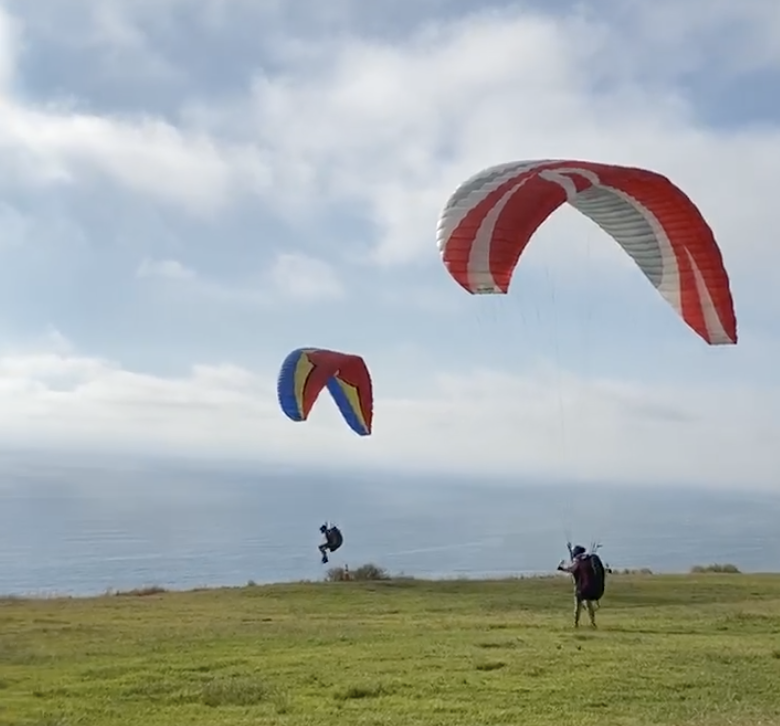
Last week I visited the Torrey Pines Golf Course just North of San Diego, CA. It is an amazing slice of golf heaven. But believe it or not, the highlight of my trip there was a visit to the nearby Torrey Pines Glider Port. This is where grown adults intentionally walk/jump off a 325ft-high cliff toward the beach below …again, and again and again. They can’t get enough of it.

If I didn’t know better, I’d say it sounds a little crazy.

Pilots launching at the Torrey Pines Glider Port near San Diego, CA

What they are really doing is called paragliding: floating on the thermal updrafts and ridge lift (vertical winds) created by the ocean breeze moving inland. These flyers gracefully raise fabric wings above them and fly around in the buoyant currents of air for hours. It’s really cool to see up close.

While they are doing this, what they focus on becomes very important. (No, duh! Ok…just hear me out…)  Among other things, they must stay aware of their position in space, their proximity to other fliers, the ground, and the cliff below them…as well as where they ultimately want to go. To fly safe – and to achieve their mission – they must not get fixated only on the things right in front of them, even if those things represent potential danger.

Where they are looking matters – for achieving short term AND longer-term goals. Their success as paragliders depends upon their capacity to notice what is going on around them, and yet still steer themselves to where they want to go.

In aviation circles there is a saying: Where you look is where you will go. (If you keep staring at the cliff, you will eventually fly into it.) There is a reason this is a saying…because it happens. Sometimes pilots get mesmerized by the things close to them.

My friend and colleague Rob Nielson – a former US Army helicopter pilot  – recently told me:

“I remember the first time a flight instructor told me to drop my scout helicopter into a riverbed at 140 MPH with trees soaring above and around us, with about 10 feet of clearance on either side of the rotor disc. He told me exactly what you said: Look to where you want to go and your hands will fly you there.”

What do you spend your time looking at when you play on the course? It is so easy to get fixated on that the danger we perceive. The out of bounds on the left. The creek on the right. The trap near the green. The branch you are trying to hit under.

The problem is that when we get fixated on these things, we can lose perspective. We can lose sight of the longer-term objective. The place we ultimately want to get to…our purpose…the reason we were are playing the game.

We perform at our best when we are aware and conscious of all the things around us -and at the same time aware of and very clear about our ultimate objectives.

Moe Norman famously described all the “trouble” on the courses he played as “decorations.” And in keeping with his philosophy of playing with an “alert attitude of indifference,” Moe simply saw these things for what they were – but kept his focus on the goal: the fairway, the green, the hole.

Moe trusted that his “…hands would fly him there.”

There is a lot going on when you are playing golf. Lots of shiny objects and danger that are like the cliff at Torrey Pines, or the trees next to Rob Nielson’s helicopter rotors. Yes, it’s prudent to be aware of them…but it won’t serve you very well to focus only on them. Only one thing really matters.

Bring your eyes up. Change your language about what you see. (Do you see a sand trap?…or do you see a decoration?) Reconnect with where you really want to go on the course. (Forget about where you don’t want to go.) Trust that your hands know what to do.

And then step up and hit it there.

Tips for Improving #14 – Keep Your Big Goals a Secret

This is the 14th and final part of a series of practice tips titled “Tips for Improving”.

In those practice tips we discussed how we work with our students to create new habits rather than breaking old habits. It is essentially impossible to break bad habits (our mind/body is not set up that way) … but we are set up to be able to create new habits and ultimately make changes/create new movements, etc. we want.

We talked about a book we strongly recommend – The Little Book of Talent/52 Tips for Improving Your Skills by Daniel Coyle.

It is described as a manual for building a faster brain and a better you. It is an easy-to-use hand book of scientifically proven, field tested methods to improve your skills – your skills, your kids’ skills, your organization’s skills – in sports, music, art, math and business. The product of five years of reporting from the world’s greatest talent hotbeds and interviews with successful master coaches, it distills the daunting complexity of skill development into 52 clear, concise directives.

Whether you are 10 or 100, this is an essential guide for anyone who ever asked, “How do I get better?”

9780345530257

This book is available at Amazon.com

The last instructional newsletters (Tips for Improvement Part 1 through 13) we discussed 50 tips for improvement from staring a who you want to become, to being willing to be stupid, to finding the sweet spot, to practicing by yourself, to taking a nap…. Again, if you have not reviewed these past practice tips, would recommend.

This instructional newsletter (Part 14) we cover the next 2 tips for improving your skills and relate them to you learning/working on your single plane swing and golf game.

51. Keep Your Big Goals a Secret

While it’s natural and oh so tempting to want to announce your big goals, it’s smarter to keep them to yourself.

Telling others about your big goals makes them less likely to happen, because it creates an unconscious payoff – tricking our brains into thinking we’ve already accomplished the goals.

Plus, telling our big goals puts too much unneeded pressure on oneself. Very few you are telling will understand the road you will be following and navigating to reach those goals. They will only see the result or outcome. They do not understand the time needed, the persistence needed, the “grit” needed, etc… they will only see if the goal has been reached or not.

Telling others about intermediate goals, intermediate check points, etc… is fine. But the “Big Goal” – keep it to yourself and only announce when reached.  (Secret here – when you reach it… won’t have to announce it – everyone will already know…)

Example. Big Goal – “Becoming a single digit handicap golfer” (keep to yourself) Intermediate goals – “Averaging less than 1 three putt per round” Intermediate goal – “Hitting 75% of fairways per round” Intermediate goal – “Averaging 50% up / down in your short game” ….

Tell anyone and everyone intermediate goals if you like… the Big Goal. let that be “your secret”.

52. “Think Like a Gardener, Work Like a Carpenter”

We all want to improve our skills quickly – today, if not sooner. But the truth is, talent/new habits are created slowly. You would not criticize a seedling because it was not yet a tall oak tree, nor should you get upset because your skill circuitry or habit formation is in the growth stage. Instead, build it with daily/routine deep practice.

To do this, it helps to “think like a gardener and work like a carpenter.”

Think patiently, without judgement. (the gardener)

Work steadily, strategically, knowing that each piece connects to a larger whole. (the carpenter)

I hope you have enjoyed the previous 13 newsletter practice tips containing the 52 tips for improving your skills/creating new habits and improving your golf game.

I would like to thank Daniel Coyle, the author of “The Little Book of Talent / 52 Tips for Improving Your Skills” for sharing his insights and experiences to help us improve our skills and help us create new habits.

If you would like more information in this area – strongly suggest reading Mr. Coyle’s original book – “The Talent Code”.

FREE SINGLE PLANE CLUB FITTING

Whether looking to fit/replace a single club to an entire set, from a putter to a driver to your irons, wedges, etc.. it is ABSOLUTELY CRITICAL that the club(s) is fit to YOUR individualized swing and single plane specifications.

An UNfit club will hinder your improvement process, an UNfit club will hinder your golf game, an UNfit club will not allow you to reach your potential, an UNfit club can and many times will actually physical hurt you (tendonitis in elbows and wrists are many times causes and exaggerated by club with improper lie angles), and UNfit club is basically worthless to you. I don’t care how much you spent for the golf club(s) – if they are not individually fit to you – they are worthless to your game – and worse than that, can and many times will actually “hurt” you.

The Graves Golf Academy has custom fitting programs established with most major manufacturers in the golf industry. And many of the manufacturers install our grips in their custom department (no other instruction group can say that….). We have worked VERY HARD to set this customizing system up for our customers, students, etc. anyone interested in the single plane golf swing.

Also, because of the amount of equipment we sell from each manufacturer, we are many times offered equipment at a reduced rate for our customers. We are always able to match industry pricing and many times able to beat the pricing. We are also many times able to offer clubs at a significantly reduced price (last year’s models, etc. as these manufactures know how many clubs we sell and “hold some back” for us). Please watch our newsletters (bimonthly) for these specials – as they typically don’t last long as many are interested in these special pricings.

Customization done at the manufacturer (Callaway, Taylormade, Titleist, etc..) is free through the Graves Golf, there is no added cost for the GGA grips installed and customized at the manufacturers. Plus, there is no shipping charge (within US) and no tax (outside of OK) through Graves Golf.

To get a FREE individualized custom fitting please go to:  http://moenormangolf.com/clubs/free-club-fittings/

To View Single Plane Fitting Informational / Instructional Webinar:   CLICK HERE

LEARN

THE

SWING

Join 1M+ Subscribers to get your FREE Video Quick Start Guide that reveals how to hit the ball farther and straighter more consistently from now on…

START YOUR NEW GOLF SWING