Rethinking Practice and Play

Rethinking Practice and Play

Author’s Note:  My sense is that you have heard plenty of ways to deal with the COVID-19 pandemic – including how to make it through while maintaining some sense of well-being and happiness. I certainly wish for that for you and your family…but I don’t think you need my advice about that in this space.

So, I have decided to stick to the topics I normally write about here…and to stay focused on being a resource for you on how to master the mental side of this game we love.

In his book Rethinking Golf, author Chuck Hogan – when explaining the purpose of his book –  wrote:

What this book asks you to do is be fearless. Go Play. Forget what you think play is and just indulge in the experience of play… Return to your origins. Just do. Don’t do “it.” 

Two weeks ago – before everything in this country went sideways – I spent 3 days in Scottsdale with two wonderful and fascinating people in the golf performance space: Lynn Marriott and Pia Nilsson. Lynn and Pia were the long-time coaches to Annika Sörenstam (…only the winningest female player in the history of golf) as well as many other highly successful players on the PGA and LPGA tours.

They have spent their entire careers growing in their own understanding of what creates great performances on the course  – and creating a framework for their
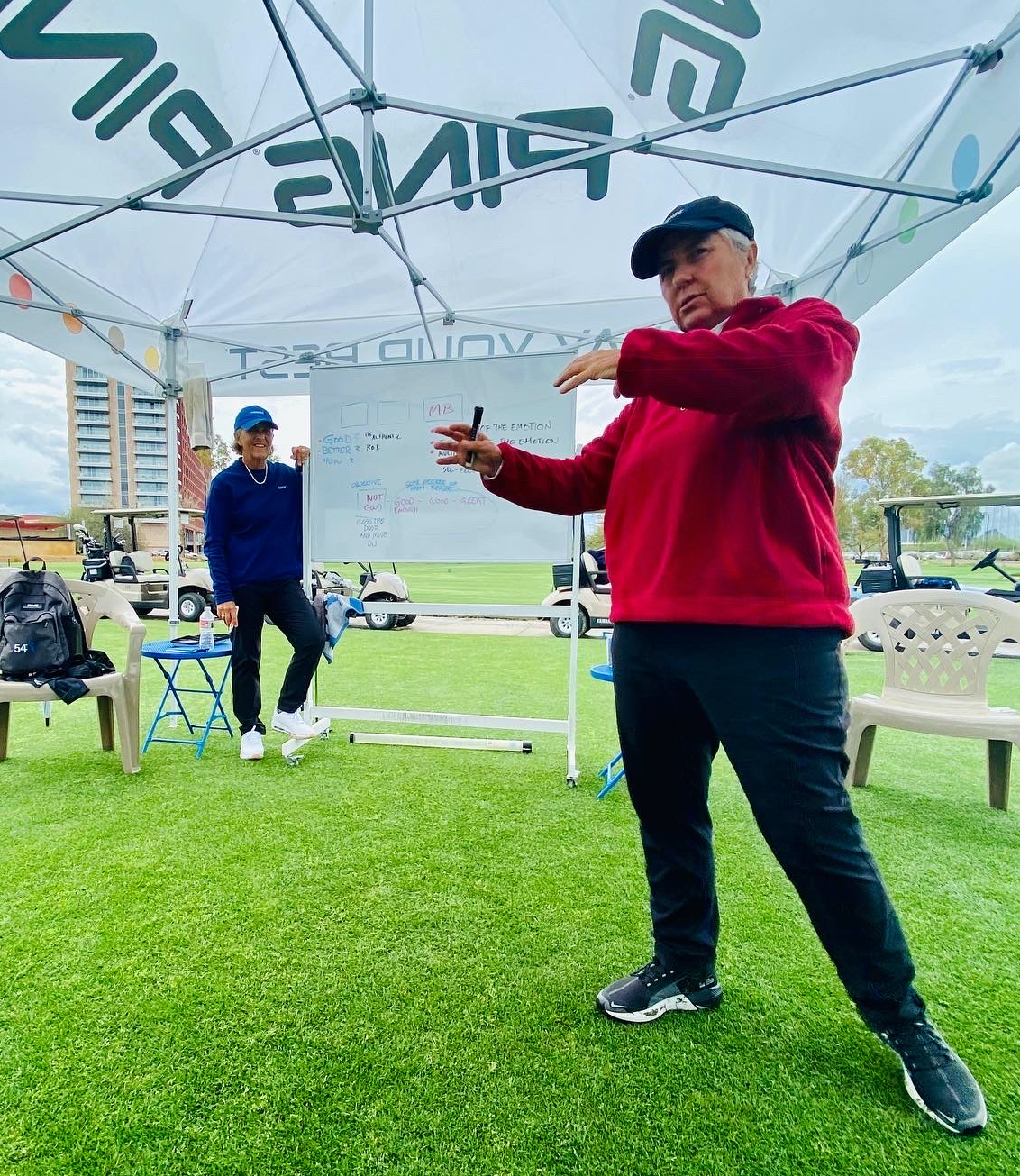
Pia Nilsson (L) and Lynn Marriott (R) teaching at Talking Stick Resort in Scottsdale, AZ

students and clients to “indulge in the experience of play” as Hogan said.  (Incidentally, Lynn worked with Chuck Hogan for many years.)

And while I learned so much about myself and my game that week, among my key takeaways with Lynn, Pia and the Vision54 Team were these:

  1. Our practice sessions can be WAY more productive when we bring purpose to each and every shot.
  2. We can create much better outcomes ON the course when we set aside the need to fulfill swing mechanics objectives and instead focus on what Lynn and Pia refer to as our Human Skills…which we can control.

Practice Slower, Play Faster. This is one of our Alert Attitude of Indifference Big Ten Strategies we teach at our AAI playing schools. It means:

  • That we all benefit by taking a MUCH slower approach to our practice sessions.
  • That instead of raking over and hitting ball after ball after ball, we can be much more productive – and learn a lot more while practicing – when we hit fewer balls – not more.
  • That when every shot has a purpose outside of a technical skill, we can learn to practice hitting shots as an athletic endeavor – not a cognitive one. (Thanks Lynn and Pia for articulating that so well!)

So, what does that look like when I am practicing slower?

  • No more bucket of balls poured-out next to my hitting station. Hit one ball at a time. No more raking over the next ball!
  • Prior to each shot, I am thoughtful about where I want each ball to fly to, it’s trajectory, and perhaps a feeling I am trying to notice.
  • I leave all thinking behind once I step up to the ball…and just “play.” (yes…even in a practice scenario.)

Playing faster on the course is also an important way to rethink your approach to the game. It means:

  • Not lingering over the shot as you are about to hit it.
  • Leaving your THINKING behind when you are executing a shot. (Including thoughts about how to hit position 3, how to keep your primary tilt, how to transition properly…etc.)
  • Creating a deliberate system that gets you to execute a shot in 4-7 seconds instead of 10-20 seconds.

Why is this important? Because executing each shot is an athletic endeavor – not a cognitive one. (Thanks again Lynn and Pia!) The LESS time you spend hovering over the ball, the less chance there is for your (very) active brain to get involved in the process.

Watch Todd Graves for a great model of what playing faster can look like while: https://www.youtube.com/watch?v=oC1_i–oeRU

As you practice and play over the next few weeks, see if you can do these two things. Practice slower and more purposefully. And when you play, pull the trigger sooner. Stop lingering over the ball. Stop overthinking. Just do.

I think if you can do this, you will have taken an important step toward achieving what Chuck Hogan wanted for all of us to experience when we play. And what Lynn Marriott and Pia Nilsson preach and teach every day. Just play. Just do. Be fearless. Stop getting stuck in your head. Go out and have fun. Loosen your grip on the outcomes. Enjoy the game more.

Stay Healthy!

-Paul

Tips for Improving (Part # 9) – End on a Positive Note

This is the 9th part of a series of practice tips titled “Tips for Improving”.

If you have missed any of the first 8 parts, please review on our home page on our website at www.moenormangolf.com

You can also go to:  http://moenormangolf.com/category/etip/

In those practice tips we discussed how we work with our students to create new habits rather than breaking old habits. It is essentially impossible to break bad habits (our mind/body is not set up that way) … but we are set up to be able to create new habits and ultimately make changes/create new movements, etc.  we want.

We talked about a book we strongly recommend – The Little Book of Talent / 52 Tips for Improving Your Skills by Daniel Coyle

It is described as a manual for building a faster brain and a better you. It is an easy-to-use hand book of scientifically proven, field tested methods to improve your skills – your skills, your kids’ skills, your organization’s skills – in sports, music, art, math and business. The product of five years of reporting from the world’s greatest talent hotbeds and interviews with successful master coaches, it distills the daunting complexity of skill development into 52 clear, concise directives.

Whether you are 10 or 100, this is an essential guide for anyone who ever asked, “How do I get better?”

9780345530257

This book is available at Amazon.com

The last instructional newsletters (Tips for Improvement Part 1 through 8) we discussed 36 tips for improvement from staring a who you want to become, to being willing to be stupid, to finding the sweet spot, to practicing by yourself, to taking a nap…. Again, if you have not reviewed these past practice tips, would recommend.

This instructional newsletter (Part 9) we cover the next 5 tips for improving your skills and relate them to you learning/working on your single plane swing and golf game.

37.  To Choose the Best Practice Method, Use the R.E.P.S. Gauge

This tip provides a way to measure practice effectiveness. It’s call the R.E.P.S. Gauge. Each letter stands for a key element of deep practice.

R:  Reaching and Repeating

E:  Engagement

P:  Purposefullness

S:  Strong, Speedy Feedback

Reaching and Repeating: Does your practice have you operating on the edge of our ability, reaching and repeating? The key here is being you at the edge of your ability. When you are working on new moves, creating new habits, it should not be easy…  you should be pushing the edge of your ability.

Engagement: Does your practice command your attention? Does it propel you toward your goal? This is a perfect example of doing drills slow and making sure you hit all positions perfect and correct… It is not a matter of doing drills many times fast, but rather, fewer times slow. Doing a drill one time one time perfect is MUCH better than many times close to perfect…

Purposefulness: Does the task (drill) directly connect to the skill (new habit/new move) you want to build? Do you know which drills work for different areas of the swing? Do you know which drills you need to focus on? If not, it is critical to determine which drills you need to work on…

Strong, Speedy Feedback: Do you receive a stream of accurate information about your performance? Where you succeeded and where you made mistakes? You need to figure out a way to get the most direct and immediate feedback as possible. Direct and immediate feedback leads to VERY rapid learning and dramatically decreases the time to create new/lasting habits. The best and direct feedback we have is our Single Plane Academy Inner Circle Gold Program. You can see more at:  https://members.singleplaneacademy.com/gold-membership/

38.  Stop Before Your Exhausted

In many skills, particularly athletic, there’s a long tradition of working/practicing until total exhaustion. It may be good for improving fitness and mental toughness, but when it comes to learning, exhaustion is the enemy.

Fatigue slows the brain. It triggers errors, lessens concentration, and leads to shortcuts that create (or “bring back) bad habits. It’s no coincidence that it has been shown the premium practice occurs when people are fresh, usually in the morning, if possible. When exhaustion creeps in, it’s time to stop.

This is a perfect scenario when we talk about practicing for 15 minutes, taking a break, working another 15 minutes, etc. Don’t overdue it as you can easily “erase” what you’ve built.

39.  Practice Immediately After Performance

For most, after performance (playing), practice is probably the last thing you want to do, but if you are not work out (exhausted), it is absolutely the best time to practice. It is the time you will be able to target your weak points and fix them. Jack Nicklaus said: “I always achieve my most productive practice after an actual round. Then the mistakes are fresh in my mind and I can go to the practice tee and work specifically on those mistakes.”

40.  Just Before Sleep, Watch a Mental Movie

Many top performers have described this habit. Just before falling asleep, they play a movie of their idealized performance in their heads. A wide body of research supports this idea, linking visualization to improved performance, motivation, mental toughness and confidence. It will help your unconscious mind work toward your goals.

41.  End on a Positive Note

A practice session should end like a good meal – with a small, sweet reward. I strongly suggest ending your practice sessions on a good note. If you are working on a drill and feel like you hit the position(s) perfect – stop. Don’t do one more…. stop on the perfect one. If you are hitting balls and working on your swing – you have 5 or 10 balls left to hit and you hit one that feels just right and you feel like you make a “great” move at the ball… end the session. We used to call it “Leaving a few balls for the range rats…” It is much better to leave a few balls on the range ending on a good note, then hitting every last ball and ending on a negative one…

Please watch upcoming newsletter practice tips for continuation of the tips for improving your skills/creating new habits and improving your golf game.

FREE SINGLE PLANE CLUB FITTING

Whether looking to fit/replace a single club to an entire set, from a putter to a driver to your irons, wedges, etc.. it is ABSOLUTELY CRITICAL that the club(s) is fit to YOUR individualized swing and single plane specifications.

An UNfit club will hinder your improvement process, an UNfit club will hinder your golf game, an UNfit club will not allow you to reach your potential, an UNfit club can and many times will actually physical hurt you (tendonitis in elbows and wrists are many times causes and exaggerated by club with improper lie angles), and UNfit club is basically worthless to you. I don’t care how much you spent for the golf club(s) – if they are not individually fit to you – they are worthless to your game – and worse than that, can and many times will actually “hurt” you.

The Graves Golf Academy has custom fitting programs established with most major manufacturers in the golf industry. And many of the manufacturers install our grips in their custom department (no other instruction group can say that….). We have worked VERY HARD to set this customizing system up for our customers, students, etc. anyone interested in the single plane golf swing.

Also, because of the amount of equipment we sell from each manufacturer, we are many times offered equipment at a reduced rate for our customers. We are always able to match industry pricing and many times able to beat the pricing. We are also many times able to offer clubs at a significantly reduced price (last year’s models, etc. as these manufactures know how many clubs we sell and “hold some back” for us). Please watch our newsletters (bimonthly) for these specials – as they typically don’t last long as many are interested in these special pricings.

Customization done at the manufacturer (Callaway, Taylormade, Titleist, etc..) is free through the Graves Golf, there is no added cost for the GGA grips installed and customized at the manufacturers. Plus, there is no shipping charge (within US) and no tax (outside of OK) through Graves Golf.

To get a FREE individualized custom fitting please go to:  http://moenormangolf.com/clubs/free-club-fittings/


To View Single Plane Fitting Informational / Instructional Webinar:   CLICK HERE

The 4 Cs of a Great Short Game

Had our first short game school of 2020 last week.  During the school we discuss many principles and philosophies of the short game, such as the 4 Cs of the short game.

Wanted to remind everyone about my 4 Cs of a GREAT Short Game. These are/will be covered “in depth” during our short game school and covered in all different areas (putting, chipping, pitching, bunker, specialty shots… especially those specialty short game shots).

In our schools, camps, and clinics (and pretty much anytime you’re around me), you will continually hear how important the short game is for scoring. In this article, I’m going to compare the long game vs. short game then give you my 4 Cs that you must follow to have a great short game.

First, you must be convinced that the short game is the most important part of scoring. Here are a couple facts about the short game.

Fact: The difference between a 30 handicap golfer and a scratch golfer (0 handicaps) is associated with 7 to 10 shots in the long game (shots over 50 yards) and 20 to 23 shots in the short game (shots under 50 yards). Meaning, if you are a 30 handicap golfer and only work on your long game you will only improve 7 to 10 shots toward scratch golf. The best you will ever reach is a 20 handicap. The difference between a 15 handicap golfer and the scratch golfer is associated with 3 to 5 shots in the long game, and 10 to 12 shots in the short game. In other words, if you are a 15 handicap golfer wanting to reach scratch, if you only work on the long game, you will basically never improve beyond a 10 handicap.

Fact: No professional (or scratch golfer) has an advantage in their short game over yours. In other words, the short game is not associated with strength, working out or athletic ability. It is a part of the game that is associated with practicing the correct fundamentals and putting those fundamentals into play at the right time. Ever notice how many young players (talking about 10, 11, 12-year-old juniors) have a great short game. In fact, many compare to the professional’s short games. Don’t you wonder how someone who is 75 pounds soaking wet can compete with the best players in the world? This shows it is not strength, but rather what matters are things like finesse and feel. This is what I call the 4 Cs to the short game: Creativity, Confidence, Commitment, and Critique.

4 Cs

CREATIVITY: The first thing you must do when confronted with a short game shot (pitch, chip, etc.) is to create the shot. Part of the teaching we give our students during their short game instruction is to pick a shot around the green and ask the group to name 5 different ways to play the shot. Most of the time the group is able to name 2 or 3, but almost never 5. An example would be a shot that is 20 to 25 yards off the green with minimal rough between the ball and the hole.

You could:

  1. Pitch the shot to the hole,
  2. Chip the shot into the fringe around the green and roll to the hole,
  3. Putt through the entire rough and fringe,
  4. Hit a flop shot all the way to the hole, or
  5. Hit a 3 wood chip that will have moreover spin and roll to the hole???

The point here is you need to be creative over the shot. I like to call it the “artistic” part of the game.

A good rule of thumb: “Putt when you can, Chip when you can’t putt, Pitch when you have too…” (Aka – the “PCP Rule” – refer to past articles on the PCP Rule). Yes, this is a very basic “rule”, but a good one to fall back on.

COMMITMENT: Once you have created the shot, you must commit to the shot that is the lowest risk for error FOR YOU. If you have a good pitch shot and feel it is the most likely to get the ball close to the hole with the least room for error, hit the pitch shot. Many will feel the chip from the fringe or even the putt will be their lowest risk shot. DON’T think you have to hit a shot in a particular manner because the pros on TV hit it that way, but rather execute the shot YOU feel you can hit with the most confidence.

CONFIDENCE: So now that you have created and committed to the shot, you must play the shot with confidence. This means that if you have chosen to chip the shot, tell yourself you will chip it close, pick your spot you want to hit, use good fundamentals, and with 100% confidence, hit the shot. If you don’t feel confident over the shot, BACK OFF and commit to something different or swing a couple practice swings/chips until you have gained the confidence back. The last of the 4 Cs are:

CRITIQUE: You must critique your short game shots after you have executed them. This is not to say, “I can’t hit a particular shot”, but rather “I had 4 chip and run shots today and only hit 1 good. Therefore, I need to put more practice in the chip and run shot”. Look back at each shot and determine if you need more practice in that area. Here’s a question you can ask yourself and see how well you currently critique your short game: How many of you practice chipping short of the green (maybe into the fringe) and then roll the ball onto the green close to the hole or how many of you when practicing putting, putt balls from off the green (from the fringe or low rough) to the green? I believe that these are the shots that, after you critique your short game, will probably be the shots that need the most practice.

Finally, I believe that EVERYONE can have a GREAT short game. In fact, everyone can have a short game that is as good or better than any professional. But, to get this GREAT short game, you must first learn the proper fundamentals and practice these fundamentals. Then you can use the 4 Cs – Creativity, Commitment, and Confidence and then Critique to bring that short game to the course.

Good Luck and Remember – ALWAYS PRACTICE WITH A PURPOSE!

Tips For Improving (Part #8) – The Sandwich Technique

This is the 8th part of a series of practice tips titled “Tips for Improving”.

In those practice tips we discussed how we work with our students to create new habits rather than breaking old habits. It is essentially impossible to break bad habits (our mind/body is not set up that way) … but we are set up to be able to create new habits and ultimately make changes/create new movements, etc. we want.

We talked about a book we strongly recommend – The Little Book of Talent/52 Tips for Improving Your Skills by Daniel Coyle

It is described as a manual for building a faster brain and a better you. It is an easy-to-use hand book of scientifically proven, field tested methods to improve your skills – your skills, your kids’ skills, your organization’s skills – in sports, music, art, math and business. The product of five years of reporting from the world’s greatest talent hotbeds and interviews with successful master coaches, it distills the daunting complexity of skill development into 52 clear, concise directives.

Whether you are 10 or 100, this is an essential guide for anyone who ever asked, “How do I get better?”

9780345530257

This book is available at Amazon.com

The last instructional newsletters (Tips for Improvement Part 1 through 7) we discussed 31 tips for improvement from staring a who you want to become, to being willing to be stupid, to finding the sweet spot, to practicing by yourself, to taking a nap…. Again, if you have not reviewed these past practice tips, would recommend.

This instructional newsletter (Part 8) we cover the next 5 tips for improving your skills and relate them to you learning/working on your single plane swing and golf game.

32.  Make Positive Reaches

There’s a moment during every practice or rep (action) when you face a choice: You can either focus your attention on what you want to do, or you can focus on the possible mistake (what you want to avoid). This tip is simple – ALWAYS focus on the positive move, the one you want to do, not the negative.

A perfect example is stroking a putt. Tell yourself what to do, rather than what not to do. Say the putt breaks about 1/2 a cup right to left. Say to yourself, “smooth stroke at the right lip”, rather than “don’t pull the putt”.

The point is, it always works to reach for what you want to accomplish, not away from what you want to avoid.

33.  To Learn From a  Book, Close The Book

What is the better way to learn from a book?

To read the book many times in a row, trying to memorize it?

or

To read the book once, close the book and write a summary of what you read?

There is no question, the best way to learn is writing the summary of what you learned. In fact, research shows people following the summary strategy learn 50% more material than those who try to memorize.

This is because one of deep practice’s most fundamental rules: Learning is Reaching. Closing the book and writing a summary forces you to figure out the key points (one set of reaches), process and organize those ideas so they make sense to you. The equation is always the same: More reaching equals more learning.

We strongly recommend the same whether you are learning from a video, from online coaching or attending one of our schools. In fact, during our schools we STRONGLY encourage and give time for all our students to take notes during and just after they learn new fundamentals so they can “write” those fundamentals in their own words. They can summarize what they just learned in their “own words”, they can process what they’ve just learned and can organize for themselves so they have a better understanding.

Again, whether you are learning from a video, webinar, online coaching or at a school, your best and most effective learning will be when you “close the book” and summarize for yourself, in your own words so you can review and process in the future.

34.  Understand The Sandwich Technique

What’s the best way to make sure you don’t repeat mistakes? (The million $ question right????)

One of the best ways is to employ the sandwich technique. It goes like this:

1.  Make the correct move.

2.  Make the incorrect move.

3.  Make the correct move again.

The goal is to reinforce the correct move and to put spotlight on the mistake, preventing it from slipping past undetected and becoming “wired” into your circuitry (brain).

During this technique, it doesn’t hurt to say to yourself – this is the good move or what I want to do. And when you are during the incorrect move, saying, this is the incorrect move or what I don’t want to do…

This technique is good to perform every so often, especially when you are confirming/checking to make sure you are doing a move correct. If you can perform the correct move and then the incorrect move, you can see/feel/know a difference, a great way to make sure doing move correct.

I employ this technique often when working with students and it always surprises me when the student will tell me they “don’t want to make the bad move again”. They act as if they are “afraid” to make the incorrect move again, because it might “stick” or something like that.

It will only “stick” or “creep back” if you aren’t aware of it. Doing it intentionally every so often will keep you aware of “what to look” for….

35.  Use The 3 x 5 Technique

It has been shown by those who research memory and learning – that our brains make stronger connections when they are stimulated three times with a rest period of ten minutes between each stimulation.

Translation: To learn something most effectively, practice it three times, with ten-minute breaks between each rep.

Perfect example would be the Single Plane Position Trainer drill (drill to learn backswing, top of swing to impact position). Practice the Single Plane Position Trainer drill for a few minutes (slowly) until you feel you have “hit” a position or two correct. Then take a ten-minute break. Do it again, practice the drill for a few minutes until you “hit” a position or two correct, then take another break.

I have also heard of this as the “commercial” technique for learning. When you are watching a T.V. show (or sporting event…), practice/drill during the commercials – then take a break while watching the shows. Work on the commercials, break during the show/action. Typically sets you up for drilling/practicing for a few minutes, then taking about a 10 minute break between.

36.  Invent Daily Tests

Daily routine (or when you practice) should include “little tests”. These tests should not be scientific, and should not be treated as verdicts, but rather as “fun games” to keep one involved, entertained and focused during the learning process.

Examples (ones I use often).

Chip 10 balls around the green and see how many you can get within 3 feet (the length of your putter (short putter)).

Putt 5 balls from 5 feet from 4 points around the hole (Twelve o’clock, 3 o’clock, 6 o’clock and 9 0’clock). Of the 20 balls, how many do you make?

Pick two points out on the range about 20 to 25 yards apart and about where your driver distance (ball flight) would land. How many balls out of 25 can you hit between those targets with the driver?

Hit 10 balls with an 8 iron to a target and see how many you can hit within 20 feet?

Again – these are just examples of “little tests” you can do for yourself to see if you are improving and a fun way to help you keep entertained and focused on your learning process.

Creating “tests” for yourself is a great way to enhance your learning process and to keep you focused.

Please watch upcoming newsletter practice tips for continuation of the tips for improving your skills/creating new habits and improving your golf game.

Take a Nap, Tips for Improving (Part 7)

This is the 7th part of a series of practice tips titled “Tips for Improving”.

In those practice tips we discussed how we work with our students to create new habits rather than breaking old habits. It is essentially impossible to break bad habits (our mind/body is not set up that way) … but we are set up to be able to create new habits and ultimately make changes/create new movements, etc. we want.

We talked about a book we strongly recommend – The Little Book of Talent / 52 Tips for Improving Your Skills by Daniel Coyle

It is described as a manual for building a faster brain and a better you. It is an easy-to-use hand book of scientifically proven, field tested methods to improve your skills – your skills, your kids’ skills, your organization’s skills – in sports, music, art, math and business. The product of five years of reporting from the world’s greatest talent hotbeds and interviews with successful master coaches, it distills the daunting complexity of skill development into 52 clear, concise directives. Whether you are 10 or 100, this is an essential guide for anyone who ever asked, “How do I get better?”

9780345530257

This book is available at Amazon.com

The last instructional newsletters (Tips for Improvement Part 1 through 6) we discussed 26 tips for improvement from staring a who you want to become, to being willing to be stupid, to finding the sweet spot, to practicing by yourself….  Again, if you have not reviewed these past practice tips, would recommend.

This instructional newsletter (Part 7) we cover the next 5 tips for improving your skills and relate them to you learning/working on your single plane swing and golf game


27.  Close Your Eyes

One of the quickest ways to deepen/enhance practice is also one of the simplest, Close Your Eyes. Closing your eyes is a quick way to “enhance” certain senses. Many times golfers/students get WAY TOO “tied up” in ball results and not in the movement/feeling of the movement of the golf swing.

Quite often in our schools, when a student is starting to get the club on plane, or starting to get into proper positions (could be grip, set up, etc..) we will have the student close their eyes and “feel” that position or swing. It is critical to have a good sense of feel in the swing.

The sequence is to work on fundamental positions/swing, as you are starting to figure out and get closer to the model, you want to turn it into “feel”. This is greatly enhanced when you “close your eyes” at times during practice. We are not recommending hitting balls with the eyes closed, but practice swinging and working on fundamental positions with the eyes closed is a wonderful learning tool.

28.  Mime It

Swing the golf club WITHOUT a golf ball. Removing everything except the essential action lets you focus on what matters most – making the right/correct action/move.  Do this with the full swing, with putting, chipping, pitching, etc… etc. As you are “miming” – think what you want it too look like. Think of the model you are trying to copy. Put this together with tip # 27 – Mime while closing your eyes. Start slow, and eventually build up speed.

29.  When You Get It Right, Mark The Spot

One of the most fulfilling moments of a practice session is when you make your first perfect rep. When this happens, FREEZE. “Rewind” the mental tape and play the move again and again in your mind. Memorize the feeling in rhythm, the physical and mental sensations.

The point is to mark the moment – this is the “spot” where you want to go again and again and again.

This is NOT the finish – it’s the new starting line for perfecting the skill/building the new habit(s).

Love the saying – “Practice begins when you get it right.”

This is one of those situations it would really help to video your swing/new positions so you can check against the model (Moe). Many ask how to short cut the process… there is no real short cut – but it can be sped up by a student viewing/watching his swing more. Videoing does this (and it is VERY simple). If you have questions how to video your swing, Chandler Rusk, Master Instructor will be more than happy to assist you – you can contact him at ChandlerR@gravesgolf.com

30.  Take A Nap

This has to be one of the best tips…  The science: Napping is good for the learning brain, because it helps strengthen the connections formed during practice and prepares the brain for the next session. It has actually been shown that learning improves by as much as 10% after a nap compared to those that don’t take one.

Now, I know if is unrealistic to take naps during practice (or between different sessions) – like going from chipping practice to full swing practice.  BUT – you should take a break (can even think of it as a “power nap” … sort of). You should NEVER practice for more than 10 or 15 minute sessions, and between these sessions you should let the mind/brain relax. Take a break…. let the brain take a “nap”.

I like to listen to music (headphones) between practice sessions – a good way for me to get “away” from my golf thoughts.

The more you can relax between your different practice sessions, the more effective the sessions will be.

Example of a typical practice session (1 hour) – Few minutes of stretching. 10 to 15 minute of putting (then listen to a few minutes of music). 10 to 15 minutes of chipping/pitching (then listen to a few minutes of music). 20 to 30 minutes of full swing work (spit up into 10 to 15 minute sessions relaxing between..)

31.  To Learn A New Move, Exaggerate It

It you have read past instructional tips you have heard us talk about this many times.

To learn a new move, exaggerate it. Don’t be halfhearted… you can always “dial back” later. Go too far so you can feel the “outer edges” of the move, and then work on building the skill with precision.

Also, for most, unless you exaggerate it, you will not create the new habit/new move.

This is the perception vs. reality concept. You might think you are making a change, but most are not changing enough (if at all). They think they are making a change… and really aren’t. Exaggerating the change will take care of this. Remember, you can always “bring it back” a little. And if you have made the “dramatic” change, “bringing it back” a little will not be hard and will take very little time.

The best way to create a new habit – exaggerate it.

The best way to get feel in a new habit – exaggerate it.

The best way to make sure you created the new habit – exaggerate it.

The quickest way to create a new habit – exaggerate it.

Think you get my point….

Please watch upcoming newsletter practice tips for continuation of the tips for improving your skills/creating new habits and improving your golf game.


LEARN

THE

SWING

Join 1M+ Subscribers to get your FREE Video Quick Start Guide that reveals how to hit the ball farther and straighter more consistently from now on…

START YOUR NEW GOLF SWING