FREE SINGLE PLANE CLUB FITTING

FREE SINGLE PLANE CLUB FITTING

Whether looking to fit/replace a single club to an entire set, from a putter to a driver to your irons, wedges, etc.. it is ABSOLUTELY CRITICAL that the club(s) is fit to YOUR individualized swing and single plane specifications.

An UNfit club will hinder your improvement process, an UNfit club will hinder your golf game, an UNfit club will not allow you to reach your potential, an UNfit club can and many times will actually physical hurt you (tendonitis in elbows and wrists are many times causes and exaggerated by club with improper lie angles), and UNfit club is basically worthless to you. I don’t care how much you spent for the golf club(s) – if they are not individually fit to you – they are worthless to your game – and worse than that, can and many times will actually “hurt” you.

The Graves Golf Academy has custom fitting programs established with most major manufacturers in the golf industry. And many of the manufacturers install our grips in their custom department (no other instruction group can say that….). We have worked VERY HARD to set this customizing system up for our customers, students, etc. anyone interested in the single plane golf swing.

Also, because of the amount of equipment we sell from each manufacturer, we are many times offered equipment at a reduced rate for our customers. We are always able to match industry pricing and many times able to beat the pricing. We are also many times able to offer clubs at a significantly reduced price (last year’s models, etc. as these manufactures know how many clubs we sell and “hold some back” for us). Please watch our newsletters (bimonthly) for these specials – as they typically don’t last long as many are interested in these special pricings.

Customization done at the manufacturer (Callaway, Taylormade, Titleist, etc..) is free through the Graves Golf, there is no added cost for the GGA grips installed and customized at the manufacturers. Plus, there is no shipping charge (within US) and no tax (outside of OK) through Graves Golf.

To get a FREE individualized custom fitting please go to:  http://moenormangolf.com/clubs/free-club-fittings/


To View Single Plane Fitting Informational / Instructional Webinar:   CLICK HERE

Get Out of Your Own Way!

The human potential is an amazing thing.

Dr. Andy Walshe has spent a career trying to understand it…in athletes, musicians, leaders and others who want to perform at their best.

He has spent time with Olympic ski teams, and many well-known athletes and performers. And for seven years, he played an integral role in the Red Bull Stratos project which culminated in 2012 with a successful (and record-breaking) high-altitude free fall from 127,000 feet by Austrian skydiver Felix Baumgartner.

I spent time with Andy last week during a meeting at the Kauffman Foundation where he presented many of his research and findings over the years, including some great stories from sports and performance arenas.

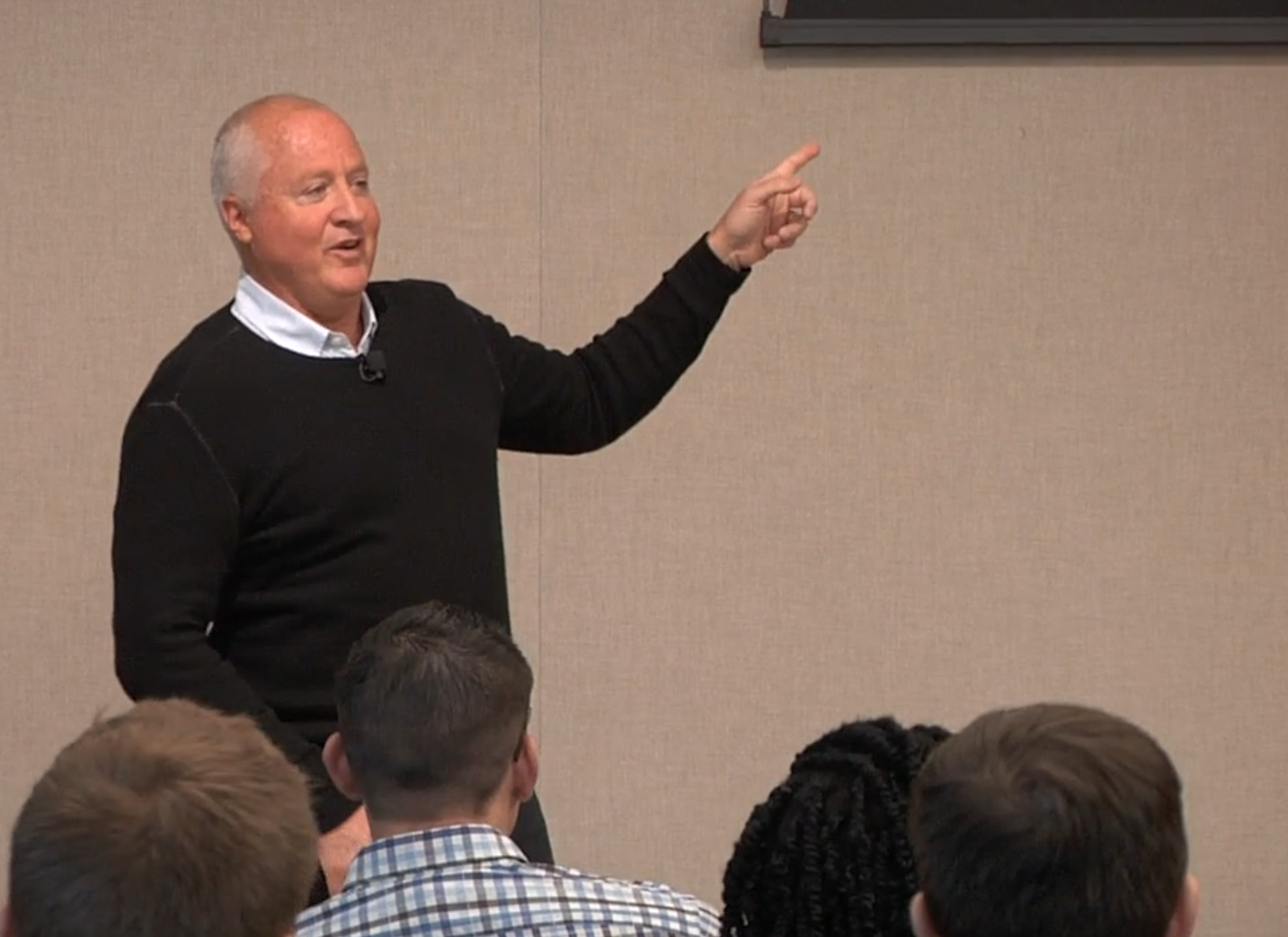
Dr. Andy Walshe presenting at the Kauffman Foundation, Kansas City, MO February 19, 2020.

What stood out for me most is that while Andy and his team are quantifying human potential like never before, they are also validating one of the key concepts that Moe Norman used to talk about.

A few of my takeaways:

  • There is a difference between Perceived Risk and Actual Risk.
  • Managing Risk and pushing yourself past fears is a key to realizing your performance potential.
  • Andy and his team are beginning to quantify in new ways the profound benefits of proper rest (read: sleep) on high performance.
  • Responding moves you toward your goal. Reacting gets you stuck.
  • We are capable of so much more than we think…if we can learn to get out of our own way.

Yes…there it is! “…if we can learn to get out of our own way.” Moe Norman used to say all the time: “You just gotta get out of your own way.”

The challenge for most golfers is that:

  • They worry about the risks ahead. (“What if I hit it in the water?)
  • They struggle to interpret events in objective ways. (“Oh crap, I hit it in the water!”)
  • They fail to take a “winning or learning” mindset onto the course. (“I hit it in the water…I’m such a loser!”)

And while much of the game of golf is about mastering a physical skill, a great deal of thriving and performing at one’s best on the course is about managing the thoughts, feelings and emotions that are part of the experience of playing the game. (Don’t ignore this!!!)

At Liminal Collective, the organization that Dr. Walshe leads, they challenge the athlete’s fears by putting them in a room with a bear, or a box of snakes. (Yikes!…I know!!)  Or they help the athlete grow their self-concept – their sense of what is possible for them –  by teaching them to hold their breath under water for 4-5 minutes…all within the course of a single day-long training experience.

Moe Norman knew about human potential on the golf course. And while he didn’t have the language or the scientific understanding that Dr. Walshe and his team have uncovered, he had a way of facing his fears on the course – and of getting out of his own way.

What did Moe do?

  • He sought to play with an alert attitude of indifference.
  • He learned to tune-in to his feelings and emotions…monitoring what was supporting his performance, and what was impacting it negatively.
  • He learned to care a little less. To be indifferent to the outcome, even if it wasn’t aligned with his objective.
  • He learned to play from his authentic self, and not let his ego take over. He learned to get out of his own way

What can you do?

Much the same.

  • Become more aware of your feelings while playing the game… and the thoughts that drive them.
  • Reframe your interpretations about the “bad” things that happen on the golf course. See if you can label the “bad” situations on the course as a gift or a learning opportunity, instead of “…more proof that I am a terrible human being.”
  • Respond to what happens on the course. Don’t react. Let objectivity and curiosity drive your behavior. Don’t let your ego – and all that it “needs” create knee-jerk reactions.

And as much as anything, commit to improving your skill set. (But recognize where you are on your skill journey at any given time. This perspective is important in fast-tracking your development.)

It’s warm in Florida and Phoenix! See you there soon!

All the best & have a great week!

-Paul

Slow Down (Even Slower Than You Think) – Tips for Improving Part # 6

Hopefully, you were able to read the last 5 practice tips – Tips for Improving (Part 1, 2, 3, 4 and 5)

In those practice tips we discussed how we work with our students to create new habits rather than breaking old habits. It is essentially impossible to break bad habits (our mind/body is not set up that way) … but we are set up to be able to create new habits and ultimately make changes/create new movements, etc. we want.

We talked about a book we strongly recommend – The Little Book of Talent/52 Tips for Improving Your Skills by Daniel Coyle

It is described as a manual for building a faster brain and a better you. It is an easy-to-use hand book of scientifically proven, field tested methods to improve your skills – your skills, your kids’ skills, your organization’s skills – in sports, music, art, math and business. The product of five years of reporting from the world’s greatest talent hotbeds and interviews with successful master coaches, it distills the daunting complexity of skill development into 52 clear, concise directives. Whether you are 10 or 100, this is an essential guide for anyone who ever asked, “How do I get better?”

9780345530257

This book is available at Amazon.com

The last instructional newsletters (Tips for Improvement Part 1, 2, 3 and 4) we talked about the following tips

  1. Staring at who you want to become.
  2. Spending 15 minutes a day engraving the skills on your brain.
  3. Stealing without apology.
  4. Buying (and keeping) a notebook.
  5. Be willing to be stupid
  6. Choose spartan over luxurious
  7. Before you start, figure out if it’s a hard skill or a soft skill
  8. To build hard skills, work like a careful carpenter
  9. To build soft skills, play like a skateboarder
  10. Honor the hard skills
  11. Don’t fall for the prodigy myth
  12. How to pick a high-quality teacher
  13. Finding the sweet spot
  14. Take off your watch
  15. Break every move down into chunks
  16. Each day, try to build one perfect chunk
  17. Embrace struggle
  18. Choose five minutes a day over an hour a week
  19. Don’t do “drills”.  Instead, play small, addictive games
  20. Practice alone

This instructional newsletter (Part 6) we cover the next 6 tips for improving your skills and relate them to you learning/working on your single plane swing and golf game.

21.  Think in Images

Which instruction is easier to remember?

Grip the club lightly.   – 0r –  Grip the club like you are holding a baby bird.

Release the club through impact.  – or –  Toe of club should be over through impact.

For most, images are far easier to grasp, recall and perform. Whenever possible, create a vivid image for each chuck (new habit) you want to learn. The images don’t have to be elaborate, just easy for you to “see” and feel.

22.  Pay Attention Immediately After You Make a Mistake

Most of us are “allergic” to mistakes. When we make one, our every instinct urges us to look away, ignore it, and pretend it didn’t happen. This is not good, because as we’ve seen, mistakes are guideposts for improvement.

Studies reveal that within 0.25 seconds after a mistake is made, people (the brain) do one of two things – they look hard at the mistake or they ignore it. People who pay deeper attention to an error learn significantly more than those who ignore it.

Develop a habit to look your mistakes right away… don’t “look away”. Ask yourself what you can do next to improve them. Take mistakes seriously, but never personally.

As Moe said MANY times (when he sees another golfer hit a poor golf shot), “Don’t worry about it, learn something from it.”

23.  Visualize The Wires of Your Brain Forming New Connections

When you go to the sweet spot on the edge of your ability and reach beyond it, you are forming and strengthening new connections in your brain.

Mistakes aren’t really mistakes, then – they’re the information you use to build the right links.

The more you pay attention to mistakes and fix them (creating new/correct habits), the more of the right connections you’ll be building inside your brain.

24.  Visualize the Wires of Your Brain Getting Faster

Every time you practice deeply – the wires of your brain get faster.

When you practice, it’s useful and motivating to visualize the pathways of your brain being transformed to “high-speed broadband”.

Our saying “Always practice with a purpose” added to deep practice will get this “high-speed wiring” going.

25.  Shrink the Space

Smaller practice spaces can deepen practice when they are used to increase the number and intensity of the reps and clarify the goal.

For your practice I would suggest shrinking the space by (examples):

– Focusing on the PVC drill

– Focusing on Leverage Bag drill

– Using the string (putting alignment aid) on the putting green (or indoor on a putting mat)

All these drills are extremely important/critical for developing/checking core fundamentals. “Shrinking the Space” will help you focus on these core fundamentals and their movements.

26.  Slow Down (Even Slower Than You Think)

When we learn how to do something new, our immediate urge is to do it again, faster. The urge to speed makes perfect sense, but it can also create sloppiness, particularly when it comes to hard skills (see Tip # 8).

We trade precision – and long term performance – for a temporary thrill. So, slow it down.

Super-slow practice works like a magnifying glass. It lets us sense our errors more clearly, and thus fix them.

A great example of slow practice was often performed by Ben Hogan – he routinely practiced so slowly that when he finally contacted the ball, it moved about an inch.

As the saying goes, “It’s not how fast you can do it.  It’s how slowly you can do it correctly”.

Please watch upcoming newsletter practice tips for continuation of the tips for improving your skills/creating new habits and improving your golf game.

FREE SINGLE PLANE CLUB FITTING

Whether looking to fit/replace a single club to an entire set, from a putter to a driver to your irons, wedges, etc.. it is ABSOLUTELY CRITICAL that the club(s) is fit to YOUR individualized swing and single plane specifications.

An UNfit club will hinder your improvement process, an UNfit club will hinder your golf game, an UNfit club will not allow you to reach your potential, an UNfit club can and many times will actually physical hurt you (tendonitis in elbows and wrists are many times causes and exaggerated by club with improper lie angles), and UNfit club is basically worthless to you. I don’t care how much you spent for the golf club(s) – if they are not individually fit to you – they are worthless to your game – and worse than that, can and many times will actually “hurt” you.

The Graves Golf Academy has custom fitting programs established with most major manufacturers in the golf industry. And many of the manufacturers install our grips in their custom department (no other instruction group can say that….). We have worked VERY HARD to set this customizing system up for our customers, students, etc. anyone interested in the single plane golf swing.

Also, because of the amount of equipment we sell from each manufacturer, we are many times offered equipment at a reduced rate for our customers. We are always able to match industry pricing and many times able to beat the pricing. We are also many times able to offer clubs at a significantly reduced price (last year’s models, etc. as these manufactures know how many clubs we sell and “hold some back” for us). Please watch our newsletters (bimonthly) for these specials – as they typically don’t last long as many are interested in these special pricings.

Customization done at the manufacturer (Callaway, Taylormade, Titleist, etc..) is free through the Graves Golf, there is no added cost for the GGA grips installed and customized at the manufacturers. Plus, there is no shipping charge (within US) and no tax (outside of OK) through Graves Golf.

To get a FREE individualized custom fitting please go to:  http://moenormangolf.com/clubs/free-club-fittings/
 

To View Single Plane Fitting Informational / Instructional Webinar:   CLICK HERE

The Lower Body “Limits” of Moe Norman’s Golf Swing (Part 1)

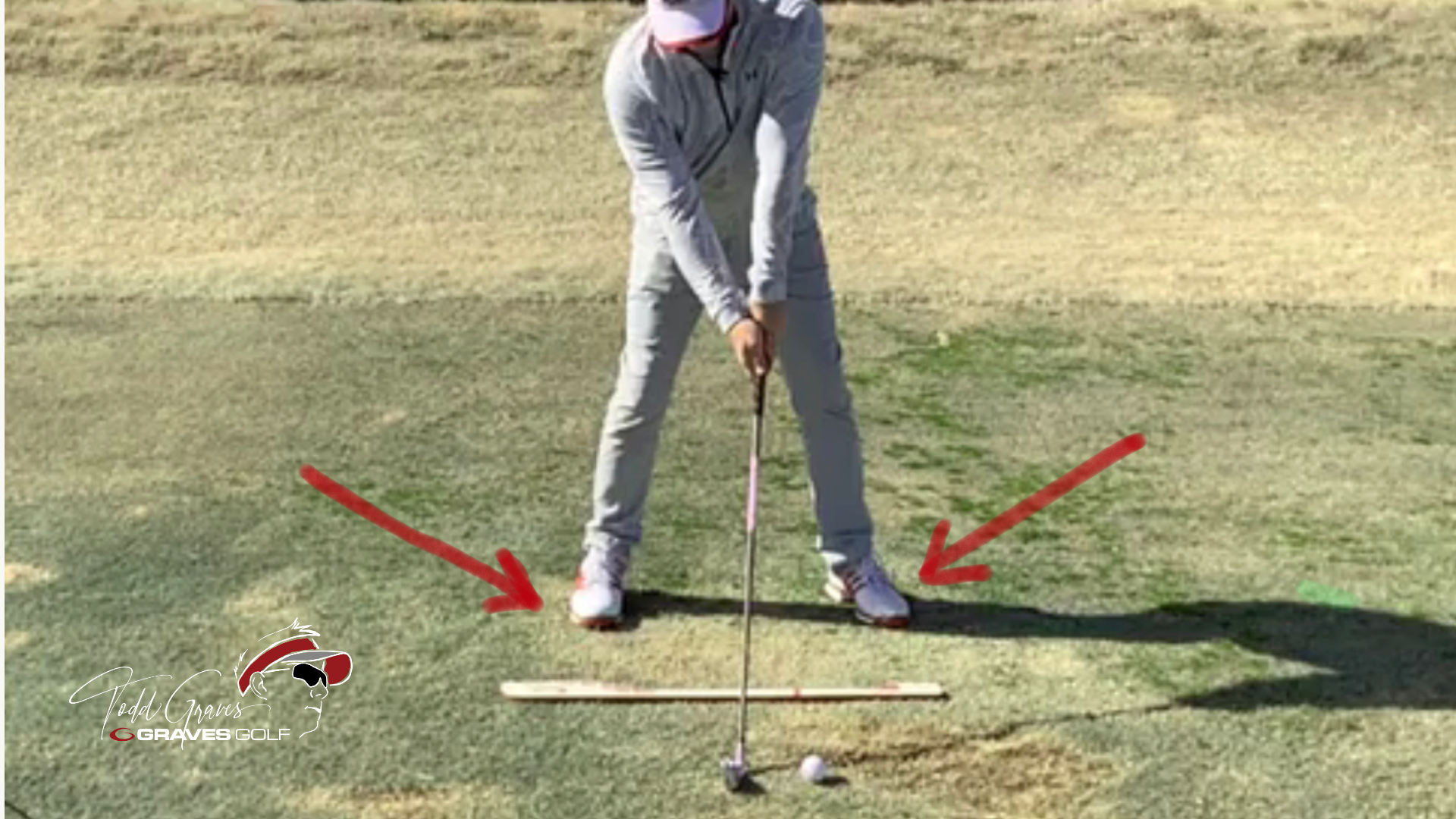
A golf swing is a simple set of sequential movements of the pelvis, torso, arms and hands.  These movements are stabilized by the legs and feet.  The position of the body, starting at address, creates limitations so that other parts of the body can move inside a range of motion.  In other words, the range of motion of the body is being limited by the subsequent body’s position.  Here is how the movement sequence and body limitations work – from the ground up in the backswing and transition.

At address the trail foot is slightly rotated open in a position to stabilize the trail leg.  The Lead foot is rotated more, opening the upper lead leg.  The trail foot’s slight rotation and lead foot rotation, allows the pelvis to turn to a specific degree in the backswing – but limits the amount as the trail leg stabilizes the rotation.

Single Plane Foot Position

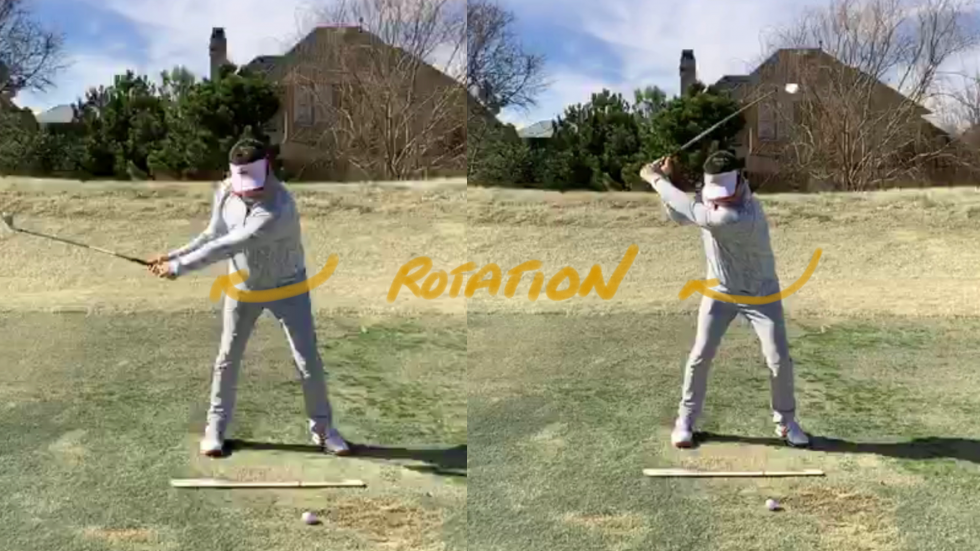
During the backswing, the lead shoulder, arms and torso begin to rotate together.  In the mid point of the arm motion, the pelvis is slowing down due to the resistance created by the positioning of the legs and feet.

Single Plane Rotation of Body

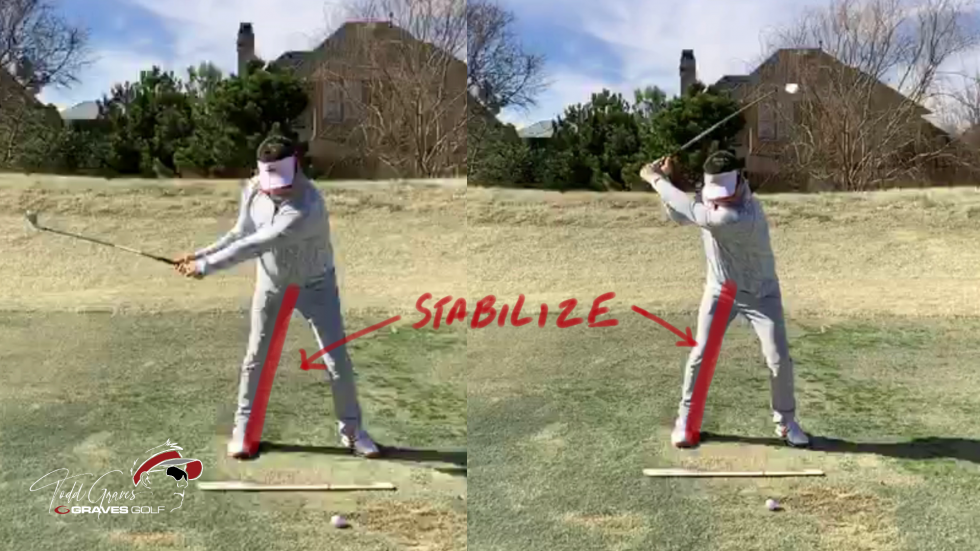
The resistance feels like a bracing on the inside of the trail leg as the body rotates.

Single Plane Leg Position

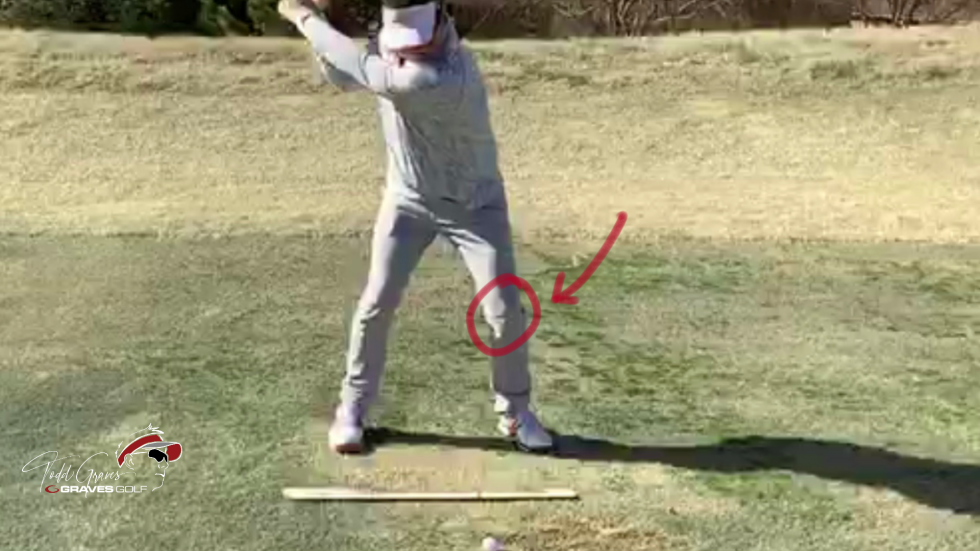
When the inside of the trail leg braces it stops the trail side of the pelvis so that the lead side can continue to rotate.  This is why the lead knee will bend inward slightly.

Single Plane Lead Knee

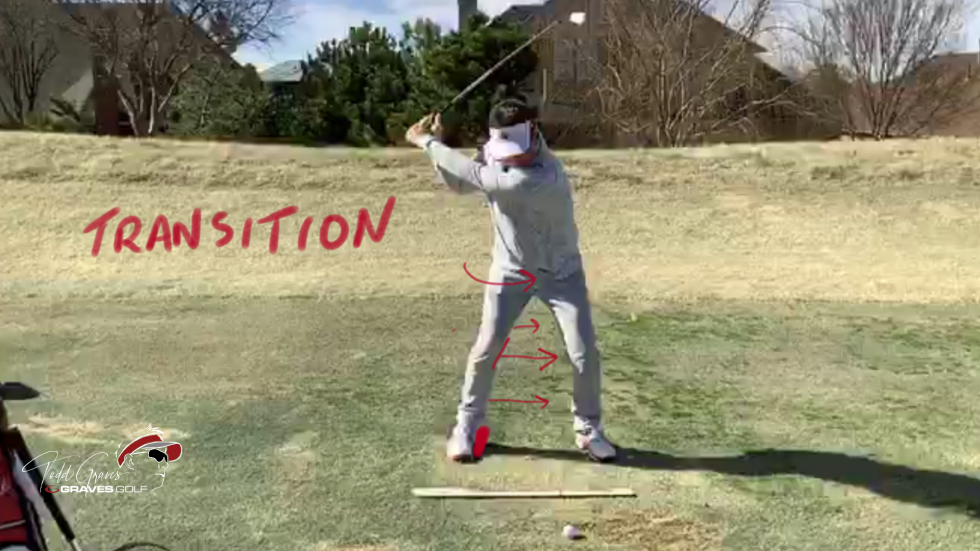
In the backswing sequence, the rotation of stabilizes against the inside of the trail foot and leg.  The allows the torso to continue rotating and then the arms to also move to the top of the swing.  The stabilization of the trail leg allows for a push of the pelvis toward the target during the transition of the swing.

Before the hands reach the top of the backswing position, the pelvis is already being pushed from the inside of the trail leg.Without this stabilized trail leg, you would be unable to move your body into the lead leg in the downswing.

Single Plane Transition

The limits created by the position of the feet have limited the rotation of the pelvis and torso making the case for the importance the attention to the minor details of body positions.

Look for Instability in Your Swing

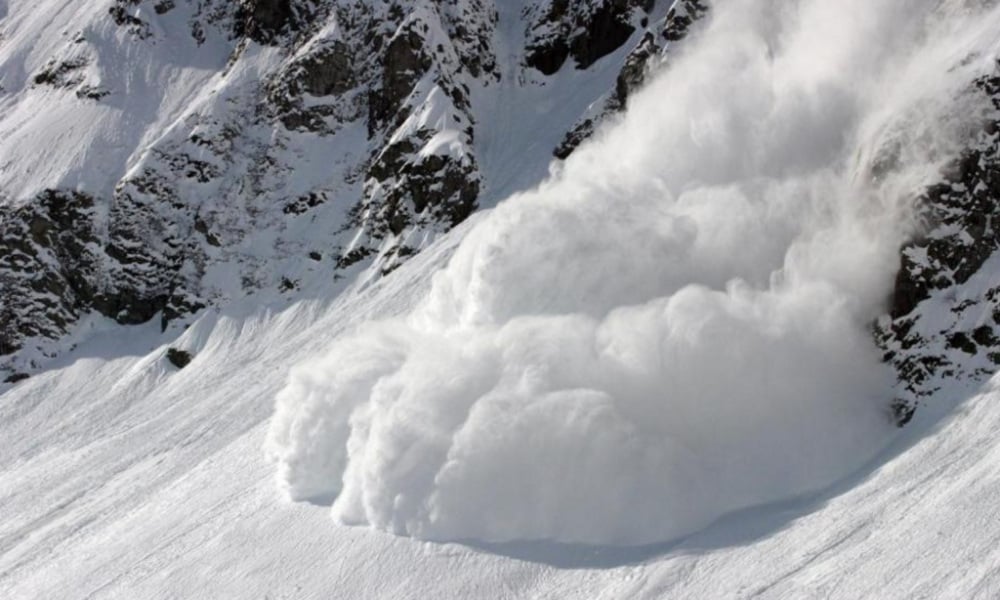
When avalanche safety experts teach back-country skiers how to avoid getting swept up in life-threatening avalanches, they take an interesting approach.

These safety guides teach skiers that when they are poking and checking the snow and terrain beneath them as they move along mountain ridges, they should not look for proof of stability in the snow.

Why not?

When stability is what you are looking for, and when you find it, it is – in a sense – the permission you are looking for to go ahead and do what you want to do.

This is a problem because it may not be thorough enough.

The same approach used to avoid avalanches may help you build a stronger Single Plane Swing in shorter time.

Instead, they teach the skiers to test the snow for proof of instability. In fact, because avalanches are so serious and deadly, they encourage the students to search relentlessly until they find instability.

What is paradoxical is that they are encouraging the students to search for what they DON’T WANT…not for what they do want. Skiers WANT to ski.

But they are also humans, susceptible to confirmation bias – a tendency to search for information that confirms beliefs or assumptions. They have invested a lot in getting to where they are (at the top of a mountain.) and the last thing they want to do is turn around and walk down the mountain. They (the skiers) will naturally look to confirm that conditions are acceptable to ski – much more so than looking for reasons to NOT ski

The safety instructors are attempting to get them to think differently.

As golfers on the Single Plane Swing journey, we can all benefit from understanding this approach.

If you are at all like me, my guess is that you want to confirm that you are swinging properly. You probably look to things like ball flight, video, and even comments from SPS golfers around you to confirm that what you are doing is correct.

But that can be problematic.

(For a long time, I could maneuver in ways that could get the clubhead back to the ball pretty square, creating some pretty nice ball flight. And this was all I needed to confirm that I had “nailed’ the Single Plane Swing.)

A better way to approach this is to look for “proof of instability” in your swing. And then look to remove that instability – one piece at a time.  (Todd and Tim Graves would say – start with Address position.)

What does this look like?

It looks like seeking proof that you haven’t mastered the swing yet: …that you are off-plane in the backswing, or that your trail leg has straightened and locked in position 2, or that you have not maintained proper leverage in position 3…etc.

It looks like being willing to say to an observer or a coach at a 3-Day School…  “How far back did I set the club?” …or: “Tim, what are you seeing here?” …or “Clay, did I slide forward too much?”  …etc.

If you want to make your Single Plane Swing better and stronger, stop looking for confirmation that you are getting closer.

Instead, think differently about this problem. Be willing to go to the experts – and beg them to tell you what they see wrong about your swing. This may be the fastest path to mastery.

It’s not life and death – as in avalanche avoidance training – but it help you learn WAY faster.

Have a great week!

-Paul

LEARN

THE

SWING

Join 1M+ Subscribers to get your FREE Video Quick Start Guide that reveals how to hit the ball farther and straighter more consistently from now on…

START YOUR NEW GOLF SWING