Mental Game Skills Must be Cultivated

Mental Game Skills Must be Cultivated

What are you doing to cultivate productive mental game skills in your golf game?

Coaches don’t really DO anything. If we are doing our job right, we engage with our clients about what they really want…and then help them to gain the insights and passion necessary to take meaningful action toward their goals.

But that action is up to them. The client. It’s not up to us. If the client doesn’t do anything with this information, nothing changes for them.

Last week’s story from Bob Piatka about winning his club’s opening  tournament is a great reminder that you must be intentional about applying mental game strategies and concepts.That you must have to have an on-purpose strategy and action plan to cultivate these skills…the same the way you build your short-game or putting skills.
In a phone conversation with him earlier this week, Bob told me that he hadn’t really given a lot of thought to building a mental game strategy. Though, he had spent a considerable amount of time working on Single Plane Swing mechanics the past two years – attending a number of schools, working with GGA coaches through video and other programs, and dedicating numerous hours on the driving range.

But that changed for Bob when he watched the webinar that Tim Graves and I did a few weeks ago on the Alert Attitude of Indifference…and it piqued his interest. More than that, it inspired him to act. As a result, he committed to cultivating the key mental game concepts Tim and I talked about…and to making them a part of his playing strategy.

For example, he committed to playing faster. He modified his own pre-shot routine so that he could hit shots inside the “play box” within 5-7 seconds. This would prevent the kind of over-analysis and over-thinking that shows up when we hover over our shots too long. (He believes that he hit a lot more high-quality shots as a result!)

And he decided that, considering the course conditions (very wet) and that they were playing lift, clean and place, he would do whatever it took to be in the fairway. So while other players were bombing it into the rough, Bob played conservatively off the tee and hit lots of shots from the fairway that day. (His discipline to creating a strategy and sticking to it was key.)

He also tuned-in to and monitored is own energy dynamics during his round– and was able to stay positive on the occasions when things didn’t turn out perfect: when he hit it into the rough on the playoff hole, he took notice of the situation, reminded himself that he had the option to stay positive, hit a clean recovery shot into the fairway, and was on the green on the next shot. (His opponent was not able to stay calm and measured when encountering challenges on that hole – and it cost him the tournament.)

It will always be the case that practice and skill development are an important part this game we play. But being intentional about cultivating your mental game skills – how you show up, how you respond to the game as it comes at you –  is also a critical element of lowering your scores.

-Paul

(If you want to really learn how to cultivate productive mental game skills, join us at our two-day Alert Attitude of Indifference School in Chicago in June!)
paul@paulmonahancoaching.com

CONGRATS BOB!!

From Bob (Piatka):

I have been a member of the GGA for a little over two years. In that time, I have attended several training classes, purchased many of the training devices, attended most webinars, got fitted clubs, and practiced to the best of my ability the teachings of the GGA.

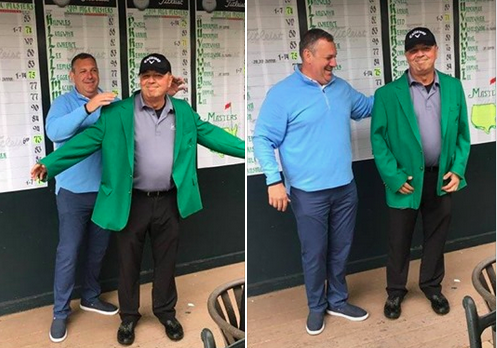
This weekend, I participated in my club’s Masters Tournament. I finished in first place in a field of 72 players after winning a tie breaker hole with another gentlemen. I received a Green Jacket, among other awards, and will be inducted into the Masters’ Club at my course. That is a pretty exclusive membership.

I wanted to thank the GGA and all the staff for showing the way and for providing me the opportunity to make myself a better golfer. This may not be the biggest or most difficult tournament in the country but it was big for me.

I especially want to mention the tips from Paul Monahan during the AAI Mental Game Webinar from last month. I used the information from the webinar to compete in the tournament under very challenging course and weather conditions, to maintain a positive energy and attitude, to avoid negative thoughts if I made a bad shot, to play my shot within 7 seconds of being at address and even thinking of a song during the tie breaker hole to alleviate some of the anxiousness. It is the first time I had ever participated in a tournament like this with a chance to win. There was a significant audience of my fellow golfers watching from the green and I was pretty nervous. I didn’t hit a good tee shot and was in some very heavy, thick, wet rough with a tree obstructing my shot. I used all of the tips from Paul to stay calm (AAI). I pitched out of the rough and back onto the fairway, got on the green and made the putt to win the hole and the tournament. This stuff worked for me.

Thanks again to all the GGA staff!

(To view the webinar (AAI Mental Game Webinar) Bob referenced:  CLICK HERE )

My Lesson in Acceptance

How good of a student are you? How willing are you to accept the feedback you get from your coach? Consider cultivating Acceptance as a key mental component of your Single Plane Swing journey.

I was on the Graves Golf Academy range with Tim Graves and GGA master instructor James Bell recently at Eagle Creek Golf Club in Florida. We were in the middle of a 5-Day Alumni Camp…and chatting through a short lull in the action as we were waiting for a group of students to make their way back to the range from the clubhouse.

Tim and James started playing a few games on the range. Tim shouted out: “Highest shot!” and he and James went head-to-head attempting to hit the highest shots with their 7 irons. I was down the range a bit working on my swing – but still within earshot. The banter between them was fun – but the competition was real: each of them wanted to “win” in that moment.

Soon after that, Tim announced: “Lowest shot!” It was a very breezy, with winds steady at 15-20mph. Both Tim and James are Oklahoma golfers…so they both know how to hit it low. But the Tim Graves “stinger” is something special. Advantage Tim.

I got excited because I’ve always wanted to learn that shot. So…from down the range I shouted: “I’m in on this one guys!” And then I started hitting shots. The first shot I hit was awesome – at least I thought it was! The ball felt so pure on the clubhead – and it took off straight into the wind. Then it went up, up and up. Not exactly a low stinger.

So I hit another one. Again – very pure and dead straight and to me it was a great looking ball…but like the first ball, it was way too high.

Then it happened… a challenge so candid and so abrupt that it frankly shook me up a bit…but ultimately taught me an amazing lesson about acceptance – and about how to be a better student when I am being coached.

The challenge from Tim at the end of the range. “Terrible shot!”, he said.

“Huh?”…I thought to myself. “How could that be a terrible shot? I just hit it so pure and straight. Why was he leaning in so hard?”

Tim shot back again. “Brutal!” “You’re dead with that shot!”

Wow…this felt a little harsh.

My sensitive little ego that wants people to like me attempted to make sense of his approach, and I tried to laugh it off a bit by saying to Tim. “Hey…quit being so mean to me!”

And then Tim did something that was brilliant.

He responded with: “Oh…so you want me to treat you like a child? Go easy on you? Tell you that you are hitting the ball just fine? That you are doing great? Fine. But if you want to really learn how to be a player, you are going to have to figure out shots like this. And right now, you aren’t even close.”

Woah.

In retrospect, I believe he was saying: “You are not listening, Paul. You are not accepting my feedback. You are not hearing me that the shot you just hit will not work in these conditions.. because you are too wrapped up in your own ego. You need to learn to hit a different shot.”

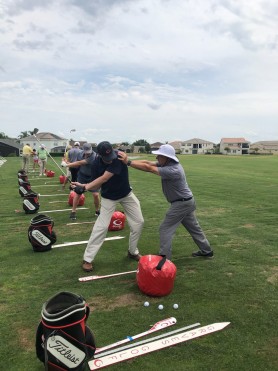
GGA Co-Founder Tim Graves leading the instruction in March 2019 at the GGA Academy in Lake Nona, FL.

He was right: my ego definitely went into action trying to defend my honor and credibility. (And part of me wanted to run back home to my mommy all at the same time. For reals.)

But then something inside me woke up and I began to think that this just might be an amazing learning opportunity for me; that I should accept what Tim is saying as the truth and deal with THAT…instead of trying to satisfy my ego or my emotional sensitivities.

I decided to stop defending my inability to create the shot I was attempting and to surrender to the moment. I remember thinking that – as uncomfortable as I was that second,  I was about to grow as a golfer – and maybe even as a person.

I think Tim had a sense that I was uncomfortable, but that I was also game for truly learning something. (Another sign of a great coach.)

Tim walked over and challenged me (athletically and mentally) in ways I had not been challenged before. He told me what to do, but he left it up to me to figure it out. I think he believed that I was capable of getting there – but not without more focus and intentionality around the thing I was trying to achieve: hit it low, powerful and boring and with compression.

I began listening to what he was saying. Objectively, and without judgment.

“Lower. Do it again. Lower. Come on. Get down and into the ball. Watch my hands. Do this.”

Soon I was getting closer and closer to producing the low “stinger” shot Tim was teaching me. My shots were no longer ballooning up into the wind. And even though they weren’t as low as I wanted, they were behaving more like Tim’s shots, low, boring and straight.

I had finally figured out what it felt like to move down and into the ball with very “hands-forward” shaft lean…and could see a much different ball flight as a result. I wasn’t producing a shot that looked exactly like Tim’s…but I was MUCH closer than I had been.

How had I accomplished that?

accepted my reality. I stopped pushing back on my coach. And I started to say: “How does that look?” and “Better?”

When we bring acceptance to our experiences, we learn to see our reality more objectively – and without judgment or personal sensitivity.  The way it looked for me that day was this:  I dropped my need to defend myself – so that I could be a better listener and a better learner.

Tim taught me a great lesson that day…certainly about how to hit a 7-iron as low as possible – but much more about how to ACCEPT feedback from those who are trying to help me. He had the instinct to lean on my a little in that moment, and I am very grateful that he did.

As a coach, I want to be as candid as possible with my clients…as brutal as it may seem for them in the moment. And as a student of the GGA swing model, I want to LOVE the idea of feedback instead of dreading it or being fearful of it. Embracing feedback will make me better.

As you prepare to work on your golf game more regularly…and to get feedback from the GGA team – in videos or in person at our live instruction schools –  remember that ACCEPTANCE is a powerful paradigm to operate from. It is what will help you become a better student…and ultimately a better player.

-Paul

(If you want to really learn what cultivating acceptance can do for your own golf game, join us at our two-day Alert Attitude of Indifference School in Chicago in June!)

paul@paulmonahancoaching.com

Tiger Vs. Moe and the Single Plane Swing

By:  Chandler Rusk, GGA Master Instructor

Congrats Tiger on your Masters win this past week!

So, how about a little Tiger vs. Moe for this week’s instruction. 

*******************

Before we get started, it is good to know that if you are looking to simplify the golf swing the following must occur:

You must –

  1. Reduce lateral movement for consistency.
  2. Reduce rotational movement and still produce speed.
  3. Reduce stress on the body parts throughout the motion.

Let’s take a look at the address position to get started….

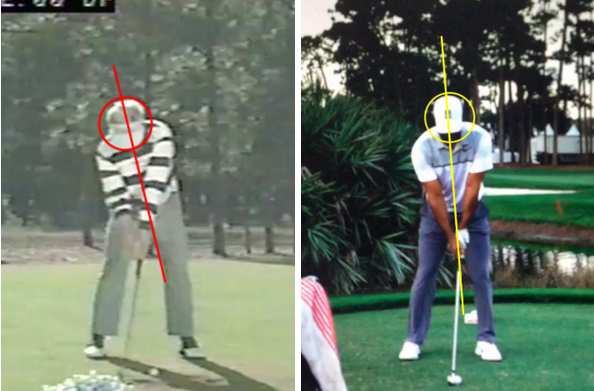
Moe and Tiger’s address position (Down-the-Line view)

No matter who we teach, we will always start with the grip & address. Simply because this is where we can eliminate the majority of the unnecessary movement.

A couple key differences here are:

  1. Tiger begins very close to the golf ball as Moe has more space. Notice the circles in between the hands and upper legs. This is a spatial problem for Tiger and is the root cause of all of his injuries.
  2. Tiger starts with his arms hanging down with the hands positioned well below where he will make the impact, this is also known as a two-plane swing. Moe starts with the club shaft on the same plane that he will make the impact – known as The Single Plane.

Face-On Address Position Above

All good ball strikers will have 25 degrees of side bend at address. Side bend is the tilt of the spine away from the target at address.

As you can see above, Tiger begins in a very straight up-and-down position (roughly 4 degrees of side bend).

Moe always began with between 15-20 degrees of side bend at address. This allowed him to maintain his head position in the backswing (see below).

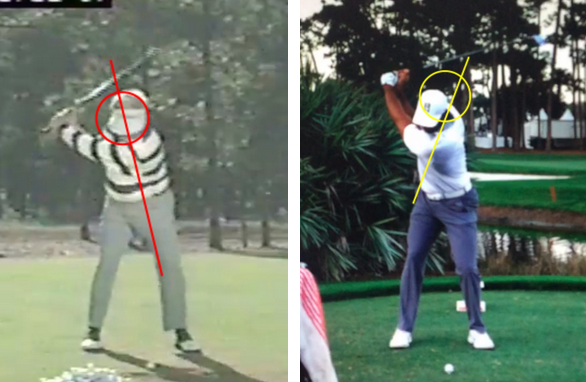
Top of the Backswing Position (Face-On View)

The address position and backswing rotations are paramount in developing consistency in the golf swing. It allows the body to transition properly to the initial part of the downswing.

Key things to observe in the above images:

  1. Head Movement

Since Tiger only has about 4 degrees of side bend at address, he is forced to create more in the backswing. This is a built-in compensation to his swing and what you will see with most conventional golfers. The head is forced down and back in the backswing. You can see that Moe’s head has stayed in position.

  1. Torso Rotation

When the head position moves down and back, the torso is forced to over-rotate. Tiger’s torso rotation is past 90 degrees at the top of his backswing which causes his arms to get trapped behind him in the downswing.

Impact Positions Above (Face-On View)

The 2nd most important way we could help Tiger, other than his address position, is how he gets to impact.

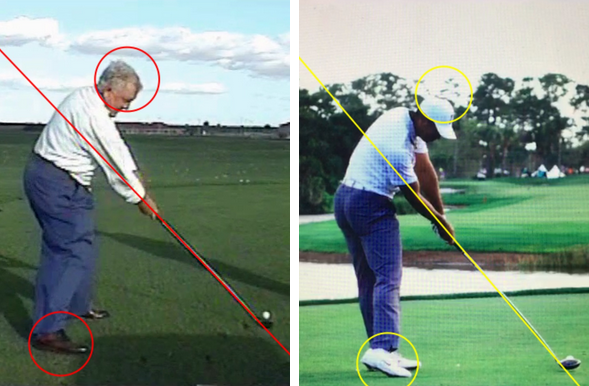
Since Tiger begins very close to the golf ball, his lower body is forced to lift and rotate to clear for his arms and hands. He snaps his left leg straight which puts immense stress on the lower part of the leg and also the lower back. All while his head has gone down and back.

When the lower body is going up but the upper body is going down, this is called compression and shear of the spine.

Remember that Moe develops space away from the golf ball at address. Since there is space, Moe was able to rotate his hips down and forward into a flexed lead knee. When the lead knee is flexed at impact, it takes all of the stress off the lower part of the leg and the back.

Side Note – In our opinion – the #1 Training Tool to help you with proper lead knee flex is the Load-n-Fire Lead Knee Brace. You can see the video about this training tool at: CLICK HERE


Impact Positions from Down-the-Line

At impact, Tiger and Moe have returned the club to where it extends through the middle of the back. This is where 99% of golfers make the impact.

Why wouldn’t everyone start there?

With Tiger, since the left leg has snapped straight, the trail heal has no other choice but to come off the ground. This is another indication that the lower body is lifting instead of staying in posture.

To see more about the Load-n-Fire Training Aid (Again – we believe one of the BEST training aids to help with lead knee flex): CLICK HERE

To see 10 Training Videos helping with trail and lead knee flex:  CLICK HERE

(Click on Load-n-Fire Drills and Tips)

************

Review of Tiger Vs Moe

  1. By simplifying Tiger’s address position, we could eliminate many compensations and also help reduce the stress on his body.
  2. Less rotation in his backswing would allow for his arms and hands to be in better position for the downswing. Tiger always fights blocked shots and snap hooks and the majority of that comes from the over-rotation in his backswing which leads to under-rotation at impact.
  3. With space created at address, Tiger could train to have a flexed lead knee at impact which would reduce all of the stress on his body and lead to more efficiency.

In Season Practice

For most – it’s golf season time or getting really close to golf season.

With the warm weather starting and sun setting later and later – hopefully everyone is getting more playing time and practice time.

So – I thought I ‘d write a little about in season practice. For those that have studied our instructions, it is what we call Practice Type A.

There are basically two different types of practice:

Practice Type A – practicing like you are about to play or practicing for playing.

&

Practice Type B – practicing to build your game, creating new habits in your swing, short game, etc. Working on changing your swing.

Practice Type A is the type of practice you need to be working on when you are “in season” or playing important rounds of golf. For the professionals, practice type A is the type of practice they perform in season, practice type B is the type of practice they perform in the off season.

Here is a good schedule and suggestions for your Practice Type A sessions.

I will use an “hour” practice session (can also break down in percentages if are practicing for less than an hour).

15 minutes (25%) Practice Putting. Start with this so you don’t skip and great way to “stretch” a little before you get on the range.

Lag Putt (30 – 40 footers – lag to a few feet (as close as possible – work on speed).

Work on making 3 and 4 footers, using 1 or 2 golf balls (no more than 2 balls), lining up the putt, setting the T on the ball toward the break and putting as if you had one putt on the course. Mimic being on the golf course. Work on your pre-shot, set up and rhythm. Work on getting comfortable over the putt.

Work on different breaks (pick one hole with break and work around it like a clock).

Work on 10 to 15 foot putts – trying to make, if miss keeping with 2 feet past the hole.

Don’t forget to hit a few putts off the edge of the green (from the fringe).

10 minutes (about 20%) Practice Chipping and Pitching

Chip and Pitch (if possible) with the same golf balls you play with. (Work on the feel, spin, the way the ball reacts when hitting the green and out of the rough).

Chip with 2 golf balls – hitting different shots to different holes. Don’t get stuck on one hole. Work around to get different chips.

Pitch the same if possible. If not, do a few minutes on the range before you work on full swing. Work on pitch shots that will roll out a little and some flop type shots with as minimal roll as possible.

5 minutes (about 5%) Practice Sand / Bunker

Work on first getting the ball out of the bunker (being aggressive enough).

Next, work on getting on green.

Finally, work on getting close to the hole (spin control).

This is not the time to “create” your bunker game – this is the time to get the feel for the sand and “remind” yourself how aggressive you need to be out of the bunker.

If you do not have a bunker for practice – use this time for additional chipping and pitching practice.

15 minutes (about 25%) Practice All Clubs in Your Bag Except Your Driver

Start with the wedge(s) and work through the irons to the longer clubs (hybrids, fairway woods, etc.)

Use an alignment aid to check alignment (whether in a Practice A or Practice B setting always use an alignment aid).

Do not get “stuck” on one club. Work through all clubs working on tempo and alignment.

Work on different shots (low, high, etc..) as you would have on the golf course (into the wind, downwind, cross wind.)

Hit a targets, check distances (to the best of your abilities hitting range balls).

15 minutes (about 25%) Practice with Your Driver

Use an alignment aid to check alignment.

Work on different shots (high, low, etc.)

If you hit a lot of fairway woods / hybrids off the tee – give them some time during this session.

Do not “shot gun” this practice. Pick a target, tee up a golf ball, check alignment, and hit. Do again as if you were on the golf course.

Work on tempo, check alignment (and ball position).

Work on different tee heights and ball positions for different shots (high vs. low) – down wind us into wind.

*******

As you see, this type of practice (Practice A) is not the practice to build or change your swing. This type of practice is again the practice to get ready to play or to keep your game in “playing mode”.

If you are one that wants to perform Practice Type B and Practice Type A in season, you must give yourself enough time for the Practice B sessions to take effect (typically about 3 weeks of continual practice to create a new habit) and also give yourself enough Practice A time to get ready / comfortable for those upcoming rounds.

It is difficult to mix Practice Type A and Practice Type B in the season. We recommend if possible – perform Practice A in those months you are playing a lot of “important” rounds and Practice Type B when those rounds don’t “matter as much….” or even better – those months when you aren’t playing.

Practice Slower. Play Faster

Practice Slower. Play Faster.

Sounds like a directive. Right?

Actually I think of it as a mental game approach. Here’s why:

At almost every GGA school I attend, lots and lots of students are doing their level-best to achieve the Single Plane Swing model. But many, if not most suffer because of two important missteps.

They practice too quickly. And they PLAY the game too slowly.

Interestingly, these are not execution missteps (caused by lack of focus or an inability to understand a strategy)…they are mental game failures.

Let me explain, first with the concept of Practicing Slower.

The Single Plane Swing curriculum that Todd and Tim Graves and their instruction team have refined over the years is based on the very latest in skill development research: that we learn best from slow, deliberate and proper practice movements. (Not beating balls over and over again.)

One simply cannot groove and assimilate new body positions without this kind of work.

Moe Norman famously said to Todd and Tim that he once spent an entire day holding what we call position five. Why? Moe said he wanted to “…make it stronger.”

Just last week I heard Todd tell the story that when Master Instructor Chandler Rusk was converting from conventional to the Single Plane Swing, he was known to spend hours on the practice range working on one thing: perfecting his move into position one.

Why won’t most students spend their practice time like this? One word: The EGO.

It’s more satisfying to the EGO to hit ONE great shot every once in a while rather than spend the time needed to master a position or two.

In other words, even though it is a rational-enough concept (practicing slowly during your swing development), it is much harder to do because a part of your brain wants to “show the world” what you are capable of.

The harsh reality in all of this is: Until you SLOW DOWN and develop a deliberate practice regimen that includes far MORE correct body movement and far LESS actual shots with a ball, you will continue to delay the mastery of the Single Plane Swing. (Sorry. That’s just the way it is.)

This requires cultivating the awareness that your EGO will try to sabotage a regimen like this. It requires that you learn to tune into your mental and emotional tendencies…and be disciplined enough to stay on track with the deliberate, deep practice that will yield the changes you are looking for.

Dan Coyle wrote about this in  The Talent Code…and Todd and Tim refer often to the research and insights from Coyle’s work. Skill development comes from deep, deliberate, proper practice.

Now let’s address Playing Faster:

When it comes to playing the game, most players play too slowly. Specifically, they tinker and hover too long over the ball when they are hitting their shots. This causes paralysis by analysis – and yes…this is an actual technical term.

Sian Beilock, in her book Choke chronicles the trouble we get into when we linger over a golf shot too long. Basically, she explains that the part of our brain that is responsible for moving the body in space (procedural memory) switches off in those moments, and then our working memory takes over. This causes over-thinking and less-than-optimal muscle movement. (And yes, often is causes: The Choke)

The antidote? Play faster. Stop lingering. Pull the trigger over your shots sooner. This will prevent over-thinking and will allow you to play golf more as a reactionary sport…and you will be able to execute shots up to your talent level, not BELOW your talent level.

So if you want to get better this year, do yourself a favor and tune up your Mental Game skills: create a discipline to practice slower when off the course, and to play faster when on it.

Have Fun!

-Paul

(If you want to really learn how to practice slower and play faster, join us at our two-day Alert Attitude of Indifference School in Chicago in June!)

paul@paulmonahancoaching.com

LEARN

THE

SWING

Join 1M+ Subscribers to get your FREE Video Quick Start Guide that reveals how to hit the ball farther and straighter more consistently from now on…

START YOUR NEW GOLF SWING