The PERFECT STORM Custom Club Special

The PERFECT STORM Custom Club Special

THE PERFECT STORM

This doesn’t happen often – in fact, I can’t remember the last time it happened.
 
In weather – a “perfect storm” is a mixture of warm air, cold air and a low pressure front – combining for one of those “exciting” nights…
 
In custom club specials – a “perfect storm” is a mixture of:
 
1. NEW just released sale combined with:
 
2. On going introductory offer combined with:
 
3. NEW trade in bonus (50%) on All Major Manufacturer’s clubs.
 
So – if you are looking for anything from ONE new club to an ENTIRE set – NOW is the time!!
 

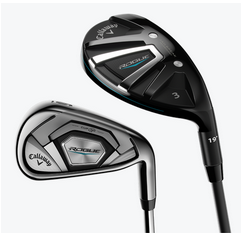
Callaway Rogue and Rogue X Hybrids and Irons NOW on Sale



#1 Rated Hybrids and Irons in Golf
 
Rogue and Rogue X Hybrids: $229 each sale price ($20 off)
 
Rogue and Rogue X irons: $899 Set of 8 Graphite ($100 off)
 
Rogue and Rogue X Hybrid / Irons Sets:  (2 hybrids, 6 irons) (graphite): $1,099 ($100 off)
 
Rogue and Rogue X Individual Irons / Hybrids /
 
* Includes upgraded graphite shafting and not additional charge (special ONLY through Graves Golf)
 
* Includes all fittings (includes GGA grips, etc..)
 

Callaway Epic Flash Driver & Fairway Woods INTRODUCTORY OFFERS



Epic Flash Driver & Fairway Wood – Golf Digest 2019 Hot List Gold Medal Winner!
 
Increased Ball Speed = Longest Clubs in Golf
 
* Introductory Offers for All NEW Epic Flash clubs through Graves Golf (Ending Next Week)
 
+ Upgraded Shafting to Your Fittings (No Charge)
 
+ Fit to You Perfect (including GGA Specialized Grips)
 
+ No Shipping Cost or Tax (Within US – we cover both)
 
Contact Tim Graves at Timg@gravesgolf.com or Timkgraves@aol.com for Introductory Pricing, Questions, More Information, etc..
 
* (These Introductory Prices CAN NOT be advertised publicly – happy to email pricing to you privately).
 

50% Trade-In Bonus

 

From now through May 5, 2019, receive an additional 50% bonus on ANY trade-in toward the purchase of new Callaway clubs.
 
Eligible products include:
 
  • Epic Flash and Sub Zero Drivers
  • Epic Flash and Sub Zero Fairway woods
  • Rogue and Rogue X Hybrids
  • Rogue, Rogue X and Rogue Pro Irons
  • Rogue and Rogue X COMBO Sets
  • Apex Hybrids
  • Apex and Apex Pro Irons
  • Big Bertha Hybrids
  • Big Bertha Irons
  • Big Bertha COMBO Sets
Eligible Trade in clubs:
 
Callaway, Odyssey, Cleveland, Cobra, Mizuno, Ping, PXG, Srixon, Taylormade, Titleist, Toulon
 

Next Steps if Interested

(1) Contact Tim at timg@gravesgolf.com or timg@moenormangolf.com with

interest or questions.

 
(2) Fill out club fitting form (see below) unless your fittings are already on file.
 
(3) If interested in trade in special – email Tim list of trade in clubs (make / model / year (if know), set make up (irons)).
 
I will answer all questions, respond to you with pricing and fitting information and recommendations. Also will respond with trade in values.
 

Club Fitting Form and Information
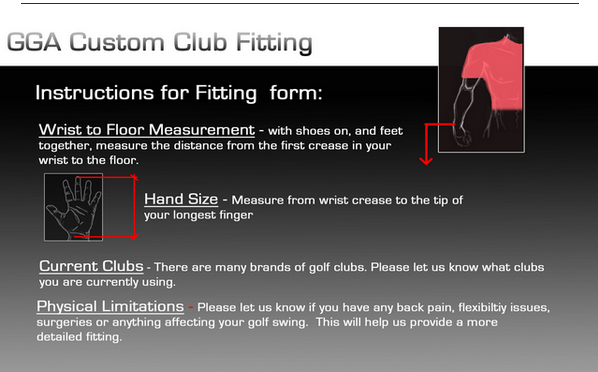
All clubs in your bag MUST fit you individually for:

Set Make Up

Loft

Length

Lie angle(s)

Shaft Flex and Shaft Weight

Grip Size and Type

and more…

Individual Club Fitting: CLICK HERE

Contact timg@gravesgolf.com for more club fitting information or questions.
 
To see club fitting article: CLICK HERE
 
Club Fitting Webinar: VIEW WEBINAR
 

CLUB FITTING VIDEO


View Video: CLICK HERE

 

Any Questions – Please feel free to contact Tim at

timg@gravesgolf.com

Hybrids – How to Hit & Drills to Help

Hybrid – How to Hit and Drills to Help

By Tim Graves, PGA

One common theme we see with golfers is the difficulty hitting hybrids. Hybrids, aka rescue clubs, long iron replacements, or baffles, are the clubs in your bag (hopefully) that are set up to replace the mid and long irons. They are the clubs that are MUCH easier to hit than the long irons because of the broader sole on the clubs. With these more general feet (and lower center of gravity) – the ball will kick up faster and get more height on the shot.

Before we get into how to hit hybrids and a couple of drills to help – let’s discuss why combinations are so important to be in EVERYONE’S bag.

Golf has changed in the past 10 to 15+ years. Greens have gotten faster, harder and more severe (sloped, etc..). The ability to maintain lawns in better condition has increased. In other words, greens are in better shape (for putting), but more challenging to keep approach shots on them. When greens are harder/faster, the approach shot coming into the greens be higher and softer to hold or stay on the grass.

With that being said, 15 to 20+ years ago, you could hit a 3, 4 or 5 iron to a green with medium trajectory and it would stop on the green not anymore. Unless you can hit those clubs high, and have the ball “fall” on the green, they will not hold. Most who hit 3, 4, 5 and even six irons into greens will see them skip off the back or jump off the sides (into rough, bunkers, etc..). Obviously, not what we want.

So, the hybrid iron was created. A club with a greater sole that will help kick the ball up in the air and will land MUCH softer than the equivalent metal. And, because of the more extensive bottom, they are MUCH easier to hit than the comparable iron. Equal irons/fairway woods to hybrids:

Two hybrids – 2 iron – 4 wood

Three combinations – 3 iron – 5 wood

Four hybrids – 4 iron – 7 wood

Five hybrids – 5 iron – 9 wood

Six hybrids – 6 iron – 11 wood

Difference between hybrids and fairway woods: Hybrids are built to stop faster. In other words, both fairway kinds of timber and mixtures have the broader soles and are typically easier to hit than the equivalent iron, but hybrids are built to create more backspin then fairway woods and hence will stop faster than the equal fairway woods. If you are hitting fairway woods into greens, they will roll off (like low hit irons) more than the equivalent hybrids. In other words, you don’t ever want to hit a fairway wood into a green if at all possible. It is much better to have the equivalent hybrid in your hand than the fairway wood (or mid/long iron).

Now, let’s talk about how hybrids should be hit.

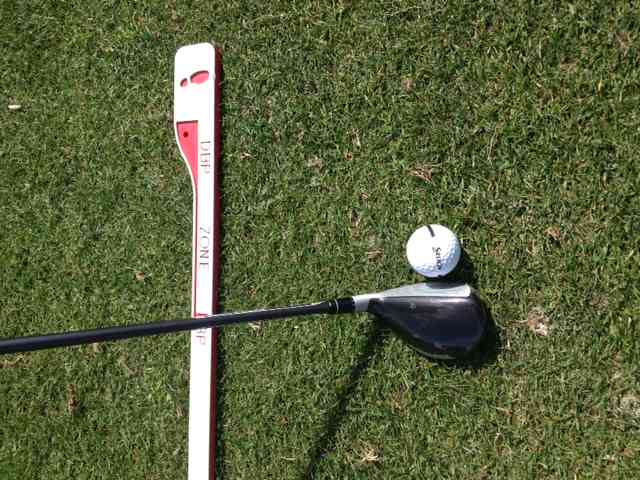
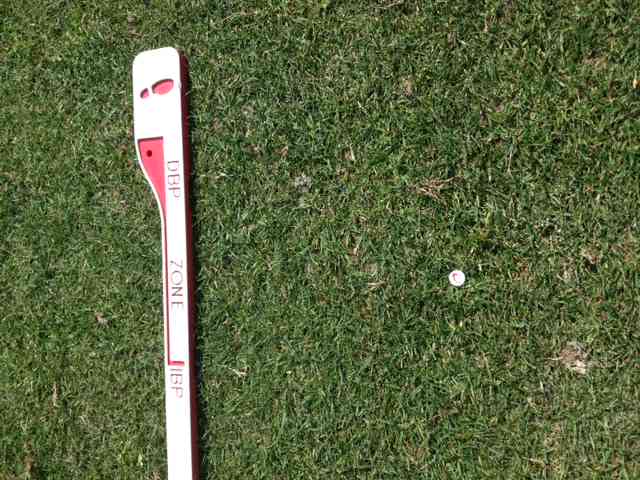
  1. The ball position for a hybrid is slightly forward of its equivalent iron – it is in the “ZONE” of the Alignment and Ball Position Trainer. The stance will be slightly wider (about 1/2 to 1 inch) because the hybrid is typically about 1/2 inch to 1 inch longer than its equivalent iron.
3 Hybrid Ball Position
  1. You will stand slightly further away from the ball with the hybrid in comparison to its equivalent iron (again about 1/2 to 1 inch). Again, because the hybrid is typically 1/2 to 1 inch longer.
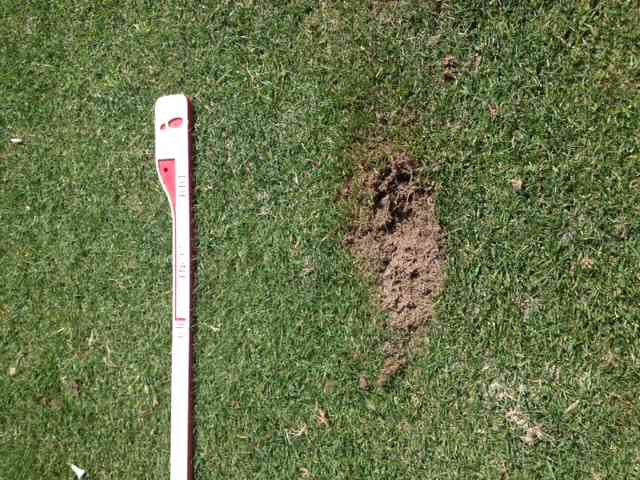
  2. You MUST hit down (create a divot or at least bruise the grass) with the hybrid. This is the problem with most golfers who do not hit hybrids well. They “sweep” the ball with the hybrid and hit the middle/equator, or higher, of the golf ball. Remember as stated above, the center of gravity of hybrids is low, that needs to go UNDER the ball – not into the ball. If you do not hit down on the ball and create a divot, you will be putting “overspin” on the golf ball, and it will not fly correctly, will not reach its optimal height, and you will lose significant distance and spin on the ball.
Example of Divot I made with a 4 Hybrid

DRILLS to help hit hybrids:

Divot / Tee Drill:

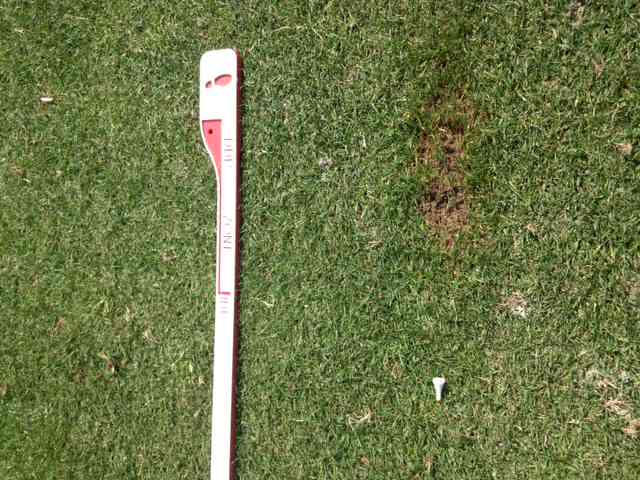
  1. Sink/Push a tee into the ground. Push the tee down until just the top of the tee is sticking out of the field. Almost level with the ground/grass.
  2. Set up to the tee (as if there was a golf ball on the tee) and swing at the tee (with your hybrid).
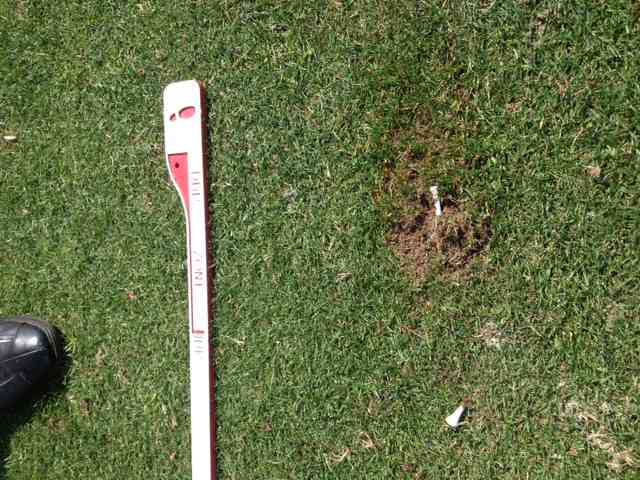
  3. You should hit the tee first, then the ground in front of the tee (divot). The tee should break, and if the field if firm enough, the tee will fly out and go backward.
Tee in Ground
Tee in Ground
Tee Broken and Divot After Hybrid Swing
  1. Do this again and again, until you can hit the tee out of the ground (or at least break the tee) every time.

Tee / Ball Drill

Now – we are going to add a golf ball.

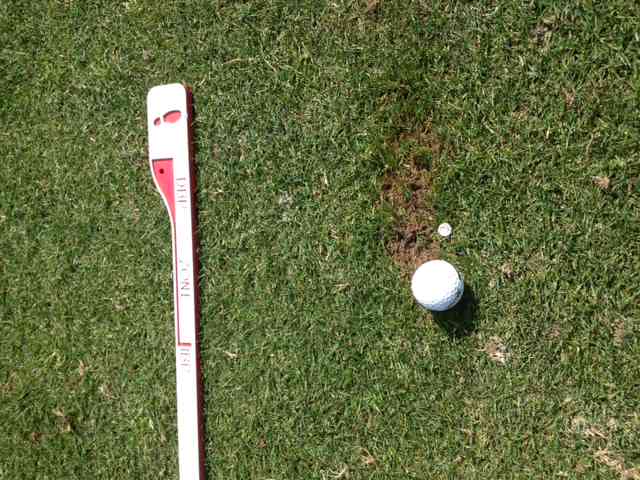
  1. Do the same set up as above, now put a golf ball on top of the tee.
  2. Set up on the ball and swing. Do not think about hitting the golf ball, but rather BREAKING the tee.
  3. Hit properly, the tee should come out of the ground/break, and a divot should be created starting where the ball was and forward.
  4. When finished, it should look the same as above – divot with a broken tee.

2 Tee / Ball Drill

If you are having a hard time making a divot ahead of the golf ball – add the second tee to your tee drill.

  1. Place a tee on the ground (with a golf ball on top) and a 2nd tee just in front (about an inch) of the golf ball.
2 Tee Drill with Golf Ball
  1. Now, hit the ball with the hybrid focusing on hitting both tees. You should hit the back tee first, and divot will hit/go through the 2nd tee.
2 Tee Drill Finish - 1st tee out of ground, 2nd broken / bent over
2 Tee Drill Finish – 1st tee out of ground, 2nd broken / bent over

This will help you to make the divot “through” the golf ball, not before the golf ball.

Being able to hit hybrids/rescue clubs/bafflers/long iron replacements is a MUST to play good golf in the 21st century…. Golf has changed, greens have changed, conditions of the course has changed, making hitting higher/softer approach shots a MUST. And for the average golfer with average swing speed, it isn’t that hard if they know how to hit hybrids properly.

Work on these drills – make sure and get “under and through” the golf ball with your hybrids – these exercises will help you to be more successful hitting your combinations and ultimately lowering your scores.

Callaway Rogue and Rogue X Hybrid Special – $229 ($20 off standard pricing of $249)

For more information – please contact timg@gravesgolf.com

A Great Lesson

Last week I got one of the best lessons I’ve ever had on a golf course. But not for the reasons you might think. Here is that story:

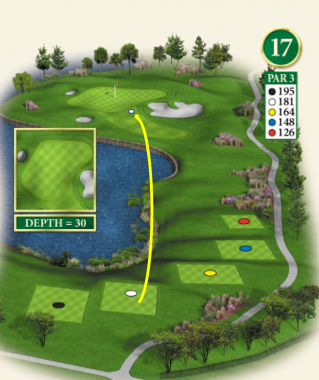
I stood on the tee at the 17th hole at Eagle Creek in Lake Nona, Fl last Monday with all the confidence I thought I needed. The shot was 188 yards over water to a large, undulating green bunkered in the front and in back.

My decision was easy. I would go with 6-iron. Why? Well, I guess because once a couple years ago I flushed a 6-iron pin-high to a hole 186 yards away. And that sort of became my 6-iron yardage forever. (Isn’t that the way it works? ) What’s another two yards?

Well…

My playing companions that day were Chris Anderson, (a terrific Single Plane Swing golfer from Detroit, MI), along with GGA Master Instructors and superb ball-strikers Chandler Rusk and Trent White.

I had watched Chandler and Trent hit one solid shot after another over the course of our round, all while I had spent the first seven holes of our back nine thinning one shot after the next.  Chris wasn’t having his best round – but had also hit plenty of quality shots.

Importantly, as Trent would later observe, I had not reached a single green up to that point. In the words of Mike Tyson, I must have been in “bolivion.”

…short again!

At #17, we all discussed the shot we were about to hit. I quickly realized that Trent and Chris were planning to hit way more club than me. And Trent looked at me half-incredulous as if to say “You’re kidding, right?””

“But, …but, …but.” said my inner narrative. “I did hit that great 6-iron at Coffee Creek in Edmond, OK in September of 2016 after all.”

Sheepishly, I walked back to the cart and grabbed a 5-iron. Then proceed to slap at that one, hit it thin (again) and land it about ten yards short. (see map on right)

Trent and Chandler, ever the gentlemen chuckled a little and did a little #SMH. We all laughed at the irony. And we went on to finish the round.

Later, over dinner Trent gently broke the news to me that I had played an exceptionally clueless round of golf…and he wanted to know when I was going to learn to set the ego aside and play more club. (OK…my words, not his.)

For a brief moment, it hit me pretty hard. I’m the mental game coach – right? How could I be so unaware? (Isn’t awareness my thing?) But once I was able to settle in to Trent’s feedback more objectively, I was able to listen to him and actually hear what he had to say. I was able to tune in to the objective truth…and not my story.

The facts were this: I had shorted myself time and time again and never made the proper adjustments that I could have. The corrective action was simple, play with more awareness and most important: club up.

Sometimes the EGO gets in the way of our decision-making…and we are completely unaware of it. This ultimately impacts how we play the game. For me last week it looked like this: my ego would not settle for attempting that shot on #17 with anything less than a 6-iron because my self-worth was on the line!

In fact, every time I stood over the ball – I was convinced that I could pull off the shot I was hoping for, even though there was very little evidence that would be possible that day.

Trent and Chandler reminded me that I don’t have to be trapped in the idea that I’m “supposed to” hit a 6-iron 188 yards. That is not what makes me a better golfer…and it certainly does not prove I’m a better human being.

They helped me to see that our clubs are nothing but a set of tools or implements. And that golf is played well when you get good at choosing the right tool for the right job in that moment. The number on the bottom of the club doesn’t matter.

And they taught me (again) that staying tuned-in to the results I am producing on the course ( I call this “Objective Reality”) can help me make better decisions going forward. (Duh…right!?)

It was not my best round of golf ever…but it turned into an amazing lesson for me. (Thanks Trent and Chandler!)

So, get out there and have fun. But for heaven’s sake: Stay alert and CLUB UP!!

-Paul

paul@paulmonahancoaching.com


Paul Monahan, is a Peak-Performance coach, member of the International Coach Federation and a certified COR.E Performance Dynamics (TM) Specialist. He resides in Cleveland, Ohio with his wife Paula and is the proud dad to three young men.

The Lob Wedge – Making It Your “Best Friend”

The Lob Wedge – Making Your “Worst Enemy” Your “Best Friend”

First, I want to say, I believe the lob wedge is one of the most important clubs in your bag.

In fact, I believe it is the 3rd most important club in your bag (refer to past e-tips for #1 (Putter) and # 2 (Driver).

Besides your putter and your driver, this is probably the club you will use the most in a given round… if you know how to use it and use it correctly…

The perfect Lob Wedge: The perfect lob wedge (in my opinion) has the following characteristics:

  1. 58* of loft or more
  2. Forged type club (the softest material in a wedge that helps create spin and a very soft feel at impact – allows for the ball to land softly on the green).
  3. C – type grind on the sole of the club. This grind on the club allows to hit off of all different surfaces (soft, hard, etc..) and allows for different ball positions instance to hit low to high (lob) type shots. The C type grind on the sole keeps the leading edge of the club low to the ground when the ball position is “pushed forward” for higher / lob type shots.
  4. Medium to Wide sole on the club – the wider the sole – the easier it is to “slide” across tight lies.
  5. Needs to have swing weight heavier than most clubs in bag besides the sand wedge (swing weight typically between D-4 and D-6) – most lob wedges are built this way as the added weight helps cut through many surfaces (high grass, sand, etc..) and helps create better “feel” around the greens.
  6. Steel shafted – (if possible). Again – the weight helps as described.
  7. Slightly rounded leading edge on the club – only slight, but this slight rounding also helps cut through different surfaces.

To see the video about us recommend wedges: CLICK HERE

Screen Shot 2015-10-17 at 8.53.57 PM

How to play the Lob Wedge:

For a full shot, (for many ranges from 30 to 60 yards, maybe slightly longer) – the ball is placed in the middle of the stance and swung with a good on the plane single plane swing. (Like any other club in the bag – ball position center of stance).

For a short pitch or high lofted shot (not lob or flop shot yet…):

  1. The ball is placed slightly forward in the stance (forward of center). As higher you want the ball – the more forward you put in the stance.
  2. The weight (body’s weight distribution) is 50/50. You do not put more weight on the lead foot.
  3. Stance is slightly open – about 10 to 20* at max.
  4. The hands are slightly ahead of the ball at set up.
  5. Choke down slightly for more control and better feel.
  6. You swing the club with VERY soft hands. This means light grip pressure on the club.
  7. You work on the fold/fold type swing. Meaning you fold your trail arm in the backswing and lead arm in the through the swing. Nice and easy….
  8. You accelerate through the shot – your hands should finish at shoulder level or above. If you think the swing is too long for the shot – shorten the backswing, but still keep a solid and extended through the swing.
  9. Swing toward the hole – as Moe said: “Try to pull the flag out with the head of the club”. This was his analogy of making sure the club is swung down the line toward the hole.
  10. Make sure the weight is evenly distributed throughout the shot and the feet stay down throughout the shot.

For a flop shot (high lofted short shot): Follow the points above except the following:

  1. Ball position – as forwarding instance as comfortable. Off lead heel or further forward is good.
  2. The weight distribution is still 50/50 or slightly toward the back foot. Keep weight balanced throughout the shot.
  3. The club slides under the ball… Think of sliding under the ball rather than hitting down on the shot.

To be honest, after teaching 1,000s of students in the past, this is always a difficult shot to master – it takes time, but once you get the “feeling” it actually becomes pretty easy and a great “shot saver” in the round. Here are a few faults many students have difficulty with while they are trying to learn the flop shot:

  1. Weight transfer – you need to keep your weight back to center during the shot – exaggerate this as much as possible. It is almost impossible to get the club to slide under the ball if you are transferring your weight too much forward.
  2. SOFT HANDS – if you think you have lightened the grip pressure enough – do it some more. The softer the grip pressure the easier it is to fold/fold in the shot which brings consistency and great feel with this shot.
  3. Acceleration – shorten the backswing enough that you feel you need to be pretty aggressive in the through the swing. A backswing that is too long creates deceleration in the through swing which leads to fat and/or thin shots.
  4. The swing toward the hole – great area to practice on swinging toward the target. Chances are if you are coming across your full shots (cut/slice) you are also doing the same in your pitching/flop shots.

In a good high pitch/flop shot the ball should land relatively soft on the green with minimal roll. In fact, if you listen to the shot, you will hear a “thud” when it hits the green. A good shot comes in soft, has minimal role… many pros call it landing like a “butterfly with sore feet”.

Hopefully, this helps those who are looking to help their short game – especially that all needed lob shot around the green.

Please feel free to contact me at timg@moenormangolf.com with any short game questions, questions about your wedges or any other club fitting questions.

Remember my saying: “I’ve never seen a good player with a bad short game and have never seen a bad player with a good short game.”

Single Plane Swing 3D – Like Taking an X-Ray of Your Swing

Bill Arnold lives in Alaska.  You can imagine that playing golf in the winter isn’t an option but that doesn’t keep him from practicing and training his Single Plane Golf Swing – thanks to the Single Plane K-Motion System.

Recently Bill began his training with the Single Plane 3D System.  It was a perfect fit for Bill’s long winters in Alaska.  We started his training with a full analysis of his swing using the Single Plane K-Coach where a total of four sensors are placed on the Torso, Pelvis, Hand and Arm.  The four sensors provide the data needed to take an “inside” look at Bill’s motion – quantifying the amount of rotation, bend and side-bend of his body throughout his swing motion.  Let’s take a look at some of the data and see how it can help Bill improve his swing motion and speed.

Impact Data

Bill Arnold Impact Data

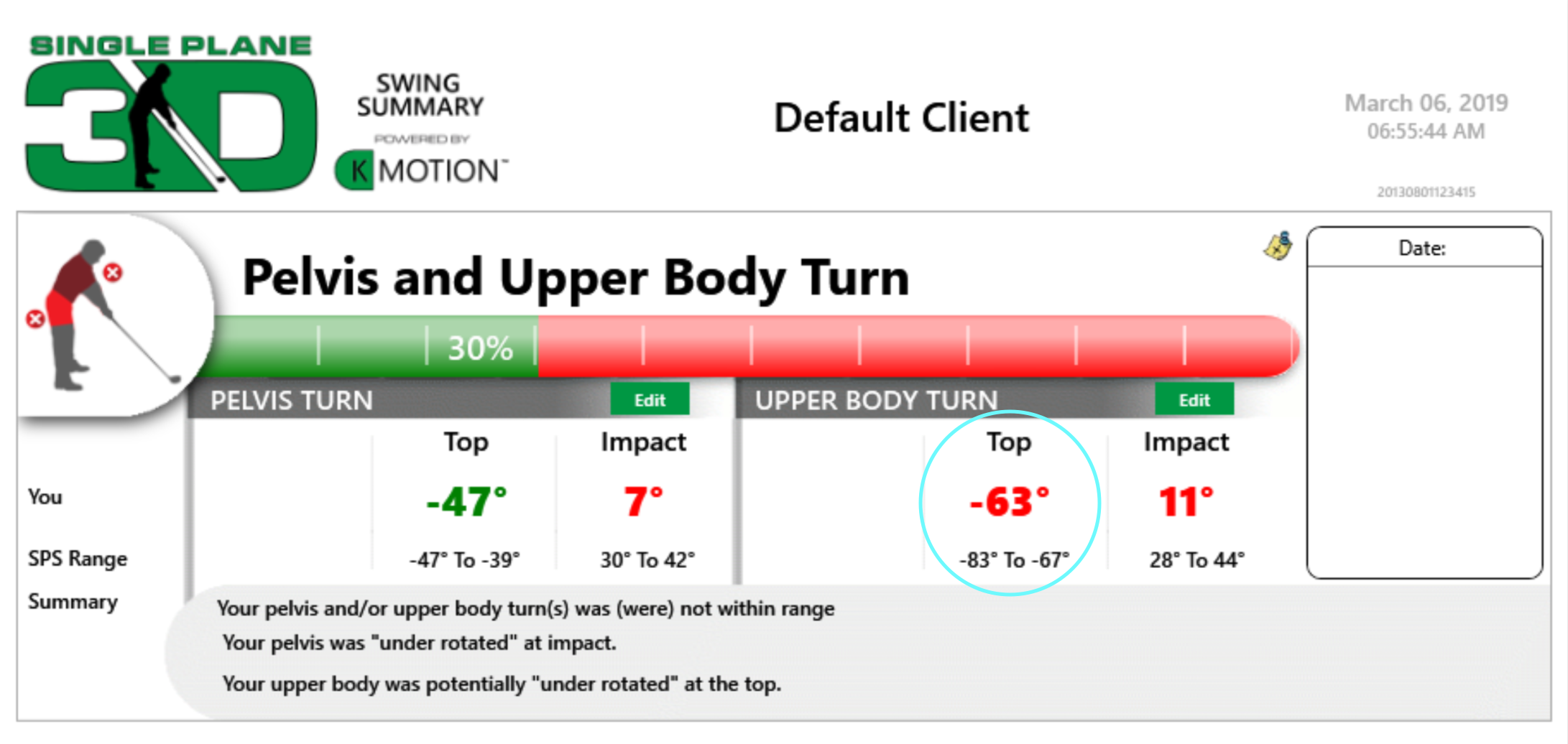
There are three areas to analyze in regards to Bill’s motion starting with the lack of rotation of his pelvis at impact.  You will notice that ideally, Bill would have between 30 and 42 degrees of rotation of his pelvis and 28 to 44 degrees of torso rotation.  He also has a large amount of toros rotation at the Top of his backswing at 47 degrees.  

You can also see that Bill has only 63 degrees of Torso turn at the top of his backswing – where ideally we would want between 67 and 83 degrees.  

The overturning of the pelvis and the under rotation of the torso have created a scenario where Bill will likely lose speed and have difficulty returning the club to impact properly.  By taking a look at his Kinematic Sequence which measures body speed and timing, we can see the results of his motion.


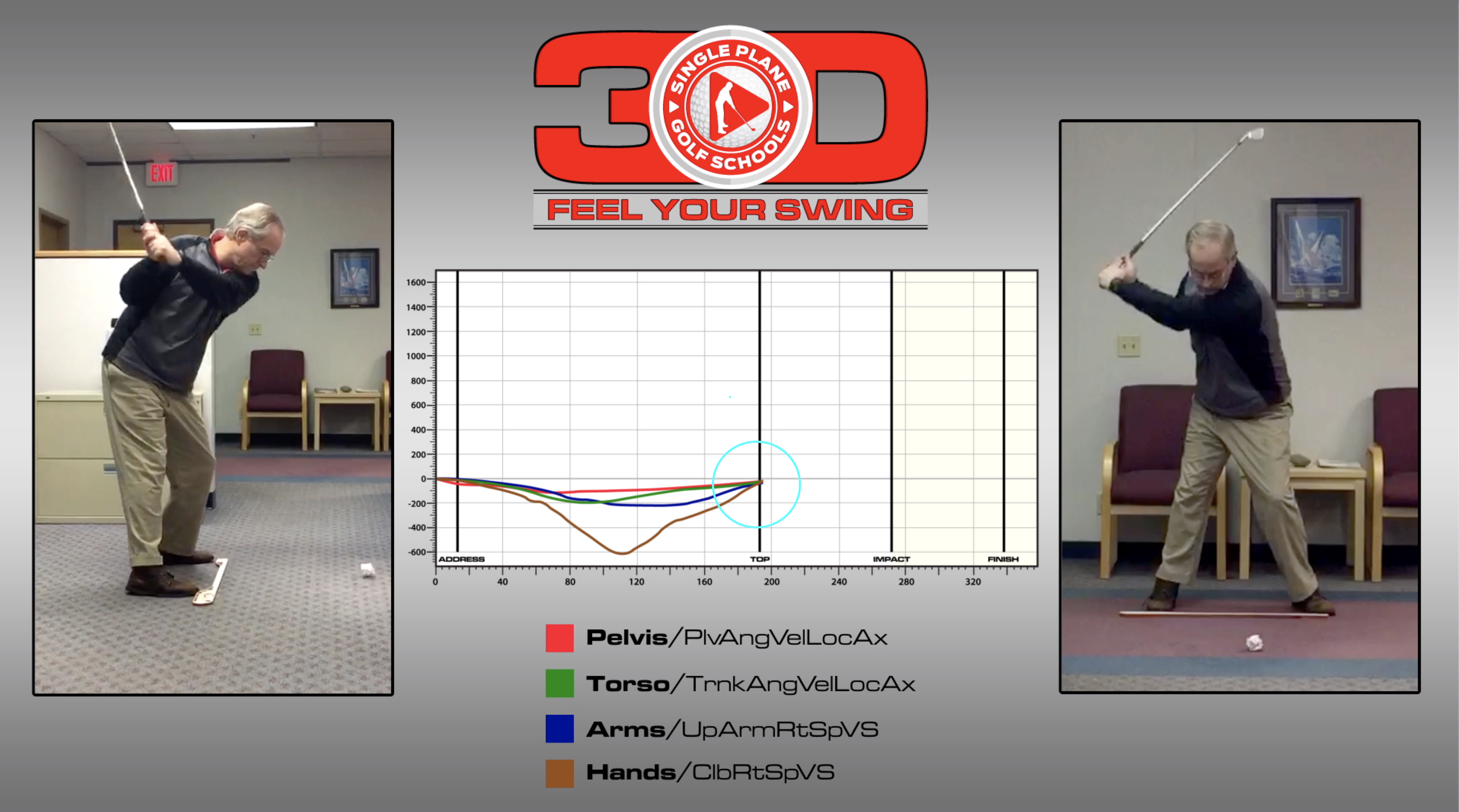
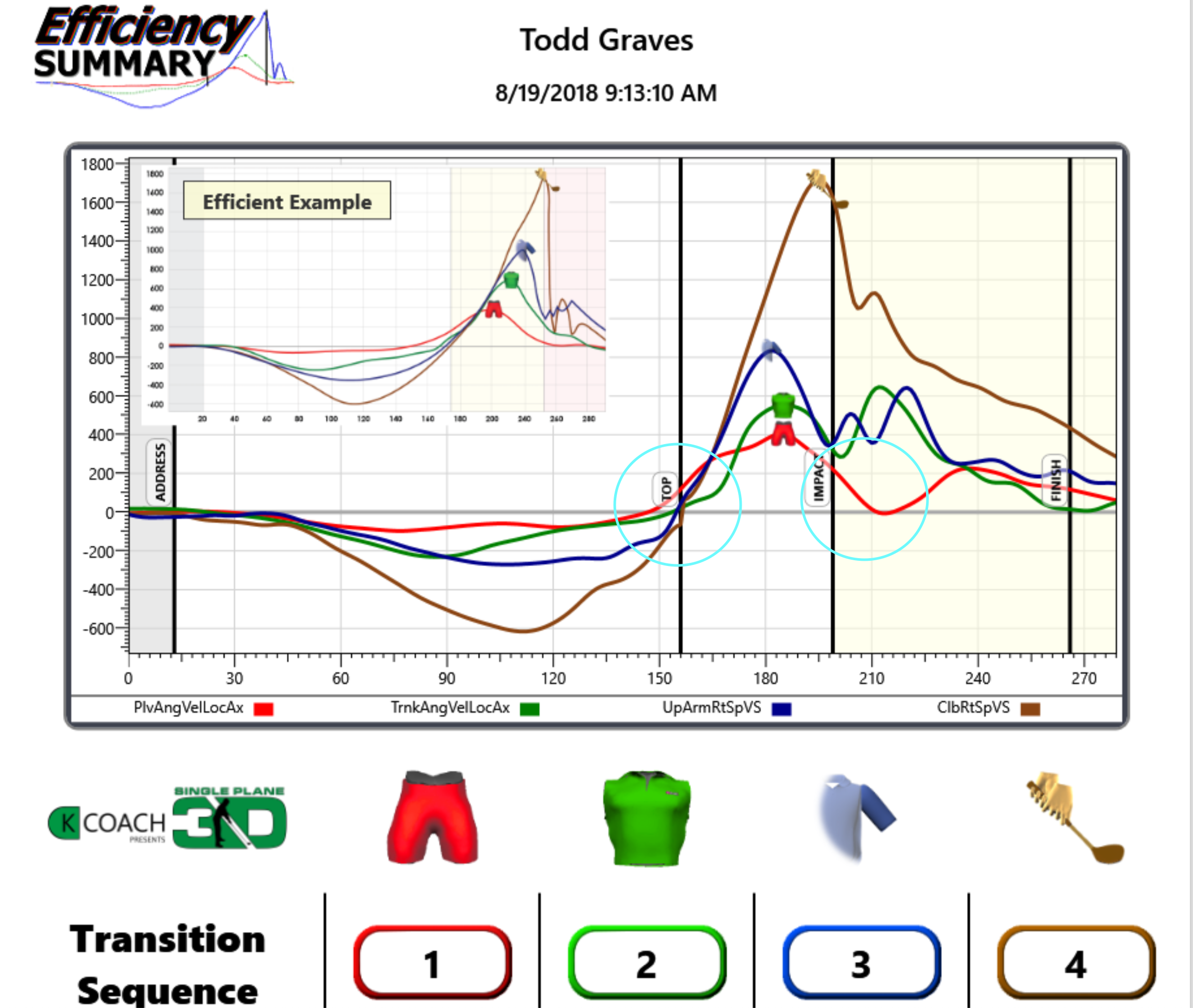
The Kinematic Sequence or Efficiency Graph shows a few indications speed loss where at the top of the swing, Bill’s Pelvis (Red Line) is not accelerating (separating) quickly enough from the Torso.  As you follow his Pelvis (Red Line) to Impact, you can see that it does not stop quickly enough either.  Here is picture of Bill’s Swing as it relates to his Kinematic Sequence:

Ideal Kinematic Sequence:

Here is a sample of an Ideal Kinematic Sequence:

Notice the large spaces between the lines where they are not grouped together.  The Red Line (Pelvis) makes a large upper movement above the baseline before the top of the swing and then makes an abrupt downward movement through impact.  This shows the acceleration and deceleration of the pelvis allowing the Torso (Green Line) to do lag and then do the same thing as the Arms (Blue Line) and Hands (Brown Line) can accelerate and decelerate in sequence.  This ideal 1-2-3-4 sequence is due to the proper acceleration and deceleration of the lower and upper body.  

Now that we have analyzed Bill’s motion and collect a bit of data on the movement, here are my suggestions for improving his power and speed:

First – Limit the pelvis rotation and increase Torso Rotation.  

By limiting the pelvis rotation, it will make it easier to get the Pelvis in sequence, starting sooner in the transition into the downswing.  By increasing toros rotation, Bill will be able to produce more speed.  Keep in mind that if you decrease Pelvis and increase Torso, you are creating what we call “Separation” and “Stretch” – making Bill’s swing faster and more efficient.

Second – Decelerate the pelvis before impact.

This is a tricky one.   The way to decelerate the pelvis is to brace into the lead knee.  We must wait and see how reducing the rotation of the pelvis affects his ability to stop it as he accelerates.  To see how his body reacts to a pelvis that moves less and a torso that separates (rotates more), I will wait for Bill’s next data.  Stay Tuned…..


LUV and Golf

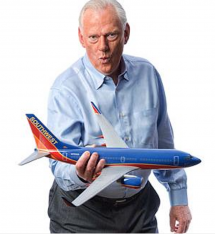
Herb Kelleher passed away recently …a couple days after New Year’s Day.

Kelleher (Herb to all who knew and met him) was the beloved co-founder and former CEO of Southwest Airlines.

If you have ever flown on a Southwest flight, you have experienced an organizational culture shaped by Herb’s philosophies and leadership.

He was known as a driven, charismatic and high-energy leader, and one who – more than anything else  – cultivated an organization in which love and respect (for each other AND for the customer) were foundational to how it operated.

For Southwest employees, love is in their DNA. They are based at Love Field in Dallas, TX. Their stock ticker symbol is LUV. And they relish saying things like: “LUV is in the air” in their marketing and corporate messaging.

And from my perspective, most of the time it seems that they truly walk the talk. (I only say “most of the time” because 99% of the time isn’t “Always.”)

So what does this have to do with golf?

The same formula that Southwest uses for high-performance and success is available to you.

When you travel on Southwest, one thing you may notice is that the employees seem to have a lot of fun. They are joyful, creative, playful…and it translates for most travelers into a great flight experience.

Kelleher’s paradigm of LOVE is what drives the culture of playfulness and fun – and which has created one of the best-performing airlines in the industry.

If you want to perform at your best on the golf course, you’d do well to consider that cultivating LOVE on the course can be an AMAZINGLY successful strategy.

What does that look like?

  • How about being intentional about sending warm and loving intentions (aloud, or not) toward the people in your playing group? And yes, even toward your competitors.
  • How about treating yourself a little better?
  • How about an inner dialogue that is supportive and loving toward yourself and others…and not the opposite?

I’ve written about this and spoken about this in depth many times at our schools. The science and research is clear: Operating from a perspective of LOVE  cultivates the kind of confidence, focus and inner calm that produces our best golf.

More important, it can also short-circuit your brain’s built-in threat response that causes missed 4-footers on the 18thhole…as well as other choking moments.

So, as you continue to either play some rounds in the warmth and sunshine of the South or Southwest, or prepare to play when the sun comes back out in the North – remember that you have a very powerful mindset option from which to operate on the course.

LUV may be in the air. But you can make sure that LOVE – and great play – is also on the course!

With Love,

-Paul

(If you fly Southwest regularly, be sure to keep an eye out for Single Plane Swing golfer and GGA Community member Captain Fuller McNutt. He usually sits in the front left seat!)

paul@paulmonahancoaching.com

Paul Monahan, PCC is a Peak-Performance coach, member of the International Coach Federation and a certified COR.E Performance Dynamicsä  Specialist. He resides in Cleveland, Ohio with his wife Paula and is the proud dad to three young men.

LEARN

THE

SWING

Join 1M+ Subscribers to get your FREE Video Quick Start Guide that reveals how to hit the ball farther and straighter more consistently from now on…

START YOUR NEW GOLF SWING