Tiger Vs. Moe and the Single Plane Swing

Tiger Vs. Moe and the Single Plane Swing

By:  Chandler Rusk, GGA Master Instructor
We literally get calls and emails every day asking us why we don’t contact Tiger and offer our help with his swing to help prevent future and more injury to his back and body.

Obviously, we would be happy to help. But, before that happens, though we would write an article about what we would teach him.

And the first thing would be to show him the differences between his current swing and Moe’s Swing.

In other words, Tiger vs. Moe….

*******************

Before we get started, it is good to know that if you are looking to simplify the golf swing the following must occur:

You must –

  1. Reduce lateral movement for consistency.
  2. Reduce rotational movement and still produce speed.
  3. Reduce stress on the body parts throughout the motion.

Let’s take a look at the address position to get started….

Moe and Tiger’s address position (Down-the-Line view)

No matter who we teach, we will always start with the grip & address. Simply because this is where we can eliminate the majority of the unnecessary movement.

A couple key differences here are:

  1. Tiger begins very close to the golf ball as Moe has more space. Notice the circles in between the hands and upper legs. This is a spatial problem for Tiger and is the root cause of all of his injuries.
  2. Tiger starts with his arms hanging down with the hands positioned well below where he will make the impact, this is also known as a two-plane swing. Moe starts with the club shaft on the same plane that he will make the impact – known as The Single Plane.
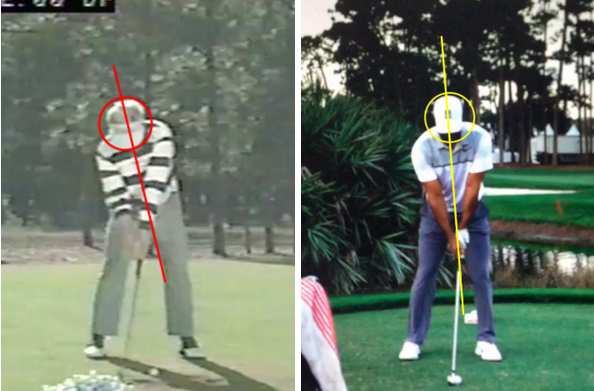
Face-On Address Position Above

All good ball strikers will have 25 degrees of side bend at address. Side bend is the tilt of the spine away from the target at address.

As you can see above, Tiger begins in a very straight up-and-down position (roughly 4 degrees of side bend).

Moe always began with between 15-20 degrees of side bend at address. This allowed him to maintain his head position in the backswing (see below).
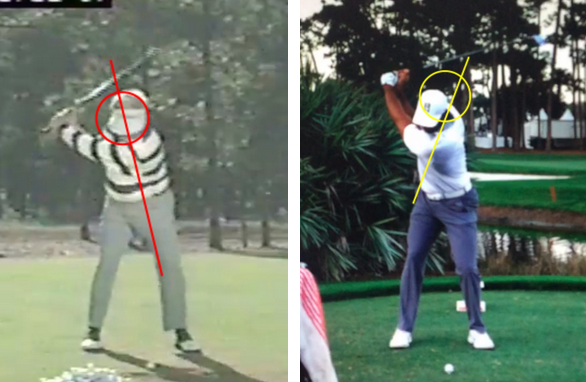
Top of the Backswing Position (Face-On View)

The address position and backswing rotations are paramount in developing consistency in the golf swing. It allows the body to transition properly to the initial part of the downswing.

Key things to observe in the above images:

  1. Head Movement

Since Tiger only has about 4 degrees of side bend at address, he is forced to create more in the backswing. This is a built-in compensation to his swing and what you will see with most conventional golfers. The head is forced down and back in the backswing. You can see that Moe’s head has stayed in position.

  1. Torso Rotation

When the head position moves down and back, the torso is forced to over-rotate. Tiger’s torso rotation is past 90 degrees at the top of his backswing which causes his arms to get trapped behind him in the downswing.

Impact Positions Above (Face-On View)

The 2nd most important way we could help Tiger, other than his address position, is how he gets to impact.

Since Tiger begins very close to the golf ball, his lower body is forced to lift and rotate to clear for his arms and hands. He snaps his left leg straight which puts immense stress on the lower part of the leg and also the lower back. All while his head has gone down and back.

When the lower body is going up but the upper body is going down, this is called compression and shear of the spine.

Remember that Moe develops space away from the golf ball at address. Since there is space, Moe was able to rotate his hips down and forward into a flexed lead knee. When the lead knee is flexed at impact, it takes all of the stress off the lower part of the leg and the back.

Side Note – In our opinion – the #1 Training Tool to help you with proper lead knee flex is the Load-n-Fire Lead Knee Brace. You can see the video about this training tool at: CLICK HERE
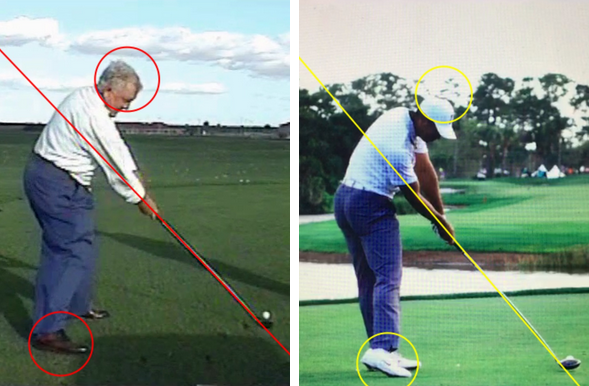
Impact Positions from Down-the-Line

At impact, Tiger and Moe have returned the club to where it extends through the middle of the back. This is where 99% of golfers make the impact.

Why wouldn’t everyone start there?

With Tiger, since the left leg has snapped straight, the trail heal has no other choice but to come off the ground. This is another indication that the lower body is lifting instead of staying in posture.

To see more about the Load-n-Fire Training Aid (Again – we believe one of the BEST training aids to help with lead knee flex): CLICK HERE

To see 10 Training Videos helping with trail and lead knee flex:  CLICK HERE

(Click on Load-n-Fire Drills and Tips)

************

Review of Tiger Vs Moe

  1. By simplifying Tiger’s address position, we could eliminate many compensations and also help reduce the stress on his body.
  2. Less rotation in his backswing would allow for his arms and hands to be in better position for the downswing. Tiger always fights blocked shots and snap hooks and the majority of that comes from the over-rotation in his backswing which leads to under-rotation at impact.
  3. With space created at address, Tiger could train to have a flexed lead knee at impact which would reduce all of the stress on his body and lead to more efficiency.

The best and easiest way to learn the simplest and most efficient swing in golf is by attending one of our Golf Schools or getting involved with our Coaching Program.
Be better, not bitter.

GGA Mental Game Coach

The key to accessing your highest potential on the golf course is to cultivate a mindset that is built and nurtured far away from the course itself.

Bart Barnard is one of the fine master-instructors at Graves Golf Academy. If you’ve ever had a chance to work with Bart – either at a GGA school, in the video coaching program or near his home at the GGA training facility at The Legacy Resort in Phoenix – you know that Bart is smart, conscientious, attentive, observant, and a very skilled golf coach and teacher.

Just another example of the terrific people Todd and Tim Graves has brought to the GGA staff over the years.

Bart came to me a little over a year ago and expressed that he was interested in collaborating together in a coach-client partnership. So we put a plan together and began working on Bart’s most important initiatives.

If you attended the Alumni 5-Day Camp in Orlando in April, on the last day of the camp, you heard Bart speak about what he experienced while working on himself over the prior year. And if you weren’t there…that’s ok…cause I want to tell you about the message Bart had for all of us about the secret to taking on nearly any performance endeavor.

In addition to the qualities I mentioned above, Bart is a thinker. And he has thought a lot about the insights he gained over the prior year…as well as his own personal and professional growth. And he expressed those insights at the alumni camp in April in one sentence:

“Be better, not bitter.”

Bart explained that he noticed that any time he showed up anywhere with negative energy…any time he experienced negative emotions like frustration, anger, anxiousness, worry…etc. …that there seemed to be an underlying negative thought process which he was experiencing as bitterness.

Not the kind of bitterness that creates a 24-7 grumpy guy, mad at the world…etc. (Although I bet you know one of those guys!) But rather, the kind of bitterness that takes away from the sweetness of life at any moment.

Bart learned that he would much rather let the experiences in his past make him better, and not create bitterness within him.

Now, let’s face it. We’ve all been there. On the golf course, or off. (OK…especially off!!) We’ve all experienced frustration, anger, anxiety…etc.

But in holding this maxim – Be better, not bitter –  Bart reminds himself (and all of us) that we have a choice about how we show up in any moment. And that the bold, productive, BEST choice is to commit to being BETTER

Being a better co-worker, a better spouse, a better teammate, a better playing partner on the golf course…just BETTER. It means something slightly different to everyone…but we all know what BETTER looks like.

And it’s a much more pleasant way to move through life.

If you want to build a successful mental game on the course, you must know how to do it elsewhere. Being Better in every facet of your life will help you to:

  • See things from a new perspective
  • Focus on others, and not just your own neediness
  • Soften the need to be right, to win, or to NOT lose
  • Build the resilience necessary to recover from setbacks
  • Bring a sense of confidence, calm and peacefulness to your experiences…which will allow you to tap into your genius, your creativity, and all your skills and abilities so that you can BE YOUR BEST…and perhaps even PLAY your best.

Focus this week on Being better, not bitter…as you prepare to play next weekend. See what a commitment to being BETTER this week can do for your mental game on the course next weekend. I think you will be pleasantly surprised!

Paul Monahan, PCC is a Peak-Performance coach, member of the International Coach Federation and a certified COR.E Performance Dynamics Specialist. He resides in Cleveland, Ohio with his wife Paula and is the proud dad to three young men. He works with elite-level performers and leaders, helping them to expand their awareness so that they perform at their best more consistently.

He can be reached at paul@paulmonahancoaching.com

Single Plane Golf 3D

Moe Norman’s swing is a biomechanical masterpiece. Every part of his body moves like a finely tuned machine. Yes, Moe was a ball-striking machine. If I had to describe his swing in just a few words it would be – powerfully efficient.

Having an efficient golf swing describes how each part of his swing moves the right amount at the right time in perfect sequence and time. When this happens the club produces speed, the goal of all efficient golf swings.

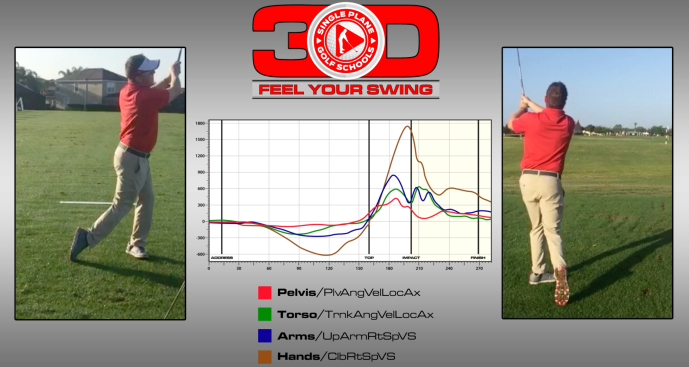
In the graph below, you can see the colored lines showing how each part of the body moves in relations to each other part.

Screen Shot 2018-05-10 at 9.17.23 AM.png

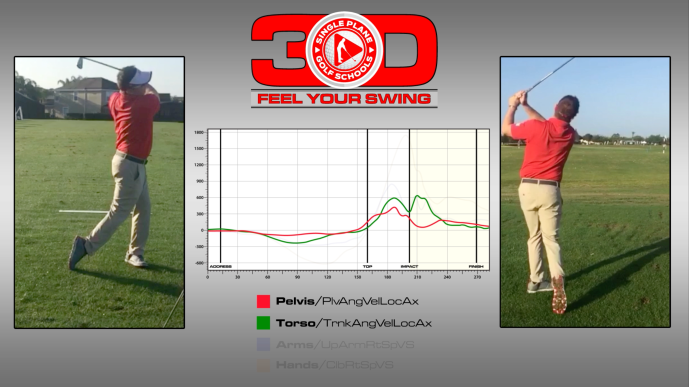
There are some significant details to recognize here. You can see them if you just look at a few of the lines together. Looking at the Red and Green line (Pelvis and Torso) you can see how related they are when it comes to producing speed.

Screen Shot 2018-05-10 at 9.01.50 AM.png

Notice that as the swing moves into the backswing where the Green line is lower than the red line. This is the middle of the backswing where the torso moves faster than the pelvis. As the pelvis slows into the backswing (red line) it then begins to move forward and beats the torso into impact. This is called Separation where the pelvis separates and moves independently from the torso.

As the torso (green line) moves from the top of the backswing into the downswing it is speeding up and you will notice that the torso and pelvis slow down at the same rate into impact.

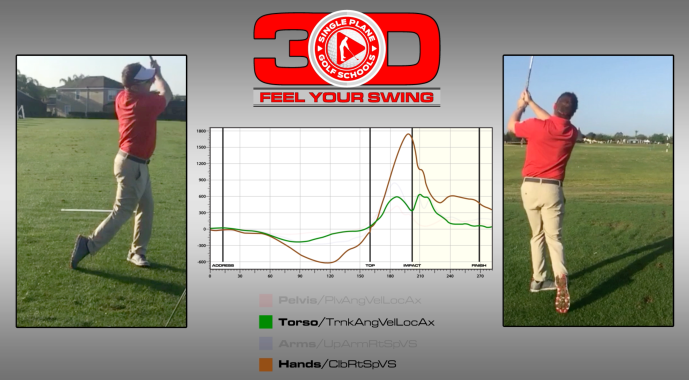
The next graph might be the most revealing. where you can see the torso movement (green line) as it relates to hand movement/speed (brown line). You can see that as the torso slows into impact, the hands accelerate into that final moment.

Screen Shot 2018-05-10 at 9.08.26 AM.png

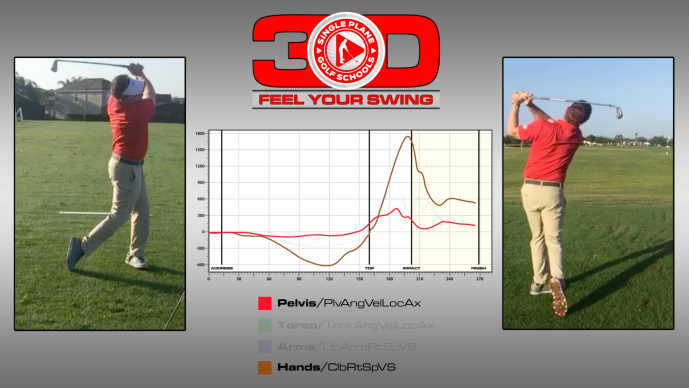
My favorite chart is to look at the fastest moving part of the body vs. the slowest moving part of the body – the Hands (brown line) vs. the Pelvis (red line).

Screen Shot 2018-05-10 at 9.10.45 AM.png

Here you can see the wide ranges of the speed of the hands vs. the speed of the pelvis. While the Pelvis (Red) is slowing, the hands are moving the fastest – a clear indication that as the pelvis slows down (decelerates) the torso is able to rotate and accelerate the arms and hands.

Single Plane 3D is the latest school from Graves Golf – diving deeper into the Science of Feel.

Mastery Orientation

GGA Mental Game Coach

Your brain is amazing.

It regulates your body process, allows you to analyze and interpret external stimuli and is the source of the very consciousness that allows you to read this sentence.

And it is also an incredible survival tool.

The brain has a very powerful (but primitive) threat response system designed to keep you alive. Great when you need to run from a tiger (as you may have needed to 50,000 years ago), but not so great when you want to perform at your best in a competitive situation (like the Spring member-guest against your buddies.)

Your brain’s threat response system is always monitoring your external environment to determine if your safety is in jeopardy, much like aa software program running silently in the background. You probably aren’t even aware of it.

The challenge with this system is that it is not smart enough to know the difference between a saber-toothed tiger running toward you (which could ACTUALLY harm you) and a slippery downhill 10-footer on the eighteenth hole to tie your match.

In both cases, your brain goes into threat response because it has assessed that you might lose something very important to you. It signals to your body that you are in danger.

The problem? On the golf course, this response has physical and mental implications. Sweaty palms impact your ability to hold the putter properly. Nervous, shaking hands affect your ability to move the putter as you would like to. And clouded judgment can impact the kind of decision-making that keeps you in your process.

So what to do?

I believe that we can be successful more consistently in nearly any performance context when we do certain things to prevent the brain’s threat response from activating.

I coach my clients on the distinction between operating from a Mastery Orientation versus operating from an Outcome Orientation. And I teach them how to adopt a Mastery Orientation whenever stepping into any kind of performance arena.

The primary difference between the two operating orientations is this: people who operate a Mastery Orientation are concerned with elevating their competence. People who operate from an Outcome Orientation are concerned with proving their competence.

Because of this, a golfer with a Mastery Orientation has a distinct performance advantage. They are more likely to stay connected to all their skills and abilities. And they can execute at a high level and do things like:

  • tune into their surroundings in productive ways
  • stick to their game plan and make clear decisions
  • stay in the present moment and execute their process
  • feel the putter move freely
  • be playful and PLAY the game

This is because they are not wrapped up in results. To them, outcomes are important, but only insomuch as they (the outcomes) reflect where they (the golfer) are on their own path to mastery.

They know deep down that the WORST that can happen is that they will learn something: about their game, their capacity for resilience, their ability to compete in certain conditions…etc. And because they hold this knowledge, their brain’s primitive threat response is not activated as easily.

When they hit wayward shots, they see those shots in the context of their overall goals in golf – and not as defining moments in that particular competition, nor even how they define their own self-worth.

In a way, golfers who operate from a Mastery Orientation have written a story for themselves about what their experiences on the golf course mean to them. And they access that story each time they play.

For them, golf is not (entirely) about winning or losing, but rather about growing in their mastery of the game. Each shot – no matter the stakes – is an opportunity to learn and improve, not a challenge.

The result? They play better. They score better. And typically enjoy themselves more.

On the other hand, the golfer who operates from an Outcome Orientation is typically in for a much more emotionally-charged ride on the course. Why? Because their ego is heavily involved in how they see each shot. (Remember, they are trying to PROVE their competence, not grow it.)

When they stand at the first tee, they experience anxiety because they are trying to show the world the fruits of all their hard work on the range. (We call this pressure.)

And when they have to face that slippery downhill 10-footer, the dominant thoughts are not about what they could gain, but rather about what they might lose. They experience what my colleague and NHL hockey prospect coach Walter Aguilar calls horizontal thinking: they “move horizontally” in their thinking to the future, imagining how awful it would be to miss the putt and to lose their credibility with their friends and/or competitors.

As a result, they begin to lose access to their high-level cognitive functioning, as well as the physical skills and abilities they possessed prior to starting the round. And of course, this can start a kind of performance death spiral that is very difficult to pull out of.

The good news is that you have options. You can choose the mental and emotional stance from which to operate when you play. You can choose the orientation you want to adopt when playing golf.

I hope you choose a Mastery Orientation.

Paul Monahan, PCC is a Peak-Performance coach, member of the International Coach Federation and a certified COR.E Performance Dynamicsä Specialist. He resides in Cleveland, Ohio with his wife Paula and is the proud dad to three young men. He works with elite-level performers and leaders, helping them to expand their awareness so that they perform at their best more consistently.

He can be reached at paul@paulmonahancoaching.com

The Lob Wedge – Making It Your “Best Friend”

The Lob Wedge – Making Your “Worst Enemy” Your “Best Friend”

First, I want to say, I believe the lob wedge is one of the most important clubs in your bag.

In fact, I believe it is the 3rd most important club in your bag (refer to past e-tips for #1 (Putter) and # 2 (Driver).

Besides your putter and your driver, this is probably the club you will use the most in a given round… if you know how to use it and use it correctly…

The perfect Lob Wedge: The perfect lob wedge (in my opinion) has the following characteristics:

  1. 58* of loft or more
  2. Forged type club (the softest material in a wedge that helps create spin and a very soft feel at impact – allows for the ball to land softly on the green).
  3. C – type grind on the sole of the club. This grind on the club allows to hit off of all different surfaces (soft, hard, etc..) and allows for different ball positions instance to hit low to high (lob) type shots. The C type grind on the sole keeps the leading edge of the club low to the ground when the ball position is “pushed forward” for higher/lob type shots.
  4. Medium to Wide sole on the club – the wider the sole – the easier it is to “slide” across tight lies.
  5. Needs to have swing weight heavier than most clubs in bag besides the sand wedge (swing weight typically between D-4 and D-6) – most lob wedges are built this way as the added weight helps cut through many surfaces (high grass, sand, etc..) and helps create better “feel” around the greens.
  6. Steel shafted – (if possible). Again – the weight helps as described.
  7. Slightly rounded leading edge on the club – only slight, but this slight rounding also helps cut through different surfaces.

To see video about our recommend wedges:  CLICK HERE

Screen Shot 2015-10-17 at 8.53.57 PM

How to play the Lob Wedge?

For a full shot, (for many ranges from 30 to 60 yards, maybe slightly longer) – the ball is placed in the middle of the stance and swung with a good on a plane single plane swing. (Like any other club in the bag – ball position center of stance).

For a short pitch or high lofted shot (not lob or flop shot yet.):

  1. The ball is placed slightly forward in the stance (forward of center). As higher you want the ball – the more forward you put in the stance.
  2. The weight (body’s weight distribution) is 50/50. You do not put more weight on the lead foot.
  3. Stance is slightly open – about 10 to 20* at max.
  4. The hands are slightly ahead of the ball at set up.
  5. Choke down slightly for more control and better feel.
  6. You swing the club with VERY soft hands. This means light grip pressure on the club.
  7. You work on the fold/fold type swing. Meaning you fold your trail arm in the backswing and lead arm in the through the swing. Nice and easy…..
  8. You accelerate through the shot – your hands should finish at shoulder level or above. If you think the swing is too long for the shot – shorten the backswing, but still keep a solid and extended through the swing.
  9. Swing toward the hole – as Moe said: “Try to pull the flag out with the head of the club”. This was his analogy of making sure the club is swung down the line toward the hole.
  10. Make sure the weight is evenly distributed throughout the shot and the feet stay down throughout the shot.

For a flop shot (high lofted short shot): Follow the points above except the following:

  1. Ball position – as forwarding instance as comfortable. Off lead heel or further forward is good.
  2. The weight distribution is still 50/50 or slightly toward the back foot. Keep weight balanced throughout the shot.
  3. The club slides under the ball… Think of sliding under the ball rather than hitting down on the shot.

To be honest, after teaching 1,000s of students in the past, this is always a difficult shot to master – it takes time, but once you get the “feeling” it actually becomes pretty easy and a great “shot saver” in the round. Here are a few faults many students have difficulty with while they are trying to learn the flop shot:

  1. Weight transfer – you need to keep your weight back to center during the shot – exaggerate this as much as possible. It is almost impossible to get the club to slide under the ball if you are transferring your weight too much forward.
  2. SOFT HANDS – if you think you have lightened the grip pressure enough – do it some more. The softer the grip pressure the easier it is to fold/fold in the shot which brings consistency and great feel with this shot.
  3. Acceleration – shorten the backswing enough that you feel you need to be pretty aggressive in the through the swing. A backswing that is too long creates deceleration in the through swing which leads to fat and/or thin shots.
  4. The swing toward the hole – great area to practice on swinging toward the target. Chances are if you are coming across your full shots (cut/slice) you are also doing the same in your pitching/flop shots.

In a good high pitch/flop shot the ball should land relatively soft on the green with minimal roll. In fact, if you listen to the shot, you will hear a “thud” when it hits the green. A good shot comes in soft, has minimal roll… many pros call it landing like a “butterfly with sore feet”.

Hopefully, this helps those who are looking to help their short game – especially that all needed lob shot around the green.

Please feel free to contact me at timg@moenormangolf.com with any short game questions, questions about your wedges or any other club fitting questions.

Remember my saying: “I’ve never seen a good player with a bad short game and have never seen a bad player with a good short game.”

Opportunities are Everywhere

GGA Performance Mindset Coach.

Just had a great week in Orlando at the GGA 5-Day Alumni Camp.

It was a fun week of learning, instruction, growth, as well as some great conversation about what it takes to perform at a high level.

My job at the camp last week was to help the attendees to expand their awareness of the mental and emotional dynamics that allow them to show up at their best.

Said a little differently, I was there to help them learn how to tune into their energetic presence…the mix of physical, mental emotional and other elements that merge to form what I refer to as performance energy.

I believe that the key to performing at your best consistently over time is to build awareness of self… and a knowledge of how the things around you are impacting your thoughts.

How does the experience of standing on the first tee with an audience of other golfers watching you impact your ability to access your skills? Does it make you feel nervous? And if it does, can you identify the actual thinking that produces that nervousness?

If you can identify the thinking, then you are well on your way toward increased awareness. And then you can do something about thoughts that are unproductive, versus ideas that are supportive of your efforts, goals, objectives…etc.

For example, you might realize that you are nervous because you don’t want to be embarrassed by duffing your tee ball into the woods. You don’t want the harsh judgment of others. Understandable.

But what’s another way to look at that? Perhaps all the guys behind you want nothing better than to see you hit it well. They too are capable of hitting it into the woods – by in their minds, they are behind you, pulling for you to hit a great shot.

Or perhaps, they don’t care that much at all. So then you can forget about all that worry and anxiety. After all, it’s just misplaced energy.

All that is left, then is for you to step up and hit it where you want to. (And accept that you can handle the results…no matter where the ball goes.)

We talked a lot last week about increasing awareness of what is happening on the golf course to play better golf.

But here’s the interesting thing: you can practice increasing your awareness all day long, anywhere you go. In traffic. At work. In your interactions with colleagues or those closest to you. There are opportunities ALL DAY LONG to tune into the thought patterns that are driving how you interpret your experiences.

My message to the group last week is the same message I give you here: if you want to improve how you play on the golf course, a practice growing your awareness of self in every moment you can. Not just on the golf course, putting green, or during play, but in every situation you experience.

Try it this week. You will be surprised at how easy it is.

The opportunities are everywhere.

Paul Monahan, PCC is a Peak-Performance coach, member of the International Coach Federation and a certified COR.E Performance Dynamicsä Specialist. He resides in Cleveland, Ohio with his wife Paula and is the proud dad to three young men. He works with elite-level performers and leaders, helping them to expand their awareness so that they perform at their best more consistently.

He can be reached at paul@paulmonahancoaching.com

LEARN

THE

SWING

Join 1M+ Subscribers to get your FREE Video Quick Start Guide that reveals how to hit the ball farther and straighter more consistently from now on…

START YOUR NEW GOLF SWING