New Single Plane Academy Inner Circle – A Must for All Single Plane Golfers

New Single Plane Academy Inner Circle – A Must for All Single Plane Golfers

The Single Plane Academy Inner Circle has been UPDATED and GREATLY enhanced!!!!

The Single Plane Academy Inner Circle now includes our entire library of content…this includes ALL of the DVDs we’ve produced over the years.

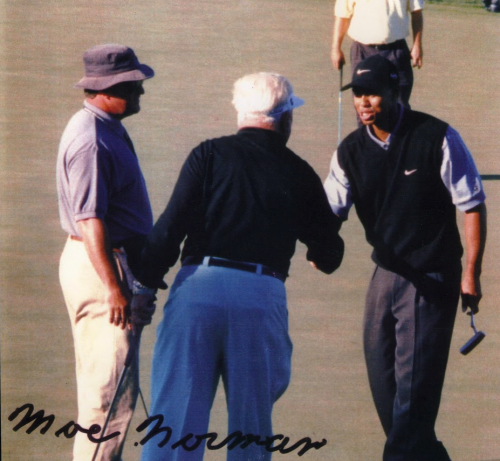
Improve your full swing with Todd Graves, your short game with Tim Graves, PGA and enjoy exclusive Moe Norman archive footage. There’s always something new to discover with more content being added each week.

We’ve made membership easy with two plans to choose.

Just select the right plan for you.

The New Silver Plan is your path to Single Plane Success. You’ll receive Total Access to the entire library of DVDs, monthly instructional Webinars, and Exclusive videos anywhere, anytime, on any device. This is over 1,000 hours of instructional content at your hands anytime!
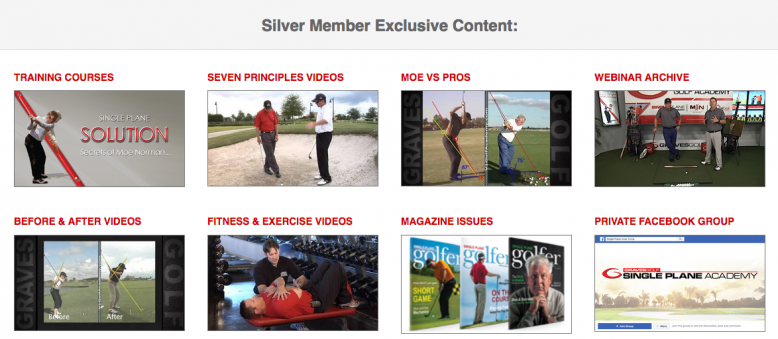

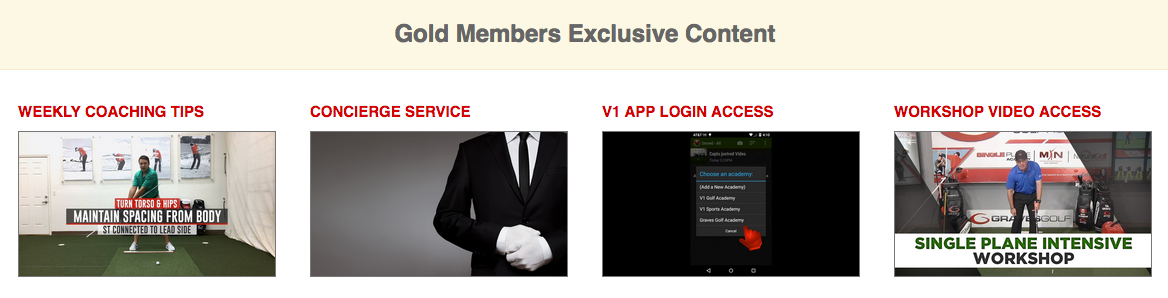
Perhaps you desire more personal one-on-one instruction…our New Gold Plan is the one for you. In addition to the entire digital content of the Silver Plan, we are rolling out a brand new Concierge Service with Member’s Only phone line to call or text when you need help or have a question. Included with this service is the ability to receive a personal coaching video answer to your questions.
Check out the entire list of Benefits for both plans by following these links:

Single Plane Academy Inner Circle ($27 – special ending shortly)CLICK HERE

Join Now and start lowering your scores!

If you have any questions about either plans or anything else, please feel free to contact our specialist, Wes Wilkinson, PGA at 866-377-2316. If leave message, he will get back to you shortly.

Advantage Me

I wrote this practice tip a few years ago and thought it would be good to publish again:

During the past couple of weeks, I have to admit I was putting in some “extra hours” to push my game to a level that hopefully could have competed with the big boys. One of my practice sessions was right after one of our school days. Typically, after a day of teaching I’m too tired to put in a good practice session, but due to the circumstances – possibly getting a call to get in the PGA Championship anytime – I put in the “after hours” practice.

During one of my post-school sessions, one of our students asked me if he could sit and watch my session. I never have a problem with anyone wanting to learn more, and gladly entertained the company.

During the middle of the practice session, it became very apparent I needed to write more about how I practice, as the student kept telling me, you need to teach this, show this. So guess what this e-tip is about? But I have put a little different take on it.

As I was talking to my student – I began to describe my “advantages” over the average golfer in my practice sessions. In other words, how I have set up my practice sessions to give me the “no excuse”, or “least amount of variables” type of practice. How do I set up my practice sessions with the least amount of doubt during the session?

So, as you haven’t seen me on my “soapbox” for a while; if you are new to our e-tips, you have never seen my “soapbox”, I thought it was about time, and I am writing this as an “advantage me” type situation. You’ll understand more as I get into detail, read on. This is my NO EXCUSE Attitude.

I have always made it a very specific point to give myself every advantage when I practice. I heard this for the first time in 1996 when I was playing in the U.S. Amateur against Tiger Woods. I remember an interview he was giving to ESPN on the range and he stated (paraphrasing) “When I (Tiger) practice, I set up a situation when no one has an advantage over me” – meaning, when Tiger practices he makes sure all the details are covered, there are a few variables as possible, etc… I’ll explain by describing my practice session I was holding with our student watching.

As I go through my practice session, think, and better yet write down how many of the points you do EVERY TIME, not some of the time, or most of the time, but EVERY TIME. Be honest with yourself – the more honest, the better.

STRETCH

First, before I start every practice session – I stretch. To be honest, probably not enough, but I put in at least 5 minutes of stretching. Making sure not to forget about my wrists and shoulder blades. I stretch with my training 6 iron in hand so when I hold the club to stretch I have the training grip in hand.

Note: If you begin your practice session tight – you will be hurting your swing – guaranteed – good luck getting into correct positions when you are tight.

I also “kill two birds with one stone” as stretching always involves a few “air swings” or golf swings without a golf ball. I want to make sure my grip is perfect, and with my training club, I don’t have to think about it – no brainer.

ADVANTAGE ME

So – if you don’t stretch before your practice session – ADVANTAGE ME. (Double Advantage me as I use a training grip club to help me stretch…)

Second – How many golf balls do you hit during practice. In other words, do you have a “limited” number of golf balls? I am going to eventually write an article for the PGA titled how “Country Club members have an advantage over the typical golfer”, not because of the course, but because of the unlimited range balls.

I’ll explain. After I stretch, I begin to hit my wedges. In fact, I hit a lot of wedges. Lob, sand, pitching, etc… I start with very short shots, maybe 30 to 40 years, and then work up to a full pitching wedge – I typically hit at least 20 to 30 balls minimum with my wedges to warm up my swing, start getting the club on plane with short easy swings is much easier than getting to the mid to long clubs too fast.

Here is the issue – with a limited number of golf balls, like a small range bucket, I promise you, you will be hitting drivers in just a few golf balls. You will not spend enough time on the wedges – which is where the warm-up should and must begin. Hit a lot of wedges.

If it is a cost issue for you, figure out a way to hit balls and shag them, find a pitching green to begin your practice, figure out something, give your wedges more time.

So – if you aren’t spending a good amount of time warming up your practice session with your wedges – ADVANTAGE ME.

Third – My clubs – this is an easy 0ne – but one missed by so many golfers.

When I practice I have NO DOUBT my clubs fit me PERFECT!

Why is this important – because it gives me a no excuse for the club’s attitude. In other words, if I hit a ball left, it wasn’t due to the club (improper fit), if I hit it right (not due to the club), too high (not the club), etc… etc. I think you get the point.

Too many golfers have club issues – clubs that don’t fit their swing. They may swing at it perfectly, but as the club doesn’t fit their swing, the lie angle pulls the ball left or pushes the ball right (vice versa for lefties) and their mind tells them there is a swing issue – when it is really a club issue. So many aren’t able to release the club because their grip size is too big and don’t know it.

This causes SO MANY problems having grips that are too big. Thirdly, I have NO DOUBT about my clubs – the fit me for a lie, length, grip size, shaft flex, and the most important playability (for my ability) and a good feel for my game. So – if you clubs might not fit you or you’re are uncertain about your club fit – ADVANTAGE ME.

Fourth – This may be the most important. I use an Alignment Aid EVERY TIME I practice – yes, even when I am warming up for a tournament, I put an alignment training aid on the ground. To be honest, this is probably the issue the disturbed me the most when I watch average golfers practice.

Why? Because it is so simple, and has such BIG effects – and so few use it. Too lazy? Don’t know the importance? Who knows? But a HUGE problem!

I lay the alignment aid pointed toward the target and put a yardstick under the training aid.

Now, every time I set up over a shot – the following are given:

  1. Perfect alignment (square to target)
  2. Perfect ball position
  3. Perfect stance (width)
  4. Perfectly square face to target (comparing leading edge of the club to edge of yardstick)
  5. Perfect distance from the ball

So simple – look at all the variables I have solved using this SIMPLE tool EVERY TIME.

I promise you, I will never hit a practice ball without an alignment tool.

So – if you aren’t using an alignment aid every time you practice – ADVANTAGE ME.

In fact – let’s say HUGE ADVANTAGE ME. In fact, soapbox time, if you aren’t using an alignment aid every time you practice, don’t read further…. no need – you have so many variables right now without using one… no need to continue to read… you won’t get past fixing all those listed above… Alignment, ball position, stance, square club face, distance to the ball…. enough said.

You will go back and forth, back and forth, back and forth fighting these issues FOREVER – I will NEVER have these issues – why because I take the extra couple of seconds to lay an alignment tool down every time I practice.

Fifth – I never practice for more than 15 minutes at a time. In other words, I hit 15 minutes’ worth of golf balls and then take a break. Might sit down for a minute or two to drink some water, might make a phone call, might walk over to the putting green and hit a few putts… you get my point.

Why? Because I give my body and more importantly, my brain, a break. None of us can focus longer than 12-16 minutes, it’s a proven fact. And as you are working on your swing (hopefully specific issues in your swing), you need to focus.

What happens when you lose your focus – your bad habits come back – FAST. If I were to hit one hours’ worth of golf balls – I would take at least 4 breaks (many times going to hit a few putts, chips, water break, etc…)

So – if you are practicing for more than 15 minutes in a row (without taking a break) – ADVANTAGE ME.

Many of you might think I video and check my swing every day. Couldn’t be further from the truth. To be honest, at most, I video my swing maybe once a week – more often, once every two weeks… I get enough from a single video session to work on for at least a couple of weeks.

What can you do? Check out our GGA Internet Golf Academy – you can do EXACTLY what I do. Send in a video every couple of weeks – we’ll give you plenty to work on.

So – if you aren’t getting some type of “outside” feedback to work on during your practice sessions – ADVANTAGE ME

In summary – be honest with yourself.

How do you rate your practice sessions compared to what I wrote above?

How many advantages do I have over you?

Remember – there is a DIRECT correlation between the time it takes to get better to the number of “advantages” you have.

Don’t leave ANYTHING to chance…. every second I practice I am assured I am getting better – I eliminate as many variables as possible.

To end – Folks, it’s not hard… in fact, it is very very simple and easy. Go through the list above again and make sure I have NO Advantage over you when we practice.

Remember – Always Practice with a Purpose!

Rare Moe Norman Footage – Last Call

I have a gift for you and you won’t believe it!

https://www.thefeelingofgreatness.com/donate

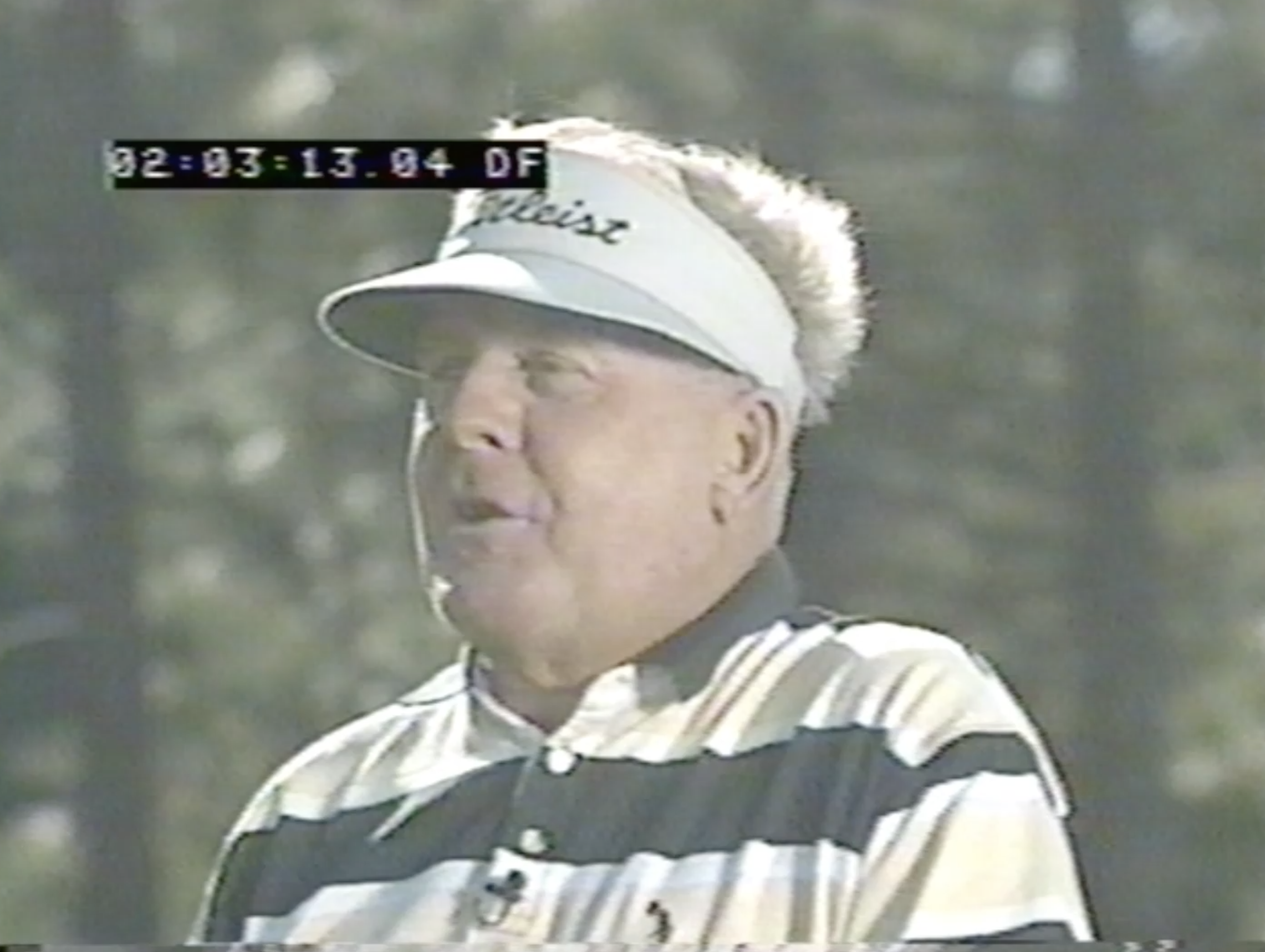
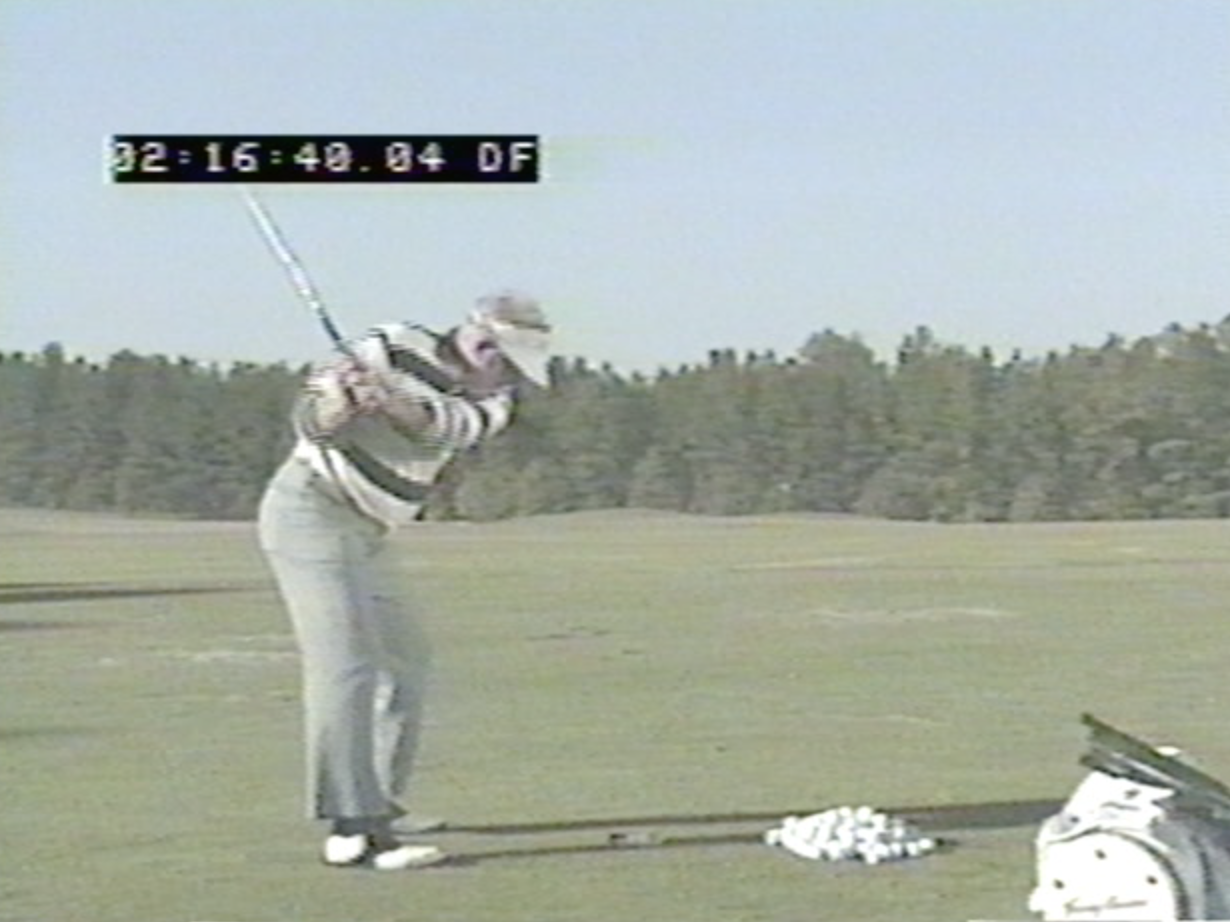
In 1991 Moe Norman asked Eric Alpenfels to produce a video of him hitting balls. It was rare for Moe to ask such a favor. Eric, having just completed a video production for a recent goal magazine, couldn’t wait to capture Moe hitting balls. He would go on to produce Moe Norman, Golf’s Journeyman displaying Moe hitting balls as Eric analyzed his golf swing. The video was spectacular and some of the best footage of Moe ball-striking ever produced.

But here’s the fun part. The Journeyman production was only part of the footage. There was moreover an hour more. Eric has gracefully given us the rare – never before seen footage, to help raise money for the Moe Norman Documentary.

“I originally shot the video of Moe because he asked me to. I did it for Moe. Now I want to give to Moe again by helping raise money for his documentary so more people can learn about him and how great he really was”.

Eric met Moe in Pinehurst in the late 80’s. Moe would often visit Pinehurst on his way to Florida for the winter where Moe would often visit Paul Bertholy, a well-known golf instructor and one of his mentors.

The rare and raw footage of Moe demonstrating is fantastic. What I enjoy even more than Moe’s amazing ball-striking is Moe just being Moe. He is humming a song the entire time while hitting balls, then in between shots, he plays with the camera crew. It is great rare footage of Moe being Moe, the kind you love to have in a documentary.

I particularly like the dialogue Moe has with everyone around him. He is enjoying himself. You can really see his personality throughout the footage.

And of course you can’t help but enjoy his amazing golf swing demonstrated from various angles and camera views.

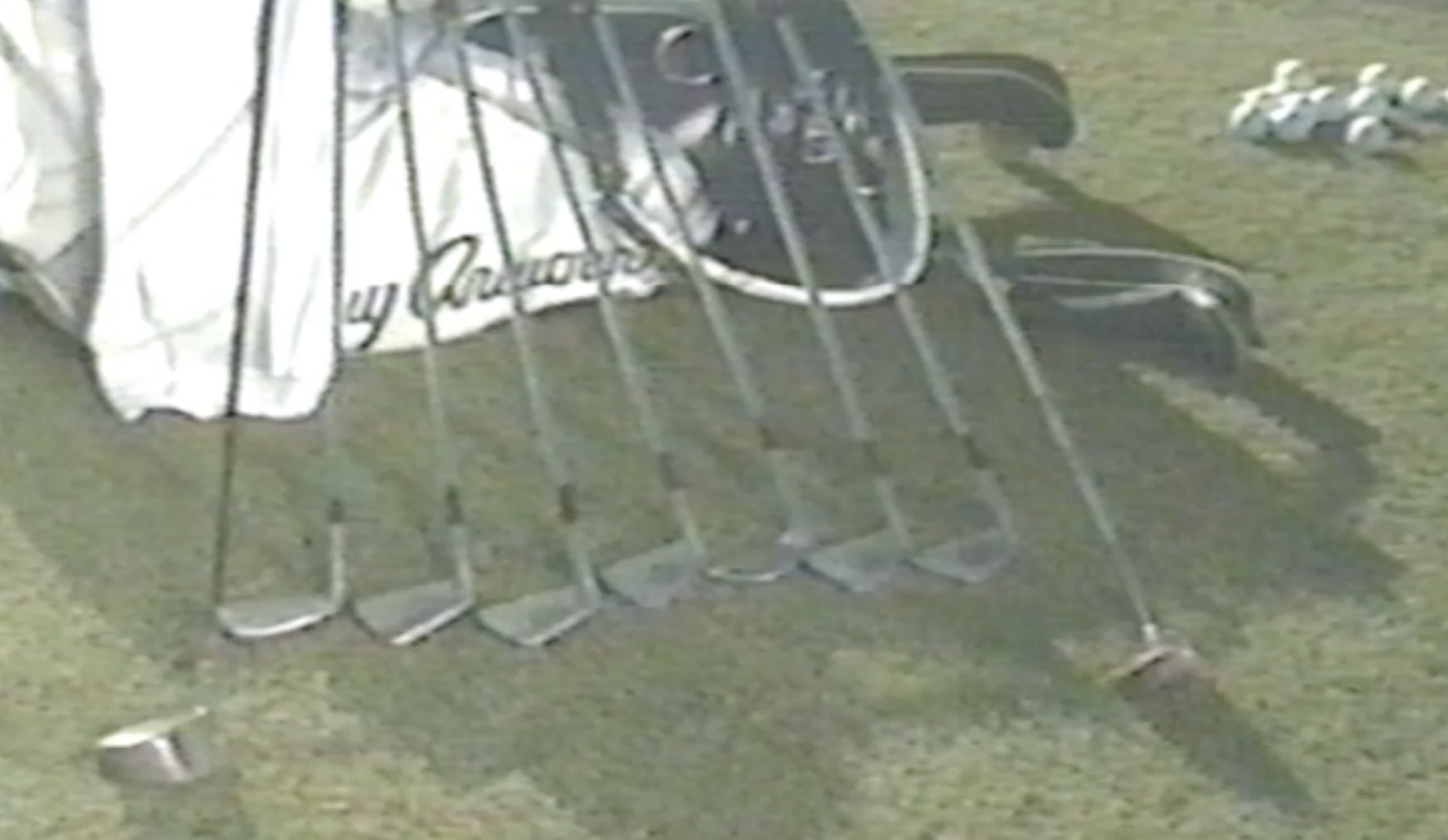
You can even see Moe’s favorite golf clubs.

I recently gave a copy of Eric’s video to Chris Anderson – a student and Moe Norman Fan. Here is what Chris had to say about the footage:

“I have seen a ton of Moe Norman videos but I love this footage of Moe being Moe. A rare glimpse into the private world of Moe that I have never seen before.”

Now, I want to give you a copy of this incredible and rare footage of Moe. All I am asking is that you help others learn about Moe by donating to his documentary “The Feeling of Greatness”. All donations of $100 or more will get a copy of this rare, unedited footage, of Moe.

By the way, you will get a credit in the film too.

Please help us tell Moe’s story to the world by donating here.

https://www.thefeelingofgreatness.com/donate

Thank you.


Todd Graves
Executive Producer – Straight Line Films

Ben Hogan vs Moe Norman (The Single Plane Swing)


In December of 2009, Golf Digest’s Jaime Diaz sat down with Tiger Woods for a series of interviews. In these interviews, Tiger is asked to describe the state of his golf game and why he has decided to go through another swing change.

At this time, Tiger was in the transition from Hank Haney to Sean Foley. People always wonder why Tiger would change his swing after winning 6 major championships and averaging a PGA Tournament victory 33% of the time (31 of 93 events).

Tiger explained that “I felt like I could get better. People thought it was asinine for me to change my swing after I won the Masters by 12 shots. … Why would you want to change that? Well, I thought I could become better.”

“If I play my best, I’m pretty tough to beat. I’d like to play my best more frequently, and that’s the whole idea. That’s why you make changes. I thought I could become more consistent and play at a higher level more often. … I’ve always taken risks to try to become a better golfer, and that’s one of the things that has gotten me this far.”

Later, in the first interview with Diaz, Woods expressed that “Only two players have ever truly owned their swings: Moe Norman and Ben Hogan. I want to own mine. That’s where the satisfaction comes from.”

Ben Hogan & Moe Norman Swing Comparison

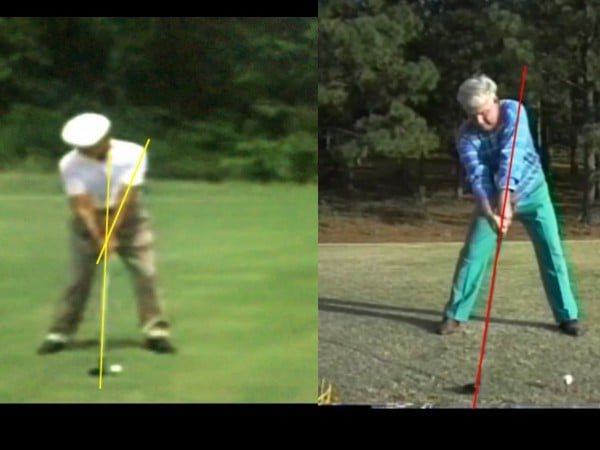
Starting with the Address Position, below you can see 2 views. One view is from down-the-line and the other is from face-on.

In the down-the-line view, Hogan begins with his arms hanging straight down from his shoulders. The 2 yellows lines intersecting each other is considered 2 planes, there is a club shaft plane and the arm plane.

With Moe, there is only one red line. This indicates the Single Plane line of the club shaft aligning with the trailing arm and running through the middle of the back.

The face-on images below examine another difference at address. Moe would always establish the “rod” position of the club shaft aligning with the lead arm. This happens because of spine tilt (notice how Moe’s lead shoulder is higher than the trail shoulder) and clubhead position.

You can see that Hogan begins where the club shaft does not align with the lead arm. Hogan has less spine tilt and the club head is positioned directly next to the golf ball.

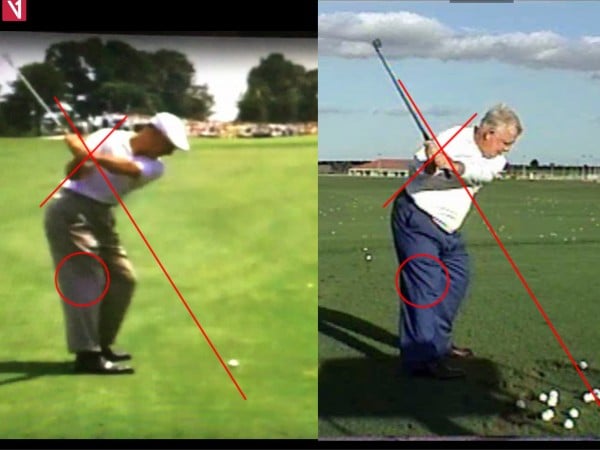
Moving into the backswing below, Hogan and Norman have multiple similarities in this position.

When the hands are positioned almost shoulder high in the backswing, notice the following:

  • The trial knee is slightly flexed and braced (maintains its position)
  • The trailing arm is folded and in line with the spine
  • The lead arm is straight
  • The club shaft is parallel to the red plane line
  • A leverage angle is created between the lead arm and the club shaft

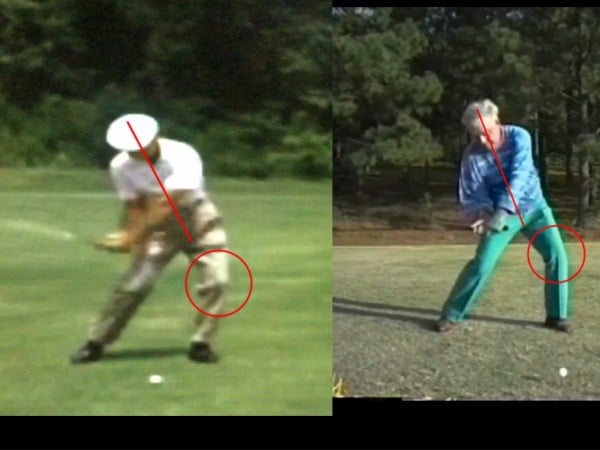
Below is Hogan and Norman in the hitting position (position 3) and also a frame just before impact. Once again, numerous similarities here from the face-on perspective:

  • The lower body has transitioned into a flexed lead knee
  • The upper body has stayed back and increased in spine tilt
  • The majority of the weight is into the lead knee
  • Both feet are on the ground
  • The hands are leading the clubhead into impact

Let’s now take a look at the most important position in the golf swing, IMPACT.

Before we get into it, remember that a Single Plane Swing is defined as starting and impacting the club shaft on the same plane.

Ben Hogan and Moe Norman both start and impact on the same plane. Therefore, both are considered to be Single Plane and according to Tiger, “Only two players have ever truly owned their swings: Moe Norman and Ben Hogan”.

Another key aspect to the impact position below is that the trail foot is on the ground which allows for the pelvis and spine to stay in posture as the body rotates in the downswing.

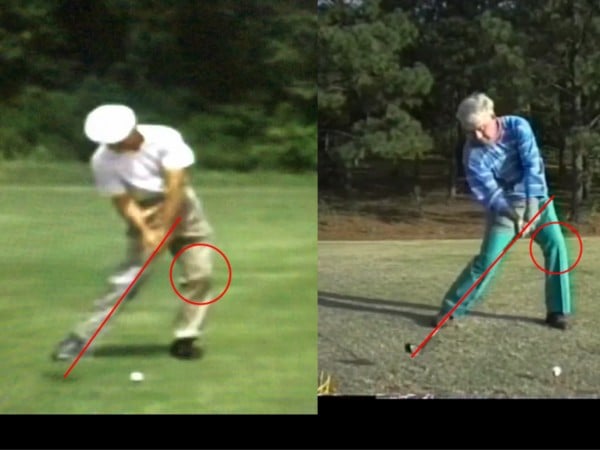
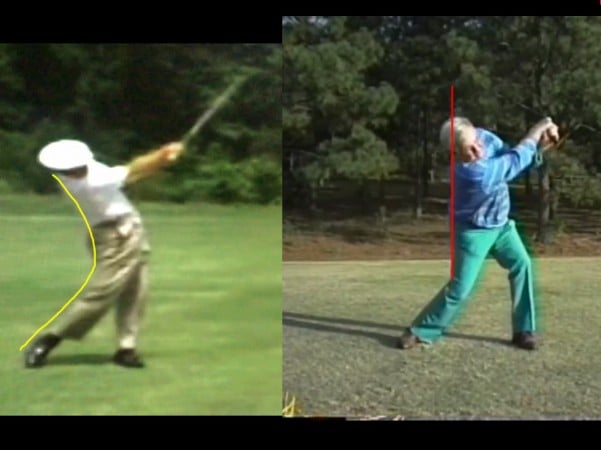
Lastly, is the release position and other than the address, is the most drastic difference between Hogan and Norman.

When looking at cause and effect, notice Hogan’s upper body in the release. Do you see how his spine is leaned back (otherwise known as a Reverse C)? This is caused by his lower body. Very quickly after impact, Hogan’s trail heal comes off the ground forcing his pelvis to slide forward and under him. This then causes his upper body to lean back.

With Moe, the lead knee remains flexed and the trail foot is on the ground which keeps his lower body in a stable position. The spine is able to achieve a straighter position which will alleviate any stress off of the back.

Putters Aren’t Balky. People Are.

GGA Mental Game Coach.

Brooks Koepka proved to be an incredible champion yesterday…defending a US Open title successfully for the first time in 29 years. It was a very special performance for sure!

And among the great performers on the very difficult Shinnecock Hills layout, (Patrick Reed, Daniel Berger, Tommy Fleetwood) there were also those who underperformed over the course of the championship. (Ricky Fowler, Rory McIlroy, Jordan Speith, Phil Mickelson …and perhaps even Dustin Johnson on Sunday.)

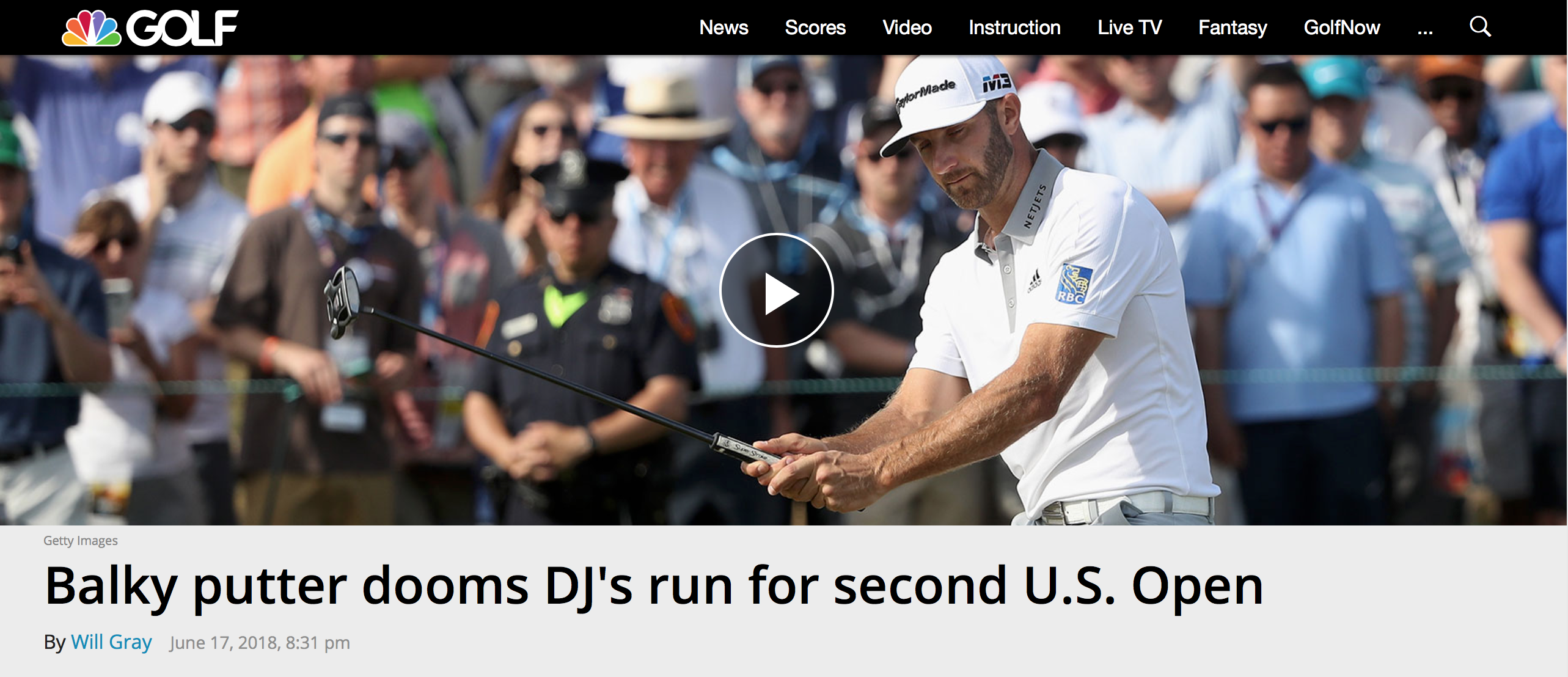
In fact, one headline that caught my attention today was this:

Screen Shot from the Golf Channel Website.

Huh?

So it was the putter’s fault? His putter didn’t cooperate?

I say nay. (…to quote the late comedian John Pinette) Putters aren’t balky. People are.

It’s tough to pinpoint exactly what went wrong for DJ…but it just seemed like he was not very confident on the greens on Sunday …and the stats show it. He took 26 putts in his first round, and 38 in his final round.

He has an incredible record in the US Open. (T4 or better in four of the past five years.) you got to love watching him play! And I can’t know for sure what was happening yesterday for Dustin…but if I was working with him, I would want to know more about how he was feeling on the greens.

Why? Our feelings are typically a product of our thoughts…and if I’m caught up in “stinking thinking”, then it is tough for me to be confident and play my best.

For example, when we operate from a scarcity perspective, it is easy to FEEL the pressure of the moment….to become stiff and protective. But when we operate from an abundance perspective, we are not limited by our thinking. We are much freer to play the game of golf with more confidence …and (all things being equal) with better results.

As a performance coach, I am interested in helping my clients to create the conditions so that the challenges they face don’t limit them from their highest potential at any moment.

From my vantage point, it seems as though many of this week’s participants may have succumbed to the narrative inside their head that is NOT supportive of great play. This narrative is often referred to as the EGO…a well-known part of our brain that is designed primarily to keep us safe…but which can alter our performance capabilities in significant ways if we are not careful?

I have learned to notice when my own EGO starts speaking loudly in reaction to my experiences. In fact, I call mine Carl. (And I encourage my clients to name their Ego as well.)

(That voice that says “You better not miss this one” when you are lining up that five-footer on the 18thgreen to beat your buddy is your Ego.)

One of the best ways of dealing with a challenge on the course (or anywhere) is to be able to tune in to the way in which your Ego is speaking to you. When you can do this, you will recognize quickly that your inner voice associated with your EGO is much more interested in what you might lose than in what you might gain. It is essentially operating from a scarcity perspective, rather than an abundance perspective.

And when you can tune-in quickly enough, you can quiet the Ego and move to more productive narratives, reaffirming to yourself that:

You HAVE enough.

You ARE enough.

You WON’T die if you miss this putt…etc.

You will remember that you need not worry about what happens on this hole. That it is THIS shot that counts. And you will begin to play a game where the only thing that matters is NOW. This moment. Right here. Right now.

You will also make space for your playful instincts to thrive. You will be more at ease than ever…and you will be more resilient – abler to tap into the BEST of your skills that day.

The next time you play, experiment with tuning in to your inner voice: The Ego that is focused on loss, losing, lack, scarcity. Name him (or her), and see if you can begin to just acknowledge him (or her), and yet move on to channel abundance, joy, creativity, innovation, and accomplishment.

I think you will find that you will cultivate a much more pleasant experience for yourself on the course…and your performance will improve as well.

Remember. Putters aren’t balky. People are.

Paul Monahan, PCC is a Peak-Performance coach, member of the International Coach Federation and a certified COR.E Performance Dynamics Specialist. He resides in Cleveland, Ohio with his wife Paula and is the proud dad to three young men. He works with elite-level performers and leaders, helping them to expand their awareness so that they perform at their best more consistently.

He can be reached at paul@paulmonahancoaching.com

The 4 Cs of a Great Short Game

With our upcoming Short Game School (2nd week of July) (very excited about having our 2nd short game school in the past 2 years…) wanted to remind everyone about my 4 Cs of a GREAT Short Game. These are/will be covered “in depth” during our short game school and covered in all different areas (putting, chipping, pitching, bunker, specialty shots… especially those specialty short game shots).

In our schools, camps, and clinics (and pretty much anytime you’re around me), you will continually hear how important the short game is for scoring. In this article, I’m going to compare the long game vs. short game then give you my 4 Cs that you must follow to have a great short game.

First, you must be convinced that the short game is the most important part of scoring. Here are a couple facts about the short game.

Fact: The difference between a 30 handicap golfer and a scratch golfer (0 handicaps) is associated with 7 to 10 shots in the long game (shots over 50 yards) and 20 to 23 shots in the short game (shots under 50 yards). Meaning, if you are a 30 handicap golfer and only work on your long game you will only improve 7 to 10 shots toward scratch golf. The best you will ever reach is a 20 handicap. The difference between a 15 handicap golfer and the scratch golfer is associated with 3 to 5 shots in the long game, and 10 to 12 shots in the short game. In other words, if you are a 15 handicap golfer wanting to reach scratch, if you only work on the long game, you will basically never improve beyond a 10 handicap.

Fact: No professional (or scratch golfer) has an advantage in their short game over yours. In other words, the short game is not associated with strength, working out or athletic ability. It is a part of the game that is associated with practicing the correct fundamentals and putting those fundamentals into play at the right time. Ever notice how many young players (talking about 10, 11, 12-year-old juniors) have a great short game. In fact, many compare to the professional’s short games. Don’t you wonder how someone who is 75 pounds soaking wet can compete with the best players in the world? This shows it is not strength, but rather what matters are things like finesse and feel. This is what I call the 4 Cs to the short game: Creativity, Confidence, Commitment, and Critique.

4 Cs

CREATIVITY: The first thing you must do when confronted with a short game shot (pitch, chip, etc.) is to create the shot. Part of the teaching we give our students during their short game instruction is to pick a shot around the green and ask the group to name 5 different ways to play the shot. Most of the time the group is able to name 2 or 3, but almost never 5. An example would be a shot that is 20 to 25 yards off the green with minimal rough between the ball and the hole.

You could:

  1. Pitch the shot to the hole,
  2. Chip the shot into the fringe around the green and roll to the hole,
  3. Putt through the entire rough and fringe,
  4. Hit a flop shot all the way to the hole, or
  5. Hit a 3 wood chip that will have moreover spin and roll to the hole???

The point here is you need to be creative over the shot. I like to call it the “artistic” part of the game.

A good rule of thumb: “Putt when you can, Chip when you can’t putt, Pitch when you have too…” (Aka – the “PCP Rule” – refer to past articles on the PCP Rule). Yes, this is a very basic “rule”, but a good one to fall back on.

COMMITMENT: Once you have created the shot, you must commit to the shot that is the lowest risk for error FOR YOU. If you have a good pitch shot and feel it is the most likely to get the ball close to the hole with the least room for error, hit the pitch shot. Many will feel the chip from the fringe or even the putt will be their lowest risk shot. DON’T think you have to hit a shot in a particular manner because the pros on TV hit it that way, but rather execute the shot YOU feel you can hit with the most confidence.

CONFIDENCE: So now that you have created and committed to the shot, you must play the shot with confidence. This means that if you have chosen to chip the shot, tell yourself you will chip it close, pick your spot you want to hit, use good fundamentals, and with 100% confidence, hit the shot. If you don’t feel confident over the shot, BACK OFF and commit to something different or swing a couple practice swings/chips until you have gained the confidence back. The last of the 4 Cs are:

CRITIQUE: You must critique your short game shots after you have executed them. This is not to say, “I can’t hit a particular shot”, but rather “I had 4 chip and run shots today and only hit 1 good. Therefore, I need to put more practice in the chip and run shot”. Look back at each shot and determine if you need more practice in that area. Here’s a question you can ask yourself and see how well you currently critique your short game: How many of you practice chipping short of the green (maybe into the fringe) and then roll the ball onto the green close to the hole or how many of you when practicing putting, putt balls from off the green (from the fringe or low rough) to the green? I believe that these are the shots that, after you critique your short game, will probably be the shots that need the most practice.

Finally, I believe that EVERYONE can have a GREAT short game. In fact, everyone can have a short game that is as good or better than any professional. But, to get this GREAT short game, you must first learn the proper fundamentals and practice these fundamentals. Then you can use the 4 Cs – Creativity, Commitment, and Confidence and then Critique to bring that short game to the course.

Good Luck and Remember – ALWAYS PRACTICE WITH A PURPOSE!

LEARN

THE

SWING

Join 1M+ Subscribers to get your FREE Video Quick Start Guide that reveals how to hit the ball farther and straighter more consistently from now on…

START YOUR NEW GOLF SWING