Can you Guarantee your Success

Can you Guarantee your Success

Only Perfect Practice Makes Perfect

Have you ever been profoundly sleeping and found yourself in a peaceful dream that suddenly turns nightmarishly dark? Curl up in your chair, place your hands over your eyes and peek through your fingers as I describe a frightening scenario.

Thousands of years ago a young warrior is learning to hunt with his father, the Chief of the tribe. As they gather their spears and arrows, the father knows what the boy doesn’t, that the future of his clan is at stake. He knows that the objective is survival – not of the fittest but the skilled. It is not a game. His son’s failure to acquire the necessary skills would jeopardize the future of his people.

The Chief begins the training by hunting small animals with arrows teaching the boy the techniques of tracking prey and the art of patience. He understands that errors are inevitable but certain technologies, erudite from centuries of mistakes, speed up the learning. He shows him how using two fingers around the string to pinch the arrow slowly while drawing it back to avoids the cracking noise the bow makes when pulled. He demonstrates how closing one eye helps peer down the shaft creating a visual tunnel to the target. Every lesson is precious; absorbed from centuries of previous warriors, feeding and protecting their families.

At first, there are too many things to think about, being quiet, finger position on the arrow, pulling the bow, balancing and aligning the body. At first, the boy is clumsy. Bolts drop from his fingertips and as the bow trembles with insecurity. It seems hopeless to the spectating tribal members. It appears that the women and children of the tribe will starve, but the Chief is wise. He trusts like survival, and that inside his son is a fighter waiting to emerge. He also something sagacious – that the errors are just as significant as the successes, a lesson taught to him by his father. He understands that as some immeasurable and unpredictable instant a miracle will occur, and a boy will transform into a warrior, but the only way to reach that precipice is to let him stumble and be patient.

The Chief also knows that each failure is one tiny adjustment closer to his skill. Each time his son misses he corrects him, repositioning his body and sharpening his aim. Each miss of the target requires an adjustment, and each strike reinforces his feel. As he improves, his confidence grows. Soon he can hit small targets from hundreds of feet away and eventually in a blink of an eye; he can perform the multitude of quiet succinct movements in perfect harmony – moving and releasing arrows effortlessly from the bow.

In the end, the fear of starvation and death created an opportunity for survival and safety. Skill has been discovered and a warrior emerges – guaranteeing the continuation of a tribe. A future teacher will establish who will eventually teach the same skills to his son.

Fast forward a few thousand years. A golfer slowly opens the back door of his SUV. As door partially opens, he sits on the bumper. He slides his feet into his golf shoes, laces them tightly and pulls out his golf bag setting it on the pavement. He closes the hatch, straps the bag over his shoulder and heads to the practice tee unaware of the threat that lies ahead.

As he walks to the practice tee, he slides a harmless seven iron from his bag and taps a golf ball from the pile into position. As he wraps his fingers around the grip of the club and addresses the ball, he is hopeful yet cautious. His mind fills anxiously with thoughts of anticipation. Will today be a good day or a bad day? Could I finally find the secret or will I be disappointed? He is unaware that inside his brain, is a potent chemical – an atomic weapon – waiting to release its power – the same gun that helped a Chief mold his son and ensures the survival of his tribe.

Each bad shot is painful and disappointing. Each good one encourages. The problem is that there is no Chief to guide him and keep him on track. He never knows what’s coming. It’s a guessing game. What happened on the bad ones? What did I do right on the good ones? Confusion, fear, and hopelessness ensue.

There is something even more frightening going on inside the golfer’s brain – an intelligent design that the Chief innately knew. Inevitably, each swing causes an emotional jolt firing a neuron in the brain releasing powerful chemicals. The chemicals reinforce each experience. The experiences, good and bad, create neurological patterns that grow and solidify. The golfer continues to guess and proceed unchecked until the pattern develops landing him in the giant pile of golfers that can’t break 100. Unlike the Chief who monitored his son, adjusted his techniques and guided his behaviors, an insurance policy ensuring that the skill would evolve. Without a coach and a guide, there is no insurance of success.

The atomic chemical, innately known by the Chief, is myelin – a fatty substance that reinforces the electric circuits inside the brain. All of us have this natural swimming around in our heads waiting to build a pattern. Relentless and unbiased, it doesn’t care if the swing is a good one or bad one. It has a job to do – the same role that helped a kid become a warrior – to learn a pattern, build skill and survive.

If you’re lucky and you guessed it correctly as you practice, the myelin releases and a miracle takes place – you build an incredibly efficient circuitry that can repeatedly strike a ball dead straight long distances. Or something devastatingly nightmarish occurs illuminating the wisdom of the Chief – that the tribe will starve or in your case, you build an incredibly efficient circuitry that can’t strike a golf ball. Whether you are a boy becoming a warrior or advanced human learning to play golf, your success at learning skill depends on how you wrap myelin around the circuits of your brain.

In the past, practicing wrongdoings could mean extinction. Today it means frustration and losing dozens of golf balls. It might not be life or death but, I have a critical question. Are you willing to guess at your golf swing survival? (STAY TUNED…for the perfect golf lesson)
 

Miss it Fast

Moe Norman – through his brilliance, his pursuit of excellence, and his perspective on life and golf  –  said a lot of memorable things the course of his life.

One of my favorites is: “Miss it fast.”

What does it mean? And how does it relate to your golf game?

Turns out that the concept: Miss it Fast is amazingly simple, and yet rooted in the complex dynamics of the human brain. You see, even if Moe was not aware of it, the knowledge of what “Miss if Fast” yields for athletes like golfers is supported by the latest research and science in human performance.
And it has surprising implications for your mental game.

Last weekend, at the 2-Day Mental Game Playing School at Prairie Landing Golf Club in West Chicago a whole group of Single Plane Swing golfers had the opportunity to gain a much deeper understanding of what Moe meant by Miss it fast.

One of the key concepts we spent a lot of time on was this: The golf swing is a physical movement. There is a part of your brain that is dedicated to replicating the physical movements you repeat over and over again …it’s called procedural memory.

When you rely on procedural memory to execute a golf shot you give yourself the best chance of pulling off the shot the way you intend to. However, when another important part of your brain – the thinking and analytical part – gets involved, you can often struggle to create high-quality shots.

What to do?

Create routines or distractions so that you prevent too much thinking and analysis (… produced in the part of the brain associated with Working Memory.) Hitting the ball relatively quickly is a perfect example of this kind of distraction.

One super-effective portion of the instruction last weekend was dedicated to teaching a tightly-rehearsed 5-7 second pre-shot routine based on the fundamental concept that dwelling over your shot for 10-15 seconds is a sure-fire way to take you out of Procedural Memory and into Working Memory (where analysis, fear and anxiety lurk.)
Tim Graves and Chandler Rusk led the group through an exercise that allowed the guys at the school to see first-hand how much a short, crisp pre-shot routine can impact the mental game.

Elite-level golfers know that a routine like this supports great shots – but they may not know exactly why.

The reason is that when you keep your pre-shot routine short and structured you prevent the over-analysis, anxiety and resulting tightness in the swing that comes from THINKING TOO MUCH about the shot you are about to hit.

When Todd or Tim talk about “playing empty” they are talking about hitting shots when you are operating from Procedural Memory…and not Working Memory. They know – as did Moe – that if you dwell and linger over shots before you hit them – your capacity to hit great shots is significantly diminished.

So if you want to enhance your mental game, consider practicing your pre-shot routine. See if you can build a deliberate – but not rushed – routine that allows you to step into the ball and pull the trigger within 5-7 seconds. I think what you will find is that you won’t get “stuck” in your thinking nearly as often as you may be getting stuck today.

Miss it fast!

-Paul

Paul Monahan, PCC, GGA Mental Game Coach is a Peak-Performance coach, member of the International Coach Federation and a certified COR.E Performance Dynamics  Specialist. He resides in Cleveland, Ohio with his wife Paula and is the proud dad to three young men.

He can be reached at paul@paulmonahancoaching.com

Single Plane Swing Wins on PGA Tour! Bryson vs. Moe

Bryson DeChambeau vs The Single Plane Swing

Bryson DeChambeau has riveted spectators with his unique golf swing and style. He has introduced the golf world to the Single Plane address position that we have promoted for years.

It is similar to Moe Norman in many ways, but we still think Bryson’s swing can be simplified even more and Moe’s golf swing is more relaxed on the back.

If you are to simplify the golf swing the following must occur.

You must –

  1.    Reduce lateral movement for consistency.
  2.    Reduce rotational movement and still produce speed.
  3.    Reduce stress on the body parts throughout the motion.

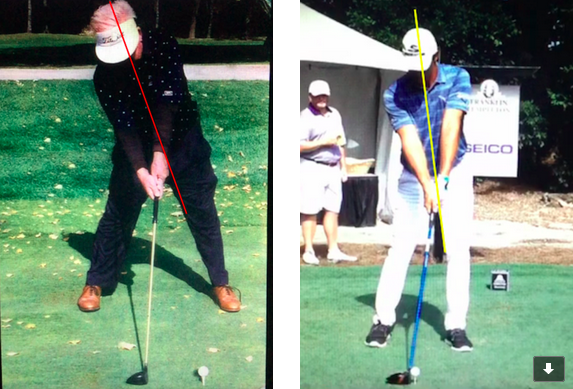
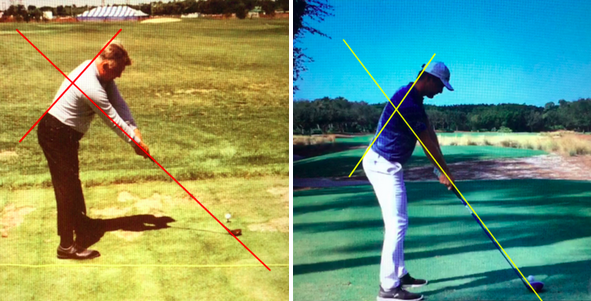
One thing that has so many people intrigued about Bryson is his address position. Bryson begins the club shaft to where it runs through the middle of the back – also known as the Single Plane. The big difference in the pictures below are the spine positions. Bryson stands much closer to the golf ball than Moe which results in a more upright spine angle

Continuing the address in the pictures below, Bryson has less secondary spine angle, side-bend, than Moe. This leads to straightening the lead leg, a lifting of the body and an over-rotation of the torso through impact.

One reason that Bryson has a less secondary tilt at address is that his stance width is very narrow. Moe’s stance width is double the width of Bryson’s (with a driver) which helps place the spine further behind the golf ball.

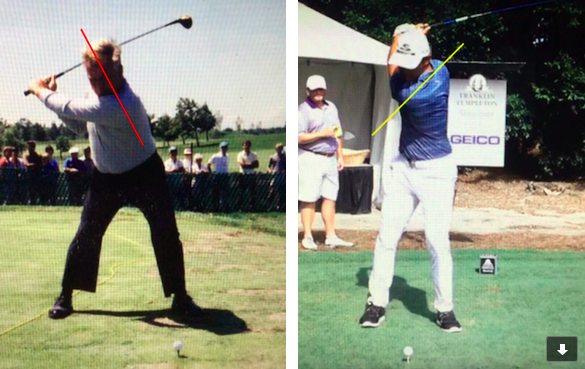
Below are Moe and Bryson at the top of their backswings. Moe on the left has less torso rotation and maintains the side bend that he started with (this helps eliminate over-rotation).

Bryson on the right rotates his torso more than 90 degrees in the backswing. The way Bryson generates speed is by extreme rotations and long levers. Bryson is 6’1″, 24 years of age, and has a daily workout routine. The average age of a golfer in the United States is 59 years old. Not many are flexible and healthy enough to copy Bryson’s 24-year-old rotational movements.

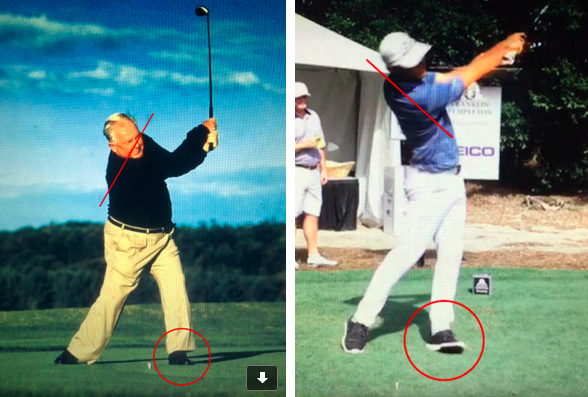
Below is the release position of Moe and Bryson. Highlighted in Bryson are the torso rotation and the lead foot. Since both of Bryson’s arms are still straight, this has forced the first shoulder to continue rotating thus eliminating speed production from the wings and wrists. The lead foot has spun out caused by a straightened lead leg forcing stress onto the lower back.

With Moe, the lead foot is fully stable on the ground. The lead knee is flexed which takes the stress off of the back. The torso rotation is less as Moe’s first arm has folded allowing the wrists to release. Bio-mechanically, this is the safest way to position the body and the main reason that Moe never had pain

Golf is fun if you don’t hurt. Therefore our goal is to produce maximum speed and move the body safely to reduce injury. The best and easiest way to learn this is at one of our Golf Schools or through our Gold Membership/Coaching Program.

To see more about our upcoming schools:  CLICK HERE

The Stockdale Paradox (Revisited)

Today – August 26, 2018 – as the nation mourns the passing of Senator John McCain – one of the United State’s most famous war heroes and prisoner of war – I thought it might be fitting to revisit a post from last fall. In the post below, I highlighted a lesson from Admiral James Stockdale who was a prisoner with McCain at the infamous Hanoi Hilton during the Vietnam War.

Later this week, about a dozen Single Plane Swing golfers will descend upon Chicago’s Prairie Landing Golf Club for a very special 2-Day Mental Game School. (Yes…still an open slot! But you have to move immediately! Click here for details!)

At this school, we will talk about how understanding the fundamental paradoxes of performance can positively impact your golf game.

Here is the blog from last November:

James Stockdale was one of the greatest military heroes our country has ever produced.

As a Navy pilot and commander, he flew over 200 combat missions during three separate deployments in Vietnam and became one of the most decorated Navy pilots ever.

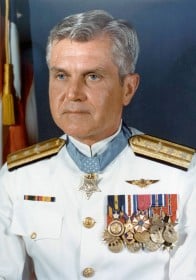
Vice Admiral James Stockdale
James Stockdale

But his most significant achievement came after September 9, 1965, the day he was taken prisoner after being shot down over North Vietnam.

As the highest-ranking Naval officer to serve as a prisoner during the war, Commander Stockdale’s leadership among the POW population was legendary. And he was credited with saving the lives of hundreds of American POWs throughout his eight-year captivity.

(If you ever want to be inspired by someone’s capacity to influence others in positive ways, read Stockdale’s essay Courage Under Fire.)

Years after the war ended, Stockdale was asked about how he managed to cope with the challenges of being a prisoner under such horrific conditions. (Stockdale and others – including a young aviator named John McCain – were routinely beaten and tortured.)

He explained that he never lost faith that things would turn out ok. He believed that he would prevail. And that he would be a better person for having persevered through the struggle.

But here is the exciting part.

When asked of his impressions about those who did not make it out of the prisons? The soldiers, sailors, and airmen who perhaps lost the will to go on. Stockdale said it was the optimists who struggled the most:

“Oh, they were the ones who said, ‘We’re going to be out by Christmas.’ And Christmas would come, and Christmas would go. Then they’d say, ‘We’re going to be out by Easter.’ And Easter would come, and Easter would go. And then Thanksgiving, and then it would be Christmas again. And they died of a broken heart.”

(Good to Great author James Collins described this as the Stockdale Paradox.)

Stockdale also was quoted as saying:

“This is a fundamental lesson. You must never confuse faith that you will prevail in the end—which you can never afford to lose—with the discipline to confront the most brutal facts of your current reality, whatever they might be.”

It turns out Commander Stockdale had studied Stoicism while in graduate school. Stoicism teaches that happiness in life comes from acceptance of each moment as it is, and from preventing one’s desire for pleasure or fear of pain to control one’s behavior.

I love Stockdale’s perspective (and Stoicism) when it comes to the human development process…and especially the Single Plane Swing.

The challenges we face as we learn to play this game of golf at a higher level are not as grim, and the stakes are not as high as those faced by American POWs…not even close. But the human psychological dynamics are similar.

The Single Plane Swing journey – in fact, any endeavor of change or transformation – is one which requires both FAITH and DISCIPLINE.

The faith to know that you will prevail.

And the discipline to forge ahead even when you experience the challenge or setbacks.

What does that look like for those on the SPS path?

That you KNOW and trust that the Single Plane Swing model can produce amazingly consistent shots and that if you listen, work at it, get feedback, and repeat the cycle enough times, you WILL improve.

When you have faith, you don’t need to put a timeline on your development. You don’t need to be an optimist. Just DO the work and trust that you will make progress.

Let go of your story about WHEN you will “arrive.” Just know that you WILL get one day. (Or that “arriving” may not be the point after all!)

And when you feel like you have plateaued or regressed, have the discipline to STAY IN THE GAME. Don’t ever quit.

You’ve done this all your life – and you have produced a lot of success in your life and careers because of it.

Have faith. Keep it real. Be disciplined. Stay in the game.

Paul Monahan, PCC is a Peak-Performance coach, member of the International Coach Federation and a certified COR.E Performance Dynamics  Specialist. He resides in Cleveland, Ohio with his wife Paula, is the proud dad to three young men and is also on the Single Plane Swing journey. Paul can be reached at paul@paulmonahancoaching.com

Hybrids vs. Irons – When to Hit

This week we are holding a private Ask Us Anything / Q & A Webinar.

We asked Single Plane Academy members to send us any Single Plane Swing, Short Game, On Course, etc.. questions and we would answer. We are filming the responses outside (not in our studio) – so we have more options for the replies.

All members – watch your email inbox this week for details as this webinar will air this Wednesday night August 23rd.

But – one “common” question received (multiple times) was hybrids vs. irons. Thought would reprint a past article about hybrids/irons.

When do you hit hybrids, when do you hit irons?

Here are a few scenarios of when it is recommended to hit a hybrid and when it is recommended to run an iron.

First – A Hybrid is best thought of as a long/mid iron replacement. It is a club with a more full sole and typically more weight on the bottom/ sole of the club which makes it much easier to hit the longer shots (with the hybrid vs. the mid to long iron). And it is much easier to hit the longer shots with height (due to lower center of gravity in the club) which typically allows the golf ball to “hold” on the green easier.


Scenario #1: Ball in Rough

Depends how the ball is sitting in the rough. If the ball is sitting on the top or middle of the rough, can use a hybrid.

If the ball is sitting at the bottom of the rough (or in deep rough) – use an iron. Might need a metal with a lot of lofts (wedge, etc.) if rough is thick enough need to get the ball up quickly to get out of rough and back in the fairway.

General Recommendation from the rough (when not buried in deep rough):

When the distance is more critical – hybrid.

When accuracy is more critical – iron.

Always remember – if there is a question if the hybrid will get the ball out of rough or not, use iron and get back into the fairway. Combinations are great clubs from “mild” rough but can get you in trouble if rough is too broad.

Scenario #2: Ball in Fairway Bunker

A hybrid is a great club to hit out of fairway bunkers. If you are beating out of a container and there is a minimal lip on bunker (don’t have to hit up fast) use the hybrid.

If the ball is sitting down in the sand (buried type lie) or you have to get up quick (high lip on the bunker) – use an iron.

Scenario #3: Hitting into the Wind

If it is minimal wind and you can account for the wind vs. added height of the hybrid – hit the combination.

If very windy and must keep shot down/low – use an iron. It is relatively difficult to keep hybrids low and not very good clubs into a lot of wind.

Many good players will put irons in their bags instead of hybrids when playing in excessively windy days. For example, wind blowing 30 mph to 40 mph or higher, might consider putting a four iron and five iron in the bag instead of 4 and five hybrid. If you carry three combinations, might find a three iron (if you have one) those days. Most good players will have both metals and hybrids (at least a few) – for example, a four combination and four iron (carrying only one, depending on conditions).

Scenario #4: Hitting below a Tree / Punch Type Shot

If you are hitting a low shot (punch type shot) below a tree, etc. it is recommended to run an iron. Hybrids are built to get height fast, and they are not good clubs to punch shots out below trees. Would recommend hitting your longest (least lofted) iron vs. hitting a hybrid in these situations. In other words, strongly suggest punching a six metal vs. a five combination under the tree. Or a five iron vs. a four hybrid, etc..

Scenario #5: Chipping when a ball is sitting into the Grain

Many times when a shot comes up short of a green and is on an uphill slope to the green, it is sitting “into the grain.” Grain of the grass typically goes the way the water would roll off the hill. In other words, if your ball is sitting on a spot the water would move away from the hole, your shot is probably sitting into the grain.

To test this, take a couple of practice strokes with iron and “feel” the grass/grain. If it feels “sticky” – like the club will not cut through the grass clean and with ease, your ball is sitting into the grain. This type of shot, many times will be hit fat or “chunky” because the club will not get through the grass clean. Use your hybrid for chipping in these situations. The wider sole of the club will glide across the grass and will not get “stuck” into the grain.

Like any “specialty” shot – they require some practice. Using the proper “tool” (hybrid vs. iron) is the first key to hitting the specialty shot. The more you practice with the proper club in each scenario, the easier it will become.

If you can think of other scenarios of a hybrid vs. iron, let me know – happy to give recommendations in upcoming practice tips.

What Are Your Waiting For?

What are you waiting for?

The Single Plane Swing has not only been a game-changer for thousands of players, but it’s also helped them to play without pain in their shoulders, lower back, hips, and knees.

And now, with your membership to the Single Plane Academy Inner Circle, you will receive access to ALL of our most effective training programs profiling Moe Norman and his extreme swing.

As you will see, the massive volume of golf instruction inside the Inner Circle is unparalleled. You have access to almost every bit of training we’ve ever developed regarding the Single Plane Swing.

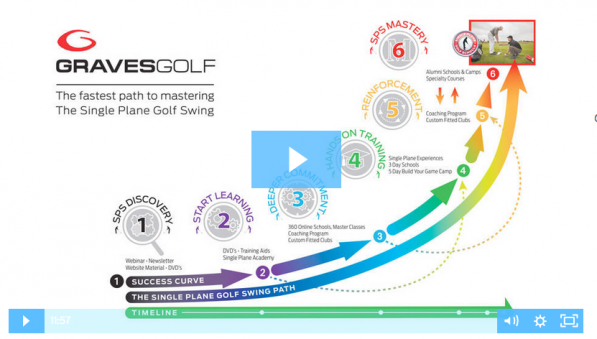
We call it the “Single Plane Success Path,” because that’s what it is, a collection of golf swing training that’s been specially designed to shortcut your way to success and get you as right as you can be…

Learn more about the Inner Circle and the different memberships:   CLICK HERE

LEARN

THE

SWING

Join 1M+ Subscribers to get your FREE Video Quick Start Guide that reveals how to hit the ball farther and straighter more consistently from now on…

START YOUR NEW GOLF SWING