Moe’s “It”

Moe’s “It”

An article from a few years ago, but recently have received some of the same question(s) – so thought would be a great time to republish.

This week – got a great email question from one of our students.  Here is the question and Todd’s response.

From:  Kevin F.:

Hi Tim!

Thanks for sending out your news letters via email, I enjoy reading them every month. I have a strange question but my wife says that’s pretty typical of me. Could you expand somehow on Moe’s quote, “When you get “it”, you won’t believe your eyes.” I know I’ve read that before, I believe somewhere when you were discussing finding the right grip and how your hands work together in the swing, but I may be wrong. Was Moe at a clinic discussing a certain segment of the swing or was he talking about the grip? Maybe that was just an overall comment regarding everything involved in his swing and working hard to finally finding the “it”, I don’t know. That quote though, for me, is actually one of Moe’s most inspiring quotes and keeps me trying to learn as much as I can about what he did and what you teach. I want to find that “it”!!! Hope to hear from you soon!

Thanks and Happy New Year!!

Kevin F. ( True believer since 1995 )
 
**********

“IT” 

By Todd Graves

As the story goes, I was playing the Canadian tour – and we had reached Toronto, the East Canada swing.  I usually only hung out with Moe on the East side of Canada because he was there in the summer.  This particular time I was playing the tournament at the Royal Woodbine Golf Club, a golf course very near the Toronto Airport.

Moe showed up the day of the practice round as I was warming up on the driving range.  I asked him to hit a few balls as all of the players on the tour gathered around to watch.  After he hit balls for about an hour with a crowd of 25 CPGA (Canadian PGA) tour players, we decided to have lunch in the clubhouse.

At the time in my career, I was struggling with-Moe’s swing – my club face was closed at the top of the back swing and, as a result, I often hooked the ball.  Moe seemed to know what I was going through and as we were eating our sandwiches he said, “You won’t believe your eyes when you get it – you won’t believe your eyes”.

At the time, I really didn’t understand fully what he meant.  I obviously knew that he saw a problem in my swing and I understood the “It” part but but I didn’t comprehend what he meant by “won’t believe my eyes”.

Many years later, after a bit of frustration of still hooking the golf ball that I changed my lead-hand grip to a fully neutral position (I struggled with this for a long time).  Of course it felt horrible and I hit the ball terribly for a month or so.  My swing, however, looked very good on video but because of the grip change the club face was in a perfect position at the top of the back swing, however, I struggled with squaring the face at impact and fully releasing the club.  (This is very common if you have a strong lead-hand grip).

After taking some time to practice, fighting through the frustration, and working on the feeling of the lead hand position for a few months, (and to be truthful I really can’t even understand how exactly), one day the ball began to sound different than any time I had practiced before.

What was even more exciting was that my shots began to have the most incredible flight.  I was hitting a 5 iron and I can honestly say I had never seen my ball fly so high, pure and straight.  Since then, I have never had a problem with my grip and I have never lost it.

Later that year, when Moe he saw me hit the ball he said ‘I told you so, you can’t believe your eyes- can you?”  – He remembered our lunch in Toronto.

So what was “It” that Moe was referring to?

The “It” Moe talked about was simply the feeling of great swing mechanics, which resulted in great ball flight. More specifically the perfect movement of the golf club AND the movement of the body that created it.

If you had the privilege to see Moe strike a golf ball in person, you would have immediately noticed the sound and flight of the golf ball.  Moe often described it as “pure”.  This pure sound and flight was the result of great swing mechanics.  Moe had “It”.

“It” is similar to making an apple pie.  You have all of the ingredients but it only tastes like apple pie when all of the ingredients are correctly mixed and properly baked.

“It” is when a child learns to ride a bike.  At first riding requires training wheels then, eventually he feels how to balance, pedal and steer.  Suddenly, when the training wheels are removed, he is riding the bike.  He gets “it”.

“It” is the result of having all of the right ingredients in all of the right places, at the right time resulting in perfect result.

In my case, “It” was years of hard work, trial and error, studying Moe’s move, talking with Moe, making changes, plenty of frustration and hours and hours of practice.  These were my ingredients.

“It” happens when you, at the subconscious level, are able to perform the given task without thinking about it.  It just happens because at a very deep subconscious level, that can only be reached through practice and repetition, “It” is the only way you know how to do it.

So, what are your “It” ingredients?  How do you get it?

Well, this is what we (the Graves Golf Academy) are all about.  Helping you get the ingredients you need to get “It”.  The ingredients might vary for some however, there are definitely certain things that are the same for everyone.

One thing that I recommend is to do your best to “shortcut” this process – one way to do this is to use video analysis and get consistent and frequent instruction in the process while you are developing and changing your swing.  If you do this, you can speed up the process and with a little hard work and practice, as Moe said during lunch in Toronto – “You won’t believe your eyes”.
A Challenge from Cap’n Video

By GGA Master Instructor and Cap’n Video himself, Clay Farnsworth, PGA

I have dubiously inherited the nickname seen above, Cap’n Vid. As you can see, I have shortened it a bit in the hopes of not getting in trouble with the REAL Captain Video, as we all know that he can never be replaced.

I trust and hope that all of our students out there are doing well and that their sports teams of choice are doing better than mine at the moment (Michigan State just suffered a big loss to Ohio State). Most, if not all of you guys know that Tim uses statistics to help compare what the averages are in the short game and Todd, frequently uses different metrics to help run the GGA marketing and other departments. I thought about using metrics too, but I took a slightly different approach.

On average, an NFL or College football game lasts about 185 minutes. During that time eleven minutes is actual playing time. Sixty minutes for commercials, as we all need to keep up on the latest and greatest stuff, seventy-five minutes watching huddles or coaches on the sidelines. Another twenty-four minutes is the average spent on replays. I won’t insult anyone’s math skills here but just say the balance of the time is sideline reporters, cheerleaders, fans, etc. You get the picture.

Here are a few more statistics that I found doing my “research”. The average American, (not to leave out our other students worldwide) watches television an average of 278 minutes a day. Another 173 minutes are spent online, and believe it or not, 92 minutes are listening to the radio. These statistics are a couple of years old but, suffice it to say, they help prove my point.

I know what you are thinking. Obviously, I have too much time on my hands. But I really am headed somewhere with all of this…a challenge. Carve some of that valuable time out of your day and devote it to practice, especially those of you who live someplace where it is not possible to get outside all of the time. Let’s use this time to work on our flexibility. Most of the exercises on the DVD “Flexibility and Exercise” can be done while watching a game. How about using that time to work on your grip or set up? Do some PVC work and even video yourself during one of those breaks in the action.

So, you get my point. As in a lot of our areas in our lives, where we focus is where we improve. Have a great month and I hope to see a lot more of you on my computer. Cap’n Vid…OUT!

SOOO Simple

One of the most searched golf terms on the internet is “consistency” but few people know what being consistent really means.

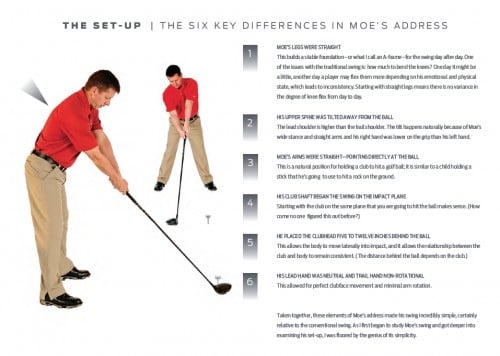
From my perspective, consistency is synonymous with simplicity especially when it boils down to how you move your body during the golf swing. The goal of all golf swings is to achieve impact. Just ask the golf ball –   all it knows is the moment that the club makes contact. Reaching impact where the club is square with ideal speed and direction is the real goal of anyone who swings a golf club. Common sense says that if you have twenty movements to swing a club to impact and I can make the same motion with fifteen, I can certainly be more consistent. Therefore, simplifying and eliminating the movement is what consistency really means. I also believe this was Moe’s gift to golf, if you are willing to listen. Here are the ways Moe’s swing simplifies golf and can make you more consistent.

  • Same Spine Tilt, Address, Backswing, Through-swing

Unlike conventional golf, Moe established his spine tilt at address. This tilt “presets” the spine for the tilt in the backswing, downswing, and impact. By establishing this tilt at address Moe eliminated unnecessary movement of the spine. Less movement means more consistency.

  • Trail (Right) Shoulder positioned on plane

Due to his address spine tilt, Moe’s trail shoulder (Right), moves up and down as opposed to around (conventional golf). We call this “planning” the shoulder. Moe would refer to this up and down movement of the shoulder moving on the same plane as the golf club as “like a pendulum”. Moe was great at simplifying the motions into understandable concepts and feelings.

  • Trail (Right) hand non rotational

Moe’s trail hand grip was placed on the club in a “non-rotational” position. Non-rotational means from address to the backswing all the way to impact, the hand does not turn. Less rotation of the trail hand means less rotation of the clubface allowing you to more easily return the club to square at impact.

  • Lead knee flexed, trail foot on the ground.

If you study Moe at impact, you immediately notice a major difference in his position compared to most conventional golfers. Moe’s right foot is on the ground and his lead knee is flexed. This positioning of his foot and knee reflect the perfect bio-mechanics of his spine position into impact. By keeping his trail foot on the ground and his lead knee flexed, Moe kept his spine exactly in the same tilt as he started. By keeping his spine tilted, he could move his shoulders on plane as the movement of the shoulders always follow the tilt of the spine.

  • The Pivot Point and Mid-spine body/club relationship at address

The simplicity of Moe’s mechanics and the simplified movements began from Moe’s address position. Moe’s setup is a platform of geometry, kinesiology, and bio-mechanics that create what I call a club to body relationship. What exactly does this mean? If you fast-forward Moe from address to impact, you see that at address and impact there is a certain distance from the ball. To be consistent, this spacing must be maintained throughout the swing. Moe accomplishes this from proper spine tilt at the beginning of the swing and proper lower body (leg and hip) movement. The club also references the lead side of Moe’s body – we call this the pivot point. This is where the club starts and impacts and can be referenced throughout the golf swing

Todd Address Moe

How to Create More Speed and Distance

As many of you know, we very seldom recommend training aids unless they are directly related to practicing Moe’s single plane swing and to be honest, most of those have been designed and produced by us. From the alignment and ball position trainer to the training grip club to the short game trainer to the perfect impact club, all our training aids have been designed to help you achieve your goals FASTER and MORE EFFICIENTLY. We have always designed our training aids to help all you improve more efficiently and keeping in mind, what will keep all our students on the “right path” during their practice.

One issue, we have dealt with since the start is how to create more distance. The answer has always been (and still is) – become more flexible, or at the least, maintain your flexibility and work on your fundamentals to hit the sweet spot on the club on the perfect plane more often. Ideal mechanics with good flexibility will get you maximum distance for your swing.

But, what can you do to increase distance? To be honest, we have never had a “great” answer….  until now.

Long story made short…. I have a son who plays baseball and works with his traveling team everyday on fielding, pitching and hitting. A couple of practices ago, one of the dads showed me a new training device that his son was wearing to create bat speed. He told me this device was used by many professional athletes and Olympic athletes to create speed.

The Hand Speed Trainer™ was developed by US Bobsled Team Member and sports enthusiast Dave Owens.

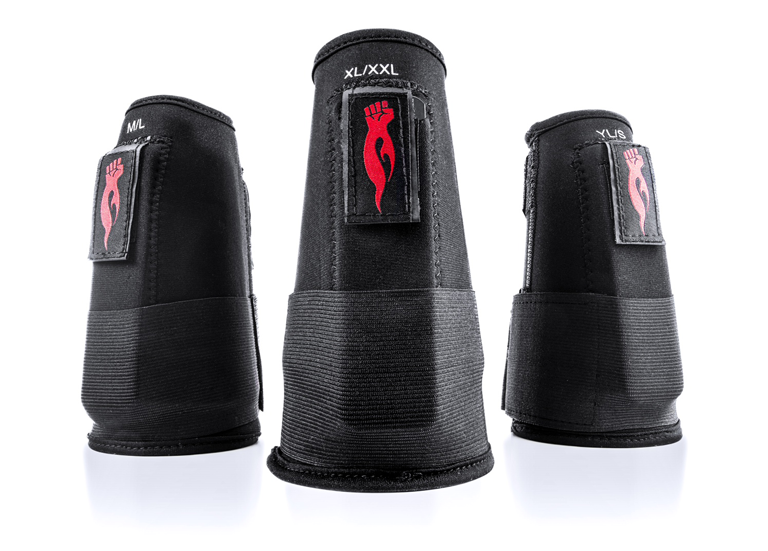
While Dave was traveling, training and competing at sports venues all around the world, he had a vision, a foresight of a training device that was needed but not yet developed to aide in quickness, speed and strength…three key elements that enhance athletic performance. He designed this training device, created it and has now patented the “Hand Speed Trainer™.” The Hand Speed Trainer™, HST™, is like no other. It is a training device that fits securely on your forearm that allows you to accomplish resistance-type training with weights while not restricting any other movement to achieve top athletic performance. It can actually train your body to operate and accept a new level of performance. By keeping the weight closer to the centerline of the body an athlete is able to maintain correct body mechanics without altering them. The HST™ allows you to train smarter and maximize your efforts.

The Hand Speed Trainer™, now will allow you to functionally strength train by performing work against resistance the right way. It is as critical to train the specific movement as it is to train the muscles involved in that movement. Your brain simply thinks in terms of whole movements not in terms of individual muscles. The exercises with the highest transfer effect are those that are essentially similar to the actual movement or activity of the skill that you want to perform in your sport.

For you to get optimal results in your sport repeated practice of the precise movement or skill is absolutely essential. It’s a must. It’s required. Because of the unique Hand Speed Trainer™ weighted system, you as an athlete are able to increase resistance in minimal increments in as little as 4 ounces. This prevents the bio-mechanics of the movements that you are focusing on from being compromised.

This allows complete focus for your neuromuscular system to specifically and functionally adapt the memorization of the specific movement needed for you to improve your overall athletic skills. Your body will adapt to the demands that are placed upon it. By wearing the Hand Speed Trainers™ as you repeat sport specific movements such as hitting a golf ball or performing drills you will see incremental improvements quickly.

Hand Speed Trainer
Hand Speed Trainer

In the past few weeks, Todd and I have used the hand speed trainer and it has shown positive results in increasing hand speed and distance. In fact, results faster than we thought would happen.

A golf study was performed and the following results were found:

Golf Study

Hand Speed Trainer Effects on Club Head Speed, Ball Speed, Total Distance and Swing Mechanics: Weighted Progression; 25 swings, 3x/Week for 4 weeks (Week 1 – 4oz, Week 2 – 8oz, Week 3 – 12oz, Week 4 – 16oz).

PURPOSE: To examine the effects of 4 weeks of weighted resistance training using the Hand Speed Trainer on club head velocity, ball speed and total distance as well as swing mechanics.

METHODS: Golfers of varying ages and handicaps wore Hand Speed Trainers for additional resistance while taking twenty-five swings, three times per week. Resistance began at 113.4 g (4 oz) and increased by 113.4 g (4 oz) every week for 4 weeks. By week 4 the resistance was 453.6 g (16 oz).

Each golfer (ranging in age from 13 to 61) recorded 5 swings measuring club head velocity, ball speed and total distance before and after the four week testing.

RESULTS: Data from 50 swings was collected measuring club head velocity, ball speed and total distance pre and post 4-week Hand Speed Trainer testing. Participants used 6 and 7 irons during data collection.

CONCLUSIONS: The data indicates that golfers using the Hand Speed Trainers 3x/week (75 swings) for 4 weeks (300 total swings) achieved an average increase in Club Head Speed (+3.50 MPH)Ball Speed (4.55 MPH) and Total Distance (+7.1 YDS) with their 6 or 7 irons. This correlates to 20 to 25 yards with their drivers.

To see more information and how to get the Hand Speed Trainers:  https://shop.gravesgolf.com/collections/full-swing-training-aids/products/hand-speed-trainer

Mr. Right or Mr. Right now

Article by GGA Master Instructor Clay Farnsworth, PGA

My apologies to the ladies out there for the name of the article although the topic usually does not fit your profile completely. What I’m referring to is the difference between a couple of types of students that I see often.

I have a few students that I’ll label Mr. Right. These students will do whatever it takes to learn the proper grip, stance, set-up before they even worry about club movement. They will use whatever means necessary to make sure that can see and feel what they are doing and making sure that it is done correctly. Some common tools that are used are mirrors and video. They are always doing movements in slow motion so they can learn the correct swing positions and what each feel like. The guys will commonly do the Pivot Point Drill ad nauseum. They will do drills to help perfect movements. They will not hit golf balls until they can move the club properly. When they do hit golf balls they do not expect great results at first, instead, they will try to feel each position and possibly even video swings to ensure that they are doing things correctly. These guys will set measurable goals that they will be able to track their progress.

Mr. Right Now will work just as hard as Mr. Right. They will do drills, video swings, and try just as hard. Their problem will be excuses. I can’t video properly; I don’t have time to get to the course or driving range. They will use full swings at full speed and wonder why they cannot progress, and in fact, they may get worse. They will focus on results. They will the drills haphazardly. They want to be able to have the best Single Plane swing but will not do what is necessary to achieve the proper techniques.

At a recent school, we went around the room and asked each student what they wanted to get out of the class. There was the usual list of items, hit it further, more consistency, etc. Then there was someone that really surprised the staff, or at least me. He said that he had a three-year plan for improvement. He would do whatever it took to improve. During the class, he hit few full shots instead went for the slow motion movement while trying to improve his feelings for the correct positions in his swing. He is not alone in this endeavor. We have several students that are training in this way. During this same class, we used this student to show what he was working on. A simple pitch shot that was done very deliberately and in slow motion. Well done I might add. Then something happened that actually shocked me more than what this student was looking for. One of the students actually said, “what if you don’t have three years”.

My point is here being what type of student would you like to be, Mr. Right or Mr. Right Now? I’m hoping that more of you are opting for the former as opposed to the latter.


How To Play In The Wind

This time of year (the fall) – it seems the wind seems to pick up (especially if you live in the “flat” states as we do.).  You have a choice when playing in the wind – you can either “fight” the wind or not. Let’s talk about what we mean in some different situations.

DSC00210

Wind Into Your Face: (When you are hitting shots directly into the wind).

First – remember – when you hit a golf shot, the lift on the shot is produced by hitting down into the ball, the hitting down action produces spin which lifts the ball. When you are hitting into the wind – you DON’T want more spin. This will produce too much lift and a “ballooned” shot which will go up and come down short of your target.

1. For every 1 mph of wind into your face add 1 yard. If 10 mph into your face, add 10 yards… Meaning a 10 mph wind into your face is what is called a 1 club wind.

2. Swing EASY. It is recommended to take 1 more club than you need after taking the wind into effect. For example, if you hit a 7 iron 150 yards, have 10 mph into your face, you would play it as 160 yards (a 6 iron) than add 1 club (a 5 iron). Take 1 more club after factoring the wind so you will swing easy – this easy swing will produce less spin and thus the ball will not balloon up.

3. Ball position – back up in your stance slightly. It is recommending to back the ball up in your stance slightly in order to help you hold the angles of impact and to help keep the loft off the club… meaning – make sure you hold angles of impact and don’t break down or “cast” the club.  This casting increases loft of the club at impact and will also cause the ball to balloon.

4. Hold impact angle (firm leading wrist) as long as possible. As stated in #3 – this angle will help keep the ball down and not balloon into the wind.

Downwind (Hitting Shots with the Wind):

1. As with the wind into your face – factor wind the same way (except this will add distance to your shots). For every 1 mph of wind downwind – take 1 yard off your shot. Meaning, if you have 10 mph of wind downwind – take one less club than normal. If you typically hit a 7 iron 150 yards and have 10 mph wind downwind – hit an 8 iron (or very easy 7 iron…).

2.  Ball position is the same as normal shots (with no wind).

3. When hitting downwind, the wind will take some of the spin off the shot. Meaning, if you typically hit shots that spin or hold greens, downwind shots will not hold as well (less spin). Play shots accordingly – meaning these shots will bounce further when they hit the green and roll out a little more.

4. Severely Downwind Shots…  If you have a lot of wind downwind – say 30 to 40 mph downwind – this wind tends to “knock the shots out of the air”. Or in other words, push the ball down to the ground. The reason for this is that amount of wind takes most of the spin off the shot and pushes the ball down. To calculate (a lot by experience) – if 40 mph downwind, you may only take 20 to 30 yards off the shot rather than 40 yards as that much wind will reduce flight of the ball.

Other Points with Downwind Shots –

There is a greater affect the longer the ball is in the air.  Meaning – a 6 iron will be affected by the wind a lot more than a wedge. Both will go further than normal – the 6 iron a longer as it is in the air longer…

Crosswind (Hitting shots with wind right to left or left to right):

1. We typically recommend to “ride the wind”.  Meaning, for example, if the wind is blowing right to left and you are right handed, play the shot right of the hole and let the wind blow back to the target. This riding the wind will typically allow you to play the “normal” yardage shot (for example – if you hit a 7 iron from 150 yards, a crosswind 7 iron will still be 150 yards) unless the wind is very severe.  If you choose to play into the wind – meaning if right to left wind and you play shot left to right, the shot will react more like an into the wind shot (as described above).

2. When playing a cross wind shot line up accordingly. For example – if a right to left wind – line up slightly to the right and hit the ball as straight as possible – and let the wind do the “work” for you. Try not to push or pull the shot into the wind… typically causes side spin on the shot which is hard to control in normal situations, not to mention windy conditions.

Other Points to Consider When Playing Wind Shots:

1. Wind DOES affect putts. There is wind close to the ground also. Play the wind accordingly when putting. Into the wind – hit a little harder, etc…

2. You might consider playing a slightly harder ball when playing in windy conditions… a harder ball will spin less and be affected less by the wind.

3. Play more fairway woods or hybrids when possible (especially when into the wind). These clubs produce less spin which will be affected less by the wind.

4. Always remember to swing EASIER when in windy conditions – for many it is “instinctive” to swing harder – swinging easier produces less spin and thus the shots will be affected by the wind less.

Good Luck!!

PLEASE don’t hesitate to call or email us anytime!!

Remember – ALWAYS PRACTICE WITH A PURPOSE

LEARN

THE

SWING

Join 1M+ Subscribers to get your FREE Video Quick Start Guide that reveals how to hit the ball farther and straighter more consistently from now on…

START YOUR NEW GOLF SWING