What’s Up With Tiger?

What’s Up With Tiger?

What’s Up With Tiger?  

It’s Not His Long Game That is the Issue

Many of you have watched Tiger the past few weeks, watched him struggle on the golf course and I am sure you have heard a thousand reasons why Tiger isn’t playing to his past ability.

So, I am going to give you the 1,001 reason (my opinion) as to why Tiger isn’t playing well… and it will probably be completely different than you have already heard.

I believe Tiger’s long game issues have as much to do with his poor short game than his swing changes.

This may sound backwards too many. Let me explain through a story I like to tell my students at our schools.

Many years ago (and it is getting more and more) I was in my freshman year at college (Oklahoma State University). One afternoon I was on the putting green at the university course working on my short game. As I was practicing my putting, an older gentleman was watching me and after a few minutes, approached me and asked me this question:

“How do you play this game?”

To be honest, I don’t remember my exact answer, but the context of my response was you hit your driver long and straight, then hit the ball as close to the hole as possible and make a few putts for good scoring.

The older gentlemen shock his head and said, “When you figure it out you will have a chance to be a good golfer.” And he walked away.

I remember looking around the green and there were some of the golf team members on the green and they were also shaking their heads.

I thought to myself, “What was he asking, why was he asking me, was this a rite of passage…? “I had no idea. I just know I guess I didn’t answer the question correct.

So a few years passed by, a lot of tournament golf and practice occurred in those few years. Bigger tournaments than I had ever played in, better players I was playing against and more practice than I had ever done before.

Fast forward to my junior year… I was again on the green and the “older” gentleman was again watching us practice. At that time, I know knew who this “older” gentleman was – Lebron Harris, Sr. – the founder of the OSU golf program and one of the first/best golf coaches.

Mr. Harris approached a young man on the green (a freshman) and asked him the same question he had asked me a few years previous. “How do you play this game?”

To be honest, I have no idea what the young man said, but I do remember seeing Mr. Harris a few minutes later in the pro shop and I responded to him.

I told him I had heard the question again and had a different response than 2 years previous. He asked me what my new response was.

My response was, “You work hard enough and build a short game that is so good, that it takes the stress of your mid game. The stress of your mid game then takes the stress of your long game.” In other words, you are able to play good golf because your short game is so good and you have so much confidence in your short game that it will take care of most long game mistakes. Understanding this will limit the stress on your long game and make you a much better to great golfer.

I remember him looking at me and saying “You are now on the way to being a good golfer.”

Now fast forward to Tiger’s current game. My belief is his struggles have much more to do with his limited practice on his short game than his swing changes. Tiger has worked so hard in the past couple of years on his swing changes that is has forgotten what got him to being one of the best players in the world. His short game.

Tiger was never the best ball striker on tour, Tiger was never the longest hitter on tour, Tiger never lead the tour in fairways hit, driving distance, greens hit in regulation… never. What Tiger was the best at was putting, chipping and saving shots around the green that a majority of even great players could not. That was Tiger’s strength.

So, what can Tiger do to get back to his playing ability of past years? He must not only continue to work on his swing changes, but must put the work back in his short game.

If not, as Mr. Harris eluted to over 25 years ago, there will be way too much stress on his long game to ever allow him to be a great player again.

****

I read a quote from Tiger last week (after his last event he withdrew from) that I really liked, and think is good for all our students to hear:

“You just have to be patient with yourself. Maybe not hold yourself to as high a standard, but try and sort of really seek out the momentum in other ways. Just try and stay positive every week. Whether the big picture doesn’t look that good, just take away a positive, whatever you can find during the week, and build upon it. You don’t want to keep knocking yourself down.”
The Right Way to Learn

by GGA Master Instructor Clay Farnsworth, PGA

All too often I have students that show up for a lesson. I’d recap what we’d covered from the previous session only to have the student say that they didn’t have time to practice. Most people don’t feel they are practicing unless they are hitting golf balls (and expecting RESULTS). This could not be further from the truth.

I met a student a couple of years ago up in Virginia. Tony S. is a business professional in the Warrenton VA. area. He is left handed and trust me when I say that my studio was not wide enough for him to hit golf shots. He adapted by aiming way to the right and basically hitting the ball with an outside in swing that rivaled no one. A well stuck 7 iron would go about 90 yards.

He “learned” the game by listening to whoever would give him advice. He finally figured out that was just not going to work. Problem was he had a swing. We had to basically tear that apart and start over from scratch.

On page 4 of our GGA golf school manual we outline what a perfect student would look like. There are several things listed there but to me the most important one is for the student to have the “willingness to do whatever is asked by the instructor and to do what it takes to reach your potential”. Tony was that type of guy. With that type of attitude and perseverance his ball striking improved dramatically. He practiced wherever he could. He was working on feeling what his left side would feel like at the top of the back swing. He showed me this one day and I asked him how often that he worked on that. He told me that all the time. “Shadow” swings to feel the position of his hands and arm at the top of his swing then transfer that to his swing with a club to get that feeling engrained. Dan Coyle would call that “Deep Practice”.

I believe that with Tony’s attitude, willingness to learn, and deep practice were some of the keys to his success. While I don’t always thing that handicap is the best indicator of progress, his scores were better and his distance had increased quite a bit. Correcting swing path and being able to compress the ball allowed Tony to now hit his 7 iron consistently 135 yards. That is a huge improvement. Also went from hitting a slice that was basically off the planet to hitting a slight draw with all of his clubs. Every one of us could learn from this example, myself included.

Back in Motion in 2015

Following a few months of Oklahoma cold weather, it was refreshing to get back into the swing of the golf schools. The Graves Golf Academy team delivered our first golf school for 2015 giving twenty-two students a start for a great new golfing year. Each school brings new opportunities to help golfers of all levels improve their golf games. It also brings new insights to share with other aspiring golfers – those unable to attend our schools. Here are a few takeaways from this last school.

Fundamental Movements are the Answer

Students often ask “What is the best way to stop hooking?” or “Why did the ball go right (or left)?” These are what I consider “quick fix” type questions. If an instructor is not present to answer them, they often lead to a guess. If you are guessing, you are no longer practicing. You must stop guessing and change the questions you ask. Instead of asking a “quick fix” question start training the movement of your swing and stop worrying about results. There is one solution to every swing problem; just practice fundamentals.

Focus on the Address Position First

Moe often said “If you don’t have a good address position, you ain’t got nothing”. He said this because the address if the foundation to movement. If you start from a bad starting place, you cannot possibly expect to end up in a good one. During the swing, the body acts like a line of dominoes where one movement triggers the next one. If your grip is misaligned, your arm rotations during your swing will also be out of rotation and this problem moves the club incorrectly. Once again, focus on the fundamentals from the beginning and master the address position.

Feedback is a Shortcut

When it comes to interpreting your swing feelings, you are not trustworthy. Don’t be discouraged, nobody is. What you think you do and what you feel that you do are on opposite sides of our universe. The only way to bring them together at light speed is with some sort of feedback. There are numerous types of feedback all of which help bring you closer to the Moe Norman Single Plane model. Types of feedback include; Video feedback, using mirrors, processing with training aids and having a coach with you while you practice. Make sure you are practicing with feedback.

Practice Each Movement

Students often ask me how I achieved the Single Plane Swing so perfectly. I tell them that I practiced for the move, not the result. This is a different mindset. Rethink it this way; if you were to train a dancer a 10 step dance, would you have them all 10 steps at once or one step at a time? The answer is obvious. Once all 10 steps are learned, the movement can be put together to make the dance. The golf swing is your body dancing with a golf club.

Don’t Hit Balls, Practice the Total Move for Feel

Once you have learned the parts of the dance, put it together and feel the move. Once you feel the movement (get feedback to ensure it is perfect), repeat it until your body can’t forget it. This is why Moe called his swing, “The Feeling of Greatness”.

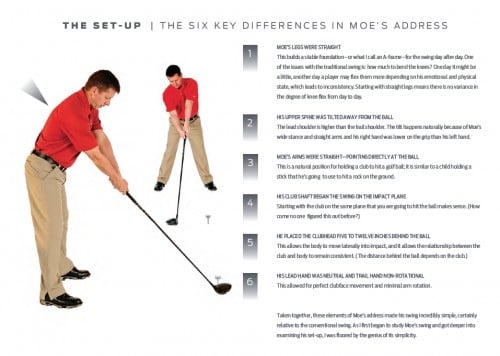
Six Key Differences in Moe’s Address

(Exerpt from The Single Plane Golf Swing/Play Better Golf the Moe Norman Way Book)

By:  Todd Graves

Todd Address Moe

1.  Moe’s Legs Were Straight

This builds a stable foundation – or what I call an A-frame – for the swing day after day. One of the issues with the traditional swing is how much to bend the knees? On day it might be a little, another day a player may flex them more depending on his emotional and physical state, which lead to inconsistency. Starting with straight legs means there is no variance in the degree of knee flex from day to day.

2.  His Upper Spine Was Tilted Away From The Ball

The lead shoulder is higher than the trail shoulder. The tilt happens naturally because of Moe’s wide stance and straight arms and his right hand was lower on the grip then his left hand.

3.  Moe’s Arms Were Straight – Pointing Directly At The Ball

This is a natural position for holding a club to hit a golf ball; it is similar to a child holding a stick that he’s going to use to hit a rock on the ground.

4.  His Club Shaft Began The Swing On The Impact Plane

Starting with the club on the same plane that you are going to hit the ball makes sense. (How come no one figure this out before?)

5.  He Place The Clubhead Five To Twelve Inches Behind The Ball

This allows the body to move laterally into the impact, and it allows the relationship between the club and the upper body to remain consistent. (The distance behind the ball depends on the club.)

6.  His Lead Hand Was Neutral And Trail Hand Non-Rotational

This allowed for perfect club face movement and minimal arm rotation.

Taken together, these elements of Moe’s address made his swing incredibly simple, certainly relative to the conventional swing. As I first began to study Moe’s swing and got deeper into examining his set-up, I was floored by his genius of its simplicity.

A note from Cap’n Video

By GGA Master Instructor Clay Farnsworth, PGA

WOW, 2015 already! I know that many of you throughout the country are suffering from cold and nasty weather. Many of you are taking advantage of this “indoor” time to work on your games through our GGA Winter Series. For those of you that are not familiar with the program check out our web page to see what it’s is all about. Trent White and Chandler Rusk are doing a bang up job in helping our students reach their potential all year long.

I also had another thought on something that you can do during this time, read. Todd’s book “The Single Plane Golf Swing” out now, is a must read of course. In addition to that, we have another couple of selections that might interest you. Dan Coyle wrote one called “The Talent Code” and the other is called “The Little Book of Talent 52 Tips for Improving Your Skills”. They deal mostly with how we learn and what it takes for true change to take place. These books are easy reading and will hopefully give you some insight into lasting change.

As your coach, I want the best for all of you. In order to make that happen, self-reflection is important. I’m practicing what I preach to each of you as I write this. I’ve been learning to swing like Moe since 2004. I use video almost every time that I practice. Many of those swings end up on the cutting-room floor, so to speak. I look at them and even before I compare them to Moe… Trash Can. I know what it is supposed to look like and when it doesn’t, sometimes frustration sets in. I’m sure that many of you can relate. But, when I look at where I started and where I have come, I can appreciate where practice has brought me.

Many of you are using video to help you improve your game. The students that are achieving the most success are taking things slowly and working on one thing at a time. That’s what I’m doing right now myself. Look at what needs improvement and go after it. So let’s get out there and in 2015 and make a New Year’s Resolution to accomplish all that we can…one swing thought at a time. I promise that I’ll do the same!

Captain Vid Over and Out!

Lessons Learned from Total Beginners, GGA China

About the Author: Ron Cruickshank, Ph.D., is a GGA Instructor and loves the game. He is now President and Director of Instruction for Future of Golf Limited (a fully licensed GGA affiliate) and operates from the beautiful tropical island of Hainan in the SW of China. His mission is to train the youth and emerging golfers in China to swing with the ease of a single plane swing.

Here in China we are now in our fifth month of golf training with total beginners and it has been a mammoth learning experience for us all. Our students, mostly under the age of 14 literally come to us knowing NOTHING about golf.

Mostly, they are here because their parents think it good for their long term success in business and life. They don’t have a family tradition in the game as none have been out playing golf with their parents on the weekend or after school. Thus they don’t even arrive with a positive emotional bias towards the game. We must build in the love of the game and sport from scratch. Ah, we love a challenge.

Let’s define a beginner golf youth in China.

  • Has never watched a golf game on TV nor seen one live.
  • For 98% of them, their parents do not play golf nor understand the game
  • They speak no English beyond hello and bye-bye.
  • Have no golf heroes nor can they name ONE professional golfer they admire other than Tiger Woods. Everyone knows him
  • Doesn’t understand how golf is scored, what the rules are nor what constitutes winning in the game.
  • Can’t name one club in the bag
  • Is VERY unfit and not used to exercise of any type (all the kids do is go to school)
  • Has no idea of a personal safety zone with their equipment
  • And……

Well, you get the idea. For us, this was equivalent to being dropped into an alien world and no one speaks our language or understands what we are trying to do. Wait a minute – that is what we are doing.

Yellowhatchina

The good news is that kids are still kids and they love to have fun, laugh and cut-up with their friends while competing. We decided to go with these characteristics as our basic insight and design our programs around what we were presented with. We decided to break down our challenges and meet them one at a time. This meant dealing with the basics in innovative ways and trying to make it fun for them. Some examples below.

  • Meet Your Club Sessions each lesson. We devised a fun game of taking all the clubs out of the bag, putting them in a pile across the room and when we called out a club name the kids would race across the room, pick up the right club and race back to put it in their bag. Very effective.
  • Golfing Vocabulary and Rules. We added a golf vocabulary session to every lesson. We do a white board or power point with golf terms and images. “This is a green, this is a rough, flag, out of bounds, etc.”  The kids have to shout out the answers and they love it.
  • On the course excursions to experience and watch holes being played.
  • Exercise and extensive warm-ups. This was perhaps the most controversial part of our program with the PARENTS. For the non-initiated parent golf training only meant hitting golf balls. For the mainstream Chinese they only see and experience golf from the driving range. Since they don’t have golf on TV here, many Chinese think that IS golf.
  • We had to educate them about the Seven Principles of golf and teach our kids that just hitting full shots is only a part of the game. We spend at least 60%-70% of our lessons teaching putting, chipping and pitching.
  • Take nothing for granted. Explain everything in minute detail and then question until certain they understand. This is often a humbling experience for the teacher.
  • Fundamentals rule. Until our kids can demonstrate the correct grip, posture, address and PVC positions they don’t hit ANY balls. Once they understand the basic PVC motor patterns we find it a small step to start hitting balls. It is a real milestone for the kids.
  • Set very clear performance goals. We teach in units much like a martial arts program and the kids must demonstrate certain competencies and skills in order to move up the ladder. We recognize this by formal testing and then giving the kids different color hats to recognize their skill levels.
    • For example: to get a Yellow Hat the kids must be able to do the following
      • Explain the difference between a traditional golf swing and a single plane golf swing. They can ALL tell you that a single plane swing advantage arises by setting up in the same posture as impact.
      • Demonstrate the ‘safety bubble’ space around them.
      • Have a history of correct golf manners and etiquette during our classes
      • Demonstrate the correct grip and basic posture of a single plane swing
      • Be able to properly set up a PVC drill using three balls and the PVC
      • Demonstrate all PVC positions in proper balance and leverage angles

As I wrote this piece it began to dawn on me ever stronger. This process of learning is good for ALL of us and it seems useful for each of us to examine what we THINK we know about the single plane swing and then examine ourselves carefully. Look at the bullet points above and ponder if you might consider these for yourself.

Start by asking yourself this simple question. How many of you could pass our basic Yellow Hat test?

LEARN

THE

SWING

Join 1M+ Subscribers to get your FREE Video Quick Start Guide that reveals how to hit the ball farther and straighter more consistently from now on…

START YOUR NEW GOLF SWING