Can You Teach an Old Dog New Tricks?

Can You Teach an Old Dog New Tricks?

Let’s put this issue to bed for good. “Coach, I am 67 years old… don’t you think I am too…   just pick one…old, set in my ways, weak, inflexible, stiff, infirm, stubborn…) to make some changes in my swing and get better?  After all, … you can’t teach old dog new tricks!

In the past few months I’ve been inspired by watching a miracle unfold in Australia. This miracle should cause us all to pause and recognize that the lid to the mental box most of us live in should be opened on a regular basis and the contents examined.  Let me tell you about John Maclean – a paraplegic athlete who has been confined to a wheelchair since 1988 after being hit by an 8-ton truck during a training run on a bike. The impact resulted in John suffering multiple breaks to his pelvis and back, a fractured sternum, punctured lungs, a broken arm, and being left a paraplegic. So what is the inspiration? In 2013, after 25 years in his wheel chair, John has re-learned how to walk. The old dog learned a pretty serious new trick!

Prior to his accident, John was a world-class athlete in his chosen sport of rugby. He is still a world-class sportsperson. His list of accomplishments since his accident boggles the mind.  In addition to being a motivational speaker and running his own company, he has found the time to do the following. Keep in mind this is but a few of his accomplishments:

  • In 1997, he not only finished the Hawaii Ironman Competition within the able-bodied cut-off times, he beat a third of the field and became the first ever wheelchair-category winner
  • In 2002, John became the first non-American inducted into the Hawaiian Ironman Triathlon Hall of Fame
  • The 1998, he was recognized as the first wheelchair athlete to swim the English Channel
  • In 2005, he completed the grueling Molokai Ocean Challenge (World Championships for open water paddling)
  • He represented Australia at the Sydney 2000 Olympic and Paralympic Games, and in 2001 he sailed in the Sydney to Hobart Yacht Race
  • In 2006, John completed the invitation-only extreme endurance event, the Ultraman World Championships, in Hawaii. (Covering a total distance of 320 miles (515 kilometers), on the Big Island of Hawaii. It requires that each participant complete a 6.2 mile (10 K) open ocean swim, a 261.4 mile (421 K) cross-country bike ride, and a 52.4 mile (84 K) ultra-marathon run)
  • Early in 2007, John took on the sport of rowing. In September 2007 he and his rowing partner claimed a silver medal at the Rowing World Championships, and followed up with GOLD at the International Regatta in Italy in April 2008. He won Rowing silver at the 2008 Beijing Paralympic Games
  • John later qualified for the 2012 Paralympic Games – and the list continues…

What is clear to all his fans is that he has lived an extraordinary life since his accident and is driven by his personal motto “ONLY POSSIBILITIES”.

I became familiar with John and started following his adventures a few years ago through a good friend of mine, an Australian named David Knight. An endurance athlete himself, David personally swam the English Channel with John and he has regaled me over the years with stories of his ‘mate’ John and John’s achievements from a wheelchair. When David sent me a link to a YouTube chronicling John’s remarkable personal developments, at first I found it hard to believe. Think on this:  after 25 years of being in a wheel chair, I was watching pictures of John walking on the beach unaided. It wasn’t a pretty or graceful sight, but neither is that wheelchair.

What Happened?

The foundation for John Maclean’s ‘miracle’ is based on the insights of another brilliant chap in Australia named Ken Ware. A former world-champion body builder (Mr. Universe) himself, Ken had observed certain phenomena over the years about what happens when the body is placed under a controlled stress (induced by lifting very light weights in a specific way) causing the production of uncontrollable tremors in the body.

The fundamental insight Ken observed was that as a result of this particular tremor activity, the body re-organized itself, the affected body system UPGRADED itself.  For example, if you had a frozen shoulder, after a tremor experience, the shoulder had more flex than prior to the tremor. Ken has frequently commented. “This is true for 100% of the people, 100% of the time.”

Ken Ware’s breakthrough insights are re-defining how we think about serious debilitations like spinal cord damage and even stroke. Fundamentally, Ken is utilizing the underlying principles of chaos theory. That is: the system will eventually and always re-organize itself into a more stable and robust system. When you increase a system’s complexity (ask it to do something new), you create new neural nets that have the potential to be better than the previous ones. Let me repeat: this is true for 100% of the people, 100% of the time.

What Does this Mean for Your Golf Game and Being an Old Dog?

There are several lessons to be learned from John Maclean and his miracle.

  • First and foremost, you must be willing to change and recognize that it is possible. Imagine if John Maclean told Ken Ware. “Forget it, I’ve been in this wheel chair for 25 years and it is not possible for me to walk again.”
  • Second is the lesson that we all can change, whenever we decide to.  To begin changing, all that is necessary is to do what the science guys call ‘perturbing the system’.  This means change what you are doing and interrupt the old patterns.
  • To cause change, you must first de-stabilize the existing model and give it a chance to re-organize. YOU will ALWAYS change the system, especially if exposed to a consistent and new request.

At Graves Golf, we are supporting your change by providing you with a full set of complementary tools for you to interrupt the old patterns and establish new and more effective patterns. This means you will get better if you make a change.

We have available the following for you:

  1. New information (DVD’s, web-based information, webinars and individual coaching)
  2. New methods to train and learn (allowing you to perturb your system/mind/body)
  3. Training aids to support and integrate the new learning. (6-Iron Training Club, Alignment and Ball Position Trainer, Short Game Alignment Board and GGA Putting System)
  4. Support Systems – Schools around the country, webinars and On-line Academy via the 360 Program

If you are an ‘old dog’ and you want to learn some new tricks, I’d encourage you to get started now. If John Maclean can begin to retrain his body to walk after 25 years in a wheel chair, certainly you can begin to change your golf swing. You are NEVER too old to learn. Besides, maybe those new tricks will win you your next club championship, The A flight tourney or a beer from your foursome.

About the Author:  Ron Cruickshank, PhD, is a GGA Master Instructor and Golf Coach in Toronto, Canada  Go on-line and book a one day Moe Norman Golf Experience at Royal Ashburn Golf Club in Whitby, Ontario. He can be reached directly via phone at 647-892-4653 or email at:   drron@moenormangolf.com
Meet the Master – Clay Farnsworth, PGA

My dad introduced me to the game of golf when I was 7 years old. He bought me a starter set of junior clubs that had a three wood, 3,5,7,9 irons, and a putter. All in a “Sunday” bag to carry. As with most kids back then, golf was another thing to do, along with every other sport. No formal training just used my natural ability and whacked the heck out of it. We played on a par three course that was always hard and dry, so my duck hooks would roll forever.

In my early teens, I was looking for work and the local driving range needed someone to help shag golf balls- while others were hitting them, literally. Our safety gear consisted of an old WWII army helmet. So, for a couple of ear ringers, I could hit as many balls as I wanted and play golf for free during the week. Life was good.

Eventually, I was promoted to working behind the counter at the driving range. My big break came when the Head Pro asked me to help him in the golf shop. I felt trusted- being left alone to open the shop at 5:45 am on weekends. The responsibility brought more money and more importantly, a discount on all golf related merchandise. I could finally afford a nice set of Ben Hogan golf clubs. Life was even better.

By the time I was a junior in high school I had played junior golf with some success. I played well enough to compete in tournaments across the state of Illinois. I made my high school golf team and we won our district and regional tournaments both years and qualified for the state tournament. I finished an individual third place as a junior and made the “All Regional” team. I was hooked.
After graduation, I moved to Michigan and began college. I played golf at the junior college level for two years until, as they say; life got in the way… marriage, kids, full-time work and school. Little time was left for sleep, let alone golf. But, I knew in my heart golf was always going to be a part of my life.

Through the 70’s and early 80’s, I played recreational golf, joined leagues at work, hit it socially with friends and participated in the occasional scramble tournament. I finally joined the Flint Elks Lodge #222 and Golf Club. That is where I got interested in tournament golf again. I played in several club championships and was fortunate enough to win three of them, all under different formats. The bug had bitten me, once again.

In the early 90’s I was traveling all over the U.S. with my job and, while it afforded me an opportunity to play beautiful courses across the country, it hampered my ability to be able to play competitively.

In 2001, I moved to Virginia and “settled” down with my beautiful wife, Karen, who wanted to learn how to play golf. I tried to teach her, (in spite of several warnings from teaching buddies to never go there). I was having trouble making her understand the lingo, the setup, the swing. She didn’t know golf speak and she had never played… then it hit me, she was a “clean slate,” with no preconceived notions, nor habits. That is when it dawned on me that it was the perfect opportunity to try out a method that I had been intrigued by years before. There were these two guys from Oklahoma City and a guy that had a funny looking swing and set-up, but as odd as it seemed, it simply made sense. The time was right, I had the willing student, and the curiosity to learn more.
As luck would have it, I searched the Natural Golf database and found that instructor Dave Predzin was close by. Karen and I signed up for a couples group, with the idea (my idea) that Dave would work almost exclusively with my wife, after all, I had been playing conventional golf for over forty years, and I’d generally done well, why would I want to switch my swing now?

As we worked through our series of lessons, covering putting, chipping, pitching and even bunker play, it all started to make even more sense to me… enough so that I started practicing the grip and swing myself. As I have said earlier in this bio I had some successes. But, I was a timing and feel player. If the timing was good, then I was good. Throw in a case of nerves, or simply an “off” day and viola, disaster waiting to happen. Now I was learning to play easier. Using technique instead of timing and feeling, WOW, what a difference.

In 2004, my lovely wife wanted to get me something special for Christmas. She enrolled me in a Graves’ Build Your Game Camp. For all of you out there that aren’t familiar, I’d call it boot camp for golf. Suffice it to say, by day three it all started to make sense. One thing builds upon another. Imagine that putting can tell you about your driver? I was hooked and fascinated (and working my butt off to learn, with only two days left). I had worked all those years to improve my timing and feel. Now I could use a technique to play. HUGE difference to say the least.

In 2005, I received an offer to take an early retirement from General Motors after working for the company for nearly 35 years. I loved my company and enjoyed my colleagues, but it was time to go, but what would be next? I was too young to truly retire, but I wanted to do something that made me feel inspired, kept me active, and used my talents. That is when it became clear that it was finally time to pursue my life-long dream of being in and around the game of golf every day. I retired April 1 and started working as an assistant pro at a local course on April 4. Long retirement, huh?
In May of that year, Virginia National Golf Club, where I was working, hosted a PGA Play Ability Test (PAT). This is a 36 hole qualifier to be able to apply to get into the PGA. If you cannot pass this test you will not be allowed to even enroll in the program. The thing is, unlike other tournaments that I’d played in the past, you were not competing against the field. You had to shoot a target score, already known before you teed it up. I hadn’t played a competitive round of golf in over ten years. But I knew I had to pursue my goal of becoming a golf pro, and in order to do that, I had to start by passing the PAT.

When I decide to play in this PAT, the first person I called was Tim Graves. I asked him how to prepare for this tournament. Tim said to work on the short game. DUH! What else did I expect him to say. Secondly, he said to leave the driver in the bag, or better yet, trunk. You read this correctly, trunk. Remove the club that could get you in the most trouble and leave it in the car. For two weeks prior to the tournament, I had no swing thoughts. All I worked on was my wedges around the greens and putting. The last piece of advice I received was from the Head Pro, Jim Burns PGA. He told me to worry about my game and ignore everyone else’s. Don’t look at their swings, don’t look for golf balls, be courteous, but focus on the task at hand. As I’d find out later, Todd plays his best golf this way, as well.

The above-mentioned advice was invaluable. Two of the people I played with did not break a hundred each round. Our target score was 155. All you had to do was shoot 78, 77. Not too difficult, except you knew that BEFORE you teed off. Thanks to the advice from my friends, teachers, and co-workers I passed with scores of 74, 75. What a relief!

I applied to get into the PGA as soon as I was eligible- in late January 2006. I completed the entire program, graduated, and became a PGA member in October 2007. It’s an accomplishment I am pretty proud of, since the program, on average, usually takes six years. The icing on the cake was the scholarship I received from Titleist for being a top performer in my section. I had a goal and I was making it happen.

For the next few years, I coached the local high school golf team, worked at the course, and occasionally taught lessons. My desire to teach full time was growing and in 2008 I was fortunate to become an instructor with Dave Predzin through his golf academy in Manassas, Virginia. In 2012, I pursued another opportunity to teach full-time at Golf Tour Trailer, where owner and friend, Jerry Donahue, PGA, built me a teaching studio.

I first started serving as an occasional instructor with Todd and Tim Graves in 2007. I traveled around the country, as necessary to help with schools. The more I was involved, the more I knew it was where I was meant to be. Even though I taught alongside these guys, I’ve never stopped learning from them. In October 2012, I became staff at GGA. Along with teaching schools as a Master Instructor, I now coach hundreds of students through the Video Coaching program.

In August of 2013, Karen and I moved to Orlando full-time. I am now able to teach year round at our host course, Eagle Creek Golf Club. Through schools, the internet Academy, and private lessons, I am living my dream of teaching and mentoring golf students each and every day, helping them improve their game and grow their love of golf. What more could a guy want?

Watching the Hope rekindle

In my career as a golf instructor, nothing, and I mean nothing give me more joy than watching the hope rekindle in a golfers’ eyes.

I estimate I’ve seen somewhere between 3,000 and 4,000 golfers come through our school programs during my tenure, and I’ve seen this phenomenon countless times, but it never gets old. Now, you may be wondering, “what the heck is he talking about?” Let me elaborate briefly:

The average golfer that we see in our school programs is a man, aged 62-65, who has been playing the game for several years. He’s struggled mightily with his game, teetering on the edge of giving the game up due to sheer frustration, or chronic injury. He’s come across a swing that is advertised to be “simpler” and “easier on the body”, and those terms resonate with him. He loves the game dearly, but often times is at the end of his rope. Tired of never improving, tired of hurting after every round, and sometimes every shot, he gives the Single Plane Swing a go.

Sometimes quite reluctantly this golfer decides to attend a GGA school, and that’s where I see the magic happen time and again.

Day 1 of the school he’s confused. “What do you mean I’m not hitting any balls?” is often heard mumbled to others in the group. But he goes with the program nonetheless.

Day 2 and on, I see a small glimmer start to form. He’s hit shots he hasn’t hit in years, or ever. All of a sudden the nonsense of training positioning on Day 1 of the program begins to make sense. His attitude improves dramatically, and by the end of the program, whether it be at the end of Day 2 or Day 5, this gentleman who walked in ready to quit has rediscovered his passion for the game. He can’t believe some of the shots he hits, or how many putts he’s making. The HOPE is burning bright, and he leaves knowing he has found a solution. This same golfer who mumbles on Day 1 “Why am I not hitting balls?” leaves the school saying “I wish I had found this 30 years ago.

How about you? Is it time to rediscover your Hope, to light your fire for your game?

If so, we are here, ready, able, and willing to help.

Come find out why 70+% of golfers come back for additional schools.

See you on the range!

Scott


Million Dollar Arm / Million Dollar Golf Swing (Part 1)

How many of you have seen the movie Million Dollar Arm?

The movie has been out a few weeks now and is a true story about a baseball agent who goes to India and runs a contest “The Million Dollar Arm” to find couple potential baseball players to bring back to the United States and train to be MLB pitchers. The agent does find a couple of young men to bring back and takes them to Dr. Tom House (at U.S.C.) to train to become pitchers in the MLB.

A couple of weeks ago, I had the great fortune to spend 3 days with Dr. House.  My son was invited to a pitching camp run by Dr. House and I was able to attend and spend a lot of time “bouncing” questions off of Dr. House and watching how himself and his assistants worked with potential future “big league” pitchers.

The reason I am writing this article is because of the numerous similarities between the training Dr. House promotes for his pitchers and the training we promote for you to improve your golf swing. As Dr. House went through his training, why he trained in a particular manner and the reason he trained in a certain order – it was absolutely amazing the similarities in what he does and what we do (how he trains and what we train…)

Basically, Dr. House broke down the kinematic sequence of the movement of a pitcher, then created drills to work on the particular areas of the kinematic sequence. We do the same with the golf swing.

First – everything taught/trained is based off of what is called the kinematic sequence (whether it is the movement of the pitcher or the golf swing – there is a particular sequence that is similar and in a particular order to be successful). Obviously, we will discuss the sequence in relationship to the golf swing, and we will discuss particular training drills to help you with the different movements/areas of the sequence.

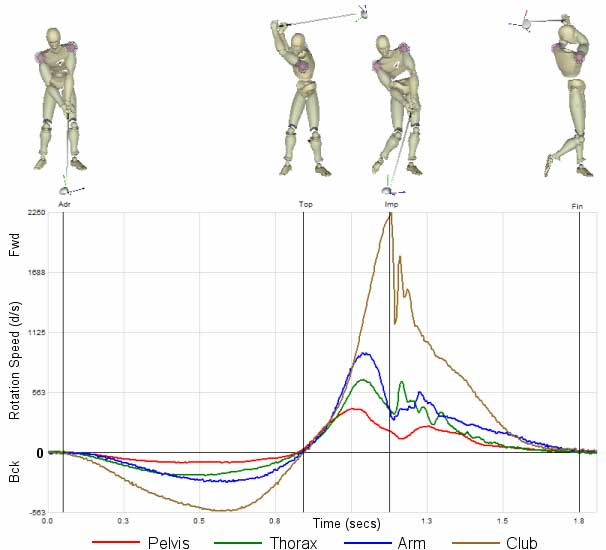
Here is a picture of the kinematic sequence of a golf swing:

AMMkinematicsequencegraphb

In simple terms, what the sequence shows is the sequence of the downswing of the golf swing starts with the hips, then the thorax/shoulders, then the arms, then the golf club.  One starts, then as it starts to slow down the next movement starts, etc… in a sequence that if done correctly will maximize speed and give you the best chance to get the club on plane. (To see additional research about the kinematic sequence of the golf swing, please refer to Dr. Greg Rose and the Titleist Performance Institute (TPI) – he is the expert in the area of researching the kinematic sequence, etc…)

We teach the same kinematic sequence in Moe’s single plane swing – with one addition. The start of the downswing is registered in the lead knee (left knee for right handed golfers, right knee for left handed golfers). In other words, in listing the sequence of the downswing of the single plane swing:

1.  Lead knee followed by

2. Hips (Pelvis) followed by

3. Thorax (Shoulders) followed by

4.  Arms followed by

5.  Club

As Moe said – the golf swing is started with the lead knee. He would often say, “My lead knee starts my down swing”.

In this first part, let’s talk about a couple drills to help you get the lead knee working correctly.

First – you must set up correctly to allow for your lead knee to flex toward your lead toe.  The lead toe must be turned out at least 10 degrees (up to 20 degrees). This turning of the lead toe outward will allow the lead knee to flex toward the toe in the downswing.

Second – you must be set up the correct distance from the golf ball. At least 26 inches from the golf ball to toe line with a 6 iron and at least 36 inches from the golf ball to toe line with a driver. Being too close to the golf ball at set up will cause the body to “pull away” from the golf ball to get enough room from the lead shoulder to the golf ball to make contact. Being the correct distance at set up (combined with clubs that fit you) will allow you to start the sequence correctly with the flex of the lead knee toward the lead toe.

Drill # 1 – Leverage Bag Drill

You can see the leverage bag drill at: https://shop.gravesgolf.com/collections/full-swing-training-aids/products/leverage-bag

Review the video on the top of the page and focus on the hold impact position and the flexed lead knee. Knees are flexed at impact – the lead knee toward the lead toe.  The flex of the lead knee starts the downswing (original move of the sequence) and stays flexed through impact.

Drill # 2 – Chipping Drill

A chip is basically a mini golf swing (to impact) with a slightly open stance. The best part of working on your chipping is you can focus on the first part of your downswing to impact. Getting your hands down the target line and focusing on your proper lead knee flex through impact and the start of the downswing.

You can see an example of this at: https://gravesgolf.com/product-support/

Click on Short Game Alignment Trainer under Products Instruction/Support and the 2nd (middle video). In particular, 2:35 into the video.  This video in particular focuses and shows you proper knee flex to start the downswing and through impact.

It is strongly recommended to start working on your proper knee flex (the start of the kinematic sequence) with chipping. Start small and work up…

Again, the key is the proper sequence of the golf swing to create maximum speed and gives you the ability to get the club on the proper plane.

Working/training on the particular parts of the sequence will allow you to eventually maximize the proper sequence.

In the next e-tips we will focus on the next steps and training/drills for the proper sequence of the single plane golf swing.

The GGA Traveling Roadshow is on the move

It’s that time of year again! The GGA instruction team is packing up and going across the country this summer and fall to bring what many attendees call “the best experience in golf” to a locale near you.

Here’s the scoop on the travels of the GGA team:

View from the GGA Range - Revere at Anthem Golf Club, Henderson, NV
View from the GGA Range – Revere at Anthem Golf Club, Henderson, NV

June

  • The Villages, FL – 11th & 12th – 2 day school
  • Orlando, FL – 14th – 1 day school
  • Oklahoma City, OK – 16th-20th – 5 day Build Your Game Camp
  • Washington, D.C. (northern Virginia) – 20th & 21st – 2 day school
  • Toronto, Ontario, Canada – 21st & 22nd – 2 day school
  • Kansas City (only trip to KC this year) – 25th – 1 day school
  • West Chicago, IL – 27th-29th – 3 day school

July

  • Houston, TX – 11th -13th – 3 day school
  • East Haddam, CT – 17th-19th – 3 day school
  • Orlando, FL – 25th & 26th – 2 day school

August

  • Washington, D.C. (northern Virginia) – 2nd & 3rd – 2 day school
  • The Villages, FL – 14th & 15th – 2 day school
  • Oklahoma City (featuring Todd/Tim Graves) – 15th-17th – 3 day Premier school
  • Chicago, IL (featuring Todd/Tim Graves) – 22nd-24th – 3 day Premier school

September

  • Orlando, FL – 6th – 1 day school
  • Oklahoma City – 8th-12th – 5 day Build Your Game Camp
  • San Diego, CA (featuring Todd/Tim Graves) – 26th-28th – 3 day Premier school

October

  • Las Vegas, NV – 7th-11th – 5 day Build Your Game Camp
  • Las Vegas, NV (featuring Todd/Tim Graves) – 24th-26th – 3 day Premier school

You can always register for the school of your choice, or find the full updated schedule on our Event Calendar page of this site.

Due to the extreme demand for instruction, this is the earliest we’ve ever released our late summer and fall schedule, and from the emails and calls I’ve been getting in recent months, spaces in these schools will go quickly.

We are also planning another trip to Palm Springs, CA in November, and are working to finalize the dates and will release those as soon as we have things firmed up.

We’ve got the bags packed, the trailers loaded, and we look forward to seeing you this year!

Scott

Keep Your Big Goals a Secret , Tips for Improving (Part 13 / Final Part)

This is the 13th and final part of a series of practice tips titled “Tips for Improving”.

If you have missed any of the first 12 parts, you can go to our blog on our homepage at moenormangolf.com or direct at: http://moenormangolf.com/blog/

In those practice tips we discussed how we work with our students to create new habits rather than breaking old habits. It is essentially impossible to break bad habits (our mind/body is not set up that way) … but we are set up to be able to create new habits and ultimately make changes/create new movements, etc. we want.

We talked about a book we strongly recommend – The Little Book of Talent/52 Tips for Improving Your Skills by Daniel Coyle.

It is described as a manual for building a faster brain and a better you. It is an easy-to-use hand book of scientifically proven, field tested methods to improve your skills – your skills, your kids’ skills, your organization’s skills – in sports, music, art, math and business. The product of five years of reporting from the world’s greatest talent hotbeds and interviews with successful master coaches, it distills the daunting complexity of skill development into 52 clear, concise directives.

Whether you are 10 or 100, this is an essential guide for anyone who ever asked, “How do I get better?”

9780345530257

This book is available at Amazon.com

The last instructional newsletters (Tips for Improvement Part 1 through 12) we discussed 48 tips for improvement from staring a who you want to become, to being willing to be stupid, to finding the sweet spot, to practicing by yourself, to taking a nap…. Again, if you have not reviewed these past practice tips, would recommend.

This instructional newsletter (Part 13) we cover the next 4 tips for improving your skills and relate them to you learning/working on your single plane swing and golf game.

49. When You Get Stuck, Make a Shift

We all know the feeling. You start out a new skill (or creating a new habit), you progress swiftly for a while, and then all of a sudden… you stop. Those are call plateaus.

A plateau happens when your brain achieves a level of automaticity; in other words, when you perform a skill or habit on autopilot, without conscious thought. Our brains love autopilot, because in most situations it makes us feel very comfortable. It allows us to perform multiple tasks without freezing our brains on what we are trying to do. When it comes to developing talent, autopilot is the enemy, because it creates plateaus.

Best way to get past a plateau(s) is to “jostle” yourself beyond it; change your practice method so you disrupt your autopilot. Ways to do this – slow things down, go so slow that you highlight previously undetected mistakes. Do the task/habit in reverse order.

Seek help or another opinion on what you can do to get past the plateau(s) – those that are more proficient then you have also hit the same plateau(s) – ask them what they did to get past those same plateau(s).

50. Cultivate Your Grit

Grit is the mix of passion, perseverance, and self-discipline that keeps us moving forward in spite of obstacles. Grit is what makes the difference in the “long run”.

Grit isn’t inborn. It’s developed, like a muscle, and that development starts with awareness.

When you hit an obstacle – how do you react?

Do you tend to focus on the long-term goal(s) or move from interest to interest?

What you are seeking in the long run?

Grit it the ability to overcome obstacles (no matter how much time), the ability to focus on long term goals without going from one interest to another, and always realizing that you are in it for the “long run”.

51. Keep Your Big Goals a Secret

While it’s natural and oh so tempting to want to announce your big goals, it’s smarter to keep them to yourself.

Telling others about your big goals makes them less likely to happen, because it creates an unconscious payoff – tricking our brains into thinking we’ve already accomplished the goals.

Plus, telling our big goals puts too much unneeded pressure on oneself. Very few you are telling will understand the road you will be following and navigating to reach those goals. They will only see the result or outcome. They do not understand the time needed, the persistence needed, the “grit” needed, etc… they will only see if the goal has been reached or not.

Telling others about intermediate goals, intermediate check points, etc… is fine. But the “Big Goal” – keep it to yourself and only announce when reached.  (Secret here – when you reach it… won’t have to announce it – everyone will already know…)

Example. Big Goal – “Becoming a single digit handicap golfer” (keep to yourself) Intermediate goals – “Averaging less than 1 three putt per round” Intermediate goal – “Hitting 75% of fairways per round” Intermediate goal – “Averaging 50% up / down in your short game” ….

Tell anyone and everyone intermediate goals if you like… the Big Goal. let that be “your secret”.

53. “Think Like a Gardener, Work Like a Carpenter”

We all want to improve our skills quickly – today, if not sooner. But the truth is, talent/new habits are created slowly. You would not criticize a seedling because it was not yet a tall oak tree, nor should you get upset because your skill circuitry or habit formation is in the growth stage. Instead, build it with daily/routine deep practice.

To do this, it helps to “think like a gardener and work like a carpenter.”

Think patiently, without judgement. (the gardener)

Work steadily, strategically, knowing that each piece connects to a larger whole. (the carpenter)

I hope you have enjoyed the previous 12 newsletter practice tips containing the 52 tips for improving your skills/creating new habits and improving your golf game.

I would like to thank Daniel Coyle, the author of “The Little Book of Talent / 52 Tips for Improving Your Skills” for sharing his insights and experiences to help us improve our skills and help us create new habits.

If you would like more information in this area – strongly suggest reading Mr. Coyle’s original book – “The Talent Code”.

LEARN

THE

SWING

Join 1M+ Subscribers to get your FREE Video Quick Start Guide that reveals how to hit the ball farther and straighter more consistently from now on…

START YOUR NEW GOLF SWING