A gift that keeps giving

A gift that keeps giving

I had the pleasure of leading a 2-day Single Plane Experience in Houston, TX recently with teammate and GGA Master Instructor Trent White, PGA. Trent and I had 11 students in attendance for the program, and despite some humid weather (is it ever NOT humid in Houston?), the school was just a fabulous experience.

The 11 golfers in attendance ranged from folks who’d been swinging on a Single Plane for over a decade, to golfers just getting their first taste of the efficient simplicity of the Single Plane.

After the school had concluded, the stories of a few of the students just stuck in my mind, and I thought them noteworthy enough to share.

The first was a gentleman who was north of age 68. In chatting with him over the 2-day program, I learned that he had just picked up the game a few years back. When I asked him about why the Single Plane Swing interested him, his response was common, but profound, “The swing just makes sense to me. And after I tried it, I found it was like a gift that keeps giving.”

I asked him to expand what he meant by “a gift that keeps giving”. He further explained that the swing was easy to understand, and even with his limited knowledge of the swing, the simplicity of it let him experience results quickly and become more consistent.

Being the teacher that I’ve become, I asked him how he felt having completed the school. His response was one I’ve heard often, but it never gets old, “I’m so excited about what I can actually do with my game now.”

The second was a couple from West Texas. I was able to share lunch with them on the first day, and during lunch, we chatted about their golf experiences. These folks were just great, they travel around the country, where ever the wind blows them, and just play golf together.

During that lunch, they shared with me that they had been to several golf schools over the years, but one in particular captured my attention. They had attended a school in Myrtle Beach with a very well-known instructor, a PGA tour player, and one other instructor. During that school, they told me that while the “names” where there, they received so little personalized instruction and were grouped with 10 other golfers with just one instructor, that the experience ended up not being a good one at all.

At the end of the school I asked them as well how they had enjoyed the experience, and they both simply asked when they could come to another school. They were genuinely excited about the prospects for their games.

It is one of the great joys of our golf school programs, and despite seeing these reactions from students at every school program, I always take great satisfaction in the ability of the Single Plane Schools to give those who attend a gift that keeps on giving.

If you’ve never had the experience of a GGA school, or are eager to experience one again, our schedule is always updated on the Event Calendar page of the site.

To your improved game,

Scott


From Cop to Golf Pro – Story of Dave Predzin, GGA Director of Instructor Certification

Wanted to copy an article Dave wrote for everyone. Realized many don’t know the history of Dave… and as he is one of our Master Instructors and now one of our new Directors, thought it might be good for everyone to “meet” Dave…

From Cop to Golf Pro – My Journey with GGA
By: Dave Predzin, PGA, GGA Director of Instructor Certification

It occurred to my bosses (Tim and Todd) that some of you might be curious as to how and why I came to be the one overseeing our new Licensed Instructor’s Program. So, reluctantly I will share my story. Trust me, I’ll make every attempt to give you the Cliff Notes version.
I learned to play golf as a teenager and even made my high school team (I had access to a car and could get team members to the matches). I learned to work around a huge slice and usually shot somewhere around 80 but was not interested in practicing. I was smart enough to know I would not get any better so I put the clubs in the garage and got busy with my first career as a police officer.

I’d still go out and hack it around with buddies once or twice a year but for the most part I stayed away from golf for 20 years. I spent nearly half of my police career at the police academy, primarily training officers in self-defense, firearms and patrol tactics. I designed the physical fitness and self-defense programs for both new and veteran officers. I went on to become an Instructor Trainer for the state of Virginia, conducting certification courses and re-certification courses throughout the state. I also spent 17 years on our SWAT team and was one of the primary trainers for the team.

My interest in golf was sparked after working the President’s Cup matches so I decided to get back into the game (and after 20 years of competing in triathlons I suddenly had a huge void in my training schedule). Competing in triathlons taught me how to train in earnest so I applied the same logic to golf. I spent a year hitting balls every day (I may have missed 4 or 5 days due to snow), reading and watching everything I could get my hands on. And after my year of diligent effort, I was actually worse and totally confused.

Along came Natural Golf’s ads on the Golf Channel. Moe’s single plane swing made a lot of sense to me and oddly enough, it looked very familiar to how we taught police officers to swing their batons. I bought the Natural Golf video package, tried it out, saw some improvements, took a one-day school, and saw some more improvement. I was excited but did not feel I understood everything I needed to know, especially since I was contemplating making golf my 2nd career. Hang in there, we’re almost done.

In 2000 Todd and Tim began teaching their Signature Schools so I signed up for a school in Orlando. We struck up a friendship at that time and they steered me in the right direction for getting into the business of teaching golf. As an experienced teacher, I was certain of two things: Moe’s single plane swing was the answer for me as both a player and instructor.  I also recognized good instruction and knew I’d found two of the best teachers in the business to learn from and partner with.

I opened my own teaching academy in 2003 in Virginia after retiring from law enforcement. I continued teaching with GGA at their schools across the country. As my teaching experience and knowledge of the single plane swing and GGA’s method expended, so has my role with GGA. Those years of teaching with GGA, teaching at my Academy, along with my prior work experience as an Instructor Trainer put me in a position to help develop and implement our Licensed Instructor program. We’ve been discussing this program for years, with an emphasis on making sure the quality control for instruction remains at the high standards set by Tim and Todd. Seeing this program come to fruition has been very gratifying.

Thanks for hanging in there…nothing I hate worse that talking about myself.

In our next article, we’ll discuss more about the specifics of our Instructor Training program and the type of instructor we are looking for.

Dave Predzin, PGA
Director of Instructor Certification
Graves Golf Academy
davep@moenormangolf.com

Converting to a Single Plane Swing

For the past 50 years, the popularity of golf has built an industry of golf instructors. Instructors face the challenge of teaching human beings how to hit a golf ball, chip and putt so that others can enjoy the game. Or so they think.  Over one million golfers begin playing the game each year and 1.1 million gofers quit playing each year. The game has a tendency to be difficult and those of you who have played for a few years know how a walk in the park can easily become a stroll in hell.

As one of the many instructors who spends my energies helping others play golf (I actually consider myself more of a technical swing teacher than playing teacher, I leave that to my brother) I am often faced with “converting” golfers from a Conventional swing to the Single Plane Swing. So let’s talk about the main aspects of this “Conversion.

1) Major Grip and address position changes.  

The most significant change is how you address and establish your starting position. The hands are higher (on plane), the lead hand is neutral, trail hand is stronger, the shoulders (spine) is tilted more, the legs are straight and not bent.

2) On Plane backswing

The club often feels like it goes “inside” or on a flatter plane in the Single Plane swing. This is because you are starting “on Plane’ allowing the club to take its natural path in the backing – with no manipulation in the backswing.

3) Less Shoulder Turn and torque on back

The Single plane swing requires less turn and stress on the torso, shoulders and back than the conventional swing. Minimal hip turn and minimal shoulder turn get the club on plane and leveraged which is all you need to hit a ball long and straight.

4) Impact with flexed lead knee and feet on ground.

A significant aspect of the Single Plane Swing is that the you are returning the club to the same plane that you had at address. There is no need to lift he body at impact. The feet can say on the ground and the lead knee can stay flexed and not straighten as you see in a conventional impact position.

5) Release and follow through with feet on ground and club swings through on plane

This is almost a “result” of a pure Single Plane Swing – the feet can stay on the ground as the club fully releases its power through the ball into the finish. Because the movement of the club is on plane and easier on the body, there is less movement throughout the entire Single Plane Swing.

If you read the above paragraphs, follow the bolded text. Use these reminders as your keys on the driving range to convert your conventional golf swing into a pure Single Plane Swing.

Ignore Bad Habits While Slowly Building New Habits, Tips for Improving (Part 12)

This is the 12th part of a series of practice tips titled “Tips for Improving”.

If you have missed any of the first 11 parts, you can go to our blog

In those practice tips we discussed how we work with our students to create new habits rather than breaking old habits. It is essentially impossible to break bad habits (our mind/body is not set up that way) … but we are set up to be able to create new habits and ultimately make changes/create new movements, etc. we want.

We talked about a book we strongly recommend – The Little Book of Talent/52 Tips for Improving Your Skills by Daniel Coyle.

It is described as a manual for building a faster brain and a better you. It is an easy-to-use hand book of scientifically proven, field tested methods to improve your skills – your skills, your kids’ skills, your organization’s skills – in sports, music, art, math and business. The product of five years of reporting from the world’s greatest talent hotbeds and interviews with successful master coaches, it distills the daunting complexity of skill development into 52 clear, concise directives.

Whether you are 10 or 100, this is an essential guide for anyone who ever asked, “How do I get better?

9780345530257

This book is available at Amazon.com

The last instructional newsletters (Tips for Improvement Part 1 through 11) we discussed 45 tips for improvement from staring a who you want to become, to being willing to be stupid, to finding the sweet spot, to practicing by yourself, to taking a nap…. Again, if you have not reviewed these past practice tips, would recommend.

This instructional newsletter (Part 12) we cover the next 3 tips for improving your skills and relate them to you learning/working on your single plane swing and golf game.

Sustaining Progress

Developing your skills (and talent) is like taking a cross-country hike. You will encounter challenges, you will hit snags, plateaus and steep paths; motivation will ebb and flow. To sustain progress, it’s necessary to be FLEXIBLE one moment and STUBBORN the next, to deal with immediate obstacles while staying focused on the horizon (or your ultimate goals).

46.  Don’t Waste Time Trying to Break Bad Habits – Instead Build New Ones

I bet I talk about this so many times in our schools, many of our students probably get “sick” of hearing it.

When it comes to dealing with bad habits, many of us attack the problem head-on, by trying to break the habit.  This tactic, of course, doesn’t work.  And we are left with the old truth – habits are tough (if not impossible) to break.  The blame lies with our brains.  While we are really good at building circuits (creating habits), we are awful at unbuilding them. Trying as you might to break a bad habit, it is still there, waiting patiently for a chance to be used.

So, what do we do?

The solution is to ignore the bad habit and put your energy toward building a new habit that will override the old/bad habit.

To build new habits, start slowly. Expect to feel stupid, clumsy, uncomfortable, and even frustrated at first…. after all, the new “wires” in your brain haven’t been built yet. Your brain still wants to follow the old “comfortable” pattern. Build the new habit by gradually increasing the difficulty, little by little. It takes time, but it’s the ONLY way new habits are created and grow.

47.  To Learn it More Deeply, Teach It

I absolutely love this one.

Here is the issue. Every good golfer, every golfer who learns something new/reaches a goal, etc… must be their own best teacher. If you cannot teach yourself, your ability to make changes, create new habits, reach goals, etc. will occur in a much slower rate.

This is not saying you must create everything yourself, but it is saying you must take what you learn and translate into self-teaching.

Think about it – how much time to you spend practicing, and how much of that practice time is with someone teaching you?

If you are like most, 90% + of your practice time is on your own, trying to create new habits, etc. on your own. Meaning, you must be able to make sure you are doing things correct, must be able to make sure you are “going down the correct path”.

A great way to determine if you can teach yourself it ask yourself “Could I teach this (new habit I am trying to learn) to someone else?”

This works because when you communicate a skill to someone, you come to understand it more deeply yourself. Also, when you see someone struggle, and help them through it, you improve your ability to deal with your own struggles.

The saying “Those who can’t do, teach” should be rewritten as “Doers who teach do better!”

48.  Give a New Skill a Minimum of Eight Weeks

When it comes to growing/creating/developing new skills, eight weeks seems to be an important threshold. It’s the length of many top-level training programs around the world, from the Navy Seals’ physical – conditioning program to the mission training for the Mercury astronauts. A recent study at Massachusetts General Hospital showed the practicing meditation for twenty-seven minutes a day created lasting brain changes in (you guessed it) eight weeks.

Of course, this doesn’t mean that you can be proficient in any skill in eight weeks. Rather, it underlines two more basic points:

1)  Constructing and honing new habits takes time, no matter who you are, and

2) Resilience and grit are vital tools, particularly in the early stages of learning. Don’t make judgements too early.

Keep at it, even if you don’t feel immediate improvement. Give your talent (your brain) the time it needs to grow and create new habits.

In the next e-tip (May issue) we will discuss in depth about when you get stuck, making shifts, plus additional tools to help you in your “journey” to great golf.

Please watch upcoming newsletter practice tips for the last of the 52 tips for improving your skills/creating new habits and improving your golf game.

Don’t Underestimate Feel

Golf is a game of feel after you develop the mechanics though practice and repetition. In other words, after the process of seemingly endless trial and error, you get to a point where you are able to repeat something. This scenario after writing it down sort of scares me. Mostly because I know the costs of doing something incorrectly and the price you pay in the long run.

So what is the best way to practice to develop skills? Let me preface the answer to this question by saying that the ones with the most patience for developing will ultimately develop sound skills. The best way to practice is to fully understand the fundamental movements and practice them slowly and endlessly until you can no longer forget them. Practice, in the skill development phase, is about development not about results.  This is where most golfers are hopelessly confused. To put this another way, in learning, you must go slow to go fast.

So let’s get to the nuts and bolts of skill building. I want to share with you my thoughts on learning a simple swing. Let me begin this lesson by saying that the golf swing is nothing more than a series of body movements put together. Let us, for a moment, forget that we are hitting a golf ball and simply look at the motion necessary to move a club. If you can get to that point in your understanding, then you are only developing movement – nothing more and nothing less. The backswing is a movement of the arms so that the body can position the club at the top in a leverage position. The downswing is the movement of the body that leads the arms and club into and through impact. Wow, that sounds so simple, doesn’t it?  So why do so many people struggle with learning this series of movements? This is where my experience as a teacher comes in.

The students I see are caught in the middle – directly between playing golf and developing motions. And these two things couldn’t be further apart. How can you dance the entire dance if you don’t know the first step? I suggest learning the movement first, the entire movement. This is why we teach particular drills such as the PVC drill, Impact Bag Drill, and Bag to Ball Drill just to name a few. Drills can help develop movement and get you out of the “middle” between hitting the ball and learning movement. So the question here is what is the best way to learn the movement. The answer is Time and Repetition of the move. In the case of golf, you should do this without hitting golf balls.

I spend hours in front of mirrors simulating the movement I want. Mirrors are a great way to watch yourself. I also hold the positions that I want to feel, making simulated golf swing motions from address, backswing, and downswing holding each position for a few seconds. In a recent article I read about the brain’s ability to learn, it mentioned that it takes up to 15 seconds for the brain to feel something. I don’t know how accurate this information is but I have found that holding a position definitely allows me to feel it throughout my entire body. This is a key component to learning moves is that you must realize that the entire body is involved.

If you are simulating the downswing in front of a mirror, and you stop at the hitting position, after a few seconds you notice that your legs get tired, your lead knee has weight into it and your trail arm feels bent. These feelings are teaching the entire body how to position itself for this moment in the swing. I find this type of practice the most important part of learning.

Hybrids – How to Hit & Drills to Help

Hybrid – How to Hit and Drills to Help

One common theme we see with golfers is the difficulty hitting hybrids. Hybirds, aka rescue clubs, long iron replacements, or bafflers, are the clubs in your bag (hopefully) that are set up to replace the mid and long irons. They are the clubs that are MUCH easier to hit than the long irons because of the wider sole on the clubs. With these wider soles (and lower center of gravity) – the ball will kick up faster and get more height on the shot.

Before we get into how to hit hybrids and a couple of drills to help – let’s discuss why hybrids are so important to be in EVERYONE’S bag.

Golf has changed in the past 10 to 15+ years.  Greens have gotten faster, harder and more severe (sloped, etc..). The ability to maintain greens in better condition has increased. In other words, greens are in better condition (for putting), but more difficult to keep approach shots on them. When greens are harder/faster, the approach shot coming into the greens be higher and softer to hold or stay on the green.

With this being said, 15 to 20+ years ago, you could hit a 3, 4 or 5 iron to a green with medium trajectory and it would stop on the green… not anymore. Unless you can hit those clubs high, and basically have the ball “fall” on the green, they will not hold. Most who hit 3, 4, 5 and even 6 irons into greens will see them skip off the back or jump off the sides (into rough, bunkers, etc..). Obviously, not what we want.

So, the hybrid iron was created. A club with a wider sole that will help kick the ball up in the air and will land MUCH softer than the equivalent iron. And, because of the wider sole, they are MUCH easier to hit than the equivalent iron. Equivalent irons/fairway woods to hybrids:

2 hybrid – 2 iron – 4 wood

3 hybrid – 3 iron – 5 wood

4 hybrid –  4 iron – 7 wood

5 hybrid – 5 iron – 9 wood

6 hybrid – 6 iron – 11 wood

Difference between hybrids and fairway woods: Hybrids are built to stop faster. In other words, both fairway woods and hybrids have the wider soles and are typically easier to hit than the equivalent iron, but hybrids are built to create more back spin then fairway woods and hence will stop faster than the equivalent fairway woods. If you are hitting fairway woods into greens, they will roll off (like low hit irons) more than the equivalent hybrids. In other words, you really don’t ever want to hit a fairway wood into a green if at all possible. It is much better to have the equivalent hybrid in your hand than the fairway wood (or mid/long iron).

Now, let’s talk about how hybrids should be hit.

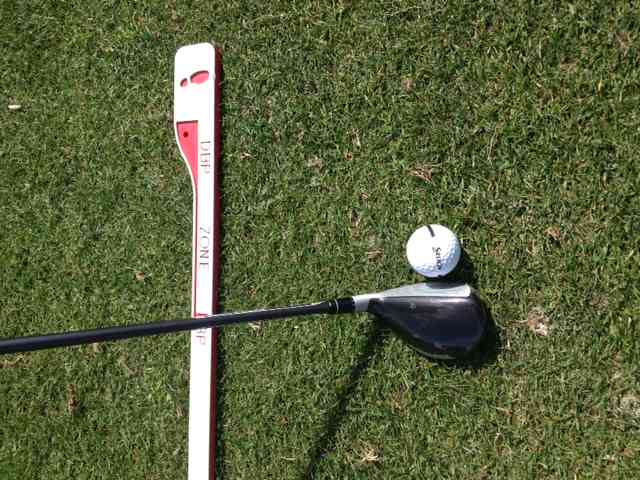
1. The ball position for a hybrid is slightly forward of its equivalent iron – it is in the “ZONE” of the Alignment and Ball Position Trainer. The stance will be slightly wider (about 1/2 to 1 inch) because the hybrid is typically about 1/2 inch to 1 inch longer than its equivalent iron.

3 Hybrid Ball Position

2. You will stand slightly further away from the ball with the hybrid in comparison to its equivalent iron (again about 1/2 to 1 inch). Again – because the hybrid is typically 1/2 to 1 inch longer.

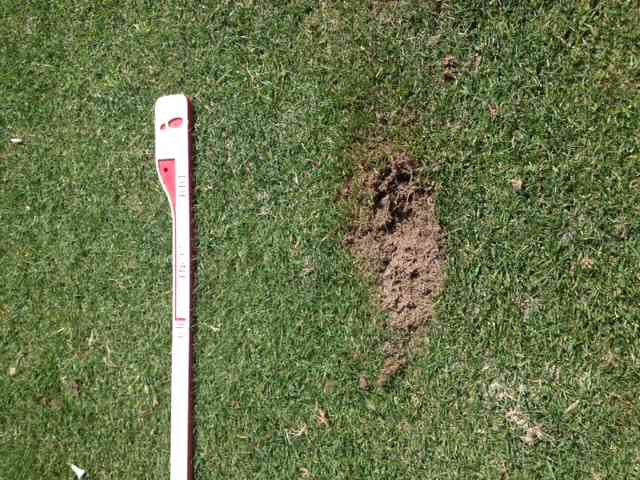
3. You MUST hit down (create a divot, or at least bruise the grass) with the hybrid. This is the problem with most golfers who do not hit hybrids well. They “sweep” the ball with the hybrid and hit the middle/equator, or higher, of the golf ball. Remember as stated above, the center of gravity of hybrids is low, that needs to go UNDER the ball – not into the ball. If you do not hit down on the ball and create a divot, you will be putting “overspin” on the golf ball and it will not fly properly, will not reach its optimal height and you will lose significant distance and spin on the ball.

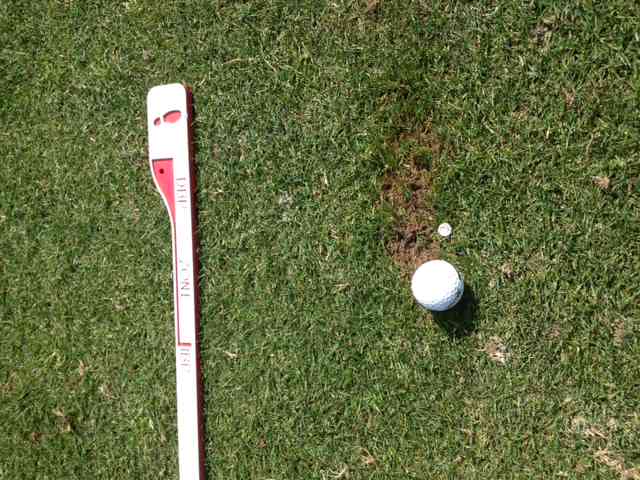
Example of Divot I made with a 4 Hybrid

DRILLS to help hit hybrids:

Divot / Tee Drill:

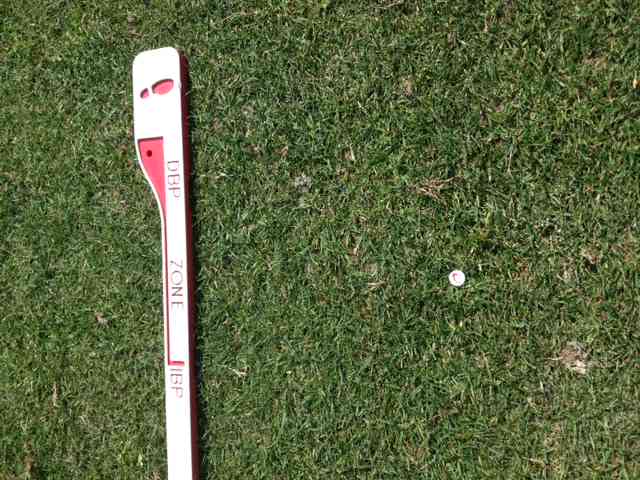
1.  Sink/Push a tee into the ground. Push the tee down until just the top of the tee is sticking out of the ground. Almost level with the ground/grass.

2.  Set up to the tee (as if there was a golf ball on the tee) and swing at the tee (with your hybrid).

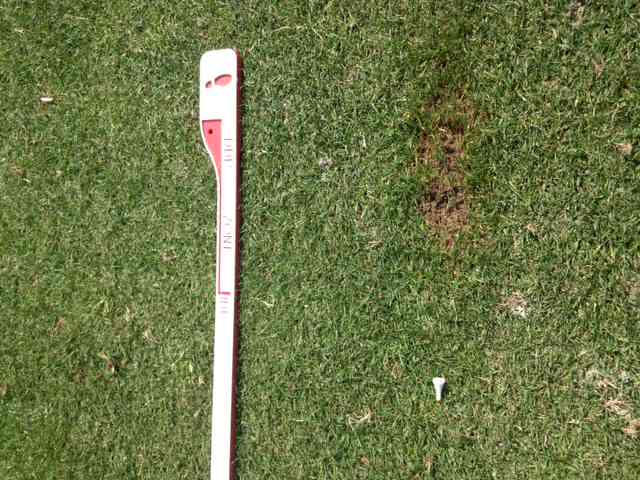
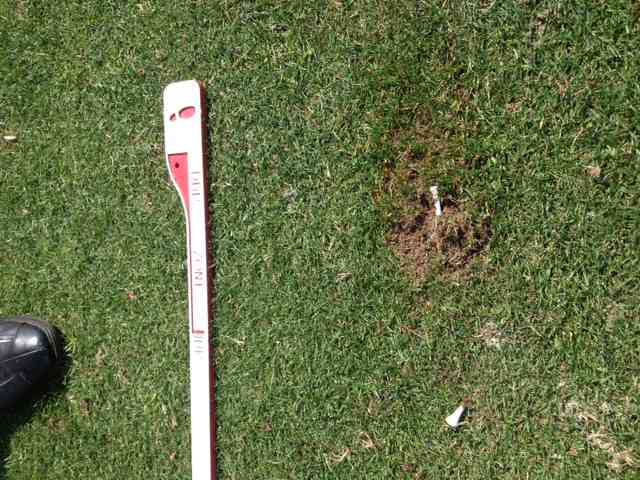
3.  You should hit the tee first, then the ground in front of the tee (divot). The tee should break, and if the ground if firm enough, the tee will actually fly out and go backwards.

Tee in Ground
Tee in Ground


Tee Broken and Divot After Hybrid Swing

4.  Do this again and again, until you can hit the tee out of the ground (or at least break the tee) every time.

Tee / Ball Drill

Now – we are going to add a golf ball.

1.  Do the same set up as above, now put a golf ball on top of the tee.

2.  Set up over the ball and swing. Do not think about hitting the golf ball, but rather BREAKING the tee.

3.  Hit properly, the tee should come out of the ground/break and a divot should be created starting where the ball was and forward.

4.  When finished, it should look the same as above – divot with broken tee.

2 Tee / Ball Drill

If you are having a hard time making a divot ahead of the golf ball – add a second tee in your tee drill.

1.  Place a tee in the ground (with a golf ball on top) and a 2nd tee just in front (about an inch) of the golf ball.

2 Tee Drill with Golf Ball

2.  Now, hit the ball with the hybrid focusing on hitting both tees. You should hit the back tee first and divot will hit/go through the 2nd tee.

2 Tee Drill Finish - 1st tee out of ground, 2nd broken / bent over
2 Tee Drill Finish – 1st tee out of ground, 2nd broken / bent over

This will help you to make the divot “through” the golf ball, not before the golf ball.

Being able to hit hybrids/rescue clubs/bafflers/long iron replacements is a MUST to play good golf in the 21st century…. Golf has changed, greens have changed, conditions of the course has changed, making hitting higher/softer approach shots a MUST. And for the average golfer with average swing speed, it isn’t that hard if they know how to properly hit hybrids.

Work on these drills – make sure and get “under and through” the golf ball with your hybrids – these drills will definitely help you to be more successful hitting your hybrids and ultimately lowering your scores.


LEARN

THE

SWING

Join 1M+ Subscribers to get your FREE Video Quick Start Guide that reveals how to hit the ball farther and straighter more consistently from now on…

START YOUR NEW GOLF SWING