Why Club Fitting is So Important and Common Questions

Why Club Fitting is So Important and Common Questions


Common Questions about Club Fitting

1.  How important is it to get clubs fit to my single plane swing (or the single plane swing I am working toward)?

It is critical to get clubs fit to your single plane swing for your individual specifications. These will include the length of the club (based on your height vs. arm length), grip size (based on your hand size), lie angle of clubs (based on height vs. arm length), shaft flex and set make up (based on factors such as distance you hit clubs, whether you make a divot, etc..) and loft of club (based on factors such as distance you hit clubs, etc..).

2.  Should I wait to get fitted clubs after I change my swing or do it now?

A very common question. It really has to do with how fast you want to make changes in swing/or create those new habits. If the clubs you are swinging fit the swing you are working toward, changes in your swing will occur MUCH FASTER than if you don’t have clubs that fit the swing you are working toward. You are ultimately working to hit better golf shots with a better/more consistent swing. If the “better swing” doesn’t fit your clubs, you will not see positive results compared to matching the improved swing and club fit.

3.  What are the most important factors in a properly fit club(s)?

The most important factors of a properly fit club(s) are:

a. Length and Lie Angles – A mid iron that is as little as 2* off in lie angle (for you) can and will be hit up to 30 yards right or left of the pin with an “on plane” golf swing. The length of the club is directly related to lie angle and proper length allows for proper set up, thus allowing for a good “on plane” swing.

b. Shaft Flex – Shaft flex determines distance and height you will hit shots. An improper shaft flex can cause significant distance loss.

c. Grip Size – A proper grip size allows for proper movement of hands, wrists and arms and which allows proper release of club. Grips too small hinder proper movement (hold club too tight), grips too big will hinder squaring the club and release (significant accuracy and distance loss).

d. Set Make Ups – Different swing characteristics require different set make ups. The slower you swing the club, the more hybrids you will need (allows you to hit longer distances with ease). The amount of divot you make determines the width of sole of club you need. Less divot, more width of sole. Helps hit ball proper height and ball flight.

e. Loft of Club(s) – Proper lofts of clubs allow you to maximize total distance, distance between clubs, and maximize your short/wedge or scoring game.

4.  How is a single plane fitting different than “conventional or traditional” fitting?

A conventional or “traditional” fit, also known as a dynamic fit, fits the clubs to your swing of today. Or in other words, the fitting is making sure the clubs you have fit today’s swing. They are/will be built to your current compensations. For example, if you have an outside to inside swing (over the top), your irons will be fit to a more upright lie angle.

A single plane fit, also known as static fit, fits the clubs to your swing you are working toward and/or the perfect single plane swing for your size (height, arm length, hand size, speed, etc.) For example, your club’s length and lie angle will be fit to you so you can stand the perfect distance from the ball, with the perfect spine tilt at the waist. At perfect set up for your size, the club will sit perfectly flat on the ground (as at impact).

5.  Do you need a special club for the single plane swing?

No, you do not need a special club for the single plane swing. The key is the club MUST fit YOU for your single plane swing. If not, it will be very difficult, if not impossible, to make changes (create those new habits). Our most popular clubs we sell to our students/customers are Taylormade, Adams, Callaway, Titleist, etc… We can get the best equipment to you for your single plane swing.

6.  If I am interested in getting a club(s) – do I have to get an entire set?

No, you can get as few a one club, or up to as many as you like. When clubs are custom fit to you, they can be ordered in any set make up you like (or needed).

7.  Is it important to have my driver and / or wedges fit to me?

Absolutely – fitting a driver will maximize distance for you. An improperly fit driver will, and typically does, limit distance. Fitting wedges (especially the lie angle) is critical. As wedges are often hit with 1/2 speed or less (short game), the club heads will twist/turn on impact if the lie angle is not correct. It is extremely hard to hit good short game shots if lie angles are not set correct.

8.  What is the chance purchasing a club off the shelf will fit me?

Zero – 0% change.  A club purchased “off the shelf” will not fit you. Standard grips, standard lie angle, standard length, shaft flex… nothing is set to your swing. Plus, most clubs off the shelf are set for golfers who “slice” the golf ball. or come over the top. meaning – they are set up for the 90% of golfers who have a “off plane” golf swing. Those are the last clubs we want in our hands.

9.  If I order clubs, how long does it take to get them? 

About 7 to 10 days (maximum 14 days). ALL clubs that are ordered through us at the GGA are custom built to you. It takes about 4 to 5 days for the manufacturers (Taylormade, Callaway, etc..) custom’s department to build the clubs, then the additional time is shipping time.

10.  Do custom clubs cost more than non-customized clubs?

No, custom clubs do not cost more than non-customized clubs. In fact, when you order clubs through us at the GGA, you will get our specialized Moe Norman Single Plane Grips on the clubs (if you request) at no extra charge also. Meaning you will be saving up to $10 per club, up to $100 per set, as the grips are free on our customized clubs.

11.  If I can’t see you in person, how can I get fit (or know what works for me)?

Very easy – as we perform static fittings (see above) – we can do much of the work online with you answering a few fitting questions for us. Filling out a few questions and submitting them to us will allow us to properly fit you perfect for clubs for your single plane swing. When you fill out and submit the form, we will return it to you with fitting recommendations/club suggestions in a day or two.

To see fitting form:  CLICK HERE

If you have additional questions (or comments), please feel free to contact me at:  timkgraves@aol.com or timg@moenormangolf.com

To see “No Excuses in Bag” Article about club fitting:  CLICK HERE

Sustaining Progress / Embrace Repetition, Tips for Improving (Part 11)

This is the 11th part of a series of practice tips titled “Tips for Improving”.

If you have missed any of the first 10 parts, you can go to our blog

In those practice tips we discussed how we work with our students to create new habits rather than breaking old habits.  It is essentially impossible to break bad habits (our mind/body is not set up that way) … but we are set up to be able to create new habits and ultimately make changes/create new movements, etc.  we want.

We talked about a book we strongly recommend – The Little Book of Talent / 52 Tips for Improving Your Skills by Daniel Coyle.

It is described as a manual for building a faster brain and a better you. It is an easy-to-use hand book of scientifically proven, field tested methods to improve your skills – your skills, your kids’ skills, your organization’s skills – in sports, music, art, math and business. The product of five years of reporting from the world’s greatest talent hotbeds and interviews with successful master coaches, it distills the daunting complexity of skill development into 52 clear, concise directives.

Whether you are 10 or 100, this is an essential guide for anyone who ever asked, “How do I get better?

9780345530257

This book is available at Amazon.com

The last instructional newsletters (Tips for Improvement Part 1 through 10) we discussed 41 tips for improvement from staring a who you want to become, to being willing to be stupid, to finding the sweet spot, to practicing by yourself, to taking a nap….  Again, if you have not reviewed these past practice tips, would recommend.

This instructional newsletter (Part 11) we cover the next tip for improving your skills and relate them to you learning/working on your single plane swing and golf game.

Sustaining Progress

Developing your skills (and talent) is like taking a cross-country hike. You will encounter challenges, you will hit snags, plateaus and steep paths; motivation will ebb and flow. To sustain progress, it’s necessary to be FLEXIBLE one moment and STUBBORN the next, to deal with immediate obstacles while staying focused on the horizon (or your ultimate goals).

43.  Embrace Repetition

Repetition has a bad reputation. We tend to think of it as dull and uninspiring. But this perception cannot be more wrong. Repetition is the single most power lever we have to improve our skills and create new habits.

The Little Book of Talent talks about Moe in this chapter:

Moe Norman was a shy Canadian who played briefly on the professional golf tour in the 1960’s and 70s. He was also, in most estimations, the most accurate golfer in history. Norman had seventeen holes in one, three scores of 59 and, in Tiger Wood’s estimation, ranked as one of two golfers in history who “owned their swing” (the other was Ben Hogan). Norman was also a likely autistic who, at a young age, became enraptured by the power of repetition. From the age of sixteen onward, Norman hit eight hundred to a thousand balls a day, five days a week, calluses grew so thick on his hands he had to pare them with a knife. Because of emotional struggles, Norman had difficulty competing in tournaments. But at a demonstration in 1995, he hit fifteen hundred drives in a row, all of them landing within fifteen yards of each other. As Woods put it, Norman “Woke up every day and knew he was going to hit it well. Every day. It’s frightening how straight he hits it.”

Embracing repetition means changing your mindset; instead of viewing it as a chore, view it as your most powerful tool. As martial artist and actor Bruce Lee said, “I fear not the man who has practiced ten thousand kicks once, I fear the man who has practiced on kick ten thousand times.”

44.  Have a Blue-Collar Mind Set

From a distance, top performers, or those who are the best at their skill, seem to have charmed, “cushy” lives. But when you look closer, you will find they spend vast portions of their life intensively practicing their craft. Their mind-set is not entitled, but rather “blue collar”. They get up in the morning and go to work every day, whether they feel like it or not, working on their craft, working to get better, working to find a way to improve.

As you are working on creating new habits, improving your game, think about taking a “blue collar” approach.

45.  For Every Hour of Competition, Spend Five Hours Practicing (at least)

Games are fun. Tournaments are exciting. Contests are thrilling. They also slow development, for four reasons:

1.  The presence of other people diminishes an appetite for risks, nudging you away from the sweet spot.

2.  Games reduce the number of quality reps.

3.  The presence of games distorts priorities, cncouraging shortcuts in technique.

4.  Games encourage players, coaches and parents (and one self) to judge success by the scoreboard (scorecard in golf) rather than by how much was learned.

Competition is a great thing. It helps built emotional control, is exciting, is challenging, and it’s fun. But it’s also, in many cases, an ineffective way to improve skill.

One solution to this problem is to make performance a “special occasion” not a routine. A five-to-one or even a ten-to-one ratio of practice time to performance time is a good starting point.

This might even be considered when just playing a round or two if you are going to use the results to judge progress.

In the next e-tip (March issue) we will discuss in depth about building new habits instead of breaking bad ones plus additional tools to help you in your “journey” to great golf.

Please watch upcoming newsletter practice tips for continuation of the tips for improving your skills/creating new habits and improving your golf game.

Demand More of Your Golf Training: The Four Pillars of Winter Prep

If you live north of the Mason-Dixon Line this year, the weather has been a total disaster for your golf game. If you live north of the 49th parallel (sometimes referred to as the USA-Canada border), you know the weather has been a total disaster for your golf game as it has had even the moose stamping their feet for warmth. Moreover, even thinking of practicing your golf game has probably been the last thing on your mind for fear the clubs would stick together in that vehicular freezer called the trunk. Seriously – it was -35 Celsius (-31F) in Toronto the other day.

What this has meant for all of us committed northern golfers, is that our games have suffered because we can’t practice or play over this weather forced hiatus. While we can practice movement with club drills and training aids, it is impossible to see what is happening to the ball. We need space –and more importantly we need feedback to keep our practice sessions and lessons sharp and focused. Remember, just because something feels right doesn’t mean it is.

Unless we head to the southern climes for a brief respite, we’ve been relegated to hitting balls in the winter ‘domes’, those blow up warehouses that are reminiscent of a Wal-Mart with artificial air being blown in by a giant fan to keep the air pressure equalized so it stays upright. While better than nothing, none of the domes here in Ontario let you work on your entire game, specifically realistic putting, bunker, pitching and chip shots – and forget the feedback.

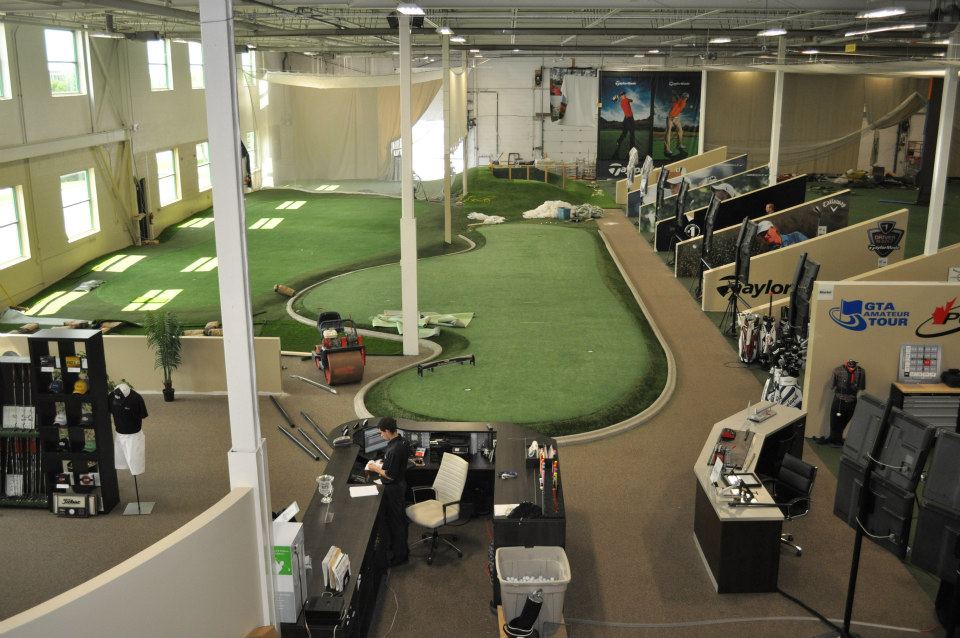
Well, all this is a thing of the past if you live in or around Toronto. Starting last November, I’ve had the distinct pleasure of conducting winter golf schools and teaching at The Golf Lab in Vaughn, just northwest of Toronto. This facility is, in my opinion, the premier winter golf training facility in Canada and measures up favorably to anything in North America. The reason is quite simple – the equipment within the facility is geared to give you accurate and reliable FEEDBACK using the large screen Trackman radar system and V1 Video. No more guessing about what is happening.

TheGolfLaboverhead

Additionally, inside the 26,000 square foot building you can practice your entire game in a warm and comfortable environment… putting, bunkers, chipping, pitching, irons and drivers. My personal favorite in the short game area is the bunker(s). The have a cool area set up with a two links style sod bunkers that feature TWO distinct textures of sand. Awesome! There is no better way to optimize your chances of starting the new season fully prepared.

TheGolfLabBay

Figure 1 Overview of The Golf Lab Training facility in Toronto, Canada. 26,000 Square feet of effective training space

My foremost point about training in the winter is to search for a facility where you can get reliable and accurate feedback about what you are doing. While good advice at any time of the year, it is especially important when making some swing changes during the winter.

Folks, let me get on my soap box for a call out. Starting now, demand more of your training facility. In my opinion, way too many golf training centers are getting by with antiquated equipment and techniques. If your facility and coaching doesn’t utilize video, gross motor pattern movement training and accurate ball, club and swing feedback you need to tell them they are behind the curve.

The Four Pillars of Effective Winter Training:  Movement, Stretching, Strength and Feedback

1. Precision Movement Based on Facts: Understand precisely what changes you are seeking to make and train precisely. During the winter when you are seeking to make some changes, I recommend slow motion training as an excellent way to learn new and more effective motor patterns. The research shows there is no better way. Having said that, all changes you undertake should be based on solid information and data. Work with your coach and have a clear understanding of what and why before you undertake any change for change sake.

At Graves Golf we have spent over a decade focused on helping you to increase your enjoyment and pleasure in the game of golf.  The recipe for getting better is not arcane or mysterious. Rather, it just requires a clear intention and dedication on your part to making the incremental improvements.

2. Stretch Yourself: I mean this in every way possible. Stretch your body first and work continually on increasing your flexibility. Rigidity (of mind and body) will NEVER produce more speed or accuracy. Recently, a long drive champion I am working with established that he lost about 15% of his flexibility over just five weeks of injury induced inactivity. You must work the body to keep it supple and agile. Recent research in brain neuroplasticity has established that the same principles apply to your mind.

3. Strength Training: Use the winter to make your body a better version of yourself. Be stronger and fitter. The surge in driving distances on the PGA Tour is as much driven by enhanced fitness as equipment. Look in the fitness trailer at any event and you will see it is at capacity all day long. One of my favorite competitive quotes is from the legendary football coach Vince Lombardi. He said. “Fatigue makes cowards of us all.” Coach Lombardi knew that the dedication to training built a sustainable winner. It is difficult in any task to reach optimum when one is out of steam and energy.

 4. High Quality Feedback: This pillar of winter training is perhaps the one you need to be the most dedicated to. You can’t underestimate the importance of getting high quality feedback on what you are doing. When making a change in your swing it is very difficult to only rely on your feelings. Your feelings when making a change are notoriously undependable! Check yourself constantly in the mirror, with a trusted eye of someone that knows your swing, with video and devices like Trackman or Flight Scope

At Graves Golf we have spent over a decade focused on helping you to increase your enjoyment and pleasure in the game of golf. The recipe for getting better is not arcane or mysterious. Rather, it just requires a clear intention and dedication on your part to making the incremental improvements.

About the Author:  Ron Cruickshank PhD, is a GGA Master Instructor and Mental Coach in Toronto, Canada.

Common Questions

There are numerous questions and comments that people consistently ask about Moe Norman and the Single Plane Golf Swing.  Lets take a look at some of the most common questions –

1) If Moe was so great, why isn’t anyone on the PGA Tour using his swing?

A few players are very close – one, in particular, is Steve Stricker. Other players are Brian Gay, Carl Peterson and there are a few others such as Steve Elkington who have dabbled with Moe Norman’s mechanics. For all players, Swing Plane is the goal of all good ball-striking. Every PGA Tour player, both good and bad ball-strikers, are seeking to swing the club on a plane which allows them to become more consistent at achieving impact. Moe Norman’s golf swing is the easiest way to achieve what all players are attempting to do.

2) What do you mean by easy or simple?

The goal of a great golf swing is achieved the most important moment – impact. We call this “perfect impact” where the club path is correct, the club is at the proper angle and the club-face is among at the target. We consider and easy swing the ability to start “at address” and get to perfect impact with the least body movement, maximum speed and least stress on your body.

Because of the common “Conventional” swing method of hanging the arms straight down at address -in the athletic position – no conventional player can truly simplify their swing because they are starting off of the natural impact plane, complicating the golf swing from the very beginning. The key to simplification of the swing is to start, at address, on the Single Plane making it easier to return to impact.

3) Moe was great because he was “different” maybe even Autistic.

The truth is that Moe is a human being, with arms, legs, hands and he learned his golf swing through practicing the proper movement of his body – just as you and anyone with arms, legs and hands can also learn to move in a “biomechanically” ideal way making golf easier.

4. Moe’s swing hits the ball shorter – not as long as the conventional golf swing.

I played with Moe at Greenlefe Resort, in Florida for the first time in 1994 while I was playing professionally. Moe was 64 years old and consistently hit the ball 260 – 270 yards off the tee. There is no evidence that Moe Norman was shorter than other players on the tour when he played. Competitors that played with Moe in his competitive years often said Moe was equal in length or even longer off the tee than most players.

5. Moe’s swing looks weird.

I often hear this comment about Moe’s swing.  But I only hear this from “amateur” golfers. Professional golfers who knew Moe understood his swing plane and see the genius in his mechanics. I have never heard a professional golfer call Moe’s swing weird.

6. How long does it take to learn?

Learning is a process of learning the proper fundamentals and then practicing them until the brain develops a program for them. This process is different for everyone, however, our research and experience show that most people do not know how to “program” their brains effectively through practice. If a student truly learns how to practice, we have found that chaining their swing can be learned in less than 30 days.

7. What is the best way to practice?

The key to practice is to learn to move correctly. This means chaining the way you currently move (swing). The best way to do this is to start learning the positions in slow motion and then, once mastered in slow motion, speed up the motion until you can do it without mistakes. Use feedback tools such as training aids, video, mirrors and coaching to make sure your “fast” swings are fundamentally correct. Once you are fundamentally correct, you can start hitting balls to check technique.

8. Moe was the only one that could swing like Moe.

This is more of a comment than a question yet I hear this from golf professionals quite a bit. Once again, which I still can’t understand to this day, biomechanics is being ignored in relation to the golf swing. Of course, you are not Moe Norman nor are you any other athlete. The fact is that the Single Plane Swing is not about Moe Norman – it is about you learning from Moe’s mechanics and applying the simplicity of his swing to your swing. You will be your version of the Single Plane Swing. You might even be better than Moe.

9. Old dogs can’t learn new tricks.

I guess this refers to the fact that once you reach a certain age, learning stops. This, however, has not been my experience watching golfers of all ages learn the Single Plane Swing. After teaching over 5,000 students in the past 14 years in our golf schools what we have learned is that there are particular learning tools that accelerate the process. We have also learned that certain thing inhibits the learning process (such as hitting golf balls while trying to change swing motions). Therefore, anyone who thinks they can’t learn or is having trouble picking up something new –  usually is practicing inefficiently.

10.  If you had to learn it all over again, what would you do?

I love this question because it allows me to teach you from my direct experience. It also allows me to tell you what I wouldn’t do. If I had to learn Moe’s swing all over again, knowing what I know now, I would study the model thoroughly and exactly compare myself to the model. Then, using video and feedback tools such as mirrors and photographs, I would model the exact movement of Moe. Once I achieved the movement (without thinking), I would try to hit balls – into a net using video. If I make any mistakes on video, I would immediately change my mistake and try again. I would use this “back and forth” video modeling process to master my swing before I even attempted to play on the course.


Becoming a Great Self Teacher, Tips for Improving (Part 10)

This is the 10th part of a series of practice tips titled “Tips for Improving”.

If you have missed any of the first 9 parts, you can go to our blog

In those practice tips we discussed how we work with our students to create new habits rather than breaking old habits. It is essentially impossible to break bad habits (our mind/body is not set up that way) … but we are set up to be able to create new habits and ultimately make changes/create new movements, etc.  we want.

We talked about a book we strongly recommend – The Little Book of Talent / 52 Tips for Improving Your Skills by Daniel Coyle.

It is described as a manual for building a faster brain and a better you. It is an easy-to-use hand book of scientifically proven, field tested methods to improve your skills – your skills, your kids’ skills, your organization’s skills – in sports, music, art, math and business. The product of five years of reporting from the world’s greatest talent hotbeds and interviews with successful master coaches, it distills the daunting complexity of skill development into 52 clear, concise directives.

Whether you are 10 or 100, this is an essential guide for anyone who ever asked, “How do I get better?

9780345530257

This book is available at Amazon.com

The last instructional newsletters (Tips for Improvement Part 1 through 7) we discussed 31 tips for improvement from staring a who you want to become, to being willing to be stupid, to finding the sweet spot, to practicing by yourself, to taking a nap….  Again, if you have not reviewed these past practice tips, would recommend.

This instructional newsletter (Part 10) we cover the next tip for improving your skills and relate them to you learning/working on your single plane swing and golf game.

42.  Six Ways to be a Better Teacher or Coach

You are probably thinking – this doesn’t relate to me. but that couldn’t be further from the truth. One of the first things we tell our students at our schools is that to become a good golfer, one must become a good student and becoming a good student involves the relationship of becoming a great self-teacher.

Let me explain – for most golfers – a majority of their practice is done on their own/or bye themselves. In other words, they don’t have a teacher/coach watching them hit balls making adjustments, recommendations, changes, etc. And if they are practicing with others, chances are those others know little about what they are working on and cannot help them. That is the nature of golf… good or bad, it is a “self” sport – one that is typically worked on by yourself – you improve as fast or as slow as you want….  you are the one responsible – a “self” sport.

So, to become a good player – you must be a good self-teacher or self-coach. You need to be able to take the information/instruction you are given/taught and be able to self-teach yourself when you are practicing.

Here are six ways that will help you be a better teacher or coach:

1.   Use the first few moments of every lesson/practice session to connect on an emotional levelAsk yourself why you want to make the changes – why they are important to you, what you are looking for in the outcome… So when the changes become a little difficult – you will keep going…

2.  Do no give yourself “long speeches” – but rather deliver vivid chunks of information. I love this one – don’t overwhelm yourself with information – but rather be to the point, be specific, be very specific – focus on one thing at a time. You can and will create new habits if you break what you are working down into chunks – small chunks, specific chunks. Example – if you are learning from a video, it is okay to go through the entire video once, but don’t expect to learn anything that way. Go through the video a “chunk” at a time. In fact, most of our instruction videos we break down into chapters to help you create the “chunks” you are working on. I would even suggest to work on small parts of each chapter at a time.

3.  Be “allergic” to mushy language – When you are studying/learning new positions – work on very specific points.  Example – if you think you need to move your hands higher at set up – don’t say to yourself, “Move your hand higher” – but rather say – “Move your hands so the butt end of the club points to the pivot point”, etc.  Be specific so when you practice there are no questions…. “mushy” language allows too much room for error or misinterpretation.

4.  Make a scorecard of learning – Pick a metric that measures your skill you want to develop, and start keeping track of it. Use the measure to motivate and orient yourself. There are many ways to do this in golf. Examples – Short game – count the number of 3 putts, count the total number of putts, percentage of up and downs, etc. In the long game, how many fairways you hit, how many greens you hit in regulation (in 2 shots on a par 4, 3 shots on a par 5, etc..), how many drives you hit under/over a certain distance in a round, etc. There are many ways to keep a scorecard of learning while you play and others while you practice.

5.  Maximize “Reachfulness” – Reachfulnes is the essence of learning. It happens when you are learning forward, stretching, struggling, and improving. The point of this rule is a good self-teacher finds ways to design environments that tip yourself away from passivity and toward reachful action. This is why good self-teachers will avoid ideal time… but rather when they practice will have a very structured format they follow during practice. From warming up, to specific drills, to check points, to working on different areas of the game during a practice session – they avoid “idle” time in their practice sessions. Think to yourself – what kind of environment can I put myself that will create the most “reachful” environment? How can I replace moments of passivity with moments of active learning in my practice sessions?

6.  Aim to make yourself an independent learner – Always remember, the outcome of any practice session (with a coach or learning from a video, webinar, etc..) is to make yourself an independent learner. Creating an environment when you can teach yourself, when you check what you are doing yourself, that you can self-correct at any time, etc… etc. Once you can do this, you will be able to quickly realize when things aren’t going correct and make the needed adjustments, etc. This is what good players do during a round of golf that prevent the “wheels from falling off”.

In the next e-tip (February issue) we will discuss how to sustain progress – additional tools to help you in your “journey” to great golf.

Please watch upcoming newsletter practice tips for continuation of the tips for improving your skills/creating new habits and improving your golf game.

MOCAP Shows Biomechanics of Single Plane Swing

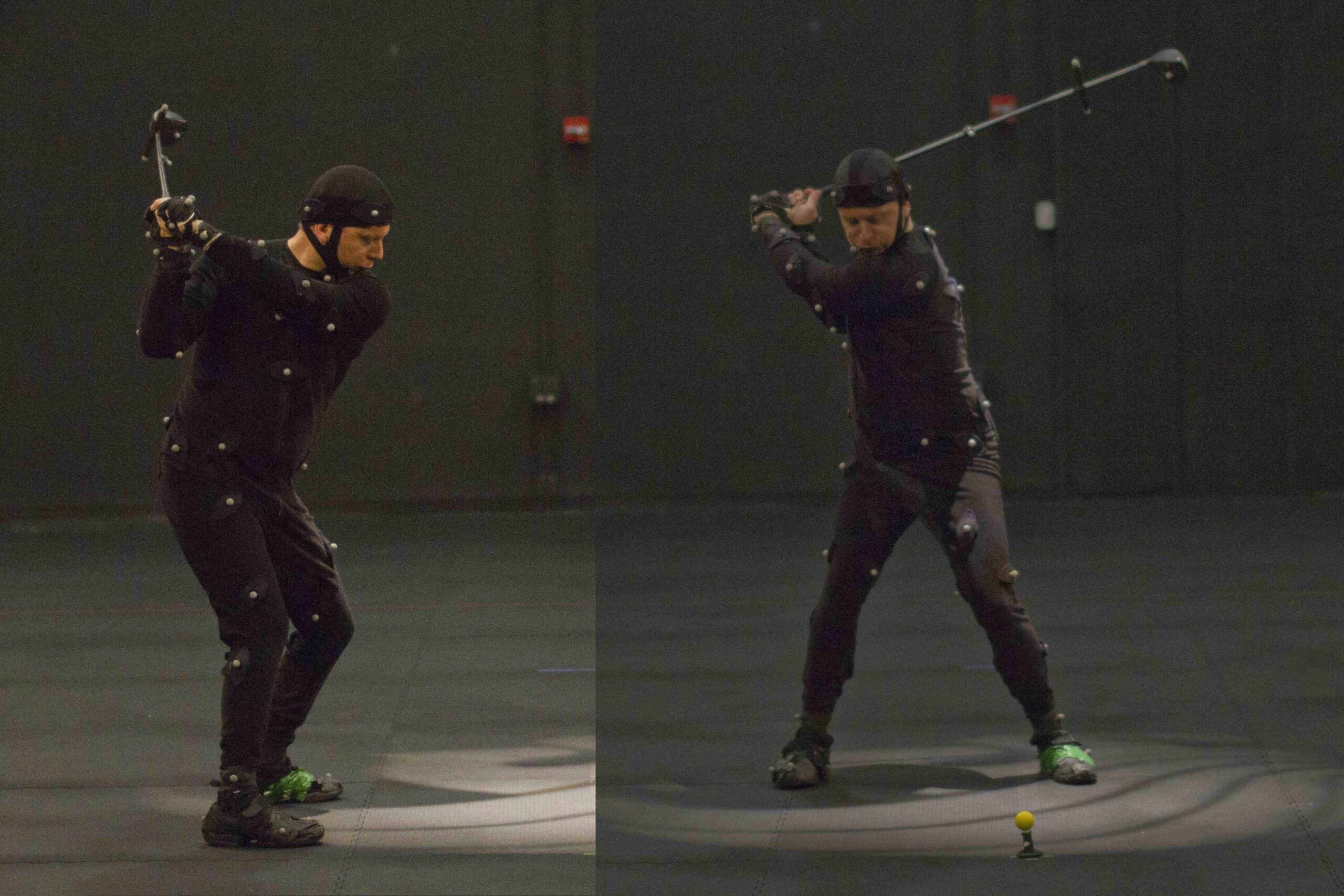
Nothing excites me more than analyzing the golf swing with the amazing technology available today. I recently worked with the studios in Orlando Florida to capture the motion of the Single Plane swing in 3D. I am using this analysis to study the simplicity of the motion and teach people how to make golf easier on their backs and body.

Here are a few of my favorite pics:

MOCAP Pos 2 FO Small copy
Top of Backswing
Release of Single Plane Swing

Motion capture analysis is 3 Dimensional whereby the suit I am wearing has various markers placed in triangular planes around the body. Cameras around the room (all dimensions) capture the movement of the points as they move through space. By studying the movement of the plane you can see the movement of the area of the body as it relates to other parts of the body. Amazing Stuff!

The next step is two put skin and bones onto the 3D model. Once the model is animated, we will be able to go inside the body with a camera to see how everything is working. Stay Tuned!

LEARN

THE

SWING

Join 1M+ Subscribers to get your FREE Video Quick Start Guide that reveals how to hit the ball farther and straighter more consistently from now on…

START YOUR NEW GOLF SWING