Improve Your Move (GO)

Improve Your Move (GO)

Green means Go. That is what I want you to do when it comes to moving your lower body. The problem with worst golf swings is that bad golf swings STOP the lower body from moving. You need to find out whether you STOP or whether you GO. This could be the difference in whether you slice the ball or hit it nice and straight.

Take a look at his sequence of Moe Norman Pics. These are some old pics of Moe from the 50’s. In the first picture, I marked his lower body position by marking his right hip position at address.  Then I marked his right hip position at impact. You can easily see how it has moved. This is exactly what I mean by GO. You must let your hips GO forward into the downswing and impact.
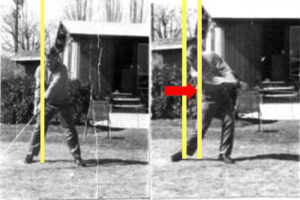
Lower body move

This is a great angle to view the lower body. It is both lateral AND rotational. Notice how Moe has moved his lower body into a flexed lead knee. His lead foot is rotated outward. Notice how he has maintained his tilt. Also keep in mind that the lower body movement is critical for the proper swing path. If you have any of the following problems, you might have problems with your lower body:

  1. Hit behind the ball
  2. Slice the ball
  3. Hit off Toe of Club
  4. Pull the ball

These are the most common problems when the lower body STOPS movement. Always remember that most swing problems are due to improper body movements. The lower body move is important to proper swing path so any problems with swing path could be lower body problems.

In summary, you must make your lower body a GO motion and not a STOP motion.  In the backswing the lower body turns (Goes) and then it GOes in the transition and it moves into the lead leg. The lead leg supports the hip motion as you release and finish.  You should feel the stopping motion in your legs, not your hips. This is why the lower body is a GO motion – just as Moe described “I swing into my legs”. In other words, Moe moved his lower body into his legs.

The Quality of Golf Schools today

At a recent 3-day school, we had just completed the 1st day of the school, and one our students needed a ride back to his hotel. His scheduled ride hadn’t shown up, so Todd and I offered to give him a ride to his hotel.

During the ride, this student, Glenn, was talking about another school he had attended a couple years back, and what he had to say left me dumbfounded.

You see, Glenn is from Northern California, and he had flown all the way across the country to attend this school in Southern Florida. The school was a multi-day program much like our school, and he had gone to considerable expense and time to attend. Curious about his experience, we asked him what he learned at the school, he stated, “Swing the Club”.

Simultaneously, Todd and I asked, “That’s it? All they told you was to Swing the Club”. He responded that yes, in fact that was all they told him the entire time he was there. He finished the story by saying that he found that experience to be a complete waste of time, travel and money. He had taken time out of his life, flew all the way across the country, to be told to “Swing the Club”.  Wow.

After our conversation with Glenn, I began to recall some of the other stories I’ve heard over the years from alumni about their experiences at other schools. And these are big “name” schools, put on by instructors you’ve heard of, and the comments are predominantly along the same lines as Glenn’s were.

These comments from our students leave me wondering about the quality of school instruction available out there for golfers like you and I. While I’m sure there are many very good instructors out there who help as best they can, it certainly seems from my view that there is a lack of quality instructional opportunities in the marketplace.

I know that I’m completely jaded, however, when I step back and look at our school programs over my 9 years with GGA, I’ve seen steady and consistent growth in the number of people attending the schools, as well as a 65-75% return rate. When we ask alumni why they keep coming back, nearly to a person they tell us that they are now ready for the next step, and while they heard the “next step” at their last school, they weren’t quite ready for it at that time, so they continue to come back.

So what is it that sets our schools, which are growing consistently, year after year, apart from other golf schools out there? And how do you judge the quality of a golf school program?

As I step back and try to look at a golf school through your eyes, there a couple main things that come to mind:

  1. Is there a model to follow?
    1. Nearly every task we’ve perfected in our lives, we’ve had a model.  Whether it’s tying our shoes, shaving our face, or driving a car, somebody in our life ‘modeled’ the way to do it, and we do it that way to this day. I tie my shoes exactly the way my mother taught me to at age 4 some 37 years later.
  2. Does the theory match the reality?
    1. Learning any task is more than just a transfer of information, especially when you are talking about a complex task like swinging a golf club. Golf swing theory abounds out there, but is there proof of the theory in reality? The theory of just “Swing the club” may make a great marketing pitch, but what does that mean in the real world?  Swing it how?
  3. Can you get real time feel and feedback?
    1. While the other 2 points are important, getting real time feel and feedback is key to perfecting a new skill as an adult learner. Our brains think we do one thing, but feedback (like video) often proves otherwise. You must have a way to match what you are supposed to be doing to what you are actually doing, otherwise it’s just exercise.
  4. What happens after the school?
    1. So you’ve done the school, now what? Does the program provide you with specific “next steps” to continue what you’ve started? How do you know if you are doing it correctly when there isn’t an instructor there with you?

Obviously I know that our school programs have very specific and clear answers to each of those questions, and from what I’ve learned from golfers like you, is that other golf school programs out there do not have those answers as clearly defined for their students, and I suppose this is why golfers walk away from these programs less than satisfied.

As I conclude, I feel I must make clear that I’m not attempting to bash other school programs out there. There are a lot of very good teachers out there who work very hard for their students, and they should be commended for their hard work. I believe that they simply do not have the tools necessary, like a model to teach to, and without a destination, any trip will wonder aimlessly.


The Formula for Improvement

What is the secret to skill building? Many of you know it but you don’t know that you know it. What you don’t know is that when you were younger, you intuitively learned skills that today, you don’t even know that you know. These skills are “natural” to you now and you don’t think about them. Let me give a few examples.

I’ll bet you eat with a fork and rarely stab yourself in the face. As a matter of fact, I bet when your sober you find your mouth almost 100 percent of the time. How about driving your car? Did you know that you perform almost fifty separate acts every time your drive including shifting, steering, listening to the radio, watching the road, stopping, checking your mirrors, using the gas peddle, and dozens of other things. Driving a car, and many other daily activities have become “automatic” to you as you live each day. So how do you make the golf swing automatic?

I have my own personal formula for how I achieved Moe Norman’s Single Plane Swing. It took me a few years to fully develop Moe’s swing to where I was fully “automatic”. Today I rarely practice but just as I don’t have to relearn riding a bike – my golf swing is now automatic. But to steal from one of my favorite authors, Dan Coyle (The Talent Code), let me show you the formula that I used to master the golf swing:

Step 1) Copy the Model Moe Norman – Steal his Swing

How do you do this?  I used video analysis tools. I simply compared Moe to me and changed everything that didn’t look like Moe.

Step 2) Work like a Carpenter 

This means that you need to study the model and carefully match it. Measure and re-measure and adjust what is necessary.

Step 3) Forget about Results – focus your mind on the model (study Video) not the ball

You will not hit the ball well when you are retraining your swing. Remember you are a carpenter and you are in the building process. The finished work will be great but right now you need to build and not get ahead of yourself. One piece at a time is the way you build anything great. This is the way I built my golf swing – one careful piece at a time.

Step 4) It’s All About Feeling

The key to modeling and using video is that you get a feel for what the model is doing. Therefore, the key to success is feeling the model – even if it doesn’t feel “right”. This means you are not there to judge what is right or wrong, just feel.

Step 5) Have Fun Building

Most people feel pressured to be a better golfer but the key to being better is to have skills. Skills are fundamentals and once you learn them, they will be there for you to perform well when you play. Those who are disappointed usually lack skills and I always found that enjoying the process of skill building made practice so much easier. I learned to have fun matching the Model of Moe – the closer I got to the model, the more fun it became.

Step 6) Stop Looking at Golf Magazines

The model of Moe is not understood by the “typical” golf world. Therefore, much of what you read in magazines or on the internet does not apply to what you know now. I suggest not reading any “conventional” instruction as often contradicts what relates to Moe’s swing as a model. Always remember that the goal is to be simple and repeatable.

Finally, when I am helping others learn to simplify their golf swings the way I did years ago, I believe that the process is somewhat transformational. This process is to develop and build not just fix. I think that many people think they need “fixing” when they actually just need to rebuild one step at a time – just like a carpenter.


Why Having an Expert Model Is Good For Learning

2013 Monograph Series, #2 How Your Brain Really Works  

Note: The goal of this series is simple – find practical applications of the latest brain science research to how one learns and stores movement. This includes all aspects of golf.

By Ron Cruickshank, Ph.D., Master Instructor, Toronto Canada

Recently, on TV, I watched Nik Wallenda, of the famed circus family, walking a high wire above an interstate in Sarasota, Florida. Just a few months previously he captivated millions of people on TV as he walked a high wire strung above Niagara Falls in conditions that included wind and mist. Each time I watched, an overriding question occurred to me. “How the heck did he learn to do that?”

His answer of course is that he was tutored by his famed Uncle Karl Wallenda and that he is in the 7th generation of circus performers, dating back to 1760 during the era of the Austro-Hungarian Empire. In a recent interview he said, “People say I’m insane all the time, but they don’t understand that this is something I’ve done since I was 2. It’s just in my blood.” In reality, from an epigenetics perspective (see last article) this is a very accurate statement. Nik Wallenda had a high quality model available to him for learning high wire walking from birth.

Putting the motivational aspect aside, the prevailing question I wish to address is how does one really learn to walk on a tight rope (or learn a competent golf swing)? Walking on a 5/8 inch wire is a very demanding task that requires complex balancing and timing skills in a hazardous environment. Also in consideration is emotional management (fear), mental focus (at 200 feet above the ground you best be paying attention and able to delete extraneous input) and the mechanics such as cable tension, wind, rain, mist, lighting, your grip on the balancing pole, the weight of the pole, its composition as well as host of other things that could influence the outcome. Sounds familiar doesn’t it?

To help us answer this question I turned to golf expert, trick roper and western humorist, Will Rodgers. Actually, I don’t know if he played golf, but I found the following quote attributed to Mr. Rodgers and decided he must have intimate knowledge of golf. He said. “Long ago, when men cursed and beat the ground with sticks, it was called witchcraft. Today it’s called golf.” Only a man familiar with the game could have this kind of insight.

Anyway, relative to learning, Will Rodgers once made a sage and apropos observation. He said there are three strategies men use to learn:

  1. The ones that learn by reading.
  2. The few who learn by observation.
  3. The rest that have to pee on the electric fenceand find out for themselves.

In the vast amphitheater of options available to us for learning golf, I think this is an accurate categorizing of the learning process most of us use to learn the game. Think about the process by which you learned to play golf.

  • Did you read Ben Hogan’s classic book Five Lessonsor one by Nicklaus, Player, Snead, Jones, Ballard and a host of others then try to learn by matching the pictures and absorbing the dialogue? (Learn by reading)
  • Did you discover Natural Golftapes or Graves Golf CD’s and attempt to learn visually?
  • Did you have a teacher or golf mentor and seek to imitate what he or she did? (Learn by observation)
  • Did you get some clubs and start banging away, learning along the way from your own mistakes and success?  (Peeing on the electric fence)

Perhaps you might have used all three methods or some composite. I know I did. I started as a number three learner (electric fence guy) when a golf team member in college gave me an old Arnold Palmer putter. Pretty soon I bought an old used set of Wilson Staff irons, some Sam Snead woods and began to read Golf Digest and anything else I could find. I spent most of my spare moments (and some study time meant for Chemistry III) going to the golf course and in the evenings would hit wedges on the soccer field. I was on the path to becoming a nice solid 90’s shooter until the soccer Coach found a series of deep divots next to the goal.

I studied hard and remained committed- hitting a LOT of balls. I spent a bunch of money, attended some golf schools and while I got somewhat better I realized it was because I was developing a really good short game. My ball striking was still just moderate at best, but I never knew how I would hit it from day to day. The truth was, I didn’t know how to get better and my model was to just keep peeing on the electric fence and hoping I would get better.

It wasn’t until I became aware of and adopted Moe Norman as a swing model did I actually start to get better as a ball striker. For the first time in my golfing career I could depend that my swing would show up reliably. Improved results began to happen. The question for us here is – why did adopting a model help my learning process? The second question of more import to you is – will embracing a model speed up the learning process in acquiring an effective golf swing for you?

Will Using an Expert Model Accelerate Learning?

The answer is yes. The use of an effective model to learn from is better than not having one. Learning that is only based on error and correction (peeing on the electric fence) can be highly effective, but it takes a long time and doesn’t always produce the results because you might not figure out a cognitive solution to the problem. Unlike Moe, you could actually hit a million balls and not get better if you don’t make the correct adjustments along the way.

By the way, I am not ignoring the obvious counter to this statement – without his experimentation, Moe would not have discovered his bio-mechanically improved method to strike a ball. However, unless you have time to hit 1-2 million balls over the next few years while keeping track of what makes your muscles sore, I believe it is more effective to find a good model and emulate.

Fundamentally, having an expert model can reduce the amount of reasoning effort and problem solving necessary on the front end of learning a sound golf swing. Having the correct (proven to work by the expert) information saves you time because you don’t have to discover everything for yourself. You can literally short-cut the process by getting the right information before you start beating thousands of balls while you search for ‘the secret in the dirt’.

Practicing without error is not the objective. We learn best through discovery as the brain stores constant iterations and then improves. Having a model allows us to discover concepts governing the movement, and therefore we aren’t just mimicking the movement, we are giving ourselves a ruler to measure ourselves against. This is really a form of what the neuroscience people call augmented feedback – in other words, this is feedback you can get from an external source and not your own senses.

The science is clear – the most effective way to learn a movement skill is to have an expert model to observe and then have expert feedback to reduce the number of iterations you must perform to learn the skill. That is it!

In practical terms the best strategy sequence for learning that optimizes the way the brain works is as follows:

  1. Adopt an expert model (Moe Norman is the one we recommend)
  2. Observe and attempt to reproduce the behavior (images, CD’s, training aids)
  3. Get regular expert feedback (put yourself on film and observe, get a lesson, attend a school or send in a tape and get feedback)

What do you have to lose except a poor golf swing? As I researched Nik Wallenda I ran across this quote and thought it superb. He said, “Fear is a choice. Danger is real.”  There is no reason why you can’t have a reliable and consistent golf swing if you are willing to go about it differently. This isn’t rocket science folks.. this is brain science!

Set a Goal (Score) or Not?

Today I had a student ask somewhat common question – “Should I set a score before I play a round or not?” The is an interesting question because many of you are trying to shoot a lower score for your personal best or beat your last round. But my answer is always “No”. Here’s why.

Golf is really NOT about score.  

This might sound contradictory to most of you since the game is measured, and we compare a measure ourselves against others by score. But if you closely examine a round, what is more important is that you play each shot to your best ability – and that’s it. You simply add the number of times you hit the ball at the end. Whether you should set a goal of a score is more of a “mental” game question and not a goal question. In my experience golf is more fun when you just “play” and see what happens.

There are uncontrollable variables that affect your score such as weather and course conditions. Some days the wind is calm and the holes are placed in the center of the green where the course plays “easy” and the next day the wind blows and holes are placed behind every bunker making the same course play five or six shots harder. In this example, the same course with different conditions greatly affects your score. My recommendation nonetheless is that you still play the “hard” course or “easy” course the dame way, One-Shot-at-a-Time (OSAAT).

Golf is not about a score, its about a process. The result of the process is the score.- Todd Graves

I would rather get involved in the process because I can control what happens in the process. I cannot, however, control what happens in the outcome. I can recall numerous rounds where unforeseen events steered my score into both favorable and unfavorable directions. In once instance, my drive struck a tree saving it from heading out of bounds – saving me from making a double bogey or worse. The tree saved my score. In another situation, I hit a perfectly struck iron shot that struck the flag sending the ball into the green-side bunker costing possibly one maybe even two shots – on a perfectly struck iron shot. But in either case, the process never changed. The process is simply to play one shot at a time in every condition and in every situation.

So on your next round, eliminate all of your expectations of any possible score. If you want to set a goal, make your goal be to simply play stay in the process of playing OSAAT.

Distance – How to Get More ….

First, I want to discuss a little about my article – “No Excuses in the Bag” – Club Fitting article.

I have received a lot of questions and comments about the article.

The most common question is “Can you get the fittings needed for the single plane swing done at a local club shop or club builder, etc.?”

To be honest, I used to say it was possible, now I am not sure…. I have seen too many times when golfers purchase clubs through other sources and think they are fit to their single plane swing, only to find out that “other source” did not fit correctly.

To solve the issue – if you are interested in purchasing any club or clubs, doesn’t matter if a single wedge, to an entire set, to hybrids, driver, fairway woods, etc. give us a call or email – we’ll make sure you get the clubs you want and make sure they are fit PERFECT for the single plane swing to YOUR individual specifications. We fit ALL clubs for length, lie angle, shaft flex, grip size, proper loft, etc… to each INDIVIDUAL’S specifications. You can see more detailed information about this at: Free Club Fitting

*********

DISTANCE – HOW TO GET MORE….

One of the most common questions we receive (seems every day) is “How can I get more distance?”

There are 3 areas you can work on / improve to help you get more distance on all your golf shots, in particular, your driver.

Those 3 areas are:

  1. Driver Technology
  2. Flexibility and Strength
  3. Swing Technique

Let’s breakdown each area a little.

1. Driver Technology:

1. Driver Technology:

A few years ago, the USGA put together a set of rules limiting how much a golf ball can “rebound” off the face of a driver (vague description) – thus putting a limit on the distance of the drivers. Since then, the golf industry realizing they can no longer make drivers than can hit it further off the face, have been working on technology that has made the “big” headed drivers more aerodynamic (thus less air resistance in the golf swing) and bigger sweet spots on the face.

Literally, older technology drivers had sweet spots the size of a dime (some smaller), newer technology drivers have sweet spots the size of half dollars (some even bigger). What that means is balls hit slightly off the middle of the club face will travel much further now.

And the key is the “average driving distance” you have, not the “one” you catch that happens to fly a long way. Meaning, if your sweet spot on the driver is large and you miss hit a few shots (or more) a round off the middle of the club face, you will still get good / more “average” driving distance. Meaning, over all you will have less club into the greens, etc… etc.

So, if you are looking to maximize or increase distance – you need to have a driver that is “modern” or at least less than 2 or 3 years old. These newer drivers have large sweet spots and have the highest technology for the least amount of wind /club head resistance in the golf swing.

2.  Flexibility and Strength

The 2nd area to focus on with distance is flexibility and strength.  And in that order. Too many worry about strength and not flexibility…. Being strong with good, or great, flexibility “allows” you to get in positions in your golf swing to hit the ball with good distance.

As we get older, we lose our strength and more importantly, our flexibility. When we start to lose our flexibility, we can no longer create certain angles in the golf swing that will allow us to create “leverage” in the golf swing which in turn creates speed and distance.

We have produced an extensive DVD on this topic. This DVD is set up to test the areas of your body and its flexibility in these areas. It then gives you 3 or 4 exercises you can perform to regain and/or create increased flexibility (and strength) in those areas. This DVD is designed around the single plane swing of Moe Norman – in other words, it takes the 8 most important positions of Moe’s swing and determines if you are flexible enough to “reach” those positions. If not, it gives you “easy” exercises to perform over time that in turn will help you gain those positions and eventually “allow” you to swing the club on plane.

You can see a lot more detail about the Flexibility and Exercise information at: Flexibility and Exercise Video

3. Swing Technique

Ultimately, the most important factor to get more distance is to improve your technique. It is always interesting, one of the things we do at all our schools and camps is to measure our students swing speed. We then correlate it to their driver swing speed and the average distance they should be hitting their driver. For most (those that swing 85 to 90 mph), they should be hitting their driver 230 to 240 yards (with a little roll). For most, when they find out how far they should be hitting their driver with the speed they currently have, they are shocked… why are they hitting it so short compared to where “their potential” says they should be hitting it?  Because of technique. They are not hitting the golf ball off the “sweet spot” of the club with a “direct hit” from the club that is on path.  In other words, they are hitting “glancing blows” that is creating side spin which is limiting or reducing the distance they should be hitting their driver.

Working on swing technique – working on getting the club on the proper single plane / path, with a square club face through impact and ultimately, limited to no side spin, will give you the maximum distance.

In conclusion… to answer the all too common question we get from so many of our students / customers…

How can I get more distance?

Answer: Obtain a new / modern driver that has the highest technology for increased sweet spot and limited wind resistance (aerodynamic), work / continue to work on flexibility (especially over the “off season” months when so many lose flexibility because of an increased static life style) and always work on improving your technique to maximize the optimal hit on the ball with limited side spin and improve how you hit.

LEARN

THE

SWING

Join 1M+ Subscribers to get your FREE Video Quick Start Guide that reveals how to hit the ball farther and straighter more consistently from now on…

START YOUR NEW GOLF SWING