In Search of the Perfect Grip

In Search of the Perfect Grip

By: Todd Graves

In Search of the Perfect Grip

Searching for perfection and for the truth can be an adventure and eye opening. Sometimes it can make you do things that most people wouldn’t think of – like crawling between someone’s legs and snapping a picture.
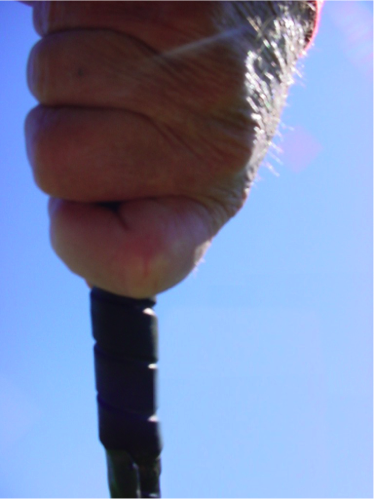
under moe

As you can see in this picture of Moe’s right hand – discovering exactly where he placed his right hand position on the club. I wanted to see his knuckle position so I crawled between his legs and took a pic. I also took dozens of other pictures from different angles of his hands on the golf club.

What I do know, after watching and learning from Moe over ten years is that Moe had the best hand action in golf because he had a perfect grip. I also learned that hand position or the grip is a vital part of the golf swing and I wouldn’t be exaggerating if I said that it could be the most important variable. Not because it is the only thing that is important but because the entire swing will often reflect and compensate for where your hands are placed on the club.

So why exactly is hand position so important?

Your hands hold the club so that you can move the club, produce speed and square the clubface at impact. I call this hand action within the golf swing and your hand action is a direct reflection of the position of your hand placement on the grip. As a matter of fact, I often check a person’s grip at the top of the backswing because you simply cannot hit a golf ball correctly if the clubface is not square during the swing movement. And the only way to have a square clubface is by having a correct hold and hand action.

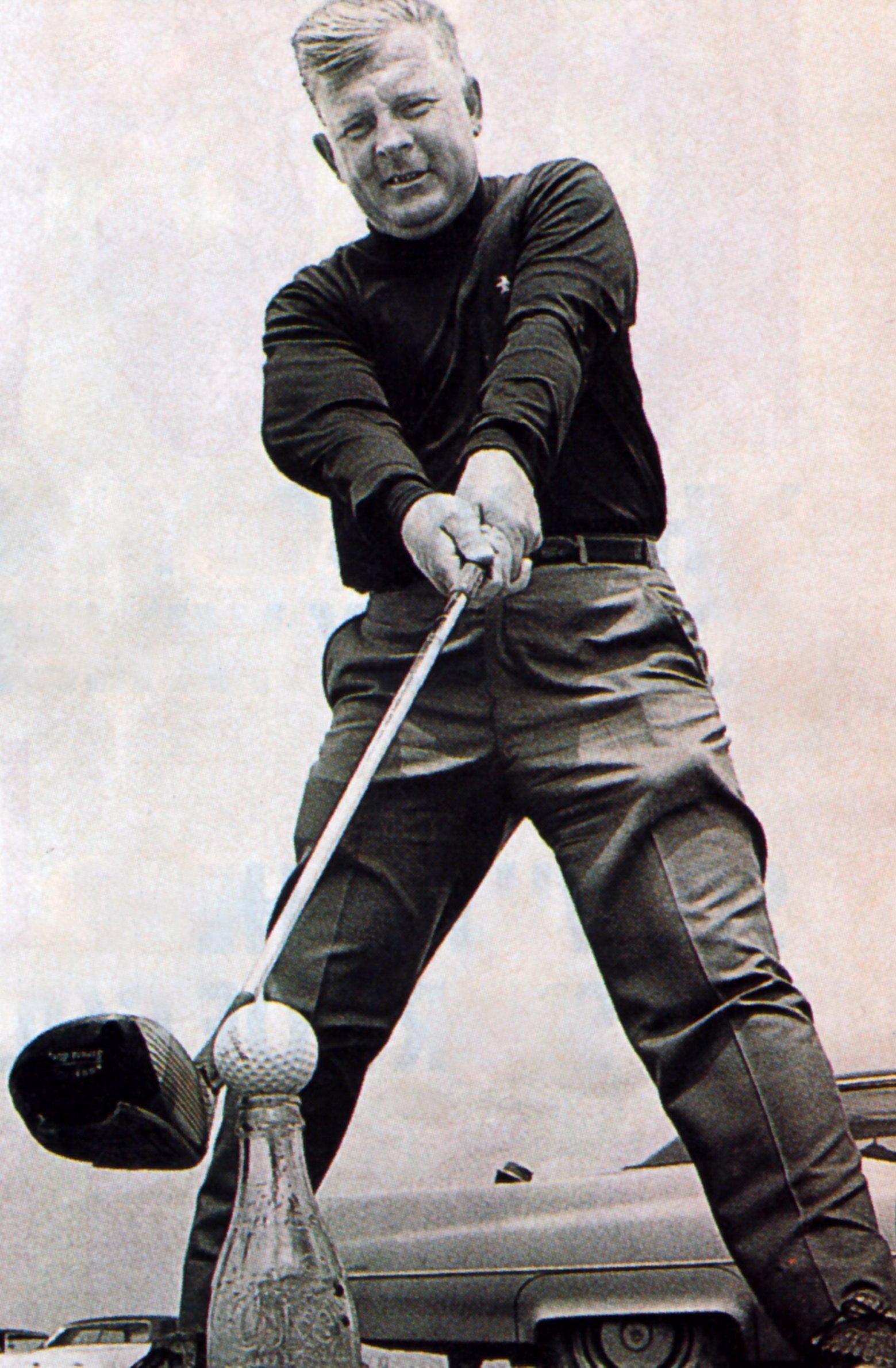
I discussed the importance of the hands position with Moe as well as how a correct hand position allows for a great address position which leads to a great hand action and swing action that Moe called – “The Feeling of Greatness”. This feeling that Moe described, started in his hands where the lead hand worked together with the trail hand to produce perfect club and club-face movement during the swing. Here are a few details to describe the Hand Position and Hand Action:

Hand Position Basics:

  1. The back of the lead hand faces the target / square with the clubface
  2. The club is held in the fingers of the lead hand (pressure points) (The Lead hand is the left hand for a right handed player).
  3. The club is held so that it aligns with the lead arm (from face on view)
  4. The Trail Hand pinky overlaps the lead hand index finger to unify the hands. (The trail hand is the right hand for a right handed player)
  5. The Trail Hand is under or aligned with the club into a “non-rotational” position where it does not rotate during the backswing or downswing allowing for a direct, straight, non-rotational movement into impact.
  6. The club also aligns with the trail arm (down-the-line view)
Moe-Coke-Bottle.bmp

Below you can see Moe’s hand position from another angle:

moe-front-grip

This angle shows Moe’s Lead hand and how it aligns with the club face. You can also see how the trail arm is below the lead arm showing that the club is placed through the lead hand under the heel pad. Notice the squareness of the club-face.

The Grip (Hands) position the wrists

With the hands placed on the club correctly, there is another key factor to the hand position – the wrists. If there were one concept that I would want you to fully understand about the grip is that when I talk about your grip, what I am really talking about is your wrists. What I mean by this statement is that your hands are like clamps and your wrists are like hinges. The clamps simply hold the club, the hinges are the things that actually move. To have a proper grip, you must hold the club so that the wrists can move together – hinging and unhinging to maximize both the range of motion and the direction of movement.

There has been much debate between a 10 finger, Overlapping and even Interlocking grip. And my position on all of these different hand positions is still the same, they all work. The problem is that none of them work if they do not place the wrists in the correct position. What needs to be discussed here is which grip promotes the ideal wrist movement – which I believe to be the Overlapping Grip.
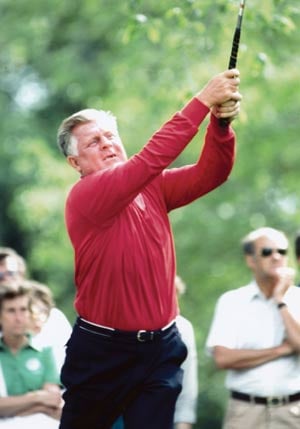
Why do I believe the Overlapping Grip provides the best possible wrist movement – the answer is simple. Because it moves the wrists closer together unifying them. By bringing the lower hand up by overlapping the pinky over the index finger, the lower hand wrist is moved closer to the lead hand wrist. Think about breaking a stick between your hands, the more you separate your hands apart, the easier it is to break the stick in between. When you bring the hands closer together, it becomes more difficult to produce pressure between your hands.

This is an important part of understanding the pressure in the hands when you hold a golf club. You want pressure on the ends of the hands, not in between the hands. This allows for you to “use” the shaft to produce speed as opposed to placing stress on the hands.

With the proper pressure points and the hands unified, the hands work together, unifed. With unified hands, you can freely move the wrists to their ideal range of motion as well as produce speed on the clubshaft propelling the club head quickly to through the golf ball.

Improperly holding the club where the hands are not unified, is the main reason I see golfers lose speed. They simply don’t have the hands working. And since the hands are such one of the main speed producers in the golf swing, without proper hand movement, the club can’t move either. Here are a few samples of improper hand positions that completely inhibit hand unification and speed:

1)   Hands in opposite rotations

2)   Hands Split or 10 finger (not unified)

3)   Lead Thumb too Short

4)   Lead Thumb too Long

5)   Club in Palm of Lead hand

6)   Club in Lifeline of Trail Hand

These are just a few of the improper hand positions that we commonly see. The main issue of course is that these hand positions inhibit wrist movement thus the entire golf swing is negatively affected – mainly club speed and angles of club approach into the ball at impact.

If you want to understand club approach into the ball – ask yourself if you take a divot or not. If you don’t take a proper divot with your irons, most likely you have issues with your hand position causing you to improperly use your wrists. In other words, you do not have angle into the ball because your wrists aren’t working.

Here are the hand action basics:

The hands work together during the backswing where:

  1. The lead hand cocks
  2. The trail Hand Hinges  (non rotationally)
  3. The lead arm stays straight in the backswing
  4. The trail arm folds in the backswing
  5. The movement of the hands and arms (hand action) planes the club shaft
  6. The movement of the hands and arms also planes the club face
  7. The uncocking and unhinging of the hands produces speed into impact
  8. The uncocking and unhinging of the hands squares the clubface at impact

As you can see, the proper grip allows for the ideal hand action throughout the golf swing including the proper angles of club approach into the ball at impact.

MN-Slider-1

The proper angles of approach result in the golf ball flying straight due to the ideal hand position as the unhinge into impact. And in my opinion playing golf with an improper grip is a waste of time because you are fighting poor fundamentals, improper face aims and angles.

Moe would call this “fighting yourself” because if your hands are on the club incorrectly, you simply cannot swing the club well. You’ve lost the battle before it has begun.

Spend some time perfecting your grip and train your hand action. You will be amazed at how much you can improve from this simple yet critically important fundamental.

Todd Graves

Speed and Distance

By:  Todd Graves
Reprinted from Nov. ’09 Practice Tip.

Speed

Everyone wants more distance. And yes, distance is an important factor when it comes to playing the game of golf. The farther you hit the golf ball, the shorter your approach shots giving you more opportunities on the green to make putts, birdies and pars.

But distance is a product of speed and can come at a price where, often when you try to swing harder, you reduce consistency often accuracy. So how do you create more speed and distance without the sacrifice?

The answer to producing more speed and maintaining accuracy is to train for speed and develop the fundamentals that produce speed. You must remember however that speed and distance are not the same thing. Speed is the velocity of the club head while distance results in how far the ball travels.

Therefore, speed is learning to move the club faster while distance is making sure that when you do, the ball is struck in a way that takes advantage of the newly found speed.

So how do you train for speed?

The first thing is to understand that speed is first and foremost a bi-product of great technique where you use the parts of the body that produce speed, mainly the hands and arms. This does not mean, however, that the lower body is not an important part of producing speed. The lower body, particularly the spine, is critical for positioning the body so that the arms can both produce speed and move the club at the proper path and approach.

When the club moves correctly with proper angles, path and maximum speed, the elasticity of the ball also contributes to speed by compressing and when it spins, you get flight. As you can see, there are many variables to maximizing speed and distance. So let’s start with the main speed producers, the hands.

The hands being major speed producers are attached to the arms. Therefore, the wrist hinge and arm action are inter related. What can severely inhibit hand action is an improper grip where the hands oppose each other’s movement and also inhibit the proper movement of the arms. One major speed inhibitor is when the hands are not unified or working together. By unifying the hands by tucking the lead thumb into the trail hand where the hands can use the hands by leveraging the club. Leveraging the golf club is nothing more than when the hands and arms hinge and fold correctly placing them in a position to produce speed.

Once the leverage position is produced, it can now deliver the club on path with proper approach angles but only if the shoulders have moved correctly. Shoulder movement is the next place where arm motion can be interrupted.

This occurs when the hips are rotated and the spine can move properly. As you can see where this conversation is heading. The arms and hands produce the most speed and yes it is true that you can sit in a chair and produce quite a bit of speed. This indicates that the hands and arms and torso are major speed producers. But don’t underestimate the chair in this scenario where the chair supports everything that is going on with the hands and arms.

Since you are not sitting in a chair when you play, speed becomes directly related to the properly using all of the body positions to maximize the efficiency. When it comes to Moe Norman’s golf swing, from address to finish, all of the body is inter-related. (This is why when Moe referred to this swing, he called it a “move.)

Once the hips rotate correctly, the spine moves correctly forward in the backswing where the arms and shoulders can arrive in the leveraged position. With the hands, being correctly hinged you can now deliver the club into impact.

This occurs when the lower body begins tore-rotates and the arms move on plane into impact where the lead knee leads the downswing, is flexed and stable as the arms straighten through the ball releasing the clubface.

This movement is a sequence of motions that must be learned from our instructional approach of U.L.T. (Understand, Learn, Train).

From the ULT approach, you understand the positions, learn the positions and train and sequence the motion until your golf swing is balanced, leveraged, timed and powerful and you are able to effortlessly produce speed.

A Destination or a Journey?

At last weeks 3-day school, I was sitting and chatting with one of the students, Henry, at the conclusion of the first day.

As I normally do, I like to find out about our school students, about their careers, their golf games, etc. In our conversation, I discovered that Henry designs and implements training programs for adults. Intrigued by this discovery, I started questioning him about the process of training, or changing behavior, of adults as our business, is very much about helping adults train.

Throughout the conversation, I discovered several reasons why are golf school programs are raved about by the students who attend. In addition, I picked up some insights on how we can do a better job in helping our golfers better grasp the concepts and information presented in the schools. I was pleased, excited and hopeful all at the same time about how our school programs help golfers find success, but also new ways, improvements we can make to help even more.

Henry and I chatted for a good while about training, how adults’ process information, how presenters can be more effective, etc., however, near the end of the conversation, Henry made a comment that floored me.

 “Training is a process, NOT an event.”

I have to admit I lost sleep that night thinking about that.

In our culture today, we are very “event” or “result” focused.  If you think about that, I believe you’d agree.

In most aspects of our culture today, what has become important to us is the event, NOT the journey. We just want to get to our destinations as quickly and conveniently as possible; the journey to that destination is no longer enjoyable, it’s no longer considered important.

I find this especially true in the game of golf. Watch the golf channel and you’ll see shows titled “The Golf Fix”.  Read golf magazines and you’ll find a quick fix for anything that ails you.  Even equipment manufacturers have joined the game, touting equipment to solve your ball flight issues.

I’m not saying these things aren’t useful in some contexts, however, what I believe has been lost in the game of golf is the art form, the connection to training your body and mind. Golf has become about “events” to fix your game and has ignored the “Process”.

I see this often in our golf schools. Students come to the Single Plane Swing looking for a quick cure for their games, and what we offer is the Process of not only curing their games but also helping them own their games. There is a disconnect between what the golfer has been conditioned to want for their games (the quick fix, the event) and the tried and true solution we offer (the process).

Our biggest challenge in training our golfers is convincing them that the quick fix, the event, will never help them reach the levels they desire consistently and that the cure, the process, is the long term solution.

In our school programs, I hear Tim encourage our students to “be different” regularly. I couldn’t agree more with that comment for those trying to make lasting improvements to their games.

“Being different” in the game of golf, especially for amateurs, means focusing on the process of improvement, and using the events, like schools, lessons, etc. as markers along the journey.

From my personal experience, and from seeing it time and time again with our golfers, those who learn to approach their improvement as the process and not as a one-time event, the sky is the limit on how good you can get at this game.

So how far do you want to go?

When you attend a GGA school, you will often hear one of our instructors say something to this effect;

“Every person here can become a scratch golfer.”

This statement is more about the system or process GGA has developed for you, and less about any magic bullet or tip one of our instructors can give you.  You see, I know firsthand that the process works 100% of the time it’s followed, the question is this –

Will you choose the event, or embrace the process?

One choice leads to endless searching for the next fix, the other to the best golf of your life.  Make the next event, whether it be a golf school or video instruction, be the starting point on your journey, follow the process, and you will achieve levels you’ve only dreamed of.

Check out the current School Calendar HERE

Master’s Experience

In the last newsletter (April) – I asked anyone who had an interesting Master’s Experience to email it to us.

Got one wanted to share with everyone:

A Masters Experience

From g p gp1950@****
To timg timg@moenormangolf.com

Tim – In “Practice tip 162” you asked to hear about our experiences. Here’s mine from the 1970 Masters.

In 1970, I was an Army private stationed at Fort Gordon, GA, just outside of Augusta. I was fortunate to earn a three-day pass during the weekend of the Masters Golf Tournament. I talked to my sergeant about getting tickets, and he suggested that I put on my dress uniform, and go to the tournament. I figured I had nothing to lose, and was totally surprised when they let me in for free.

I walked the course looking for pairings that didn’t have a lot of crowds. I found a group to follow, and was enjoying watching their games from hole to hole. After following them for three holes, one of the golfers waved for me to come over and join them. It was Tom Weiskopf. We introduced ourselves, and I almost fainted when he asked if I wanted to walk along with them. This was the second round of the Masters, and I was walking Augusta National with tour pros, talking with Tom Weiskopf.

I had to move over to the fan areas whenever we were around cameras and crowds, but I spent the rest of the round with them. I was in awe of their golf swings and shots, the golf course, the colors, how green it was, how quiet it could be. But I will never forget the opportunity that Mr. Weiskopf gave me. We talked about golf, about me being a caddie, and about what my immediate future might hold.

Rounds three and four I was back at the gate in my full dress uniform, and each day I was allowed to enter Augusta National to watch the tournament. I didn’t have the opportunity to “walk the course” like I did during round two because the crowds were larger, and competition higher. I did see Mr. Weiskopf during those rounds, and twice he acknowledged me. I will never forget those three days, and how one professional golfer made a young man feel important.  As a 19-year-old soldier, it was, and remains, a major highlight of my life. As a 62-year-old man, I still say “Thank you Mr. Weiskopf”.

Greg

Limited Practice Time?

Last week, we held our annual Alumni 5 Day Camp at our facility at Eagle Creek Golf Course in Orlando, Fl.

Always a really fun week with many students who come back year after year to spend a week with us working on their games, improving their swings and short games and generally just having a lot of fun.

This year, I interviewed the group (dozen students) and asked them a few general golf questions.

Answers to one of the questions interested me quite a bit, in fact, it actually surprised me quite a bit…

I asked them how much they practiced?

Meaning, do they practice every day, every couple of days, once a week, etc… etc.

Response:

Majority said they practiced once or twice a week.

A couple said they practiced every day or at least every other day.

A couple said they never practiced/or basically very little to never. They just played golf.

My Thought:

To be honest, I was surprised. Yes, I know this is a small grouping of golfers, not a good “evaluation” of practice among all our students, but this group is one of our groups that plays a lot of golf, travels for golf and seem to be pretty serious about getting better (at least around us.)

And I definitely expected more practice time… maybe I’m a little “warped” after playing professional golf for a living (practicing up to 8 to 10 hours a day some days…) watching my high school and college golfers/students practice all the time, or maybe I just need a reality check as for the past 13 years I have spent 99% of my time around golf as a living…

So, ultimate reason I wrote this e-tip…

With the “reality check” that many golfers have VERY limited practice time, wanted to give a few suggestions to help improve your game:

  1. Spend your time at the course practicing the swing, short game, etc. and break the practice down to what is coming up…

In other words, if you have important rounds or scrambles, etc. coming up – give extra time to the short game practice.

If not, focus on the long game and some short game. Short game is the scoring part of the game. If you are not in need for “scoring” in the near future – give the limited time to long game practice. (Yes, all those out there that know me might think I have lost my mind saying this, but again, this is for all those with limited to very limited practice time.)

  1. Work on flexibility at home as much as possible.

Most have no idea how working on their flexibility will help their swing. Working a few minutes when possible on your flexibility on specific areas related to the golf swing is critical.

  1. Indoor / evening / after work practice.

This might be the biggest area most golfers miss that can improve your swing/game dramatically. Work on areas of your swing at home, from the PVC drill, to the leverage bag drill, short training grip club/drill, etc. etc..

Try to set time during commercials, etc. a few minutes in the evenings to work on drills. Most can find a few minutes most evening to work on indoor drills and these can dramatically improve your game.

  1. Be creative…

Had a student who told me about his “man cave” …. Yes, ladies, sure you could have a place like this too.

He said he had a room in his house with a big screen T.V., an exercise bike, tread mill, an indoor putting mat (with line painted on it for squaring putter face), a leverage bag, mirror, PVC, and short training grip club.

He told me he would go into his man cave and while watching a game on T.V. would practice different areas of his game. At times, he would put one of our videos on the T.V. and check to make sure he was “drilling” correct….

AWESOME!!

Hopefully a few suggestions that will help those that have very limited practice time…

Sure we will also be making more recommendations in upcoming blogs.

Please watch our webinars, read our e-tips and don’t hesitate to call or email us anytime.

Oh Boy! – An Excuse to Own the Toys!

2013 Monograph Series on How Your Brain Really Works, #3  

Years ago I had the opportunity to go through a training and certification program called The Applied Creative Thinking Workshop with a pioneer of whole brain studies and creativity named Ned Herrmann. He was “one of the first to ascertain, thru testing, how individuals use or prefer one, two, three or all four possible brain quadrants.” Ned discovered that people have a predominate ‘preference’ for how they think and while that preference is a strength, it is also a major limiter to creativity. Ned was all about getting out of the self-imposed mental box.

A particular fun part of the training was the seminar room in Lake Lure, North Carolina. It was a sensory delight to enter. A large, open, airy room it was literally wall to wall with TOYS. That’s right, toys of every kind imaginable from squirt guns, jump ropes, board games, slinkies, yo-yo’s, dolls, masks, balls and simulation games. Ned seemed to take a delight in having every game you could imagine and his training room would have put most any toy store around to shame. More importantly, Ned was always encouraging people to play with the toys during the trainings.

What I noticed was that the toys always came out when we were at an impasse in the training, having a complicated discussion or when people seemed to be blocked in their understanding. These “play sessions” often set the tone for new learning and new associations or insights and we came to understand that the toys were present to stimulate our senses (meaning our brain) in the belief that new neural connections would be made and in return it would help facilitate learning.  It worked.

Why Having Toys (Training Aids) Help You to Learn

Golf training aids are the equivalent of TOYS because they serve the same function of stimulating new neural connections when you are uncertain or seeking to work out how to move or position your body in a specific way. If a training aid does not do this, then you don’t need it. If it does, then why would you consider training without it?

Remarkably, our awareness of this ‘toy effect’ goes back a long way. The famous philosopher Jean Jacque Rousseau wrote a letter to an Italian scientist named Michele Vincenzo Malacarne in the late 1700’s posing a radical question for the times. “Could nervous tissue be changed by experience?”

“Malacarne, who was an expert in the cerebellum, a part of the brain involved in the flow of ideas and flow of movement, basically got…two clutches of birds: one bird group he raised with lots and lots of stimulation, and the other not. Then he sacrificed the animals and looked at their brains, and Malacarne saw that the cerebellum of a bird that had been stimulated had become larger.”

Forward two centuries and this experiment got repeated in the 1960s by many other neuroscientists, this time using higher tech equipment. The results were the same.

“They compared rats raised in two environments. One was a small, barren enclosure and the other a larger space with mazes, toys, and other rats. They found that in those rats in the richer environments, the cerebral cortex, which is central to learning, weighed significantly more.”  National Institute for the Clinical Application of Behavior Medicine

Get your head around this perspective. In an environment rich in stimuli you tend to learn in a more productive manner. If you are struggling with the learning process, having difficulty letting go of old models or wanting to accelerate the learning process embrace proven training aids. They are designed to help you learn more effectively and translate the position into feelings faster. It is literally a way to enrich your learning environment.

If you examine the training aids for the single plane swing offered by Grave’s Golf you see there are not many in number. However, each one is designed to precisely aid in helping you acquire new feelings and integrate them. Below is my short form summary of how these ‘toys’ will help you build a better and more reliable golf game by making new neural links not available any other way.

  • ABT – Alignment and Ball Position Trainer:Learn the address and set up with clarity. This device will teach you how far to stand from the ball, thus insuring a proper 45-degree spine angle. It teaches the correct ball position for the various clubs, insuring a consistent impact position and demonstrates the difference in ball position between the irons and driver. It is also helpful in making sure you don’t get your hips too open or closed at address.
  • Short Game Alignment Trainer:This little device helps establish the correct face angle for chips, pitches and flop shops.  It promotes the correct shaft lean during impact and a consistent trajectory off the club for these short shots. We’ve also found it to be a dynamite way to get the feeling of working your hands down the line through impact.
  • Leverage Bag:Nothing better for teaching how to separate the lower and upper body in the transition. Most people hit the bag automatically in the correct manner and often times it is helpful to just hit and freeze at impact while noting what your body is doing. It also makes an effective door stop in an emergency, as it did for me during a recent snow storm. This is an optional benefit.
  • Six Iron Training Club: Marvelous for making sure you get the correct lead hand position and the sunny side up position of the trail arm necessary for letting the trail arm fold properly in the backswing.
  • SPPT – Single Plane position Trainer. Using the SPPT, you can experience a true one piece take away as you keep the SPPT against your lead side. Also, it gives you readily identifiable visual feedback and check points to make sure you are moving through key positions.

Folks, finally you can argue that the science is on your side in owning all the toys. I mentioned this to my wife as I made my argument for a Ferrari purchase, but found the reasoning fell apart at some point. However, I shall work diligently in tightening up my thesis. The truth about our training toys is that they exist to stimulate new neural connections in your learning and accelerate the learning process. This isn’t rocket science folks… this is brain science!

About the Author: Ron Cruickshank, Ph.D., is a GGA Master Instructor and he teaches the single plane golf swing at our Canadian HQ, The Royal Ashburn Golf Club, in Whitby, Ontario. Go on-line and book a school or a lesson. Ron is finalizing a new book entitled Swing Like Moe Norman- Use Your Brain for a Change and Learn the Swing of the World’s Greatest Ball Striker featuring Todd Graves.

LEARN

THE

SWING

Join 1M+ Subscribers to get your FREE Video Quick Start Guide that reveals how to hit the ball farther and straighter more consistently from now on…

START YOUR NEW GOLF SWING