Watch the Masses, Do the Opposite

Watch the Masses, Do the Opposite

This was a quote from one of our students at the end of our recent Build Your Game Camp.

As I reflected on his statement, I came to the conclusion that this is one of the best pieces of advice I’ve ever heard when it comes to truly improving your game. In fact, this advice is profound; let me explain.

Think about what your course looks like when you go to practice:

  • The range is likely full of guys hacking away with their driver, hitting the ball all over the range
  • The putting/chipping green is likely empty, or sparsely populated
  • The practice bunker, if there is one, will look like the Mohave Desert. No one dare enters that evil place.
  • Now that the season is winding down, folks are thinking of putting the clubs away for the off season.

So my question to you is this: Are you just following along with those masses? Does your practice look like what I’ve described above?

If you truly want to achieve improvement in your game, in your scoring or in your swing, you must ‘swing against the current’. “Watch the Masses, Do the Opposite”. Remember that, it will serve you well.

In our schools, Tim is always imploring our students to “Be Different”, and this is exactly what he’s talking about. As you likely know, or have experienced firsthand, the average golfers score has not improved a single stroke in over 20 years! Why? Because the masses just don’t get it, they don’t practice correctly, they don’t practice the right things, or practice the correct way. They truly have no hope of improving.

It is for these reasons that our school programs are among the most vibrant and vital in the entire golf instruction industry. We think differently. We teach YOU to think differently, to practice differently.

It’s why we have schools at the end of the season for most golfers out West. It’s why students don’t hit balls on the first day of our schools.

Lastly, if you believe that the advice I’ve passed along to you from a golfer just like you, then attending a golf school program will really set you apart from the masses of ‘average’ golfers out there. Statistics show that only about 1% of golfers ever seek out formalized instruction. So if you truly want to do the opposite of the masses, then get yourself in a golf school program. That alone will set you apart from the struggling masses of average golfers out there.

No Excuses In The Bag – Time to Talk Club Fitting

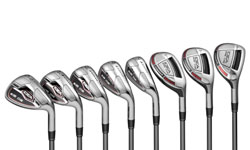
Last week was the annual PGA Golf Show in Orlando, FL. The show is held each year and attracts thousands of professionals from across the country (and world) to see the new golf attire, golf course equipment, golf clubs and anything else you can imagine associated with the game of golf. Immediately after the show, most golf club/equipment companies release their new lines of clubs for the upcoming year. They introduce them at the show, and put them “on the market” immediately after.

Myself and my staff attended the show, and as always, spent the day wearing out our feet while making sure to see as much of the new equipment as possible. After seeing all the new equipment and spending many hours taking to the reps about their equipment, thought it would be a good time to review with all of you how the Graves Golf Academy fits clubs to your single plane golf swing. I will also talk about some of the new clubs out there and which are better for this swing, etc.

First, let’s talk about fitting – or as I call it “Taking the excuses out of your bag”. It is absolutely imperative all clubs in your bag are fit to YOUR single plane swing. As I discuss the different areas of fitting, I’ll explain why each area is so important.

(Please give me a day or two to respond with your recommendations as some days we receive upwards of 100+ requests for fittings – and each response is personalized.)

There are 6 areas we look to fit clubs to your single plane swing. Length, lie angle, shaft flex, grip size, loft and set make up.

1.  LENGTH – The proper length of a golf club for your golf swing is critical. Length of the club is determined by comparing your height to your arm length (wrist to floor measurement). Having the proper length for you for each iron, driver, fairway woods, etc. will allow you to stand the proper distance from the ball with the proper spine tilt (bend at waist). Example – You need to stand 26 inches from the ball (golf ball to toe line) with a 45* spine tilt with a 6 iron. That will allow you to get the golf club on the single plane and allow you to get your arms, hands, etc. in proper position. If the club is too short, you will not have enough room to get the arms and hands in proper position and if the club is too long, the arms will typically be too high and spine tilt improper – causing golfers to swing “around” themselves, rather than “under” themselves (proper). Each club must be the proper length for your height vs. arm length. This is absolutely one of the key factors to getting the club on a single plane – your club lengths must be individualized and optimal for you and your single plane swing.

2.  LIE ANGLE – The proper lie angle is as critical, if not more, then length. The lie angle is also determined by your height vs. arm length. When set up in the proper single plane swing position, the leading edge of the club should be FLAT to the ground for you. As the set up position mirrors the impact position, the lie angle should allow the leading edge of the club to be flat to the ground at set up and impact. This will allow the club to “cut” square through the ground at impact. Improper lie angles will cause the heel or toe to dig into the ground with a good swing and the ball will fly dramatically off line. An improper lie angle of only one degree can cause a mid-iron to fly many yards (10 or 20 yards) right or left of the target. The problem is, you will make adjustments in your swing for improper lie angles. Adjustments away from the proper single plane swing fundamentals. The proper lie angle (individualized for your body measurements) is CRITICAL if you want to make rapid and proper improvement in your single plane golf swing.

3.  SHAFT FLEX – The proper shaft flex is critical for proper ball flight. Shaft flex can range from Ladies flex to Extra Stiff flex (with up to 17 flexes (graphite) in between). The more flexible the shaft flex, the higher the ball will fly. The slower a golfer swings their clubs, the more flexibility (flexible) they need in a shaft. We can determine swing speed by average distance you hit particular irons and then determine what flex shaft is needed for proper ball flight. For example, an average 6 iron’s equation is 1.77 yards per mile an hour. Meaning – if you hit a 6 iron 150 yards on average, you swing the club around 85 mph. This equates to a mid-Regular flex shaft. This is only an example, but with and individual’s average 9 iron and/or 6 iron distance (and/or swing speed) we are able to fit shaft flex accordingly. Too many golfers hit shafts that are too stiff for them, causing them to try and “lift” their golf shots for added height the shaft is not giving them. This “lifting” causes many problems in the golf swing (casting, over the top, topping the ball, etc. etc..). All because of improper shafting. Also, improper shaft flex typically leads to improper ball position. Golfers that hit shafts that are too stiff for them tend to put the ball too far forward in their stance (to help get the ball then needed height). This can cause a lot of swing issues like lateral slide in golf swing (and eventually shanking the golf ball), over the top move, topping the golf ball, etc… It is CRITICAL to have proper shaft flex as it allows for proper ball flight which will give you maximum distance for each club and allow you to hit the ball with proper flight from proper ball position fundamentals.

4.  GRIP SIZE – The proper grip size will allow you to maximize the release of the club and give you maximum distance with this release. Grip size is determined by you hand size. The measurement from the crease at the top of your wrist to the end of of middle finger. Proper grip size allows you to grip the club with “minimal” pressure, enough to keep the club from slipping in the hands, by not too tight causing too much tension in the hands, wrists and forearms which will dramatically reduce leverage angles through impact which will hinder distance and consistency.

* Plus – as you see above, we offer a “specialized” grip (the GGA Moe grip) with markings on it that will allow you to grip the club exactly like Moe (and check your grip) EVERY time you hold your club. The grip is USGA conformed.

* Taylormade Golf, Callaway Golf and Adams Golf install the GGA grips (our grip) on all clubs ordered through the GGA customized to an individual’s hand size. And these grips are installed, etc. at NO extra charge to you the customer. These grips are only available on clubs purchased through the GGA (customized to individual) or can be purchased for aftermarket installation at:  Graves Grips

* A grip installation video (showing how to install and build up the GGA grips) can be seen at:  Graves Grip Installation (GGA grips)

Proper grip size is critical to allow for optimal feel and control of the golf club and thus allows for maximum leverage in the golf swing and optimal release. This will allow you to optimize distance and control in your golf swing.

5.  LOFT – Industry average has a 4* separation in loft between the irons/clubs in a set. This, and the length of the club, are what give the golf clubs different distances when you hit them. On average (for the average golfer), with proper length and loft, there is around a 10 yard separation between clubs (ex. you hit 9 iron 110 yards, you will hit 8 iron 120 yards, etc.) This is an average.

Loft becomes a big factor in the fitting process in a couple different areas:

* Driver – it is absolutely necessary to get the proper loft on your driver to give you maximum flight and roll of your driver. The biggest factor determining what loft you need is your swing speed (listed above how calculated, etc..). Too much loft will lead to hitting too high and minimal roll, too little loft will lead to lose in flight distance. Too much or too little loft will cause loss of distance with your driver.

* Fairway woods – it is necessary to hit fairway wood(s) with enough loft that fit your swing speed/game. For most, they should not be hitting 3 woods (around 15* loft) off the ground as it is not enough loft to give them maximum fly. It is recommended you swing the driver at least 90 mph in order for you to hit a 15* fairway wood. Most golfers (average golfer) should hit a 4 or 5 wood (18* or 19*) fairway wood as the longest club off the ground. They will actually hit this club longer than a 15* club as the added loft will give them the optimal fly (and roll).

* Hybrids/Rescue Clubs/Utility Clubs – these clubs are long iron replacements. They have the needed loft and wider sole (than equivalent iron) that will allow golfers to hit the longer clubs (less lofted clubs) in their bag with the needed height and distance to be able to hold greens, etc… Average golfers, hitting their 6 iron 150 to 160 yards should hit a 3, 4 and 5 hybrids (not long irons) to give them the optimal flight and ability to hold greens with the longer clubs. All golfers need to have their club (set make up) set to their game.

* Wedges – loft of wedges need to be set to maximize an individual’s short game. There should not be uneven gaps in loft between the different wedges. Meaning – if you carry 3 wedges (Pitching, Sand and Lob)  – maybe a 6* gap between wedges. If you carry 4 wedges (Pitch, gap, sand, lob) – 4* separation, etc… Optimal scoring in golf is set up with the short game. The short game is optimized with even gaps between your wedges.

6.  Set Make Up  –  The proper set make up is individualized for each golfer. It is recommended according to individual’s:

* Swing Speed (distance they hit clubs)

* Divot pattern (Divot/No Divot) – Less divot, wider sole club recommended

* Golfer’s physical condition (injuries vs. body problems, etc…  Examples – arthritis, chronic back problems, etc.)

* Need for “feel” in the clubs vs. “forgiveness” in the clubs (or combination)

* General golf ability (new golfers vs. experienced golfers)

* Others (there are other factors we consider when recommending clubs – (for example – young golfers – how much will they grow, etc.)

These are the main areas we focus on when we fit a set of clubs to an individual’s golf game.

Whether looking to fit/replace a single club to an entire set, from a putter to a driver to your irons, wedges, etc.. it is ABSOLUTELY CRITICAL that the club(s) is fit to YOUR individualized swing and single plane specifications.

An UNfit club will hinder your improvement process, an UNfit club will hinder your golf game, an UNfit club will not allow you to reach your potential, an UNfit club can and many times will actually physical hurt you (tendonitis in elbows and wrists are many times causes and exaggerated by club with improper lie angles), and UNfit club is basically worthless to you. I don’t care how much you spent for the golf club(s) – if they are not individually fit to you – they are worthless to your game – and worse than that, can and many times will actually “hurt” you.

The Graves Golf Academy has custom fitting programs established with most major manufacturers in the golf industry. And many of the manufacturers install our grips in their custom department (no other instruction group can say that….). We have worked VERY HARD to set this customizing system up for our customers, students, etc. anyone interested in the single plane golf swing.

Also, because of the amount of equipment we sell from each manufacturer, we are many times offered equipment at a reduced rate for our customers. We are always able to match industry pricing and many times able to beat the pricing. We are also many times able to offer clubs at a significantly reduced price (last year’s models, etc. as these manufactures know how many clubs we sell and “hold some back” for us). Please watch our newsletters (bimonthly) for these specials – as they typically don’t last long as many are interested in these special pricings.

Customization done at the manufacturer (Taylormade, Callaway, Adams, Titleist, Ping, etc..) is free through the GGA, there is no added cost for the GGA grips installed and customized at the manufacturers. Plus, there is no shipping charge (within US) and no tax (outside of OK) through GG.

If you would like more information about custom fitting, questions about your clubs, about any new or old equipment on the market, etc… etc. please don’t hesitate to email timg@gravesgolf.com

Overlapping vs. 10 Finger

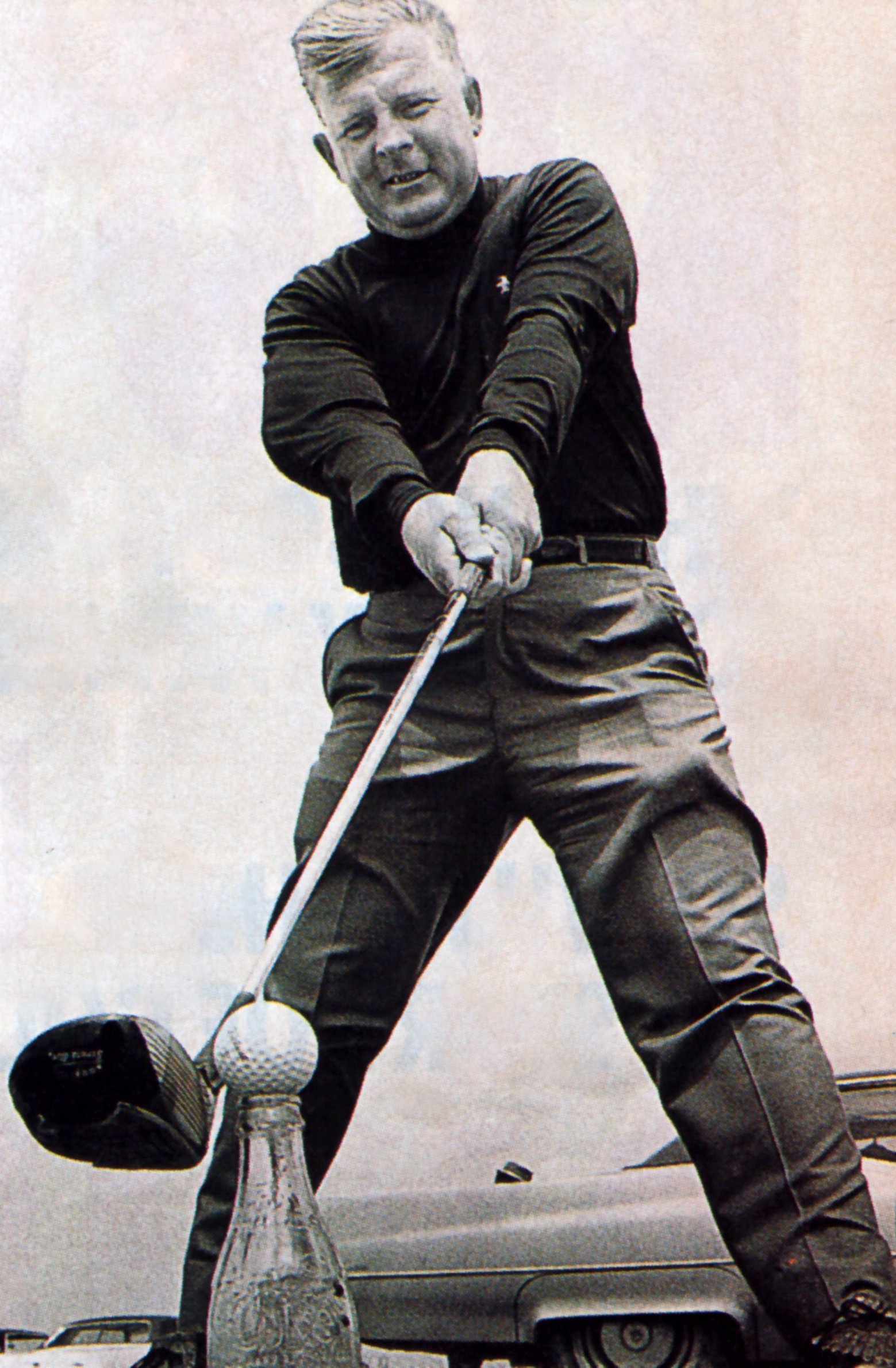
If you ever want to cheer me up on a dreary day, show me a vintage picture of Moe – something I have never seen before. Classic photos of Moe bring back memories but most importantly, they are great tools for understanding exactly how Moe achieved the recognition as the best golf ball-striker in the world. Take this photo for example. It shows Moe hitting from a Coke bottle – I pulled this photo from a recent article by David Owen. It was originally featured in the Golf Digest article in 1995. Here’s what you can learn from this photo.

Moe-Coke-Bottle.bmp

What I first notice is Moe’s hands – he is overlapping. Natural Golf, the company who sponsored Moe later in his life, promoted a 10-finger position which Moe adopted later in his life however, in his early career he won all of his tournaments with an overlapping hand position. You can see here that his arm position is in what Moe called “sunny side up” where the trial arm is rotated slightly upward while the lead arm is rotated where the elbow (and back of lead hand) are both toward the target. The “V’s” of the right (trail) hand is pointing toward the trail shoulder while the “v” of the lead hand is pointing toward the middle of the chest.

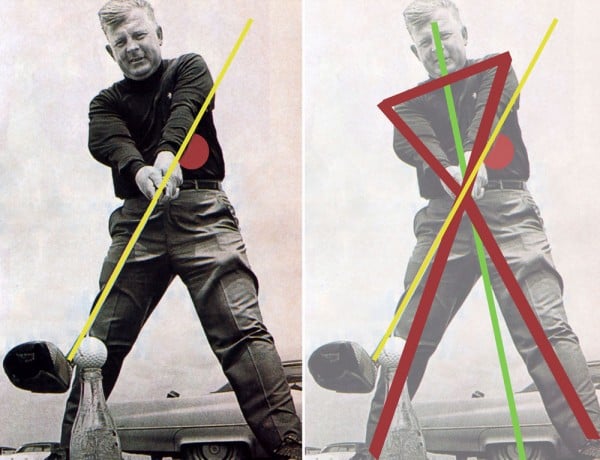
If you follow the shaft, you can see how it aligns with the lead arm and it points to the lead side of his body. Here is a bit of geometry to look for in a classic – great ball-striking – address position. The red area represents what I call the pivot point™, the area where the club references the body. We consider this an important part of great ball-striking because it is the beginning of a perfect impact relationship. The key is that the hands – lead the club into impact and in this picture, you can clearly see the angles that tilt the body so that the hands can lead the club into and through impact. What is extremely noticeable to me is the tilt in the body (green line) where it shows spine tilt. This lowers the trail (right) shoulder which pushes the trail hand and arm down.

angles1

Finally, you notice how straight his legs are. This is an important part of consistency and positioning of the lower back. We call this “posture” and what this represents is spacing between Moe and the ball. When I asked Moe why do you straighten your legs, he asked “what is straighter than straight?” What he meant was “if your legs are straight, how can you ever make a mistake at address?” This was not only biomechanically perfect, it was also a great insight to his consistency.

Just as these pictures show, you can always learn from Moe if you just pay attention to a bit of detail of these classic and educational photographs.

Todd Graves

Orlando schools off to a great start!

We have just finished our inaugural school of 2013 at the Orlando Academy, and I have to simply say this – “Wish you were here”!

We couldn’t have ordered better weather, it was absolutely perfect all 3 days of the school. The golf course and practice facility are in the best shape I’ve seen them in for years, the Eagle Creek staff is just top notch, I could go on and on.

I’ve included a few pictures of last weekend’s school so you can see what I’m talking about:

[nggallery id=18]

Through the end of April, we will be holding school at the Orlando Academy, including:

  • 3 day schools
    • Feb. 22nd – 24th
    • Apr. 26th-28th
  • 5 day Build Your Game Camps (includes $1,000 of free instruction; membership to Premier online coaching program for 1 year)
    • Feb. 6th-10th
    • Apr. 8th-12th
  • 2 day Alumni school (for GGA Alumni)
    • Feb. 25th & 26th (this is likely the ONLY Alumni school of this year, so get in it!)
  • 2 day On Course/Practice School
    • Mar. 7th & 8th
    • Brand NEW school from GGA, focusing on how to play with the mindset of a pro to record your best score, and how to practice properly, on the correct things, in the correct way
  • 2 day Short Game School
    • Mar. 9th & 10th (ONLY short game school of 2013)
    • Led by PGA section Teacher of the Year Tim Graves
    • Guaranteed to lower your scores quickly

Also, in the month of February, we are having the following Single Plane Experience schools, taught by GGA Instructor Jerry Martin in Palm Springs, CA:

  • Feb. 16th – 1 day Single Plane Experience
  • Feb. 17th & 18th – 2 day Single Plane Experience
  • Mar. 2nd – 1 day Single Plane Experience
  • Mar. 10th & 11th – 2 day Single Plane Experience
  • Mar. 16th – 1 day Single Plane Experience
  • Mar. 23rd & 24th – 2 day Single Plane Experience

The Single Plane Experience Program is the newest school program from GGA, featuring qualified and trained GGA instructors to lead you through a short term program to get you on the path to Single Plane perfection!

As you can see, there’s a lot coming up with GGA school programs in the next couple months, and spaces are limited, so check out our Calendar page, book your spot, and we’ll see you this spring!  Here’s to your best year yet on the course!

Scott

Do You Know How Your Brain REALLY Works?

2013 Monograph Series,  #1   

Note: This is the first of a 2013 Neuroscience Monograph Series. The goal is simple – finding practical applications of the latest brain science research to how one learns and stores movement. This includes all aspects of golf, from putting to the full power swing.

 By Ron Cruickshank, Ph.D.

In 1990 the Congress of the United States in conjunction with the Library of Congress and The National Institute of Public Health (NIH) declared the next ten years as the Decade of The Brain. The purpose of this declaration was “to enhance public awareness of the benefits to be derived from brain research.” Its objective was to “encourage public dialogue on the ethical, philosophical and humanistic implications of these emerging discoveries”. Wow, a government initiative that was timely, on target and in the Bush #2 administration. Wonders never cease!

However, credit must be given when earned because this declaration was truly prescient, as the advancements in understanding of brain science (neuroscience) since that date has eclipsed mankind’s understanding since the beginning of recorded time. There has been a virtually shattering of long held notions about how the brain works. In fact, even the scientists themselves have had a hard time accepting these revolutionary findings. Dr. Per Anderson, of the University of Oslo put it well when he said. “The neuroscientists have responded to these new findings with ‘resounding silence’, because “the findings are simply too startling and revolutionary to digest”.

So how are we plebian golfers supposed to separate the wheat from the chaff? My approach has been to do as much reading as possible and begin to pull out principles or key insights that have application to how we might accelerate the learning process using neuroscience insights. Below are my initial offerings as to what I see as key insights emerging from this new field we call neuroscience.

Key Insight #1: Neuroplasticity is a fact

This is a big one. It sounds like such a scholarly word but it is quite simple to comprehend. The neurons=cells that are specialized to transmit nerve impulses plus plasticity=pliability or malleability of these cells. Simply put, in the context of brain studies, the word neuroplasticity means our cells are adaptable to changes in habitat, environment and stimuli. This is a radical and new discovery.

The old accepted scientific truth held that when born we had a fixed number of neurons in the brain and they gradually died over our lifetimes. Poppycock says the neuroscientists. It turns out that our brains are much more generative, malleable and changeable than imagined, hence the term neuroplasticity. This means that regardless of age the brain is responsive to environmental stimuli and perhaps more important, the brain can change in real time in reaction to environmental input, literally within minutes of the stimulation happening.

The big implication here is that we are beginning to understand how learning happens. Moreover, it appears we can all learn new stuff at any age and that neural circuits will be developed to support such learning. Contrary to the old belief that after childhood cells could only grow in strength, we now know that brain cells can literally change throughout our entire lives. If this is the case, then it means that we can train the brain for such radical things as learning how to be happy or to cultivate compassion. In street terms, it means we can teach old dogs new tricks.

Key Insight #2: Epigenetics Changes the Nature/Nurture Argument

Increasingly, new studies concerning epigenetics (epi = from the Greek meaning over or above) are impacting how we think about who we are. The old idea was that our genes provided us with an unalterable blueprint for how our lives would unfold. The scientific community has accepted for generations that genes affected our phenotype and behavior in a highly deterministic manner, making us all victims to our gene pool. Whoops, we have to rethink this one now too.

The new thinking holds that our genes are much more susceptible to alteration in a short-term manner without altering the underlying DNA structure. This means that events that happen to us in our lives can impact our children for generations to come without altering their DNA. So, it seems that non-genetic factors can actually cause your genes to behave or ‘express themselves’ differently than the gene intends. This is heresy to old-line genetic thinking.

The implication of this insight can really give you pause. “At the heart of this new field of epigenetics is a simple but contentious idea – that genes have a ‘memory’. This means “the lives of your grandparents – the air they breathed, the food they ate, even the things they saw – can directly affect you decades later, despite you never experiencing these things yourself.” BBC. Ghost in Your Genes.

Key Insight #3:  Learning Physically Changes the Brain

Intelligence is malleable. The very act of learning enhances and thickens connections in the brain and intelligence can therefore be built. We do not come into this world with a fixed intelligence, but rather build it by making on-going and continuing connections. Our intelligence is literally forming throughout our lives.   

A genius is nothing more than someone that has made more distinctions about a specific subject than everyone else. If you know more about duck feathers than anyone else in the world, you get called a genius. (Falling in the I just had to know category – check out the International Down and Feather Laboratory– the IDFL for you newbie’s. They have feather geniuses there and I found myself spending 30 minutes learning more about duck feather turbidity than I ever wanted to know) Genius is nothing more than having extra and thicker neural connections on a specific subject than the average Joe.

It has been reported by several contemporary writers and researchers (notably authors Gladwell, Greene, & Coffman) that the table stake for genius or mastery is that you must spend at minimum 10,000 hours to have mastery level abilities. In the context of what we are learning about how the brain changes and adapts as a result of its experiences, this makes a lot of sense. After the 10,000 hours your brain is literally different, making it true that the brains of experts are different than those of non-experts. However, those differences are a result of practice, not innate intelligence.

Mesmerizing to me is that just having this knowledge that you aren’t born with a fixed amount of intelligence will make you smarter. Research at both Columbia and Stanford University in 2007 (Blackwell, Trzesniewski and Dweck) found that “both morale and grade point average took a leap when students understood the idea that intelligence is malleable”. Understand what we are saying here – you can choose to make yourself smarter and that this knowledge alone has a motivational impact.

Key Insight #4:  Use It or Lose It

We know that when people practice an activity, or even just access a memory of the activity, that the brain responds by wiring the involved cells together. However, on the other hand, it turns out that when these pathways are not used that they will diminish in strength and eventually become what scientists called ‘pruned’. This means you will lose or eliminate a skill if you stop practicing or exercising the ability.

I have a friend that spoke fluent Italian as a child growing up in Boston. As a young teen his friends would make fun of him for this and he stopped using the language. By the time he was 30 he had effectively lost his ability to communicate in Italian. When he hit 40 he could only recall a couple of phrases, generally about food. By not regularly practicing and retrieving information he completely lost the hard wiring and hence the capacity to communicate in another language.

The implication here is that while a lot of practice helps to make learning permanent, you must continue to use this learning or skill. This knowledge would also argue that a small amount of regular practice (information retrieval and rehearsal) is much better than no practice. So pick up that training club and do some drills during the winter my fellow snow bound friends.

Conclusions

There seems to be no question amongst neuroscientists that practice makes for permanent learning when reinforced regularly. As the nerves fire together they wire together and that is the basis for all expertise and mastery to develop. This includes everything from learning how to use a fork, walking or swinging a golf club.

When applying this to learning a specific motor skill (a golf swing) there is no replacement for regular and focused practice. This does not mean that all practice must be perfect or with zero variance, as that is not possible. You should practice with the correct information and as perfectly as possible. Fortunately, the brain does a superb job of learning from our errors. If you doubt that, just watch a baby learning how to walk.

I hope you’ve enjoyed this first edition of my 2013 Monograph series on neuroscience as much as I’ve enjoyed researching the subject. To this point I’ve read over 300 studies on neuroscience based research, watched dozens of videos and lectures and read a shelf full of books. Whew!  Only another 9,270 hours to go!

About the Author: Ron Cruickshank, Ph.D., is a GGA Master Instructor and the author of the soon to be available book entitled Swing Like Moe Norman- Use Your Brain for a Change and Learn the Swing of the World’s Greatest Ball Striker featuring Todd Graves. This book is written to utilize the latest insights from neuroscience to help turn you into a reliable and consistent ball striker.

A Note to Single Plane Golfers – Move

It took a trip to the PGA Show, and saw the usual stuff, adjustable game improvement equipment, teaching gadgets and new club head design. Then, after 18 years of attending the show, I saw a number of companies dedicated to golf improvement through wellness and fitness as the foundation to improvement and I realized something – people are finally “getting it”. Why do I think this?  Let me explain.

Health and fitness are more than the super muscular super-athlete on the cover of a Sports magazine. Fitness is about health of internal organs and movement which is related to flexibility and strength.

Movement of your limbs and all parts of your body is as simple as muscles designed to move bones. The bones are joined with ligaments throughout the body with various types of hinges with various ranges of movement. To be healthy, you must have healthy bones, healthy muscles and healthy ligaments.

The magic to staying healthy can be summed up into one word – Move.

Unhealthy people don’t move and healthy people do.

Another part of health is internal health or organ healthy. Much of organ health can be summed up by nutrition and the stuff we put into our bodies through our mouth. What we eat produces blood chemistry which supplies nutrients to our body. If you supply your body with healthy nutrients, your body stays healthy, if you eat junk food, you starve your organs of nutrients and eventually they will deteriorate.

My oversimplification of health is only to point out the changes I have seen happening in the world of golf. The aging golfers of the world are paying attention to their health needs – longevity is becoming a factor and with it the desire to play golf.

This focus on heath, wellness and movement has a particular effect on golf instruction where now I am beginning to see instruction more “cause” focused rather than effect focused. What this means is that golfers are getting smarter and realizing that new equipment can only take them so far – but getting healthy, flexible and strong is the root cause of most golf swing issues.

If I have my wish, we will end up in a world where “training” is perceived as valuable as new set of clubs and training regimens will become refined to help golfers of all levels build healthier golf games – as opposed to just quick fixes.

I am excited to see these changes in the thinking of the golf market. No longer is the main focus on the strength and youth of the young golfers who are playing on the PGA Tour – golf is finally paying attention to a majority who play the game – the golfer over 60. This is good for golf and good for you and me – because we all have one thing in common – we are not getting any younger.

LEARN

THE

SWING

Join 1M+ Subscribers to get your FREE Video Quick Start Guide that reveals how to hit the ball farther and straighter more consistently from now on…

START YOUR NEW GOLF SWING