Technique First, Feel Second

Technique First, Feel Second

Sometimes the world needs to work in reverse. That’s the way I see you getting better at hitting a golf ball. You need to change your mind about your approach to how you are going about it. Most people, start playing golf to learn it. They run to the golf course with their father’s old golf clubs and start making swings at the ball. Occasionally they hit it and think that since the ball got in the air, that it was correct. I bet you are thinking “that’s me, that’s how I started playing”. You are not alone. This is most people. But I want to tell you how backward this really is. This would be like learning to swim by jumping into the deep end of the pool or learning how to drive by starting on the freeway. The truth is that, similar to riding a bike, you need training wheels to learn golf. Why? Because you need to learn the technique so you can build feelings around it as opposed to feeling your way into an improper technique like so many golfers do.

The key, as Dan Coyle puts it in his recent book “The Little Book of Talent”, you must work like a Carpenter when you are learning skills. I have found this to be the shortcut to learning. Measure and adjust before you start cutting. This means that you must know how to grip the club, address the ball and know the motion before you start trying to hit balls. Your body and brain will figure out the feelings from there. The key to working like a Carpenter is that you measure and get feedback on your technique so that you are always on track. The feelings will develop from there. It’s really not about hitting the ball well, it’s about learning the feelings well. Once you learn the feelings, the results will follow. This takes patience.

You may think that you are impatient however, I have found few people as impatient as myself. But my saving grace when I learned from Moe was that my goal was not striking golf balls. My goal was to Swing Like Moe. There is a big difference. Hitting the ball well was a bi-product of the swing. I knew that going into the deal. And I want you to know that if you think you hit it good now, you can be better. I have learned that from years of teaching. The ones who are happy with their ball striking ability are the ones that need to try harder and get better. You should never be satisfied. Being satisfied makes you lazy and complacent. I want students to be driven to be mastering the Single Plane Swing, not just becoming adequate golfers. This is quite demanding I know, but I see potential in students. I am never satisfied.

So keep this in mind as you go into the next few months. Are you going to accept a mediocre golf swing or are you going to start taking technique more seriously. If you decide to start working on technique, you will soon realize that you can make some great changes in a short period of time – once you forget about ball-flight and start acting like a carpenter and focusing on how you are doing it -and develop feelings from there.
A Swing of Disastrous Distortions

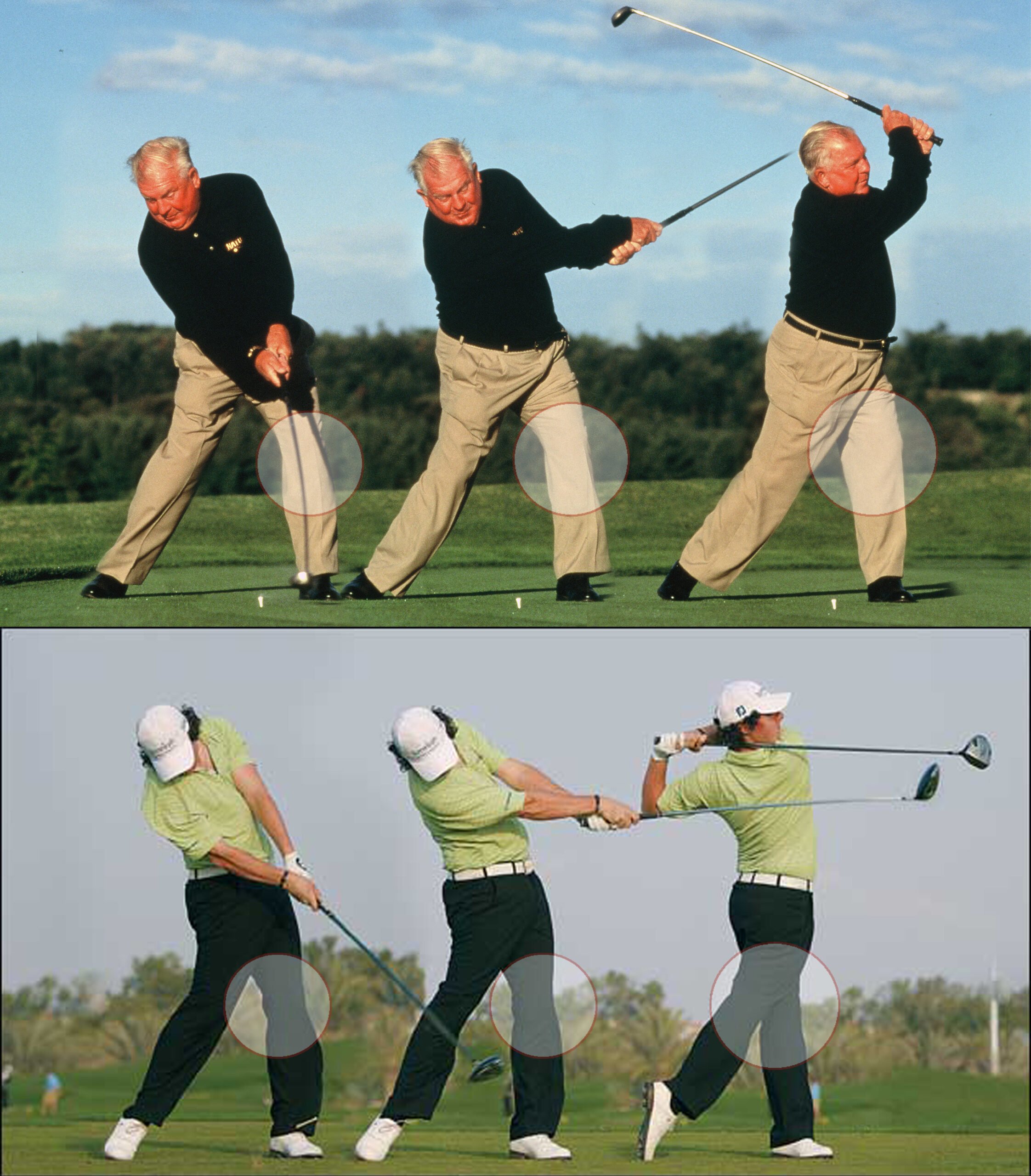
When I watch golf swings, even swings of great players such as Rory Mcilroy, it makes me cringe a bit inside my body. Don’t get me wrong, like everyone who loves golf, I enjoy watching him play golf, hit towering drives and win tournaments. I am a big fan of Rory.  But I don’t see how the average golfer can really look at Rory’s golf swing as a swing model. Rory is in his early 20’s. He’s young, flexible and fit.  He has hit thousands of golf balls to work through his swing movements and motions. His body has developed around his movements. Do I see some good things in his swing? Absolutely. But one thing that troubles me about paying too much attention to young tour players is that many people will try to model Rory – which can be a big mistake. Let’s look at some particulars.

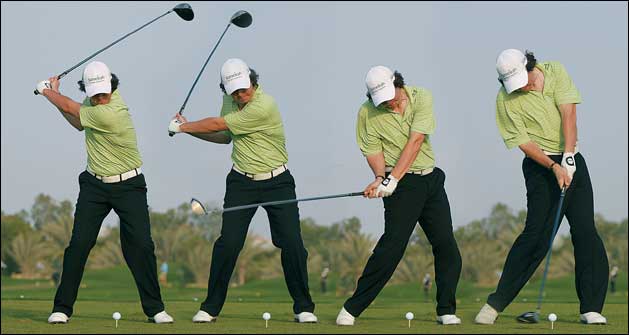
Without going into a complete breakdown of Rory’s entire golf swing, it is interesting to look closely into his downswing move. Keep in mind that I am not looking for positions here, I am looking for the stress it places on the body in regards to the task of reaching impact. (Impact is the goal of all great ball strikers). The perspective I take is that all golf swings are to achieve a perfect strike on the golf ball. The ability to reach impact starts at address. In other words, if you start in a misaligned position you must adjust during your swing to make an impact. The more misaligned you start the more contorted you swing. The problem here is that contortions are not efficient, repeatable or consistent. And these contortions can be disastrous to good ball-striking. Even worse, they can be extremely painful if you are not a 20-something year old Rory.

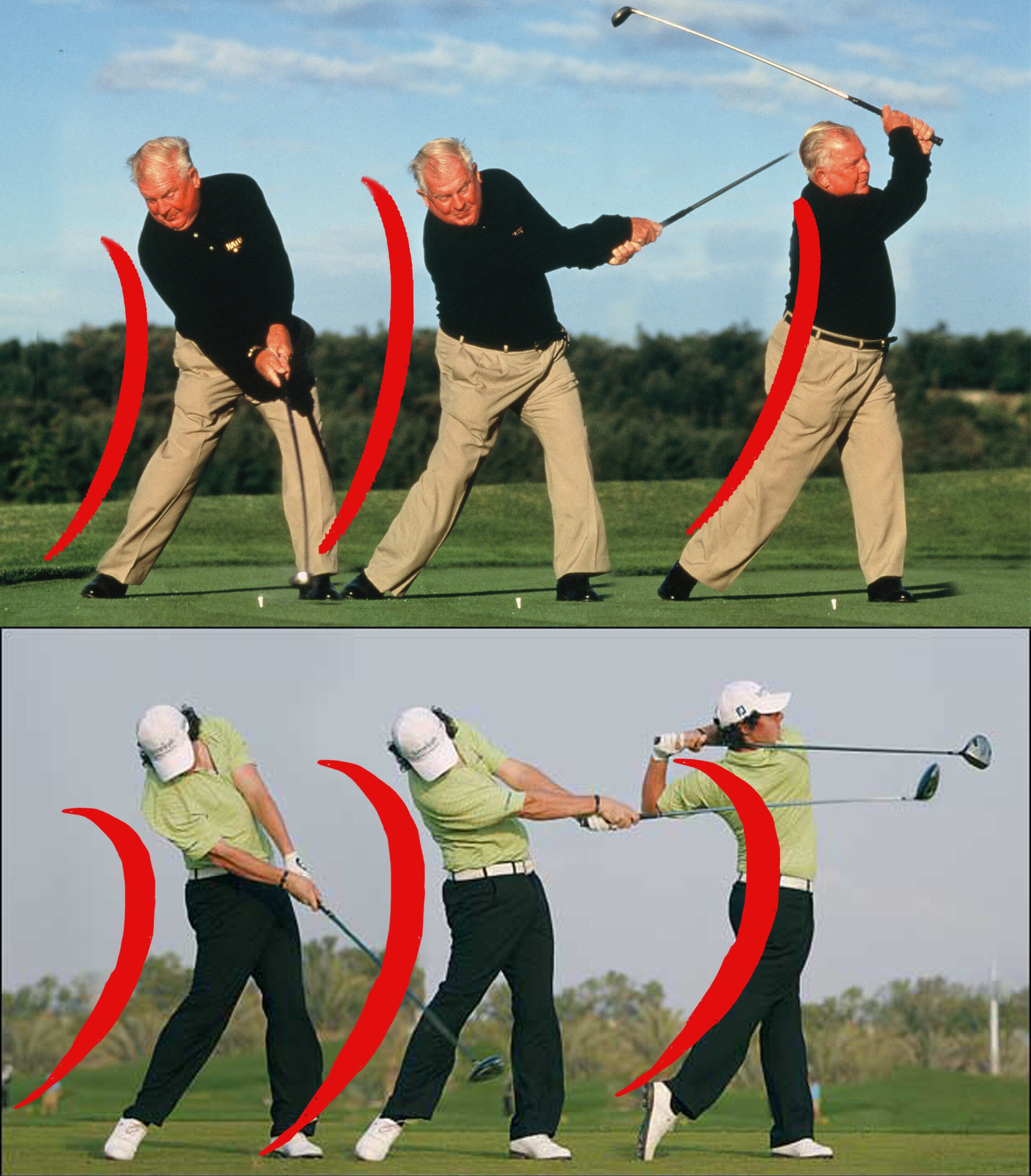
If you notice in the third picture in the sequence, you can see the crunched look of Rory’s right arm against his body. His right shoulder is jamming upward toward his head as his arms move downward. As the sequence continues, his lead leg straightens and his body move up as his arms move down – further crunching his shoulders against his torso that is moving upward due to his leg straightening. Once again, I am a huge fan of Rory, but I don’t think that this is the easiest way to get the job done for a 50 year old golfer. What I see here is a great athlete with mobility. Let me compare this with Moe Norman.

What you see from the movement forward is what I call “arm freedom”. You can see with Moe the arms have released as the lead knee has remained flexed. This shows that the arms have gone down with the body contrasting what you see with Rory where the lower body has lifted (straighten left leg) pushing the upper body up as the arms go down – crunching the shoulders and causing Rory to lean backward. This creates a reversing of the upper body or Reverse “C”.

One thing to note here is that Rory is a minimal example of this. He actually shows must less of this distortion than most conventional golfers. And as I have said in previous descriptions, this is all caused by an improper “two-plane” address position. The two plane swing comes in many forms, some more pronounced than others, sometimes in disastrous amounts. In all cases, however, the distortion of the upper body/lower body stress is a problem. I consider it a spatial problem where the conventional golfer is too close to the golf ball to start with. This results in stresses and problems reaching impact.

These things can be eliminated with the Single Plane golf swing of Moe Norman. And when they are eliminated, reaching impact is more consistent and repeatable resulting in better ball striking. The goal is to eliminate the lower body upward push. The way to do this is to get the appropriate distance from the golf ball where you start the club on the same plane at address as impact.

Learn From Pro Ams

This time of year I tend to play in quite a few pro-ams. Tournaments in which the professionals play with a group of amateurs… sometimes the amateurs play their own ball and the team takes a couple of their best scores, or some the amateurs play a scramble and the team either takes the scramble score on the hole or the pro’s score, etc. (there are other formats).

A couple of weeks ago, I played in a pro-am in northern Oklahoma (a pro-am that has been played annually for over 50 years). (On a side note, I probably played one of my best rounds of golf in very long time – I shot a 66 (6 under par) in winds that were gusting up to 50 mph… I ended up winning the tournament by quite a few shots – shot 66, 66). But, I wanted to talk about some lessons everyone can learn from what I typically see at the pro-ams.

In this practice tip, I’m going to give you 5 points everyone should do to prepare for a round of golf (things I see that most amateurs DON’T do before they play). Things the professionals/very good players do to prepare, but most amateurs miss…

1. Get to the course IN TIME to prepare for your round.

Most professionals arrive at the course an hour early to get ready for the round. This gives them time to prepare without being rushed. The worst thing you can do is be rushed in your warm up to get ready for an “important” round as it will only make you more nervous and will put you in a “rushed” rhythm for the day. Arrive in time to get something to eat (a snack) plus time to have a proper warm-up session.

Most amateurs I watched were lucky to get to the course 30 minutes (or less) to get ready….

2. ALWAYS stretch before you warm up.

Most professionals have a stretching “ritual” in which they will stretch “in general” – back, neck, shoulders, wrists, etc… And then stretch areas that are “weak” for them. Maybe they have a bad back – they will give that area a little more time. Maybe bad knee(s) – will give that area more time, etc… I do recommend starting your warm-up session by hitting a few putts. And you should stretch before you hit these putts. Putting is stressful on the back and if you don’t stretch before you start any practice/warm up – you will forget… Stretch first.

Most amateurs I watch do no stretching… nothing. And 2 Advil DOES NOT count as stretching…
It’s a wonder why 70% of golfers over the age of 50 have chronic back issues….

3. Warm up your short game AS MUCH as you do your long game.

Professionals will actually warm up their short game more than their long game. Meaning they will spend more time warming up their putting, chipping, pitching and bunker game compared to their “long” game. How many of you warm up your chipping before you play? How many warm up your pitching… or find a bunker to hit a few shots before you play? If you can’t find a place to hit a few pitches, do it on the range while your warming up your long game… the bunker may be hard to find. but if possible try and hit a few bunker shots. Nothing worse than hitting a ball into a bunker on one of the first few holes and you haven’t hit a bunker shot yet that day…. don’t expect to do anything good you haven’t “warmed up”.

Most amateurs I watch warm up their putting but do VERY LITTLE to warm up their chipping, pitching, and almost never, their bunker play. If you don’t warm it up. don’t expect to do it well.

4. Warm up on the range before the round – DON’T PRACTICE on the range before the round.

Professionals use the warm up session as it is stated… to warm up, not practice. And many times, it actually will tell them how they are going to play shots that day. I remember one time listening to an interview with Mark O’Meara. The reporter asked Mark if he would rather play a cut or draw when playing. Mark responded, he decides when he is warming up before the round. Which is working that day, that is what he would play. If he was hitting a cut during his warm up, he wasn’t going to go on the course and try and draw the ball all day. In other words, he was going to play with what he had that day.

Too many amateurs use their warm up sessions as practice sessions and are unrealistic when taking their game to the golf course. It is a warm-up session, you should not spend excess time on one club. You should go through the bag hitting a few shots with your low irons, mid irons, hybrids, fairway woods and a few more (extra) with your driver. Too many amateurs will get stuck on one club and try and hit it “perfect” …work through the bag and warm up to the best of your ability… You are not going to correct anything or create anything prior to a round. Plus, if you aren’t hitting something well enough to play with it – DON’T! For example – try and hit a few fairway woods… if you’re not getting them in the air (hitting well) on the range, don’t expect to hit them well on the golf course. Maybe hit a long hybrid instead… I promise it will help you scoring if you hit a hybrid pretty good rather than hit a fairway wood terrible… let the warm up session determine what you need to be playing that day.

5. Last thing – work on SPEED OF GREENS before going to your first tee.

The last thing you do before you go to your first tee is hit a few mid to long putts to finalize your feel for the speed of the greens.

(You can also hit a couple short putts to get a positive mind set of making a putt or two before you leave the green) – make sure and get a “feel” for the speed of the greens before you go on the course. Professionals will warm up their short game and their long game, but will always end getting a feel for the speed of the green. Nothing worse than hitting a shot onto the first green and having a mid to long putt and being unsure of the speed. DO NOT set yourself up for a 3 putt on the first green.

Too many amateurs go to the first green without having a good feel for the speed of the greens. I see way too many amateurs three putting the first few greens because of not preparing properly during their warm up sessions.

Preparing properly (warming up) before your round will give you the BEST CHANCE to play your best golf that day. Warming up properly should help take some nerves away, should put you in a “positive” state of mind and make sure you don’t hurt your body… If it doesn’t, make changes in your warm-up routine to help with those areas.

My Theory Confirmed

I have a theory, here it is.

“The most important attribute to play great golf, day in and day out, is accuracy and consistency in your golf swing – not length”.  

Did you happen to watch the Ryder Cup? If you are an American golf fan, you probably wish you hadn’t. As much as I think Davis Love is a great guy, I am not sure that he had this entire event under control. I think it is one of the greatest events in golf and yes, I admit, I like the European players better than the U.S. players. Why? Because they look like they have more fun playing golf. Really, they do! Did you watch them? Golf is a game to them and it looks like they play it to have fun. They smile, laugh, make fun of themselves and cheer each other on. They look like a Team. This seems to be in complete contrast to the U.S. Team who, other than Phil Mickleson and Keegan Bradley looked like they are taking a week out of their schedules to play for charity.

This might be a bit overstated and I admit that the rookies, even though they look like deer caught in headlights, are caught up in the moment. I think that the Ryder Cup should be the U.S. rookies vs. the European rookies where the first year players from both sides of the pond play each other for the Ryder Cup. Now that would be some great golf!

It’s the older guys on the U.S. Team that seem to have the most to lose – and it shows when they get in these team events. It seems like they are trying not to lose rather than trying to win. Maybe we should rethink our selection process – I vote for all rookies, especially players like Ricky Fowler. Mostly because he isn’t afraid of match play. Who would you rather watch, Tiger protecting his reputation or Ricky going for every reachable par 4? Hey, the Ryder Cup is one of the grandest stages for golf – let’s go for it!

And after watching almost every minute of the event and witnessing the European players enjoy themselves even though they trailed the entire match until the last groups on the last day – I still don’t think that the players on the tour are great ball-strikers. Nope, sorry. If you saw the same event I did, you saw way too many shots missing greens, hitting trees and even a “shank”.

I have never played in a “Ryder Cup” however, I do play Medinah more than any course in my yearly golf schedule of 10 rounds per year. The course is demanding and difficult. It requires shots that angle over doglegged fairways where you must carry tall trees at corners with draws and fades. But the errant tee shots that clip a tree while cutting corners aren’t the ones that bother me. The ones that bother me are seven irons and wedges that miss the greens. Just like hole number 17 and 18 where we lost every match we played on these holes.

Luckily for us we had some length on our team with Bubba, Phil and Tiger – so we could reach the par 5’s in two. But what good did that do us? It was the 17th hole a water protected par 3 and the 18th a straight forward par 4, that finished us off. Once again, my theory is confirmed and Moe was right – length is great to have when you play golf. It’s a great tool to have but it won’t win you a Ryder Cup. The key is accuracy and consistency – oh and the ability to make putts.

The GGA 3 Day School Succeeds

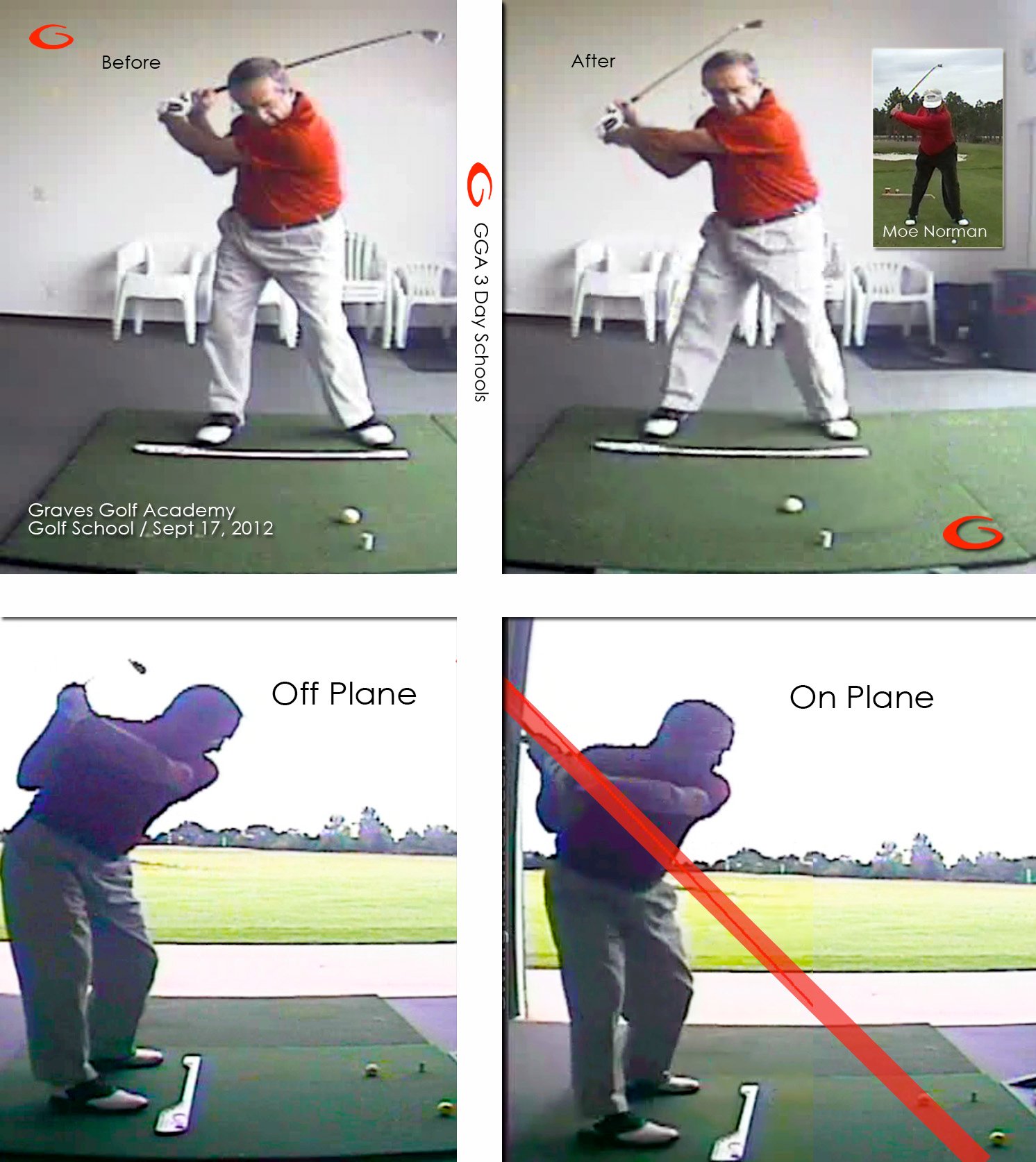
All golf schools are not created equal. There are good golf schools and great golf schools. So what can you expect from a GGA 3 Day School? Success, as well as a clear understanding of exactly how to achieve a perfect Single Plane Golf Swing, like Moe Norman. I consider a guarantee a great school. And we guarantee that you will get the club On Plane at our golf schools. Here is an example of our recent Single Plane Golf School success with a student named Jim.

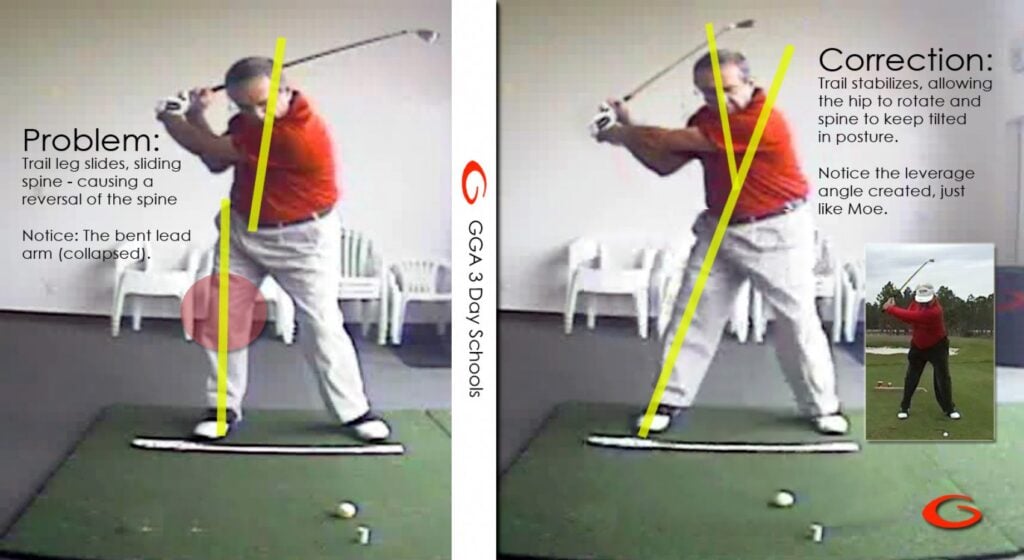
As you can see the before swing position of Jim where his trail knee has moved to away from the target, causing a shifting of his hips. This “lateral” move slides his lower back away from the target causing him to “reverse” or tilt in the wrong direction.

To correct this slide, the key is to rotate the hips around a stable trail knee. This allows the back (spine) to stay forward not slide backward. By keeping the spine forward, eliminating the “reverse” shift, the arms can leverage the club into a stronger and On Plane position.

Being on the Single Plane (as indicated by the red line), is a result of proper body position. This is the goal of a 3 day school – to get you on the Single Plane, and make your swing less complicated. In this case, Jim learned to stabilize his trail knee and simplify his backswing. As you can see in the picture, he achieved Moe Norman’s position at the top of the swing.

Now, as I often mention in our 3 day program, Jim must follow through with the most important day of the school, what I call Day 4. Day 4 is making sure that Jim remembers how to achieve what he felt at the school. It is important to know that the feelings that one attains at a golf school are the things that the student can take home.

I always suggest that each student practice for a few hours the day after the school. This helps to recall all that was learned and if any questions arise, this is a good time to contact us to find the “feeling” gained at the school. The feeling of being on a plane, once learned, should be repeated as much as possible – as Moe would say “Oh, what a great feeling”!

Progress and a History Lesson

The last four months have been extraordinary. Since the Acquisition of Natural Golf at the end of last year, our focus as a company has become even more clear – to apply Moe Norman’s Single Plane Fundamentals to help simplify your golf game. Let’s review just how far, on the path with Natural Golf, we’ve come.

1993 – Natural Golf Starts up – teaching a split grip/Large Grips on Clubs/Extra Long Clubs
1994 – Introduction of Natural Golf To Moe Norman
1995 – Moe Featured on the Cover of Golf Digest
1995 – Natural Golf Instruction evolves more toward Moe/bringing hands together – no more split.
1997 – The Natural Golf Infomercial – Introducing the Single Plane to hundreds of thousands
2001 – Natural Golf goes public/moving its instruction further from Moe Norman – focus on club sales
2001 – The Natural Golf Makeover on the Golf Channel – focus on club sales
2003 – Natural Golf is purchased under a new ownership – focus further on club sales
2003 – GGA produces the “Little Moe Swing for Life” Video series – keeping focus on Moe
2007 – Natural Golf is purchased again under new ownership – focus still on club sales

The Back to Moe Period
Late 2007- Moe Norman Golf Academy is launched by Natural Golf
2007 – Moenorman.com/Moenorman.org is launched by GGA
2010 – Single Plane Solution is produced by GGA – focus on Moe Norman’s golf swing mechanics
2010 – GGA Launches the Single Plane Academy (membership site)
2010 – GGA Launches live broadcasts – webinars
2011 – Natural Golf is purchased by GGA – the end of club focus
2011 – GGA Produces The Drills Video – Making Feel Real
2012 – Moe Norman, Natural Golf and the Single Plane are now under GGA

The Future
The Legacy of Moe Norman and the Single Plane – all under GGA

As you can see by this history, all of this has been an Evolution of a great concept and technique (the Single Plane) validated and demonstrated by Moe Norman – that has gone through a transformation to now being in our hands (GGA) where our focus is completely about instruction using Moe Norman as the model.

Stay tuned for our latest developments of the GGA Single Plane Training Program coming soon.

Until then. Stay focused and Keep it simple.

Todd Graves

LEARN

THE

SWING

Join 1M+ Subscribers to get your FREE Video Quick Start Guide that reveals how to hit the ball farther and straighter more consistently from now on…

START YOUR NEW GOLF SWING