Hopefully My “Heart Ache” Can Help You…

Hopefully My “Heart Ache” Can Help You…

(Reprint from July ’09):

Many of you may have seen me this past week (on the golf channel) – or may have heard about my “exploits” at the PGA National Club Professional Championship. I first want to thank all those who sent emails, phone calls and/or text messages to me during and after the event (when I walked off the course on Wednesday I had over 50 text messages and when I turned on my computer that night – over 200 emails about the tournament) – you will never know how much the support is appreciated – thank you very much!!

For those that didn’t see my tournament or didn’t hear about my experience – thought I’d share some details and hopefully going through my story will help your golf and game.

First – the Tournament was the PGA National Club Professional Championship.

Held annually at different locations across the U.S. – it starts with sectional qualifiers for the 35,000 PGA Class A professionals.

There are 41 sections and the 35,000 professionals qualify for 300 spots (typically each section has 5 to 7 spots). I qualified last September for this year’s tournament.

The 300+ finalists tee it up at 2 different courses (at one location). This year it was at Twin Warriors Golf Course in Albuquerque, NM (Twin Warriors Golf Course and Santa Anna Golf Course).

Before I get to details – want to add one more… I had an INCREDIBLE caddie – I was assigned a young man – Tim Madigan from Albuquerque, NM – plays golf for New Mexico State and it a great golfer himself – he has won numerous events in NM and on Twin Warriors and was literally my “guide” for the week. (Tim was assigned to me because of my connections to Twin Warriors – knowing one of our alumni – Court Koontz really helped – he is a long time player at Twin Warriors and good friend of the tournament’s caddie master… nice to have connections!!)

Now on to details….

I teed off Sunday morning at 7am on Santa Anna Golf Course – in fact I was the first player to tee off in the tournament. The only issue was it was blowing 40+ mph. It was one of the windiest days I have ever teed it up – and that is saying something when you grew up playing in Oklahoma. In fact, the greens were so fast and it was so windy, I literally couldn’t keep a ball on the chipping green during practice – I would chip to the hole, would roll back toward me off the green… I kept thinking to myself – it’s going to be a long/tough day….

As I approached the first tee (coming off the range) I told my caddie, my main goal today was to keep the ball down and not get into too much trouble…. I knew there would be a few if not a lot of errant shots that day, I just wanted to limit the “high numbers”. I knew pars would be great and bogies wouldn’t hurt too much…. bigger numbers would… so I wanted to just keep the ball “down” and in play.

I went through the day keeping the ball low and playing “relatively conservative” for the wind/weather. I finished the day with a 74.

Problem was, as I walked off the course (literally as I was walking down # 18), it started to rain for about a 1/2 hour and then the wind completely stopped. Went from blowing 40+ to rain to no wind at all…. One half the field was able to play in good to very good conditions. I knew I’d be behind the “8 ball” after the first day… but there is NOTHING you can do about mother nature…. sometimes you get the breaks sometimes you don’t….

After day #1 – I was in the middle of the pack (around 130th place I believe…)

(One of my golf buddies, a great golfer also qualified and played the first day… the problem is he is pretty tall and has a very upright swing – meaning he hits the ball very high… he shot an 84 the first day – shot himself out of the tournament due to his ball flight…)

Lesson #1 – Not only do you need to know where the ball is going, you need to know how to control your trajectory. “Towards is not everything, Towards and controlling height/flight is….”

Day #2 – I teed off at Noon on Twin Warriors Golf Course. Was an absolutely perfect golf day the entire day. (To be honest, I was actually hoping it would be windy again the ENTIRE day so I could make up a few strokes… much easier to make up strokes in adverse conditions, but you get what you get…)

I knew the 2nd day I would have to shoot a few under (at least) to make the cut. The cut in the tournament after the 2nd day is the top 70 players and ties.

I told my caddie (Tim) we were going to take the TLC approach that day (in fact, I take that approach any time the “nerves” start to take over… I try to simplify it as much as possible.)

My caddie looked at me like I was crazy – not sure what he thought I meant by TLC – so I explained.

My TLC approach stands for the following:

T – Target off the tee – Hit at a target off the tee (could be a tree, rock, spot in fairway… something very specific)
L – Line – Hit your approach shot on the best line possible.. Do the work – figuring yardage, wind, etc… but ultimately my responsibility was to hit the ball on the best LINE possible.
C – Chance – Give every putt a chance… a good chance. Don’t take any for granted and don’t ever give up on any putt… give them all a chance.

I told my caddie, if I could stick to this game plan no matter what the shot – I would simplify my game – allow me to play one shot at a time and not get ahead of myself… would help me stay within the moment and shot.

Day 2 started off pretty well – I birdied the first 3 holes… in fact, I was told they took some highlights of my round after the first 3 birdies on the Golf Channel… I ended up shooting 4 under on the front nine.

My 10th hole (a 560 yard par 5) – was definitely the “make it or break it” point in the round….

I teed off and pulled a driver a little left. It ended up on the lip of a bunker – in which I had to stand about 3 feet below the ball (in the bunker with the ball out) – had to swing at the ball like a baseball bat…. Problem was I had to advance the ball 120+ yards to carry over the desert and to the fairway. I chose a 7 iron, swung at the ball and proceeded to shank the ball sideways about 150 yards into the desert. In fact, the ball went over the forecaddy’s head, and she never saw it… she just warned me of all the rattle snakes I was about to encounter looking for the golf ball…. I found the ball WAY in the desert, a place where very few have ever been…. not good.

I asked my caddie for a yardage – he response was “Your kidding me right” – that’s how off line I was…. finally, he came back to me with a 230 yard guess…. but I had no idea where the green was… couldn’t see it…. So, I asked my caddie for a line. He told me where to hit it, I hit a 4 iron over the target and hoped for the best….

As I approached the green, one of the gentleman in the gallery had to tell us where the ball went – it had buried in 6 inch rough left of the green. I “crawled” into the rough, hit a great flop shot which proceeded to hit the edge of the fringe and roll 30 feet past the pin… I looked at my caddie and said “This is never going to end” – he laughed. I got over my 30 foot putt, thought to myself “give it a chance” – hit the putt and guess what – it went dead center – for a par 5. Probably the most dramatic and most “sideways” par I have ever made….

I have to say, I made 5 birdies on the front 9, but that par meant more to me about the round…. NEVER say done… NEVER!!

As I approached my 17th hole, I was 6 under. The 17th hole is a 490 yard par 4 – by far the hardest driving hole on the course. I hit a good drive, but didn’t carry it far enough. I buried in waist high grass on the top lip of a fairway bunker.

As I approached the shot, I told my caddie I was going to take an “unplayable” lie and give myself the best shot at a 5 on the hole…. he disagreed. He thought I should try and hit the ball and see if I could advance a little… I weighted the risks and thought to myself – would rather take a shot penalty and guarantee a decent 2nd shot vs. take the gamble….
I dropped and was 250 yards (uphill) from the green. I hit a good fairway wood, but went left of the green – again in 6 inch rough. Crawled into the rough again – hit a flop shot to about 3 feet and made the putt for a 5. As I told my caddie – bogies NEVER kill, others DO!!

I ended up parring the final hole for a 66 (was told competitive course record at the time). Moved up over 120 spots to a tie for 8th after the 2nd day… (BTW – I was told I had 23 putts on day #2…)

Lesson # 2 – Most of the time it isn’t the birdies that make a round, it is limiting the bad holes to bogies (or pars…) rather than others. It is VERY easy to make up for a bogey… not so easy to make up for others….

The third day was on Twin Warriors again. Third day was why we use the single axis swing…. I didn’t putt well (one of those days.) but hit all but 2 fairways and 16 greens. I shot 72. I played with two other very good players who swings didn’t hold up and shot themselves out of the tournament…. I kept using the TLC approach and kept myself in the game even though the putts didn’t’ seem to fall…. After the 3rd day I was in a tie for 18th place.

Lesson # 3 – Develop a swing that will “keep you in the game” … even if you’re not putting well, you will still be in the game….

Finally, it was the 4th (and final) day… also at Twin Warriors. I told my caddie we were going to use the same TLC philosophy we had used all week and try and keep as “calm” and “slow” as possible… not get ahead of ourselves, not think about the future, etc… (you’ll know why in a second…)

What I haven’t mentioned yet and you might not know is the top 20 in the field qualify for the PGA Championship. Yes, if you finish in the top 20, you will be teeing it up in August with Tiger (this year at Hazaltine GC in Chaska, MN).

Needless to say, it would be very easy to think ahead and start choking…… I wanted to avoid that at all costs… In fact, I’ll give you a “little secret I use” to help myself… when I start to think ahead, I was once told by a sports psycologist to imagine a stop sign in my head – and say to myself – STOP…. nothing you can do about future shots… Stop geting ahead of yourself.

I teed up in front of a pretty good crowd. many alumni and others supporting me, in fact, one traveled over 1,000 miles to see my last round (thanks Tom..).

I played okay for the first 14 holes… was one under. In fact, played pretty well when thinking about pin positions, conditions, pressure, etc. played solid.

I then 3 putted 15 (missed a shot putt) – but came back with a great birdie on 16.

On number 17, my drive rolled about a foot into the deep rough and I could only advance to the front of the green (in rough). I boogied the hole – probably more of pressure issue vs. hard shot…

Then it was Number 18. By far the hardest finishing hole I have played in a long time. 500 yard par 4 with bunkers on both sides of fairway – and very high rough on either side. I watched many double bogies++ on the hole the previous 2 days…. My two playing partners hit fairway woods off the tee to about 210 to the hole…. we figured I needed birdie to “guarantee” spot, par maybe…. I was going to hit a fairway wood. My caddie looked at me and asked me this question “Do you trust yourself… I do…. hit the driver.” So I did… hit is 320 down the middle of the fairway – perfect shot!

My second shot was 174 yards to the pin – pin tucked top right of green behind the bunker. I got over the shot, my heart was coming out of my chest and I told my caddie – “you give me the club, I’ll give you the line”. I hit an 8 iron to 20 feet above the hole – was one of the best shots I have hit (ever) under the circumstances…. couldn’t have pictured it better!

We got to the putt… 18 feet above the hole – 6 inch right to left break…. (Was told I was live on Golf Channel now…) We lined up the putt and my caddie told me… “Give it a chance… like we have all week… confident stroke, make sure when you leave the green you can say to yourself you gave it a chance”. I hit the putt – many of you probably saw it on TV – 2 feet from the hole it was dead center – my hand went up – thought I made it…. it lipped out to the right – in fact, from my view it went into the hole and out….

I finished 2 under for the tournament – and in a tie for 16th place. If the putt would have gone in, would have finished 10th….

Come to find out, there were 8 that tied for 16th place, so after 2 1/2 hours of waiting, there was a 8 man playoff for 5 spots to go to the PGA Championship.

Was live on the Golf Channel (8 man playoff for 5 spots – felt like the Big Break…).

I hit a great drive off the first tee, hit my target, but bounced right into the rough… not much of a shot into the green from the rough, hacked a 7 iron into the front bunker. Had a very hard 25 yard bunker shot and hit it about 35 feet past the hole. There were going to be at least 5 pars on the hole – so I knew if I made bogey I was out… I got over the putt and made it… was told it was very dramatic…. gallery yelled and was told gave a lot watching the Golf Channel a “heart attack” ….. All I know is I took the ball out of the hole, was walking to the next tee and Donna Capone (Golf Channel Announcer) grabbed me a hugged me… she was pretty excited….

I hit a good iron off the next tee (short lay-up par 4) and had 122 yards into the hole. Pin was center of green with ridge left and behind the hole. Problem was I had mud on the right side of my golf ball… thought would come off when hit…. I hit a gap wedge (easy) and pulled the shot… ball went left and I hit too far left over the ridge in the green. I proceeded to 3 putt the green (hit first putt a little hard – nerves I guess) and make bogey… there were 5 pars or birdies on the hole…. I was out… First alternate in the PGA.

So, very long story make short….35,000 PGA professionals to first alternate in the PGA…. if one of the top 20 can’t make it, I’ll be there with Todd (he’ll be loopin’ for me) – trust me we’ll have a blast….

Last Lesson – You never know – especially in this game…. always give yourself a chance…. even when you think you are completely out of a hole or round… you never know. This is a FUNNY game – you NEVER know….

Hope my story didn’t bore too many and hopefully it can teach or help you with your golf games…. Again – to all those who called, emailed, sent texts – I thank you VERY much – they were greatly appreciated and even after a couple of nights of reliving that pulled wedge over and over again in my head – made this golfer feel A LOT better!!!
A Band-aid for Internal Bleeding

As I’ve come up in the golf industry first as a student and now as an instructor, I’ve noticed an odd phenomenon about the golf instruction industry. For years, I’ve tried to understand this phenomenon, rationalize it, to no avail. So what is this phenomenon that I’m talking about?

The 1 hour golf lesson.

For the life of me, I can’t figure out why as amateur golfers that we believe that a 1 hour ball beating session overseen by an instructor is going to produce long lasting benefits to our golf game. What’s even more troubling is that the majority of these 1 hour lessons are done without any video feedback. Having worked through many swing changes myself, and having taught thousands of students in our schools, the majority of golfers simply cannot “feel” a change. For true success, you have to match the feeling to the correct movement, and video is the only way I’ve ever seen to match up our perception (feel) to reality (real on video).

The best rationalizations I’ve come to thus far are these:

  1. Golf is a hobby for most amateur golfers.  The goal is simply to not embarrass themselves when they play, so they go to an instructor for a 1 hour lesson to find a way to accomplish that goal.
  2. Many amateur golfers still mistakenly believe that there is just one ‘secret’ that’s keeping them from true golf prowess.

For many years I was baffled that Todd and Tim wouldn’t take on 1 hour private lessons, but insisted upon a commitment of time from the student before they would even consider teaching them. As they years have gone by, I now understand the “why” behind that thinking. You see, for an instructor interested more in their reputation than making a quick buck, the 1 hour lesson is a minefield, which can rarely be navigated safely.

Here’s how that minefield works; an instructor agrees to take a 1 hour lesson with a student, and during that lesson immediately realizes that there are some major issues that need to be addressed with the student’s swing. So the instructor has a choice – (a) ignore the major issues and try to get the student to hit the ball better during the lesson (the band-aid approach), or (b)suggest the necessary changes that the student must make for true improvement. It’s a catch 22 for the instructor, and unbeknownst to the student, for him as well.

Why you may ask?

If the instructor tries to put a band-aid on the big problems, the student will inevitably regress to old, bad habits in a matter of days, if not hours. If the instructor suggests and insists on the major changes needed, the student leaves that lesson and gets invariably worse, because they have not or will not implement the recommended changes.  And who gets blamed for that? The instructor.

Nobody wins in either situation, and it’s a travesty of modern golf instruction.

One of my favorite quotes from Todd to students in our schools is this – “You’re either trained, or untrained”. What does he mean by this?

Simply put, if you are trained, you have developed sound fundamentals through coaching and training, over time, through diligent and meaningful practice. Everything else is untrained. As much as the golf industry would like to tell you that it isn’t true, I believe you know deep down that it is.

So if you are untrained, and you are tired of putting Band-Aids on your swing’s internal bleeding, what should you do?  Well, there are several options:

  1. Devote yourself to matching the Moe Norman model. It works 100% of the time.  Simply put, the closer you match the model, the more trained you become.
  2. Develop a long term approach to becoming trained.  This can include, but is not limited to; attending a school once a year, participating in the Internet Golf Academy, our long distance coaching program, learning to study your swing on video yourself.

Simply put, you have a choice with your game, like every other golfer out there – keep putting Band-Aids on and hope it stops the bleeding long enough to play a respectable round, or get trained.

Here’s what I know to be 100% true 100% of the time – the closer you get to matching Moe’s swing with your own, the more consistent and accurate your ball striking will become. How do I know this? Because I’ve experienced myself, first hand, and I’ve seen it in hundreds of our students who’ve taken on the task of becoming trained in the Moe Norman swing. I’ve never seen a golfer who made a change to match Moe who did not become a better ball striker.

So are you up to the challenge of becoming trained? What are you willing to do to accomplish that task?

“Last Curtain Call” by Robb Hemmelgarn

Gary Broering, a Graves Golf family member, lost his son to Leukemia in 1993.  This blog is a short story about his son, Joel, and a message for this holiday season to spend as much time as we can with those we love.

——

The following account isn’t about state championships, All-Ohio accolades, or lucrative college careers. It is about a sometimes larger-than-life kid whose example personified life it isn’t always about the destination, but more about the journey… As I lazily stomped from the saturated turf at Lima Shawnee High School on that dreary and blustery November Friday night in 1993, the scoreboard that just went dark was another painful reminder that I had played in my last high school football game. For a senior in high school, that feeling was an internal Armageddon. While my final muddy steps across the all-weather track grew heavier, I noticed my classmate, Joel Broering, standing awkwardly in the aisle yelling in our direction as we exited the field. Through the years, Joel’s voice was always booming, and this particular time it was difficult to ignore.While I was overly-busy pitying myself after the loss, Joel stood there alone on a pair of crutches, unbeknownst to any of us that he was only a few weeks away from his own funeral.

Growing up, Joel’s head housed one of the keenest sports-minds I had ever known in all of my ten or eleven years of childhood and he wasn’t afraid to let you know. Without the convenience of up-to-minute tweets and text messages, Joel had a knack for reciting the latest scores, injury reports, and roster moves of seemingly every team from Major League Baseball to the USFL, and his bedroom was decked in memorabilia that made even the humblest kids ooze with envy.

Anytime there was a pickup game to be played – whether it was baseball behind Greg Balster’s house on Walnut Street, basketball on the driveway in front of my parent’s garage, or wall-to-wall football in Doug Speck’s living room, there was little doubt that Joel would make an appearance. While most of the time he was welcome, it all depended on whether he was in the mood to argue when things didn’t go in his favor. The funny thing about Joel was how he would rather run through a lion’s cage in a meat suit than lose a game, which was interesting because as smart as he was when it came to sports, he wasn’t all that talented of an athlete. His participation worked out pretty well for me because at 5-5 and 112.75 pounds, he was one of the few kids other than the girls at that age that I had a chance at beating.

Once high school seemingly slammed into us from out of the blue, Joel’s attention faded from football and baseball, and leaned more toward golf and girls. This concept is another fascinating tidbit because while he absolutely excelled at golf, his game toward the girls was in the same relative ballpark as the ones we played in Greg Balster’s backyard, my driveway, or Doug Speck’s living room. One afternoon in 1991, I popped into the downstairs restroom at St. Henry High School and Joel was slouched on the floor in tears. Abiding by the certain code forbidding boys our age asking other boys the same age what was wrong, I headed back to class. A few days later the news broke – Joel had been diagnosed with Acute Lymphocytic Leukemia.

Suddenly, rather than sports, cars, girls, and school dances, Joel’s spare time was filled with coming to grips with chemotherapy, hair loss, countless medicines, and weight fluctuation – experiences no teenager should ever have to burden. Following a nearly-immediate remission, the reigning MVP on St. Henry’s golf team relapsed about a year later. Joel submitted to a bone marrow transplant in early 1993, and for a few months the cancer went back into remission. For a moment, Joel evolved back into the kid we all knew – an energetic ball of, well – Joel.

His progress didn’t last long enough. That summer, Joel was granted a wish by the Make-a-Wish Foundation, and he elected to hang out with his favorite professional golfer – Payne Stewart. For the 1993 Skins Game in Palm Desert, there sat Joel on national television resembling a miniature Stewart as he was decked out in knickers and a tam-style headpiece. After winning the third Skins game in three tries, Stewart presented the trophy to Joel. He returned home and in early December a group of us visited Joel, who was bed-ridden to his living room. To lay there and joke with his friends, only to witness us leave and return to our ‘normal’ teenage lives, had to be excruciating for him and his family, but not once did Joel seem to feel sorry for himself. As we left, I had an unsettling feeling that it was going to be the last time we spoke with our buddy. Unfortunately, I was right.

Eighteen years ago this week, we all paid our final respects to our classmate. Joel would be 36 years old in a couple of months. It’s difficult to predict whether he would be married, have kids, or still live in the area, but I think we are all pretty certain that he would be making a living either as a sports writer, broadcaster, coach, or maybe even a defense attorney. There weren’t many people who didn’t know Joel. Whether you engaged in nonstop debates with him or just rolled your eyes when he demanded he was right, the undeniable truth is that on December 11, 1993, St. Henry and the Class of 1994 in particular, lost a good kid at much too young of an age. A generation later, as real life has morphed us from careless high schoolers to warriors fighting a daily barrage of mortgages, deadlines, disciplining kids, and every other curveball imaginable, it is hard not to drift back to the words my cancer-ridden friend hollered from the bleachers that night in Lima as we limped from the field – “Get your heads up guys, life is too short to get this upset!”

Joel Broering, February 13, 1976 – December 11, 1993

———-

Merry Christmas to all.   Thanks for sharing this with us Gary.

It’s Not about the PGA Tour…It’s about You.

If you want me to walk away from a conversation, start the discussion by asking me why you don’t see Moe Norman’s golf swing on the PGA Tour.  Why?  Because I don’t care if Moe’s swing on the PGA Tour.  Sure it would be great for business especially if a Single Plane Swing wins an event.  But the fact is that Moe Norman’s golf swing is much more than just another swing – and if you understand it, you also understand its benefits.  But before I go into why I believe that everyone, especially tour players would benefit from Moe’s swing, lets have a discussion that I usually only have with other, well seasoned, golf instructors and coaches.  This conversation usually starts with a comment like this.

“People don’t understand what it takes to improve at golf”.

I hear this comment from All instructors and coaches and they say this because of the difficulty of the game and the complexity of teaching the golf swing. Furthermore, if you really observe great golfers, it seems that every one of them is trying to do the same thing (play golf) but they all look different doing it.  In other words, if you want to learn by watching, who do you copy?   Also, learning any physical skill takes time and repetition and most people are not willing to invest in the time and effort necessary, especially if they are unsure of what to do when the y DO practice.

So lets review:

Golf is complicated,

Teaching golf is complicated

There isn’t a concrete model to follow

It takes the dedication of Time and Effort to improve

Based on these points, doesn’t it make sense to, in some way, find a model which simplifies the golf swing, instruction, and takes less time and effort to improve?  You see, the PGA Tour isn’t important.  Moe Norman’s golf swing is about you, not the PGA Tour.

So instead of arguing the point of why you don’t see Moe’s s swing in the PGA Tour, which by the way you see in Steve Striker’s swing, I would rather talk about all of the things that the Moe Norman swing can do for you.  The Single Plane Golf Swing is about simplifying the golf swing.  It accomplishes this by a very simple concept that most other methods ignore – biomechanics.  The Single Plane Swing is the easiest way to move your body to strike a golf ball.  This alone is enough to want to make everyone try to swing like Moe.  But there is something that most people don’t consider because they don’t know better, that golf is a game of consistency.  Those who are the most consistent are the best players.

If you look at golf from this perspective, you would be looking for a consistent golf swing. And if you do your homework, you would learn that there has never been a player more consistent at ball-striking than Moe Norman.

No, I don’t argue about Moe Norman’s golf swing,  The truth of it is self evident if you understand it.  If you don’t understand it you should and if you at some time in your life want to improve, and you continue with learning conventional methods, I will see you sometime in the future if you don’t quit first.  So before you quit, do yourself and your golf game a favor, give us a call and learn about an easier more consent way.


Success is a Messy Project

I recently had an email exchange with one of our long time alumni on the topic of success. It was enlightening to hear the ideas of this student’s idea of what success was, and how his understanding of success had changed over the years. This conversation prompted this article, due to the reality that many of us don’t have a clearly defined idea of what success looks like, but rather have a distorted theory of what success ‘should’ look like.

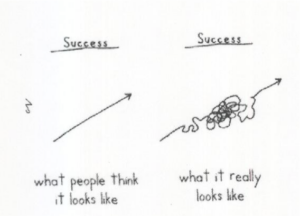
To best illustrate the concept, I want to share with you a picture this student shared with me, which I believe best exemplifies our theory of success vs. the reality of success.

To me, the left side of this image sums up why a vast majority of golfers never truly improve their games. They, like most, believe that they just need that one “secret” to instant improvement; just a little ‘tweak’ here or there on their swing, or their putting stroke, and voila!, they will be shooting better scores, hitting longer, straighter drives, etc. In other words, they have bought into the hype of “lose 30 lbs in 10 days” that is so prevalent in marketing today. On a sidebar, this has been and continues to be our biggest struggle as a company trying to market in the golf world. How do you market something that will take some work and effort on the part of the consumer? As one student told me after a school; the truth is the hardest thing to sell. But I digress.

The right side of the image is, in my own experience, what success really looks and feels like. It’s a mess. Frustrating, sometimes confusing, often fleeting, and never as satisfying as we expected. However, if you study the “mess” of success, notice how the trend is generally in a positive direction most of the time? Such is the reality of success.

Many years ago, Todd and I were in Orlando, and I was frustrated with my own ‘success’ with the Moe Norman Single Plane Swing. I couldn’t deny that I was hitting the ball better than I ever had, but I still wasn’t happy. To be honest about it, I was whining to Todd about it. And he finally got tired of my whining and said something to me that will stick with me as long as I live. “Scott”, he said, “if you went on a diet and had a goal to lose 50lbs by a certain date, but got to that date and had only lost 45lbs, would you consider yourself a failure?”

I have to admit that his comment hit me like a ton of bricks. Of course, my answer was “No, I didn’t fail, I just came up short of my goal, but I did make progress in the right direction”. Our conversation then turned to how that analogy parallels success in golf.

When you apply that same analogy to your golf game, here’s what you get the game of golf is a game of misses. The ‘better’ your misses are, the better you play, the better you score. Even Moe Norman was still working to ‘miss it better’ at age 74 just prior to his death.

As I’ve written before, the game of golf is so great because it parallels the game of life; there is no perfection, just the pursuit.

So, let me summarize before I get too far gone into this and end up writing a book on this subject:

  1. Success with your golf game is about the pursuit of developing ideal fundamentals, not about shooting better scores.Better scores are a by-product of better fundamentals. Obviously, Moe Norman’s Single Plane Swing gives each of us not only the simplest way to achieve better fundamentals, but also a clear and concise model to compare ourselves to along the journey. The undeniable truth here is that the closer you are to matching Moe and the way he moved the club, you will become a more consistent ball striker. The same holds true with your putting stroke or chipping stroke.
  2. Your journey on the ‘success’ pathway will be a damned mess sometimes.It’s inevitable. Sometimes you will regress, other times you’ll get frustrated. You’ll have flashes of brilliance followed by maddening mediocrity. How you deal with these times will be the key to your long-term

The bottom line my friends is this; those of us who have taken up Moe’s Single Plane swing has a huge benefit over our less enlightened golf brethren. You see, we have a model to compare ourselves to at each step along the way, they do not. In order words, we have a gauge to compare ourselves to. We always know where we stand in comparison to the model, as long as we take the time and put the effort in to compare ourselves to the model.

My challenge to you – get out of the ‘instant gratification’ mindset of success, and immerse yourself in the “mess” that success truly is. Work to match the model in every aspect, and know that when it gets maddening and frustrating, you know you’re in the ‘success sweet spot’.

Drills Anyone?

Anyone who remembers the movie Karate Kid will never forget the scene where Daniel, an aspiring Karate student, ambitiously awaits instruction from his teacher, Mr. Miyagi. They make as secret pact, where Mr. Miyagi promises to teach Daniel what he knows about Karate and Daniel promises to learn but he is not allowed to ask any questions.

“I say, you do” explains Mr. Miyagi.

They agree.

But then, thinking that he will reveal special Karate secrets, Mr. Miyagi hands Daniel a rag and tells him to wash and wax his cars.

“But why do I have to wash your cars,” Daniel asks.

“Remember deal, no questions” says Mr. Miyagi.

Later, after washing and waxing all of Mr. Miyagi’s cars, painting his house and sanding his wooden floors, a frustrated Daniel accuses Mr. Miyagi of not teaching him anything about karate.

Mr. Miyagi responds, “Not everything is as seen,” he says and then he demonstrates how all of the chores that Daniel had reluctantly completed, including waxing the cars, painting the fence and sanding the floor were actually ways of teaching the same movements as needed for karate.

Mr. Miyagi had taught Daniel Karate without actually “teaching” him karate. He did it through teaching the movements of Karate without actually teaching Daniel Karate. Mr. Miyagi’s household chores were actually karate, disguised as drills.

Golf, like Karate, is an art form. It is a learned set of bodily movements that when sequenced together, form a golf swing. The golf swing, once formed, is then used to strike a golf ball at a target.

Historically, however, most people do not approach learning golf in a similar fashion to learning martial arts. If martial arts were taught the same way as golf, you would begin your training by fighting the most skilled martial artists – black belts.

Just think of the frustration (and pain) you would feel, attempting to fight the most skilled black belt opponent. Quite frankly, you are going to get your but kicked. Why? Because you are untrained and unskilled.

This is not the way to learn martial arts. As a matter of fact, over the thousands of years of martial arts training, they developed a color coded belting system – a way to measure and test skills. This way, you could learn, improve and develop skills in an organized way to eventually reach higher degrees of skills to compete against your opponent.

Golf is not quite as punishing as sidekicks, blocks and fist fighting, however, your opponent in golf is thousands of yards of fairways and rough with 18 holes of bunkers, water hazards, and undulations. The Golf Course is always a black belt and he is often quite formidable.

So why do untrained and unskilled golfers keep fighting him? Maybe it’s because of an occasional long drive or squarely struck putt (a lucky punch) but most of the time, golfers are getting their butts kicked. Could losing the fight be why so many golfers are quitting the game each year?

Golf is a game that is meant to be enjoyed as a recreation, however, the attrition of golfers (golfers quitting the game) and the frustration of those who keep trying exemplifies the need for better ways to develop the skills necessary to enjoy the game at a much higher level.

Golf, in my opinion, must be trained and learned in a systematic and efficient way – similar to martial arts. Simplifying the golf swing technique – using the single plane and effective skill training and there are key positions that are mandatory to become skilled at ball-striking.

Drills

When Daniel discovered that he actually learned Karate without “knowing” that he had learned it, he realized that by washing cars he had developed karate skill

When thought of this way, does it really matter if you are hitting golf balls when you learn the movements of the golf swing? Like waxing cars to learn the necessary arm movements of karate, doesn’t it make more sense to train the movements of the golf swing without the results a ball to interrupt the learning process?

The “Making Feel Real” Drills video is designed to teach you, thorough various drills some with a ball and some without, the necessary movements and feelings of a perfect single plane golf swing. This e-book is a supplemental guide to explain how the drills you are learning improve your overall movement and mastery of the Single Plane Golf swing.

If Mr. Miyagi was teaching you the art form of golf, the Graves Golf Academy Drills Video “Making Feel Real” would be his guide to helping you master the Single Plane Swing without you even knowing it.  So buy the video and get to work on mastering the Feeling of the Single Plane Swing and – “don’t ask questions.  Deal?

LEARN

THE

SWING

Join 1M+ Subscribers to get your FREE Video Quick Start Guide that reveals how to hit the ball farther and straighter more consistently from now on…

START YOUR NEW GOLF SWING