Single Plane

Student Testimonial

HI,

I have been using Moe’s single plane swing technique to allow me to play golf again.

I had my first spinal fusion in 1980. Before that I played using the rotary swing technique. My surgeon asked me after the surgery if I played golf? I replied, ‘yes’. He replied ‘No yo don’t, now that you have the lumbar fusion’. I had to wait a year before trying to swing a club.  My use of the rotary swing style was impossible with my spinal fusion. No lower rotation since my lumbar was now fused. Sprayed the ball every where. So in 1981, I gave golf up.

I had some success from the surgery but in later years started having more issues with pain. In mid 2005, I started getting epidurals to stop or relief of the pain. I asked my new surgeon if the removal of the surgical knot rods could be removed? His reply was that we do not do the surgery. After that I had to have a cage put in at the thoracic L3-L4 along with a plate and screws. THat relieved some of the pain. My step-daughter who is a charge nurse gave me a reference to a surgeon in LIbertyville, Il, Dr  Jonathan Citow. I made an appointment and took all my images along with records. My pain was intensifying. Dr. Citow reviewed my records and images along with a physical, he then stated; ‘You need the hardware to be taken out to lessen the pain. Scheduled the surgery and he removed the knot rods at lumbar, screws & plate at thoracic. The cage had to remain because it was fused already.

After all this, I came across a article about Moe Norman and the single plane swing. I started to review all the videos I could find. I found your videos & DVD. Purchased; ‘Single Plane Solution’, ‘Flexibility & exercises’, ‘The Moe Norman Notebook’. After viewing the DVD’s I tried a swing that I modified for my restricted spine.

I took a few of my wife’s clubs (too short) but was able to hit balls. So I purchased a set of irons and continued my training. I purchased a Cobra driver that I felt comfortable to swing. Added a few Hybrids to help me along the course. Repeating my exorcise and swing techniques with a modified single plane swing using my big muscles the best I can.  I now play a fair game and surprise my fellow golfers with my repeatability. Sure my distance is not as far as when using a rotary but I am now 39 years older at 69.

I am having fun again swinging a club on the course. People still asked me why I do not follow through to the end top of my swing. This is limited by the fusion lower and thoracic. My swing allows me to comfortably swing. MY grip technique helps me. I do not overlap but I have found my grip. I just need to keep my body steady with a good stance during my swing using the upper big muscle without allowing the fusions to interfere. I know the length of my swing and restrict myself to those limits, if I do not then my swing is not complete but erratic. And I do feel the pain from a poor swing.

Sorry about the long story, left out some details that would have elongated the story.

Just a thank you to all members of the Graves academy for your videos & notebooks that have opened my experiences with a little modification to the technique to suit my physical limitations.

I have decided to try the new King Cobra One Length irons. I feel the set will improve my repeatability and hopefully my distance will equalize for each club as compared to my varied length ‘Ideas’. MY swing speed is rhythmic with slow back and pause at the top with the top of my end swing at 3/4 because of the fusion (mostly due to the thoracic).

Again, Thank you very much for continuing Moe’s proven technique for a single plane swing.

Regards,

Gary S.

Gary,

Thank you so much for your email about your success with the SPS.  You are the reason that we (GGA) continue to innovate and spread our message to golfers around the world. It is great to hear that even though you have had some pretty serious back surgeries, you continue to play and love the game.  That, in itself, makes my day.

Keep having fun and swinging like Moe!  

Todd
Moe’s Swing – A Masterpiece of Movement

If you were an artist describing Moe Norman’s swing you would call it a masterpiece. You would see the geometry of the lines, the beauty of the movement and how there isn’t one wasted brush stroke. You would also see the architecture, the powerful club delivery and the economy of his movement.

Geometry, power and economy – three technical words to describe what Moe called a “Feeling” of greatness. So how do you go from the technical aspects of a golf swing to feel? To use the body as a tool and tech it to or swing effortlessly is a magical feat. In my opinion, this is one of the greatest accomplishments.

As you know, every artist who seems to be performing miraculous illusions on canvas has a few tricks up their sleeve. I believe Moe did as well. I believe his swing motion and movement was based on limitations. Yes, limitations. I believe that what you are seeing when you watch Moe – is a swing that won’t fail.

In other words, Moe is rotating in the backswing and rotating in the downswing as much as he can to his limits. Let me show you.

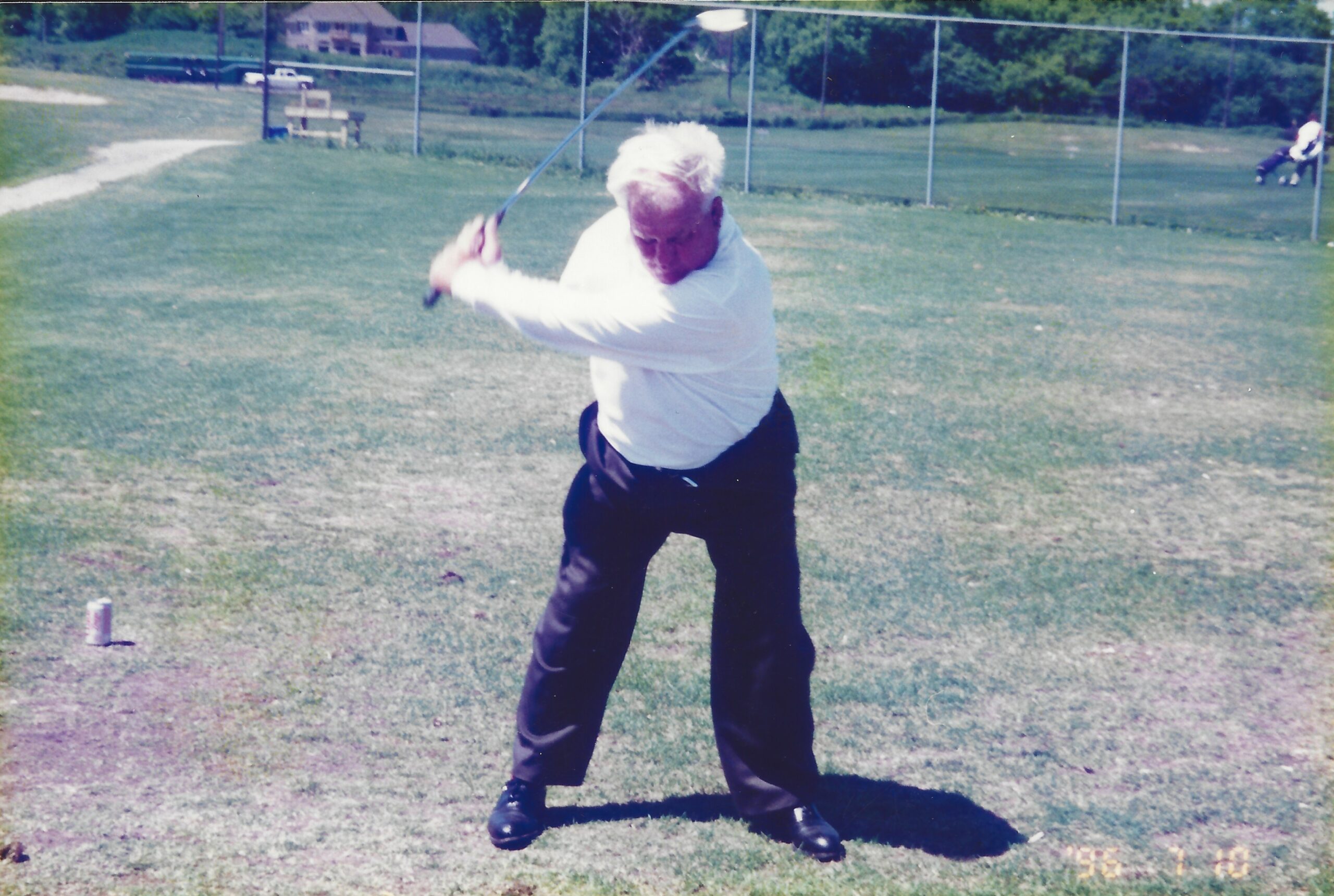
If I told you to make a backswing but do not let the trail knee move and keep your lead heel completely on the ground your backswing would look something like this:

moe-on-range-1997-white-shirt-2

You see how Moe’s lead foot is on the ground, his spine is tilted and his trail leg hasn’t moved. The trial leg has braced the rotation of his hips. Moe has limited the motion with certain aspects of his body. In doing so, this is the only place he can take the golf club in the backswing – he has reached a maximum.

If I asked you to rotate your hips in the downswing, you might ask “how much”. What if I said “As much as you can” but only under these two conditions: you must keep your trail foot on the ground and you must have you lead knee flexed all the way through your release and into your finish.

By giving you freedom to rotate to your maximum ability but placing limitations on certain aspects (what I call rules), you create the perfect environment for consistency and repeatability. Why? If you do it correctly you can’t over rotate or under rotate your hips and by allowing you to move to your maximum ability, you can amplify your speed.

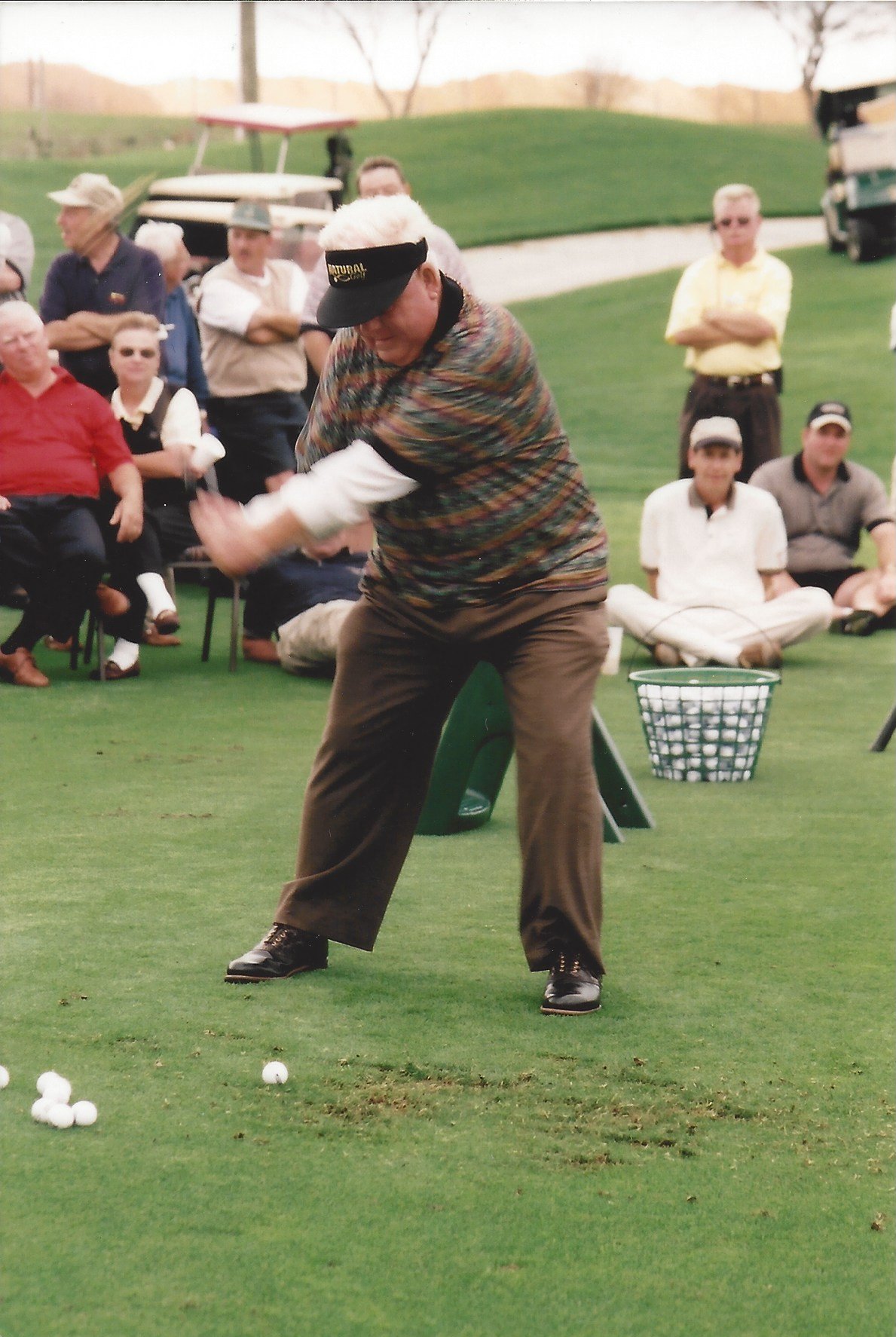
Take a look at this picture: Moe is hitting into a flexed la knee creating a limit to his hip turn. His trail foot is on the ground These factors create a boundarmoe-clinic-2001-1y that allowed Moe to move maximal and masterfully.
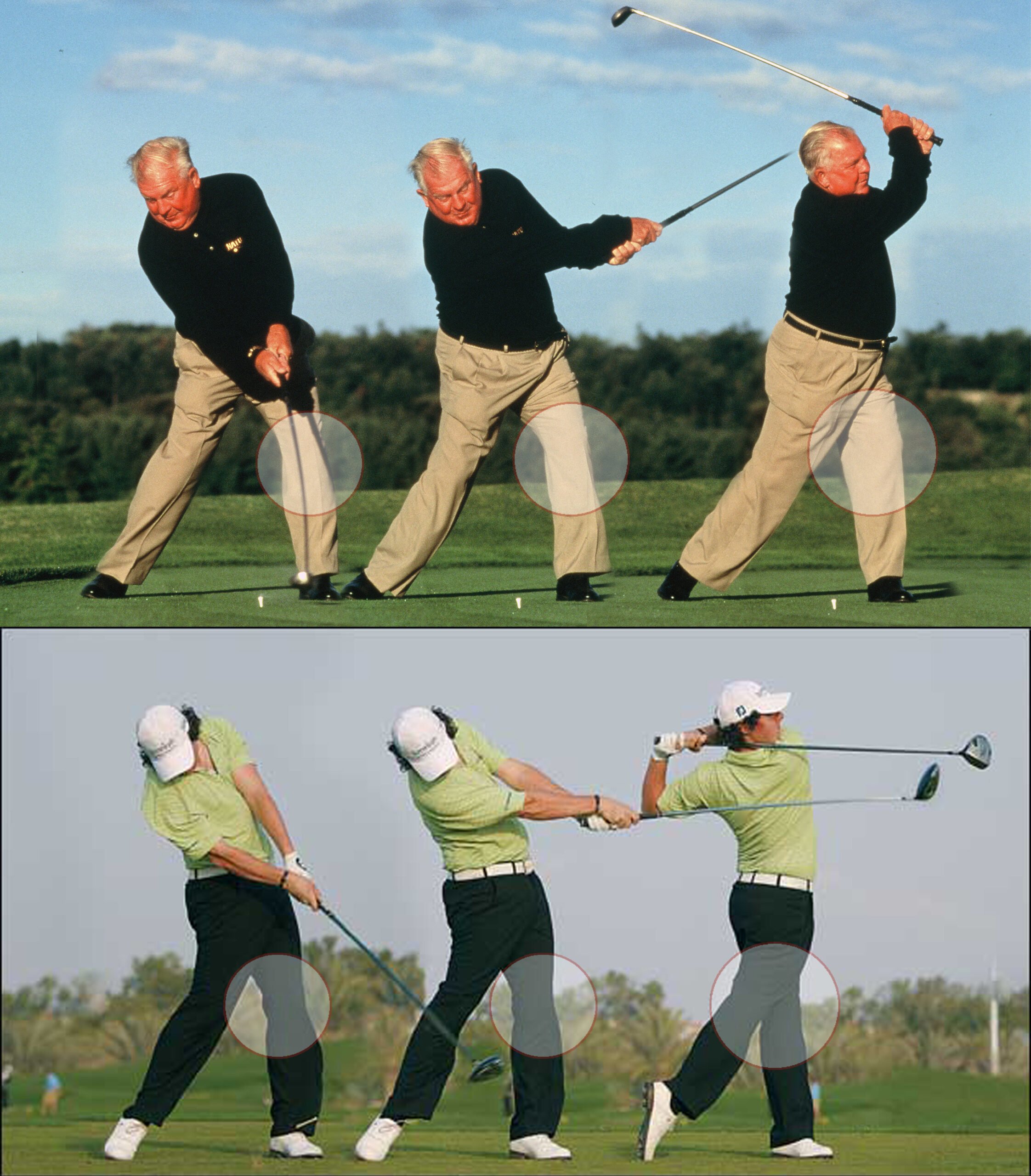
Like all artists who understand the mechanics of their art, Moe limited the movement of his body – possibly making this a “secret” to consistency and accuracy.


The Best Training I’ve Ever Seen

At a recent 3 Day Premier school in Palm Springs, I experienced a truly amazing transformation of a group of golfers. It was awe inspiring to watch, and as an instructor, very, very exciting to see. Permit me to elaborate.

It was on the 2nd morning of our 3-day school, and the group of students were warming up that morning by practicing our PVC drill. Our group of instructors, 5 of us in all, we walking the tee line, helping each golfer individually. After a few minutes of observation of not only the individuals, but the group in general, we noticed that the majority of the students were doing the drill incorrectly.

Now, if you’ve followed our instruction, you know our firm belief that if a drill isn’t done correctly, it’s doing more harm than good. In fact, practicing incorrectly can be fatal to your game.

We decided to stop the entire group, and circled everyone up. We reviewed each position of the PVC drill, reminded the group of valuable checkpoints at each position, had the group demonstrate correct positioning, and sent them back to the line to “try again”.

What transpired over the next 20 minutes was the best training session I have ever seen.  I saw a group of golfers who were intensely focused on each position. These golfers were moving to a position, checking it, and if the position was not correct, they fixed it immediately.  It was a truly magical moment to behold. That group improved their swings in that 20-minute session, which is what the schools are all about.

It’s training, and I mean truly training, that makes the golf school experience superior to any other form of instruction out there.

At each and every GGA school program, from the 5 day Build Your Game Camp to the 1-day Single Plane Experience, our focus as an instruction company is helping you learn to train. The fundamentals of the swing, putting, and the wedge game are simple, it’s learning how to train each of those areas – correctly – that make the golf school experience last.

If you are ready to experience exactly what your perfect golf swing feels like, then I encourage you to get to attend a GGA school sooner rather than later. If you are like most of our students, you’ve spent enough time guessing and being frustrated. It’s time to experience it, learn it, and train it under the supervision of a trained eye.

To find a school, CLICK HERE , and we look forward to helping you discover what true golf swing training really is.

Hit em’ straight!

Scott


Thank You Conventional Golf

What do I say to all of the teachers of conventional methods, and any golf instructor NOT teaching the Single Plane Swing?

I would say – thank you.  Thank you for the job security.

Your job is difficult because not matter what you do, you are at a disadvantage teaching a method that no matter what you do will be difficult for the average golfer to achieve. The conventional, arms hanging below the shoulders address position makes your job almost impossible.

You are also at a disadvantage because the amount of practice it takes to become skilled enough to achieve consistent swings to impact from the conventional address position takes extraordinary amounts of practice, timing and this still doesn’t guarantee success.

Golf is a difficult game – the goal should be to make it easier not more difficult.

The unfortunate part of this conversation is that you, the conventional student is the one who suffers. I see it every day – golfers who are frustrated because of disadvantaged mechanics.  They blame the instructors but it’s not really their fault. I Their instruction isn’t necessarily bad – just almost impossible for the average golfer to achieve.

Let me say first of all that, contrary to what many believe, the golf swing is NOT rocket science, even if it seems extremely difficult for many of you. It has become so difficult because you are at a fundamental disadvantage – which can easily be corrected. Here are some of the conventional to Single Plane adjustments that can transform your conventional swing into an easier Single Plane Swing.

1)   Move away from the ball and align the club with the arms – on the Single Plane.

This is the foundation of simplifying your swing because it sets the club on the same plane that you impact. It establishes a straight line to impact as opposed to starting on one plane and impacting on another.

2)   Tilt your spine away from the target so you trail shoulder (right if you are right handed is lower than the left)

By lowering the trail shoulder, your hands can lead into impact, eliminating the over the top and release early. The Tilt of the spine gets the lower body moving first in the downswing allowing the hands to lead into impact to compress the ball.

 3)   Rotate the hips but keep the feet on the ground.

Because you are on a Single Plane, you are now able to keep the spine in the same tilt from address, to backswing to impact. You no longer need to lift your body into impact as required in the conventional golf swing. By keeping the spine in the original “tilt” your feet will stay on the ground as you rotate your hips in the backswing and downswing.

Here are a couple of my keys to great Single Plane ball-striking:

 1)   Build an A-frame out of the legs at address.

2)   Brace around the trail leg in the backswing (do not let the knee move)

3)   Rotate the hips into the downswing into a flexed lead knee

4)   Keep the feet on the ground into impact

One of the “secrets” to the simplicity of the Single Plane Golf swing is how the back (spine) is being moved during the golf swing. The hips control the spine so as you rotate the hips in the backswing around a stable trail knee and then into a flexed lead knee, your spine moves forward but stays in the same tilt from start to release. I consider this “posture” where the spine tilt maintains throughout the swing.

By maintaining “posture” the shoulders also stay on plane where the trail shoulders position (lower than the lead shoulder) can get the hands leading to the left side of the body into impact.

As difficult as it is to describe the golf swing mechanics with words, you can understand that the goal of a golf swing is to achieve a perfect impact position. Therefore, simplifying your movement from address to impact is should be where you spend your time.

If you have learned a conventional method of golf instruction, consider this an invitation to help you simplify your movement and make golf easier. If you haven’t tried the Single Plane swing – give it a try. You might wonder why you haven’t tried it sooner and you might even say what many of our students say – “It just can be this easy”.

A Swing of Disastrous Distortions

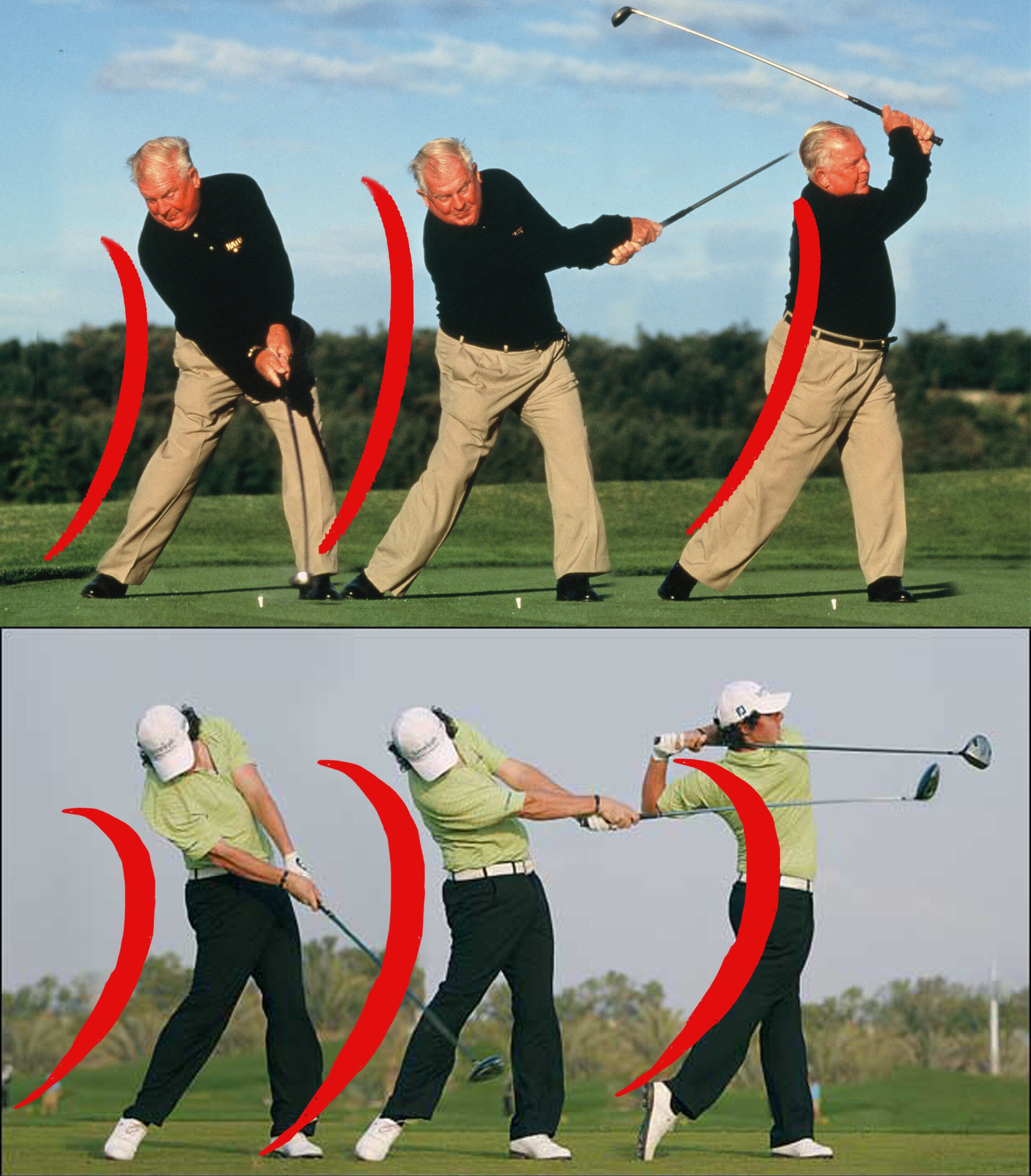
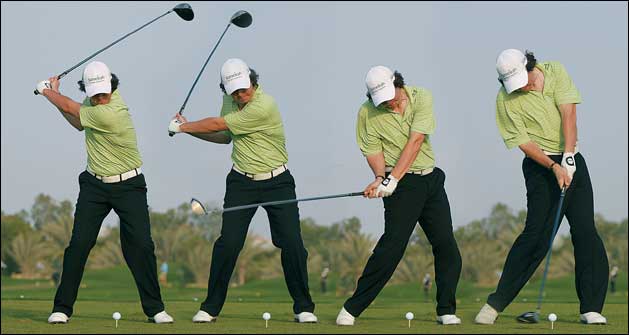
When I watch golf swings, even swings of great players such as Rory Mcilroy, it makes me cringe a bit inside my body. Don’t get me wrong, like everyone who loves golf, I enjoy watching him play golf, hit towering drives and win tournaments. I am a big fan of Rory.  But I don’t see how the average golfer can really look at Rory’s golf swing as a swing model. Rory is in his early 20’s. He’s young, flexible and fit.  He has hit thousands of golf balls to work through his swing movements and motions. His body has developed around his movements. Do I see some good things in his swing? Absolutely. But one thing that troubles me about paying too much attention to young tour players is that many people will try to model Rory – which can be a big mistake. Let’s look at some particulars.

Without going into a complete breakdown of Rory’s entire golf swing, it is interesting to look closely into his downswing move. Keep in mind that I am not looking for positions here, I am looking for the stress it places on the body in regards to the task of reaching impact. (Impact is the goal of all great ball strikers). The perspective I take is that all golf swings are to achieve a perfect strike on the golf ball. The ability to reach impact starts at address. In other words, if you start in a misaligned position you must adjust during your swing to make an impact. The more misaligned you start the more contorted you swing. The problem here is that contortions are not efficient, repeatable or consistent. And these contortions can be disastrous to good ball-striking. Even worse, they can be extremely painful if you are not a 20-something year old Rory.

If you notice in the third picture in the sequence, you can see the crunched look of Rory’s right arm against his body. His right shoulder is jamming upward toward his head as his arms move downward. As the sequence continues, his lead leg straightens and his body move up as his arms move down – further crunching his shoulders against his torso that is moving upward due to his leg straightening. Once again, I am a huge fan of Rory, but I don’t think that this is the easiest way to get the job done for a 50 year old golfer. What I see here is a great athlete with mobility. Let me compare this with Moe Norman.

What you see from the movement forward is what I call “arm freedom”. You can see with Moe the arms have released as the lead knee has remained flexed. This shows that the arms have gone down with the body contrasting what you see with Rory where the lower body has lifted (straighten left leg) pushing the upper body up as the arms go down – crunching the shoulders and causing Rory to lean backward. This creates a reversing of the upper body or Reverse “C”.

One thing to note here is that Rory is a minimal example of this. He actually shows must less of this distortion than most conventional golfers. And as I have said in previous descriptions, this is all caused by an improper “two-plane” address position. The two plane swing comes in many forms, some more pronounced than others, sometimes in disastrous amounts. In all cases, however, the distortion of the upper body/lower body stress is a problem. I consider it a spatial problem where the conventional golfer is too close to the golf ball to start with. This results in stresses and problems reaching impact.

These things can be eliminated with the Single Plane golf swing of Moe Norman. And when they are eliminated, reaching impact is more consistent and repeatable resulting in better ball striking. The goal is to eliminate the lower body upward push. The way to do this is to get the appropriate distance from the golf ball where you start the club on the same plane at address as impact.

My Theory Confirmed

I have a theory, here it is.

“The most important attribute to play great golf, day in and day out, is accuracy and consistency in your golf swing – not length”.  

Did you happen to watch the Ryder Cup? If you are an American golf fan, you probably wish you hadn’t. As much as I think Davis Love is a great guy, I am not sure that he had this entire event under control. I think it is one of the greatest events in golf and yes, I admit, I like the European players better than the U.S. players. Why? Because they look like they have more fun playing golf. Really, they do! Did you watch them? Golf is a game to them and it looks like they play it to have fun. They smile, laugh, make fun of themselves and cheer each other on. They look like a Team. This seems to be in complete contrast to the U.S. Team who, other than Phil Mickleson and Keegan Bradley looked like they are taking a week out of their schedules to play for charity.

This might be a bit overstated and I admit that the rookies, even though they look like deer caught in headlights, are caught up in the moment. I think that the Ryder Cup should be the U.S. rookies vs. the European rookies where the first year players from both sides of the pond play each other for the Ryder Cup. Now that would be some great golf!

It’s the older guys on the U.S. Team that seem to have the most to lose – and it shows when they get in these team events. It seems like they are trying not to lose rather than trying to win. Maybe we should rethink our selection process – I vote for all rookies, especially players like Ricky Fowler. Mostly because he isn’t afraid of match play. Who would you rather watch, Tiger protecting his reputation or Ricky going for every reachable par 4? Hey, the Ryder Cup is one of the grandest stages for golf – let’s go for it!

And after watching almost every minute of the event and witnessing the European players enjoy themselves even though they trailed the entire match until the last groups on the last day – I still don’t think that the players on the tour are great ball-strikers. Nope, sorry. If you saw the same event I did, you saw way too many shots missing greens, hitting trees and even a “shank”.

I have never played in a “Ryder Cup” however, I do play Medinah more than any course in my yearly golf schedule of 10 rounds per year. The course is demanding and difficult. It requires shots that angle over doglegged fairways where you must carry tall trees at corners with draws and fades. But the errant tee shots that clip a tree while cutting corners aren’t the ones that bother me. The ones that bother me are seven irons and wedges that miss the greens. Just like hole number 17 and 18 where we lost every match we played on these holes.

Luckily for us we had some length on our team with Bubba, Phil and Tiger – so we could reach the par 5’s in two. But what good did that do us? It was the 17th hole a water protected par 3 and the 18th a straight forward par 4, that finished us off. Once again, my theory is confirmed and Moe was right – length is great to have when you play golf. It’s a great tool to have but it won’t win you a Ryder Cup. The key is accuracy and consistency – oh and the ability to make putts.

LEARN

THE

SWING

Join 1M+ Subscribers to get your FREE Video Quick Start Guide that reveals how to hit the ball farther and straighter more consistently from now on…

START YOUR NEW GOLF SWING