DRIVING DISTANCE – HOW TO GET MORE….

DRIVING DISTANCE – HOW TO GET MORE….

By Tim Graves, PGA

One of the most common questions we receive (seems every day) is “How can I get more distance?”

There are three areas you can work on/improve to help you get more distance on all your golf shots, in particular, your driver.

And, all of these, you can and SHOULD work on over the fall / winter (training sessions).

Those three areas are:

  1. Driver Technology
  2. Flexibility and Strength
  3. Swing Technique

Let’s break down each area a little more.

1.  Driver Technology:

A few years ago, the USGA put together a set of rules limiting how much a golf ball can “rebound” off the face of a driver (a vague description) – thus putting a limit on the distance of the drivers. Since then, the golf industry realizing they can no longer make drivers that can hit it further off the face, have been working on technology that has made the “big” headed drivers more aerodynamic (thus less air resistance in the golf swing) and more prominent sweet spots on the face.

Older technology drivers had sweet spots the size of a dime (some smaller), newer technology drivers have sweet spots the size of half dollars (some even bigger). What that means is balls hit slightly off the middle of the club face will travel much further now.

And the key is the “average driving distance” you have, not the “one” you catch that happens to fly a long way. Meaning, if your sweet spot on the driver is large and you miss hit a few shots (or more) around off the middle of the club face, you will still get good/more “average” driving distance. Meaning, overall you will have less club into the greens, etc. etc.

So, if you are looking to maximize or increase distance – you need to have a driver that is “modern” or at least less than 2 or 3 years old. These newer drivers have large sweet spots and have the highest technology for the least amount of wind/club head resistance in the golf swing.
2.  Flexibility and Strength

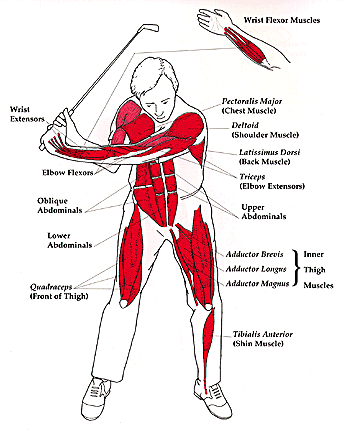
The 2nd area to focus on with distance is flexibility and strength. And in that order. Too many worries about strength and not flexibility. Being strong with good, or great, flexibility “allows” you to get in positions in your golf swing to hit the ball with reasonable distance.

As we get older, we lose our strength and more importantly our flexibility, when we start to lose our elasticity, we can no longer create certain angles in the golf swing that will allow us to create “leverage” in the golf swing which in turn produces speed and distance.

We have produced an extensive DVD on this topic. This DVD is set up to test the areas of your body and its flexibility in these areas. It then gives you 3 or 4 exercises you can perform to regain or create increased flexibility (and strength) in those areas. This DVD designed around the single plane swing of Moe Norman – in other words, it takes the eight most significant positions of Moe’s swing and determines if you are flexible enough to “reach” those positions. If not, it gives you “easy” exercises to perform over time that in turn will help you gain those positions and eventually “allow” you to swing the club on plane.

You can see a lot more detail about the Flexibility and Exercise information at: https://watch.gravesgolf.com/

3.  Swing Technique

Ultimately, the most crucial factor to get more distance is to improve your technique. It is always interesting, one of the things we do at all our schools and camps is to measure our students swing speed. We then correlate it to their driver swing speed and the average distance they should be hitting their driver. For most (those that swing 85 to 90 mph), they should be hitting their driver 230 to 240 yards (with a little roll).

For most, when they find out how far they should be hitting their driver with the speed they currently have, they are shocked. Why are they hitting it so short compared to where “their potential” says they should be hitting it? Because of technique. They are not hitting the golf ball off the “sweet spot” of the club with a “direct hit” from the club that is on the path.

In other words, they are hitting “glancing blows” that is creating side spin which is limiting or reducing the distance they should be hitting their driver.

Working on swing technique – working on getting the club on the proper single plane/path, with a square club face through impact and ultimately, limited to no side spin, will give you the maximum distance.

In conclusion, to answer the all too common question, we get from so many of our students/customers

How can I get more distance?

Answer:

1.  Obtain a new/modern driver that has the highest technology for increased sweet spot and limited wind resistance (aerodynamic).

2.  Work/continue to work on flexibility (especially over the “off-season” months when so many loose elasticities because of an increased static lifestyle) and… 

3.  Always work on improving your technique to maximize the optimal hit on the ball with limited side spin and enhanced sureness of hit.

P.S – Here is the P.S. to this article as EVERYONE will ask this question to us (in person, at schools, during webinars, across emails, etc….).

What is the fastest way to improve technique?

Answer – FIGURE OUT YOUR NEXT STEP TO IMPROVEMENT

To see more about YOUR NEXT STEP TO IMPROVEMENT: CLICK HERE

(You can see the specials associated with the Your Steps Video above)

Please feel free to contact me anytime at timg@gravesgolf.com with questions, comments, etc..

Old Man Golf…. No Excuses…

By: Tim Graves, PGA

Hello Everyone –

I wanted to write a quick story about what something I went through a few weeks ago. The title “Old Man Golf” isn’t being sarcastic… but being realistic… I wanted to grab your attention – will explain.

A few weeks ago I was playing in an event at Battle Creek Golf Course in Broken Arrow, OK (just outside Tulsa). It was a South Central Section PGA one day event with about 75 players in the field.

A few days before the event I did something “stupid” when practicing… I went out to practice with one of my students (was close to 100* out), hit balls, work on short game, etc.. for about 3 hours. Took a break (for about an hour), then went out to play a few holes with my student. My mistake was when I went back out to the course to play a few holes, I did not stretch (well enough). On about the 4th hole, I felt a sharp pain in my trail hip (front side.. hip flexor muscle). And like the “smart guy” I am, I decided to try and play through the pain for a few more holes…. needless to say, it didn’t get any better.. in fact, by the end of the few holes with my student, it hurt a lot…

Now, back to the tournament (3 days after my hip flexor incident on golf course). It was not feeling any better.. in fact, it had gotten worse. Heating / cooling, ointment, Theragun… a lot of therapy (worked with my doctor) and it was not feeling any better. But…. the tournament was for points (cumulative for the year) which result in the player of the year award.. So, if you miss the tournament, you miss the potential for that tournament’s points.. Needless to say, even against my wife’s wishes and pleading, I played in the event… I was hurting… hurting bad…

How bad was I hurting… normally I hit 15 to 20 minutes worth of golf balls to warm up before the round… I hit 3 balls on the range.. it hurt way too much. Normally I putt and chip for 15 to 20 minutes before a tournament to warm up… I putted for 5 minutes and hit about 10 chips… it hurt too much to bend over and pick up the golf balls. I spent the majority of the warm up session stretching.. doing everything possible to get my hip to feel better.. The problem was, not only was my hip hurting now, it was going into my lower back… How to describe.. just past impact, it felt like someone was sticking an knife in my trail hip (in the front) and as I finished the swing, the pain radiated to my lower back..

Before you email me and tell me you suggest I didn’t play in this event – get in line with my wife, my doctor, and a couple of my close friends who were watching me stretch before the event and saw how much pain I was in….

But, off the the first tee I went. Yes, I am an idiot (at times) (that was for my wife..), but I was going to do everything possible to finish the round to get some points…

I played with two of my friends, one a PGA professional teacher in Tulsa, and one an PGA assistant professional in Oklahoma City. Both, I have played with 100s of times. I know them well, and they know me well…..

We started on #2 (shotgun start) – a 390 yard uphill, slight dogleg right Par 4. I set up over my drive, did the best I could advancing it down the fairway… My second shot was 210 yards from the hole. I hit a 3 wood about 40 yards short of the green, got up and down, made par on the first hole.

Here is the summation of my round… (and I was actually told this by my friend who I rode with during the tournament.. he felt so sorry for me.. he was so nervous not to hit any bumps driving the cart, because I was in serious pain getting in and out of the cart and it hurt worse every bump he hit…). In fact, I tried to walk when I could.. helped a little….

I did not hit a drive over 180 yards. One hole, I think I hit a cart path, and it went around 200 yards.

On 10 par 4s, I hit hybrid or fairway wood on my second shot on 8 of them. (Normally, I might hit one or two a round.)

On 4 par 5s, I had at least 100 yards on every 3rd shot.. (one of them I topped the tee ball as I just couldn’t finish the swing..) (Normally, I can hit at least 1/2 the par 5s in two..)

On 4 par 3s, I had to hit hybrid on 3 of them, 7 iron on one (it was 120 yards..) (Normally I hit a 7 iron 165 yards.)

Needless to say, it was BRUTAL!!! Golf I am not used too… drives going 180 maximum yardage, hybrids or more into all the holes… we played the course at 6,350 yards. My playing partner and good friend told me I was playing “Old man golf..”.

So, what did I shoot????

1 over par… a 73. And that was with a double on the last hole. I hit a drive off the tee into the right rough, had about 170 left into the green, should NOT have tried to hit a hybrid out of the rough, but I did… and topped it into a pond short of the green as my hip hurt WAY too much to hit a shot out of rough that deep….. I was one under par, hurting worse than I have ever hurt on a golf course and lost my mind for a minute… cost me a couple…

My stats…

Fairways: 12 / 14 (Pretty easy to hit when only hitting driver 180 yards..)

Greens in Reg: 6 / 18 (Hard to hit when hitting hybrids and fairway woods into most..)

Up and Down: 11 / 12

Putts: 25

So, why did I write this story for you…..

  1. Please tell me you have to hit your driver 250 yards + to play good golf….
  2. Please tell me the short game is not important to scoring….
  3. Please tell me “I hit hybrids into every green, this doesn’t let me score well..”
  4. Please tell me “I’m a good putter, I average 35… putts per round”
  5. Please tell me “I have a good short game, but I can’t break an 80..”
  6. Please tell me “Driving is the most important part of the game for scoring.”

Yes, I am being sarcastic… Think you get my point….

  1. Yes, in hind site, I probably should have sat that round out… so all you that are going to send me emails telling me that…. I agree. (I have since visited my doctor, got PT, and am now much better).
  2. I wrote this article to prove a point…. You DO NOT need to hit the driver “long” to play scratch golf. In fact, you can hit it “short” and play scratch golf… You MUST have a scratch short game to play scratch golf…. that is what is important to scoring…
  3. I wrote this article and want to remind you – NO ONE has an excuse when it comes to your short game. You can be old, young, middle age, male, female, (other..), green, blue, purple… it doesn’t matter. No one has an advantage over another in their short game as it doesn’t involve strength… it involves TOUCH, FEEL and PRACTICE… And BTW – the touch and feel come from guess what.. PRACTICE…

I hope you enjoyed this article – please feel free to let me know what you think…. timg@gravesgolf.com

FYI – Finished 2nd in the event to my good friend (I rode with.. he shot 1 under…. yup, the last shot cost me the event… but who cares.. I survived and got a GREAT story out of it..).

Give Yourself the Best Chance in Your “Scoring” Part of the Game

By Tim Graves, PGA

Hello Everyone, I thought I’d write a little about wedges, spin and the importance of having a good wedge game.

First – as most of you have read from me before – the wedge game is a CRITICAL part of the golf game. When I am talking about wedges, I am basically talking about anything inside 100 yards for most.  (For some will be a little further, for some a little shorter). This is a part/large part of the “scoring” part of the game.

Second – Again – as most of you have heard me say before – no one should have an advantage over you in this part of the game. Meaning – it is not a strength issue, but rather a practice/technique, etc… issue. In other words, you can have a GREAT wedge game as long as you work on it properly and have the proper equipment to give you the best chance.

Third – You need to make sure your equipment allows you to maximize your wedge game. As I have come to find out, it seems a majority of golfers don’t understand wedges, how they can work for them and how to use them…

So, let’s talk about wedges and hopefully working with your equipment can help improve your game, or at least, give you the best chance to score your best.

  1. I believe you should carry the maximum amount of wedges “your bag” will let you carry. Meaning – as you can only carry 14 clubs – I would recommend carrying at least 4 wedges (including your pitching wedge). If possible, carry 5. (Pitching, Attack, Gap, Sand and Lob). Reason – the more wedges you carry the better your yardages will be between the wedges.  In other words, you will less gap in yardages between the wedges the more you carry.
  2. Different wedges are made to use for different shots. Let’s talk about the sand wedge first (typically 54 to 56 degrees).
    Most sand wedges have at least 10 degrees of bounce or more and a S or C type Grind on the wedge. The Bounce is the angle on the sole from the back of the club to the front. Every club in your bag has a little bounce, the sand wedge has increased bounce (typically 2 to 3 times as much) to help you keep the club from digging in the sand (soft surface) too much. Meaning, it is a very good bunker/sand or medium to high grass club, but not so good at hitting short shots from “tight” (minimal grass) or hard lies. The added bounce on the club will make the club skip/bounce on hard ground and will cause blade/thin type shots. Most see this when hitting chips/or shot shots off of tight lies. It is not recommending to chip or pitch with a sand wedge from tight/hard lies. The grind on the club allows for the club to be played in many different situations including tight lies, rough, high rough, bunker, etc..
  3. The lob wedge (typically 58* +) is a great wedge for high pitch/lob type shots.  Reason – appropriate bounce, added loft and typically a little “wider” sole. Most lob wedges have a slightly wider sole which will help the lob wedge slide across the ground and get more weight on the ball to help get the ball up fast. The bounce should be at least 10* and it must have a C type grind on the sole which will keep the leading edge of the club down when pitching from tight lies.
  4. It is recommending to have steel shafts in your wedges (sand and lob and sometimes Attack and Gap).  Reason – you want the added weight in the clubs. These clubs are the shortest clubs in the bag (besides putter) and are often hit with 1/2 shots, out of rough, out of sand, etc. etc…  The added weight is a big advantage when hitting the clubs in these situations.  Makes it easier to hit out of rough, sand, etc. Don’t have to swing so hard, club head will get through grass, sand much easier with added weight. Graphite is a great material to protect the body when the club is being swung fast and allows you to hit the club further. No needed with the wedges – wedges are “control” type clubs – the added weight in steel is STRONGLY recommended in the wedges.

Last – let’s talk about spin. We all want to create spin on our wedges. Without spin, it is very difficult to get the ball close to the hole. Most won’t be able to create spin to stop the ball completely, but everyone can and should create spin to slow the ball down which helps get it close to the hole.

The primary variables of spin are angle of attack/speed, club type, and ball type. The more speed, the more spin you can create.  The softer (or more layers) the golf ball, the more spin you will create. Finally, the softer the metal of the club, the more spin you will/can create.

Another important variable and the one of improved grooves on the wedges. The most updated and improved grooves in wedges are in the new Callaway Opus Wedge. The New Opus Wedges feature: Spin Gen Face Technology which provides spin and control in your wedges by combining 3 key elements on the face; an all-new tighter pitch which puts more grooves on the face, offset groove-in-groove for spin when opening the face, and a new aggressive face blast providing spin and bite on partial shots. These three elements work in conjunction to provide a crisp, tour level spin.

To make a “long story short” it is recommending everyone carry wedges that give them their best advantage in their scoring part of the game.

The recommended wedges are those that are a “forged” (soft metal) type, steel shafted, with the best / most updated grooves (maximum spin grooves).

If you have any additional questions about the wedges, groove rules, etc… please don’t hesitate to give us a call or email anytime.

If you would like to order new/additional wedges give us a call. All wedges need to be custom built to the golfer’s specifications – absolutely critical to have a proper fit.

To see more about the “just released” OPUS Wedge: CLICK HERE

Remember – Always Practice with a Purpose.

Also, Remember – A little improvement every time you practice adds up to a lot of improvement over time.

Be Careful What You Hear…

I recently posted a video discussing Moe’s address position and the importance of Shaft lean into impact. I mentioned the importance of taking a divot and one of the comments on the post mentioned the following:

“But MOE never took a divot, or very rarely did he. He even said it himself”.

I replied: “Moe took divots albeit shallow. As Moe said “Bacon strips, not pork chops”.

Then he replied:

“Maybe sometimes but I can show you a video where he said he doesn’t take divots and that he could , “ put your Casio watch on the ground and I could hit off of it and not break the grass.” Also, I have seen many of his hitting clinics on video and he rarely ever takes a divot. He said he would sweep the grass.”

Let’s set the record straight.

While Moe might have said he didn’t take a divot, what he felt he did and what he actually did were quite different.  I have not doubt that Moe could have hit a golf ball off of a Casio watch face.  This doesn’t mean that you shouldn’t take a divot.  Moe’s swing was perfectly shallow into impact.  He compressed the ball perfectly.  Yet, when the ball was on tight turf, he took a shallow divot.  Here are some pics that tell the story.

Moe Norman
Moe Norman Front View

Once again, there is a difference between feel and real and you must be cautious between what you hear Moe say and what is actually happening. 

Cam Young’s Problem

By Paul Monahan, Graves Golf Mental Game Coach

Cam Young was in contention at the 2024 Rocket Mortgage Classic. But he had a problem. 

The 27-year-old rookie of the year (2021-2022) has played some amazing golf lately – including shooting a 59 at the Travelers a week before the Tour stop in Detroit. And he has had seven runner-up finishes in his career, including two 2ndplace finishes in majors. But at this point, he has not cashed a winner’s check on the PGA Tour.

Cam is an incredibly talented player, but he also seems to be in struggle right now.

And while it might be understandable – his level of struggle totally avoidable with the right understanding of how the mind works.

You see, frustration for Cam Young (or any of us) is not a result of “bad” stuff happening in his golf game. It’s a result of how he thinks about what is happening. But only 100% of the time.

He likely has a story (as you do) about where he should be in his game right now. How many victories, trophies, winners’ checks, and even playing exemptions he should have by now.

So when reality – the thing that is happening in front of him – does not line up with his story, he gets frustrated. And when he gets frustrated, he tends to disconnect from his skillset. And that’s The Problem.

It’s true for him. And it’s true for us. 

So, the next time you start to spin up and feel frustration on the course, remember that you are not frustrated by what happened. You are frustrated by your thinking about what happened.

Change your thinking, and you can be ready to play the next shot. 

Dwell in the unproductive thinking, and you can say goodbye to the scores and the victories you have been hoping for.

-Paul Monahan

Author: The Most Important Game

Paul Monahan, CPC

Paul Monahan Coaching and Consulting

Be Different!

By: Tim Graves, PGA

We have discussed this before, but I am constantly reminded and want to bring up again and again and again when I watch “typical” golfers practice at local ranges and golf courses…. the importance of being DIFFERENT than the typical/average golfer.

First – want to remind you of a few stats.

1. The average male golfer shots a 97, female average is 107.
I assume everyone wants to be different than this – wants to shoot better scores….

2. Less than 20% of golfers get some type of “formalized” instruction, whether a lesson, clinic or school. And 75% of these 20% are ladies or juniors.
Meaning – most golfers are trying to improve on their own.

3. Of all golfers who purchase video type instruction, less than 10% ever watch the video(s). (Not just true for golfers, but video instruction in general.)

4. A very small percent (unknown exact percent) have a particular “model” they follow in their golf instruction.
Meaning – a majority of golfers are GUESSING when they are trying to improve.

5. Fifty percent of golfers who practice will get no better, 40% will get worse.
Meaning – only 10% of golfers who practice will improve.  90% will see no improvement or make themselves worse.
Meaning – a high majority of golfers have no idea how to practice.

6. The typical golfer spends 95% of their time practicing their long game, and less than 5% of their time practicing their short game.

If you ask me, I want to be different than the “average” golfer listed above and want to make sure every time I practice I am getting better – EVERY TIME!!

So – What do we need to do to be

different?

MN-Slider-1

1. Have a model you study, have a model you practice. 

Hopefully every one of you is dedicated to the Moe Norman Single Plane theory. That is a BIG start…. being dedicated to this system – you are starting to be different than most golfers who are guessing on trying to improve.

The model/theory can be studied/learned by watching our Single Plane Solution instruction.

(And be one of the ten “percenters” – get our On Demand App – LEARN something, study the model, get a good picture in your head what you are working on/towards.)

Understand and learn (everything can be found in the single plane solution) the:

  • Grip
  • Single Plane Address Position
  • The Pivot Point™
  • The Mid-Spine Intersect™
  • The Seven Positions and Movements of the Single Plane Golf Swing
  • The Transition Moe – Moe’s Vertical Drop

2. Work on positions in the swing, short game, etc… Don’t guess on what you are working on.                     

Many times, if not most of the time, working on these positions can and should be done with drills that don’t involve hitting golf balls.

Learn / study the following:

  • How Moe addressed the ball and why a bad foundation causes inconsistency and poor ball-striking.
  • How to feel and master the perfect address position.
  • How to learn the ideal positions the golf swing.
  • How to make the proper swing positions with the PVC Drill.
  • How to know what ideal positions feel like with a golf club.
  • How to work on the proper lower body, leg and knee movement during the swing.
  • How to feel the proper shoulder and club plane.
  • The importance of proper spine positioning.
DrillsKit

3. Every time you practice – make sure you are practicing CORRECTLY. 

As stated above, 90% of golfers when they practice, get on better or make themselves worse. Do not be in the 90%.

When you practice – use training aids, check your practice with these training aids and check positions of the training aids.

These training aids include the Alignment and Ball Position Trainer, Grip Training Club, Leverage Bag, Short Game Trainer, and a few others.

2083607567_comp

4. Set Goals for Yourself

I would guess that less than 1% of golfers have ever sat down and listed a set of goals for themselves and their golf game. You might think this is only for the good / great players – UNTRUE. It is/should be for everyone.

Maybe you’ve never broken 100 – write down that goal and then list how you are going to do it.  Write down 5 or 10 things that will help you reach that goal. Maybe working on your short game more, maybe working on a certain fundamental flaw you have, etc. etc…  Maybe just practicing a little more during the week on CORRECT fundamentals … write down how you think you can reach these goal(s).  Try and make a plan for yourself.

SGAT 1

5. Actually practice your short game.

Practice your putting, your chipping and your pitching.

70% of your scoring occurs within 100 yards of the green. But a majority of golfers spend less than 5% of their time practicing this part of their game…. If you want to improve, you MUST spend time practicing the scoring part of the game.

Remember my saying – “I have never seen a good player with a bad short game, and I have never seen a bad player with a good short game.”

Long story made short… (as they say) – Please, please, please be different than the “typical” golfer. And that is a REALLY good thing. If there is anytime you want someone to think you are “different” – it is in your golf game.

“Different” golfers break 90, “different” golfers have a plan, “different” golfers know how to practice, “different” golfers will get better every time they practice, “different” golfers know they are getting better – they have a plan, “different” golfers actually practice their short game.

So, I am telling you to be DIFFERENT when it comes to golf…. and yes, that is a VERY good thing.

Remember – Always Practice with a Purpose

LEARN

THE

SWING

Join 1M+ Subscribers to get your FREE Video Quick Start Guide that reveals how to hit the ball farther and straighter more consistently from now on…

START YOUR NEW GOLF SWING