Every Shot is From The First Tee

Every Shot is From The First Tee

By: Shane Matzen, Graves Golf Single Plane Coach / Membership Liason

I think about golf and Single Plane a lot.  I guess you could say in a much more general sense that I THINK A LOT.  That could be construed to be a good thing but for those of you who operate in the same “always-on” universe that I do, I think you understand where this gets us into trouble on the golf course!

It’s been a very enjoyable experience following along with our new Fast Forward Winter Training program that we’ve rolled out the past few months.  The training and insight provided by Todd (Full Swing), Tim (Short Game), Chris Henning (Fitness), Paul Monahan (Mental Game) and Oli Stanway (host of the proceedings) have really been outstanding, and I’ve learned a lot.  I hope many of you who have been involved with it feel the same way.

A recent Mental Game portion of the course got me thinking (there I go again!) though about our attitude towards the present and the “WIN” concept (“What’s Important Now”) that Paul and Oli rolled out during the past couple of Mental Game lessons.  The obvious part of their teachings and discussions leads us to understand and work towards an attitude of not worrying about what’s happened or could happen but living in the present.

As I delved into the bottomless pit of my mind with this concept, it occurred to me that there are really 18 (or 9 if you only book half a round) times on a course that we, for the most part, accept what’s in front of us and almost always have a great and positive attitude towards our next shot:  In the tee box.  When we walk up to put a tee in the ground, we know that we’re in a place that’s been designated by folks who have made decisions that are out of our control (the course superintendent and his staff) and that we have a clear and definite opportunity in front of us.  Now, what helps with this is that SOMEONE ELSE made the decision for us to be in this location, but I’d challenge you to think about how inconsequential it is that this other person or persons designated where we should take our next shot from.

The bottom line, no matter, if someone laid out some unique-to-the-course blocks on either side of our shot or we are on the side of a mound to the right of the fairway getting ready to take our second shot or preparing to take our our wedge to hit out of the bunker to try and get up and down…….THERE IS AN OPPORTUNITY IN FRONT OF US. 
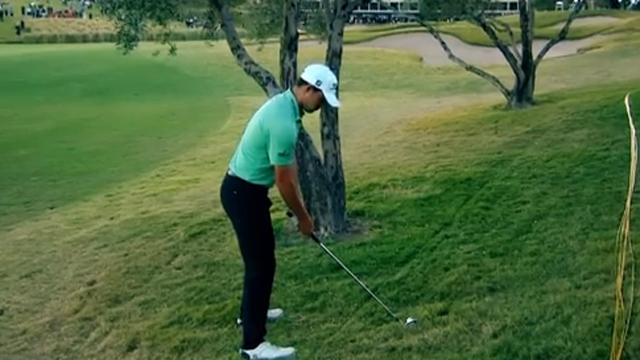
 

“The present”, “the next shot”, what’s important now”, etc, etc, etc, all apply no matter the situation.  I would challenge you to take that same mindset you have when you step up to the tee whereby you accept the opportunity to do the same for EVERY SHOT.  The workings of how you came to that next shot really don’t matter when you think about it.  The next shot is the next shot is the next shot no matter where it is.  Take it for the test and opportunity it is, learn from it and go meet the next scenario.  

I’ll end with this…..I played in an alumni golf tournament a couple of years ago back in my hometown.  Once the round was over, I sat with a gentleman who was my dad’s age who I knew well but hadn’t seen in a while.  He was one of the best players to ever play my hometown course having won more club championships than I could count but he was a very “stay close to home” guy.  I asked him why he didn’t play more courses and why he would choose to come out to the same course day after day, year after year.  His answer was great.  He said, “Shane, every time I come out here, no matter how many times I play this course, it’s a new game.”  

Think about that for a minute.  No matter where we hit from during a round or the situation that got us to that moment, there’s a reason why we play this game.  I think he summed it up perfectly.

Winter Training – Get Ahead of Your Buddies

It’s the off-season for golf. Your golf buddies are eating turkey and getting fat. I can’t think of a better time to get the edge on them. So get off the couch and let’s get practicing!

Students often ask how to improve their games in the off-season.And most of you who have participated in our instruction know that we strongly promote many types of practice away from the driving range – in your own home, even while you watch football.

We have quite a few options for working on your game in the winter. Here are some ideas:

1) always work on flexibility strength and fitness. Remember, you are an athlete if you play golf. Train like an athlete. See our “Flexibility and Exercise Video” for more information. Also “Improve your Move” Video is great for indoor training.
2) Practice positions in front of a mirror – all of the positions of the swing. You can learn the positions in “The Single Plane Solution” Video.
3) Find an indoor studio where you can hit balls into net. I suggest using video to look at your swing and compare to Moe and model the Single Plane Swing. Indoor – Net practice is great for making changes in the winter.
4) Practice your putting stroke on the grout lines in your kitchen.
5) Use the PVC Drill – found in our “SPS Drills = Making Feel Real” video. This teaches positions with the PVC.

Online Coaching

Finally, I can’t think of a better time to change you swing than in the winter. We can help. Become a member of our online coaching program – where you can send video of yourself practicing indoors to our coaches. They can review your practice and coach you to a better game – anytime and anywhere.  Give us a call at 866-377-2316 if interested.

Todd

Walking the Talk Here at Graves

By: Shane Matzen

Graves Golf Membership Liaison/Coach

If you’ve ever heard me speak or write before about my former career as a basketball coach, you heard me talk about the way we always tried to teach our players and teams about how to deal with success and failure.  That is, we always acknowledged that it’s good to celebrate our successes and feel down about our setbacks but that we always would only allow 24 hours for those emotions before we got back to work and tried to move things forward again.  One of the things I’ve enjoyed about my opportunity to work here at Graves is that the same attitude really exists here.

When I joined the Single Plane Academy as a member back in the summer of 2020, I was so excited about the possibilities of having professional coaches evaluate and make corrections with my swing via video.  And as someone who really eats up instruction, having the old SPA website was a godsend for me.  I tore through that material with every spare minute I could find.  Having said all that, I was satisfied and happy with everything that my membership was bringing me.  I was a little over a year in though when I realized that this company was not one to rest on their laurels.

Back around the end of 2021/early 2022, Graves Golf On-Demand came into existence.  As someone who has put together video collection and set up keywords myself, I quickly realized the amount of time and effort that was put in to make On-Demand a reality from an idea that our COO, Thomas Purvis, had in mind to advance member access to our vast array of teaching materials.  Something we take for granted now was a MAJOR step forward for the service our members got to take advantage of.

This past year of 2023 has been one of major advancements here at Graves.  From the rollout of our comprehensive, individualized coaching levels with VIP and Elite in January to the incredibly ingenious tool created by Todd and Tim that we have available that’s made the game easier with the Lock-N-Roll Putter to the new travel options that became reality with the inaugural Single Plane Showdown in Las Vegas to the detailed new Fast Forward Winter Training Program and now as we end the year with Todd’s rollout of the Single Plane 4D System which everyone has quickly realized is revolutionary in how golf can be taught and learned.  And to wrap all of that up, don’t forget the amazing Graves Golf Performance Center which is moving from a dream of Tim and Todd’s to being constructed as I type.  

2023 Las Vegas Single Plane Showdown Scramble , Wildhorse Golf Club,  Henderson, November 1 to November 3 | AllEvents.in

From a personal story standpoint, I’ll relate this to you….we had a really great year at Graves in 2023 in no small part from what you read about above.  But as a member of our staff, I’m really pleased to call out my cohorts as there was a lot of hard work put in this year to advance our company and business.  I recall vividly that we had a couple of months where we’d just made some really amazing progress within the company and how we judge our efforts.  Everyone was very excited obviously but I hearkened back to my coaching days when, after acknowledging some of our accomplishments, it was decided rather quickly to focus on “how can we make next month a bigger month for the company and what ideas can we bring to our members to make their experience an even better one?”  

In my mind, and I now go back to the title of this article, that’s why Graves Golf is truly a “10% organization”.  We don’t exist, we grow.  We don’t provide services to our customers and members; we help them advance.  And I hope you, as someone who has a relationship with us, feel this in every dealing that you have with us however minor or large. 


I’ll summarize with this:  I’m at a stage in my life where I could drift off into retirement after the 32 years I gave my heart and soul to my previous career.  But I’m sure I’m like most of you who have retired from a career and a chapter in your life, I want to keep living and see what other challenges are out there.  Graves is a good place for this whether you’re an old retired basketball coach like me who has more to give or you’re a golfer who hasn’t given up on the game and the possibilities of getting better and having even MORE fun with it. 


2023 was great and I’ll even allow myself to celebrate this as there are a few more days left on the calendar as I pen this article but 2024 is on our doorstep.  Let’s make it even better.


Give Yourself the Best Chance

By Tim Graves, PGA

Hello Everyone, I thought I’d write a little about wedges, spin and the importance of having a good wedge game.

I know it’s the off-season or winter season for many, and most probably aren’t thinking about their wedge game this time of year, but with all the recent “rules” about the golf ball, limiting golf ball distance, spin with the golf balls, etc.. and all the questions/talk we continue to get about wedges and the wedge game – thought I’d give a little information to help everyone.

First – as most of you have read from me before – the wedge game is a CRITICAL part of the golf game. When I am talking about wedges, I am basically talking about anything inside 100 yards for most.  (For some will be a little further, for some a little shorter). This is a part/large part of the “scoring” part of the game.

Second – Again – as most of you have heard me say before – no one should have an advantage over you in this part of the game. Meaning – it is not a strength issue, but rather a practice/technique, etc… issue. In other words, you can have a GREAT wedge game as long as you work on it properly and have the proper equipment to give you the best chance.

Third – You need to make sure your equipment allows you to maximize your wedge game. As I have come to find out, it seems a majority of golfers don’t understand wedges, how they can work for them and how to use them…

So, let’s talk about wedges and hopefully working with your equipment can help improve your game, or at least, give you the best chance to score your best.

  1. I believe you should carry the maximum amount of wedges “your bag” will let you carry. Meaning – as you can only carry 14 clubs – I would recommend carrying at least 3 wedges (including your pitching wedge). If possible, carry 4. (Pitching, Gap, Sand and Lob). Reason – the more wedges you carry the better your yardages will be between the wedges.  In other words, you will less gap in yardages between the wedges the more you carry. –
  2. Different wedges are made to use for different shots. Let’s talk about the sand wedge first (typically 54 to 56 degrees).
    Most sand wedges have at least 10 degrees of bounce or more. The Bounce is the angle on the sole from the back of the club to the front. Every club in your bag has a little bounce, the sand wedge has increased bounce (typically 2 to 3 times as much) to help you keep the club from digging in the sand (soft surface) too much. Meaning, it is a very good bunker/sand or medium to high grass club, but not so good at hitting short shots from “tight” (minimal grass) or hard lies. The added bounce on the club will make the club skip/bounce on hard ground and will cause blade/thin type shots. Most see this when hitting chips/or shot shots off of tight lies. It is not recommending to chip or pitch with a sand wedge from tight/hard lies. –
  3. The lob wedge (typically 58* +) is a great wedge for high pitch/lob type shots.  Reason – appropriate bounce and grind, added loft and typically a little “wider” sole. Most lob wedges have a slightly wider sole which will help the lob wedge slide across the ground and get more weight on the ball to help get the ball up fast. –
  4. It is recommending to have steel shafts in your wedges (gap, sand and lob).  Reason – you want the added weight in the clubs. These clubs are the shortest clubs in the bag (besides putter) and are often hit with 1/2 shots, out of rough, out of sand, etc. etc…  The added weight is a big advantage when hitting the clubs in these situations.  Makes it easier to hit out of rough, sand, etc. Don’t have to swing so hard, club head will get through grass, sand much easier with added weight. Graphite is a great material to protect the body when the club is being swung fast and allows you to hit the club further. No needed with the wedges – wedges are “control” type clubs – the added weight in steel is STRONGLY recommended in the wedges.

Last – let’s talk about spin. We all want to create spin on our wedges. Without spin, it is very difficult to get the ball close to the hole. Most won’t be able to create spin to stop the ball completely, but everyone can and should create spin to slow the ball down which helps get it close to the hole.

The primary variables of spin are angle of attack/speed, club type, and ball type. The more speed, the more spin you can create.  The softer (or more layers) the golf ball, the more spin you will create. Finally, the softer the metal of the club, the more spin you will/can create.

Another important variable and the one that is changing is the grooves on the wedges. The current groove (pre 2010) can create more spin then the one’s the USGA are requiring in the upcoming years.  (2014 for USGA amateur events, 2024 (this upcoming year) for everyone). All wedges sold now (we sell) (and in past few years) are conforming to the current / new USGA rules.

To make a “long story short” it is recommending everyone carry wedges that give them their best advantage in their scoring part of the game.

The recommended wedges are those that are a “forged” (soft metal) type, steel shafted (sand and lob wedges) and are fit to you perfect for length, lie angle, shaft flex and weight, grip size with our specialized grips, and set make up.

If you have any additional questions about the wedges, wedge set make up, your fittings … please don’t hesitate to give us a call or email anytime.

If you would like to order new/additional wedges give us a call. All wedges need to be custom built to the golfer’s specifications – absolutely critical to have a proper fit.

Remember – Always Practice with a Purpose.

Also, Remember – A little improvement every time you practice adds up to a lot of improvement over time.

The Grand Illusion

By, Paul Monahan, Graves Golf Mental Game Coach

Famous author C.S. Lewis wrote an article in 1948 about how to cope successfully in an “Atomic age.” It was only a few years since the emergence of the first atomic bombs –  the entire world was nearly paralyzed with fear over what the future would be like – and whether the human race could survive.

Lewis’ message in his article was meant to help people to gain a little CONTEXT in the midst of a fearful time so that they could live more satisfying lives. He had noticed that the anxiety people were experiencing was debilitating. And so, he urged the reader to think in more objective ways (and ultimately more productive ways) about risk and mortality.

He pointed out that there were lots of risks that people had accepted in their lives – driving in automobiles, living in cites with high crime, coping with sickness and diseases…etc.  – and these did not paralyze them. They went on living.

He reminded people that they likely did not have control over whether or not they died in an atomic bomb blast…so why worry about it?

He asked: “Why should living in the atomic age be any different than what they had already been experiencing? Why not just live your life the way you wanted to in the first place?” He implored the reader to: play with your kids, engage in your work and your passions, enjoy your family, and focus on the things you can control. This is what Lewis said would allow you to live life to the fullest.

Easier said than done sometimes. (Like in pandemics, maybe?) But it makes complete rational sense – does it not?

In my experience spending time with performance experts from all over the world and in multiple domains – US Navy Seals, Corporate CEOs, Major League Baseball teams, the NHL, the NBA, Aussie Rules Football, New Zealand Rugby League, Big Wave Surfing, Country Music and even Electronic Gaming just to name a few –  I have learned that one of keys to performing at your best in any moment lies in your ability to contextualize.

If you can put your challenges into proper perspective as you move through the day today – engaged in your work, interacting with your spouse, practicing your single plane swing, or playing a round of golf – you will have a much better chance of staying connected to your potential and performing at your best.

Yes. It actually is that simple.

What does contextualizing look like on the golf course?

Instead of berating yourself for the wayward drive off the number one tee box, you accept that miss-hits will happen for you – especially on the first hole. Instead of getting mad about your ball hitting the cart path and bouncing out-of-bounds, you laugh at the unpredictability and variability inherent in the game. And instead of steaming over a missed five-footer, you accept that you may have not yet mastered a successful putting formula from that distance.

But why do we struggle mentally and emotionally on the golf course anyway?

Because we want to WIN. (Or because we just don’t want to LOSE. Same coin, different side.)

I know many who would say – “I play golf for fun. I don’t need to win.” I get that… But let me tell you: you ARE playing to win… or to NOT lose. You just label it differently. Winning for you is mastering the bunker shot. It’s launching a 4 hybrid to 8 feet on that long par 4. It’s sinking a 30 foot double-breaker. It’s driving past your friends in the center of the fairway.  And losing is hitting it out of bounds off the tee box three holes in a row. Losing is three-putting six greens. Losing is hitting a bucket of balls and not hitting ONE ball pure.)

Struggle is technically biological – it shows up when we think we won’t get what we want. (“If I miss this putt, I will lose the momentum going into the last hole…and lose the match!”)  Then our survival brain kicks in and the wheels come off of our game. (Amirite?)

So, how’s this for some contextualizing the next time you are in struggle…and stuck on winning/not losing:

There is no such thing as winning or losing.  They are illusions. Constructs of our imagination… brought to life through language.

Winning and Losing is what I call The Grand Illusion.

That’s right. And here’s the good news – you never have to worry about winning or losing ever again. Instead, just go play the game the best way you know how today …and accept (even embrace) what happens. Chances are that you will stay much more aware, present and playful …and shoot a lower score because of it.

Think of your golf experiences as just one more step on your journey to single plane swing mastery…without the baggage and meaning of terms like winning and losing. How much calmer mentally and emotionally would that make you?

“But wait, Paul,” you say. “You mean to tell me I should stop thinking about winning? Are you crazy? How am I ever going to win anything with that strategy!!??”

In the world of elite performance, there is AWARENESS of winning and losing, for sure. But the best performers can continually and quickly put all their challenges or disappointments into context. And while inside of their performances they can separate their identity from the concept of winning or losing. Why…because they know that they cannot completely control whether they win or lose.

(One possible exception in golf was Tiger Woods. In the first fifteen years he played on the PGA tour, Tiger Wood’s skills were so far above his peers, that he actually got away with focusing on winning in nearly every moment. He was known to be singularly focused on winning …and he talked about it all the time. But he got away with that because his skills were so much better than his competitors. Read The Big Miss by Hank Haney for more insight into Tiger’s mental game during the 2000’s )

 In the past ten years, as his skills have waned, you may have noticed Tiger talking a lot more about the journey – and contextualizing more often. Which is a good thing for him – it keeps him in the game. Otherwise, he would self-destruct due to the struggle that comes from not getting what he wants. These days I believe that Tiger is playing a mental game that more closely matches the rest of the PGA Tour field than at any time in his career. Just a guess…I could be wrong.)

So what is left? Show up and do your best in that moment. Focus on what you can control.

When I played in my club championship earlier this year, I drew a much better player from my flight in the first round. On paper, advancing past this player was a long shot, so I set aside my attachment to winning and focused on what I could control – like how I showed up mentally and emotionally. And how I reacted to what was happening in front of me.

(Yes, for those that have worked with me and heard me talk about this – I DID pour out LOTS of love and positive intentions toward my competitor that day!)

The result: I played 4 strokes better than my handicap, and was tied thru 17 when my opponent pulled off an amazing shot to win on the 18th hole. Losing was not what I wished for. But I was proud that I realized my full potential that day because of how I showed up. And I am a better player today because of what I experienced: focusing on the things I can control – and letting go of the things I cannot.

High performers understand that the thing they want is more likely to show up when they loosen their mental and emotional grip on it. When they “want it a little less.” (Sounds counter-intuitive – I know.)

Moe Norman was very intentional about achieving this level of calm, often saying that his goal was to play with an “alert attitude of indifference.” (At Graves Golf Academy, we conduct an entire two-day playing school based upon this concept!)

As you start a new year – full of promise and potential – I want to encourage you to keep in mind that success in golf and in life comes – in part – from being great at contextualizing…from putting your challenges and setbacks (and achievements) into proper perspective.

And keep in mind that winning and losing is an illusion that you need not fall prey to!

-Paul

The Man With The Perfect Swing – Reader’s Digest Article – December 1999

Reprint

By: Bruce Selcraig

“His game was close to genius, but could he find acceptance”

On a warm morning at a country club near Orlando, a stocky gentleman with wispy gray hair makes his way past the crowd gathered for today’s exhibition. To those who don’t know better, the impish old fellow could be just another sunburned senior dreaming of bogey golf.

He wears a black turtleneck despite the heat. The left pocket of his neon-lime slacks bulges, as always, with two golf balls – never more, never fewer. All three watches on his left wrist are set to the same time.

Taking his position at the tee, he quickly lofts a few short wedge shots about 70 yards. At first, the spectators seem unimpressed. Then they notice that the balls are landing on top of one another. “Every shot same as the last,” chirps the golfer, as if to himself, “Same as the last.”

Moving to a longer club, a seven iron, he smoothly launches two dozen balls, which soar 150 yards and come to rest so close to each other you could cover them with a bedspread. He then pulls out his driver and sends a hail of balls 250 yards away – all clustered on a patch of grass the size of a two-car garage. Astonished laughter erupts from the crowd. “Perfectly straight,” says the golfer in a singsong voice. “There is goes. Perfectly straight.”

Those who have followed Moe Norman’s career are no longer surprised by his uncanny displays of accuracy. Many professionals and avid players consider the 70-year-old Canadian a near-mythical figure. But few outside the sport have ever heard his name. Fewer still know the story of his struggle to find acceptance in the only world he understands.

One cold January morning in 1935, five-year-old Murray Norman was sledding double with a friend on an ice-packed hillside near his home in Kitchner, Ontario. Speeding downhill, the sled hurtled into the street and skidded under a passing car.

Both boys survived and ran home crying. But the car’s right rear tire had rolled over Moe’s head, pushing up the cheekbone on one side of his face. His parents, unable to afford medical care, could only pray he did not suffer serious brain damage.

As Moe grew older he developed odd behavioral quirks and a repetition, staccato speech pattern. His older brother Ron noticed that Moe seemed unusually frightened of unfamiliar situations. At night, Ron often heard his little brother sobbing in bed, devastated by some real or imagined slight.

At school Moe felt glaringly out of place among other kids. Desperate for friends and acceptance, he tried to be playful, but his efforts often backfired-pinching people too hard or bear-hugging them until they pushed him away. He heaped ridicule on himself and even coined his own nickname: Moe the Schmoe. He became known as a slow student in every subject-except one. At math no one could touch Moe Norman. He astounded his classmates by memorizing complicated problems and multiplying two-digit numbers in his head almost instantly.

When he wasn’t acting the clown, Moe walled himself off from others. Over time he plunged deeper into isolation, and yet, ironically, it was loneliness that led him to his greatest happiness.

In the years following his accident, Moe spent hours atop the same winter sledding hill, hacking around an old golf ball with a rusty wood-shafted five iron he found at home. Here in the solitary and magical world of golf, he found a reason to wake up each morning.

Kitchner, Ontario, in the 1940’s was a gritty factory town where working-class teenagers had little desire or money to play the “sissy”, upper -class game of golf. Moe was spellbound, often skipping meals, school and chores to head off by himself in a field to hit balls-500 or more a day. He practiced until dark, sometimes until the blood from his hands made the club too slippery to hold.

In his early teens, Moe got a job as a caddie at a country club only to be fired when he hurled the clubs of a low-tipping local mogul into some trees. Soon he gave up caddying to concentrate on playing, honing his skills at a nearby public golf course. He quit school in tenth grade, and by the time he was 19, he knew he was blessed with a rare talent: he could hit a golf ball wherever he wanted it to go.

Moe left home in his early 20s, hitching rides to compete in amateur golf tournaments all over Canada, supporting himself with a succession of low-paying jobs. At his first few tournaments in the late 1940s, fans didn’t know what to make of the odd little fellow with the garish, mismatched outfits, strawlike red hair and crooked teeth.

He manner was playful, almost childlike, his self-taught technique wildly unorthodox. Legs spread wide, he stood over the ball like a slugger at the plate, clutching the club not with his fingers, as most golfers are taught to do, but tightly in his palms, wrists cocked, as if he were holding a sledgehammer. Many spectators dismissed him as an amusing sideshow. Some giggled when he stepped up to the tee. Soon though, Moe Norman was turning heads for reasons other than his personal style.

Recognized as a gifted player who could hit a golf ball with breath-taking precision, he quickly became a sensation on the amateur golf circuit. In one year alone he shot 61 four times, set nine-course records and won 17 out of 26 tournaments.

Even as his fame grew, Moe remained painfully shy and could not shake the sense that he was undeserving of the attention. Rather than bask in the spotlight, he avoided it. In 1955, after winning the Canadian Amateur Open in Calgary, Moe failed to show for the awards ceremony. Friends later found him by the nearby Elbow River, cooling his feet.

The victory qualified Moe for one of golf’s most prestigious events: the Masters. When he got the invitation to the tournament, he was only 26 and spending his winters setting pins in a Kitchner bowling alley. This was his chance not only to represent his country but to show skeptics he wasn’t just some freak on a run of beginner’s luck.

But his old demons would give him no rest. Moe felt like an intruder among some of golf’s brightest lights. He played miserably in the first round and even worse on day two. So he fled to a nearby driving range to practice.

While hitting balls, Moe noticed someone behind him. “Mind if I give you a little tip?” asked Sam Snead. The Hall of Famer merely suggested a slight change in his long-iron stroke. But for Moe it was like Moses bringing an 11th commandment down from the mountaintop.

Determined to put Snead’s advice to good use, Moe stayed on the range until dark, hitting balls by the hundreds. The next day, unable to hold a club, he withdrew from the Masters, humiliated.

But Moe climbed right back up the ladder to win the Canadian Amateur again a year later. A string of victories followed. In time, he had won so many tournaments and collected so many televisions, wristwatches and other prizes that he began selling off those he didn’t want.

When the Royal Canadian Golf Association charged him with accepting donations for travel expenses, which was against regulations for amateurs, Moe decided to turn professional. His first move as a pro was to enter, and win, the Ontario Open.

As a newcomer to professional golf, Moe approached the game with the same impish lightheartedness of his amateur years. When people laughed, he played along by acting the clown. An extremely fast player, he’s set up and make his shot in about three seconds, then sometimes stretch out on the fairway and pretend to doze until the other players caught up.

Fans loved the show, but some of his fellow competitors of the U.S. PGA Tour did not. As the Los Angeles Open in 1959, a small group of players cornered Moe in the locker room. Stop goofing off, they told him, demanding that he improve his technique as well as his wardrobe.

Friends say a shadow fell across Moe that day. Some believe the episode shattered his self-confidence and persuaded him to back out of the American tour, never to return. More than anything, Moe had wanted to be accepted by the players he so admired. But he was unlike the others, and he was being punished for it.

The laughter suddenly seemed barbed and personal. No longer could he shrug it off when some jerk in the galleries mimicked his high-pitched voice or hitched up his waistline to mock Moe’s too-short trousers.

Because Moe never dueled the likes of Americans Jack Nicklaus or Arnold Palmer, he achieved little recognition beyond Canada. At home, though, his success was staggering. On the Canadian PGA Tour and in smaller events in Florida, Moe won 54 tournaments and set 33-course records. While most world- class golfers count their lifetime holes-in-one on a few fingers, Moe has scored at least 17.

Despite his fame and the passing years, Moe was continually buffeted by the mood swings that tormented him in childhood. Even among friends, he could be curt, sometimes embarrassingly rude.

At other times he was charming, lovable Moe, bear hugging friends and tossing golf balls to children like candy-the happy-go-lucky clown from his amateur days.

Through the 1960’s and ’70s Moe racked up one tournament victory after another. But in the early 1980’s his enthusiasm for competition began to wane. His winnings dwindled, and he slipped into depression. Not being wealthy, he seemed to care very little for money, lending thousands to aspiring golfers and never bothering to collect.

Broke and all by forgotten, he drifted from shabby apartments and boardinghouses to cut-rate roadside motels, often sleeping in his car. Had it not been for the generosity of friends-and a stroke of good luck- he might have faded entirely into obscurity.

Moe has never had a telephone, a credit card or owned a house. Few people know where he might be living on any given day, and he seldom talks to strangers. Little wonder it took Jack Kuykendall two years to track him down.

Kuykendall, founder of a company called Natural Golf Corp., finally caught up with him in Titusville, Fla. He told Moe that, trained in physics, he had worked for years to develop the perfect golf swing-only to discover that an old-timer from Canada had been using the same technique for 40 years. He had to meet this man.

Moe agreed to demonstrate his swing at clinics sponsored by Natural Golf Corp. Word spread quickly through the golfing grapevine, and before long, sports magazines were trumpeting the mysterious genius with the killer swing.

Among those following Moe’s story was Wally Uihlein, president of the golf-ball company Titleist and Foot-Joy Worldwide. Hoping to preserve one of golf’s treasures, Uihlein announced in 1995 that his company was awarding Norman $5000 a month for the rest of his life. Stunned, Moe asked what he had to do to earn the money, “Nothing,” said Uihlein. “You’ve already done it.”

Two weeks later, Moe Norman was elected to the Canadian Golf Hall of Fame. Even today, however, he remains largely unknown outside his native country except among true disciples of the game. For them, Moe is golf’s greatest unsung hero, the enigmatic loner once described by golfer “Lee Trevino as “the best ball-striker I ever saw come down the pike.” Many agree with Jack Kuykendall-had someone given Moe a hand 40 years ago, “we would know his name like we know Babe Ruth’s.”

In a parking lot of a Florida Country Club, Moe Norman is leaning into his grey Cadillac, fumbling through a pile of motivational tapes. He seems nervous and rushed, but as he slides behind the wheel, he pauses to reflect on his life, his family and his obsession.

Moe never had a real mentor or a trusted adviser. “Today’s kids,” he says, “are driven right up to the country club. Nice golf shoes, twenty-dollar gloves, nice pants. “Have a nice day, son.” I cry when I hear that. Oooh, if I’d ever heard that when I was growing up…”

He squints into the sun and cocks his head. “Everyone wanted me to be happy their way,” he says. “But I did it my way. Now, every night I sit in the corner of my room in the dark before I go to bed and say, “My life belongs to me. My life belongs to me.”

With that, he shuts the door and rolls down the window just a crack. Asked where he’s going, Moe brightens instantly, and a look of delight spreads across his face.

“Gone to hit balls,” he says, pulling away. “Hit balls.” It is and forever will be, the highlight of his day.

Reprinted from the December 1999 Issue of Reader’s Digest @ 1999 the Reader’s Digest Association, Inc., Pleasantville, N.Y. 10570 Printed in U.S.A.

LEARN

THE

SWING

Join 1M+ Subscribers to get your FREE Video Quick Start Guide that reveals how to hit the ball farther and straighter more consistently from now on…

START YOUR NEW GOLF SWING