Lock – n – Roll and 2 Birds – Great Observation!!

Lock – n – Roll and 2 Birds – Great Observation!!

By Tim Graves, PGA

Got a great email from one of our alumnus. Wanted to share with everyone.

From: Brett M. <*****>
Date: Sat, Oct 14, 2023
Subject: L&R Putter is Amazing (with a Full Swing instructional question)
To: Tim Graves <timg@gravesgolf.com>

Hey Tim,

Thought I would send a quick note with a question.

The Note:  The L&R is amazing.  Got it Wednesday evening, putting it together was a snap.  Going wrist lock for now.  Love the grip.  Took about 5 minutes to get used to the putter.  I just applied your putting method to the putter and it feels like I have putted this way all my life except significantly better.   It is everything I have been using in my putting stroke for years, except now I don’t have the breakdowns that would occur with my beautiful but traditional putter. 

Took it to the practice green on Thursday.  Worked on lag putting since some said they had challenges with this, but I found my lag puts to be much better because my hands and wrists are not variables any more, it is simply a shoulder turn from the focal point at my neck, as you have taught, and my lag putting is massively more consistent.  No more nervous little flick of the wrist for erratic distance.  And STRAIGHT!  It is very, very difficult to hit a put that is not amazingly straight.  I have never hit such significantly straight putts over and over and over with no real effort.  

I love the method you have taught about how to step into the putt.  It literally gives me a beautiful consistent pre-putt routine.  After reading the green, I line the ball up, take two practice strokes from behind the ball, step into the putt as you have taught and make the stroke.  No nervousness, no questions, just commitment and feel. 

Took it on the course yesterday (Friday).  Here comes the best part of the putting story (but perhaps there is  even more in the upcoming question).  I have never been a great green reader.  Our greens are notoriously treacherous.  It is always difficult to determine if I misread the putt or mishit the putt.  Now there is no doubt.  I know I am hitting my line on every putt, so guess what is occurring.  I am starting to be able to read the greens without the doubt.  If I miss a putt it is because I judged too much or too little break, because I know I hit the putt on my line.  To me this is the piece de resistance because my green reading is getting accurate feedback on every putt.  Not only is this putter amazingly easy to hit perfectly straight, it also produces consistent speed control, provides a beautiful pre-putt routine and gives amazing instruction via feedback on green reading. 

P.S. I had no issues with the Silver weight (screws fit precisely).  No issue with the head cover, but I understand the concern.  I just broke the cover in well and pay attention with it.  Now the question and perhaps the best part of the L&R putter.

The Question:  You have stressed with all of us, including me, that getting the feel for hands leading while putting will help our full swing.  I have been playing quite well (for me) because of the benefits created from doing the Elite 8 assessments as well as a disciplined practice regime.  However my full swing is unfortunately always a work in progress with a general feeling that I am misunderstanding a key element that is holding me back. 

Using the L&R putter has given me a feeling of hands leading that is unmistakable.  It is different than with my conventional putter, because (I believe) of my misunderstanding of the concept and my misapplication of the technique.  I never quite got the concept or feeling of hands leading like I do with the L&R.  Because of the L&R putter this feeling is consistent time and time and time again. 

I have been practicing my full swing trying to create and maintain this “L&R hands leading feeling” into my full swing.  It has produced some very good results.  It has required some slight modifications to my sequence and rotations, but to me this new movement matches what has been taught about the full swing model and it is producing some excellent results.  Primarily fixing my out to in swing path.    

So my question is:  Am I correct that this hands leading feeling with the putter is what I should be feeling with my full swing into impact and up to the release?  If it is then the L&R putter is not only the greatest putter created, it is also the greatest training aid ever created (at least for me).  Talk about two birds with one stone!

ANSWER – YES BRETT, THE HANDS LEADING FEELING WITH THE LOCK – N – ROLL PUTTER IS THE FEELING YOU SHOULD HAVE WITH YOUR FULL SWING INTO IMPACT AND UP TO RELEASE. THE SHAFT LEAN OF THE LOCK – N – ROLL PUTTER GIVES YOU THAT FEELING, THE ANGLE OF THE TRAIL WRIST THROUGH THE PUTT WITH SHAFT LEAN GIVES YOU THAT FEELING AND THE STRAIGHT LINE FORMED WITH THE LEAD ARM (FOREARM) WITH THE LOCK -N – ROLL PUTTER THROUGH IMPACT WILL GIVE YOU THAT FEELING.

Let me know if I am off track on this thought.  I don’t need to be going down another rabbit hole, but it seems to align with what I am hearing from your teaching.  If it is correct then I feel like I have finally found the missing piece for me.

YOU ARE DEFINITELY ON THE RIGHT TRACK. GREAT OBSERVATION!!!

And if this is correct then the L&R putter is worth its weight in gold for multiple reasons. 

Thanks,

Brett M.
Rate Your Scoring / Putting Game

RATE YOUR SCORING / PUTTING GAME

By Tim Graves, PGA
Graves Golf Co-Owner

How important do you think putting is to your scoring?

How many of you think you are a good putter, but don’t score as well as you want?

How many of you know how to Rate Your Putting Game?

Fact #1:  Over 40% of scoring occurs with the putter in your hand (up to 50% for higher handicap golfers).

Fact #2:  The quickest way to reduce your scoring / handicap is to improve your putting.

Fact #3:  Most don’t know how to improve their putting… it is more than just going to a green and hitting a few putts… 

To determine where you can improve your putting, rate your putting game below:

There are 10 areas of your putting that are critical to having a good / great putting game – each is to be rated on a scale of 0 to 3.

Keep a running count and finally a total of the 10 areas.

EQUIPMENT:

1. Is your putter fit to you for length, lie angle, grip size and weighting?

0 – No, or I don’t know

1 –  Partially fit (maybe grip size, not lie angle, etc..)

2 – All but one area fit – ie. length and grip size, lie angle, but not weighting, etc.. 

3 – My putter was fit perfect for me and can be adjusted as needed (change weighting, adjust lie angle, etc..)

2. Do you practice and play with one type / brand of golf ball?

0 – I play and practice with different golf balls – no one in particular.

1 –  I play with one type of golf ball, but practice with different.  

2 – Most of the time I practice putt with same ball I play with.

3 – I always practice putt with the same golf ball I play with – Always.

3. Does  your putter and golf ball have an alignment system / aid and you use when you putt.

0 – No, I don’t have or don’t use alignments aids on either golf ball or putter.

1 – Yes, one does, one does not (or don’t use). 

2 – Yes, both have alignment aids, but I don’t use all the time.  (Practice and Play)

3 – Yes, and I use both when I practice and play.  

4 – (Extra point) – The alignment aid on my putter MATCHES alignment aid on golf ball.

FUNDAMENTALS:

4. Do you understand how your putting fundamentals (3 Hs of Putting) (Hands leading, hands down the line, hip check) are directly related to your chipping / pitching and your full swing fundamentals?

0 – I have no idea how they are related?

1 – I have heard they are related, but have not studied how they are related.

2 – I know they are related and have watched the “2 Birds with One Stone” instructional information once. 

3 – I know they are related, watch the “2 Birds with One Stone” instructional material routinely and use Graves Golf On Demand to study additional information on the different fundamentals and their relationships. 

5. Is the golf ball position at set up under your eye line and forward of center?

0 – Don’t know or have never checked

1 – I think so, but have no way to check with current system.

2 – Yes, but ball position can change under pressure or over time without consistent practice.

3 – Yes, it is guaranteed under my eye line and forward of center as my putter is set up to get me in the perfect / ideal position every time. 

6. Do you have shaft lean in the putter at set up, at impact and through the stroke?

0 – Don’t know or have never checked

1 – I think so, but have no way to check and / or will break down at impact, through stroke, etc..

2 – Yes, but it will break down when under pressure.

3 – Yes, it is guaranteed as my putter build guarantees shaft flex at set up, impact and through stroke. 

6. Do you accelerate through the putting stroke?


0 – Don’t know or have never checked


1 – I think so, but have no way to check and / or will break down at different times.


2 – Yes, but I still tend to miss too many difficult short putts (example down hill with break)..


3 – Yes, it is guaranteed as when I practice I use tools that show me I accelerate every time (Use Excalibur putting training aid). 

PRACTICE:

7. Do you practice putting at least 25% of your practice time?

0 – No, I do not.  I seldom practice my putting.

1 – At different times of they year, I will practice putting 25% of my practice time.

2 – Different times of year and when important rounds / tournaments are coming up I will practice putting at 25% of my practice time.

3 – Year round, I practice putting 25% of my practice time or more.

8. Do you use both Practice A (play type) and Practice B (fundamental type) putting sessions?

0 – I don’t know the difference between Practice A and B putting sessions.

1 – When I practice, I typically just work on speed of greens (neither A or B sessions).

2 – I typically will work on fundamentals when I practice (Practice B session) and will use training aids when I practice (Excalibur, String/Mirror, etc..)

3 – I have both Practice A Sessions (gamify and assessments) and / or Practice B sessions (Fundamental type practice) every time I practice.  I never practice putting without a purpose. 

9.  Are you able to adjust your putter / putting according to environment (conditions)? For example – Slow greens, bumpy greens, windy, etc..

0 – I putt the same and putter is set up same no matter what conditions.

1 – I make adjustments in my stroke / set up for different conditions.

2 – I make adjustments in my putter (add / subtract weight), add or shorten shaft length for different conditions. 

3 – I make adjustments in both my putter and stroke / set up for different conditions when needed. 

10.  Do you have a system / method to read break in greens and do you use that method / system when you play and practice?


0 – No, I do not have any system / method to read break in greens.  I just use what I see…


1 – I have a system / method I use when I play, but I seldom practice reading greens when my system / method.


2 – I have a system / method I use when I play and practice, but sometimes I forget to use the system / method.  


3 – I make a system / method I use when I play and practice and will put in time every time I practice (Practice Type A) enhancing and staying comfortable my system / method. 

11 (Bonus).  Do you have a pre-shot routine, in-shot, and post-shot routine you practice and use during play (Red, Green and Grey Zone) and do you keep stats on your putting?


0 – No, I don’t have or use a pre-shot, in-shot and post-shot routine and never keep putting stats.


1 – I sometimes use a pre-shot routine, but am not sure about in-shot or post-shot routine and sometimes keep stats. 


2 – I use a pre-shot routine every time, and sometimes a in-shot or post-shot routine and will keep putting stats when I play. 


3 – I use a pre-shot, in-shot and post-shot routine every time I play and typically keep stats when I play.

4 –  BONUS – I use a pre-shot, in-shot and post-shot routine every time I play AND I practice these routines often in my Practice A Sessions.  And I keep putting stats every time I play.

Before we break down each area and how we can improve – let’s go over our totals and potential:

0 to 9 points – Very little to no potential to have a good putting / scoring game. 

10 to 15 points – Some potential, but wouldn’t count on having a consistent scoring / putting game.  You might putt well one day and poor the next.  

16 to 20 points – Medium potential, will putt good some times, not good others and have some potential to putt better – need to focus on weak areas.  

21 to 25 points – Above Average potential – You are a good putter, but to be a great putter, need to focus on the few weak areas – especially if those have to do with fundamentals. 

26 points +: – Very high potential, unless one area (above) is low, you will putt good a majority of time.  

Let’s give a “short” review of each area above and if you scored low, how you can improve that area. 

EQUIPMENT:

1. Is your putter fit to you for length, lie angle, grip size and weighting?


Your putter must be fit to you perfect for length, lie angle, weight, grip size, etc..

If you have not been fit:  please fill out and submit:  https://gravesgolf.com/putter-fitting/


2. Do you practice and play with one type / brand of golf ball?


You need to practice and play with the same make / model of golf ball.  This creates, develops and enhances feel on the greens.


3. Does  your putter and golf ball have an alignment system / aid and you use when you putt.

Your putter and golf balls must have alignment aids on the top of the putter and on the ball you use during practice and play.  

Examples are the 3 lines (alignment aid) on the top of the Lock-n-Roll putter.  The Triple Track lines on the golf balls, etc..  

Click:  Lock-n-Roll Putter Information

FUNDAMENTALS:

4. Do you understand how your putting fundamentals (3 Hs of Putting) (Hands leading, hands down the line, hip check) are directly related to your chipping / pitching and your full swing fundamentals?


Study Graves Golf Two Birds with One Stone – review frequently.  

You can view on Graves Golf On Demand App 


5. Is the golf ball position at set up under your eye line and forward of center?


Study Graves Golf putting fundamentals and have a way to check those fundamentals when you practice (and play).

See:  Graves Golf On Demand Instruction

See:  Lock-n-Roll Putter Fundamentals

Or:  Click Here

6. Do you have shaft lean in the putter at set up, at impact and through the stroke?


You must have putter shaft lean at set up, at impact and through the stroke.  This allows for a square putter head with proper loft (not too much created during stroke) and will lead to consistent putting with square face through stroke. 

See:  Lock-n-Roll Putter Fundamentals

Or:  Click Here

6. Do you accelerate through the putting stroke?


You must accelerate over every putt and every putting stroke.  If you do not, you will not be a good / consistent putter and will miss many short putts (especially those with some break) that you should make consistently. 

Use the Excalibur Training Aid to practice and check your acceleration each and every time you practice.

See:  Excalibur Training Aid

PRACTICE:


7. Do you practice putting at least 25% of your practice time?


You must practice your putting at least 25% of the time you practice.  The more the better to become a good / great putter.  You can practice in and outside.  


8. Do you use both Practice A (play type) and Practice B (fundamental type) putting sessions?


Study the difference in Practice A putting sessions (practicing like you play) and Practice B (fundamental practice). 

See:  Graves Golf On Demand Instruction


9.  Are you able to adjust your putter / putting according to environment (conditions)? For example – Slow greens, bumpy greens, windy, etc..


You must be able to adjust your set up (stance width, ball position (forward, back, etc..)) and putter (weight, length) according to conditions you are playing in.  For example, winder conditions might require a wider stance and shorter (wrist lock vs. arm lock) putter.

10.  Do you have a system / method to read break in greens and do you use that method / system when you play and practice?


You must have a method to read greens that you use every time you play.  This system needs to be used each time you play and must practice this system when you are practicing your putting. 

11 (Bonus).  Do you have a pre-shot routine, in-shot, and post-shot routine you practice and use during play (Red, Green and Grey Zone) and do you keep stats on your putting?


If you don’t have a pre-shot, in-shot and post-shot routine, you need to develop a routine for each and practice these routines during practice.  You also need to keep putting statistics during your play to determine your strengths and weaknesses in your putting game (short putts vs. long putts vs. lag putts, etc..)

Summary –

You play with a putter that is fit to you perfect and the same (type) of golf balls when you play and practice.  This putter and golf ball have alignment systems that you use during play and practice.

You use and practice the Graves Golf core fundamentals of putting. Golf ball under the eye line and forward of center, maintaining shaft lean throughout the stroke with minimal body movement, acceleration through the stroke and a different grip (hold) of the putter to eliminate release (twisting) of the putter head.

When you practice, at least 25% of time is spent practicing putting, you know how to practice fundamentals and play (difference between type B and A practice), you have a way to adjust your fundamentals and putter for different conditions, and you have a method to read greens every time you play that you practice often.

Finally – You have a pre-shot, in-shot and post-shot routine you use every time you play that you practice often and you keep putting statistics to keep track of your putting now and in the future.  

Rating your Putting / Scoring Game, working on your weak areas and improving your points (score) will ultimately improve your potential for becoming a good to great putter and ultimately greatly improve your scoring.

What Makes a Good / Great Teacher

By: Tim Graves, PGA
(Replay from a couple of years ago…. “oldie by goodie”…)

Have you tried to teach yourself?

Have you tried to teach someone else golf – like your child, your wife, your husband?

Have you ever taken a lesson from a professional?

Have you ever attended a golf clinic/school/camp?

Golf Teacher’s Motto:

“If you’re going to teach golf, accept the responsibility of having an impact on people’s lives and work every day to be help your student obtain their goals.”

Last Year, I (Tim) was honored to be awarded the Professional Golfers Association (PGA) South Central Section’s Teacher of the Year.

Part of the selection process (which lead to the award) includes answering questions about my teaching philosophy, discussing what I have done in the past year and finally, what I consider a good teacher. This and reading a few recent blogs got me thinking….

What Makes a Good Teacher?

Whether teaching yourself, working with others, or being a student, what should you look for in a good teacher?

What does the Graves Golf Academy strive to attain with every one of our students?

Here is my “Top Ten” points I think everyone should look for in a good teacher.

1. There is a program for improvement, not just a single lesson. A single lesson is like putting a “bandage” on the swing/golf issue. It doesn’t “cure” the problem, only covers it up until it “falls off”. When working with a student, the teacher MUST teach the student how to “self-teach” or become their own best teacher. 99% of a golfers practice occurs by him/herself – to improve, the student must be able to “self-teach”.

2. Goals for improvement should be discussed along with a “realistic” time frame. Nothing in golf is an “overnight” fix – NOTHING!  Every golfer can improve – the pace of improvement depends on his/her practice time and quality of practice. Practice DOES NOT have to be “range time” – in fact, the most effective practice can be done inside, without hitting golf balls, etc…

3. There should be an equal emphasis on short game and long game. Never forget:  70% + of the scoring occurs in the short game.

4. The entire game of golf should be taught – NOT just the golf swing. Meaning, a good instructor will teach short game, long game, course management, mental game, rules of golf, club fitting, flexibility/fitness, etc…

5. Concepts should be explained, demonstrated and shown in an UNDERSTANDABLE manner in “bite-size” pieces. Too many look at the golf swing as an “elephant” ….  What is the saying…  “When eating an elephant take one bit at a time.” If the student understands WHY a change is needed, there is a much better chance the change will occur. In other words, a good teacher will explain WHY changes are being taught.

6. Information “overload” must be avoided.

7. The student should be given drills and or training aids that will turn new concepts into habits. It is impossible to break old habits, the key is to create new habits. Making the new habits “stronger” than the old habits. Drills and training aids will greatly enhanced learning these new habits.

8. The instructor should use VIDEO ANALYSIS as a feedback tool. Video is the BEST way to bridge the gap between perception and reality and fact and feel. If a picture is worth a 1,000 words, a video is worth a million????

9. The instructor must understand everyone “learns” a little different, and he/she should be able to teach the student in a way the student “learns” the best. Some learn by feel, some learn by what they see, some learn by what they hear, many learn by combinations of the three. A great instructor will quickly figure out how their student learns and will teach in that manner.

10. The instructor should have a “passion” for the game of golf and for the student’s improvement.

My recommendation for you, whether teaching yourself, working with others, or taking a lesson, is to follow these 10 points.

Use them as a guide, and you won’t go wrong.

This is our philosophy at the Graves Golf Academy which is set up to aid you in playing your BEST GOLF EVER!!!!

Responsibility Mindset

By Paul Monahan, GGA Mental Game Coach

By Paul Monahan –

Graves Golf Performance Mindset Coach.

Ted Ligety was among the favorites to win gold in the Giant Slalom this year at the Olympics in Pyeongchang. Having won gold in 2006 in Turin, and again in 2014 at the Sochi Games in 2014, along with world championship titles in 2011, 2013, and 2015, Ligety is known as the King of the Giant Slalom.

But in 2018, there would be no gold medal in Pyeongchang. After a slow first run, Ligety finished the event tied for 15th…far out of the medal standings and a very long way from a gold medal. And he didn’t perform well enough in his second run to move up in the standings.

I don’t think anyone would begrudge Ligety if he were to look for something or someone to blame. “I didn’t have the right equipment.” “The conditions were poor.” “The food in Pyeongchang was terrible.” “My coach didn’t prepare me right.”

But Ted Ligety didn’t say any of those things. In fact, I doubt he even though those things. Ligety only stepped up and took ownership of his results, saying:

“That first run was purely me not having the right approach and going hard enough and going straight and clean enough. That’s all on me. Nothing to blame but myself for that first run.”

And then he said this:

“The second run was a mini-step in the right direction, but not anywhere close to the giant leap I needed to do anything. I tried to step it up a little bit more but didn’t have the speed in the legs today. So, that’s how it goes sometimes.”

I love that. And here’s why:

Ted Ligety knows who was responsible for his results on the hill. It was him. And he was not about to pretend that others (or other things) were to blame just so that he could save face or so that his pain of loss would hurt a little less.

So he stayed true to himself and was honest about his reality.

The highest achievers …athletes, leaders and performers don’t blame others when things go wrong. They seem just to know intuitively that their achievement depends first and foremost upon their actions.

How can this help your golf game?

I believe that any successful endeavor must include a responsibility mindset: a mindset that never blames others or on other things. It is a mindset that is rooted in the belief that we control our destiny and that our thought processes, decisions, and actions are what drive our success or achievements.

We all know someone who blames everyone else (or everything but themselves) for the things that happen to them.

They might even use language like: “He was talking about my backswing…that’s why I hit it in out of bounds.” “She didn’t pack my rain jacket, that’s why I lost the match.” “I missed the putt because these greens are terrible.”

Etc…etc…etc

While that person might believe that all these things are causational, the objective reality is much different.

If I were working with them as their coach, I would challenge their notion of cause and effect …and would help them to understand what was going on. I would point out to them:

You hit it out of bounds because you did not deliver the clubhead squarely to the ball.

You lost the match because your opponent scored more points than you.

You missed the putt because you misread the break.

Why is knowing this important?

Because the sooner you can see your reality more objectively, the sooner you can develop the skills that allow you to perform better. (Like, squaring the clubhead to the ball more regularly, scoring more points in your matches, and reading brakes more efficiently.)

I encourage my clients to learn how to tell the difference between what is TRUE for them versus what is THE TRUTH (objective reality.)

Once they get better at seeing the TRUTH, their mental and emotional dynamics change for the better, and they can work more productively toward their desired goals: more fairways hit, more greens run in regulation, fewer putts per round…etc.

Operating from blame is a trap it limits our potential at any moment.

Operating from objectivity…when we are not weighed down by judgment or our story is liberating.

Free yourself. Be responsible. Stop blaming. Period.

To see more about upcoming Graves Golf Mental Game / On Course Instruction: CLICK HERE

Paul Monahan, PCC , Graves Golf Mental Game Coach, s a Peak-Performance coach, member of the International Coach Federation and a certified COR.E Performance Dynamics Specialist. He resides in Cleveland, Ohio with his wife Paula and is the proud dad of three young men. He works with elite-level performers and leaders, helping them to expand their awareness so that they perform at their best more consistently.

Mental Game Skills MUST Be Cultivated

By Paul Monahan, Graves Golf Mental Game Coach

What are you doing to cultivate productive mental game skills in your golf game?

Coaches don’t really DO anything. If we are doing our job right, we engage with our clients about what they really want…and then help them to gain the insights and passion necessary to take meaningful action toward their goals.

But that action is up to them. The client. It’s not up to us. If the client doesn’t do anything with this information, nothing changes for them.

Last week’s story from Bob about winning his club’s opening  tournament is a great reminder that you must be intentional about applying mental game strategies and concepts.That you must have to have an on-purpose strategy and action plan to cultivate these skills…the same the way you build your short-game or putting skills.

In a phone conversation with him earlier this week, Bob told me that he hadn’t really given a lot of thought to building a mental game strategy. Though, he had spent a considerable amount of time working on Single Plane Swing mechanics the past two years – attending a number of schools, working with GGA coaches through video and other programs, and dedicating numerous hours on the driving range.

But that changed for Bob when he watched the webinar that Tim Graves and I did on the Alert Attitude of Indifference…and it piqued his interest. More than that, it inspired him to act. As a result, he committed to cultivating the key mental game concepts Tim and I talked about…and to making them a part of his playing strategy.

For example, he committed to playing faster. He modified his own pre-shot routine so that he could hit shots inside the “play box” within 5-7 seconds. This would prevent the kind of over-analysis and over-thinking that shows up when we hover over our shots too long. (He believes that he hit a lot more high-quality shots as a result!)

And he decided that, considering the course conditions (very wet) and that they were playing lift, clean and place, he would do whatever it took to be in the fairway. So while other players were bombing it into the rough, Bob played conservatively off the tee and hit lots of shots from the fairway that day. (His discipline to creating a strategy and sticking to it was key.)

He also tuned-in to and monitored is own energy dynamics during his round– and was able to stay positive on the occasions when things didn’t turn out perfect: when he hit it into the rough on the playoff hole, he took notice of the situation, reminded himself that he had the option to stay positive, hit a clean recovery shot into the fairway, and was on the green on the next shot. (His opponent was not able to stay calm and measured when encountering challenges on that hole – and it cost him the tournament.)

It will always be the case that practice and skill development are an important part this game we play. But being intentional about cultivating your mental game skills – how you show up, how you respond to the game as it comes at you –  is also a critical element of lowering your scores.

-Paul

(If you want to really learn how to cultivate productive mental game skills, join us at our three-day Alert Attitude of Indifference School in the near future.)

Single Plane + Mental Game = Wins

BY: Tim Graves, PGA

Hello Everyone –

Wanted to share a couple of golf stories from this past week.

First Story – I (Tim) had the opportunity to play in the 2023 National Senior PGA National Championship Qualifier last week.

Long story made short – after 36 holes of golf, I was tied for the qualifying spot. It came down to me and 2 other PGA professionals.

We went to the first playoff hole, a par 5, 560 yard dogleg right (uphill tee shot).

Myself and one other pro, hit pretty good drives down the fairway, the 3rd, hit it into the right trees (and was basically out of hole..).

I had 300 yards remaining to the hole and laid up to 60 yards out. The remaining professional had 250 yards to the hole (he hits it a LONG way) and hit his 2nd shot right of the green.

I went to my 60 yard shot to a very tough tucked pin behind a bunker with minimal green to work with and bunker behind the pin… About 25 total feet of green between front edge and back edge of green..

Here is point of story… I set up over my 3rd shot – obviously nervous – trip to the Senior PGA Professional National Championship on the line, and trying to calm down my heart rate and brain…

I realized I needed to find my “comfort zone” ASAP… I was exactly 60 yards to the pin and needed to fly the shot 55 yards (minimum) with spin. As I set up over the shot, I thought and repeated in my head, 60 yards, 60 yards, 60 yards, 60 yards…. (I’m a numbers guy and have practiced different yardage shots repeating the numbers in my head 1,000,000s of times…) I hit the pitch, it landed at 57 yards, skipped forward and stopped 1 inch short of the hole… Easy birdie (4). My opponent, could not get up and down from his position and playoff over after one hole….

Moral of story:

  1. Play to your strengths. I could have laid up to a 100 yard, 50 yard, etc.. shot. I wanted the 50 to 60 yard shot for spin.
  2. When over nervous shots, have something in your head (MENTAL GAME) to fall back on. Might be a word (easy, soft, relax, etc..) or might be a number (yardage as I used), or might be a something like a song you are singing in your head to relax you…. We STUDY and REVIEW this extensively in our Mental Game School (Alert Attitude of Indifference School) with Paul Monahan.

Second Story – Congrats to LeeAnn Fairlie

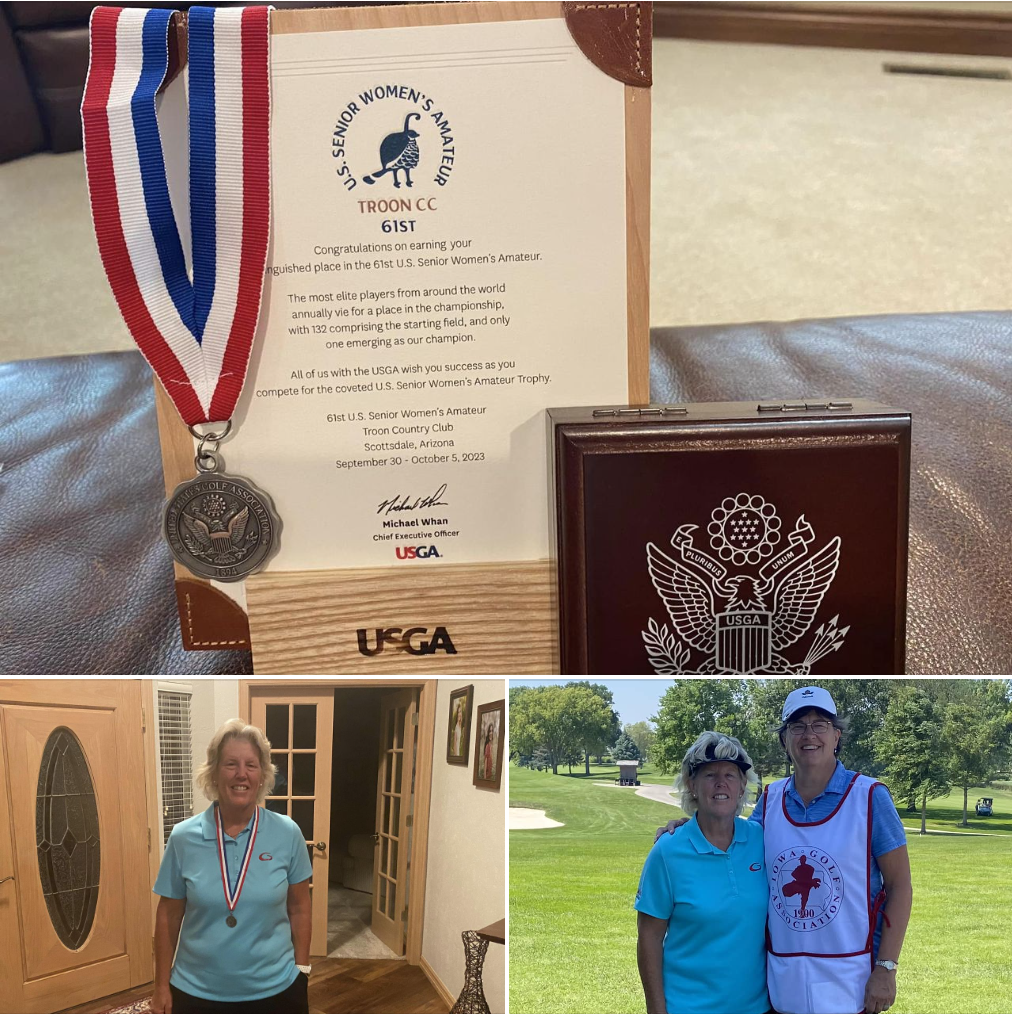
LeeAnn punched her ticket to the 61st USGA Senior Women’s Amateur last week!

Quote from LeeAnn: “Love Des Moines Country Club North course!! I Can’t wait to go to Troon Country Club at the end of September for the Championship! Thank you to my caddie Kristy for being so supportive, Paul Monahan for helping me with my mental game and Graves golf with my swing!”

Single Plane Swing + Mental Game = WINS!!!!

LEARN

THE

SWING

Join 1M+ Subscribers to get your FREE Video Quick Start Guide that reveals how to hit the ball farther and straighter more consistently from now on…

START YOUR NEW GOLF SWING