Advantage Me – Again

Advantage Me – Again

By Tim Graves, PGA

I wrote this practice tip a few years ago and thought it would be a good time to publish again.

This is one of those articles that is good to republish at least once a year…. especially at the start of golf season for most..

During the past couple of weeks, I have to admit I was putting in some “extra hours” to push my game to a level that hopefully could have competed with the big boys. One of my practice sessions was right after one of our school days. Typically, after a day of teaching I’m too tired to put in a good practice session, but due to the circumstances – possibly getting a call to get in the PGA Championship anytime – I put in the “after hours” practice.

During one of my post-school sessions, one of our students asked me if he could sit and watch my session. I never have a problem with anyone wanting to learn more, and gladly entertained the company.

During the middle of the practice session, it became very apparent I needed to write more about how I practice, as the student kept telling me, you need to teach this, show this. So guess what this e-tip is about? But I have put a little different take on it.

As I was talking to my student – I began to describe my “advantages” over the average golfer in my practice sessions. In other words, how I have set up my practice sessions to give me the “no excuse”, or “least amount of variables” type of practice. How do I set up my practice sessions with the least amount of doubt during the session?

So, as you haven’t seen me on my “soapbox” for a while; if you are new to our e-tips, you have never seen my “soapbox”, I thought it was about time, and I am writing this as an “advantage me” type situation. You’ll understand more as I get into detail, read on. This is my NO EXCUSE Attitude.

I have always made it a very specific point to give myself every advantage when I practice. I heard this for the first time in 1996 when I was playing in the U.S. Amateur against Tiger Woods. I remember an interview he was giving to ESPN on the range and he stated (paraphrasing) “When I (Tiger) practice, I set up a situation when no one has an advantage over me” – meaning, when Tiger practices he makes sure all the details are covered, there are a few variables as possible, etc… I’ll explain by describing my practice session I was holding with our student watching.

As I go through my practice session, think, and better yet write down how many of the points you do EVERY TIME, not some of the time, or most of the time, but EVERY TIME. Be honest with yourself – the more honest, the better.

STRETCH

First, before I start every practice session – I stretch. To be honest, probably not enough, but I put in at least 5 minutes of stretching. Making sure not to forget about my wrists and shoulder blades. I stretch with my training 6 iron in hand so when I hold the club to stretch I have the training grip in hand.

Note: If you begin your practice session tight – you will be hurting your swing – guaranteed – good luck getting into correct positions when you are tight.

I also “kill two birds with one stone” as stretching always involves a few “air swings” or golf swings without a golf ball. I want to make sure my grip is perfect, and with my training club, I don’t have to think about it – no brainer.

ADVANTAGE ME

So – if you don’t stretch before your practice session – ADVANTAGE ME. (Double Advantage me as I use a training grip club to help me stretch…)

Second – How many golf balls do you hit during practice. In other words, do you have a “limited” number of golf balls? I am going to eventually write an article for the PGA titled how “Country Club members have an advantage over the typical golfer”, not because of the course, but because of the unlimited range balls.

I’ll explain. After I stretch, I begin to hit my wedges. In fact, I hit a lot of wedges. Lob, sand, pitching, etc… I start with very short shots, maybe 30 to 40 years, and then work up to a full pitching wedge – I typically hit at least 20 to 30 balls minimum with my wedges to warm up my swing, start getting the club on plane with short easy swings is much easier than getting to the mid to long clubs too fast.

Here is the issue – with a limited number of golf balls, like a small range bucket, I promise you, you will be hitting drivers in just a few golf balls. You will not spend enough time on the wedges – which is where the warm-up should and must begin. Hit a lot of wedges.

If it is a cost issue for you, figure out a way to hit balls and shag them, find a pitching green to begin your practice, figure out something, give your wedges more time.

So – if you aren’t spending a good amount of time warming up your practice session with your wedges – ADVANTAGE ME.

Third – My clubs – this is an easy one – but one missed by so many golfers.

When I practice I have NO DOUBT my clubs fit me PERFECT!

Why is this important – because it gives me a no excuse for the club’s attitude. In other words, if I hit a ball left, it wasn’t due to the club (improper fit), if I hit it right (not due to the club), too high (not the club), etc… etc. I think you get the point.

Too many golfers have club issues – clubs that don’t fit their swing. They may swing at it perfectly, but as the club doesn’t fit their swing, the lie angle pulls the ball left or pushes the ball right (vice versa for lefties) and their mind tells them there is a swing issue – when it is really a club issue. So many aren’t able to release the club because their grip size is too big and don’t know it.

This causes SO MANY problems having grips that are too big. Thirdly, I have NO DOUBT about my clubs – the fit me for a lie, length, grip size, shaft flex, and the most important playability (for my ability) and a good feel for my game. So – if you clubs might not fit you or you’re are uncertain about your club fit – ADVANTAGE ME.

Fourth – This may be the most important. I use an Alignment Aid EVERY TIME I practice – yes, even when I am warming up for a tournament, I put an alignment training aid on the ground. To be honest, this is probably the issue the disturbed me the most when I watch average golfers practice.

Why? Because it is so simple, and has such BIG effects – and so few use it. Too lazy? Don’t know the importance? Who knows? But a HUGE problem!

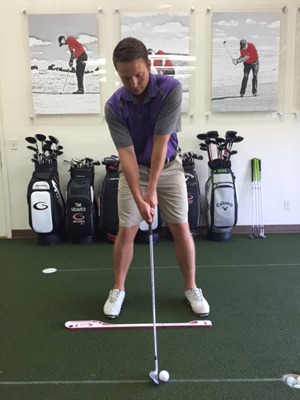
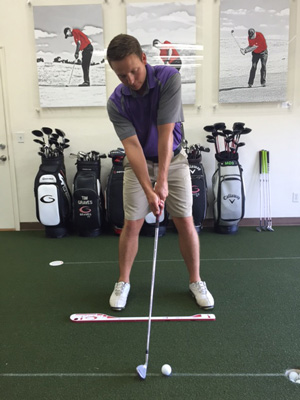
I lay the alignment aid pointed toward the target and put a yardstick under the training aid.

Now, every time I set up over a shot – the following are given:

  1. Perfect alignment (square to target)
  2. Perfect ball position
  3. Perfect stance (width)
  4. Perfectly square face to target (comparing leading edge of the club to edge of yardstick)
  5. Perfect distance from the ball

So simple – look at all the variables I have solved using this SIMPLE tool EVERY TIME.

I promise you, I will never hit a practice ball without an alignment tool.

So – if you aren’t using an alignment aid every time you practice – ADVANTAGE ME.

In fact – let’s say HUGE ADVANTAGE ME. In fact, soapbox time, if you aren’t using an alignment aid every time you practice, don’t read further…. no need – you have so many variables right now without using one… no need to continue to read… you won’t get past fixing all those listed above… Alignment, ball position, stance, square club face, distance to the ball…. enough said.

You will go back and forth, back and forth, back and forth fighting these issues FOREVER – I will NEVER have these issues – why because I take the extra couple of seconds to lay an alignment tool down every time I practice.

Fifth – I never practice for more than 15 minutes at a time. In other words, I hit 15 minutes’ worth of golf balls and then take a break. Might sit down for a minute or two to drink some water, might make a phone call, might walk over to the putting green and hit a few putts… you get my point.

Why? Because I give my body and more importantly, my brain, a break. None of us can focus longer than 12-16 minutes, it’s a proven fact. And as you are working on your swing (hopefully specific issues in your swing), you need to focus.

What happens when you lose your focus – your bad habits come back – FAST. If I were to hit one hours’ worth of golf balls – I would take at least 4 breaks (many times going to hit a few putts, chips, water break, etc…)

So – if you are practicing for more than 15 minutes in a row (without taking a break) – ADVANTAGE ME.

Many of you might think I video and check my swing every day. Couldn’t be further from the truth. To be honest, at most, I video my swing maybe once a week – more often, once every two weeks… I get enough from a single video session to work on for at least a couple of weeks.

What can you do? Check out our GGA Internet Golf Academy – you can do EXACTLY what I do. Send in a video every couple of weeks – we’ll give you plenty to work on.

So – if you aren’t getting some type of “outside” feedback to work on during your practice sessions – ADVANTAGE ME

In summary – be honest with yourself.

How do you rate your practice sessions compared to what I wrote above?

How many advantages do I have over you?

Remember – there is a DIRECT correlation between the time it takes to get better to the number of “advantages” you have.

Don’t leave ANYTHING to chance…. every second I practice I am assured I am getting better – I eliminate as many variables as possible.

To end – Folks, it’s not hard… in fact, it is very very simple and easy. Go through the list above again and make sure I have NO Advantage over you when we practice.

Remember – Always Practice with a Purpose!
Common Fault & Fix, Straight Lead Leg at Impact

By: Tim Graves, PGA & Trent White, PGA

One fault many students struggle with is straightening the lead leg during the downswing. This fault typically results in an over the top (slice) path of the golf club.

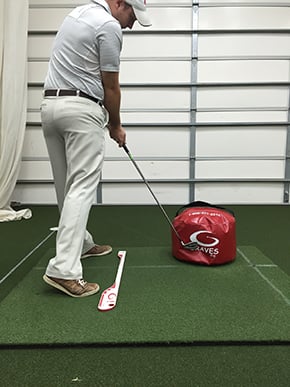
As seen in the pictures of impact:

IMG_1048
IMG_1050

1. The lead leg is straight

2. The spine was unable to maintain the correct posture

3. The lead shoulder is pulling up and out forcing the hands to come across the target line.

4.  The trail foot heal is off the ground because of the lead shoulder pulling up and out.

5.  Excess stress on the back.

Corrections & Checkpoints for Flexed Lead Leg

The proper movement of the lower body in the downswing allows the path of the club to come from the inside, the club to be on plane, and relieves stress from the low back.

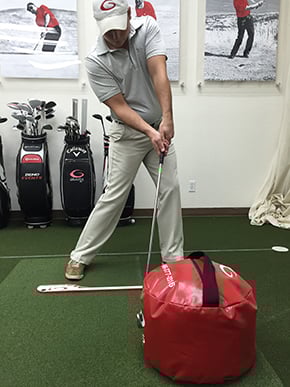
As seen in the in these pictures:

IMG_1054
IMG_1052

1. The lead leg is flexed (braced)

2. The hips are rotated

3. Spine is still in posture

4. The hands are going down the target line and leading at impact

5.  The trail foot heal is on the ground.

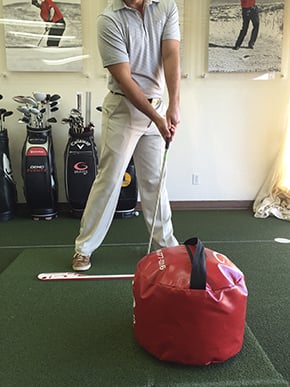
A good drill to work on the flexed lead leg is the leverage bag drill. To see this drill: CLICK HERE

Rate Your Wedge Game

By Tim Graves, PGA

Some of you may have read this “similar” article before and even rated your wedge game in the past.

Whether you have done so in the past, or have never rated your wedge game, I strongly suggest doing again (or for the first time).

This is something I recommend doing routinely – as the higher your rating, the higher your potential for great scoring.

**********

Assume many of you watches the “big boys” (and ladies) play in the weekly PGA, LPGA or Senior PGA tournaments.

As you watch these tournaments, how many times do you think you heard the announcers mention spin…. whether shots into the green, pitch shots to the green, flop shots, etc… it is mentioned again and again and again, as it is critical to be able to put backspin on the golf ball to stop it on greens.

As golf course maintenance improves and the golfer’s expectations of greens increase, greens have become harder and faster over the past years. Think of greens 15 to 20 years ago compared to today’s greens…. it is more important than ever to be able to create spin on the golf ball to be able to score.

So, I decided to write a practice tip that will let you rate your wedge game potential. This rating will show you where you currently stand (potential to create spin/have a great wedge/scoring game) and will also show you where you can improve your wedge game.

There are 9 areas – each is to be rated on a scale of 0 to 3.

Keep a running count and finally a total of the 9 areas.

Creation of Spin:

The 3 major factors that affect spin are:

* Angle of approach and speed to the golf ball.

* Type of wedge (metal) the club(s) is made of.

* Type of golf ball you are playing.

1. How much Divot do you take when you hit a pitch or wedge shot?

0 – No divot,

1 – Bruise/scrape the grass,

2 – Take a divot but not every time,

3 – Take a divot (need to replace grass or fill in with sand) every time.

2. How much Speed to you create (how far do you hit your pitching wedge (typically club between 40* and 46*)?

0 – Hit pitching wedge (40* to 46* wedge) less than 60 yards

1 – Hit pitching wedge 60 to 90 yards

2 – Hit pitching wedge 90 to 120 yards

3 – Hit pitching wedge more than 120 yards

3. Do you carry a Lob Wedge (58* or lower loft) and Sand Wedge (54* or lower loft) in your golf bag?

0 – No, I don’t carry a Lob or Sand Wedge (or don’t know).

1 – I carry only a Sand Wedge

2 – I carry only a Lob Wedge

3 – I carry both a Sand and Lob Wedge.

4. What type of Wedge (Lob and / or Sand Wedge) to you hit?

0 – Cast wedge (or don’t know) (Typically matches the other clubs in your bag (9 iron, 8 iron…)

1 – Forged type wedge (soft metal) with old grooves

2 – Forged type wedge (soft metal) with new grooves

3 – Forged type wedge (soft metal) with new grooves with other factors adding to spin (spin milled, rusty, etc..) –

Typically wedges made in past 2 to 3 years.

5. Were your wedges fit to you for length, lie angle, shaft flex, grip size?

0 – No, or I don’t know

1 – Some of them are, others are not.

2 – Partially fit (maybe grip size, not lie angle, etc..)

3 – All wedges were fit to me for length, lie angle, shaft flex, grip size, shaft weight, etc..

6. What type of Golf Ball do you play?

0 – Play any ball I find…. no one in particular

1 – Hard Golf Ball (2 piece golf ball) i.e Callaway SuperSoft, Titleist DT, Taylormade Burner Soft..

2 – Medium Soft Golf Ball – (typically 3 piece ball) – i.e Callaway ERC, Taylormade Project A, Titleist NXT..

3 – Soft Golf Ball (4+ piece golf ball) – i.e Callaway Chrome Soft & (X), Titleist Pro-V1 & (X)…

Next, need to factor in swing fundamentals:

7. Is the toe of the wedge up when the club is parallel to the ground in backswing?

(Set up like you are going to hit a pitch and stop when the club is parallel to the ground in the

backswing – the toe of your club should be pointed up.)

0 – Toe of club is pointed to 9 o’clock everytime or don’t know

1 – Toe of club is pointed to 12 o’clock some of the time.

2 – Toe of club is pointed to 12 o’clock (or up) most of the time.

3 – Toe of club is pointed to 12 o’clock (up) every time.

8. Do you accelerate through the shot (in particular a pitch shot)?

(Check this position when you finish the shot.)

0 – Hands finish at waist high or lower.

1 – Hands finish between waist high and shoulder height

2 – Hands finish above shoulders some of the time.

3 – Hands finish above shoulders every time.

9. How consistent are the pitches in relationship to contact on face of club?

(Look at the mark (grass mark, etc..) on the face of the club after impact.

0 – Inconsistent, marks all over face – even shank some shots

1 – Consistently off the heel of the club (toward the heel).

2 – Some shots off middle of face of club, some off the heel of club.

3 – All shots off the middle of club face (some hit all slightly toward toe)

Before we break down each area and how we can improve – let’s go over our totals and potential:

0 to 9 points – Very little to no potential to create spin and have a good short game.

10 to 15 points – Some potential, but wouldn’t count on any spin when hitting short game shots.

16 to 20 points – Medium potential, can create and play some spin on medium/soft to slow greens.

21 to 24 points – High potential, can create and play spin on most all types of greens, still some
areas (above) to work on.

25 points + – Very high potential, unless one area (above) is low, no problem creating spin when

needed.

An interesting comment I often hear is, “I don’t play good enough to care about creating spin on my short game shots.” Could not be further from the truth. The more greens you miss, the shorter game shots you will have – and the more you will need to hit good shots that have spin when needed. Basically all short game shots should have some type of spin – some more than others. A short chip will have spin as it hits the green – allows you to be more aggressive. A pitch or lob/flop shot needs spin to stop quick and even most bunkers (sand trap) shots need spin to get close to the hole.

Let’s give a “short” review of each area above and if you scored low, how you can improve that area. 

1. How much divot do you take when you hit a pitch or wedge shot?

You need to take a divot (can be small), but need a divot most every time you hit a pitch, even with a chip off a “tight” lie (lie with minimal grass). This divot should start slightly after/past the ball and is indicative of good “angle” toward the ball. You always want to be hitting down on the shot. If you cast, “flip” or release early – you will have a lot of problems taking a divot.

Fix – Work on your leverage angles through impact. Work on your hands leading the shot (getting your hands ahead of the club head through impact).

Drill – Work on the LEVERAGE BAG – one of the best, if not best, drill you can use to work on your hands leading the shot. Please review – http://moenormangolf.com/store/products/gga-leverage-bag/

2. How much Speed to you create?

Speed is a hard thing to increase (when over 30 to 35 years of age). But, can work on optimizing speed at impact. Leverage bag drill above will help.

Speed is a factor or your club being on plane (squareness of hit) vs. strength vs. flexibility. Improving one of these areas will increase speed, improving all will dramatically increase speed.

Fix – Work on improving your flexibility: http://moenormangolf.com/store/products/flexibility-exercises/

Fix – Always work on getting / keeping your club on plane (effective speed at impact).

3. Do you carry a Lob Wedge (58* or lower) and Sand Wedge (54* or lower) in your golf bag?

Most important club in the bag – your putter.

2nd most important club – your driver.

3rd most important club – your lob wedge.

Your lob wedge saves shots, helps you score, if “your friend” – the best tool to scoring in your bag. Saving shots, creating shots, allowing you to “take more risks”, etc…

Recommended to carry as many wedges as you can in your bag (within limit) – they are your SCORING clubs.

Fix – Get a lob and sand wedge.

Everyone’s bag should include at least the following wedges (to maximize the scoring part of their game).

Pitching wedge (typically matches their set (matches 9, 8, 7 iron in bag in model and shafting). – (Between 40 and 46*)

Gap Wedge (can match set (PW, 9, 8, 7 iron in bag) or can be a Mac Daddy JAWS RAW Signature wedge. (Between 47 and 52*)

Sand Wedge – Callaway Mac Daddy JAWS RAW Signature Wedge (54* or 56*).

Lob Wedge – Callaway Mac Daddy JAWS RAW Signature Wedge (58* or 60*).

4. What type of Wedge (Lob and / or Sand Wedge) to you hit?

If you hit a pitching wedge 90 yards or more it is recommended to have STEEL shafted FORGED type sand and lob wedges (even gap wedge for some).

You want steel shaft for weight (helps in high grass, sand, 1/4 or 1/2 shots, etc.) and added weight will increase spin.

All major companies carry forged type wedges – email or call us if you have questions.

Fix – Get a forged NEW sand and lob wedge.

5. Were your wedges fit to you for length, lie angle, shaft flex, grip size?

If your wedges are not fit to you, they are potentially doing more harm than good. A wedge too upright (lie angle – or toe of club off ground) will cause perfect swing/path to pull the ball to the left (for right handers). A club too flat – will cause ball to go to the right. A grip that is too big – limited feel in the shot.

Fix – Get wedges that fit you. If you want your fittings, please go to: http://moenormangolf.com/clubs/free-club-fittings/

6. What type of Golf Ball do you play?

The softer / more layers the golf ball – the more spin you can create.

Also – you need to play the same type of golf ball, at least around the greens. It is almost impossible to have good “feel” in the short game if you are always using different golf balls.

Fix – Experiment with different golf balls – see what you like. Talk to your local pro (most are trained……) about the new golf balls on market. Soft/feel golf balls are not always expensive.

7. Is the toe of the wedge up when the club is parallel to the ground in backswing?

It is essential you swing the club (club head) properly on plane to get maximum / correct spin on the golf ball. Check this position often.

Drill – Most who have problems with the toe up position have grip issues (grip too strong, etc..)

Others problems can be back swing issues, etc..

Fix – Work with GGA Grip Training Club 

8. Do you accelerate through the shot (in particular a pitch shot)?

A majority of golfers who have difficulty pitching decelerate through the shot. A divot with deceleration will cause fat shots, short shots, club head twisting. Most, instead of fixing acceleration, work on hitting less divot (not good….).

Drill – Work on “mini” golf swing with short back swing and longer through swing.

Fix – Continually work on shortening your back swing in a pitch and chip if you are decelerating. Shorter the better…..

9. How consistent are the pitches in relationship to contact on face of club?

Most often this is a path (swing path) issue. A pitch is a “mini” golf swing.

Drill – Work on your golf swing – (very small) and work up. Start small (short shots) and work up.

Pitch 20 yards or less, check the face for marks. Don’t get longer unless consistent with

short shots.

Fix – Start small and work up. Don’t rush…. the more “deliberate” you are with small shots and then work longer only when short shots make consistent contact, the faster you will get better.

Summary –

You play fitted (to you) forged wedges (sand and lob) and the same (type) soft (multi layered) golf balls. You create a divot every pitch, marks on club face are consistently in middle, toe of club is up when waist high every time in back swing and your hands finish high (on finish).

Highest potential in your short game/pitching to create spin and ultimately score better (much better).

Purity of Technique

Golf teachers will often agree that there are many ways to hit a golf ball. Some swings are upright, and some are flat. Many will have the clubface closed or even open during the swing motion. Yes, all of these types of swings can, in some level of aptitude, strike a golf ball. Each of them, however, has built-in compensations for flaws.

Years ago a well-known teacher taught me that he shows swing flaw must have an accompanying flaw to fix it. What this means is that for every swing problem you must have a second flaw in make-up for the initial question. You can’t just have one swing fault – you must have at least two. Without the compensating correction, you can’t hit the ball.

For example, if you have a closed clubface during your backswing, you must have a movement to open the face in your downswing. One flaw always has an offsetting flaw.

In many ways, this is why golf lessons can make you worse before you get better. If you fix one flaw and the compensating flaw still exists, then you are caught in the dilemma of only having one swing problem resulting in lousy golf shots.

This is what initially attracted me to Moe’s swing. Not only did I recognize his abilities, but I saw a real swing motion – one without compensations.

I often call the address position of the conventional golf swing “The one mistake.” Why? Because it has a built-in problem – standing too close to the ball. The accompanying flaw/movement is to move the body upward to compensate.

The way I see it is that you have a choice to play golf.

You can use the grip it and rip it mentality and fight your way through your compensations OR you can build a swing that is pure technique. Of course, I prefer the Purity of Technique way for some reasons including the following:

  1. Pure technique without compensations allows you to have a better chance of your bad shots being good.
  2. without compensations, your swing becomes less maintenance.
  3. Timing elements of the compensations are not necessary
  4. It is easier on the body
  5. Easier to repeat

*************

Why is water wet? Why is the sky blue?  Moe would often ask me questions that seemed ambiguous. He would say “Once you know the answers to these questions, you will know.”

“Know what?” I asked.

‘The Secrets” he said.

The answer to Moe’s questions was not complicated. Water is wet because it is all that it can be. The sky is blue because it is what it is. Moe’s golf swing was simply because it was all that it could be. I call it mistake-proof.

Consider placing your body in a position where it has no choice but to move most efficiently. At address, your body position, arms, hands, and club extend so that when you turn, the club runs into a perfect backswing path. The “Sum” of your body position makes it the only place the club can go.

Moe would often say – “I can’t take the club outside “because the club was placed up to 12 inches behind the ball. Due to his spine position, club position and the relationship of the club to pointing to the lead hip, when Moe turned the club immediately when inside – back on the plane. It just couldn’t go anywhere else.

Moe at address DTL.jpg

Moe’s address position was the beginning of being “Mistake-proof” This included many things that some consider idiosyncratic, these are the elements of what I think the Purity of Technique?

  • Moe’s legs were straight
  • This builds a stable foundation for the swing day after day. One of the issues with the traditional swing is: how much to bend the knees? One day it might be a little, another day a player may flex them more depending on his emotional and physical state, which leads to inconsistency. Starting with straight legs means there is no variance in the degree of knee flex from day to day.
  • Moe’s arms were straight–pointing directly at the ball
  • There is a natural position for holding a club to hit a golf ball; it is similar to a child holding a stick that he’s going to use to run a rock on the ground.
  • His club shaft began the swing on the impact plane
  • Starting with the club on the same plane that you are going to hit the ball makes sense. (How come no one figures this out before?)
  • His upper spine was tilted away from the ball (the lead shoulder is higher than the trail shoulder)
  • The tilt happens naturally because of Moe’s wide stance, straight arms and his right hand was lower on the grip than his left side.
  • He placed the club head five to 12 inches behind the ball (depending on the club)
  • This allows the body to move laterally into impact.
Moe at address

Taken together, these necessary elements of Moe’s address made his swing incredibly simple, certainly relative to the conventional swing. As I first began to study Moe’s swing and got deeper into examining his set-up, I was floored by the genius of its simplicity.

In Full Swing

Paul Monahan GGA Mental Game Coach

March 19, 2023

If you have been anywhere near Netflix the past month, or talked to a golfing buddy who has been, you know that the documentary Full Swing was released on February 15th. Full Swing follows a cast of top PGA / LIV Golf players throughout 2022, and chronicles the challenges, ups and downs, struggles, joys, complexity, and many other facets of what life is like at the elite levels of professional golf.

If you haven’t seen it yet, I think you’ll like it. Go check it out. If you have been watching it, I suspect you’d back me up.

Because this game we love is so mental, there are lots of moments throughout the Full Swing series that give us a glimpse into the mental dynamics of the PGA Tour player.  But one thing came up in episode two that was, on the one hand a little surprising and on the other, quite validating.

The surprising part of episode 2 for me was – spoiler alert – how profoundly Brooks Koepka was struggling mentally in 2022. I think many people could see he was struggling on the course in 2021, and into 2022. His play during that stretch was not what we were used to seeing compared to the incredible results he posted over the prior three years.

But he’s had back issues, and other injuries…and because we don’t usually get a detailed behind the scenes look at players like Koepka, we never really know for sure what is going on for most golfers on the PGA Tour.

Full Swing has allowed us to see what we would normally not.

The validating part of episode 2 for me showed up in the juxtaposition between Koepka’s struggle and Scottie Scheffler’s breakthrough. It was validating because of what I wrote in this column just 10 months ago regarding the dynamics behind Scheffler’s amazing run of four victories in 57 days early in 2022. You can revisit the article from May 2022 here: Scottie’s Secret.)

In that article, I assessed that Scheffler’s success was as much a function of his productive mental game as it was the physical and mechanical skills that he was bringing with him onto the course.

So, without going into the detail (and spoiling if for those who have not seen it), I would invite you to play a little game:

  1. Watch season 1 episode 2 if you have not yet, or
  2. Go back and watch the episode again if you have already seen it

… with the intention of exploring two things:

  • See if you can identify the differences in mental games between Koepka and Scheffler. (Look for the answers to questions like: What thoughts are they anchored to that serve them? What are they stuck on that does not? How are they processing the game as it comes at them? What kind of language are they using about the game and their success or failure in it…etc.
  • See if you can capture the key elements of Scheffler’s mental game model (hint: it’s not complicated) and see if you can operationalize that model for yourself… that is, bring it out onto the course with you when you play.

The more I spend time around this game, the more I am convinced that we all need to start with building the inside game skills first. It is foundational to everything else. It’s a must have for maximizing and optimizing all our outside game skills… so that we can play at our best when it means the most. So that we can overcome the challenges of the game no matter the stakes or situation.

Have a great week!

-Paul

Paul Monahan, PCC is a Peak-Performance coach, member of the International Coach Federation and a certified COR.E Performance Dynamicsä  Specialist. He resides in Cleveland, Ohio with his wife Paula and is the proud dad to three young men.

Common Fault & Fix – Shaft Out of Alignment With Lead Arm

By: Tim Graves, PGA

Fault 1

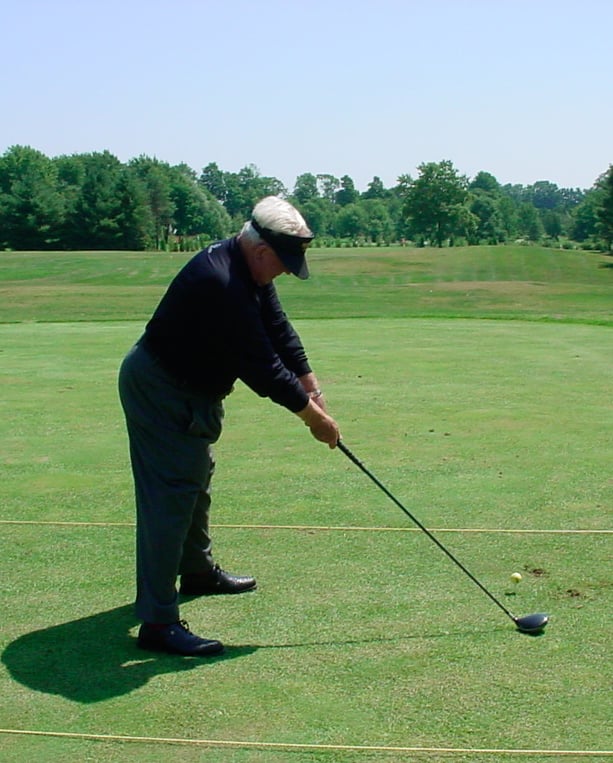
The Fault – Not establishing the “Rod” Position

When the club shaft is out of alignment with the lead arm at address, we consider this an incorrect position. This alignment is very important when it comes to the Single Plane Swing because it puts the body in a position to move into a perfect takeaway every time.

As seen in the photo above, note the following:

  1. The club shaft is not in alignment with the lead arm.
  2. The hands are behind the golf ball as opposed to ahead.
  3. The club head is directly behind the golf ball
  4. The lead hand wrist is cupped as opposed to being flat

With this incorrect alignment, here are some compensations that golfers will develop:

  1. Improper takeaway due to the hands being behind the ball at address
  2. Early release of the golf club
  3. Hitting behind the ball at impact
  4. Hitting the top of the ball at impact

Ultimately leading to:

  1. Loss of Distance
  2. Loss of Accuracy
  3. Inconsistency
Fix 1

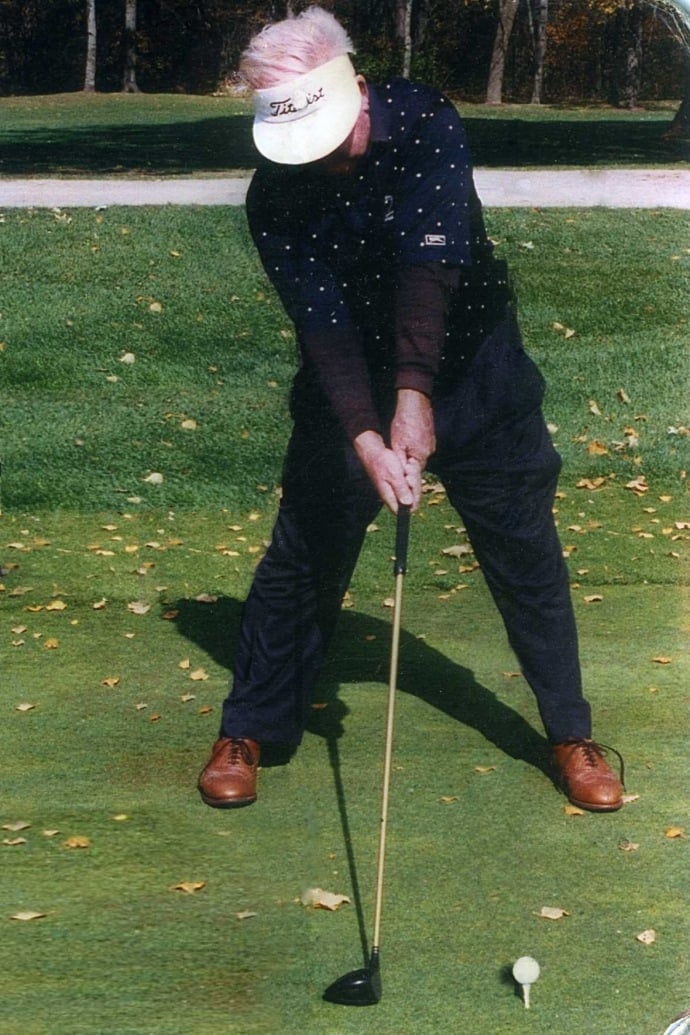
Checkpoints, and Correction for not establishing the “ROD” position

  1. Facing a mirror, get in your set up position.
  2. Place the club head directly beneath your nose, and look at the alignment of the club shaft and lead arm.
  3. The club shaft should be in a direct line with the lead arm, which points to the lead shoulder.
  4. The hands will be ahead of the club head
  5. The butt end of the grip will point towards the lead side of the body

With this correct alignment, golfers will develop:

  1. Proper takeaway due to the hands being ahead of the ball at address
  2. Hitting the ball first at impact
  3. Being able to create a divot (with irons, hybrids and fairway woods) past the golf ball
  4. Solid impact with proper and good compression of the golf ball
  5. Proper and full release of the golf club

Ultimately leading to:

  1. Maintaining and increasing distance
  2. Increase in accuracy
  3. Consistency

LEARN

THE

SWING

Join 1M+ Subscribers to get your FREE Video Quick Start Guide that reveals how to hit the ball farther and straighter more consistently from now on…

START YOUR NEW GOLF SWING