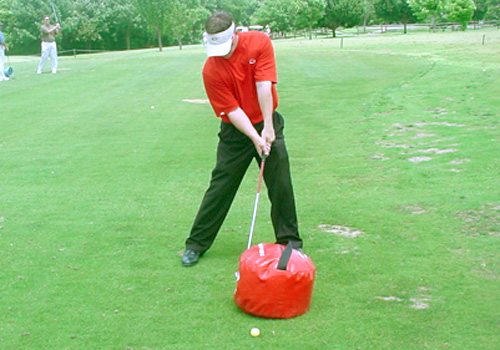
Common Fault and Fix – Casting the Club

Common Fault and Fix – Casting the Club

By Tim Graves, PGA

In our golf schools, one of the most common faults we see in our golfers is casting the club into impact with the ball. For reference, we define “casting” as any time the hands are behind the club head at the moment of impact. You may of also heard this as early release or flipping the club or loosing shaft lean at impact.

Casting has many negative effects on your game, some of which are:

1 – Inability to make solid contact with the ball. All shots are hit slightly “thin”

2 – Inability to compress the golf ball, or use the energy of the golf ball.

3 – Significant loss of potential distance on all clubs

4 – Almost impossible to hit hybrids and fairway woods

Here is a picture of casting:
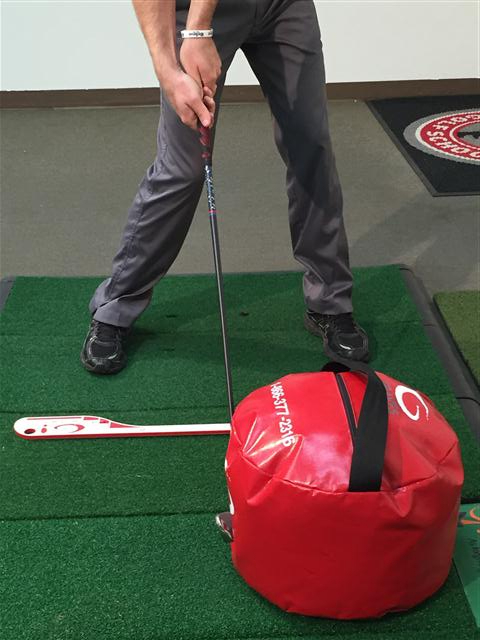
image2655493

As you see in this picture, at impact position (club head against the leverage bag), the hands are behind the club head, the shaft is leaning away from the target, in other words – the club head is ahead of the hands at impact. This is casting.

Corrections and Checkpoints for Casting the Club Into Impact

As seen in the image above, the ideal Single Plane impact position shows that at the moment of impact, the hands are leading the club head into impact.

image2655496

To check and train the ideal impact position:

  1. Use a GGA Leverage Bag and Alignment Trainer. To view leverage bag and Alignment trainer training:  CLICK HERE
  2. As demonstrated in the picture above, set the edge of the bag 4 inches behind the “IBP” (Iron Ball Position). The phone number on the Leverage Bag should be at “IBP”.
  3. Using a mid-iron, hover the club above the ground so that you will impact the center of the Leverage Bag.
  4. From your Single Plane Address, take a small backswing, and then move into the impact position, hitting the Leverage Bag. HOLD your impact position.

While holding your impact position, check the following:

  1. Your hands should be at the black handle of the ball.
  2. The club face should be square into the center of the bag
  3. Your trail arm should still be slightly bent
  4. Your trail foot should still be on the ground, and your lead knee flexed

If you notice while practicing into the Leverage Bag that your hands are not getting to the black strap, or any of the other checkpoints are not correct, we suggest training slowly using the Leverage Bag without hitting balls to train yourself to get into the ideal impact position.

We recommend swings at 15-20% speed to start, so you can check each of the checkpoints. As your position improves, you can speed up.

Good Luck – be watching future e-tips for more tips and more common faults and their fixes.

The Master Will Appear

BY: Tim Graves, PGA

Paul Monahan, Graves Golf Mental Game Coach, honored me yesterday with a request to write a forward for his new / soon to be released book. (I will let everyone know how to get his book when available.)

Thought I’d give you a “sneak peak” of a quick story I will put in the forward…

A few years ago, Paul and I (Tim) were running an Alert Attitude of Indifference Mental Game School in Orlando, FL. The school is a 2 day school in which we work with our student’s on their mental game during play and practice in their golf game. Time is spent in the classroom, on course and performing exercises and drills in different practice areas to help our students improve their golf games through a better / more positive mental game.

On the first morning, Paul, myself and our students were on the putting green performing one of Paul’s exercises. This particular exercise involved the following:

  1. Paul gave every student a sheet of 16 labels. Eight of the labels had positive words printed on them (ie. Happy, Positive, Encouraging, Loving, etc..) and 8 labels had negative words on them (ie. Sad, Negative, Discouraging, Unhelpful, etc..).
  2. Paul then told the students to stick one of the positive labels on another student. Do this eight times until all the positive labels are gone from their sheet. They peeled the label off the page and picked a student to put it on (I participated in this exercise and found this very easy…. pick another person and put a positive label on them).
  3. Paul then told the students to pick one of the negative labels and stick it on a student. Do this until the eight negative labels were gone. (I participated in this also and found it very hard to do this..)

After the exercise was completed, Paul discussed with the group about self talk, positive vs. negative, how easy it is to talk positive about another, how hard it is to label another negative, but consequently, how easy it is to talk negative to yourself, and how hard it is for so many to talk positive to themselves. Ultimately, how positive self talk must be encouraged and how positive self talk will greatly enhance your change for improvement both in play and practice.

The 2nd day of our school, we always start with a question and answer session about the previous day’s teaching. I typically ask the students, “How do you think yesterday went and if there was anything they wanted to talk about?”

At this school, immediately after my question, one of our students stood up and said, “I thought the exercise we did on the green yesterday was a complete waste of time, and in my opinion, all we did was litter (when the labels feel of the students and blew away).”

I have to be honest (and many of you who know me can probably can predict my response…) I was not very happy with this student as was about to “escort him out of the school…”

I can only assume Paul saw my initial reaction, and stopped me in my tracks…. Before I responded to this student, Paul stood up and asked if he could address the question.

Paul proceeded to ask the student why he felt that way, why he thought the exercise was a waste of time and in general, discussed the student’s mental approach to his golf game.

Come to find out, it wasn’t about the exercise at all. It was about the discouragement this gentleman felt every time he practiced because he expected faster results, and more about how he was expecting his golf game to help reduce his pressure he was feeling at work. Paul proceeded to discuss with this gentleman how the same exercise could and should be used outside of golf – in his personnel and professional life… and how this exercise could and would change his perspective in all areas of his life.

Honestly – I was completely taken back… Paul turned a negative situation (and one I was probably going to only turn more negative) into one of the best morning talks I have ever heard or been part of… I went from being so mad I was “seeing red” to having a tear in my eye listening to Paul’s encouraging conversation with this student.

At the end of the morning discussion, the students got up and left the room to start our next exercise. After the last student left the room, I turned to Paul and said “that might be the greatest and most encouraging thing I have ever heard told to one of our students”.

Paul turned to me and said Tim, never forget…. “When the student is ready, the master will appear”.

I will never forget this morning, this saying and how great Paul handled the situation.

******

So – I have some questions for you (our students)… When you “self talk”, is it negative or positive, are you encouraging or discouraging to yourself, do you put positive or negative labels on yourself…. and ultimately, “Are you ready for the master to appear”?

I’d again like to thank Paul for the honor of writing a forward for his book and wish him all the best upon publication.

Playing Winter Lies

By Tim Graves, PGA

It’s that time of year again.

As always with this time of year, it is a much different game than that in the summer or even spring. The main difference is the lies you get. Yes, some of you might play winter lies (moving the ball to a “favorable” lie when the grass is dormant) – and to be honest, I am not totally opposed to that…. I would rather you enjoy the game in the winter, than struggle with lies that you would never see professionals play or even big “amateur” events being played on.

But… there are times you will need to know how to hit shots off these “tight” lies. Whether you are playing the ball down on the dormant grass that is “beat down” or as at a lot of Florida courses in the winter, the fairways are green (over seeded) – but mowed extremely tight. The fairways, the first cut around the greens, etc. can have extremely short grass this time of year. If you don’t understand how to play shots off these type of lies, it can become very frustrating.

A golfer who finds his ball on such a lie can be helped by knowing some of the “tricks” in playing these shots.

First: If the distance to the green is within chipping or pitching range, it is wise to take a less-lofted club than normal and play a chip-and-run type shot. This is the safest choice for two reasons:

  1. The flange on the club will be narrower and tend not to “bounce” into the ball.
  2. More importantly, the club head speed for the less lofted iron will be slower than for the deep-faced, wider-flanged pitching club, so that if the ball is miss hit the error will be less severe.

Chipping, or even putting, from areas with “tight grass” from off the green is generally good advice.

If the ground is “rock hard”, and the player must use a sand  or lob wedge, be sure the minimum bounce from the sole is presented. This is accomplished by squaring the face up at address. Play the ball back in the stance so the contact point for the clubface will be at the very base of the ball where it meets the ground. Make no attempt to lift the ball. Instead, maintain the shaft angle that was established at address. It takes considerable trust to execute this shot because the margin for error is close to zero.

For full shots off of hard ground or ground with very little grass or even fairways with very “tight” lies, follow these tips:Play the ball back a little further in the stance than normal. Maybe a ball or two (length) further back.

  1. Playing the ball back a little bit will take a little of the “effective” bounce off the club and will help you hit the ball on a slightly more descending blow. You will need the “increased descending” angle to catch the ball clean as it is very easy to “bounce” the club off the ground and into the ball off the tight lie. Adding a little more “downward angle” on the shot will help.
  2. Take a club or two more than you need and choke down slightly. Swing “smooth” rather than “hard” at the shot. Swinging hard will cause excess movement in the body and with minimal room for error – it is much more important to swing “smooth” and steady rather than “hard”.
  3. Many times on very tight fairways, or “hard pan” type shots, it is easier and more “reliable” to hit a “punch” type shot or even a hard “chip” type shot. The reason is you are more likely to keep your lead wrist firm through the shot in a punch or hard chip type shot – which will make is easier to hit through the shot. If you are swinging a full swing type shot off of a “tight” lie and cup the wrist (or breakdown) prior to impact, you are very likely to either miss the ground all together or hit behind the ball and the club will bounce off the ground into the ball. Either one of these misses will lead to a “bladed” or “thin” type shot
  4. A good drill to work on hitting through the shot:

Place a tee in the ground just ahead of the ball (like the golf ball feel backward off the tee). You should hit the ball and the divot should take the tee out of the ground.  The divot should start where the tee is in the ground. The divot (at worst) should start at the lead side of the golf ball – the back end of the divot should be ahead of the golf ball.  Or paint a line on the ground perpendicular to your target. Place golf balls on the line. Hit the golf balls.  The club should enter the ground on the leading edge of the line or ahead of the line and the divot will be in front of the line.  At worse, the back end of the divot will be on the front edge of the line painted on the ground.

dc3b8ae5-be58-4f4e-a0ba-7de83bc2da70

Ultimately, being able to hit shots off of “tight” lies comes down to how well you can hold your proper angles through impact. In other words, those that keep a “firm lead wrist” through impact will have a much easier time than those that cup or break down their lead wrist prior to impact. Working on leverage angles, leverage bag, etc. will help master the correct positions and angles at impact.

Good Luck!!

TIPS FOR IMPROVING OVER THE WINTER

By: Tim Graves, PGA

Thought it was about time to start talking about fall / winter practice. I know for most of us it is time we are inside, and when inside, some of us try to figure out ways to practice to get ready for the spring.

Before we get into any details – wanted to review a little about practice (especially when working on new habits over the fall / winter).

It is essentially impossible to break bad habits (our mind/body is not set up that way) … but we are set up to be able to create new habits and ultimately make changes/create new movements, etc.  we want.

Sustaining Progress

Developing your skills (and talent) is like taking a cross-country hike. You will encounter challenges, you will hit snags, plateaus and steep paths; motivation will ebb and flow. To sustain progress, it’s necessary to be FLEXIBLE one moment and STUBBORN the next, to deal with immediate obstacles while staying focused on the horizon (or your ultimate goals).

Don’t Waste Time Trying to Break Bad Habits – Instead Build New Ones

I bet I talk about this so many times in our schools, many of our students probably get “sick” of hearing it.

When it comes to dealing with bad habits, many of us attack the problem head-on, by trying to break the habit. This tactic, of course, doesn’t work. And we are left with the old truth – habits are tough (if not impossible) to break.  The blame lies with our brains.  While we are really good at building circuits (creating habits), we are awful at quitting them. Trying as you might to break a bad habit, it is still there, waiting patiently for a chance to be used.

So, what do we do?

The solution is to ignore the bad habit and put your energy toward building a new habit that will override the old/bad habit.

To build new habits, start slowly. Expect to feel stupid, clumsy, uncomfortable, and even frustrated at first…. after all, the new “wires” in your brain haven’t been built yet. Your brain still wants to follow the old “comfortable” pattern. Build the new habit by gradually increasing the difficulty, little by little. It takes time, but it’s the ONLY way new habits are created and grow.

To Learn It More Deeply, Teach It

Here is the issue. Every good golfer, every golfer who learns something new/reaches a goal, etc… must be their own best teacher. If you cannot teach yourself, your ability to make changes, create new habits, reach goals, etc… will occur in a much slower rate.

This is not saying you must create everything yourself, but it is saying you must take what you learn and translate into self-teaching.

Think about it – how much time to you spend practicing, and how much of that practice time is with someone teaching you?

If you are like most, 90% + of your practice time is on your own, trying to create new habits, etc… on your own. Meaning, you must be able to make sure you are doing things correct, must be able to make sure you are “going down the correct path”.

A great way to determine if you can teach yourself it ask yourself “Could I teach this (new habit I am trying to learn) to someone else?”

This works because when you communicate a skill to someone, you come to understand it more deeply yourself. Also, when you see someone struggle, and help them through it, you improve your ability to deal with your own struggles.

The saying “Those who can’t do, teach” should be rewritten as “Doers who teach do better!”

Give a New Skill a Minimum of Eight Weeks

When it comes to growing/creating/developing new skills, eight weeks seems to be an important threshold. It’s the length of many top-level training programs around the world, from the Navy SEAL’s physical – conditioning program to the mission training for the Mercury astronauts. A recent study at Massachusetts General Hospital showed the practicing meditation for twenty-seven minutes a day created lasting brain changes in (you guessed it) eight weeks.

Of course, this doesn’t mean that you can be proficient in any skill in eight weeks. Rather, it underlines two more basic points:

1)  Constructing and honing new habits takes time, no matter who you are, and

2) Resilience and grit are vital tools, particularly in the early stages of learning. Don’t make judgements too early.

Keep at it, even if you don’t feel immediate improvement. Give your talent (your brain) the time it needs to grow and create new habits.

Please watch upcoming newsletters for more winter practice tips.

Get Your Free Single Plane Fitting

By: Tim Graves, PGA

Whether looking to fit/replace a single club to an entire set, from a putter to a driver to your irons, wedges, etc.. it is ABSOLUTELY CRITICAL that the club(s) is fit to YOUR individualized swing and single plane specifications.

An UNfit club will hinder your improvement process, an UNfit club will hinder your golf game, an UNfit club will not allow you to reach your potential, an UNfit club can and many times will actually physical hurt you (tendonitis in elbows and wrists are many times causes and exaggerated by club with improper lie angles), and UNfit club is basically worthless to you. I don’t care how much you spent for the golf club(s) – if they are not individually fit to you – they are worthless to your game – and worse than that, can and many times will actually “hurt” you.

The Graves Golf Academy has custom fitting programs established with most major manufacturers in the golf industry. And many of the manufacturers install our grips in their custom department (no other instruction group can say that….). We have worked VERY HARD to set this customizing system up for our customers, students, etc. anyone interested in the single plane golf swing.

Also, because of the amount of equipment we sell from each manufacturer, we are many times offered equipment at a reduced rate for our customers. We are always able to match industry pricing and many times able to beat the pricing. We are also many times able to offer clubs at a significantly reduced price (last year’s models, etc. as these manufactures know how many clubs we sell and “hold some back” for us). Please watch our newsletters (bimonthly) for these specials – as they typically don’t last long as many are interested in these special pricings.

Customization done at the manufacturer (Callaway, Taylormade, Titleist, etc..) is free through the Graves Golf, there is no added cost for the GGA grips installed and customized at the manufacturers. Plus, there is no shipping charge (within US) and no tax (outside of OK) through Graves Golf.

To get a FREE individualized custom fitting please go to:  http://moenormangolf.com/clubs/free-club-fittings/

To View Single Plane Fitting Informational / Instructional Webinar:

  CLICK HERE

Me & My Mind

By: Shane Matzen, Graves Golf Single Plane Academy Liaison

I will tell you upfront, the longer I’ve been associated with Graves Golf, both as a member of our Single Plane Academy and now on our staff, one of the things that has fascinated me most has been the mental game.  Or, as Moe would like to say, “An Alert Attitude of Indifference”.  I’ve always appreciated that Tim and Todd make it a point to include this as part of their agenda when they teach us everything about Single Plane Golf.  You name it:  AAI Schools, AAI MasterClass, bringing the mental game expert, Paul Monahan, aboard to contribute….the list goes on and on.  They always make sure that we recognize that we must train our mind as well as our flexibility and ability to hit our positions.

What prompted me to write about this topic was a chat session on the now-in-progress Alert Attitude of Indifference MasterClass.  One of our members asked a question in the very-cool, interactive zoom session about using a big portion of the backswing as his personal “waggle”.  Tim thought about it for a second and came back with something like this, “Well, normally we don’t want you taking practice swings.  But if taking your club back to a position, checking it for a second and then pulling the trigger MAKES YOU COMFORTABLE, then by all means.”  And then the discussion went into the professionals that do just such a thing before their swing (see Justin Thomas).

Well, as has been mentioned many times on our SPA Facebook group, in my weekly videos there and in this space, I get a real kick out of analyzing things.  Sometimes that borders dangerously on OVER-analysis but in this case, I’m not going to cross that line.  Stay with me through a few examples….

Tim and Todd have always taught us that there is a proper amount of time after we set up to the ball that we should execute our swing.  And we’re talking here only about a few seconds.  I loved Tim’s reference in the aforementioned AAI chat that if we go past that point of a few seconds, our minds are going to invariably go to the technical or negative and thus, make it impossible to mindlessly just EXECUTE.  Or in other words, do what we’re supposed to do when we get into what Todd has taught us in the Green Zone.  

I had an issue when I was very young taking my medicine in the form of pills.  My mom came up with a genius method to make it happen and end the aggravating-to-her discussion that I just couldn’t do it.  She put my pill in a glob of jelly in a spoon and reminded me how much I love grape jelly and to just swallow it all down at once.  All of a sudden, my mind went to the jelly and well, you can guess how that went…..instant success!

Fast forward to my freshman year in high school.  Basketball season and not to brag, but I was having a really good season.  At one point in the year, I’d made 21 consecutive free throws in games and ended the year shooting 79% from the line.  The next season, 15 years old and a sophomore I made the varsity and started most of the season for a team that I’d like to think was the best team we’d had to date in the history of our high school.  We ended up winning 26 games and advanced deep into the postseason.  My job was to play defense and rebound as we had plenty of scorers and I was happy to fill that role.  What really bothered me though was I ended that season shooting 48% from the line.  Now what was different?  Well, let me list the ways:  we played most games in front of packed houses that season, the importance of the games was ratcheted up about 1000%, I had more people depending on me and being 15 in and of itself was just the cherry on top to deal with everything.

From the first time I began to love basketball, Julius Erving was my hero.  Dr J could do it all and though I couldn’t swoop around the backboard and perform highlight reel dunks, I COULD follow his free throw routine.  From the beginning, I dribbled five times, spun the ball around, took a deep breath, looked at the rim and then put up the shot.  Up until that 1983-84 season, this had always worked for me.  But even back then, my brain would go into coach mode and I self-analyzed pretty deeply that offseason leading into my junior year.  I knew my technique was good so what would cause me to drop 27 percentage points?  It didn’t take me long to come to the conclusion that I was getting in my own way.  My junior and senior years my routine (as much as I hated to leave my Dr J-like routine) became two dribbles, set and fire.  I ended up getting back into the high 70s again and hit a couple of late free throws my senior year to win our own tournament which I’ll spare you the importance of to someone growing up in Eldon, MO and the history of that event (which this year will be 90 years old).

One more hoops-related story for you….1993 comes along and I’m a head basketball coach for the first time and my point guard is a young man who was supremely-skilled with confidence to go with it.  He could handle the ball, was a tremendous/unselfish passer of the ball and a really good shooter.  But you can guess it, history repeated itself and he was struggling at the free throw line.  I proceeded to tell him my story and it was our first year together and we were still in the feeling-out stage so he was nice enough to tell me he’d consider changing his routine.  I was ok with that because a routine is a very personal thing and was not something, to me, that you create ultimatums on.  I kept an eye on him the next couple of days at practice and I could tell he was experimenting with some things at the charity stripe.  We got to the next game though and he pulled this out of his hat:  the referee handed him the ball for his first free throw that night and the moment it touched his hands, the shot went up.  Yep, no dribble, no spin, no nothing.  He just shot it.  If I recall, he went about 8/9 that night and the one he missed we got the offensive rebound because our guys knew what he was doing and were able to get in position for an offensive board before the other team even knew what was going on.  Needless to say, this is a story I’ve gotten a lot of mileage out of.  

Present day now and I’m all in on “Matching the Model”.  I’ve always thought Todd’s routine is a solid one so I’ve tried emulating it.  But my waggle has evolved and while probably 85% of what I do is Todd Graves-like, there’s some differences.  But hearing what Tim said in his chat that I mentioned at the beginning of this article makes me feel as Tim would say, “comfortable” in my own skin as far as my prep to swing the club.  While there’s no jelly involved in my process, making sure “less is more” is a big part of what I try to do in preparation for a swing.  

My mind is pretty persuasive over the rest of me and sometimes I literally feel like I have the proverbial angel on one shoulder and the devil on the other both whispering in my ears.  I just don’t give them the time to make their point.  

For those of you who are mentally strong enough to just turn to each shoulder and say “Shut up!” and those dudes go away, I’m jealous.  For those of you like me though, my hope is you’ll join me in this quest to find ways to just shut off the negative conversations and beat back our demons.  We CAN do it.  We just have to find the way that works for us.

LEARN

THE

SWING

Join 1M+ Subscribers to get your FREE Video Quick Start Guide that reveals how to hit the ball farther and straighter more consistently from now on…

START YOUR NEW GOLF SWING