Coaching: A Two-Way Street

Coaching: A Two-Way Street

Let me preface what you’re about to read below with a little history….I grew up in the early-to-mid 80s with my athletic career before becoming a coach in the early 90s.  I played basketball and football in high school prior to choosing against a small-college basketball career to be a manager for Norm Stewart’s Missouri Tigers in the late 80s.  Playing in those days, being on the staff at Mizzou and then becoming a coach myself, all occurred during a much different time for being an athlete and coaching athletes than the one we are in now.

Now before you jump to the conclusion that this is going to be a “those were the good old days” article I want to make very clear that nothing could be further from the truth.  I think in all things related to life we should be looking forward.  If something was great at one time, shouldn’t we always be wanting to make it better?  We may find out that something that worked “back in the day” IS what we should be doing but it’s my opinion that the effort to always see if there’s a better method should come first and foremost.

In the days that I played sports competitively, I always tell the story about what happened my senior year playing hoops.  I had a coach who I had the utmost respect for.  He worked hard at his craft, had a long history of success and I looked up to him as a person as much or more than I did as a coach.  One day at practice, I was having let’s just say a “non-stellar” time of things.  He’d already made this clear to me verbally but at some point, he got in close proximity and proceeded to make a point by jabbing me in the sternum with his index finger.  I mention this because the next day he showed up at school with a splint on that finger and it came out that he’d actually broken that finger making that point to me.  Now, we’re talking 1985 so my reaction to the whole thing was “I need to get my a** in gear and work harder” when all that went down.  Fast forward to 2022.  If that would have happened with one of the coaches I was in charge of as the athletic director in my last year in that position and well….you can guess where things would have ended up.  

Please know I’m not vouching that my coach breaking his finger on my sternum was right.  And I’m not saying that coaches shouldn’t push their athletes in 2022 either.  There IS a best way for coaches to coach and there IS a best way for athletes to be coached.  And what’s best in 2022 will not be what’s best in 2032 either.  I would hope everyone would strive to make tomorrow a better version of today in all things we do.

I would relate a very meaningful day in my coaching career when things started to turn for me.  In 2003 my team I was coaching (I was a high school basketball coach for 23 years prior to becoming an athletic director) was coming off a less-than-successful year in so many ways.  We were not the most talented team but I can honestly say that I worked very hard trying to push the right buttons that year but looking back, I mostly pushed the wrong ones.  

When the season was over, I was in our equipment room a week or so after our last game just doing inventory and there was a knock on the door.  One of my players walked in and asked if he could talk to me.  Now please understand the background of the two of us; Deonte was a 6-8, 240-pound 16-year-old from inner city St Louis and I was a 6-0 or so 36-year old who grew up in a rural town in central Missouri.  Yes, I was his coach and he was my player but we could not have come from more different places in life.  I asked Deonte what he needed and I could tell this was hard for him.  He said something to the effect of, “Coach, I’m not sure how to say this to you.”  I could tell he was hurting so I lost interest in putting away uniforms and turned 100% of my attention to him and prodded him on.  He eventually said to me, “Coach, I’m not having any fun playing basketball anymore” as a tear rolled down his cheek.

Now think about this for a second.  How much courage did it take for this young man to come to me and say something that he probably thought would anger me and make me think less of him?  It took everything.  I had two emotions come over me instantly:  My admiration for Deonte went through the roof that he cared about his feelings, his teammates and you’ll be surprised to hear this but also how much he cared about ME to say these things.  It would have been easy for him to wait until after he’d played his last game as a senior to let loose on me but he wanted so badly to have a great senior year and as we continued our talk in that storage room it was obvious to me that HE WANTED ME TO ENJOY COACHING MORE.  

Deonte is 36 years old now.  He and I stay in touch and always text on holidays and birthdays.  Heck, the night he proposed to his soon-to-be-wife he texted me at 1am sending me the video of his proposing to this lucky woman an hour earlier.  He scored a lot of points for us, he grabbed a lot of rebounds for us and went on to honor our school with his scholarship he got to play college basketball and the degree he went on to earn.  BUT I WILL OWE HIM FOR THE REST OF MY LIFE.  He opened my mind as to what coaching can be.  People who are being coached want more than to win games, shoot lower scores or swing a golf club better.  They want someone who cares about them.  My last 10 years or so of coaching were the most gratifying of my life.  I credit that young man who had the guts to say the things that needed to be said to me for this.  I enjoyed my players and my staff members more than I ever did before and realized that the time we spent together working hard, developing relationships and making memories far outweighed any statistics or marks made in a scorebook.  

Now before you think I’ve gone all soft and tipped the scales to all responsibility on the coach, you could not be more wrong.  Golfers receiving instruction, speech and debate participants receiving guidance, you name the situation; there is a tremendous onus on those individuals to put the work in and accept coaching for what it is and should be:  an honest and sincere effort from the coach to guide you and yes, PUSH YOU to be what you have the ability to be.  Sometimes this is uncomfortable.  But it seems to me that the number of achievements and where our station in life end up being very low if all we ever do to further ourselves is considered comfortable.  

But if you think that these duties of a coach and his/her athlete are two separate streets that run parallel to each other, I would disagree with you.  It’s the job of a coach to make an honest effort AND to figure out what makes their athlete tick.  It’s the job of an athlete to work their tail off, follow instructions and YES, meet their coach halfway by communicating on their end with the coach as to what will help the coach do their job most effectively.  

When I ran a leadership group with our athletes and fine arts performance kids when I was our athletic director, I always saw mouths drop open and surprised looks when I told them at our first meeting:  One of my main priorities in this meeting is to help you HELP YOUR COACHES.  They had never thought about how creating open lines of communication with the people they were being coached by could not only make themselves but their teammates and thus, team, be more than they ever thought it could be.

In closing, how does this relate to Graves Golf and our members?  It means everything.  We need you to be attentive to the coaching and resources that you’re receiving that can bring you closer to the Moe Norman model.  And what do you need?  You need us to have great work ethics and to be personable and flexible in learning what works for you.  If you’ve ever sent in a video to our coaches, you’ve experienced this.  I know as a former member my journey was never a straight line to success.  I had ups and downs but man, I kept coming back for more.  And you know what?  The coaching staff that endured my 100+ videos I sent in kept coming back at me with great instruction, they never quit encouraging me but pushed me week after week.  It’s why being a Single Plane Academy meant so much to me.  I never felt like this was a me-doing-my-thing and the coaches doing their thing independent of each other.  My experience was always that we were doing this together.  It made everything meaningful to me and is why I love the Single Plane experience so much and is why I’m very glad to still be a part of it and hopefully help make you feel the way I did.

Oh, and I’d be remiss if I didn’t end with this:  Deonte, thank you.

“Hello” Graves Golf

When I was growing up in elementary school in the mid-1970s, there was always that uncomfortable moment when the new kid in class was made by the teacher to stand up, give their name and say hello to the class.  He/she never wanted to do it and everyone in the room (or at least most of us who had a nice bone in our body) cringed as they got through this time-tested ritual.  Well, I’m standing up and leaning down over my keyboard as I type this to you.  Thankfully for me, as I told our COO at Graves, Thomas Purvis, I’m that odd duck who actually likes to write and so he invited me to reach out to you and let you know who the new guy at Graves is and what you can maybe expect from me.

I won’t go too deep into my history so that you’ll keep reading but I grew up in a small town near Lake of the Ozarks in Missouri called Eldon.  I was the typical small-town athlete, playing basketball and football and they meant everything to me.  My eighth-grade coach, Cloyce Klein, started a program whereby he had his players coach the spring 6th grade intramural program to prep those kids to go represent our school in a local tournament after intramurals ended.  Well, long story short, I caught the coaching bug….HARD.  While I had previously enjoyed writing and public speaking and had thought journalism might be my thing, this experience changed everything.  I had helped someone else be successful at something.  And if you boil coaching down to one sentence, the one I just typed probably sums it up pretty well.

A few small colleges around Missouri came calling offering to have me lace up my basketball shoes for them but the opportunity to go become a student assistant/manager for the University of Missouri and Hall of Fame Coach Norm Stewart came my way.  It was an ego-check for me to go from being on the floor to keeping stats and doing all the dirty jobs but I knew this was my key to learn and have opportunities I’d never have otherwise.  My career after graduation from Mizzou and stories too numerous to count (1986-1990 arguably was the most exciting four years in the history of the program for the Tigers—yep, I’m biased!) led me to coach at Central Methodist University as an assistant, then to Elsberry (MO) High School and finally to Marquette High School here in suburban St Louis.  I’ve spent the past 27 years at Marquette where I served as a teacher and head basketball coach for 18 years before becoming the school’s activities director for the last nine years of my tenure.  

The memories, wins, losses, friendships and relationships, heartbreak from losing players before their time, it all makes for a story that I think any coach could write a novel about.  Suffice it to say though, I have no regrets about my decision to become a coach.  And while being our school’s AD allowed me the chance to be around more of our athletes and performers and cultivate relationships closer to more of our staff and community, it was nine years that I wasn’t on the court or in the locker room with “my guys” if you get my drift.  

In the summer of 2020 in the midst of the early covid months, my extended family was in Washington, DC to attend our long-awaited opportunity to lay my father-in-law to rest at Arlington Cemetery.  It was an experience I’ll never forget and I know he knows how proud our family is for his service to our country in Viet Nam.  While we were in DC there was quite a bit of downtime and as I’m wont to do, I was cruising the internet trying to search for that “magic pill” to make me a better golfer.  This was a search that in essence, I’d been carrying on for 35 years since I first picked up a used, ladies club someone handed me when we snuck onto our local course back when I was in high school.  I’d never had any trouble from the get-go getting the ball up and going but I think many of you know the story….it was the “where” that was the issue.  Back to DC though, I ran across one of those Graves facebook ads that we’ve all seen.  I clicked and thought, “What the heck, what do I have to lose at this point?”  I’ll gladly pay the six bucks and change for shipping if this Todd Graves dude could help me.  

I’m an impatient guy so at this point, I started doing some youtube searches and found Todd’s and Graves Golf’s channels.  As a coach who knows that anytime I tried a quick fix with my teams, it usually blew up in my face, I was more than intrigued that here was a guy who wasn’t making me any “do this and you’re cured” promises.  What he was promising was a system that if I followed it, I would eventually become successful if I wanted to put in the time and effort.  AND, he backed it up with as his brother, Tim, likes to say, the “why” of the system.  Now, the hook was in my gills and I couldn’t get away.  ?  One of the tenets of my coaching was not being a “do this my way” and ending the conversation there.  I ENJOYED the process of helping my players understand why we were defending a perimeter screen away from the ball so that they would buy in.  Long story short, this was right down my alley.  I couldn’t wait to get home from DC and then wait for my intro pamphlet so I went on Amazon and downloaded Todd’s book “The Single Plane Swing” onto my Fire tablet and zipped through it in no time flat knowing that I would be coming back to reference it again and again.

I can’t tell you the number of times the next couple of years when I had a moment to take my mind from the job I had to think about positions, sequence, limitations, etc.  It really became a very guilty pleasure of mine to go in and see if I could find something else to learn.  Now, before you think “Wow, Shane must be ready for the tour at this point,” I would tell you instead that I am that guy that Tim refers to often as the “book smart student”.  I would try to squeeze in some swings and rotation drills at 5:30 in the morning before going to work and kept my indoor trainer at my desk at school to get a swing or two in before hall, lunch or bus duty but time has been my enemy.  My recent retirement from my old job has already opened up such an opportunity to accelerate what I’ve already learned and put it to use.  I’m so looking forward to that.

Whether you’re still a working person like I was or if you’re retired, I must tell you how great going to a Graves School was.  I was able to go to Oklahoma City in July, 2021 and learn from the really great Graves staff.  I’ve put a detailed explanation of those five days in the Graves Single Plane Academy Facebook group and would be happy to share if anyone is interested.  What I can tell you over anything else was that I was absolutely, 100% fully engaged that week.  I knew what an opportunity I had and I stopped thinking about what I had to do the next week, what emails I needed to reply to and for one of the few times in my life simply “took it all in”.  I made some great friends that week and can tell you it took all the excitement and passion I had for the Single Plane Swing and multiplied it.  

I told my wife on a weekend trip we took to Branson in the midst of this golfing journey I’m telling you about that when I retire from my then-current job I really didn’t want to go back to that setting but that I missed coaching a lot and helping people.  And I told her how much this Graves membership meant to me.  Our conversation steered around to reaching out just to see if there was some interest in maybe those two situations could maybe be tied together.  I had some preliminary discussions the year prior to when I retired and I’m eternally grateful that the folks at Graves felt good enough about things to continue to talk with me and ramp things up as I got closer to retirement to see where I might fit into their big scheme.

I sit here typing to you now in anticipation of getting a chance to meet some of you at a school in the near future to work with you and also being able to be someone to work with new members to help them navigate through what opportunities they now have given what my experience was.  My age stands at 54 so I’m no young pup anymore.  But I always told people as I became a “veteran” coach, I think you don’t truly become smart until you realize what you don’t know.  That’s why, as a newbie with this company, I’m so excited to learn from everyone on the staff.  I have a real desire, and it’s always been the driving force for me in any job I’ve ever had, to be someone that others can count on.  I want to be that someone for the folks at Graves and even more importantly, for you our potential and current members.

So, at this point, this article telling you a little bit about myself has been more than enough.  It’s time to get to work.  Please don’t ever hesitate to reach out if there’s something I can do to be of help to you and your Single Plane journey.  My goal is for it to be as meaningful for you as it has been for me.

Driving Distance & How to Get More…

DISTANCE – HOW TO GET MORE….

One of the most common questions we receive (seems every day) is “How can I get more distance?”

There are three areas you can work on/improve to help you get more distance on all your golf shots, in particular, your driver.

And, all of these, you can and SHOULD work on over the fall / winter (training sessions).

Those three areas are:

  1. Driver Technology
  2. Flexibility and Strength
  3. Swing Technique

Let’s break down each area a little.

Rogue ST Max Driver
Callaway Rogue ST Max Driver

1.  Driver Technology:

A few years ago, the USGA put together a set of rules limiting how much a golf ball can “rebound” off the face of a driver (a vague description) – thus putting a limit on the distance of the drivers. Since then, the golf industry realizing they can no longer make drivers that can hit it further off the face, have been working on technology that has made the “big” headed drivers more aerodynamic (thus less air resistance in the golf swing) and more prominent sweet spots on the face.

Older technology drivers had sweet spots the size of a dime (some smaller), newer technology drivers have sweet spots the size of half dollars (some even bigger). What that means is balls hit slightly off the middle of the club face will travel much further now.

And the key is the “average driving distance” you have, not the “one” you catch that happens to fly a long way. Meaning, if your sweet spot on the driver is large and you miss hit a few shots (or more) around off the middle of the club face, you will still get good/more “average” driving distance. Meaning, overall you will have less club into the greens, etc. etc.

So, if you are looking to maximize or increase distance – you need to have a driver that is “modern” or at least less than 2 or 3 years old. These newer drivers have large sweet spots and have the highest technology for the least amount of wind/club head resistance in the golf swing.

2.  Flexibility and Strength

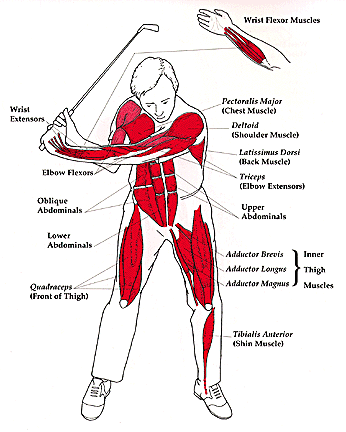
The 2nd area to focus on with distance is flexibility and strength. And in that order. Too many worries about strength and not flexibility. Being strong with good, or great, flexibility “allows” you to get in positions in your golf swing to hit the ball with reasonable distance.

As we get older, we lose our strength and more importantly our flexibility, when we start to lose our elasticity, we can no longer create certain angles in the golf swing that will allow us to create “leverage” in the golf swing which in turn produces speed and distance.

We have produced an extensive DVD on this topic. This DVD is set up to test the areas of your body and its flexibility in these areas. It then gives you 3 or 4 exercises you can perform to regain or create increased flexibility (and strength) in those areas. This DVD designed around the single plane swing of Moe Norman – in other words, it takes the eight most significant positions of Moe’s swing and determines if you are flexible enough to “reach” those positions. If not, it gives you “easy” exercises to perform over time that in turn will help you gain those positions and eventually “allow” you to swing the club on plane.

You can see a lot more detail about the Flexibility and Exercise information at: https://watch.gravesgolf.com/

3.  Swing Technique

Ultimately, the most crucial factor to get more distance is to improve your technique. It is always interesting, one of the things we do at all our schools and camps is to measure our students swing speed. We then correlate it to their driver swing speed and the average distance they should be hitting their driver. For most (those that swing 85 to 90 mph), they should be hitting their driver 230 to 240 yards (with a little roll).

For most, when they find out how far they should be hitting their driver with the speed they currently have, they are shocked. Why are they hitting it so short compared to where “their potential” says they should be hitting it? Because of technique. They are not hitting the golf ball off the “sweet spot” of the club with a “direct hit” from the club that is on the path.

In other words, they are hitting “glancing blows” that is creating side spin which is limiting or reducing the distance they should be hitting their driver.

Working on swing technique – working on getting the club on the proper single plane/path, with a square club face through impact and ultimately, limited to no side spin, will give you the maximum distance.

In conclusion, to answer the all too common question, we get from so many of our students/customers

How can I get more distance?

Answer:

1.  Obtain a new/modern driver that has the highest technology for increased sweet spot and limited wind resistance (aerodynamic).

2.  Work/continue to work on flexibility (especially over the “off-season” months when so many loose elasticities because of an increased static lifestyle) and… 

3.  Always work on improving your technique to maximize the optimal hit on the ball with limited side spin and enhanced sureness of hit.

P.S – Here is the P.S. to this article as EVERYONE will ask this question to us (in person, at schools, during webinars, across emails, etc….).

What is the fastest way to improve technique?

Answer – FIGURE OUT YOUR NEXT STEP TO IMPROVEMENT

To see more about YOUR NEXT STEP TO IMPROVEMENT: CLICK HERE

(You can see the specials associated with the Your Steps Video above)

Please feel free to contact me anytime at timg@gravesgolf.com with questions, comments, etc..

Ball Strikers Creed

At the bottom of this article, you will see “The Ball Strikers Creed” which is a part of the really good “Purify Your Swing” Master Class.  If you’ve never watched it, I highly recommend it. 

Anyway, with my retirement a couple of weeks ago, several people who I am good friends with congratulated me with the gift of free golf, and I love it.  For those of you who don’t know, I worked in public education for the last 30+ years, and the last nine have been as an athletic director at the same large high school that I spent the last 27 years at after 18 as a basketball coach and teacher.  During that time, especially the last nine, the job has really been a roadblock for me to actually go out and play.  For the past two years, I’ve studied and practiced the Single Plane swing as much as possible in the time I could and have made some good strides.  Having said all that, there’s something to be said for just being on the course to get better as a player and to find out where you’re really at….

Scores are relative of course, for each of us.  Some of you, I see you posting your scores in the 70s and I am jealous, but I keep in mind where I’ve been and where I need to go.  And while I flirted just above and below with bogey golf yesterday depending on which nine of the course I was on, I counted on one hand the number of swings I took which didn’t result in contact, which to me, was more than acceptable.  And really, if you’re striking the ball well, a score which isn’t where you end up wanting to be could be a result of not taking into account wind, not having the best handle on your club distances, the contour of the course you’re on and the list goes on and on and on.  But if you can strike the ball and get that Moe-like “click” where he would exclaim “SOOOOO PURE” then you have to feel good about where you are and where you’re headed.  Those other factors just mentioned can be conquered SO much more quickly than not being able to put a club face on the ball properly.

There was a point in my basketball coaching career where our program was doing fine but we weren’t taking the next step with where I wanted us to be.  Being a coach at public school, you’re always faced with the fact that the talent you put on the floor is what it is.  You have to maximize it with how you prepare.  Much like we are the athlete we are as a golfer.  But I thought to myself, “Who are the teams and coaches in our state which are the gold standard?”  Two came to mind.  One of the programs was known for their ultra-aggressiveness and the other was known as the team that was most well-prepared each and every year.  I thought to myself, “If we can prepare and be completely ready to compete with these two teams, it would stand to reason that we would be perfectly fine with the final score vs any team we played” (including those two); and add in to that….the raw talent we had on any roster would not play a factor in this equation.  We would just be maximizing everything we brought to the court. 

As much as someone might wonder how the sports of basketball and golf relate to each other, the will to prepare to be the 100% absolute best you can be regardless of a single round or game’s outcome to me, has to be the goal.  There are zero variables to aspiring to this.

And, as someone who is the same guy now as a member of the Graves Golf staff as I was as a Single Plane Academy member, I write this to hopefully help those who may have been, will be or who are currently in the same situation as me.  Much like the positions of the swing which we have to conquer sequentially, I think our progress in becoming the player we know we can be has to be in some semblance of order too. 

I love reading everything Paul Monahan submits for us to ponder.  I kept thinking of Paul yesterday and The Ball Strikers Creed as I would write down a number I normally would let ruin my round.  Everything in golf, and life really, is about how you approach things.  It’s up to us.

Be Different!

We have discussed this before, but I am constantly reminded and want to bring up again and again and again when I watch “typical” golfers practice at local ranges and golf courses…. the importance of being DIFFERENT than the typical/average golfer.

First – want to remind you of a few stats.

1. The average male golfer shots a 97, female average is 107.
I assume everyone wants to be different than this – wants to shoot better scores….

2. Less than 20% of golfers get some type of “formalized” instruction, whether a lesson, clinic or school. And 75% of these 20% are ladies or juniors.
Meaning – most golfers are trying to improve on their own.

3. Of all golfers who purchase video type instruction, less than 10% ever watch the video(s). (Not just true for golfers, but video instruction in general.)

4. A very small percent (unknown exact percent) have a particular “model” they follow in their golf instruction.
Meaning – a majority of golfers are GUESSING when they are trying to improve.

5. Fifty percent of golfers who practice will get no better, 40% will get worse.
Meaning – only 10% of golfers who practice will improve.  90% will see no improvement or make themselves worse.
Meaning – a high majority of golfers have no idea how to practice.

6. The typical golfer spends 95% of their time practicing their long game, and less than 5% of their time practicing their short game.

If you ask me, I want to be different than the “average” golfer listed above and want to make sure every time I practice I am getting better – EVERY TIME!!

So – What do we need to do to be

different?

MN-Slider-1

1. Have a model you study, have a model you practice. 

Hopefully every one of you is dedicated to the Moe Norman Single Plane theory. That is a BIG start…. being dedicated to this system – you are starting to be different than most golfers who are guessing on trying to improve.

The model/theory can be studied/learned by watching our Single Plane Solution instruction.

(And be one of the ten “percenters” – actually watch the Instruction – LEARN something, study the model, get a good picture in your head what you are working on/towards.)

Understand and learn (everything can be found in the single plane solution) the:

  • Grip
  • Single Plane Address Position
  • The Pivot Point™
  • The Mid-Spine Intersect™
  • The Seven Positions and Movements of the Single Plane Golf Swing
  • The Transition Moe – Moe’s Vertical Drop

2. Work on positions in the swing, short game, etc… Don’t guess on what you are working on.                     

Many times, if not most of the time, working on these positions can and should be done with drills that don’t involve hitting golf balls.

Learn / study the following:

  • How Moe addressed the ball and why a bad foundation causes inconsistency and poor ball-striking.
  • How to feel and master the perfect address position.
  • How to learn the ideal positions the golf swing.
  • How to make the proper swing positions with the PVC Drill.
  • How to know what ideal positions feel like with a golf club.
  • How to work on the proper lower body, leg and knee movement during the swing.
  • How to feel the proper shoulder and club plane.
  • The importance of proper spine positioning.

Consider our Graves Golf Single Plane Academy / Gold Program (at home) – Watch the upcoming webinar (Oct. 20th) for specials / details.

DrillsKit

3. Every time you practice – make sure you are practicing CORRECTLY. 

As stated above, 90% of golfers when they practice, get no better or make themselves worse. Do not be in the 90%.

When you practice – use training aids, check your practice with these training aids and check positions of the training aids.

These training aids include the Alignment and Ball Position Trainer, Grip Training Club, Leverage Bag, Short Game Trainer, and a few others.

2083607567_comp

4. Set Goals for Yourself

I would guess that less than 1% of golfers have ever sat down and listed a set of goals for themselves and their golf game. You might think this is only for the good / great players – UNTRUE. It is/should be for everyone.

Maybe you’ve never broken 100 – write down that goal and then list how you are going to do it.  Write down 5 or 10 things that will help you reach that goal. Maybe working on your short game more, maybe working on a certain fundamental flaw you have, etc. etc…  Maybe just practicing a little more during the week on CORRECT fundamentals … write down how you think you can reach these goal(s).  Try and make a plan for yourself.

SGAT 1

5. Actually practice your short game.

Practice your putting, chipping and your pitching.

70% of your scoring occurs within 100 yards of the green. But a majority of golfers spend less than 5% of their time practicing this part of their game…. If you want to improve, you MUST spend time practicing the scoring part of the game.

Remember my saying – “I have never seen a good player with a bad short game, and I have never seen a bad player with a good short game.”

Long story made short… (as they say) – Please, please, please be different than the “typical” golfer. And that is a REALLY good thing. If there is anytime you want someone to think you are “different” – it is in your golf game.

“Different” golfers are in the 10% group, “different” golfers have a plan, “different” golfers know how to practice, “different” golfers will get better every time they practice, “different” golfers know they are getting better – they have a plan, “different” golfers actually practice their short game.

So, I am telling you to be DIFFERENT when it comes to golf…. and yes, that is a VERY good thing.

Remember – Always Practice with a Purpose

Rethinking Practice and Play

In his book Rethinking Golf, author Chuck Hogan – when explaining the purpose of his book –  wrote:

What this book asks you to do is be fearless. Go Play. Forget what you think play is and just indulge in the experience of play… Return to your origins. Just do. Don’t do “it.” 

Two weeks ago – before everything in this country went sideways – I spent 3 days in Scottsdale with two wonderful and fascinating people in the golf performance space: Lynn Marriott and Pia Nilsson. Lynn and Pia were the long-time coaches to Annika Sörenstam (…only the winningest female player in the history of golf) as well as many other highly successful players on the PGA and LPGA tours.

They have spent their entire careers growing in their own understanding of what creates great performances on the course  – and creating a framework for their

Pia Nilsson (L) and Lynn Marriott (R) teaching at Talking Stick Resort in Scottsdale, AZ

students and clients to “indulge in the experience of play” as Hogan said.  (Incidentally, Lynn worked with Chuck Hogan for many years.)

And while I learned so much about myself and my game that week, among my key takeaways with Lynn, Pia and the Vision54 Team were these:

  1. Our practice sessions can be WAY more productive when we bring purpose to each and every shot.
  2. We can create much better outcomes ON the course when we set aside the need to fulfill swing mechanics objectives and instead focus on what Lynn and Pia refer to as our Human Skills…which we can control.

Practice Slower, Play Faster. This is one of our Alert Attitude of Indifference Big Ten Strategies we teach at our AAI playing schools. It means:

  • That we all benefit by taking a MUCH slower approach to our practice sessions.
  • That instead of raking over and hitting ball after ball after ball, we can be much more productive – and learn a lot more while practicing – when we hit fewer balls – not more.
  • That when every shot has a purpose outside of a technical skill, we can learn to practice hitting shots as an athletic endeavor – not a cognitive one. (Thanks Lynn and Pia for articulating that so well!)

So, what does that look like when I am practicing slower?

  • No more bucket of balls poured-out next to my hitting station. Hit one ball at a time. No more raking over the next ball!
  • Prior to each shot, I am thoughtful about where I want each ball to fly to, it’s trajectory, and perhaps a feeling I am trying to notice.
  • I leave all thinking behind once I step up to the ball…and just “play.” (yes…even in a practice scenario.)

Playing faster on the course is also an important way to rethink your approach to the game. It means:

  • Not lingering over the shot as you are about to hit it.
  • Leaving your THINKING behind when you are executing a shot. (Including thoughts about how to hit position 3, how to keep your primary tilt, how to transition properly…etc.)
  • Creating a deliberate system that gets you to execute a shot in 4-7 seconds instead of 10-20 seconds.

Why is this important? Because executing each shot is an athletic endeavor – not a cognitive one. (Thanks again Lynn and Pia!) The LESS time you spend hovering over the ball, the less chance there is for your (very) active brain to get involved in the process.

As you practice and play over the next few weeks, see if you can do these two things. Practice slower and more purposefully. And when you play, pull the trigger sooner. Stop lingering over the ball. Stop overthinking. Just do.

I think if you can do this, you will have taken an important step toward achieving what Chuck Hogan wanted for all of us to experience when we play. And what Lynn Marriott and Pia Nilsson preach and teach every day. Just play. Just do. Be fearless. Stop getting stuck in your head. Go out and have fun. Loosen your grip on the outcomes. Enjoy the game more.

Stay Healthy!

-Paul

LEARN

THE

SWING

Join 1M+ Subscribers to get your FREE Video Quick Start Guide that reveals how to hit the ball farther and straighter more consistently from now on…

START YOUR NEW GOLF SWING