It’s the Journey

It’s the Journey

In early 2015, I realized that I had visited nearly all 50 states in America….all except Idaho and Montana. It occurred to me that I would be turning 50 years old that year – and I had this idea that if I got a little intentional, I could complete the 50 States x 50 Race” (…I think I made up) by visiting all 50 states before I turned 50. What an incredible accomplishment that would be! Right?

I worked through the logistics: I would fly to Spokane, WA then drive to Coeur d’Alene, ID. While there, I could play some golf, and then make my way over to Montana…only a short distance from Coeur d’Alene. My buddy Jon from high school, – always up for an adventure – would come with me. The trip was on.

So, in May of that year, Jon and I hopped on a flight and we headed out on our adventure. On day one we travelled to Idaho (#49…check!). On day two, we played golf at the Coeur d’Alene Resort (…famous for its moveable island green. Yes…I got the certificate!). And on day three we drove an hour or so East to the Montana border. (#50…check!) The race was over. I won!

Cue the big celebration, right? The elation. The pure joy. The confetti.

Well… what I experienced was a bit different. And frankly it was a bit of a letdown.

There was no there there. I can’t even tell you how ridiculous I felt. I said to myself “ You did what? Travelled all this way just to be able to tell your friends you travelled to 50 states!?”  (… this whole essay is starting to feel like a giant humble brag.)

But the truth is that I had an amazing three days with a life-long buddy who enjoys many of the things I do. Golf, adventure, great conversations about the meaning of life…etc. That was where the joy and happiness was for me. And if I reflect on my journey through the other 48 states, I can think of tons of great memories and experiences as well.

So, by the time I got to the Montana border, the “prize” didn’t matter as much.

The point is this: it’s not about the destination – it’s about the journey. Always has been. Always will be.

When I was younger, I thought that was just another platitude. Pure garbage. A phrase invented by people who were too afraid or too timid to do what it took to get themselves across the finish line.

I don’t believe that anymore. I believe that I am most energized when I am working toward something – engaged purposefully in pursuit of a goal, dream, or defined outcome. On the path. On the journey.

I am immensely satisfied when I arrive at my goals… and even happy or elated sometimes. (Ask me about my experiences walking across the Grand Canyon’s Rim-to-Rim route the next time you see me.) But looking back, it really WAS the journey that mattered most. And looking ahead, I believe it really IS the journey that matters most.

The journey is what points you. It is what energizes you, challenges you, and puts you into the kind of productive struggle that creates growth. (Thank you, Dan Coyle.)

Learning to play golf at a higher level the way you are doing it IS a journey. Remember to enjoy it. Relish it. Know what it is – and what it is not. It IS an amazing adventure of learning and growth. It is NOT your identity. It is NOT an obstacle to be overcome – but an experience to move through that will change you forever.

In Jordan Petersons’ book Beyond Order, he says that “You are not only something that is. You are something that is becoming…”

Humans are teleological… we must have purpose. We must have targets. We must be aimed at a destination…and be traveling in that direction. It is how we are wired. But what truly brings joy, satisfaction and happiness to a life is not necessarily arriving at some pre-ordained goal, but rather what we experience along the journey itself.

The next time you are in struggle, experiencing frustration about your game or about that shot that just went sideways, stop. Take a deep breath and remind yourself:  “It’s the journey.” Then consider the gift inherent in that moment …how that moment will make you stronger, smarter, and more able to complete the journey you are on. Remember that you are becoming… one little step at a time.

Safe travels!


-Paul

Todd vs. Bryson (Part 2)

Hello SinglePlaners,

Here is Part 2 of my swing though vs. Bryson DeChambeau.

Bryson:  SWING ON A SINGLE – PLANE CIRCLE

Bryson: Making a single-plane swing is so easy, it feels like cheating. At address, picture a tilted circle around your body—the bottom runs through the ball and the sides arc through your shoulders. (If it helps, think of your move as a “shoulder-plane swing.”) The goal? Swing your hands, arms and club along the imaginary circle from start to finish (photo, left). That’s it! Years ago, my longtime coach, Mike Schy, built a ring for me at his training center in Madera, Calif., and I’ve spent countless hours in it grooving this simple up-and-down motion—never above or below the shoulder plane. On the course, I like to feel that I’m swinging my hands and arms toward my right shoulder and adding a tinge of wrist hinge and forearm rotation. This way, the club stays in line with my hands and on-plane. Then I just retrace my steps back down to the ball. This image isn’t just for full swings, either. “The circle” works on chips, pitches and bunker shots.

Todd:  Imagination and reality are different.  When you move your arms around your body, they form a natural circle and path we call a plane.  This Natural circle is different on the backswing and downswing because when you rotate into the backswing and then into the downswing, your body is rotationally different. In other words, you have more rotation in your backswing than in your downswing. Therefore, the Circle / Plane must shift to accommodate the body.  Think of Skipping a rock.  The arm moves back in one direction and then forward in another.  The arm is on a Single plane with the body, (not rotating relative to the body) but not on the SAME plane back and forward. 

 Todd: The problem with Bryson’s circle is that it is not Natural and not the Natural path of the arms and hands around the body.  In many ways, attempting to stay on the SAME circle around the body is very unnatural.  The Single Plane should be Natural arm movement around the body.

Here is a video that discusses this: https://youtu.be/kc3KfM-HGQQ

Bryson: MAINTAIN YOUR GRIP STRENGTH

Bryson: Back in step one, I mentioned the importance of gripping the club in your left palm. That’s non-negotiable. But feel free to make your grip as strong (hands rotated to the right) or weak (rotated to the left) as you like. The single-plane swing can work with either one. What’s critical is that you match the angle of your left wrist at the top and at impact to the angle you establish at address. If your grip is super-strong at setup, with a noticeable cup in your left wrist, the cup had better be there at the top and at impact. If your left wrist goes flat at either position, the ball will hook. If you prefer a weak grip, but allow your left wrist to go from flat at address to cupped at the top or at impact, you’ll probably hit a slice. Yes, I know Dustin Johnson starts with a strong left hand and then bows at the top, but DJ is an athletic freak. You and I aren’t so lucky.

I call this “equivalent left wrist,” and it’s yet another way to eliminate unnecessary swing variables. (Less is more!) To practice, make slow-motion backswings, monitoring your wrist position throughout (you can swing next to a full-length mirror, if it helps) and minimizing your wrist action. I’m not big on effortfully hinging the wrists. Rather than making a conscious swing move, let it happen smoothly and naturally.

Todd: I disagree. Bryson’s “equivalent left wrist” ignores an important variable – the club face.  For a person who is eliminating variables, I would think he would want to eliminate variables here too.  If you are going to match address with impact, the solution is to find the biomechanical easiest way to square the club face from address to impact.  You cannot ignore the club face in this scenario. You also cannot ignore how the hand position affects body motion.   By the way, you don’t see Bryson with a strong grip.  He definitely does understand this at some level.

Todd: Furthermore, Grip size determines where the club rests in your hands.  Gripping in the palm is relative to grip size.  As far as the left hand is concerned, you must align the Lead hand with the club face.  You cannot grip a stong or as weak as you like because the hands work together in unison.  Your body must accommodate your lead hand and arm position at impact. 

BRYSON:  SHIFT LESS, ROTATE MORE

Bryson: It’s difficult to make a good single-plane swing if you have a lot of lateral motion. There’s no need to aggressively shift weight back and forth when you swing. But you do need to rotate. Simply put, rotation is your swing’s engine. Just make sure to rotate in place, keeping your head in the same position from address until after impact. Check out the photos at left: I’ve merely rotated my body to the right on the way back, then turned it in the opposite direction into a full finish—all while keeping my weight spread evenly in my feet. Removing lateral weight from your swing is yet another example of eliminating a needless variable.

Rotation has two big benefits over lateral movement. It helps the club swing along the plane established by the shaft’s lie at address. And the more you rotate, the faster you swing, so you make up for speed you may have lost by switching to a palm grip. This swing is just as fast, twice as accurate, and simpler than ever. Congrats. Golf is about to get a lot more fun!

Todd: To discuss Lateral Motion and Rotational motion you need to understand the how the spine works when it is tilted.  I know that sounds mechanical however, Bryson says he bases his swing on Science, so there needs to be discussions about Kinesiology here.

Todd: I agree with the analogy that rotation is the swing’s engine however the lower body must be stable to use the engine.  (You can’t move a car when it is on ice no matter how powerful the engine).  Lateral movement is a part of stability and it occurs because of Rotation.  Again, this sounds complicated and it might be what Bryson is trying to describe but a simple observation of the pelvis movement (Sacrum) you can see in this video.

Lower bod video here: https://youtu.be/mdO0-6FxzXc

Todd vs. Bryson (Part 1)

#MoeNorman #BrysonDeChambeau #TheSinglePlaneSwing

There has been a discussion about Bryson’s Comments about the golf swing from an article in Golf Magazine.  I love what Bryson is doing for golf.  I love the way he starts and impacts on The Single Plane. 

There are variances in what I teach vs. what Bryson Teaches.  Below, you will see my comments about the differences in what Graves Golf Teaches vs. Bryson.  I have taken the liberty to put Bryson’s name in front of his quotes from the article. 

Bryson: GRIP THE CLUB IN YOUR PALM, NOT YOUR FINGERS

Bryson:  Most golfers are taught to grip the club in the fingers, to help create more clubhead speed. But research shows that your hands contribute only 10 percent to your overall swing velocity. Would you trade just a little speed for a grip that lets you hit a lot more fairways and greens? I thought so. (Don’t worry—I’ll show you how to get back those missing mph’s a bit later).

Step one in establishing a single-plane swing: Place the grip in the middle of your left palm, then wrap your digits around the handle (bottom photo, right). Your hold will feel more secure, and the grip will sit higher in your hands, creating the ideal angle for a single-plane swing. In a finger grip, the shaft sits too flat in your hands, adding a needless variable to your motion. To ramp up your control, try a thicker grip, like I have. Using a palm hold on a standard-size grip often makes it difficult to get your left-hand pinkie all the way around the handle. You need all 10 fingers on the club to consistently catch the ball square.

Todd: I agree that speed doesn’t come from the hands. I disagree that holding in the Palm has much to do with Single Plane.  The Single Plane alignment runs the axis of the club through hand because of tilt of the body and hand and forearm rotation. 

Todd: Also, holding in the palm is relative to grip size. Yes, I believe Grip size matters but it is Shaft Axis (Through the hand) that matters.  The grip may fit into the palm, however, just like if you hold a water bottle, the bottle is in the palm but the center line (axis) of the of the bottle is not.  

Todd: No, You do not need all ten fingers on the club to catch the ball square. There is no scientific basis for that comment. The ball has no idea how you hold the club.  The club is reacting to the hands as levers.   As a matter of fact, there are two levers,  the left wrist and right wrist.  They act as hinges.  You must get them to work together.

Here is a video to clarify: https://youtu.be/NbtwprWqDCk

Bryson: USE MY “IMPACT FIX POSITION” TRIGGER

Bryson: Something always bothered me about the swing as it’s commonly taught: You start in one position (address) but “end” in another (impact). That’s another variable to worry about, and if your goal is to swing on the same plane from start to finish, the starting and end points must match. That’s why I get into what I call an “impact fix position” at address. It’s not a drill. On every swing, I press my hands forward and shift some weight to my front foot in a mock impact position before I start back. I learned about this move while reading Homer Kelley’s book The Golfing Machine as a kid, and it really clicked. Case in point: On Tour in 2016, I was seventh in proximity to the pin from 125 to 150 yards (19′ 3″), and I ranked fourth from 150 to 175 yards (24′ 1″). And those numbers could have been even better! (I only played in 13 events.) A lot of my success is about removing superfluous moves and making my swing more repeatable, and this swing trigger keeps things simple. And let me add: There’s no such thing as “natural talent.” Anyone can do this! The guy who always beats you? I’ll bet he’s simply applied himself more to learning the game. You work hard, too, but hard work is useless if you get bad information. I wouldn’t preach the single-plane swing if it didn’t work!

Todd:  I agree that you can simplify the golf swing at address and at the start.  The Single Plane Swing starts and impacts on the same plane (shaft positon). 

Todd: In The Single Plane Swing, Moe started club head behind the ball and his hands ahead of the club head.  This was Moe’s Preset position.  This also tilted his spine closer to where it would be at impact.  This also promoted a Natural takeaway making it easy to stay under the plane into impact. 

Here is a video about The Perfect Single Plane Address:  https://youtu.be/Dg5zIHfENAA

Part 2 Coming Soon.

Take Excuses Out Of The Bag

Last week was the annual PGA Golf Show in Orlando, FL. The show is held each year and attracts thousands of professionals from across the country (and world) to see the new golf attire, golf course equipment, golf clubs and anything else you can imagine associated with the game of golf. Immediately after the show, most golf club/equipment companies release their new lines of clubs for the upcoming year. They introduce them at the show, and put them “on the market” immediately after.

Myself and my staff attended the show, and as always, spent the day wearing out our feet while making sure to see as much of the new equipment as possible. After seeing all the new equipment and spending many hours taking to the reps about their equipment, thought it would be a good time to review with all of you how the Graves Golf Academy fits clubs to your single plane golf swing. I will also talk about some of the new clubs out there and which are better for this swing, etc.

First, let’s talk about fitting – or as I call it “Taking the excuses out of your bag”. It is absolutely imperative all clubs in your bag are fit to YOUR single plane swing. As I discuss the different areas of fitting, I’ll explain why each area is so important.

I’ll will remind now (and later) – everyone can get a free fitting through Graves Golf at: Club Fitting Form

(Please give me a day or two to respond with your recommendations as some days we receive upwards of 100+ requests for fittings – and each response is personalized.)

There are 6 areas we look to fit clubs to your single plane swing. Length, lie angle, shaft flex, grip size, loft and set make up.

1.  LENGTH – The proper length of a golf club for your golf swing is critical. Length of the club is determined by comparing your height to your arm length (wrist to floor measurement). Having the proper length for you for each iron, driver, fairway woods, etc. will allow you to stand the proper distance from the ball with the proper spine tilt (bend at waist). Example – You need to stand 26 inches from the ball (golf ball to toe line) with a 45* spine tilt with a 6 iron. That will allow you to get the golf club on the single plane and allow you to get your arms, hands, etc. in proper position. If the club is too short, you will not have enough room to get the arms and hands in proper position and if the club is too long, the arms will typically be too high and spine tilt improper – causing golfers to swing “around” themselves, rather than “under” themselves (proper). Each club must be the proper length for your height vs. arm length. This is absolutely one of the key factors to getting the club on a single plane – your club lengths must be individualized and optimal for you and your single plane swing.

2.  LIE ANGLE – The proper lie angle is as critical, if not more, then length. The lie angle is also determined by your height vs. arm length. When set up in the proper single plane swing position, the leading edge of the club should be FLAT to the ground for you. As the set up position mirrors the impact position, the lie angle should allow the leading edge of the club to be flat to the ground at set up and impact. This will allow the club to “cut” square through the ground at impact. Improper lie angles will cause the heel or toe to dig into the ground with a good swing and the ball will fly dramatically off line. An improper lie angle of only one degree can cause a mid-iron to fly many yards (10 or 20 yards) right or left of the target. The problem is, you will make adjustments in your swing for improper lie angles. Adjustments away from the proper single plane swing fundamentals. The proper lie angle (individualized for your body measurements) is CRITICAL if you want to make rapid and proper improvement in your single plane golf swing.

3.  SHAFT FLEX – The proper shaft flex is critical for proper ball flight. Shaft flex can range from Ladies flex to Extra Stiff flex (with up to 17 flexes (graphite) in between). The more flexible the shaft flex, the higher the ball will fly. The slower a golfer swings their clubs, the more flexibility (flexible) they need in a shaft. We can determine swing speed by average distance you hit particular irons and then determine what flex shaft is needed for proper ball flight. For example, an average 6 iron’s equation is 1.77 yards per mile an hour. Meaning – if you hit a 6 iron 150 yards on average, you swing the club around 85 mph. This equates to a mid-Regular flex shaft. This is only an example, but with and individual’s average 9 iron and/or 6 iron distance (and/or swing speed) we are able to fit shaft flex accordingly. Too many golfers hit shafts that are too stiff for them, causing them to try and “lift” their golf shots for added height the shaft is not giving them. This “lifting” causes many problems in the golf swing (casting, over the top, topping the ball, etc. etc..). All because of improper shafting. Also, improper shaft flex typically leads to improper ball position. Golfers that hit shafts that are too stiff for them tend to put the ball too far forward in their stance (to help get the ball then needed height). This can cause a lot of swing issues like lateral slide in golf swing (and eventually shanking the golf ball), over the top move, topping the golf ball, etc… It is CRITICAL to have proper shaft flex as it allows for proper ball flight which will give you maximum distance for each club and allow you to hit the ball with proper flight from proper ball position fundamentals.

4.  GRIP SIZE – The proper grip size will allow you to maximize the release of the club and give you maximum distance with this release. Grip size is determined by you hand size. The measurement from the crease at the top of your wrist to the end of of middle finger. Proper grip size allows you to grip the club with “minimal” pressure, enough to keep the club from slipping in the hands, by not too tight causing too much tension in the hands, wrists and forearms which will dramatically reduce leverage angles through impact which will hinder distance and consistency.

* Plus – as you see above, we offer a “specialized” grip (the Graves Golf / Moe grip) with markings on it that will allow you to grip the club exactly like Moe (and check your grip) EVERY time you hold your club. The grip is USGA conformed.

* Callaway Golf installs the Graves Golf grips (our grip) on all clubs ordered through Graves Golf customized to an individual’s hand size. And these grips are installed, etc. at NO extra charge to you the customer. These grips are only available on clubs purchased through Graves Golf (customized to individual) or can be purchased for aftermarket installation at:  Graves Grips

* A grip installation video (showing how to install and build up the Graves Golf grips) can be seen at:  Graves Grip Installation (Graves Golf grips)

Proper grip size is critical to allow for optimal feel and control of the golf club and thus allows for maximum leverage in the golf swing and optimal release. This will allow you to optimize distance and control in your golf swing.

5.  LOFT – Industry average has a 4* to 5* separation in loft between the irons/clubs in a set. This, and the length of the club, are what give the golf clubs different distances when you hit them. On average (for the average golfer), with proper length and loft, there is around a 10 to 12 yard separation between clubs (ex. you hit 9 iron 110 yards, you will hit 8 iron 120 yards, etc.) This is an average.

Loft becomes a big factor in the fitting process in a couple different areas:

* Driver – it is absolutely necessary to get the proper loft on your driver to give you maximum flight and roll of your driver. The biggest factor determining what loft you need is your swing speed (listed above how calculated, etc..). Too much loft will lead to hitting too high and minimal roll, too little loft will lead to lose in flight distance. Too much or too little loft will cause loss of distance with your driver.

* Fairway woods – it is necessary to hit fairway wood(s) with enough loft that fit your swing speed/game. For most, they should not be hitting 3 woods (around 15* loft) off the ground as it is not enough loft to give them maximum fly. It is recommended you swing the driver at least 90 mph in order for you to hit a 15* fairway wood. Most golfers (average golfer) should hit a 4 or 5 wood (18* or 19*) fairway wood as the longest club off the ground. They will actually hit this club longer than a 15* club as the added loft will give them the optimal fly (and roll).

* Hybrids/Rescue Clubs/Utility Clubs – these clubs are long iron replacements. They have the needed loft and wider sole (than equivalent iron) that will allow golfers to hit the longer clubs (less lofted clubs) in their bag with the needed height and distance to be able to hold greens, etc… Average golfers, hitting their 6 iron 150 to 160 yards should hit a 3, 4 and 5 hybrids (not long irons) to give them the optimal flight and ability to hold greens with the longer clubs. All golfers need to have their club (set make up) set to their game.

* Wedges – loft of wedges need to be set to maximize an individual’s short game. There should not be uneven gaps in loft between the different wedges. Meaning – if you carry 3 wedges (Pitching, Sand and Lob)  – maybe a 6* to 8* gap between wedges. If you carry 4 wedges (Pitch, gap, sand, lob) – 4* to 6* separation, etc… Optimal scoring in golf is set up with the short game. The short game is optimized with even gaps between your wedges.

6.  Set Make Up  –  The proper set make up is individualized for each golfer. It is recommended according to individual’s:

* Swing Speed (distance they hit clubs)

* Divot pattern (Divot/No Divot) – Less divot, wider sole club recommended

* Golfer’s physical condition (injuries vs. body problems, etc…  Examples – arthritis, chronic back problems, etc.)

* Need for “feel” in the clubs vs. “forgiveness” in the clubs (or combination)

* General golf ability (new golfers vs. experienced golfers)

* Others (there are other factors we consider when recommending clubs – (for example – young golfers – how much will they grow, etc.)

These are the main areas we focus on when we fit a set of clubs to an individual’s golf game.

Whether looking to fit/replace a single club to an entire set, from a putter to a driver to your irons, wedges, etc.. it is ABSOLUTELY CRITICAL that the club(s) is fit to YOUR individualized swing and single plane specifications.

An UNfit club will hinder your improvement process, an UNfit club will hinder your golf game, an UNfit club will not allow you to reach your potential, an UNfit club can and many times will actually physical hurt you (tendonitis in elbows and wrists are many times causes and exaggerated by club with improper lie angles), and UNfit club is basically worthless to you. I don’t care how much you spent for the golf club(s) – if they are not individually fit to you – they are worthless to your game – and worse than that, can and many times will actually “hurt” you.

Graves Golf has a custom fitting program established with most major manufacturers in the golf industry. And many of the manufacturers install our grips in their custom department (no other instruction group can say that….). We have worked VERY HARD to set this customizing system up for our customers, students, etc. anyone interested in the single plane golf swing.

Also, because of the amount of equipment we sell from each manufacturer, we are many times offered equipment at a reduced rate for our customers. We are always able to match industry pricing and many times able to beat the pricing. We are also many times able to offer clubs at a significantly reduced price.  Please watch our newsletters (bimonthly) for these specials – as they typically don’t last long as many are interested in these special pricing.

Customization done at the manufacturer  is free through Graves Golf, there is no added cost for the Graves Golf grips installed and customized at the manufacturers. Plus, there is no shipping charge (within US) and no tax (outside of OK) through the Graves Golf.

To get a FREE individualized custom fitting please go to:  http://moenormangolf.com/clubs/free-club-fittings/

(Please give me a day or two to respond with your recommendations as some days we receive upwards of 100+ requests for fittings – and each response is personalized.

If you would like more information about custom fitting, questions about your clubs, about any new or old equipment on the market, etc… etc. please don’t hesitate to email timg@gravesgolf.com or timkgraves@aol.com any time.

Like Having Moe in My Pocket

#MoeNorman #GravesGolf #TheSinglePlaneGolfSwing

If don’t know about you but I love my peaceful mornings on the range.  I look forward to them.  They are a meditation. I find these sessions are so important that every Sunday when I plan my week, I make sure I put them on my schedule.

At my home club in Oklahoma, I even have a special “corner” of the range.  It’s my spot on the end of the practice tee where I like the visual angles to the targets.  It’s my place to get away from phone calls and distractions so I can be alone and focus on my swing.

Recently I was in my “place” having a fun practice session and I remembered a comment Moe made to me about practice.  He said that the swing is “Natural, with less moving parts.”

 I wanted to share with you my take on why Moe’s Single Plane Swing, The Single Plane Swing, is “Natural”.

If you are wondering what makes a great golf swing, it comes down to having proper path and face angle of the club as you swing through impact – what some call swing plane. What most golfers don’t understand is that swing plane occurs naturally.

The good news is that the club starts on an ideal plane, the way it is designed.   This is the ideal starting position that creates the ideal spacing from the body.

Todd Graves Single Plane Address

As you rotate and move your arms into the backswing, you notice that the club will move under the plane line but parallel to the original plane.

The Single Plane Backswing

This is because during the backswing, the body has 50 degrees of rotation.  This is the natural movement of the arms relative to the body rotation.

The Single Plane Torso Rotation

Then as you swing down, the club returns to impact on the same plane you established at address.

The Single Plane Impact
The Single Plane Impact Plane

The club even matches the plane on the through swing.

The Single Plane Finish Plane

He said, “No matter how good you are, you can always make it stronger”.   Moe has always been my inspiration and watching his swing always motivates me.   I learn every time  I watch him and I just can’t get enough.

That’s why, thanks to some recent additions to our delivery platform, finding a video of Moe is easier than ever.  My favorite videos of Moe are now on our latest platform, Graves Golf On-Demand.

I opened the Graves Golf On-Demand App (available in the App Store, Roku, and other platforms) and watched a video of Moe called Pipeline Moe in “The Moe Norman Archive” – my personal collection of Moe Norman videos.

Moe Norman Archive

Watching Moe’s Motion, and his purity of technique I found myself reinvigorated and motivated to hit 30 more drivers with the “vision” of Moe’s swing in my mind.  Having Moe in my pocket was a perfect motivation.

Graves Golf On-Demand might not change the world, but it certainly changed how quickly I can access information when I need it.  Inside the app, you will also find all of our Single Plane Training ranging from the basic Single Plane Solution to the more advanced Domino Effect.

To find out more about Graves Golf On-Demand and having Moe in Your pocket, click this link.

watch.gravesgolf.com

See you there!


Increasing Speed and Distance Over the Winter

As many of you know, we very seldom recommend training aids unless they are directly related to practicing Moe’s single plane swing and to be honest, most of those have been designed and produced by us. From the alignment and ball position trainer to the training grip club to the short game trainer to the perfect impact club, all our training aids have been designed to help you achieve your goals FASTER and MORE EFFICIENTLY. We have always designed our training aids to help all you improve more efficiently and keeping in mind, what will keep all our students on the “right path” during their practice.

One issue, we have dealt with since the start is how to create more distance. The answer has always been (and still is) – become more flexible, or at the least, maintain your flexibility and work on your fundamentals to hit the sweet spot on the club on the perfect plane more often. Ideal mechanics with good flexibility will get you maximum distance for your swing.

But, what can you do to increase distance?  To be honest, we have never had a “great” answer…. until now.

Long story made short…. I have a son who plays baseball and works with his traveling team everyday on fielding, pitching and hitting. A couple of practices ago, one of the dads showed me a new training device that his son was wearing to create bat speed. He told me this device was used by many professional athletes and Olympic athletes to create speed.

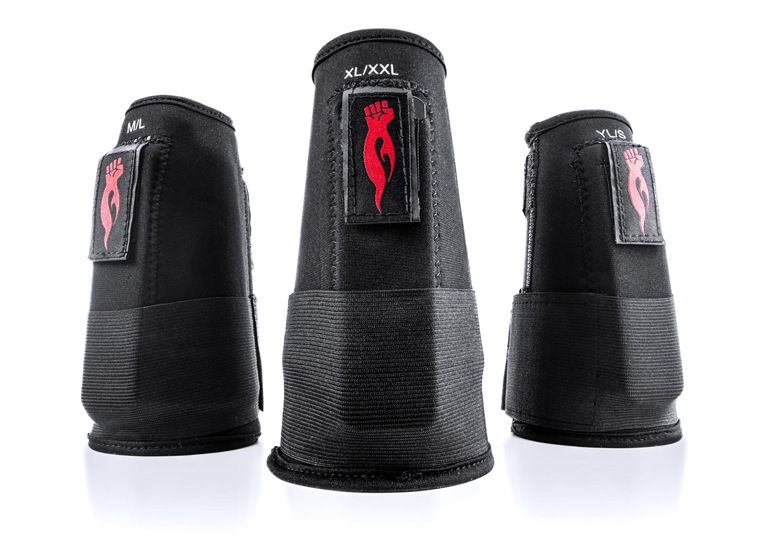
The Hand Speed Trainer™ was developed by US Bobsled Team Member and sports enthusiast Dave Owens.

While Dave was traveling, training and competing at sports venues all around the world, he had a vision, a foresight of a training device that was needed but not yet developed to aide in quickness, speed and strength…three key elements that enhance athletic performance. He designed this training device, created it and has now patented the “Hand Speed Trainer™.” The Hand Speed Trainer™, HST™, is like no other. It is a training device that fits securely on your forearm that allows you to accomplish resistance-type training with weights while not restricting any other movement to achieve top athletic performance. It can actually train your body to operate and accept a new level of performance. By keeping the weight closer to the center line of the body an athlete is able to maintain correct body mechanics without altering them. The HST™ allows you to train smarter and maximize your efforts.

The Hand Speed Trainer™, now will allow you to functionally strength train by performing work against resistance the right way. It is as critical to train the specific movement as it is to train the muscles involved in that movement. Your brain simply thinks in terms of whole movements not in terms of individual muscles. The exercises with the highest transfer effect are those that are essentially similar to the actual movement or activity of the skill that you want to perform in your sport.

For you to get optimal results in your sport repeated practice of the precise movement or skill is absolutely essential. It’s a must. It’s required. Because of the unique Hand Speed Trainer™ weighted system, you as an athlete are able to increase resistance in minimal increments in as little as 4 ounces. This prevents the bio-mechanics of the movements that you are focusing on from being compromised.

This allows complete focus for your neuromuscular system to specifically and functionally adapt the memorization of the specific movement needed for you to improve your overall athletic skills. Your body will adapt to the demands that are placed upon it. By wearing the Hand Speed Trainers™ as you repeat sport specific movements such as hitting a golf ball or performing drills you will see incremental improvements quickly.


Hand Speed Trainer

Hand Speed Trainer

In the past few weeks, Todd and I have used the hand speed trainer and it has shown positive results in increasing hand speed and distance. In fact, results faster than we thought would happen.

A golf study was performed and the following results were found:

Golf Study

Hand Speed Trainer Effects on Club Head Speed, Ball Speed, Total Distance and Swing Mechanics: Weighted Progression; 25 swings, 3x/Week for 4 weeks (Week 1 – 4oz, Week 2 – 8oz, Week 3 – 12oz, Week 4 – 16oz).

PURPOSE: To examine the effects of 4 weeks of weighted resistance training using the Hand Speed Trainer on club head velocity, ball speed and total distance as well as swing mechanics.

METHODS: Golfers of varying ages and handicaps wore Hand Speed Trainers for additional resistance while taking twenty-five swings, three times per week. Resistance began at 113.4 g (4 oz.) and increased by 113.4 g (4 oz.) every week for 4 weeks. By week 4 the resistance was 453.6 g (16 oz.).

Each golfer (ranging in age from 13 to 61) recorded 5 swings measuring club head velocity, ball speed and total distance before and after the four week testing.

RESULTS: Data from 50 swings were collected measuring club head velocity, ball speed and total distance pre and post 4 week Hand Speed Trainer testing. Participants used 6 and 7 irons during data collection.

Screen Shot 2016-11-07 at 7.57.02 PM

CONCLUSIONS: The data indicates that golfers using the Hand Speed Trainers 3x/week (75 swings) for 4 weeks (300 total swings) achieved an average increase in Club Head Speed (+3.50 MPH)Ball Speed (4.55 MPH) and Total Distance (+7.1 YDS) with their 6 or 7 irons. This correlates to 20 to 25 yards with their drivers.

To see more about Hand Speed Trainers:  CLICK HERE

To see Video on Training With Hand Speed Trainers:  CLICK HERE

LEARN

THE

SWING

Join 1M+ Subscribers to get your FREE Video Quick Start Guide that reveals how to hit the ball farther and straighter more consistently from now on…

START YOUR NEW GOLF SWING