Carpe Diem

Carpe Diem

If you are of a certain age, you may remember the scene from the classic 1989 movie Dead Poets Society in which Robin Williams implores his young students to “Seize the day, boys. Make your lives extraordinary.”

In that scene, Williams (as Professor Keating) leans on the Latin phrase carpe diem – loosely translated as seize the day – from a poem written by a famous Roman poet named Horace in 23 BC.

The context of Horace’s poem in which the words carpe diem appear – we are not guaranteed tomorrow, life is fleetingly short – has two implications. First, if you are not intentional about creating exactly what you want in your life, before you know it, you will run out of time. Second, life is meant to be enjoyed – and if you forget to enjoy today you will have wasted a very precious gift.

In the past 30 years or so, carpe diem has been popularized as a motivation to: take on today, to seize it, to crush it, to make it the best day ever, to “win” the day, to dominate the day…etc.

All well and good. But it turns out that the sentiment of carpe diem is more accurately translated as “pluck the day.” In other words, to approach today as if it were a piece of ripe fruit on the tree of life ready to be plucked and enjoyed.

Why is this subtle shift in meaning important? If today is to be plucked, there is no need to chase it down, grapple with it, fight with it, seize it or overcome it. It is here already to enjoy…all you need to do is step up and pluck it. It also means that you live in a state of abundance. The tree of life is essentially right beside you – and full of ripe fruit.

Having a masterpiece day today need not be rare, or an exception. It is available to you right now. (But yes, you must act!)

As you begin the new year and think about all you want to accomplish in golf in 2022, consider the shift in thinking and actions required for you to pluck the day today – and what it could mean for how you approach your Single Plane Journey.

Maybe it would mean getting after the things that are important to your development journey in golf…like waking up a little early tomorrow to stretch and prepare your body for practice. Or eating a little more sensibly this week so that you have the stamina to play your best for a full 18 holes. Or sending that video into the GGA coaching staff so that they can help you in your transition from the top.

Perhaps it would also mean enjoying and appreciating more moments – big and small…like the smell of the grass at the course you are playing at, or the sound of a perfectly hit shot, the feel of a well-struck putt, or the satisfaction of keeping your head down on that slippery 8-footer on the 18th.

And maybe it would mean taking the focus off yourself and your own needs and turning it towards others… inspiring, influencing, serving, or make a difference in the lives of the people around you.

Perhaps it would mean doing one thing each day this year that gets you closer to your goals, makes you 1% better, or improves the life of another.

The day is yours for the taking. Get after it, yes – but savor it as well. No need to seize it or wrestle it to the floor. Just pluck it. Just step up and do the things that get you closer to what you want to create in the game you love and the life you lead.

Here’s to an extraordinary 2022. Carpe Diem!

-Paul
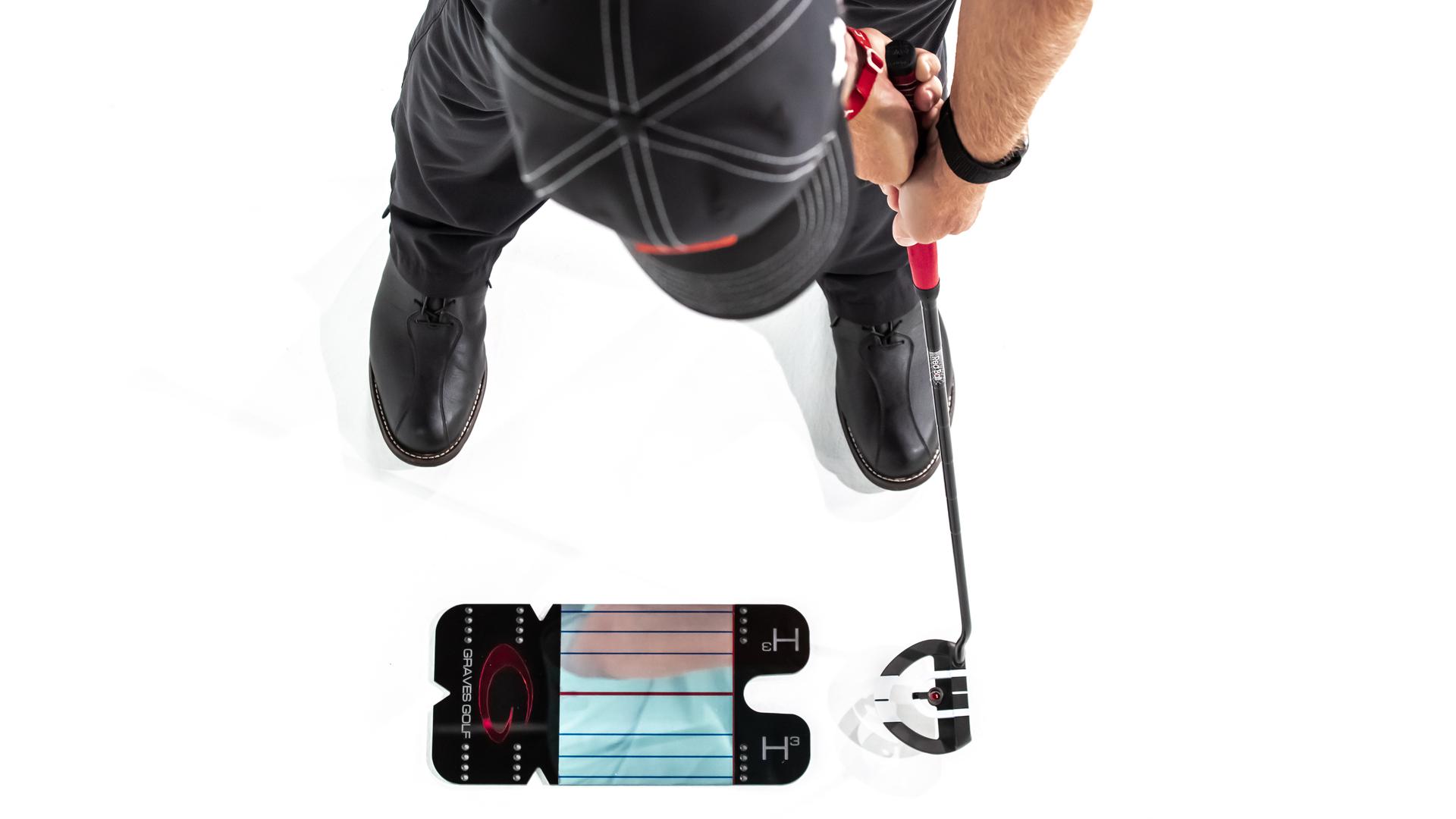
5 Minutes to Lower Your Scores

Well, we’ve reached the end of 2021.  If you’re like me, you’re ready for a fresh start!

I’m not gonna preach at you today about how important your putting stroke is.

If you’ve been around for a bit, you know that I’m VERY passionate about putting!

When it comes to creative and simple ways to check each aspect of your putting stroke away from the golf course, I’ve tried them all.

It was through many years of trial and error that I developed what I consider a great, as well as simple way, to check each aspect of your putting stroke away from the golf course.

You see, to practice efficiently, you must check a couple key areas:

  1. Squareness of putter face
  2. Eyes over the ball (target line)
  3. Squareness of shoulders at address
  4. The path of the putter head during the stroke

Being able to check these fundamental positions each and every stroke is key to having productive practice sessions.

With the development of the H3 Putting Mirror, I now have a way to ensure each fundamental of my putting stroke is perfect.

Simply put, this is a vital tool during my off season practice.

If you aren’t using an H3 Putting Mirror, I have to ask you, bluntly,

“Why?”

Even a 3-5 minute practice session in your living room with the H3 Putting Mirror will ensure:

  1. Your eyes are over the ball (target line), which will help you see the line, as well as create an ideal stroke.
  2. Ideal shoulder alignment that you can check in the mirrored surface.  Square shoulders produce an ideal stroke.
  3. You’ll see a perfectly square club face, as well as the ideal stroke with the guidelines on the H3.
  4. Raised edges will make you catch the ball on the upstroke, creating a perfect roll every time.
  5. CNC milled holes to develop a putting gate to further hone the perfect stroke each and every time.

THE 3 Ps OF PUTTING AND USING THE H3 PUTTING TRAINER

What are the 3 Ps of putting?…  simply stated, it is “Practicing your Putting with a Purpose”

Folks, it is actually pretty simple and painless, you just have to DO IT RIGHT!!!

Now, before you think to yourself, “Yeah, I know, Tim always says how important putting is, but I really need to work on my full swing first”, please read the following stats and “studies” that have been conducted and then I will explain how you can literally improve your game overnight…

First – You must first realize the importance of putting. 43% of scoring occurs on the putting green for the average player (male shooting 97, female shooting 107). As the scoring increases, so does the % of putts. For a scratch golfer, the percentage lowers to about 40%, but no lower.

The statistics are as follows:

30 handicap golfer (aver score of 100) – average 45 putts per round

20 handicap golfer (aver 90) – 40 putts per round

10 handicap golfer (aver 80) – 35 putts per round

Scratch golfer (aver 70) – 30 putts per round

Professional golfer – 28 putts per round

Second – You would think “that only makes sense” as the 30 handicap golfer will hit it further from the hole than the 20 handicap golfer, thus have more putts…. but you would be wrong. If you think of the way golf is played and the way putting stats are kept (just add up how many putts you have once the ball is on the green) – the 20 handicap golfer actually will hit more greens in regulation than the 30 handicap golfer (the 30 handicap golfer will be chipping from the side of the green, etc..). Meaning, if you take the average distance to the hole once the player hits the green, typically the 20 handicap golfer will be further than the 30 handicap golfer… in theory if both had equivalent mid/short games – but here lies the problem.

Third – There are only 3 areas that matter in putting (or any part of the golf swing) – Path, Face Angle, and Speed. Putting is affected by these 3 areas and only these 3 areas. Meaning, everything you work on in putting (for example the grip, set up, etc..) affects either path, face angle and/or speed. The better your path, the better your putting, the better your face angle at impact, the better your putting, the better your speed, the better your putting.

Fourth – READ THIS VERY CAREFULLY: Studies have shown that of 10 golfers who practice their putting, 5 will get no better, 4 will actually get worse, ONLY 1 will improve after practice. Please read this again – of those who practice their putting, 10% will improve after the practice, 50% will not, and 40% will ACTUALLY MAKE THEMSELVES WORSE. (This study was performed numerous times testing golfer’s putting prior to their practice session and after.) As is said by the individuals who performed these studies, “Golfers can add, subtract, multiply and divide, and they DON’T like these odds.” I don’t know about you, but if I have a 90% chance of not improving when I practice, “I ain’t practicing” (as they say in Oklahoma…)

Okay – now that everyone is on a “downer” about their putting practice, we’re here to fix that.

Over the years of playing and practicing with some of the best players in the world (including Moe, Tiger and many others), competing against many of these players, studying numerous techniques of the short game, etc… etc. we have created/perfected a method to improve your putting.

H3 Putting Trainer – How to Practice Your Putting with a Purpose EVERY TIME you practice. (In other words, every time you practice, you will one of the 10% who improves!!)

This is a Putting Trainer that works – WE GUARANTEE IT!!! This is how you (and most professionals) improve your putting. The system is not hard – in fact, it is very simple and doesn’t take that much time. Every minute you practice using the H3 Putting Trainer, it will improve your putting… which in turn will improve your scoring and decrease your handicap – SIGNIFICANTLY!!

Here are highlights of the H3 Putting Trainer:

    * Mirror for proper eye and shoulder alignment 

    * Beveled leading edge for easy ball placement 

    * Easy to see red line for proper path and face alignment

    * Red line to check ball under eye line and head still during putting stroke

    * Blue alignment lines to help the putter go back square

    * Blue alignment lines to square your shoulders

    * Putting gate holes to use tees to get path correct in back stroke (set up for different sized putters)

    * Putting gate holes to use tees to get path correct in through stroke (set up for different sized putters)

    * Raised edges for proper stroke.  Upstroke at impact, and proper back stroke

Here is what the H3 Putting Trainer checks (check points) every time you use it:

  • Square putter face at set up
  • Eyes over the golf ball (ball under eye line)
  • Golf Ball is forward of center at set up (creates overspin)
  • Golf Ball is set up in the middle of the putter (sweet spot)
  • Shoulders are square at set up
  • Only the shoulders move / rock in putting stroke.   Remainder of body still.
  • Hands lead maintaining shaft lean through impact 
  • Golf ball is impacted at center with no side spin (only overspin) and on center of putter 
  • Golf ball is hit on an upward blow
  • Hand are leading (H1)
  • Hands down the line (H2)
  • Hip check reminder (H3)

Everyone – no matter where you game is now – needs to improve their putting. You need to create more consistency in your putting. As shown, it is absolutely the faster way to lowering your scoring.

Remember the 3 Ps of Putting – Always Practice Your Putting with a Purpose and the best way to practice with your putting with a purpose is to use the H3 Putting Trainer.

H3 Training Aid:  CLICK HERE

H3 Training:  CLICK HERE

Why We Do What We Do…

Received a couple very nice email this past week – wanted to share.

Tim and Todd,

I have been with you since my first GGA school in October 2009. A lot has happened during that time: my game has gotten frighteningly good at times and poor at times when I deviate from the model or my body fails me.

As I write this I am 81 years old having survived pancreatic cancer & dealing now with metastatic prostate cancer. Still, I haven’t lost my desire to play or my commitment to the SPS.

Throughout these many years I have been constantly amazed by the devotion each of you shows to teaching and supporting your players. It’s astounding the new ways you both communicate to help us, whether on YouTube, gold and regular webinars, weekly videos, etc. or the man hours I can only imagine the club fitting and equipment fulfillment load Tim takes on.

As I start into my winter training, I want to thank each of you and your entire team for everything you do for each of us and the game of golf.

May 2022 bring you increased success, personal fulfillment and plenty of opportunity to refresh yourselves both physically and spiritually.

You guys are the absolute best.

Tim Grogan
Brigadier General, USA (Ret)
SPS & GGA devotee

********

Happy New Year to all the staff at GGA. I just finished watching the clip on maintaining side bend. Great instruction and detail. I have enjoyed the On Demand on my big 65 LG screen. The visual is so good can really see the face of the club and all the positions. I can now watch from my recliner after my shoulder surgery and not have to worry about being in front of my computer.

Graves Golf has done so much for all of the SPS. I was ready to give golf up and ran into someone on a driving range. I watched him hit the shot the same way every time, so I asked where he learned that swing. His response was have you ever heard of Moe Norman, which I hadn’t DUH! I Googled him and it led me to Graves Golf Academy. I have attended two schools in OKC and became a GOLD member. I attend all the Webinars and LOVE the ON DEMAND!!!

The doctor said it will probably be 3 to 4 months before I can swing a golf club again. During my rehab time I can keep up with all the videos with the ON Demand. I will probably have to start over and relearn as they will be replacing the shoulder.

Enough of that. I just want you and all the staff at GGA to know how much I appreciate all you do for us.

Thanks again,
Michael W. Morgan

Thanks for the Reminder

(Follow up to “One Thing at a Time Article” – https://wp.me/p1H7zF-7gg )
(From Tim F. (Auburn, WA))
Awesome ..
Thank you for the teaching
Lucky young man!
Reminds me of a GREAT story when I coached my brothers 13-14 year old baseball team.
Something about proper warm up during practices (Every practice) and proper sequencing of your practices.
Jogging, stretching, then throwing, relay drills every practice.
Then infield outfield and finally hitting.
First game. Opposing player jacks a drive in the whole in right center…
My brother and I jump up and yell RELAY, RELAY to third.
They executed it flawlessly. Nailed the guy at third by 8 feet, wasn’t even close.
Everyone was shocked.
The kids came into the dugout beaming!
About five innings later, same game… exact same thing happened ( I guess it was ordained)
Shot to the gap in right center, again my brother and I jump up and yell in unison, Relay, Relay to third…
Both relay’s were actually double relays as the opponent had hit the ball that far, and they are only 13-14 year olds.
Again, nailed the runner at third, wasn’t even close.
My brother looked over at me and said, Tim, this really works!
The players now believed in their coaches.
It was amazing!
Thanks for the reminder.
Tim Flynn (Auburn, WA)

Old Hacker Into Better Player from 3,000 Miles

Great story Tim but obviously this young lad had got a lot of ability to start with if he’s stroke average was78.5. And having youth on his side.

(Referring to “One Thing at a Time” Article)

My experience is nowhere near his but one I would like to share. I am 62 and have been playing golf on and off since my teenage years. But really regular from my late twenties.

My first club handicap at the age of 30 was 21. At the age of 59 my handicap was 22. In these years I had paid out on many hours of PGA instruction to the point of being told you hit the ball like a pro and the next shot like you have just picked up a golf club. His advice was to Just go play and practice and I think he gave up on me.

My best round of 22 had been in a friendly to shoot 84. Then 3 years ago just by chance I came across (you guys). I tried copying what he was teaching and there was a improvement in my driving. I had my leg pulled over how I was setting up, but started having the last laugh when winning the money.

So I became a gold member about 2 years ago, it coincided with lockdown here in England. I bought a net and started to study the lessons, practice and send in videos. I know it might sound silly but sending in my first video was hard because I  didn’t want to look bad and get a knock to my confidence.

But once past this and having great response and help, I spent lockdown practicing. When golf was opened up and we could start playing again my handicap dropped for the first time in 30 odd years.

In one season I dropped from 22 to 14.6 and on a good day can shoot below my handicap.

This winter I’m working on my nemesis, the short game. Always been totally hopeless from 50 yards in and chipping. I was just a nervous wreck every time I stood over one. But with two birds and one stone and determination practice and sending in my videos I can feel it coming.

So a big thank you to at Graves golf and the Gold membership although attending a school is a bit too far off my bus route you guys are fantastic.

And can even make an old hacker from over 3000 miles away into a better player from a 22 handicap to 14, something 30 years of frustration couldn’t do.

Paul D.  West Midlands, UK

One Thing At a Time

I wanted to tell everyone a story about a student I (Tim) have been teaching the past few months. Of course, as always, story is to help those who read it…

I have been teaching a young man from Edmond, OK for about 2 months now. His father called me and asked if I would take a look at his game and determine if I could assist him. This young man is a student at the high school down the road from our course and plays on the golf team (he’s a freshman). The tie I had with his father was I played on a Pro-Am team with him last year in a tournament I play in yearly. He remembered my game and “history” and wanted to know if I could possibly help him. I told him I’d see…

I met the young man at his golf course and played nine holes with him.

My assessment was as follows:

  1. Pretty good short game – (you guys knew I’d look at that first).
  2. Swing was inside to out with almost no release – reason was very poor balance and body positions would not allow for a good release in his positions.
  3. Because of swing he was hitting weak left shots with almost no distance (He is left handed)
  4. He was having to hit mid to long irons to all par fours – his friends his age were outdriving him by 40 yards +++.
  5. His grip was good – his set up – hands too low, head too far forward, weight center (balance) was toward the toes, and very little knee flex because of this.
  6. There were other issues… but most others were minor.

His stroke average for the year was 78.5 and best round was 75. So – I told his father we could start working together. I’d do some work with him.

Little history about the young man –

  1. He has no idea who Moe Norman is.
  2. He has no idea what a single axis swing is.
  3. On his golf team, he plays with many good players including one whose father plays on the PGA tour.

So we started.

The first thing I did with him was reviewed the fundamental positions. He had a good grip, so we went to set up. He was leaning way too far forward (toward the ball) on set up. I showed him the correct position, videoed him before and after we made the change to show difference and had him demonstrate to me. He hit about 10 balls during the hour lesson – mainly just set up and tried to get comfortable. Then set up again, and again and again and again.. hitting only a couple of shots. I asked him what it felt like, what he saw, etc.. This was the first lesson.

Lesson #2 – I saw him a week later. When I saw him, he was back to his old set up…. (not the one we had worked on). I set him up again in a proper set up (single plane of course) and went through the exact same process of the first lesson – no more.

Lesson #3 – Saw him about 10 days later. He had made great process in the setup. His lead arm was now above his trail, his shoulders were square to the target and his balance was over the balls of his feet – MUCH better than where we started. I checked these positions and had him hit a couple of shots.

Each shot he started from a good set up. So we went on. His takeaway was slightly inside and the face of his club was slightly hooded on the backswing. I showed him the proper takeaway and where the club should be at waist high. He repeated that position (probably 200 times) during the lesson – he hit very few balls… I showed him on video, we checked, rechecked, he described the feelings.. etc… Lesson ended.

Lesson #4 – 2 weeks later – he came to the academy. I checked his backswing – was inside and hooded. Showed him the correct position. His quote was he knew where we were supposed to be… I answered “Great – show me”. He showed me correct position in a drill – then when hitting a ball – brought the club inside… I had him drill to correct position again and told him to continue to work on it… that’s it, no more… (To be honest, think he was a little frustrated, but he was starting to get the hint we were not going on until he fixed what we were working on).

Lesson #5 – Week later – he came to the academy. Perfect single axis set up – perfect back swing. Absolutely on plane to the top of his swing… but he was over swinging and his elbow was flying. You should have seen his face when he saw his perfect backswing… Now a dilemma… I knew we needed to shorten up his swing and get his elbow in a much better position (no flying out like Jack Nicklaus). I discussed with his father and we decided to wait – not because he couldn’t handle it, but he had a big tournament the next week and this change was sure to cause a lot of bad scoring (big change and dramatic different feeling in swing). So – I did the next best thing. I discussed where he needed to have his elbow at the top of his swing and why. He understood it was to make sure his elbow was in front of him at impact rather than “trapped” behind him which will happen if the elbow “flies” in the backswing. So we worked on impact with trail elbow in front of him.

Next Week – His tournament – Par 70, 30 mph wind, 36 hole Conference tournament.

He shot 70, 69 (1 under) – finished top 5 – hit 75% of the fairways and 80% of the greens (yes, he did not putt well……but we haven’t got there yet…)

Reason I tell this story….

As you see – when working with this young man, I worked on ONE THING and only ONE THING at a time. NO MORE. Not because he couldn’t handle more, but because any golfer who wants to get better has to MASTER one thing at a time, and only ONE thing at a time. If you don’t, you will get nowhere. The entire process will be confusing and misleading. If you progress in this manner – you’ll be amazed how much better you get FAST.

This young man was an interesting “case” as he didn’t know what I was going to teach next… he hadn’t studied “ahead” as many of those we work with. Not that this is bad (in fact, we think it is great to “read ahead”), but you still must work on one thing at a time. No matter how much you want to skip ahead, it doesn’t work… skipping ahead only causes confusion and problems (big problems) in the swing.

Moral of story:

  1. Get something to study to view the “perfect” model of the swing. Check your swing against this model.
  2. Get someone to look at your swing. You can video your own swing (view yourself), send it to us for comments, etc.. or see us in person.
  3. Take ONE thing at a time. No matter how good a student you are, you can only work on and master one thing at a time. Some will master faster, some slower… but if you do one thing at a time – you will master the fundamental positions.
  4. Check your swing often and know the model well enough that you know when you have “mastered” a position. You will, you’ll be surprised how fast you can do this and be even more surprised how mastering just one thing will dramatically improve your swing.
  5. Don’t put a time frame on fixing your swing. Some positions will come faster than others, but they will come with time.
  6. GET OUT OF YOUR OWN WAY – as Moe always said…..

Good Luck – Remember – Always practice with a purpose (one thing at a time).

LEARN

THE

SWING

Join 1M+ Subscribers to get your FREE Video Quick Start Guide that reveals how to hit the ball farther and straighter more consistently from now on…

START YOUR NEW GOLF SWING