Where Success Lives

Where Success Lives

Steve Chandler knows where to find success. He spent much of his career as a sales trainer helping sales professionals to optimize their selling skills, and now he helps professional coaches to build thriving practices. 

What Chandler understands is that most coaches struggle to build a meaningful book of business because of one simple reason: a fear of doing what is truly necessary to create success. So, for example, he believes that most coaches won’t engage in the conversations that might lead to a new client because they fear rejection. They fear the “No.”

To help his clients overcome their fear of No, Chandler constructed a simple mental model  – a fresh way of thinking about selling. He tells his clients: “YES lives in the land of NO.”

With simple words and imagery, he helps his coaches understand that if they want to find a YES, they must be willing to metaphorically walk out into the land of NO. They must be willing to engage with potential clients. And they must be ok enough hearing “NO” a lot until they finally come upon the YES. 

(In fact, he says that they must learn to love the NO because of what it means: that they are that much closer to the YES they are looking for.)

His approach is a kind of mental jujitsu for coaches and sales professionals. A way of reframing the challenge ahead so that they can stay in the game long enough, overcome setbacks and discouragement, and ultimately be successful in their businesses.

It hit me recently that the journey that we are all on learning the Single Plane Swing could be served by a similar metaphor. So, my version of Chandler’s mental model is this:

Success lives in the land of Not Yet.

Say that out loud. Let it sink in for a minute. Think about what that means.

Golf is a hard game. Golf played well is even harder. It’s easy to get discouraged, to doubt one’s ability to ever “get it,” and to simply give up and go play bocce instead.

But the journey need not feel that heavy. Not if you know where Success lives… and you are willing to go out and find it. In the land of Not Yet.

I get it, Success can feel elusive at times. It’s hard to find. Especially on the golf course. But you can find it on the course in essentially the same place you found success anywhere else in your life: In the land of Not Yet. A place where you didn’t get it right at first, where you made mistakes, and had to play the role of the student for a while. A place where you willingly stepped into action, practice, objectivity, resetting, getting back at it, joy and an upbeat attitude. 

And it’s a place that makes it possible for you to see a 95 in your last tournament as feedback, not failure.

I like the concept of Not Yet for two reasons. One: it’s factual and objective with no emotional baggage. It’s the truth – and there is no judgment hanging all over it. Two: it plants a seed in your subconscious that whatever you are trying to do is possible and is not a matter of “IF”, but a matter of when.

Operating from possibility is one of my favorite concepts. I don’t always achieve it – but if I can connect to the idea of possibility, especially in the middle of struggle or a challenge, then I am FAR more likely to stay connected to my full potential in that moment.

Where are you in our journey right now? Are you struggling to find the success you have hoped for? If you are, that’s ok. It’s part of the process. Stay the course. Realize that your struggle is only so because you have interpreted it as such. In fact, the struggle might be a result of your use of the word “failure” instead of Not Yet. 

Consider anchoring to the idea that all the misses and struggles and that you are experiencing are not failures, they are simply Not Yets – an important part of your journey. In fact, what if Not Yet means that you are in action towards your goal?  That you are making progress? That you can only fail if you stop moving?

Here’s to the land of Not Yet… and to the signals it gives us that Success is nearby. And here’s to a fresh way of thinking about the success that can be yours if you are willing to go to where it lives.

Paul Monahan, PCC is a Peak-Performance coach, member of the International Coach Federation and a certified COR.E Performance Dynamicsä  Specialist. He resides in Cleveland, Ohio with his wife Paula and is the proud dad to three young men.

Always Pay Attention to “Paying Attention”

By: Shane Matzen, Graves Golf Single Plane Coach & Member Liason

ALWAYS Pay Attention to “Paying Attention”

By Shane Matzen

Graves Golf Single Plane Coach/Member Liaison

There’s a story that Tim Graves tells often that’s one of my favorites I’ve ever heard him go through.  Tim was at a school talking to the group and a gentleman asked him a question.  Tim hesitated but then said something to the effect of, “Bill, I know you’ve been to at least 4-5 schools of ours and I’ve been over this topic at each and every one.  How could you ask this question after all those times?”  And “Bill” said, “Well, I wasn’t ready to hear it until now.”

I love at that point how Tim always goes into how he realized how the learning process is different for everyone and how “Bill” wasn’t ignoring him but that what he heard that day resonated.  My goal with this article isn’t to lay out the exact scenario but I believe Tim’s experience at that school with “Bill” fits into the same category…..

If you’ve been with Graves for any length of time through whatever relationship you’ve had with them (a full-fledged member), a Youtube follower, reading all the emails, etc. then you have come across some of the same parts of the swing many, many times.  I wonder how many times though (and I’m guilty of this) that Todd or Tim or one of our other folks at Graves begins a topic that you’ve heard about and you basically “tune out”.  And I don’t mean you do this maliciously but you say to yourself, “I’ve seen how to rotate before, I’ll wait until they start on something else.”

I bring this up because of two recent situations I found myself in.  I’m admittedly (both positively and negatively) probably one of Graves’ most “book-smart” students during my time tackling Single Plane golf.  I mean, I have REALLY watched a lot and tried to digest as much as possible.  I was listening to one of Tim Graves’ recent podcasts (called “What Else Is New”) and Tim was speaking about ways to climb out of a ditch you’d dug for yourself during a round you’re playing in.  Well, I’d heard Tim talk about all the information in that podcast episode many times over the past few years.  And I could have easily tuned out but I hung in there.  And then I heard him say the acronym “BAT”.  And he said when you’re in a tough stretch out on the course, you can bet your bottom dollar that it has something to do with Ball position, Alignment or Tempo.  I’d never heard Tim use that acronym before and it was easy to remember and stuck with me.  

The second incident I bring up involves Todd Graves’ current Masterclass entitled Power Generation.  Todd was talking about rotation and again, the same situation as what I described above with Tim.  There was material I had seen in other places related to getting into the lead leg like Moe was so known for.  This is a tough topic for Single Plane newbies as many of you know due to our many years of posting up in a traditional two-plane swing.  Well, Todd talked about how to make the environment easier for us to transition, getting the trail hip moving down and forward and putting the pressure on our lead quadricep (which is capable of handling it better than any other part of our body-specifically our backs).  What he said was that as we make this move forward and down, our lead hip has to continue rotating until it can’t any more (with the stabilization of our feet down of course) so that it is open by the time we get to impact.  I had never heard this described this way but it reminded me of when Tim teaches us to cheat our hips open to allow our chips/pitches to occur.  That lead hip opening makes that move towards our lead leg with our trail hip and obviously arms and hands following along really resonated with me.

How many times as kids were we told by parents, teachers, coaches, etc to “pay attention!”?  Countless obviously.  Well, I said something very early on in my experience as a Single Plane student that while the amount of information to learn the swing is finite, I’m always amazed that it’s seemingly an INFINITE amount of ways that we are taught those finite fundamentals by Tim, Todd and the staff.  There’s ALWAYS a nugget waiting for you that you’ve never heard before which will MEAN SOMETHING TO YOU.  But imagine the shame of not hearing that really, really great item which COULD have helped you.

It’s realizing scenarios like this and being in the moment that has made my transition to Single Plane such an enjoyable experience and I sincerely hope it’s been, is and will be the same for you.

Plane The Trail Shoulder.. Is It Really That Simple?

By Tim Graves, PGA

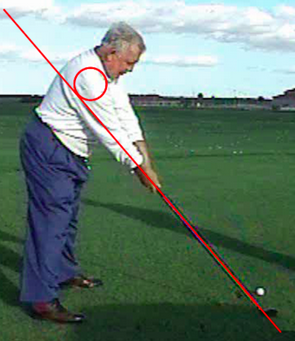
Moe at Address

Moe’s body and arm position at address allowed for him to reduce numerous variables in the golf swing.

When you can eliminate variables, you can become more consistent. In the picture above, you can see a red circle on his trail shoulder. The trail shoulder is positioned slightly above the red plane line. Once we establish this address position, it causes a smooth backswing and downswing….

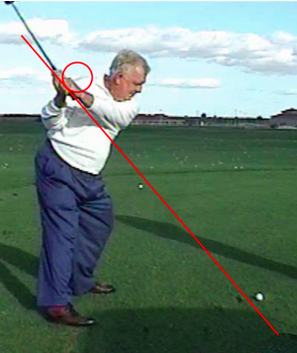
Moe at Top of Backswing

As Moe takes the club back, the trail shoulder rides merely directly up the plane line. How does he do this?

By rotating his body and folding his trail arm. At the top of the backswing, you can see that the trail shoulder is slightly above the plane line, mirroring the position it started in higher up. With this simple movement, the hands are on the plane line, and the club shaft is correctly on the plane

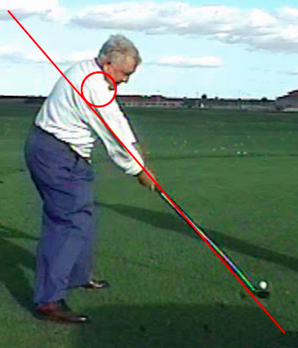
Moe at Impact

Do you see anything similar here?

That’s correct. The trail shoulder has come right back down the plane line resulting in an up and down motion. Moe called this “the pendulum.”

The only difference between address and impact from this down-the-line perspective is the rotation of Moe’s hips and torso. In this picture to the right, you can see how the hips and chest are rotated open. This has to occur for the hands to lead.

Join Us – Let Us Help You Make It That Simple….

If you have any questions/comments about our Premier Schools, how to become a Member of our Single Plane Academy, or anything else, please contact us at  or call (405) 250-6960

WWDWWD x 2

By Tim Graves, PGA

Why We Do What We Do x 2…

Had another great email wanted to share with everyone… Another Why We Do What We Do email.

From: James Wiggins <jawiggins****>
Date: Tue, Jun 20, 2023 at 10:06 AM
Subject: Feedback on June 12-14 Golf School
To: timg@gravesgolf.com 

Dear Tim,

I want you’ll to know how much I enjoyed the June 12-14 Golf School in Oklahoma City.  I have played golf for over 50 years and at one time I had a scratch handicap.  My swing was the traditional two plane swing with a reverse “C” finish. In my late 30’s I herniated two discs in my lower back which I aggravated every time I tried to play.  I had trouble walking for days after each golf outing and out of frustration, I was close to quitting the game. Approximately 5 years ago, I stumbled across the Graves Golf Academy, and I immediately switched to the single plane swing and my back problems subsided.  I have spent numerous hours watching videos, webinars, Graves Golf on Demand and sent in videos for analysis and coaching.  I thought I was close to the model, but my ball striking was not improving and I felt that there was something that I was missing which prompted me to sign up for the school. 

Within the first hour of school, I had an “ah ha” moment and realized that I was not setting up correctly at address which was causing problems throughout the swing.  It was a minor adjustment but one that I would not have caught had I not attended the school.  I learned something new in every classroom session and was able to use that knowledge while putting, chipping and on the range with the guidance and coaching of your team.  All the instructors were knowledgeable and shared their experience transitioning to the single plane swing which was helpful to all the attendees.  Major thanks to Derek, Brad, David and Matt for an informative, helpful and fun week!  

The attendees had diverse golfing backgrounds ranging from beginners to those that have attended numerous Graves Golf Schools but all of us shared the same goal of improving our golf with the single plane swing.  We all left with a new set of skills and a renewed determination to improve.  My current handicap is a 9 and I am confident that I will have a low single digit handicap by the end of summer due to attending the school. 

Thanks again for all that you do and for making golf fun again!

Sincerely,

James Wiggins

Why We Do What We Do (WWDWWD)

By Tim Graves, PGA

*******

Wanted to share an email we received last week from one of our recent students.

You want to know Why We Do What We Do… PERFECT example…

*******

Good evening gentlemen,

Tim – it was really great to meet you in Orlando last week.  Thanks for stopping by to say hello to our group. 

The reason I am writing is to give a heartfelt thank you to James, Clay, Paul and Parker for their support and instruction last week in Orlando.  I had attended 3 day before and was confident I would learn a ton, and I sure did.  That was amazing! 

For me though the highlight was the to share the experience with my 80 year old dad, Joe Peterson.  I hadn’t gotten the chance to spend one on one time with him in quite a while and this gave us a great bonding experience.  Joe has enjoyed playing golf with hand-me-down clubs for years but didn’t know what he was capable of accomplishing.

He absolutely loved this three day school! Each night after we got home we would eat dinner then head to the putting/chipping green to go over what we learned that day.  He would study his notes before we went out and then we would go over the fundamentals and checkpoints together. This would arm him with some questions for the instructor team the next day. 

He was and still is enthusiastic about getting back on the course to enjoy golf again. Watching his progress through the coaching of your incredible team was one of the highlights of my week.  When he started working with the demo driver on the range and blasted several dead straight bombs, he was shocked and thrilled. 

James, when you cheered for him after that it really made his day! He didn’t stop talking about your reaction on the way home, and then again over dinner with my mom.

So a huge, heartfelt thank you! Your team of coaches are amazing coaches/instructors and even more amazing human beings! Their patience and camaraderie with Joe made this an incredible experience I’m sure he will remember for the rest of his life!

Thank you again and hope to see you at school again in the future!

Len B. (Rockville, MD)

A Growth Mindset

Paul Monahan GGA Mental Game Coach

Somehow, I have managed to meet so many amazing people in my life. People who have done incredible things, who love to challenge themselves, who understand that growth is a product of continuously revisiting important concepts, and who are ok experiencing a bit of discomfort because of it.

Truth be told, many of them are a part of this amazing Graves Golf Academy community. 

Without exception, these are people with a growth mindset – the term made famous years ago by researcher Carol Dweck in her book Mindset, The New Psychology of Success.

In Mindset, Dweck draws a distinction between those who operate with a fixed mindset – believing that it’s too risky to try new things, and those who operate with a growth mindset – believing that a fulfilled life is one in which we are constantly learning and growing until the day we die.

Speaking of growth mindset and amazing people, a few weeks ago I spent three days with my friends Lynn Marriott and Pia Nilsson at their Vision 54 school in Scottsdale. This was my third visit in the past four years. And it likely won’t be my last. 

Why not?

Because I continue to learn about myself and grow as a player and a coach. Because I continue to learn how to access the best version of myself – and not just my golf self. And because I see myself as a person who is on a growth mindset path.

In this reflection, I thought I would pass along a few things that I took away from my most recent experience at Vision 54.

Number one: I was taking too long in the Think Box (Red Zone)

I didn’t realize it, but I was flat-out spending LOADS of time back behind the ball as I prepared for each shot. In my (ego’s) defense, I sure that I was considering all kinds of worthy things like: wind direction, distance to the pin, distance to cover, target, envisioning the shot shape, and many more I’m sure. The problem was twofold. It was taking too long. And it wasn’t helping me.

Pia helped me to see that I could benefit greatly by spending less time behind the ball. I learned to quickly get a good yardage, pick the right tool, pick my spot in front of the ball, trust my intuition, and then get in the play box. It made a big difference.

Number two: I was thinking way too much in the Play Box (Green Zone)

This was a little surprising to me. But as I moved through the first day of on-course play, it occurred to me that I was bringing far too many swing thoughts into the green zone with me. The green zone is supposed to be the place where we aren’t thinking much at all, and where our only job is to get settled, pull the trigger and making a great swing. (Todd Graves says he likes to “play empty”…his term for describing what’s on his mind when he is hitting the ball.)

Funny thing – I thought I was doing a decent job in the green zone. But it became apparent to me as I thought about it that there was an opportunity to grow in this area. Luckily, I was in the right kind of space to explore that. 

Number three: My Memory Box (Gray Zone) was not nearly as positive as I thought it was.

Many people I know would peg me as a fairly positive dude. In fact, most of the time when I play, I am able to see the outcomes of my errant shots as feedback, not failure. (One of my favorite Chuck Hogan rules.) But I was little off that week, and what we noticed was that I was putting more negative energy on my less-than-perfect shots. And it was impacting my game. (In fact, at one point, Lynn asked me where the “real” Paul was. Apparently some other guy showed up in my place!)

So I took a breath and committed to anchoring to productive or neutral thoughts after each shot, and never the negative ones. It was harder than I thought. But soon I was growing the skill again of staying “up” and energetic after each shot, no matter the outcome.

Number four: Tempo is a great playing focus for me on the greens.

When I focus on tempo while putting, creating a calm measured feeling of back and forth through the ball, and NOT rushing, stabbing, or jerking the putter at the ball, everything works better. I found that my pace was outstanding, and my line was great too. Putting is so much more fun for me if I commit to feeling my tempo through to the end of the stroke.

Number five: I learned a ton from my fellow classmates.

For example, one player, made incredible strides because she figured out a way to NOT turn inward when she was struggling. She realized that for her, she had more resilience and played better if she stayed social and compassionate toward others even when she didn’t feel like it. At the end of the school, she reported that this was one of her most important takeaways.

Another player also made great strides in her Memory Box (Gray Zone) when she learned to compare herself only to herself – and to stop measuring her progress against others. 

Operating from a growth mindset is not the default mode for most humans you know. (We love certainty – and we struggle with change.)  But to truly grow, it means we must be willing to move into exploration mode. It means that we must move a little out of our comfort zone. It means that we must challenge our thoughts about who we are being, or what we have been doing. And that’s not always easy.

But for me, it’s the path I choose because I believe it makes life and golf (What’s the difference – right?)  so much more fulfilling. And because I just like hanging out with all you amazing people. 

Paul Monahan, PCC is a Peak-Performance coach, member of the International Coach Federation and a certified COR.E Performance Dynamicsä  Specialist. He resides in Cleveland, Ohio with his wife Paula and is the proud dad to three young men.
LEARN

THE

SWING

Join 1M+ Subscribers to get your FREE Video Quick Start Guide that reveals how to hit the ball farther and straighter more consistently from now on…

START YOUR NEW GOLF SWING