The Concomitant Relation of Swing Plane, Lag and Release

The Concomitant Relation of Swing Plane, Lag and Release

I don’t know a golfer on the planet who doesn’t want to add 20 yards on the end of their average drive.  This equates to a club-head speed increase of approximately 8 miles per hour which, for most golfers, is a dramatic 10% increase.

Increasing your club head Club-head speed by 10% is a function of many factors which contribute to how efficient we use our bodies to release the speed in the correct location of the golf swing.  In other words, if you have great technique, you can easily produce speed.

Moe would often discuss how he would “lead and lag” and included this as one of his magic movements of his swing.  In this picture he was exaggerating his demonstration of this feeling.

Moe Norman
Moe Demonstrating Leading and Laging

This feeling is only felt (excuse the redundancy), by proper movement and hitting the ideal positions of the body where the arms and hands can efficiently move. To understand why the technique of these factors are directly connected is so important, you must realize the relationship between Swing Plane, Lag and Release.

Swing Plane

Swing Plane is created by positioning our bodies correctly so that when the arms moves the club, they moves in a way where the club-head can move on an arc and path that can accumulate speed.  This accumulation of speed is also called “timing” where, as the body rotates and the arms move and hands hinge, the club is moving in a semi-circular path around the rotating body.

The initial swing plane is referenced at address (the Single Plane) where the club shaft is aligned with the trail arm. This extension of the arms creates a spatially wide radius for the hands to move the club around the body.

Single Plane Top of Backswing
Swing Plane at Top of Backswing

When you move the hands and arms correctly with the rotation of the body, the extension and timing of the hands and arms move in a way where the club can make a path of least resistance back and down.  A better way to say this might be to say – that the club is able to move on it’s fastest and most efficient path.

Lag

Technically, lag is where one thing leads as another thing follows another or lags behind.  Therefore, during a downswing, the body moves first, the arms and hands move next and the club follows.  One important aspect of lag is the leverage angle formed by the hand hinge which creates and angle allowing the club-head to lag behind the hands. This angle, after lagging behind in the downswing, will release to produce speed.

The angle formed by the hand hinge allows the club head to lag far behind the arms when the arms pull the club down in the downswing.

This angle is related to the grip and how the hands put pressure on the club as well as wrist hinge and how the trail arm folds.


The Pressure Points of the Hands

Feeling Swing Plane and Lag

When the arms pull the club, the club head will lag behind the hands where the mass of the club head is being pulled by the shaft.  This creates a Feel where you are pulling on the club but the club-head is staying behind. The pull of the club is related to how the pressure points of the hands are aligned to the shaft and the face angle.

The hinge of the lead arm pulls on the shaft when the torso rotates and pulls the arm.  The trail hand supports the club and will eventually “skip a rock” as it moves through to release the club through impact.


The Body Pulls the Lead Arm, which pulls the hand which pulls the club


Release

Release is dependent on a number of factors including how the body leads in the downswing and the lag being maintained in the downswing. When the body rotates ant the trail arm extends the club is released through the ball.  The trail arm has extended from its bent position (see picture above) and at the point of release, both arms are straight.  


The Position of release is dependent on how well the arm stayed bent in the downswing and the stability of the lead leg so that the upper body can continue to turn as the trail arm extends.

In summary, Swing Plane, Lag and Release are all related to producing speed and timing of the golf swing.  When you begin to move correctly and the club moves on plane, the hands hinge correctly and your body is able to efficiently “pull’ the club into the downswing.

As you pull and the pulling side of the body begins to stop, the trial side and take over as it rotates.  The trail arm extends and releases the leverage created in the backswing and downswing.

Similar to cracking a whip, release is a place where the speed of the club reaches its fastest point after impact.



Tips for Improving (Part #1)

A few years ago now – I wrote a series of instructional articles inspired by Dan Coyle’s “The Little Book of Talent, 52 Tips for Improving Your Skills”.

At the time – these articles got GREAT REVIEWS!!

And guess what – we still use these Improving Your Skills methods in our schools, camps and all our instruction….

So, I figured it is about time to bring these instructional articles back – whether reading for the first time, or seeing again – great winter training information.

*******

The more Todd and I teach, the more we realize it is more about getting adults to make changes vs. teaching fundamentals.

To be honest, the fundamentals of Moe’s single plane swing really aren’t that difficult (if you compare to many other methods)… the difficult part is getting adults/students to make changes.

As we have discussed many times, it is not about breaking habits (that is impossible), but rather about creating new habits.

Over the past years, we have worked and worked and worked with 1,000s of students and we have worked and worked and worked on what is the best way for adults to create new habits.

A couple of years ago, we came across a book called “The Talent Code” by Daniel Coyle. If you have been reading our past newsletters or watched our webinars in the past, I am sure you have heard us reference this book many times. In fact, we had Mr. Coyle as a guest lecturer and instructor during one of our past webinars. The Talent Code is about how to create new habits through deep practice – everyone knowing that practice is a key to success. What everyone doesn’t know is that specific kinds of practice can increase skill up to 10 times faster than conventional practice. It also discusses ignition – motivation to get started and master coaching – virtues that enable coaches to fuel passion, inspire deep practice and bring out the best in their students. A great read I would recommend to everyone.

This past year, Mr. Coyle published a new book inspired by the original Talent Code called “The Little Book of Talent, 52 Tips for Improving Your Skills”.

It is described as a manual for building a faster brain and a better you. It is an easy-to-use hand book of scientifically proven, field tested methods to improve your skills – your skills, your kids’ skills, your organization’s skills – in sports, music, art, math and business. The product of five years of reporting from the world’s greatest talent hotbeds and interviews with successful master coaches, it distills the daunting complexity of skill development into 52 clear, concise directives. Whether you are 10 or 100, this is an essential guide for anyone who ever asked, “How do I get better?”

9780345530257

(The book is available at Amazon.com)

What I want to do in upcoming instructional e-tips is go through these tips for improving your skills and directly relate them to you creating new habits and learning the single plane swing fundamentals.

Tip # 1   Stare At Who You Want to Become

Use this as an “energy source” for your brain. Use pictures or, better, videos. Watch videos of who you want to emulate (Moe), watch them before you practice, watch them at night before you go to bed, watch them anytime to imprint a vision of what you want to do.

A great place to see videos of Moe is on our single plane academy at:  singleplaneacademy.com  Go to the home page and and you will see Moe vs. Pros Section.  You will also see exclusive content which includes numerous hours of Moe’s Clinics.  You will see videos and still pictures of Moe performing demos, etc.

Tip # 2  Spend Fifteen Minutes A Day Engraving The Skill On Your Brain

Watch the skill being performed, closely and with great intensity, over and over, until you build a “high-definition” mental blueprint or “engrave” in on your brain. The key to effective engraving is to create an intense connection: to watch and listen so closely that you can imagine the feeling of performing the skill. Project yourself inside the performer’s body… Become aware of the movement, the rhythm; try to “feel” the interior shape of the moves.

Again, would suggest watching the Moe and Todd videos. You can also search a few we have put on YouTube. As Mr. Coyle stated, spend 15 minutes doing this – this about all the time we can focus intently on something. too much we lose focus and will “wonder” back into our old habits… Picture yourself swinging like Moe, think what it would and should feel like, watch his timing and rhythm….

Tip #3 Steal Without Apology

We are often told that talented people acquire their skill by following their “natural instincts”. This sounds nice, but in fact it is baloney. All improvement is about absorbing and applying new information, and the best source of information is top performers. So steal it.

We have done this for you.  Obviously we are “stealing” Moe’s swing. We have done the research for you, we have the “stealing” for you. Study this material and start to put into action. The best start is to view our Single Plane Solution DVD. It is the absolute best place to start learning Moe’s fundamentals.


Tip #4   Buy A Notebook

Top performers keep some form of daily performance journal. What matters is not the precise form. What matters is that you write stuff down and reflect on it.  Results from today, ideas for tomorrow, goals for next week, etc. A notebook works like a map: It creates clarity.

Again, these are tips from The Little Book of Talent – 52 Tips for Improving Your Skills.

This is just a start – we will be reviewing many more tips for improvement and relate them to how you can create new habits / learn Moe’s single plane swing.

Following these tips are designed to help you get started, improve your skills / swing, and then help you sustain progress.

Indoor Training – Putt Your Way to a Great Swing

During a recent webinar I discussed how working on your short game (putting, chipping and pitching), if done properly, can and will dramatically improve your long game.

Had GREAT response during and after the webinar. To be honest, didn’t surprise me as it is the same response I get when I present this same topic during our schools and camps.

What does surprise me is how many don’t understand this concept – working on proper short game fundamentals will improve your long game.

Click HERE for your FREE PUTTER FITTING

So – thought would talk about the first (putting) and how working on putting can help your long game.

Fundamental #1 – Hands Leading

In every shot in golf – your hands should lead at impact. In other words, your hands will be ahead of the golf ball at impact including putting. Then why do most average golfers set up with their hands behind the ball when putting?

When you set up over a putt, your hands must be ahead of the golf ball. The butt end of your putter grip should be forward of your belly button – in fact, for most, half way (or more) between your belly button and your lead hip.

If your hands do not lead when you putt, it is guaranteed your hands will not be leading in your full swings. If your hands are not leading, you are training your body to make impact with the golf ball with the hands behind the ball. (Aka casting in the full swing).

Fundamental #2 – Face Square at set up and Impact

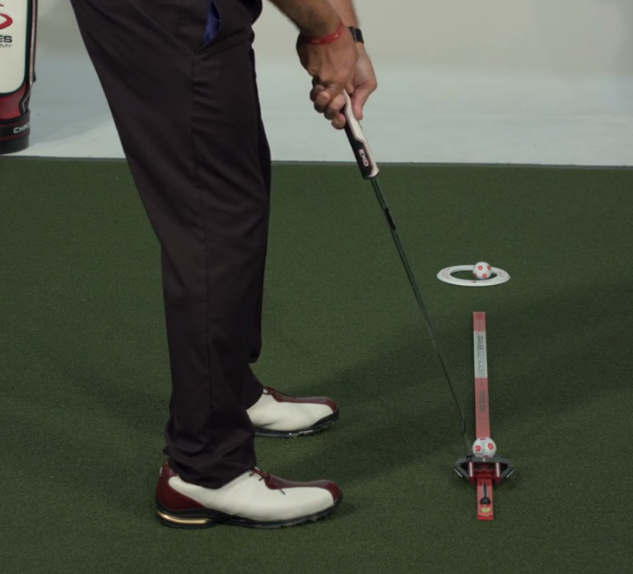
How are you checking to make sure your club face (putter face) is square at set up and impact?

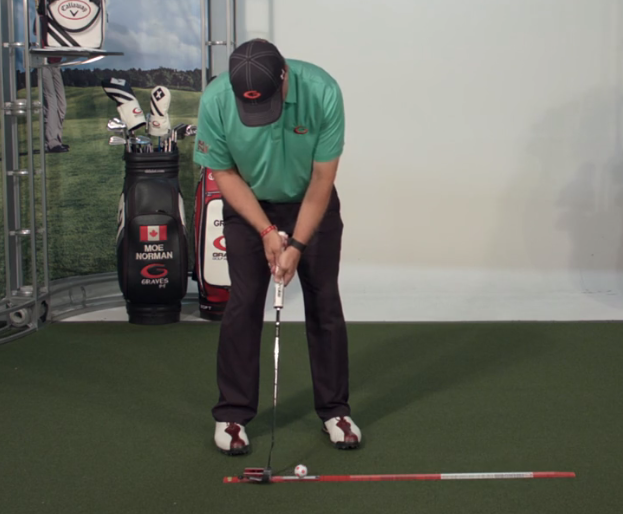
It is strongly recommended you use a check system to make sure your putter is square at set up and impact (square to where you are trying to hit the ball).

It is surprising how many golfers do not have a square face and compensate during the stroke.

The picture above shows using the GGA putting stick – checking the putter face angle.

And – can almost guarantee – problem squaring your putter face, same problem squaring any club face…

Fundamental # 3 – Hands Down the Line

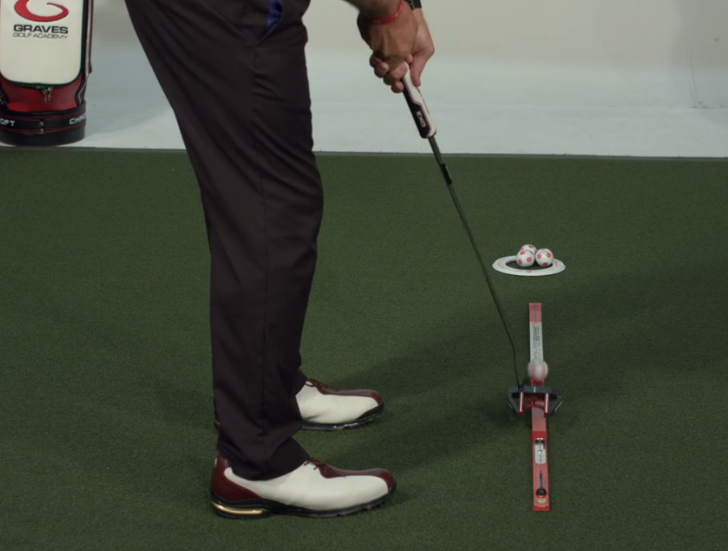
How do you check to make sure your hands go “down the line” past impact?

Your hands should go down the line and toward the intended target through impact.

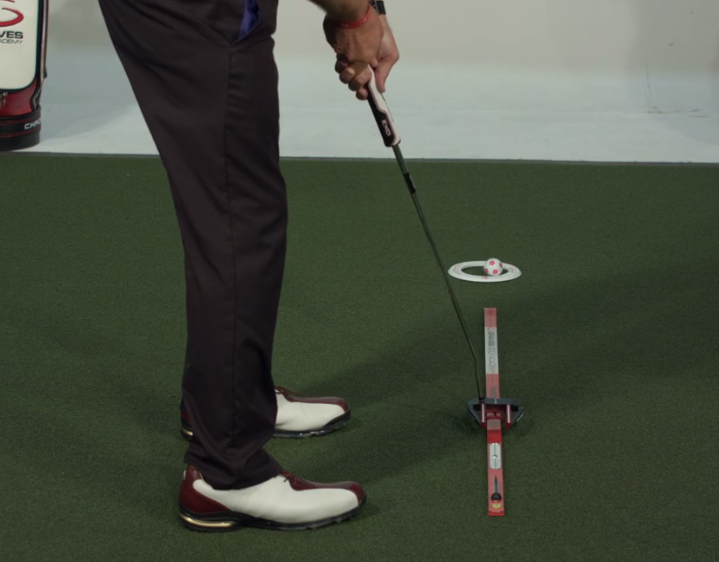
Most golfers struggle with this fundamental. Their hands go in and up through and past impact. Your hands should go down the line through impact. As you see in the picture below the putter face is still square past impact and down the line. This check will make sure your hands are going “down the line” toward your target.

Here is another picture of the putter face down the line:

In the full swing, your hands must go down the line through impact. You can have an on plane golf swing – but if your hands do not go down the line, it will cause impact with a club face coming to impact at an angle (out to in, etc..). This is a start to working on getting your club face and hands down the line.

These are 3 putting fundamentals you can check that, if done correct, will not only greatly improve your putting, but will also help your full swing.

More information about our PUTTING STICK:  CLICK HERE

Its Not Magic. Or is it?

John Michael Hinton is an amazing magician, speaker, redhead – as his branding tells us. He is all those things and more…and no matter what you call him he is an incredibly entertaining stage performer.

My wife Paula and I got a chance to see John perform his show in Cleveland in October…and were blown away by what we saw. His specialty is close-up slight-of-hand magic. He made cards and money disappear and then reappear. He solved a Rubik’s Cube without even touching it. And he blew my mind with a bag of Skittles.

I got a chance to speak at length with my new friend John recently about the performance dynamics of a stage performer like himself. I was curious to learn from him about how the performance dynamics that we see in leaders of organizations or athletes on the field of play – including golfers – would show up for an elite-level magician/performer. And he was kind enough to give me some time during his busy schedule on the road ahead of a show in Denver, CO.

John Michael Hinton in Cleveland, Ohio with some new friends.

It may surprise you – but there are many similarities between the things that we encounter on our Single Plane Swing journey and what John encounters on his performance journey. John told me that there are certain things that he does as part of his success formula that help to ensure he is in the proper mental state to perform his act. And there are things that occur that can throw John off his game a bit – even if just temporarily.

But one thing he did say reminded me of something that I have talked about in this space – and that you have heard many times from Todd, Tim, and the  instruction team at Graves.

John said that most of his confidence that he takes with him onto the stage is a result of the hours and hours he spends on honing his skills. He said that a well-known old quote has become a standard by which he approaches his development as a performer:

“Don’t practice until you get it right. Practice until you can’t get it wrong.”

In fact, he has even modified it a bit to fit his performance needs. When he says it to himself these days it sounds like:  “Don’t practice until you get it right. Practice until you know all the ways it can go wrong.”  Bottom line: for John there is no substitute for mastering the skill. It is one of the things that produces the right kind of performance energy he needs to be at his best.

John said that his intention is to practice more than he ever thinks he needs to. Putting in these hours is what gives him confidence.

John also said the one of his secrets to his development as a performer is his willingness to take new tricks and illusions onto the road with him. He understands that part of his journey to mastery is putting his new performances to the test with live audiences. He knows he has to “Road Test” parts of his act -and to be willing to be vulnerable, knowing that he may not have mastered the trick just yet. As a part of this process, he’s willing to subject himself to the negative judgment of others.

Finally, on of the most important insights for me came when John talked about the intention he brings to every performance. When asked what his focus is prior to each performance, he said that it is this: to ensure that people who experience his show feel loved and cared for.

That’s right. It’s not: “I hope they all buy my T shirts.” Or:  “I hope that the scout from America’s Got Talent likes my show.” Or: “How much money am I gonna make from these people?” Or: “I hope they like me.”

It’s different. It’s about a focus on OTHERS and not himself. John knows that if he focuses on his purpose –  to ensure that others feel loved and cared for – there is a much better chance he can perform at his best.

What does this have to do with golf? What if you approached practice and play the same way John Michael Hinton thinks about his own performance journey?

  • Practice more than you think you need to. Work on building your skills and your feel. There is no substitute for great mechanics and ball-striking skills for all elements of the game. It’s the key to elevating your confidence on the first tee.
  • Subject yourself willingly to the judgment of others. Often. It will build your resilience and the skills of learning to play in front of others. Loosen your grip on your story about what it means to make a mistake in front others. Mistakes are information. Embrace them. Mistakes help us learn and develop. Everyone makes them.
  • Consider the power of approaching the game with more love, gratitude and appreciation. For the game. For the course, For your playing partners. Make your golf experience about something other than fulfilling YOUR needs. Life is too short for that.

It works for John Michael Hinton. It can work for you too.

It’s not magic.  But it might produce magical results for you!

What Makes A Good Teacher

By Tim Graves, PGA

Have you tried to teach yourself?

Have you tried to teach someone else golf – like your child, your wife, your husband?

Have you ever taken a lesson from a professional?

Have you ever attended a golf clinic/school/camp?

Golf Teacher’s Motto:

“If you’re going to teach golf, accept the responsibility of having an impact on people’s lives and work every day to be help your student obtain their goals.”
Last Year, I (Tim) was honored to be awarded the Professional Golfers Association (PGA) South Central Section’s Teacher of the Year.

Part of the selection process (which lead to the award) includes answering questions about my teaching philosophy, discussing what I have done in the past year and finally, what I consider a good teacher. This and reading a few recent blogs got me thinking….

What Makes a Good Teacher?

Whether teaching yourself, working with others, or being the student, what should you look for in a good teacher?

What does the Graves Golf Academy strive to attain with every one of our students?

Here is my “Top Ten” points I think everyone should look for in a good teacher.

  1. There is a program for improvement, not just a single lesson. A single lesson is like putting a “bandage” on the swing/golf issue. It doesn’t “cure” the problem, only covers it up until it “falls off”. When working with a student, the teacher MUST teach the student how to “self-teach” or become their own best teacher. 99% of a golfers practice occurs by him/herself – to improve, the student must be able to “self-teach”.
  2. Goals for improvement should be discussed along with a “realistic” time frame. Nothing in golf is an “overnight” fix – NOTHING!  Every golfer can improve – the pace of improvement depends on his/her practice time and quality of practice. Practice DOES NOT have to be “range time” – in fact, the most effective practice can be done inside, without hitting golf balls, etc…
  3. There should be an equal emphasis on short game and long game. Never forget – 60% + of the scoring occurs in the short game.
  4. The entire game of golf should be taught – NOT just the golf swing. Meaning, a good instructor will teach short game, long game, course management, mental game, rules of golf, club fitting, flexibility/fitness, etc…
  5. Concepts should be explained, demonstrated and shown in an UNDERSTANDABLE manner in “bite-size” pieces. Too many look at the golf swing as an “elephant” ….  What is the saying…  “When eating an elephant take one bit at a time.” If the student understands WHY a change is needed, there is a much better chance the change will occur. In other words, a good teacher will explain WHY changes are being taught.
  6. Information “overload” must be avoided.
  7. The student should be given drills and or training aids that will turn new concepts into habits. It is impossible to break old habits, the key is to create new habits. Making the new habits “stronger” than the old habits. Drills and training aids will greatly enhanced learning these new habits.
  8. The instructor should use VIDEO ANALYSIS as a feedback tool. Video is the BEST way to bridge the gap between perception and reality and fact and feel. If a picture is worth a 1,000 words, a video is worth a million????
  9. The instructor must understand everyone “learns” a little different, and he/she should be able to teach the student in a way the student “learns” the best. Some learn by feel, some learn by what they see, some learn by what they hear, many learn by combinations of the three. A great instructor will quickly figure out how their student learns and will teach in that manner.
  10. The instructor should have a “passion” for the game of golf and for the student’s improvement.

My recommendation for you, whether teaching yourself, working with others, or taking a lesson, is to follow these 10 points.

Use them as a guide, and you won’t go wrong.

This is my philosophy and those of my instructors at the Graves Golf Academy which is set up to aid you in playing your BEST GOLF EVER!!!!

LEARN

THE

SWING

Join 1M+ Subscribers to get your FREE Video Quick Start Guide that reveals how to hit the ball farther and straighter more consistently from now on…

START YOUR NEW GOLF SWING