5 Minutes To Better Scoring

5 Minutes To Better Scoring

By Tim Graves, PGA

If you’ve been around for a bit, you know that I’m VERY passionate about putting!

When it comes to creative and simple ways to check each aspect of your putting stroke away from the golf course, I’ve tried them all.

It was through many years of trial and error that I developed what I consider a great, as well as simple way, to check each aspect of your putting stroke away from the golf course.

You see, to practice efficiently, you must check a couple key areas:

  1. Squareness of putter face
  2. Eyes over the ball (target line)
  3. Squareness of shoulders at address
  4. The path of the putter head during the stroke

Being able to check these fundamental positions each and every stroke is key to having productive practice sessions.

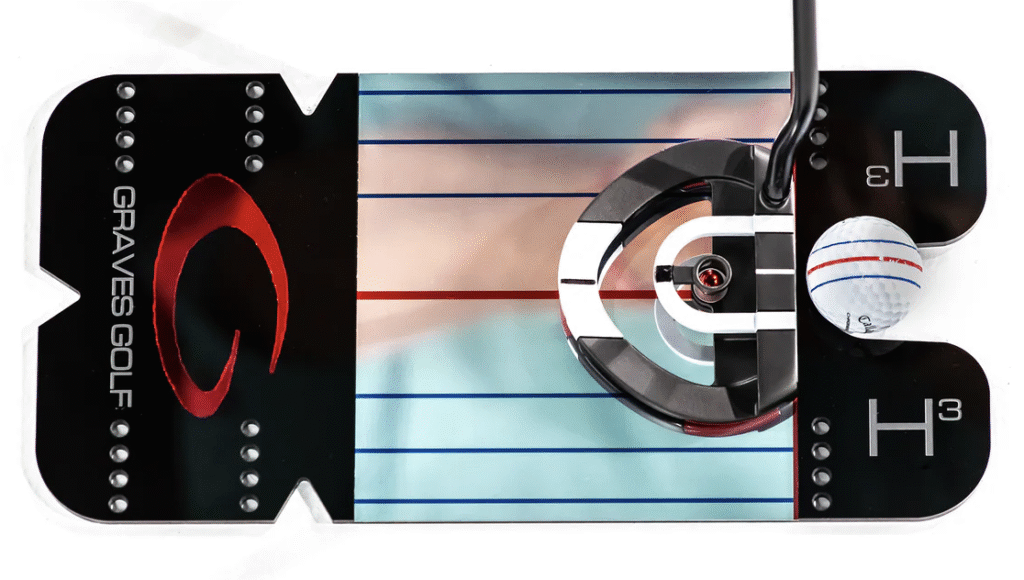
With the development of the H3 Putting Mirror, I now have a way to ensure each fundamental of my putting stroke is perfect.

Simply put, this is a vital tool during my off season practice.

If you aren’t using an H3 Putting Mirror, I have to ask you, bluntly,

“Why?”
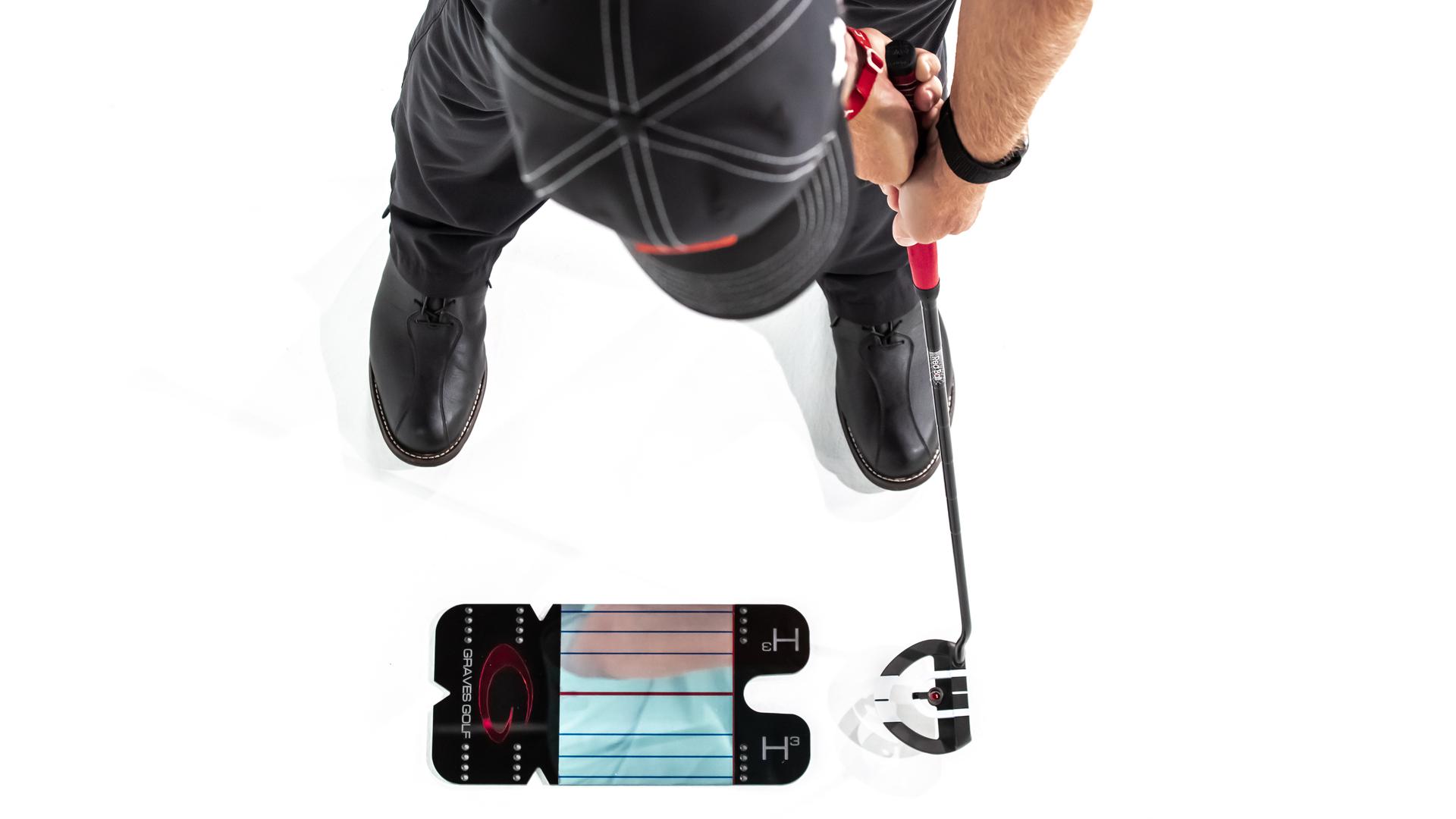
Even a 3-5 minute practice session in your living room with the H3 Putting Mirror will ensure:

  1. Your eyes are over the ball (target line), which will help you see the line, as well as create an ideal stroke.
  2. Ideal shoulder alignment that you can check in the mirrored surface.  Square shoulders produce an ideal stroke.
  3. You’ll see a perfectly square club face, as well as the ideal stroke with the guidelines on the H3.
  4. Raised edges will make you catch the ball on the upstroke, creating a perfect roll every time.
  5. CNC milled holes to develop a putting gate to further hone the perfect stroke each and every time.

THE 3 Ps OF PUTTING AND USING THE H3 PUTTING TRAINER

What are the 3 Ps of putting?…  simply stated, it is “Practicing your Putting with a Purpose”

Folks, it is actually pretty simple and painless, you just have to DO IT RIGHT!!!

Now, before you think to yourself, “Yeah, I know, Tim always says how important putting is, but I really need to work on my full swing first”, please read the following stats and “studies” that have been conducted and then I will explain how you can literally improve your game overnight…

First – You must first realize the importance of putting. 43% of scoring occurs on the putting green for the average player (male shooting 97, female shooting 107). As the scoring increases, so does the % of putts. For a scratch golfer, the percentage lowers to about 40%, but no lower.

The statistics are as follows:

30 handicap golfer (aver score of 100) – average 45 putts per round

20 handicap golfer (aver 90) – 40 putts per round

10 handicap golfer (aver 80) – 35 putts per round

Scratch golfer (aver 70) – 30 putts per round

Professional golfer – 28 putts per round

Second – You would think “that only makes sense” as the 30 handicap golfer will hit it further from the hole than the 20 handicap golfer, thus have more putts…. but you would be wrong. If you think of the way golf is played and the way putting stats are kept (just add up how many putts you have once the ball is on the green) – the 20 handicap golfer actually will hit more greens in regulation than the 30 handicap golfer (the 30 handicap golfer will be chipping from the side of the green, etc..). Meaning, if you take the average distance to the hole once the player hits the green, typically the 20 handicap golfer will be further than the 30 handicap golfer… in theory if both had equivalent mid/short games – but here lies the problem.

Third – There are only 3 areas that matter in putting (or any part of the golf swing) – Path, Face Angle, and Speed. Putting is affected by these 3 areas and only these 3 areas. Meaning, everything you work on in putting (for example the grip, set up, etc..) affects either path, face angle and/or speed. The better your path, the better your putting, the better your face angle at impact, the better your putting, the better your speed, the better your putting.
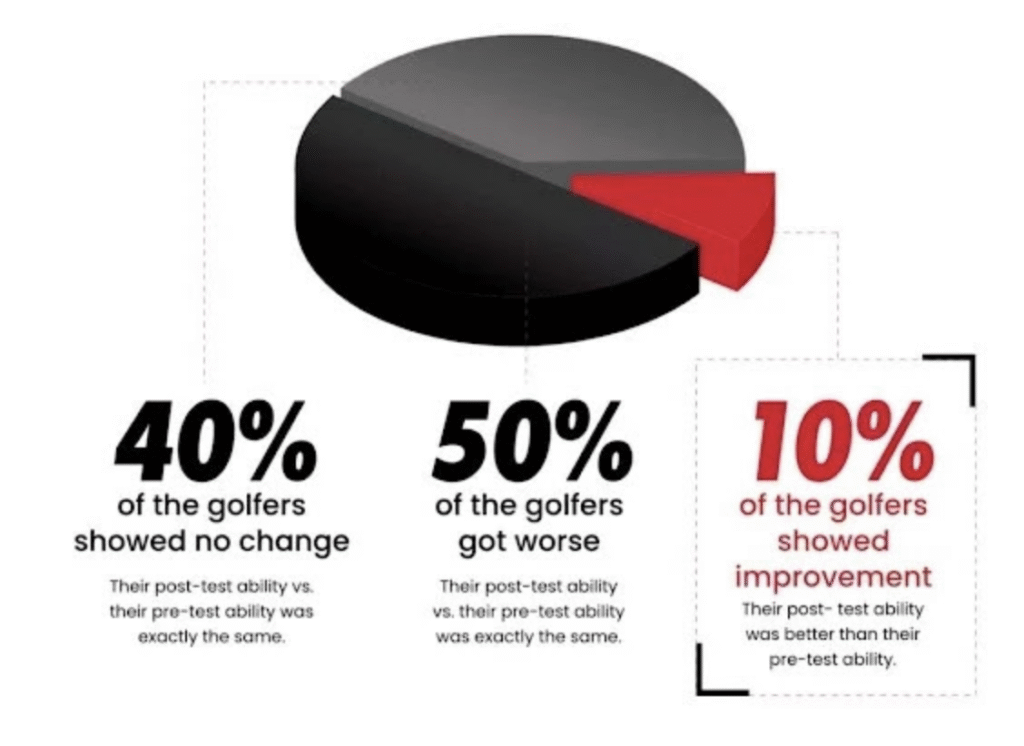
Fourth – READ THIS VERY CAREFULLY: Studies have shown that of 10 golfers who practice their putting, 5 will get no better, 4 will actually get worse, ONLY 1 will improve after practice. Please read this again – of those who practice their putting, 10% will improve after the practice, 50% will not, and 40% will ACTUALLY MAKE THEMSELVES WORSE. (This study was performed numerous times testing golfer’s putting prior to their practice session and after.) As is said by the individuals who performed these studies, “Golfers can add, subtract, multiply and divide, and they DON’T like these odds.” I don’t know about you, but if I have a 90% chance of not improving when I practice, “I ain’t practicing” (as they say in Oklahoma…)

Okay – now that everyone is on a “downer” about their putting practice, we’re here to fix that.

Over the years of playing and practicing with some of the best players in the world (including Moe, Tiger and many others), competing against many of these players, studying numerous techniques of the short game, etc… etc. we have created/perfected a method to improve your putting.

H3 Putting Trainer – How to Practice Your Putting with a Purpose EVERY TIME you practice. (In other words, every time you practice, you will one of the 10% who improves!!)

This is a Putting Trainer that works – WE GUARANTEE IT!!! This is how you (and most professionals) improve your putting. The system is not hard – in fact, it is very simple and doesn’t take that much time. Every minute you practice using the H3 Putting Trainer, it will improve your putting… which in turn will improve your scoring and decrease your handicap – SIGNIFICANTLY!!

Here are highlights of the H3 Putting Trainer:

    * Mirror for proper eye and shoulder alignment 

    * Beveled leading edge for easy ball placement 

    * Easy to see red line for proper path and face alignment

    * Red line to check ball under eye line and head still during putting stroke

    * Blue alignment lines to help the putter go back square

    * Blue alignment lines to square your shoulders

    * Putting gate holes to use tees to get path correct in back stroke (set up for different sized putters)

    * Putting gate holes to use tees to get path correct in through stroke (set up for different sized putters)

    * Raised edges for proper stroke.  Upstroke at impact, and proper back stroke

Here is what the H3 Putting Trainer checks (check points) every time you use it:

  • Square putter face at set up
  • Eyes over the golf ball (ball under eye line)
  • Golf Ball is forward of center at set up (creates overspin)
  • Golf Ball is set up in the middle of the putter (sweet spot)
  • Shoulders are square at set up
  • Only the shoulders move / rock in putting stroke.   Remainder of body still.
  • Hands lead maintaining shaft lean through impact 
  • Golf ball is impacted at center with no side spin (only overspin) and on center of putter 
  • Golf ball is hit on an upward blow
  • Hand are leading (H1)
  • Hands down the line (H2)
  • Hip check reminder (H3)

Everyone – no matter where you game is now – needs to improve their putting. You need to create more consistency in your putting. As shown, it is absolutely the faster way to lowering your scoring.

Remember the 3 Ps of Putting – Always Practice Your Putting with a Purpose and the best way to practice with your putting with a purpose is to use the H3 Putting Trainer.

H3 Training Aid:  CLICK HERE
The Master Will Appear

BY: Tim Graves, PGA

Was reminded of this story at our Mental Game School last week…. was suprised how many had not heard the story before, so thought would get it out again…

Paul Monahan, Graves Golf Mental Game Coach, honored me with a request to write a forward for his newly released book.

Thought I’d give you a “sneak peak” of a quick story I will put in the forward…

A few years ago, Paul and I (Tim) were running an Alert Attitude of Indifference Mental Game School in Orlando, FL. The school is a 2 day school in which we work with our student’s on their mental game during play and practice in their golf game. Time is spent in the classroom, on course and performing exercises and drills in different practice areas to help our students improve their golf games through a better / more positive mental game.

On the first morning, Paul, myself and our students were on the putting green performing one of Paul’s exercises. This particular exercise involved the following:

  1. Paul gave every student a sheet of 16 labels. Eight of the labels had positive words printed on them (ie. Happy, Positive, Encouraging, Loving, etc..) and 8 labels had negative words on them (ie. Sad, Negative, Discouraging, Unhelpful, etc..).
  2. Paul then told the students to stick one of the positive labels on another student. Do this eight times until all the positive labels are gone from their sheet. They peeled the label off the page and picked a student to put it on (I participated in this exercise and found this very easy…. pick another person and put a positive label on them).
  3. Paul then told the students to pick one of the negative labels and stick it on a student. Do this until the eight negative labels were gone. (I participated in this also and found it very hard to do this..)

After the exercise was completed, Paul discussed with the group about self talk, positive vs. negative, how easy it is to talk positive about another, how hard it is to label another negative, but consequently, how easy it is to talk negative to yourself, and how hard it is for so many to talk positive to themselves. Ultimately, how positive self talk must be encouraged and how positive self talk will greatly enhance your change for improvement both in play and practice.

The 2nd day of our school, we always start with a question and answer session about the previous day’s teaching. I typically ask the students, “How do you think yesterday went and if there was anything they wanted to talk about?”

At this school, immediately after my question, one of our students stood up and said, “I thought the exercise we did on the green yesterday was a complete waste of time, and in my opinion, all we did was litter (when the labels feel of the students and blew away).”

I have to be honest (and many of you who know me can probably can predict my response…) I was not very happy with this student as was about to “escort him out of the school…”

I can only assume Paul saw my initial reaction, and stopped me in my tracks…. Before I responded to this student, Paul stood up and asked if he could address the question.

Paul proceeded to ask the student why he felt that way, why he thought the exercise was a waste of time and in general, discussed the student’s mental approach to his golf game.

Come to find out, it wasn’t about the exercise at all. It was about the discouragement this gentleman felt every time he practiced because he expected faster results, and more about how he was expecting his golf game to help reduce his pressure he was feeling at work. Paul proceeded to discuss with this gentleman how the same exercise could and should be used outside of golf – in his personnel and professional life… and how this exercise could and would change his perspective in all areas of his life.

Honestly – I was completely taken back… Paul turned a negative situation (and one I was probably going to only turn more negative) into one of the best morning talks I have ever heard or been part of… I went from being so mad I was “seeing red” to having a tear in my eye listening to Paul’s encouraging conversation with this student.

At the end of the morning discussion, the students got up and left the room to start our next exercise. After the last student left the room, I turned to Paul and said “that might be the greatest and most encouraging thing I have ever heard told to one of our students”.

Paul turned to me and said Tim, never forget…. “When the student is ready, the master will appear”.

I will never forget this morning, this saying and how great Paul handled the situation.

******

So – I have some questions for you (our students)… When you “self talk”, is it negative or positive, are you encouraging or discouraging to yourself, do you put positive or negative labels on yourself…. and ultimately, “Are you ready for the master to appear”?

I’d again like to thank Paul for the honor of writing a forward for his book.

The Man With The Perfect Golf Swing – Reader’s Digest Article

Reprint

By: Bruce Selcraig

“His game was close to genius, but could he find acceptance”

On a warm morning at a country club near Orlando, a stocky gentleman with wispy gray hair makes his way past the crowd gathered for today’s exhibition. To those who don’t know better, the impish old fellow could be just another sunburned senior dreaming of bogey golf.

He wears a black turtleneck despite the heat. The left pocket of his neon-lime slacks bulges, as always, with two golf balls – never more, never fewer. All three watches on his left wrist are set to the same time.

Taking his position at the tee, he quickly lofts a few short wedge shots about 70 yards. At first, the spectators seem unimpressed. Then they notice that the balls are landing on top of one another. “Every shot same as the last,” chirps the golfer, as if to himself, “Same as the last.”

Moving to a longer club, a seven iron, he smoothly launches two dozen balls, which soar 150 yards and come to rest so close to each other you could cover them with a bedspread. He then pulls out his driver and sends a hail of balls 250 yards away – all clustered on a patch of grass the size of a two-car garage. Astonished laughter erupts from the crowd. “Perfectly straight,” says the golfer in a singsong voice. “There is goes. Perfectly straight.”

Those who have followed Moe Norman’s career are no longer surprised by his uncanny displays of accuracy. Many professionals and avid players consider the 70-year-old Canadian a near-mythical figure. But few outside the sport have ever heard his name. Fewer still know the story of his struggle to find acceptance in the only world he understands.

One cold January morning in 1935, five-year-old Murray Norman was sledding double with a friend on an ice-packed hillside near his home in Kitchner, Ontario. Speeding downhill, the sled hurtled into the street and skidded under a passing car.

Both boys survived and ran home crying. But the car’s right rear tire had rolled over Moe’s head, pushing up the cheekbone on one side of his face. His parents, unable to afford medical care, could only pray he did not suffer serious brain damage.

As Moe grew older he developed odd behavioral quirks and a repetition, staccato speech pattern. His older brother Ron noticed that Moe seemed unusually frightened of unfamiliar situations. At night, Ron often heard his little brother sobbing in bed, devastated by some real or imagined slight.

At school Moe felt glaringly out of place among other kids. Desperate for friends and acceptance, he tried to be playful, but his efforts often backfired-pinching people too hard or bear-hugging them until they pushed him away. He heaped ridicule on himself and even coined his own nickname: Moe the Schmoe. He became known as a slow student in every subject-except one. At math no one could touch Moe Norman. He astounded his classmates by memorizing complicated problems and multiplying two-digit numbers in his head almost instantly.

When he wasn’t acting the clown, Moe walled himself off from others. Over time he plunged deeper into isolation, and yet, ironically, it was loneliness that led him to his greatest happiness.

In the years following his accident, Moe spent hours atop the same winter sledding hill, hacking around an old golf ball with a rusty wood-shafted five iron he found at home. Here in the solitary and magical world of golf, he found a reason to wake up each morning.

Kitchner, Ontario, in the 1940’s was a gritty factory town where working-class teenagers had little desire or money to play the “sissy”, upper -class game of golf. Moe was spellbound, often skipping meals, school and chores to head off by himself in a field to hit balls-500 or more a day. He practiced until dark, sometimes until the blood from his hands made the club too slippery to hold.

In his early teens, Moe got a job as a caddie at a country club only to be fired when he hurled the clubs of a low-tipping local mogul into some trees. Soon he gave up caddying to concentrate on playing, honing his skills at a nearby public golf course. He quit school in tenth grade, and by the time he was 19, he knew he was blessed with a rare talent: he could hit a golf ball wherever he wanted it to go.

Moe left home in his early 20s, hitching rides to compete in amateur golf tournaments all over Canada, supporting himself with a succession of low-paying jobs. At his first few tournaments in the late 1940s, fans didn’t know what to make of the odd little fellow with the garish, mismatched outfits, strawlike red hair and crooked teeth.

He manner was playful, almost childlike, his self-taught technique wildly unorthodox. Legs spread wide, he stood over the ball like a slugger at the plate, clutching the club not with his fingers, as most golfers are taught to do, but tightly in his palms, wrists cocked, as if he were holding a sledgehammer. Many spectators dismissed him as an amusing sideshow. Some giggled when he stepped up to the tee. Soon though, Moe Norman was turning heads for reasons other than his personal style.

Recognized as a gifted player who could hit a golf ball with breath-taking precision, he quickly became a sensation on the amateur golf circuit. In one year alone he shot 61 four times, set nine-course records and won 17 out of 26 tournaments.

Even as his fame grew, Moe remained painfully shy and could not shake the sense that he was undeserving of the attention. Rather than bask in the spotlight, he avoided it. In 1955, after winning the Canadian Amateur Open in Calgary, Moe failed to show for the awards ceremony. Friends later found him by the nearby Elbow River, cooling his feet.

The victory qualified Moe for one of golf’s most prestigious events: the Masters. When he got the invitation to the tournament, he was only 26 and spending his winters setting pins in a Kitchner bowling alley. This was his chance not only to represent his country but to show skeptics he wasn’t just some freak on a run of beginner’s luck.

But his old demons would give him no rest. Moe felt like an intruder among some of golf’s brightest lights. He played miserably in the first round and even worse on day two. So he fled to a nearby driving range to practice.

While hitting balls, Moe noticed someone behind him. “Mind if I give you a little tip?” asked Sam Snead. The Hall of Famer merely suggested a slight change in his long-iron stroke. But for Moe it was like Moses bringing an 11th commandment down from the mountaintop.

Determined to put Snead’s advice to good use, Moe stayed on the range until dark, hitting balls by the hundreds. The next day, unable to hold a club, he withdrew from the Masters, humiliated.

But Moe climbed right back up the ladder to win the Canadian Amateur again a year later. A string of victories followed. In time, he had won so many tournaments and collected so many televisions, wristwatches and other prizes that he began selling off those he didn’t want.

When the Royal Canadian Golf Association charged him with accepting donations for travel expenses, which was against regulations for amateurs, Moe decided to turn professional. His first move as a pro was to enter, and win, the Ontario Open.

As a newcomer to professional golf, Moe approached the game with the same impish lightheartedness of his amateur years. When people laughed, he played along by acting the clown. An extremely fast player, he’s set up and make his shot in about three seconds, then sometimes stretch out on the fairway and pretend to doze until the other players caught up.

Fans loved the show, but some of his fellow competitors of the U.S. PGA Tour did not. As the Los Angeles Open in 1959, a small group of players cornered Moe in the locker room. Stop goofing off, they told him, demanding that he improve his technique as well as his wardrobe.

Friends say a shadow fell across Moe that day. Some believe the episode shattered his self-confidence and persuaded him to back out of the American tour, never to return. More than anything, Moe had wanted to be accepted by the players he so admired. But he was unlike the others, and he was being punished for it.

The laughter suddenly seemed barbed and personal. No longer could he shrug it off when some jerk in the galleries mimicked his high-pitched voice or hitched up his waistline to mock Moe’s too-short trousers.

Because Moe never dueled the likes of Americans Jack Nicklaus or Arnold Palmer, he achieved little recognition beyond Canada. At home, though, his success was staggering. On the Canadian PGA Tour and in smaller events in Florida, Moe won 54 tournaments and set 33-course records. While most world- class golfers count their lifetime holes-in-one on a few fingers, Moe has scored at least 17.

Despite his fame and the passing years, Moe was continually buffeted by the mood swings that tormented him in childhood. Even among friends, he could be curt, sometimes embarrassingly rude.

At other times he was charming, lovable Moe, bear hugging friends and tossing golf balls to children like candy-the happy-go-lucky clown from his amateur days.

Through the 1960’s and ’70s Moe racked up one tournament victory after another. But in the early 1980’s his enthusiasm for competition began to wane. His winnings dwindled, and he slipped into depression. Not being wealthy, he seemed to care very little for money, lending thousands to aspiring golfers and never bothering to collect.

Broke and all by forgotten, he drifted from shabby apartments and boardinghouses to cut-rate roadside motels, often sleeping in his car. Had it not been for the generosity of friends-and a stroke of good luck- he might have faded entirely into obscurity.

Moe has never had a telephone, a credit card or owned a house. Few people know where he might be living on any given day, and he seldom talks to strangers. Little wonder it took Jack Kuykendall two years to track him down.

Kuykendall, founder of a company called Natural Golf Corp., finally caught up with him in Titusville, Fla. He told Moe that, trained in physics, he had worked for years to develop the perfect golf swing-only to discover that an old-timer from Canada had been using the same technique for 40 years. He had to meet this man.

Moe agreed to demonstrate his swing at clinics sponsored by Natural Golf Corp. Word spread quickly through the golfing grapevine, and before long, sports magazines were trumpeting the mysterious genius with the killer swing.

Among those following Moe’s story was Wally Uihlein, president of the golf-ball company Titleist and Foot-Joy Worldwide. Hoping to preserve one of golf’s treasures, Uihlein announced in 1995 that his company was awarding Norman $5000 a month for the rest of his life. Stunned, Moe asked what he had to do to earn the money, “Nothing,” said Uihlein. “You’ve already done it.”

Two weeks later, Moe Norman was elected to the Canadian Golf Hall of Fame. Even today, however, he remains largely unknown outside his native country except among true disciples of the game. For them, Moe is golf’s greatest unsung hero, the enigmatic loner once described by golfer “Lee Trevino as “the best ball-striker I ever saw come down the pike.” Many agree with Jack Kuykendall-had someone given Moe a hand 40 years ago, “we would know his name like we know Babe Ruth’s.”

In a parking lot of a Florida Country Club, Moe Norman is leaning into his grey Cadillac, fumbling through a pile of motivational tapes. He seems nervous and rushed, but as he slides behind the wheel, he pauses to reflect on his life, his family and his obsession.

Moe never had a real mentor or a trusted adviser. “Today’s kids,” he says, “are driven right up to the country club. Nice golf shoes, twenty-dollar gloves, nice pants. “Have a nice day, son.” I cry when I hear that. Oooh, if I’d ever heard that when I was growing up…”

He squints into the sun and cocks his head. “Everyone wanted me to be happy their way,” he says. “But I did it my way. Now, every night I sit in the corner of my room in the dark before I go to bed and say, “My life belongs to me. My life belongs to me.”

With that, he shuts the door and rolls down the window just a crack. Asked where he’s going, Moe brightens instantly, and a look of delight spreads across his face.

“Gone to hit balls,” he says, pulling away. “Hit balls.” It is and forever will be, the highlight of his day.

Reprinted from the December 1999 Issue of Reader’s Digest @ 1999 the Reader’s Digest Association, Inc., Pleasantville, N.Y. 10570 Printed in U.S.A.

How to Add Driving Distance

By: Tim Graves, PGA

One of the most common questions we receive (seems every day) is “How can I get more distance?”

There are three areas you can work on/improve to help you get more distance on all your golf shots, in particular, your driver.

And, all of these, you can and SHOULD work on over the fall / winter (training sessions).

Those three areas are:

  1. Driver Technology
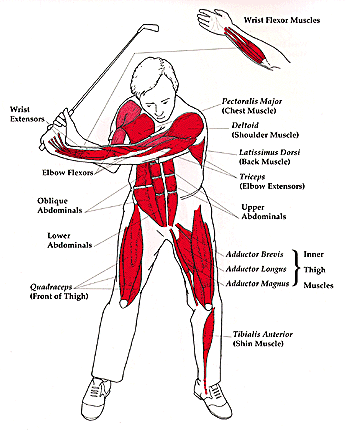
  2. Flexibility and Strength
  3. Swing Technique

Let’s break down each area a little.

Rogue ST Max Driver
Callaway Rogue ST Max Driver

1.  Driver Technology:

A few years ago, the USGA put together a set of rules limiting how much a golf ball can “rebound” off the face of a driver (a vague description) – thus putting a limit on the distance of the drivers. Since then, the golf industry realizing they can no longer make drivers that can hit it further off the face, have been working on technology that has made the “big” headed drivers more aerodynamic (thus less air resistance in the golf swing) and more prominent sweet spots on the face.

Older technology drivers had sweet spots the size of a dime (some smaller), newer technology drivers have sweet spots the size of half dollars (some even bigger). What that means is balls hit slightly off the middle of the club face will travel much further now.

And the key is the “average driving distance” you have, not the “one” you catch that happens to fly a long way. Meaning, if your sweet spot on the driver is large and you miss hit a few shots (or more) around off the middle of the club face, you will still get good/more “average” driving distance. Meaning, overall you will have less club into the greens, etc. etc.

So, if you are looking to maximize or increase distance – you need to have a driver that is “modern” or at least less than 2 or 3 years old. These newer drivers have large sweet spots and have the highest technology for the least amount of wind/club head resistance in the golf swing.

2.  Flexibility and Strength

The 2nd area to focus on with distance is flexibility and strength. And in that order. Too many worries about strength and not flexibility. Being strong with good, or great, flexibility “allows” you to get in positions in your golf swing to hit the ball with reasonable distance.

As we get older, we lose our strength and more importantly our flexibility, when we start to lose our elasticity, we can no longer create certain angles in the golf swing that will allow us to create “leverage” in the golf swing which in turn produces speed and distance.

We have produced an extensive DVD on this topic. This DVD is set up to test the areas of your body and its flexibility in these areas. It then gives you 3 or 4 exercises you can perform to regain or create increased flexibility (and strength) in those areas. This DVD designed around the single plane swing of Moe Norman – in other words, it takes the eight most significant positions of Moe’s swing and determines if you are flexible enough to “reach” those positions. If not, it gives you “easy” exercises to perform over time that in turn will help you gain those positions and eventually “allow” you to swing the club on plane.

You can see a lot more detail about the Flexibility and Exercise information at: https://watch.gravesgolf.com/

3.  Swing Technique

Ultimately, the most crucial factor to get more distance is to improve your technique. It is always interesting, one of the things we do at all our schools and camps is to measure our students swing speed. We then correlate it to their driver swing speed and the average distance they should be hitting their driver. For most (those that swing 85 to 90 mph), they should be hitting their driver 230 to 240 yards (with a little roll).

For most, when they find out how far they should be hitting their driver with the speed they currently have, they are shocked. Why are they hitting it so short compared to where “their potential” says they should be hitting it? Because of technique. They are not hitting the golf ball off the “sweet spot” of the club with a “direct hit” from the club that is on the path.

In other words, they are hitting “glancing blows” that is creating side spin which is limiting or reducing the distance they should be hitting their driver.

Working on swing technique – working on getting the club on the proper single plane/path, with a square club face through impact and ultimately, limited to no side spin, will give you the maximum distance.

In conclusion, to answer the all too common question, we get from so many of our students/customers

How can I get more distance?

Answer:

1.  Obtain a new/modern driver that has the highest technology for increased sweet spot and limited wind resistance (aerodynamic).

2.  Work/continue to work on flexibility (especially over the “off-season” months when so many loose elasticities because of an increased static lifestyle) and… 

3.  Always work on improving your technique to maximize the optimal hit on the ball with limited side spin and enhanced sureness of hit.

P.S – Here is the P.S. to this article as EVERYONE will ask this question to us (in person, at schools, during webinars, across emails, etc….).

What is the fastest way to improve technique?

Answer – FIGURE OUT YOUR NEXT STEP TO IMPROVEMENT

To see more about YOUR NEXT STEP TO IMPROVEMENT: CLICK HERE

(You can see the specials associated with the Your Steps Video above)

Please feel free to contact me anytime at timg@gravesgolf.com with questions, comments, etc.

Purity of Technique

Golf teachers will often agree that there are many ways to hit a golf ball. Some swings are upright, and some are flat. Many will have the clubface closed or even open during the swing motion. Yes, all of these types of swings can, in some level of aptitude, strike a golf ball. Each of them, however, has built-in compensations for flaws.

Years ago a well-known teacher taught me that he shows swing flaw must have an accompanying flaw to fix it. What this means is that for every swing problem you must have a second flaw in make-up for the initial question. You can’t just have one swing fault – you must have at least two. Without the compensating correction, you can’t hit the ball.

For example, if you have a closed clubface during your backswing, you must have a movement to open the face in your downswing. One flaw always has an offsetting flaw.

In many ways, this is why golf lessons can make you worse before you get better. If you fix one flaw and the compensating flaw still exists, then you are caught in the dilemma of only having one swing problem resulting in lousy golf shots.

This is what initially attracted me to Moe’s swing. Not only did I recognize his abilities, but I saw a real swing motion – one without compensations.

I often call the address position of the conventional golf swing “The one mistake.” Why? Because it has a built-in problem – standing too close to the ball. The accompanying flaw/movement is to move the body upward to compensate.

The way I see it is that you have a choice to play golf.

You can use the grip it and rip it mentality and fight your way through your compensations OR you can build a swing that is pure technique. Of course, I prefer the Purity of Technique way for some reasons including the following:

  1. Pure technique without compensations allows you to have a better chance of your bad shots being good.
  2. without compensations, your swing becomes less maintenance.
  3. Timing elements of the compensations are not necessary
  4. It is easier on the body
  5. Easier to repeat

*************

Why is water wet? Why is the sky blue?  Moe would often ask me questions that seemed ambiguous. He would say “Once you know the answers to these questions, you will know.”

“Know what?” I asked.

‘The Secrets” he said.

The answer to Moe’s questions was not complicated. Water is wet because it is all that it can be. The sky is blue because it is what it is. Moe’s golf swing was simply because it was all that it could be. I call it mistake-proof.

Consider placing your body in a position where it has no choice but to move most efficiently. At address, your body position, arms, hands, and club extend so that when you turn, the club runs into a perfect backswing path. The “Sum” of your body position makes it the only place the club can go.

Moe would often say – “I can’t take the club outside “because the club was placed up to 12 inches behind the ball. Due to his spine position, club position and the relationship of the club to pointing to the lead hip, when Moe turned the club immediately when inside – back on the plane. It just couldn’t go anywhere else.

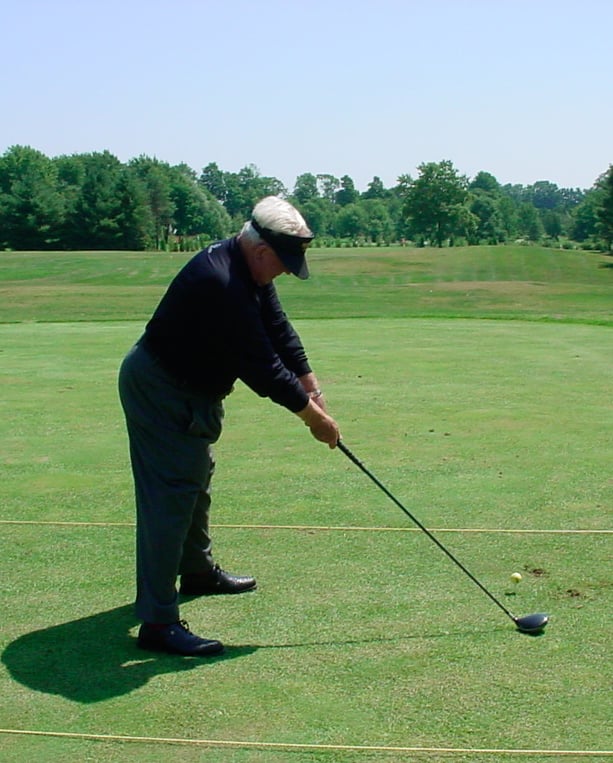
Moe at address DTL.jpg

Moe’s address position was the beginning of being “Mistake-proof” This included many things that some consider idiosyncratic, these are the elements of what I think the Purity of Technique?

  • Moe’s legs were straight
  • This builds a stable foundation for the swing day after day. One of the issues with the traditional swing is: how much to bend the knees? One day it might be a little, another day a player may flex them more depending on his emotional and physical state, which leads to inconsistency. Starting with straight legs means there is no variance in the degree of knee flex from day to day.
  • Moe’s arms were straight–pointing directly at the ball
  • There is a natural position for holding a club to hit a golf ball; it is similar to a child holding a stick that he’s going to use to run a rock on the ground.
  • His club shaft began the swing on the impact plane
  • Starting with the club on the same plane that you are going to hit the ball makes sense. (How come no one figures this out before?)
  • His upper spine was tilted away from the ball (the lead shoulder is higher than the trail shoulder)
  • The tilt happens naturally because of Moe’s wide stance, straight arms and his right hand was lower on the grip than his left side.
  • He placed the club head five to 12 inches behind the ball (depending on the club)
  • This allows the body to move laterally into impact.
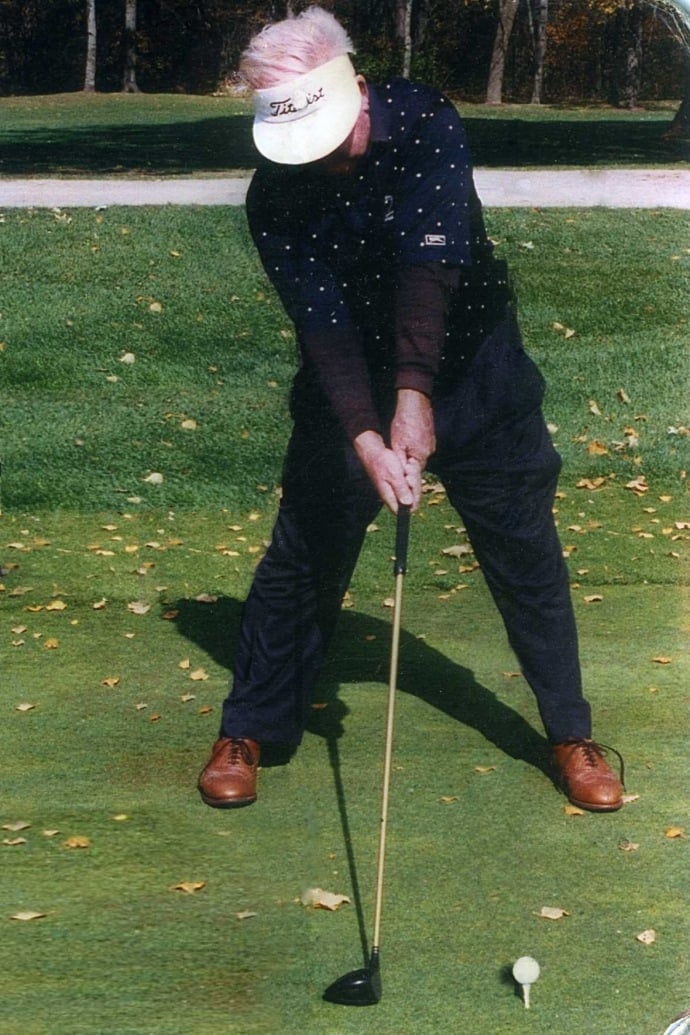
Moe at address

Taken together, these necessary elements of Moe’s address made his swing incredibly simple, certainly relative to the conventional swing. As I first began to study Moe’s swing and got deeper into examining his set-up, I was floored by the genius of its simplicity.

Make Change Happen

By: Paul Monahan, Graves Golf Mental Game Coach

&

Tim Graves, PGA

Making Change – Intentionality and Commitment:

If you want your golf experience to transform into something it is not, (If you want to play better, struggle less, and enjoy the game more) then you have to be intentional about what you are willing to do to affect change in your game, and you have to stay committed to the actions that will create that change.

The brilliant and experienced GGA coach Ralph Rabago suggests that we change our language about practice and development. He uses the word: “training” instead of the word practice –  and I think you should seriously consider using it yourself.

Check out Ralph’s discussion with Tim Graves on Tim’s podcast: Tim G Podcast

Think about it, if you and your subconscious are going to “practice” your mental game skills (or any skill set) the idea of practice just does not hold that much import. “I’m gonna go practice a little and see what happens.” (Ralph says that practice is often a little “loosie goosey” – without a lot of clear goals or outcomes.)

However, if you tell yourself – “I am in training” with respect to your mental game development you will approach the transformative process differently. You will:

  • Get clear on the gap between where you are right now and where you want to be in six months.
  • Find ways to measure your development.
  • Get intentional about exploring the most important ideas.
  • Set goals and measure your progress.
  • Show up to train and develop your mental game skills – not just “practice” them.

If you want lasting change, if you want transformation in your game, commit to being “In Training” not just practicing. This is the key to your development.

LEARN

THE

SWING

Join 1M+ Subscribers to get your FREE Video Quick Start Guide that reveals how to hit the ball farther and straighter more consistently from now on…

START YOUR NEW GOLF SWING