The Sandwich Technique – Tips for Improving Part #8

The Sandwich Technique – Tips for Improving Part #8

By Tim Graves, PGA

This is the 8th part of a series of practice tips titled “Tips for Improving”.

In those practice tips we discussed how we work with our students to create new habits rather than breaking old habits. It is essentially impossible to break bad habits (our mind/body is not set up that way) … but we are set up to be able to create new habits and ultimately make changes/create new movements, etc. we want.

We talked about a book we strongly recommend – The Little Book of Talent/52 Tips for Improving Your Skills by Daniel Coyle

It is described as a manual for building a faster brain and a better you. It is an easy-to-use hand book of scientifically proven, field tested methods to improve your skills – your skills, your kids’ skills, your organization’s skills – in sports, music, art, math and business. The product of five years of reporting from the world’s greatest talent hotbeds and interviews with successful master coaches, it distills the daunting complexity of skill development into 52 clear, concise directives.

Whether you are 10 or 100, this is an essential guide for anyone who ever asked, “How do I get better?”

9780345530257

The last instructional newsletters (Tips for Improvement Part 1 through 7) we discussed 31 tips for improvement from staring a who you want to become, to being willing to be stupid, to finding the sweet spot, to practicing by yourself, to taking a nap…. Again, if you have not reviewed these past practice tips, would recommend.

This instructional newsletter (Part 8) we cover the next 5 tips for improving your skills and relate them to you learning/working on your single plane swing and golf game.

32.  Make Positive Reaches

There’s a moment during every practice or rep (action) when you face a choice: You can either focus your attention on what you want to do, or you can focus on the possible mistake (what you want to avoid). This tip is simple – ALWAYS focus on the positive move, the one you want to do, not the negative.

A perfect example is stroking a putt. Tell yourself what to do, rather than what not to do. Say the putt breaks about 1/2 a cup right to left. Say to yourself, “smooth stroke at the right lip”, rather than “don’t pull the putt”.

The point is, it always works to reach for what you want to accomplish, not away from what you want to avoid.

33.  To Learn From a  Book, Close The Book

What is the better way to learn from a book?

To read the book many times in a row, trying to memorize it?

or

To read the book once, close the book and write a summary of what you read?

There is no question, the best way to learn is writing the summary of what you learned. In fact, research shows people following the summary strategy learn 50% more material than those who try to memorize.

This is because one of deep practice’s most fundamental rules: Learning is Reaching. Closing the book and writing a summary forces you to figure out the key points (one set of reaches), process and organize those ideas so they make sense to you. The equation is always the same: More reaching equals more learning.

We strongly recommend the same whether you are learning from a video, from online coaching or attending one of our schools. In fact, during our schools we STRONGLY encourage and give time for all our students to take notes during and just after they learn new fundamentals so they can “write” those fundamentals in their own words. They can summarize what they just learned in their “own words”, they can process what they’ve just learned and can organize for themselves so they have a better understanding.

Again, whether you are learning from a video, webinar, online coaching or at a school, your best and most effective learning will be when you “close the book” and summarize for yourself, in your own words so you can review and process in the future.

34.  Understand The Sandwich Technique

What’s the best way to make sure you don’t repeat mistakes? (The million $ question right????)

One of the best ways is to employ the sandwich technique. It goes like this:

1.  Make the correct move.

2.  Make the incorrect move.

3.  Make the correct move again.

The goal is to reinforce the correct move and to put spotlight on the mistake, preventing it from slipping past undetected and becoming “wired” into your circuitry (brain).

During this technique, it doesn’t hurt to say to yourself – this is the good move or what I want to do. And when you are during the incorrect move, saying, this is the incorrect move or what I don’t want to do…

This technique is good to perform every so often, especially when you are confirming/checking to make sure you are doing a move correct. If you can perform the correct move and then the incorrect move, you can see/feel/know a difference, a great way to make sure doing move correct.

I employ this technique often when working with students and it always surprises me when the student will tell me they “don’t want to make the bad move again”. They act as if they are “afraid” to make the incorrect move again, because it might “stick” or something like that.

It will only “stick” or “creep back” if you aren’t aware of it. Doing it intentionally every so often will keep you aware of “what to look” for….

35.  Use The 3 x 5 Technique

It has been shown by those who research memory and learning – that our brains make stronger connections when they are stimulated three times with a rest period of ten minutes between each stimulation.

Translation: To learn something most effectively, practice it three times, with ten-minute breaks between each rep.

Perfect example would be the Single Plane Position Trainer drill (drill to learn backswing, top of swing to impact position). Practice the Single Plane Position Trainer drill for a few minutes (slowly) until you feel you have “hit” a position or two correct. Then take a ten-minute break. Do it again, practice the drill for a few minutes until you “hit” a position or two correct, then take another break.

I have also heard of this as the “commercial” technique for learning. When you are watching a T.V. show (or sporting event…), practice/drill during the commercials – then take a break while watching the shows. Work on the commercials, break during the show/action. Typically sets you up for drilling/practicing for a few minutes, then taking about a 10 minute break between.

36.  Invent Daily Tests

Daily routine (or when you practice) should include “little tests”. These tests should not be scientific, and should not be treated as verdicts, but rather as “fun games” to keep one involved, entertained and focused during the learning process.

Examples (ones I use often).

Chip 10 balls around the green and see how many you can get within 3 feet (the length of your putter (short putter)).

Putt 5 balls from 5 feet from 4 points around the hole (Twelve o’clock, 3 o’clock, 6 o’clock and 9 0’clock). Of the 20 balls, how many do you make?

Pick two points out on the range about 20 to 25 yards apart and about where your driver distance (ball flight) would land. How many balls out of 25 can you hit between those targets with the driver?

Hit 10 balls with an 8 iron to a target and see how many you can hit within 20 feet?

Again – these are just examples of “little tests” you can do for yourself to see if you are improving and a fun way to help you keep entertained and focused on your learning process.

Creating “tests” for yourself is a great way to enhance your learning process and to keep you focused.

Please watch upcoming newsletter practice tips for continuation of the tips for improving your skills/creating new habits and improving your golf game.

Take a Nap – Tips for Improving Part # 7

By, Tim Graves, PGA

This is the 7th part of a series of practice tips titled “Tips for Improving”.

In those practice tips we discussed how we work with our students to create new habits rather than breaking old habits. It is essentially impossible to break bad habits (our mind/body is not set up that way) … but we are set up to be able to create new habits and ultimately make changes/create new movements, etc. we want.

We talked about a book we strongly recommend – The Little Book of Talent / 52 Tips for Improving Your Skills by Daniel Coyle

It is described as a manual for building a faster brain and a better you. It is an easy-to-use hand book of scientifically proven, field tested methods to improve your skills – your skills, your kids’ skills, your organization’s skills – in sports, music, art, math and business. The product of five years of reporting from the world’s greatest talent hotbeds and interviews with successful master coaches, it distills the daunting complexity of skill development into 52 clear, concise directives. Whether you are 10 or 100, this is an essential guide for anyone who ever asked, “How do I get better?”

9780345530257

This book is available at Amazon.com

The last instructional newsletters (Tips for Improvement Part 1 through 6) we discussed 26 tips for improvement from staring a who you want to become, to being willing to be stupid, to finding the sweet spot, to practicing by yourself….  Again, if you have not reviewed these past practice tips, would recommend.

This instructional newsletter (Part 7) we cover the next 5 tips for improving your skills and relate them to you learning/working on your single plane swing and golf game

27.  Close Your Eyes

One of the quickest ways to deepen/enhance practice is also one of the simplest, Close Your Eyes. Closing your eyes is a quick way to “enhance” certain senses. Many times golfers/students get WAY TOO “tied up” in ball results and not in the movement/feeling of the movement of the golf swing.

Quite often in our schools, when a student is starting to get the club on plane, or starting to get into proper positions (could be grip, set up, etc..) we will have the student close their eyes and “feel” that position or swing. It is critical to have a good sense of feel in the swing.

The sequence is to work on fundamental positions/swing, as you are starting to figure out and get closer to the model, you want to turn it into “feel”. This is greatly enhanced when you “close your eyes” at times during practice. We are not recommending hitting balls with the eyes closed, but practice swinging and working on fundamental positions with the eyes closed is a wonderful learning tool.

28.  Mime It

Swing the golf club WITHOUT a golf ball. Removing everything except the essential action lets you focus on what matters most – making the right/correct action/move.  Do this with the full swing, with putting, chipping, pitching, etc… etc. As you are “miming” – think what you want it too look like. Think of the model you are trying to copy. Put this together with tip # 27 – Mime while closing your eyes. Start slow, and eventually build up speed.

29.  When You Get It Right, Mark The Spot

One of the most fulfilling moments of a practice session is when you make your first perfect rep. When this happens, FREEZE. “Rewind” the mental tape and play the move again and again in your mind. Memorize the feeling in rhythm, the physical and mental sensations.

The point is to mark the moment – this is the “spot” where you want to go again and again and again.

This is NOT the finish – it’s the new starting line for perfecting the skill/building the new habit(s).

Love the saying – “Practice begins when you get it right.”

This is one of those situations it would really help to video your swing/new positions so you can check against the model (Moe). Many ask how to short cut the process… there is no real short cut – but it can be sped up by a student viewing/watching his swing more. Videoing does this (and it is VERY simple).

30.  Take A Nap

This has to be one of the best tips…  The science: Napping is good for the learning brain, because it helps strengthen the connections formed during practice and prepares the brain for the next session. It has actually been shown that learning improves by as much as 10% after a nap compared to those that don’t take one.

Now, I know if is unrealistic to take naps during practice (or between different sessions) – like going from chipping practice to full swing practice.  BUT – you should take a break (can even think of it as a “power nap” … sort of). You should NEVER practice for more than 10 or 15 minute sessions, and between these sessions you should let the mind/brain relax. Take a break…. let the brain take a “nap”.

I like to listen to music (headphones) between practice sessions – a good way for me to get “away” from my golf thoughts.

The more you can relax between your different practice sessions, the more effective the sessions will be.

Example of a typical practice session (1 hour) – Few minutes of stretching. 10 to 15 minute of putting (then listen to a few minutes of music). 10 to 15 minutes of chipping/pitching (then listen to a few minutes of music). 20 to 30 minutes of full swing work (spit up into 10 to 15 minute sessions relaxing between..)

31.  To Learn A New Move, Exaggerate It

It you have read past instructional tips you have heard us talk about this many times.

To learn a new move, exaggerate it. Don’t be halfhearted… you can always “dial back” later. Go too far so you can feel the “outer edges” of the move, and then work on building the skill with precision.

Also, for most, unless you exaggerate it, you will not create the new habit/new move.

This is the perception vs. reality concept. You might think you are making a change, but most are not changing enough (if at all). They think they are making a change… and really aren’t. Exaggerating the change will take care of this. Remember, you can always “bring it back” a little. And if you have made the “dramatic” change, “bringing it back” a little will not be hard and will take very little time.

The best way to create a new habit – exaggerate it.

The best way to get feel in a new habit – exaggerate it.

The best way to make sure you created the new habit – exaggerate it.

The quickest way to create a new habit – exaggerate it.

Think you get my point….

Please watch upcoming newsletter practice tips for continuation of the tips for improving your skills/creating new habits and improving your golf game.
What Do I Get From Graves Golf?

By Terry Medina (Graves Golf Alumnus)

What do I get from Graves Golf? I have been a single planer for about eight years, starting at age seventy. Like most members, I started out of frustration that my game was not very good and never getting better. My NCGA index was about 26. I joined and have been through all the machinations of membership. That first three-day school in Phoenix was the eye opener that unlocked my golf future. Of course, the videos, DVDs, booklets, training aids all helped. I am not the fastest learner, but I keep at it. It took me two years to really understand commitment. Graves Golf staff was clearly committed to me. Was I clearly committed to them and myself? I know I had to be if I was going to be in that 10%.

I went all in at age 73.  I would “Burn the Boat” before the term was used. I bought every training aid and a tall mirror. I learned B-practice and made a practice schedule. Because I live on a golf course and can play almost year-round, I used to let playing golf get in the way of practice and improvement. I now try to have a club in my hand every day even if it is just to practice chipping on the living room carpet with the chipping board, short game impact club and tall mirror.

Early on I took advantage of fitted clubs from Tim Graves, not to mention the other perks like balls, gloves, etc. The fitted clubs were such an improvement. I am on the yearly replacement program. Trade-In/Trade-Up provided my whole bag (minus wedges) for approximately the cost of a new driver.

I am currently a level four elite member with a great coach, Parker Elrod. There has been so much to take advantage of. With Single Plane 30, Fast Forward and so much more, it’s hard to know what to do next! But it is all in On Demand where all Graves Golf training and information resides. It is my go-to for everything SPS. Frankly I appreciate the “Quick Tips” a lot and try never to miss one.  The best thing about level four is live Zoom lessons with Parker, sending in video is a close second, sending in data sheets is a close third. It provides great feedback, and I don’t use it enough.

I started out with the question “what do I get from Graves Golf Academy?” The answer is CONFIDENCE. At every GGA school I have been to, there have been many students who say they want consistency. I believe for me the result of everything GGA has placed in me, the swing technique, promoting physical exercise, mental game plus my level of work has resulted in confidence. Confidence that when I get over a shot, I am going to strike it well. Driver, iron, pitch, chip; and should I not strike it as intended I have confidence in the feel of my swing, that I know what I did and can put that in my grey zone. Yes, my index got down to 14.4 but that is the by-product of confidence in my all-inclusive training with Graves Golf.

For me, there is a bonus. My wife Myrna plays golf and last year converted to GG Single Plane Swing and joined my level four status. Yes, she is elite in my book. We attend schools together, do zoom lessons together and she even went all in on fitted clubs.

My New Years Resolution is to maintain confidence in my game, double my effort on putting practice and work more on physical conditioning, stretching, flexibility and add some band and weight training. I am playing the best golf of my life. Everything I have absorbed from Graves Golf has given me confidence over every shot!

Merry Christmas you guys and Happy New Year! You do make a positive difference.

Sincerely,

Terry

Turning Tough Times Into Progress

by Shane Matzen, Graves Golf Coach/Membership Liaison

Recently, I was on one of our Single Plane 30 zooms and we were getting close to wrapping up another month of training, conversations and reflecting.  As our students are wont to do, one of them admitted going out to try the new swing on the course.  As you might imagine, the results of his venture were not what he had envisioned.  While SP30 had brought him so much satisfaction and answered so many questions he’d had about the game for so long, translating it to performance and scoring had left him frustrated and wondering how to handle his angst as it related from going to the practice mat/net to the course.

 A person holding a golf club

Description automatically generated

As I was listening, so many thoughts from my previous coaching career in the sport of basketball came to mind.  After I’d gathered those thoughts into something coherent, I decided to virtually “raise my hand” and wait my turn to give my input into our zoom conversation.  Once Scott Renfrow, our SP30 Director, called on me, I related some of my experiences dealing with how frustration plays a part in all of our endeavors…..

I was blessed to coach many, many young men in my 23 years coaching hoops and I could never thank them enough for the work, diligence, loyalty and acceptance of me and what I was trying to teach them.  But I knew throughout those two-plus decades that I wasn’t always right and that more than a few (some more than others!) of my players didn’t always agree with what or how I was guiding them.

Most fans of sport who haven’t coached assume that having a “yes sir/no sir” player is the ideal situation for a coach.  And I had many of these players.  They’re wonderful.  There are very little issues and generally you move forward with few major roadblocks in your path.  Having said that, not having those roadblocks sometimes kept you from getting to know those players with their personalities and things they believe in.  

On the other hand, and this is where many coaching novices think that getting into coaching would not be a viable option for them, you WILL have players who find fault, who are always looking to dig deep into why their coach does what he/she does and will often express their disagreement or displeasure.  And lemme tell you….heads DO butt many times between said player and his/her coach.  

But after coaching for a few years, I decided, “You know what?  That’s ok.”  I grew to love and appreciate my players who I would often relate to my coaching peers as those with “some p*** and vinegar”.  They kept me in check, I got to know them in a deeper way and they pushed me to get better.  

Now, having said all that, how does this relate to going through three weeks of Single Plane 30 training and then seemingly forgetting everything you’ve learned when the ball in front of you is on the third fairway of your local course?  Well, I don’t think I’m in the minority here but when adversity, frustration and obstacles get in my way with something I care about, I tend to push harder.  And when I do succeed in pushing past my failures and turning them into successes, the sense of gratification to me is so much deeper and meaningful.

We all have had that one good shot in the midst of a bad round that we’ve related to our friends, “Man, that shot filled up my tank to come back”.  I would challenge you to consider that there are many sources of fuel.  A good shot, great friends to spend four hours with, beautiful weather and yes, frustration, can all be fuel.  It’s when you cease to care that you should become concerned.  

In the midst of our zoom conversation, I was taking some notes for when it was my turn to speak and I scribbled down the following:

Frustration is Fuel

Apathy = an Empty Tank

One of the best parts of my job with Graves Golf is when I get to talk to folks via phone or zoom sessions and they talk to me through their experience learning Single Plane.  When they get into the whole “I’m aggravated and frustrated” issue, I have zero issues steering them into how we can work with them.  I’m not going to lie to you here in this space though….I get very worried that I can’t help when they tell me they’re done with the game.  

Being super happy and satisfied with an endeavor generates the same degree of passion as being frustrated with yourself and your progress with that endeavor.  Passion is that fuel which can lead to production.  Keep that in mind when your passion seems to be of a negative grade.  Bottom line, the engine will run on frustration-grade and we can switch you over to premium, I mean positive-grade, as long as you are passionate about doing so.

A person holding a golf club

Description automatically generated

The Slower You Do It, The Faster You Will Get It – Tips for Improving Part # 6

By Tim Graves, PGA

Hopefully, you were able to read the last 5 practice tips – Tips for Improving (Part 1, 2, 3, 4 and 5)

In those practice tips we discussed how we work with our students to create new habits rather than breaking old habits. It is essentially impossible to break bad habits (our mind/body is not set up that way) … but we are set up to be able to create new habits and ultimately make changes/create new movements, etc. we want.

We talked about a book we strongly recommend – The Little Book of Talent/52 Tips for Improving Your Skills by Daniel Coyle

It is described as a manual for building a faster brain and a better you. It is an easy-to-use hand book of scientifically proven, field tested methods to improve your skills – your skills, your kids’ skills, your organization’s skills – in sports, music, art, math and business. The product of five years of reporting from the world’s greatest talent hotbeds and interviews with successful master coaches, it distills the daunting complexity of skill development into 52 clear, concise directives. Whether you are 10 or 100, this is an essential guide for anyone who ever asked, “How do I get better?”

9780345530257

This book is available at Amazon.com

The last instructional newsletters (Tips for Improvement Part 1, 2, 3 and 4) we talked about the following tips

  1. Staring at who you want to become.
  2. Spending 15 minutes a day engraving the skills on your brain.
  3. Stealing without apology.
  4. Buying (and keeping) a notebook.
  5. Be willing to be stupid
  6. Choose spartan over luxurious
  7. Before you start, figure out if it’s a hard skill or a soft skill
  8. To build hard skills, work like a careful carpenter
  9. To build soft skills, play like a skateboarder
  10. Honor the hard skills
  11. Don’t fall for the prodigy myth
  12. How to pick a high-quality teacher
  13. Finding the sweet spot
  14. Take off your watch
  15. Break every move down into chunks
  16. Each day, try to build one perfect chunk
  17. Embrace struggle
  18. Choose five minutes a day over an hour a week
  19. Don’t do “drills”.  Instead, play small, addictive games
  20. Practice alone

This instructional newsletter (Part 6) we cover the next 6 tips for improving your skills and relate them to you learning/working on your single plane swing and golf game.

21.  Think in Images

Which instruction is easier to remember?

Grip the club lightly.   – 0r –  Grip the club like you are holding a baby bird.

Release the club through impact.  – or –  Toe of club should be over through impact.

For most, images are far easier to grasp, recall and perform. Whenever possible, create a vivid image for each chuck (new habit) you want to learn. The images don’t have to be elaborate, just easy for you to “see” and feel.

22.  Pay Attention Immediately After You Make a Mistake

Most of us are “allergic” to mistakes. When we make one, our every instinct urges us to look away, ignore it, and pretend it didn’t happen. This is not good, because as we’ve seen, mistakes are guideposts for improvement.

Studies reveal that within 0.25 seconds after a mistake is made, people (the brain) do one of two things – they look hard at the mistake or they ignore it. People who pay deeper attention to an error learn significantly more than those who ignore it.

Develop a habit to look your mistakes right away… don’t “look away”. Ask yourself what you can do next to improve them. Take mistakes seriously, but never personally.

As Moe said MANY times (when he sees another golfer hit a poor golf shot), “Don’t worry about it, learn something from it.”

23.  Visualize The Wires of Your Brain Forming New Connections

When you go to the sweet spot on the edge of your ability and reach beyond it, you are forming and strengthening new connections in your brain.

Mistakes aren’t really mistakes, then – they’re the information you use to build the right links.

The more you pay attention to mistakes and fix them (creating new/correct habits), the more of the right connections you’ll be building inside your brain.

24.  Visualize the Wires of Your Brain Getting Faster

Every time you practice deeply – the wires of your brain get faster.

When you practice, it’s useful and motivating to visualize the pathways of your brain being transformed to “high-speed broadband”.

Our saying “Always practice with a purpose” added to deep practice will get this “high-speed wiring” going.

25.  Shrink the Space

Smaller practice spaces can deepen practice when they are used to increase the number and intensity of the reps and clarify the goal.

For your practice I would suggest shrinking the space by (examples):

– Focusing on Single Plane Position Trainer Drill(s)

– Focusing on Leverage Bag drill(s)

– Using the string (putting alignment aid) on the putting green (or indoor with Excalibur Putter Training Aid).

All these drills are extremely important/critical for developing/checking core fundamentals. “Shrinking the Space” will help you focus on these core fundamentals and their movements.

26.  Slow Down (Even Slower Than You Think)

When we learn how to do something new, our immediate urge is to do it again, faster. The urge to speed makes perfect sense, but it can also create sloppiness, particularly when it comes to hard skills (see Tip # 8).

We trade precision – and long term performance – for a temporary thrill. So, slow it down.

Super-slow practice works like a magnifying glass. It lets us sense our errors more clearly, and thus fix them.

A great example of slow practice was often performed by Ben Hogan – he routinely practiced so slowly that when he finally contacted the ball, it moved about an inch.

As the saying goes, “It’s not how fast you can do it.  It’s how slowly you can do it correctly”.

As we say in every school – our school motto: “The slower you do it, the faster you will get it!”

Please watch upcoming newsletter practice tips for continuation of the tips for improving your skills / creating new habits and improving your golf game.

Where Are You Looking?

By: Paul Monahan, Graves Golf Mental Game Coach

(AAI Schools)

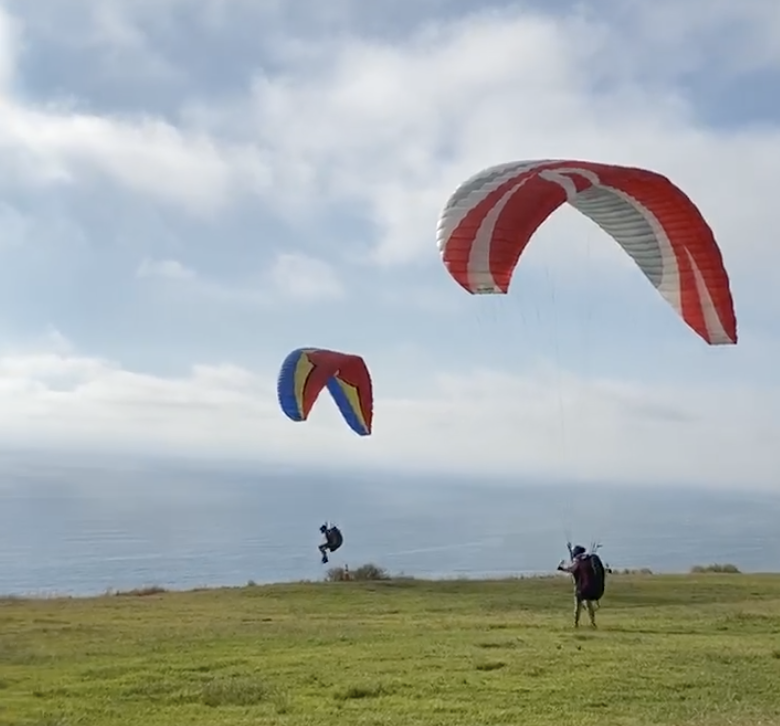
Last week I visited the Torrey Pines Golf Course just North of San Diego, CA. It is an amazing slice of golf heaven. But believe it or not, the highlight of my trip there was a visit to the nearby Torrey Pines Glider Port. This is where grown adults intentionally walk/jump off a 325ft-high cliff toward the beach below …again, and again and again. They can’t get enough of it.

If I didn’t know better, I’d say it sounds a little crazy.

Pilots launching at the Torrey Pines Glider Port near San Diego, CA

What they are really doing is called paragliding: floating on the thermal updrafts and ridge lift (vertical winds) created by the ocean breeze moving inland. These flyers gracefully raise fabric wings above them and fly around in the buoyant currents of air for hours. It’s really cool to see up close.

While they are doing this, what they focus on becomes very important. (No, duh! Ok…just hear me out…)  Among other things, they must stay aware of their position in space, their proximity to other fliers, the ground, and the cliff below them…as well as where they ultimately want to go. To fly safe – and to achieve their mission – they must not get fixated only on the things right in front of them, even if those things represent potential danger.

Where they are looking matters – for achieving short term AND longer-term goals. Their success as paragliders depends upon their capacity to notice what is going on around them, and yet still steer themselves to where they want to go.

In aviation circles there is a saying: Where you look is where you will go. (If you keep staring at the cliff, you will eventually fly into it.) There is a reason this is a saying…because it happens. Sometimes pilots get mesmerized by the things close to them.

My friend and colleague Rob Nielson – a former US Army helicopter pilot  – recently told me:

“I remember the first time a flight instructor told me to drop my scout helicopter into a riverbed at 140 MPH with trees soaring above and around us, with about 10 feet of clearance on either side of the rotor disc. He told me exactly what you said: Look to where you want to go and your hands will fly you there.”

What do you spend your time looking at when you play on the course? It is so easy to get fixated on that the danger we perceive. The out of bounds on the left. The creek on the right. The trap near the green. The branch you are trying to hit under.

The problem is that when we get fixated on these things, we can lose perspective. We can lose sight of the longer-term objective. The place we ultimately want to get to…our purpose…the reason we were are playing the game.

We perform at our best when we are aware and conscious of all the things around us -and at the same time aware of and very clear about our ultimate objectives.

Moe Norman famously described all the “trouble” on the courses he played as “decorations.” And in keeping with his philosophy of playing with an “alert attitude of indifference,” Moe simply saw these things for what they were – but kept his focus on the goal: the fairway, the green, the hole.

Moe trusted that his “…hands would fly him there.”

There is a lot going on when you are playing golf. Lots of shiny objects and danger that are like the cliff at Torrey Pines, or the trees next to Rob Nielson’s helicopter rotors. Yes, it’s prudent to be aware of them…but it won’t serve you very well to focus only on them. Only one thing really matters.

Bring your eyes up. Change your language about what you see. (Do you see a sand trap?…or do you see a decoration?) Reconnect with where you really want to go on the course. (Forget about where you don’t want to go.) Trust that your hands know what to do.

And then step up and hit it there.

LEARN

THE

SWING

Join 1M+ Subscribers to get your FREE Video Quick Start Guide that reveals how to hit the ball farther and straighter more consistently from now on…

START YOUR NEW GOLF SWING