Keep Your Big Goals a Secret, Tips for Improving #13

Keep Your Big Goals a Secret, Tips for Improving #13

By Tim Graves, PGA

This is the 13th and final part of a series of practice tips titled “Tips for Improving”.

In those practice tips we discussed how we work with our students to create new habits rather than breaking old habits. It is essentially impossible to break bad habits (our mind/body is not set up that way) … but we are set up to be able to create new habits and ultimately make changes/create new movements, etc. we want.

We talked about a book we strongly recommend – The Little Book of Talent/52 Tips for Improving Your Skills by Daniel Coyle.

It is described as a manual for building a faster brain and a better you. It is an easy-to-use hand book of scientifically proven, field tested methods to improve your skills – your skills, your kids’ skills, your organization’s skills – in sports, music, art, math and business. The product of five years of reporting from the world’s greatest talent hotbeds and interviews with successful master coaches, it distills the daunting complexity of skill development into 52 clear, concise directives.

Whether you are 10 or 100, this is an essential guide for anyone who ever asked, “How do I get better?”

9780345530257

The last instructional newsletters (Tips for Improvement Part 1 through 12) we discussed 48 tips for improvement from staring a who you want to become, to being willing to be stupid, to finding the sweet spot, to practicing by yourself, to taking a nap…. Again, if you have not reviewed these past practice tips, would recommend.

This instructional newsletter (Part 13) we cover the next 4 tips for improving your skills and relate them to you learning/working on your single plane swing and golf game.

49. When You Get Stuck, Make a Shift

We all know the feeling. You start out a new skill (or creating a new habit), you progress swiftly for a while, and then all of a sudden… you stop. Those are call plateaus.

A plateau happens when your brain achieves a level of automaticity; in other words, when you perform a skill or habit on autopilot, without conscious thought. Our brains love autopilot, because in most situations it makes us feel very comfortable. It allows us to perform multiple tasks without freezing our brains on what we are trying to do. When it comes to developing talent, autopilot is the enemy, because it creates plateaus.

Best way to get past a plateau(s) is to “jostle” yourself beyond it; change your practice method so you disrupt your autopilot. Ways to do this – slow things down, go so slow that you highlight previously undetected mistakes. Do the task/habit in reverse order.

Seek help or another opinion on what you can do to get past the plateau(s) – those that are more proficient then you have also hit the same plateau(s) – ask them what they did to get past those same plateau(s).

50. Cultivate Your Grit

Grit is the mix of passion, perseverance, and self-discipline that keeps us moving forward in spite of obstacles. Grit is what makes the difference in the “long run”.

Grit isn’t inborn. It’s developed, like a muscle, and that development starts with awareness.

When you hit an obstacle – how do you react?

Do you tend to focus on the long-term goal(s) or move from interest to interest?

What you are seeking in the long run?

Grit it the ability to overcome obstacles (no matter how much time), the ability to focus on long term goals without going from one interest to another, and always realizing that you are in it for the “long run”.

51. Keep Your Big Goals a Secret

While it’s natural and oh so tempting to want to announce your big goals, it’s smarter to keep them to yourself.

Telling others about your big goals makes them less likely to happen, because it creates an unconscious payoff – tricking our brains into thinking we’ve already accomplished the goals.

Plus, telling our big goals puts too much unneeded pressure on oneself. Very few you are telling will understand the road you will be following and navigating to reach those goals. They will only see the result or outcome. They do not understand the time needed, the persistence needed, the “grit” needed, etc… they will only see if the goal has been reached or not.

Telling others about intermediate goals, intermediate check points, etc… is fine. But the “Big Goal” – keep it to yourself and only announce when reached.  (Secret here – when you reach it… won’t have to announce it – everyone will already know…)

Example. Big Goal – “Becoming a single digit handicap golfer” (keep to yourself) Intermediate goals – “Averaging less than 1 three putt per round” Intermediate goal – “Hitting 75% of fairways per round” Intermediate goal – “Averaging 50% up / down in your short game” ….

Tell anyone and everyone intermediate goals if you like… the Big Goal. let that be “your secret”.

53. “Think Like a Gardener, Work Like a Carpenter”

We all want to improve our skills quickly – today, if not sooner. But the truth is, talent/new habits are created slowly. You would not criticize a seedling because it was not yet a tall oak tree, nor should you get upset because your skill circuitry or habit formation is in the growth stage. Instead, build it with daily/routine deep practice.

To do this, it helps to “think like a gardener and work like a carpenter.”

Think patiently, without judgement. (the gardener)

Work steadily, strategically, knowing that each piece connects to a larger whole. (the carpenter)

I hope you have enjoyed the previous 12 newsletter practice tips containing the 52 tips for improving your skills/creating new habits and improving your golf game.

I would like to thank Daniel Coyle, the author of “The Little Book of Talent / 52 Tips for Improving Your Skills” for sharing his insights and experiences to help us improve our skills and help us create new habits.

If you would like more information in this area – strongly suggest reading Mr. Coyle’s original book – “The Talent Code”.

Tips for Improving Part #12

By Tim Graves, PGA

This is the 12th part of a series of practice tips titled “Tips for Improving”.

In the first 11 practice tips we discussed how we work with our students to create new habits rather than breaking old habits. It is essentially impossible to break bad habits (our mind/body is not set up that way) … but we are set up to be able to create new habits and ultimately make changes/create new movements, etc. we want.

We talked about a book we strongly recommend – The Little Book of Talent / 52 Tips for Improving Your Skills by Daniel Coyle.

It is described as a manual for building a faster brain and a better you. It is an easy-to-use hand book of scientifically proven, field tested methods to improve your skills – your skills, your kids’ skills, your organization’s skills – in sports, music, art, math and business. The product of five years of reporting from the world’s greatest talent hotbeds and interviews with successful master coaches, it distills the daunting complexity of skill development into 52 clear, concise directives.

Whether you are 10 or 100, this is an essential guide for anyone who ever asked, “How do I get better?

9780345530257

The last instructional newsletters (Tips for Improvement Part 1 through 11) we discussed 45 tips for improvement from staring a who you want to become, to being willing to be stupid, to finding the sweet spot, to practicing by yourself, to taking a nap…. Again, if you have not reviewed these past practice tips, would recommend.

This instructional newsletter (Part 12) we cover the next 3 tips for improving your skills and relate them to you learning/working on your single plane swing and golf game.

Sustaining Progress

Developing your skills (and talent) is like taking a cross-country hike. You will encounter challenges, you will hit snags, plateaus and steep paths; motivation will ebb and flow. To sustain progress, it’s necessary to be FLEXIBLE one moment and STUBBORN the next, to deal with immediate obstacles while staying focused on the horizon (or your ultimate goals).

46.  Don’t Waste Time Trying to Break Bad Habits – Instead Build New Ones

I bet I talk about this so many times in our schools, many of our students probably get “sick” of hearing it.

When it comes to dealing with bad habits, many of us attack the problem head-on, by trying to break the habit.  This tactic, of course, doesn’t work.  And we are left with the old truth – habits are tough (if not impossible) to break.  The blame lies with our brains.  While we are really good at building circuits (creating habits), we are awful at unbuilding them. Trying as you might to break a bad habit, it is still there, waiting patiently for a chance to be used.

So, what do we do?

The solution is to ignore the bad habit and put your energy toward building a new habit that will override the old/bad habit.

To build new habits, start slowly. Expect to feel stupid, clumsy, uncomfortable, and even frustrated at first…. after all, the new “wires” in your brain haven’t been built yet. Your brain still wants to follow the old “comfortable” pattern. Build the new habit by gradually increasing the difficulty, little by little. It takes time, but it’s the ONLY way new habits are created and grow.

47.  To Learn it More Deeply, Teach It

I absolutely love this one.

Here is the issue. Every good golfer, every golfer who learns something new/reaches a goal, etc… must be their own best teacher. If you cannot teach yourself, your ability to make changes, create new habits, reach goals, etc. will occur in a much slower rate.

This is not saying you must create everything yourself, but it is saying you must take what you learn and translate into self-teaching.

Think about it – how much time to you spend practicing, and how much of that practice time is with someone teaching you?

If you are like most, 90% + of your practice time is on your own, trying to create new habits, etc. on your own. Meaning, you must be able to make sure you are doing things correct, must be able to make sure you are “going down the correct path”.

A great way to determine if you can teach yourself it ask yourself “Could I teach this (new habit I am trying to learn) to someone else?”

This works because when you communicate a skill to someone, you come to understand it more deeply yourself. Also, when you see someone struggle, and help them through it, you improve your ability to deal with your own struggles.

The saying “Those who can’t do, teach” should be rewritten as “Doers who teach do better!”

48.  Give a New Skill a Minimum of Eight Weeks

When it comes to growing/creating/developing new skills, eight weeks seems to be an important threshold. It’s the length of many top-level training programs around the world, from the Navy Seals’ physical – conditioning program to the mission training for the Mercury astronauts. A recent study at Massachusetts General Hospital showed the practicing meditation for twenty-seven minutes a day created lasting brain changes in (you guessed it) eight weeks.

Of course, this doesn’t mean that you can be proficient in any skill in eight weeks. Rather, it underlines two more basic points:

1)  Constructing and honing new habits takes time, no matter who you are, and

2) Resilience and grit are vital tools, particularly in the early stages of learning. Don’t make judgements too early.

Keep at it, even if you don’t feel immediate improvement. Give your talent (your brain) the time it needs to grow and create new habits.

In the next e-tip (April Update issue) we will discuss in depth about when you get stuck, making shifts, plus additional tools to help you in your “journey” to great golf.

Please watch upcoming newsletter practice tips for the last of the 52 tips for improving your skills/creating new habits and improving your golf game.

Embrace Repetition

By Tim Graves, PGA

This is the 11th part of a series of practice tips titled “Tips for Improving”.

In those practice tips we discussed how we work with our students to create new habits rather than breaking old habits.  It is essentially impossible to break bad habits (our mind/body is not set up that way) … but we are set up to be able to create new habits and ultimately make changes/create new movements, etc.  we want.

We talked about a book we strongly recommend – The Little Book of Talent / 52 Tips for Improving Your Skills by Daniel Coyle.

It is described as a manual for building a faster brain and a better you. It is an easy-to-use hand book of scientifically proven, field tested methods to improve your skills – your skills, your kids’ skills, your organization’s skills – in sports, music, art, math and business. The product of five years of reporting from the world’s greatest talent hotbeds and interviews with successful master coaches, it distills the daunting complexity of skill development into 52 clear, concise directives.

Whether you are 10 or 100, this is an essential guide for anyone who ever asked, “How do I get better?

9780345530257

The last instructional newsletters (Tips for Improvement Part 1 through 10) we discussed 41 tips for improvement from staring a who you want to become, to being willing to be stupid, to finding the sweet spot, to practicing by yourself, to taking a nap….  Again, if you have not reviewed these past practice tips, would recommend.

This instructional newsletter (Part 11) we cover the next tip for improving your skills and relate them to you learning/working on your single plane swing and golf game.

Sustaining Progress

Developing your skills (and talent) is like taking a cross-country hike. You will encounter challenges, you will hit snags, plateaus and steep paths; motivation will ebb and flow. To sustain progress, it’s necessary to be FLEXIBLE one moment and STUBBORN the next, to deal with immediate obstacles while staying focused on the horizon (or your ultimate goals).

43.  Embrace Repetition

Repetition has a bad reputation. We tend to think of it as dull and uninspiring. But this perception cannot be more wrong. Repetition is the single most power lever we have to improve our skills and create new habits.

The Little Book of Talent talks about Moe in this chapter:

Moe Norman was a shy Canadian who played briefly on the professional golf tour in the 1960’s and 70s. He was also, in most estimations, the most accurate golfer in history. Norman had seventeen holes in one, three scores of 59 and, in Tiger Wood’s estimation, ranked as one of two golfers in history who “owned their swing” (the other was Ben Hogan). Norman was also a likely autistic who, at a young age, became enraptured by the power of repetition. From the age of sixteen onward, Norman hit eight hundred to a thousand balls a day, five days a week, calluses grew so thick on his hands he had to pare them with a knife. Because of emotional struggles, Norman had difficulty competing in tournaments. But at a demonstration in 1995, he hit fifteen hundred drives in a row, all of them landing within fifteen yards of each other. As Woods put it, Norman “Woke up every day and knew he was going to hit it well. Every day. It’s frightening how straight he hits it.”

Embracing repetition means changing your mindset; instead of viewing it as a chore, view it as your most powerful tool. As martial artist and actor Bruce Lee said, “I fear not the man who has practiced ten thousand kicks once, I fear the man who has practiced on kick ten thousand times.”

44.  Have a Blue-Collar Mind Set

From a distance, top performers, or those who are the best at their skill, seem to have charmed, “cushy” lives. But when you look closer, you will find they spend vast portions of their life intensively practicing their craft. Their mind-set is not entitled, but rather “blue collar”. They get up in the morning and go to work every day, whether they feel like it or not, working on their craft, working to get better, working to find a way to improve.

As you are working on creating new habits, improving your game, think about taking a “blue collar” approach.

45.  For Every Hour of Competition, Spend Five Hours Practicing (at least)

Games are fun. Tournaments are exciting. Contests are thrilling. They also slow development, for four reasons:

  1. The presence of other people diminishes an appetite for risks, nudging you away from the sweet spot.
  2. Games reduce the number of quality reps.
  3. The presence of games distorts priorities, encouraging shortcuts in technique.
  4. Games encourage players, coaches and parents (and one self) to judge success by the scoreboard (scorecard in golf) rather than by how much was learned.

Competition is a great thing. It helps built emotional control, is exciting, is challenging, and it’s fun. But it’s also, in many cases, an ineffective way to improve skill.

One solution to this problem is to make performance a “special occasion” not a routine. A five-to-one or even a ten-to-one ratio of practice time to performance time is a good starting point.

This might even be considered when just playing a round or two if you are going to use the results to judge progress.

In the next e-tip we will discuss in depth about building new habits instead of breaking bad ones plus additional tools to help you in your “journey” to great golf.

Please watch upcoming newsletter practice tips for continuation of the tips for improving your skills/creating new habits and improving your golf game.

Be a Better Self Teacher or Coach

This is the 10th part of a series of practice tips titled “Tips for Improving”.

If you have missed any of the first 9 parts, you can go to our blog

In those practice tips we discussed how we work with our students to create new habits rather than breaking old habits. It is essentially impossible to break bad habits (our mind/body is not set up that way) … but we are set up to be able to create new habits and ultimately make changes/create new movements, etc.  we want.

We talked about a book we strongly recommend – The Little Book of Talent / 52 Tips for Improving Your Skills by Daniel Coyle.

The last instructional newsletters (Tips for Improvement Part 1 through 9 ) we discussed 41 tips for improvement from staring a who you want to become, to being willing to be stupid, to finding the sweet spot, to practicing by yourself, to taking a nap….  Again, if you have not reviewed these past practice tips, would recommend.

This instructional newsletter (Part 10) we cover the next tip for improving your skills and relate them to you learning/working on your single plane swing and golf game.

42.  Six Ways to be a Better Teacher or Coach

You are probably thinking – this doesn’t relate to me. but that couldn’t be further from the truth. One of the first things we tell our students at our schools is that to become a good golfer, one must become a good student and becoming a good student involves the relationship of becoming a great self-teacher.

Let me explain – for most golfers – a majority of their practice is done on their own/or bye themselves. In other words, they don’t have a teacher/coach watching them hit balls making adjustments, recommendations, changes, etc. And if they are practicing with others, chances are those others know little about what they are working on and cannot help them. That is the nature of golf… good or bad, it is a “self” sport – one that is typically worked on by yourself – you improve as fast or as slow as you want….  you are the one responsible – a “self” sport.

So, to become a good player – you must be a good self-teacher or self-coach. You need to be able to take the information/instruction you are given/taught and be able to self-teach yourself when you are practicing.

Here are six ways that will help you be a better teacher or coach:

1.   Use the first few moments of every lesson/practice session to connect on an emotional level.  Ask yourself why you want to make the changes – why they are important to you, what you are looking for in the outcome… So when the changes become a little difficult – you will keep going…

2.  Do no give yourself “long speeches” – but rather deliver vivid chunks of information.  I love this one – don’t overwhelm yourself with information – but rather be to the point, be specific, be very specific – focus on one thing at a time. You can and will create new habits if you break what you are working down into chunks – small chunks, specific chunks. Example – if you are learning from a video, it is okay to go through the entire video once, but don’t expect to learn anything that way. Go through the video a “chunk” at a time. In fact, most of our instruction videos we break down into chapters to help you create the “chunks” you are working on. I would even suggest to work on small parts of each chapter at a time.

3.  Be “allergic” to mushy language. When you are studying/learning new positions – work on very specific points.  Example – if you think you need to move your hands higher at set up – don’t say to yourself, “Move your hand higher” – but rather say – “Move your hands so the butt end of the club points to the pivot point”, etc.  Be specific so when you practice there are no questions…. “mushy” language allows too much room for error or misinterpretation.

4.  Make a scorecard of learning. Pick a metric that measures your skill you want to develop, and start keeping track of it. Use the measure to motivate and orient yourself. There are many ways to do this in golf. Examples – Short game – count the number of 3 putts, count the total number of putts, percentage of up and downs, etc. In the long game, how many fairways you hit, how many greens you hit in regulation (in 2 shots on a par 4, 3 shots on a par 5, etc..), how many drives you hit under/over a certain distance in a round, etc. There are many ways to keep a scorecard of learning while you play and others while you practice.

5.  Maximize “Reachfulness”  Reachfulnes isthe essence of learning. It happens when you are learning forward, stretching, struggling, and improving. The point of this rule is a good self-teacher finds ways to design environments that tip yourself away from passivity and toward reachful action. This is why good self-teachers will avoid ideal time… but rather when they practice will have a very structured format they follow during practice. From warming up, to specific drills, to check points, to working on different areas of the game during a practice session – they avoid “idle” time in their practice sessions. Think to yourself – what kind of environment can I put myself that will create the most “reachful” environment? How can I replace moments of passivity with moments of active learning in my practice sessions?

6.  Aim to make yourself an independent learner. Always remember, the outcome of any practice session (with a coach or learning from a video, webinar, etc..) is to make yourself an independent learner. Creating an environment when you can teach yourself, when you check what you are doing yourself, that you can self-correct at any time, etc… etc. Once you can do this, you will be able to quickly realize when things aren’t going correct and make the needed adjustments, etc. This is what good players do during a round of golf that prevent the “wheels from falling off”.

In the next e-tip (March Newsletter Update issue) we will discuss how to sustain progress – additional tools to help you in your “journey” to great golf.

Please watch upcoming newsletter practice tips for continuation of the tips for improving your skills/creating new habits and improving your golf game.

End on a Positive Note

By Tim Graves, PGA

This is the 9th part of a series of practice tips titled “Tips for Improving”.

In those practice tips we discussed how we work with our students to create new habits rather than breaking old habits. It is essentially impossible to break bad habits (our mind/body is not set up that way) … but we are set up to be able to create new habits and ultimately make changes/create new movements, etc.  we want.

We talked about a book we strongly recommend – The Little Book of Talent / 52 Tips for Improving Your Skills by Daniel Coyle

It is described as a manual for building a faster brain and a better you. It is an easy-to-use hand book of scientifically proven, field tested methods to improve your skills – your skills, your kids’ skills, your organization’s skills – in sports, music, art, math and business. The product of five years of reporting from the world’s greatest talent hotbeds and interviews with successful master coaches, it distills the daunting complexity of skill development into 52 clear, concise directives.

Whether you are 10 or 100, this is an essential guide for anyone who ever asked, “How do I get better?”

The last instructional newsletters (Tips for Improvement Part 1 through 8) we discussed 36 tips for improvement from staring a who you want to become, to being willing to be stupid, to finding the sweet spot, to practicing by yourself, to taking a nap…. Again, if you have not reviewed these past practice tips, would recommend.

This instructional newsletter (Part 9) we cover the next 5 tips for improving your skills and relate them to you learning/working on your single plane swing and golf game.

37.  To Choose the Best Practice Method, Use the R.E.P.S. Gauge

This tip provides a way to measure practice effectiveness. It’s call the R.E.P.S. Gauge. Each letter stands for a key element of deep practice.

R:  Reaching and Repeating

E:  Engagement

P:  Purposefullness

S:  Strong, Speedy Feedback

Reaching and Repeating: Does your practice have you operating on the edge of our ability, reaching and repeating? The key here is being you at the edge of your ability. When you are working on new moves, creating new habits, it should not be easy…  you should be pushing the edge of your ability.

Engagement: Does your practice command your attention? Does it propel you toward your goal? This is a perfect example of doing drills slow and making sure you hit all positions perfect and correct… It is not a matter of doing drills many times fast, but rather, fewer times slow. Doing a drill one time one time perfect is MUCH better than many times close to perfect…

Purposefulness: Does the task (drill) directly connect to the skill (new habit/new move) you want to build? Do you know which drills work for different areas of the swing? Do you know which drills you need to focus on? If not, it is critical to determine which drills you need to work on…

Strong, Speedy Feedback: Do you receive a stream of accurate information about your performance? Where you succeeded and where you made mistakes? You need to figure out a way to get the most direct and immediate feedback as possible. Direct and immediate feedback leads to VERY rapid learning and dramatically decreases the time to create new/lasting habits. The best and direct feedback we have is our Single Plane Academy Membership. You can see more at:  https://gravesgolf.com/membership/

38.  Stop Before You’re Exhausted

In many skills, particularly athletic, there’s a long tradition of working/practicing until total exhaustion. It may be good for improving fitness and mental toughness, but when it comes to learning, exhaustion is the enemy.

Fatigue slows the brain. It triggers errors, lessens concentration, and leads to shortcuts that create (or “bring back) bad habits. It’s no coincidence that it has been shown the premium practice occurs when people are fresh, usually in the morning, if possible. When exhaustion creeps in, it’s time to stop.

This is a perfect scenario when we talk about practicing for 15 minutes, taking a break, working another 15 minutes, etc. Don’t overdue it as you can easily “erase” what you’ve built.

39.  Practice Immediately After Performance

For most, after performance (playing), practice is probably the last thing you want to do, but if you are not work out (exhausted), it is absolutely the best time to practice. It is the time you will be able to target your weak points and fix them. Jack Nicklaus said: “I always achieve my most productive practice after an actual round. Then the mistakes are fresh in my mind and I can go to the practice tee and work specifically on those mistakes.”

40.  Just Before Sleep, Watch a Mental Movie

Many top performers have described this habit. Just before falling asleep, they play a movie of their idealized performance in their heads. A wide body of research supports this idea, linking visualization to improved performance, motivation, mental toughness and confidence. It will help your unconscious mind work toward your goals.

41.  End on a Positive Note

A practice session should end like a good meal – with a small, sweet reward. I strongly suggest ending your practice sessions on a good note. If you are working on a drill and feel like you hit the position(s) perfect – stop. Don’t do one more…. stop on the perfect one. If you are hitting balls and working on your swing – you have 5 or 10 balls left to hit and you hit one that feels just right and you feel like you make a “great” move at the ball… end the session. We used to call it “Leaving a few balls for the range rats…” It is much better to leave a few balls on the range ending on a good note, then hitting every last ball and ending on a negative one…

Please watch upcoming newsletter practice tips for continuation of the tips for improving your skills/creating new habits and improving your golf game.

Questions / Comments: Please contact me at timg@gravesgolf.com

Will help with whatever you need.

Get Out of Your Own Way

By, Paul Monahan, Graves Golf Mental Game Coach

The human potential is an amazing thing.

Dr. Andy Walshe has spent a career trying to understand it…in athletes, musicians, leaders and others who want to perform at their best.

He has spent time with Olympic ski teams, and many well-known athletes and performers. And for seven years, he played an integral role in the Red Bull Stratos project which culminated in 2012 with a successful (and record-breaking) high-altitude free fall from 127,000 feet by Austrian skydiver Felix Baumgartner.

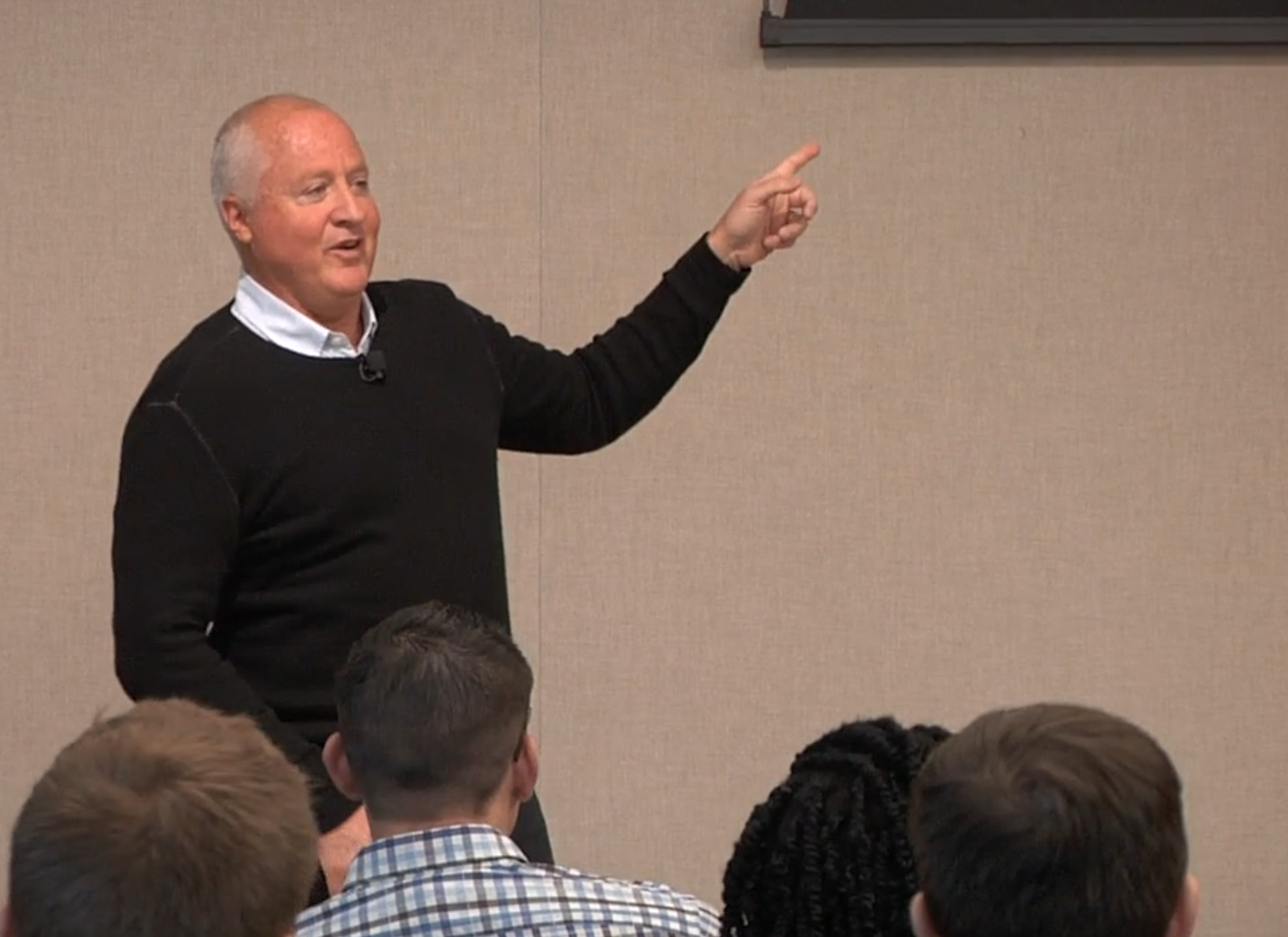
I spent time with Andy last week during a meeting at the Kauffman Foundation where he presented many of his research and findings over the years, including some great stories from sports and performance arenas.

Dr. Andy Walshe presenting at the Kauffman Foundation, Kansas City, MO February 19, 2020.

What stood out for me most is that while Andy and his team are quantifying human potential like never before, they are also validating one of the key concepts that Moe Norman used to talk about.

A few of my takeaways:

  • There is a difference between Perceived Risk and Actual Risk.
  • Managing Risk and pushing yourself past fears is a key to realizing your performance potential.
  • Andy and his team are beginning to quantify in new ways the profound benefits of proper rest (read: sleep) on high performance.
  • Responding moves you toward your goal. Reacting gets you stuck.
  • We are capable of so much more than we think…if we can learn to get out of our own way.

Yes…there it is! “…if we can learn to get out of our own way.” Moe Norman used to say all the time: “You just gotta get out of your own way.”

The challenge for most golfers is that:

  • They worry about the risks ahead. (“What if I hit it in the water?)
  • They struggle to interpret events in objective ways. (“Oh crap, I hit it in the water!”)
  • They fail to take a “winning or learning” mindset onto the course. (“I hit it in the water…I’m such a loser!”)

And while much of the game of golf is about mastering a physical skill, a great deal of thriving and performing at one’s best on the course is about managing the thoughts, feelings and emotions that are part of the experience of playing the game. (Don’t ignore this!!!)

At Liminal Collective, the organization that Dr. Walshe leads, they challenge the athlete’s fears by putting them in a room with a bear, or a box of snakes. (Yikes!…I know!!)  Or they help the athlete grow their self-concept – their sense of what is possible for them –  by teaching them to hold their breath under water for 4-5 minutes…all within the course of a single day-long training experience.

Moe Norman knew about human potential on the golf course. And while he didn’t have the language or the scientific understanding that Dr. Walshe and his team have uncovered, he had a way of facing his fears on the course – and of getting out of his own way.

What did Moe do?

  • He sought to play with an alert attitude of indifference.
  • He learned to tune-in to his feelings and emotions…monitoring what was supporting his performance, and what was impacting it negatively.
  • He learned to care a little less. To be indifferent to the outcome, even if it wasn’t aligned with his objective.
  • He learned to play from his authentic self, and not let his ego take over. He learned to get out of his own way

What can you do?

Much the same.

  • Become more aware of your feelings while playing the game… and the thoughts that drive them.
  • Reframe your interpretations about the “bad” things that happen on the golf course. See if you can label the “bad” situations on the course as a gift or a learning opportunity, instead of “…more proof that I am a terrible human being.”
  • Respond to what happens on the course. Don’t react. Let objectivity and curiosity drive your behavior. Don’t let your ego – and all that it “needs” create knee-jerk reactions.

And as much as anything, commit to improving your skill set. (But recognize where you are on your skill journey at any given time. This perspective is important in fast-tracking your development.)

It’s warm in Florida and Phoenix! See you there soon!

All the best & have a great week!

-Paul

LEARN

THE

SWING

Join 1M+ Subscribers to get your FREE Video Quick Start Guide that reveals how to hit the ball farther and straighter more consistently from now on…

START YOUR NEW GOLF SWING