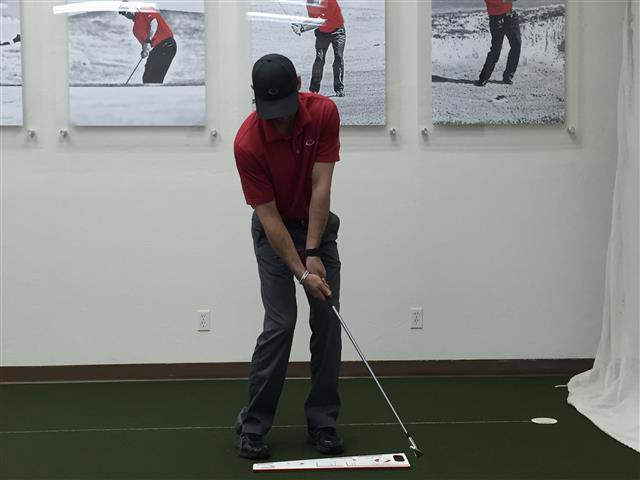
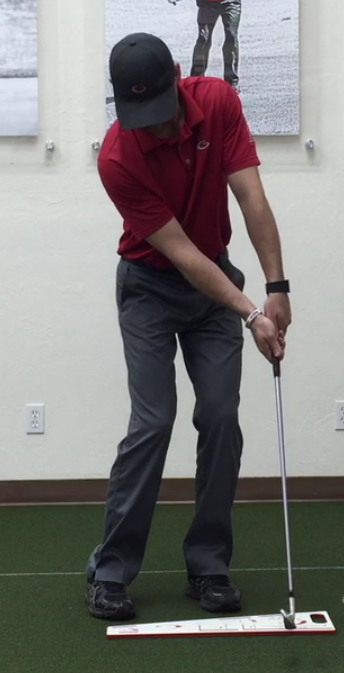
The Single Plane Address

The Single Plane Address

I’ve taught thousands of students the Single Plane Swing of Moe Norman. One thing that is consistently true about learning Moe’s swing is the importance of the Address position. Moe was right when he said:

“If you haven’t got a good address position, you haven’t got anything”.

– Moe Norman

Moe also said, “give yourself a chance“.

As I continue to research the swing, Moe’s comment is glaringly more exact. Why? Mostly because the effects of a bad address are now measurable. I can quantify the mistakes and find the causes. Many times the reasons are at the beginning of the swing – address position.

I hope that this article will help you understand that you must consistently check your address position. There are quite a few elements to it including the alignment of the feet, hand position, arm and leg position, spine tilt and bend and rotation. It can quickly get off track.

As usual, I don’t mean to overanalyze the address. It’s very simple. As I always say, just model Moe. But even modeling Moe can be tricky – because what you see can be deceiving. What you see is not still what you feel. Take for example the tilt and bend of the spine.

There are two tilts of the spine, the forward angle which is toward the golf ball and the side bend, which is the tilt away from the target. The trick is that you must have both inclinations to position the shoulders correctly so the arms can extend in the proper position.

Here is a picture of Moe at address – side bend (away from the target) is 20 degrees.
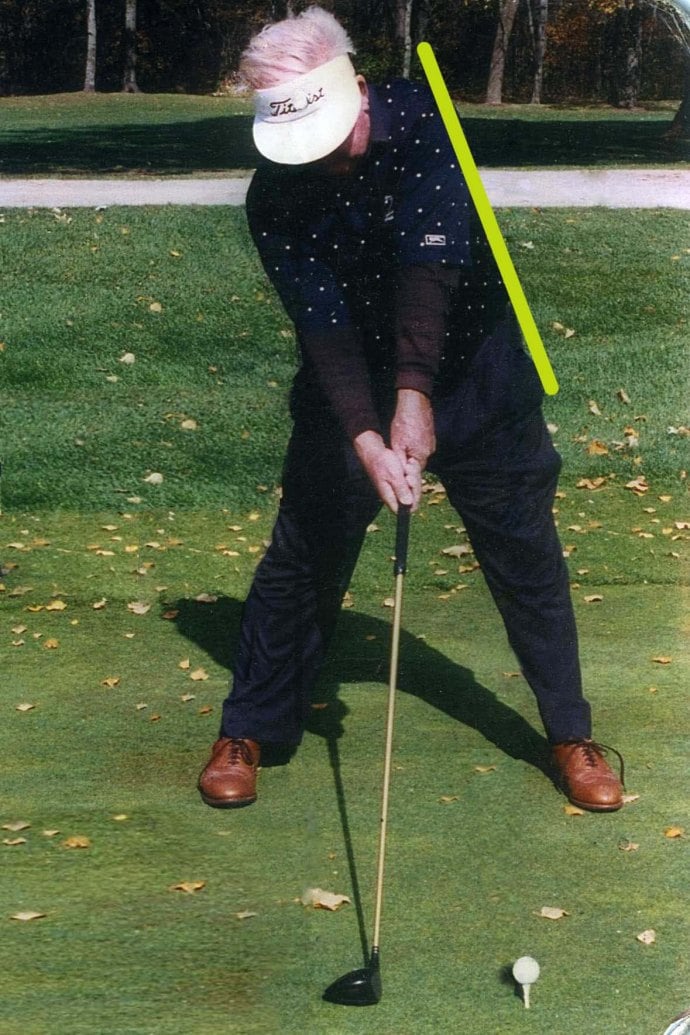
Moe Norman Address
Moe Norman side bend of twenty degrees at address

In my opinion, the side bend is the most difficult to feel and accomplish because it is entirely contrary to the conventional address position of having your arms hanging below your shoulders. With the proper side bend, you need a few other elements including the first foot rotation and trail leg braced.
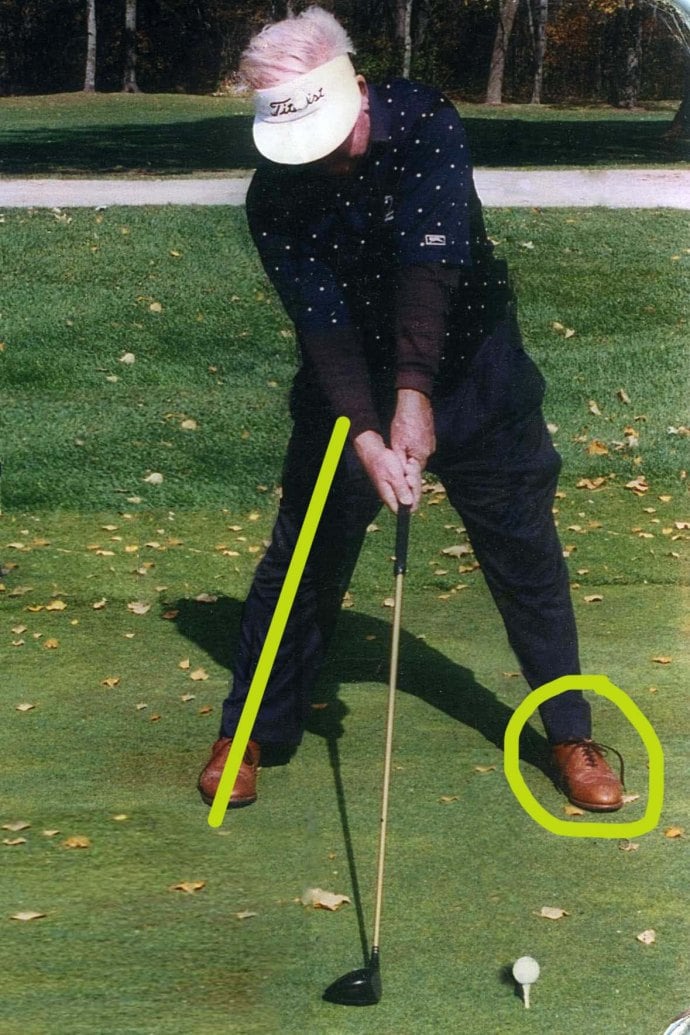
Moe Norman Address
Moe Norman Braced Trail Leg and Rotated Lead Foot

Once you have the lead foot and trail leg in position, you can quickly align the club and first arm.

Moe Norman Address
Moe Norman – Alignment of Lead Arm and Club

In many ways, the grip is a function of this address position. When you have the body in the proper side-bend, the lead holder lifts. This raises the first arm. When you grip the club, the arm is higher and rotated, aligning the back of the hand and wrist to the target. The trail shoulder is lower. When you lift the side to the club, it is rotated under the organization – creating an alignment to the single plane where the trailing arm aligns with the shaft.
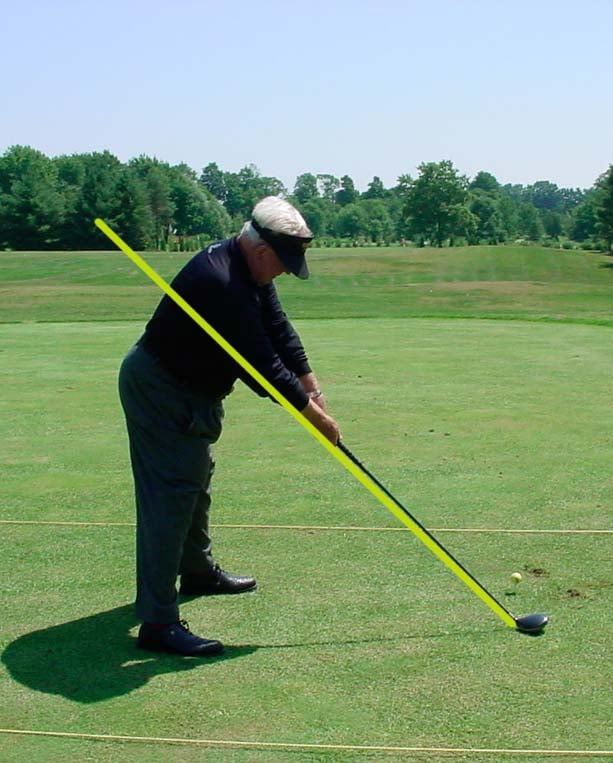
Moe Norman
Moe Down the Line Address – Single Plane

You can see in the Down-the-line view what Moe’s legs are straight. His lead arm is higher than his trail arm – both essential variables to the ideal Single Plane Swing.

In this position, the shoulders appear to be “closed” or pointing to the right of his feet line. In actuality, his shoulders are open at address.
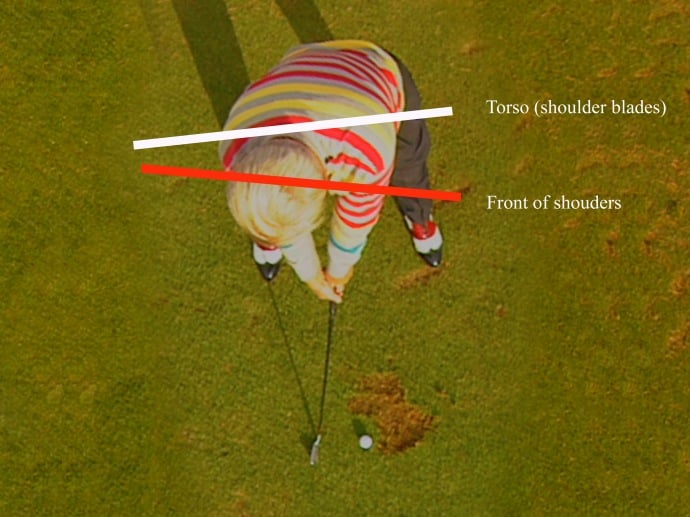
Moe Overhead Poster no lines copy

The fact that his body is open at speech is significant. At address, Moe’s shoulders are approximately 15 degrees open. When he rotates to the top of the backswing, he will turn about 65 degrees. Making the total turn 80 degrees. Why is this important?

When Moe returns to impact, his shoulders and hips will be 35 degrees open – 20 degrees more than at address. By opening the shoulders through impact, the hands can lead – give the club speed and proper angles into the ball to create compression.

My suggestion is that you consistently monitor and check your address position in a mirror or by using video. The address position sets up the golf swing, and as Moe mentioned, without it, you don’t have a chance.


Resilience is a Super Power (especially in your Golf Game…)

By Paul Monahan – GGA Performance Mindset Coach

College football is so exciting because you never know what is going to happen. You never know how teams will respond to adversity.

I just finished watching one of the Marquee College Football matchups of the week – and can’t help but think about how well both teams responded to challenges and setbacks.

If you watched the Penn State vs. Ohio State game, you know that the Nittany Lions scored on the first play of the game, and added another touchdown only a few minutes later to go up 14-0 early in the first quarter. And they led until just under two minutes in the game.

Penn State has an incredible team, and you could hardly blame the Ohio State players if they felt a little deflated early on. I mean, how do you get back in the game when you are dominated so thoroughly and so soon?

What you may not know however is that the Ohio State team has a unique resource: a peak performance coach by the name of Tim Kight who teaches resilience – something I believe is a real Super Power when it comes to realizing your best performances. Kight’s goal: to help the OSU football players master a new language and produce supportive self-talk to navigate through setbacks successfully.

Kight’s work is not the only thing that determines the team’s results. And it doesn’t always produce the results they want. But more often than not, his work cultivates a performance dynamic for the players to operate from a productive mindset and play their best, no matter the situation.

Mental and emotional resilience – the capacity to bounce back from challenges, disappointments, and setbacks quickly – is such an essential part of golf as well.

In today’s column, I will present some concepts that may allow you to think differently about setbacks, and help you to build your capacity to be resilient while practicing and playing.

I believe that with some intention and awareness, you can build MORE resilience into your practice and play so that this single-plane-swing journey is a lot easier and way more fun.

How? First, we have to start with some basics.

There is only one reason why you experience adversity, but it’s probably not the reason you think.

Here’s how we often process challenges on the golf course our self-talk sounds like this:

Seems logical, but the truth is quite different.

You see, you’re not upset because you drove it into the trees, skulled a wedge across the green or missed that easy four-footer on the last green.

You’re mad for a much more fundamental reason.

That’s right. You’re upset because the REALITY you are experiencing does not align with your STORY about what you SHOULD be experiencing.

(Read that again. It’s super talented.)

You’re not mad because you drove it into the woods. You’re crazy because your STORY says you should be able to hit the fairway…or perhaps that guys like you don’t run it into the woods.

The stories you anchor in critical moments shape how you interpret each moment. And when your reality and your story are misaligned, it’s easy to understand any moment as bad, negative, disappointing, frustrating…etc.

If you played golf with me when I was 20, you’d understand why I threw my clubs all the time…or why I played the game so frustrated.

It wasn’t because I was producing terrible shots. (Though there were LOADS of those!) It was because my STORY and my reality were not aligned. My story was: “I should be able to produce great shots all the time.” And yet my fact was entirely different, and it was hard to be resilient.

So what to do?

I believe that there are three easy ways to build more resilience in your golf game.

  • Be more aware of your internal mechanics:

Awareness is both a skill and a discipline. When you bring knowledge of your own mental and emotional state to the golf course, you can improve how you play and experience the game.

But you need to work at it…and be intentional about it.

Your brain is continually monitoring your environment looking for nominal conditions. And when situations fall outside of theoretical – when reality and story are not aligned – red flags go up, and your emotional intensity rises.

But missing a four-footer just means that you lost a four-footer. The event itself is neutral. It doesn’t say anything until you – guided by your internal mechanics – decide it does.

So pay more attention to your internal mechanics…the part of your brain that signals potential danger – and that can take you out of productive thinking if you are not careful.

And when you are facing adversity ask yourself: Is this a disaster …? Or is this something more benign?

Take a few moments the next time you show up to practice or play, and try and assess your own mental and emotional state. And work to be more aware of when your internal mechanics are trying to hijack your game.

Fault / Fix – “Flipping” the Release in the Chipping Stroke

After this past week’s 3-day school at our Phoenix base – thought it would be a good idea to review a common fault and its fix – Flipping in the Chipping Stroke. The proper chipping stroke/movement is CRITICAL for adequate impact in full swing.

 
SEE BELOW:
 

If there is one area where golfers build poor technique into their full swing, it is in their chipping stroke. In reality, the chipping stroke for the short shots around the green directly relates and builds habits into the way a golfer attacks a golf ball. When teaching chipping to our students, one of the most significant issues we see is the “Flip” the release through the ball. As seen in the picture above, the “Flip” is when the club head gets in front of the hands just past the impact zone. In the “flip,” note how the lead wrist is bent, the trail wrist has released, and the clubhead is ahead of the hands. Also, you see the butt end of the club pointing behind the golfers lead hip. The “flip” in the chip shot leads to many, many bigger problems, including:

  1. Chip shots hit fat or thin. No distance control.
  2. “Skulled” chip shots
  3. Every golf shot becomes a “flipped” release, from putts to the driver
  4. Significant loss of distance in full shots
  5. Topping or fatting of iron/hybrid shots
  6. Inability to compress the golf ball at impact / “weak” shots and more.

Simply put, the “flipped” chip shot is not only an issue when chipping, but creates a myriad of problems throughout your game. If you have lost distance, are having a hard time hitting the ball solid, or get the chipping “yips,” then see the video below on how to fix this pervasive, very damaging issue.

FIX – Firm Lead Wrist Through Impact

Screen Shot 2016-03-21 at 1.29.16 PM


Click on Above Play “Arrow” to See Video of Fix

Focus on the Process

By Paul Monahan – GGA Performance Mindset Coach

Great Results.

It’s a big part of what we look for when we play golf.

Everybody I know on the Single Plane Swing journey – myself included – wants to play better golf, hit it farther, shoot lower scores and beat their buddies for once.

So what do we do? We focus on: Hitting the ball farther. Shooting lower scores. Beating our buddies.

And what could be wrong with that? After all, we all know that if you want something – you focus on that thing and get it. Right?

Well…sometimes yes. And sometimes no.

The truth is that when it comes to performing at our best, (and even learning a new way to hit a golf ball) focusing on the process is more important than focusing on the result – a bit of a paradox – but one worth breaking down.

In my practice, I often help my clients to become more aware of their thoughts at any given time. The ideas that you anchor to each moment matter because they drive your mental and emotional state, as well as how you show up to perform in each moment. (Especially during those times I call “critical moments” when you feel – consciously or not – like you have a lot invested in a particular outcome)

One of the most important concepts we often discuss is the distinction between operating from a Results Orientation versus a Mastery Orientation…a distinction that helps them to understand two very different perspectives through which to view critical moments.

Here is how I explain it:

To operate from a Results Orientation means that you maintain the perspective that you MUST achieve a specific result. In essence, it’s as if you are holding a tight grip on your story(s) about a pre-defined result: sinking a six-footer, driving the ball in the fairway, reaching the green with this shot…etc.

None of those stories sound too uncommon. However, when you operate from a Results Orientation your THOUGHTS often seem more like: “I need to sink this putt…OR ELSE.” “I need to drive it into the fairway, OR ELSE.” “I need to reach the green, OR ELSE.”

And your thoughts drift toward what you might LOSE.

The result? Pressure. Nervous energy. Indecision. Doubt. Herky-jerky putts. Anything, but freedom and flow. (I think you get the picture.)

Operating from a Mastery Orientation, on the other hand, happens when you maintain the perspective that every one of your experiences is merely a step on your journey (or path) to mastery.

All your performances – each shot on the golf course, every sales call, each presentation – have a neutral value even if they produce results not aligned with your desires.

If you hit the fairway from the #1 tee box, great; enjoy that. Take satisfaction in it. If you find the right rough, still great. Relish the opportunity to learn and grow.

And so, operating from this perspective feels much freer, more relaxed and less emotionally intense, a state that promotes your best performances.

When you take a Mastery Orientation onto the golf course, you prevent your primitive survival responses – anxiousness, doubt, nerves, frustration – from kicking in and hijacking the moment. You can experience things more objectively and access your skills and abilities much easier without expending the kind of energy that leaves you mentally and emotionally drained.

Importantly as well, when you operate from a Mastery Orientation, your focus changes from results to process. You TRUST that the results you want will come so long as you get the process steps right.

How would this play out in real life?

You may decide that you want to drive the ball 240yds in the fairway at least six times in your next round. Great. That’s your goal. Put it up on the wall.

Then set it aside.

Why? Because focusing on your goal won’t get you to your goal.

But a focus on the process steps WILL.

So what precisely to focus on?

It will be different for everyone, depending on where you are in your own single plane swing development. But you might decide to focus on:

Slowing down your pre-shot routine.

Feeling a “released” lead hand as you grip the club at address.

Feeling the braced trail leg.

Rotating properly through position 3 to impact.

The key: You need not focus on your goal. Instead, trust that if you develop mastery of the process components, achievement of your goal will be the natural by-product.

The other key: Let go of your attachment to a specific result. If you do everything right, and still don’t get the result you had hoped for, that’s ok. That’s called golf. That’s called life. You are going to be okay.

So, as you learn and develop as a single plane golfer, focus on the process, accept the outcomes and cultivate the understanding for yourself that everything you do in this endeavor is just one more part of the journey.

And trust that if you do it enough, and in the correct ways, the results will come. You will hit it farther than you ever have, score lower than before and play better golf.

Paul Monahan, PCC is a member of the International Coach Federation and is a certified COR.E Performance Dynamics™ Specialist. He resides in Cleveland, Ohio with his wife Paula and is the proud dad to three young men.

Distance – How to Get More ….

DISTANCE – HOW TO GET MORE….

One of the most common questions we receive (seems every day) is “How can I get more distance?”

There are three areas you can work on/improve to help you get more distance on all your golf shots, in particular, your driver.

Those three areas are:

  1. Driver Technology
  2. Flexibility and Strength
  3. Swing Technique

Let’s break down each area a little.

1.  Driver Technology:

A few years ago, the USGA put together a set of rules limiting how much a golf ball can “rebound” off the face of a driver (a vague description) – thus putting a limit on the distance of the drivers. Since then, the golf industry realizing they can no longer make drivers that can hit it further off the face, have been working on technology that has made the “big” headed drivers more aerodynamic (thus less air resistance in the golf swing) and more prominent sweet spots on the face.

Older technology drivers had sweet spots the size of a dime (some smaller), newer technology drivers have sweet spots the size of half dollars (some even bigger). What that means is balls hit slightly off the middle of the clubface will travel much further now.

And the key is the “average driving distance” you have, not the “one” you catch that happens to fly a long way. Meaning, if your sweet spot on the driver is large and you miss hit a few shots (or more) around off the middle of the clubface, you will still get good/more “average” driving distance. Meaning, overall you will have less club into the greens, etc. etc.

So, if you are looking to maximize or increase distance – you need to have a driver that is “modern” or at least less than 2 or 3 years old. These newer drivers have large sweet spots and have the highest technology for the least amount of wind/clubhead resistance in the golf swing.

2.  Flexibility and Strength

The 2nd area to focus on with distance is flexibility and strength. And in that order. Too many worries about strength and not flexibility. Being strong with good, or great, flexibility “allows” you to get in positions in your golf swing to hit the ball with reasonable distance.

As we get older, we lose our strength and more importantly our flexibility, when we start to lose our elasticity, we can no longer create certain angles in the golf swing that will allow us to create “leverage” in the golf swing which in turn produces speed and distance.

We have produced an extensive DVD on this topic. This DVD is set up to test the areas of your body and its flexibility in these areas. It then gives you 3 or 4 exercises you can perform to regain or create increased flexibility (and strength) in those areas. This DVD designed around the single plane swing of Moe Norman – in other words, it takes the eight most significant positions of Moe’s swing and determines if you are flexible enough to “reach” those positions. If not, it gives you “easy” exercises to perform over time that in turn will help you gain those positions and eventually “allow” you to swing the club on plane.

You can see a lot more detail about the Flexibility and Exercise information at: Flexibility and Exercise information at: Flexibility and Exercise Video

3.  Swing Technique

Ultimately, the most crucial factor to get more distance is to improve your technique. It is always interesting, one of the things we do at all our schools and camps is to measure our students swing speed. We then correlate it to their driver swing speed and the average distance they should be hitting their driver. For most (those that swing 85 to 90 mph), they should be hitting their driver 230 to 240 yards (with a little roll).

For most, when they find out how far they should be hitting their driver with the speed they currently have, they are shocked. Why are they hitting it so short compared to where “their potential” says they should be hitting it? Because of technique. They are not hitting the golf ball off the “sweet spot” of the club with a “direct hit” from the club that is on the path.

In other words, they are hitting “glancing blows” that is creating side spin which is limiting or reducing the distance they should be hitting their driver.

Working on swing technique – working on getting the club on the proper single plane/path, with a square clubface through impact and ultimately, limited to no side spin, will give you the maximum distance.

In conclusion, to answer the all too common question, we get from so many of our students/customers

How can I get more distance?

Answer: Obtain a new/modern driver that has the highest technology for increased sweet spot and limited wind resistance (aerodynamic). Work/continue to work on flexibility (especially over the “off-season” months when so many loose elasticities because of an increased static lifestyle) and always work on improving your technique to maximize the optimal hit on the ball with limited sidespin and enhanced sureness of hit.

P.S – Here is the P.S. to this article as EVERYONE will ask this question to us (in person, at schools, during webinars, across emails, etc….).

What is the fastest way to improve technique?

Answer – BECOME INVOLVED IN OUR COACHING PROGRAM

These are our premier instructional program set up for personalized instruction from a distance (from your home).

In fact, this is the program we GIVE to everyone who attends our Build Your Game Camps – this is how we follow up with all our camp students to guarantee continued success and improvement in a much shorter period.

To see more about our coaching program: CLICK HERE

(We are currently running (as of today) a VERY limited coaching program special)

For more information, please click link above or you can email Trent White, PGA – Coaching Program Manager at trentw@moenormangolf.com

New GGA Staff Member & Training Aid Specialist

Want to introduce a new staff member with the Graves Golf Academy – Wes Wilkinson, PGA.

Introductory Blog from Wes:

My Name is Wes Wilkinson. I am the new training aid specialist for Graves Golf Academy.

As your Training Aid Specialist my job is to answer any questions about the many training aids available at Graves Golf Academy. I want to make sure you get the training aids you need to improve your single plane swing.

I have known Todd and Tim Graves for over 35 years. I have played golf with them and 15 years ago worked for Graves Golf Academy by setting up and running junior camps. Because of that experience their simply and easy system is integrated into my teaching philosophy and teaching practices.

Tim Graves and I went through PGA school together where we were both successful in becoming PGA members.

Through my career I have worked in the golf business as an assistant golf professional, a teaching professional, a director of golf, a Callaway Tech Rep, and an instructor at The University of Central Oklahoma in the PGA Golf Management Program.

I am excited to be back with Graves Golf Academy as the Training Aid Specialist. I look forward to helping you learn your new and more reliable single plane swing.

To contact Wes (questions/comments about GGA Training Aids): WesW@moenormangolf.com or 866-377-2316

LEARN

THE

SWING

Join 1M+ Subscribers to get your FREE Video Quick Start Guide that reveals how to hit the ball farther and straighter more consistently from now on…

START YOUR NEW GOLF SWING