Feel Your Swing

Feel Your Swing

Inside-SPS-DVD-Bundle
I am very excited to announce our latest product – Inside the Single Plane Swing. What inspired me to develop this product was a thought I had over twenty years ago when I first witnessed Moe hitting balls. Watching what he called “the purity of technique”, I couldn’t help but think:“I wonder what that feels like…what if I could just feel that one time?”

Ironically, Moe called his swing The Feeling of Greatness. I was always curious and wondered exactly what does that really mean? Moe explained it as knowing that he was going to hit it well before he actually hit it. His feelings, as with all feelings, were internal and emotional.

Then I spent years finding various ways to feel like Moe. I modeled and practice Moe’s movements. I copied him on video. I stood next to him and even crawled between his legs when he hit balls. I did everything I could to get INSIGHT into his movements with one goal in mind – to feel his swing.

Moe Norman
Learning from Moe

What does it feel like to swing like Moe Norman?

Yet we all experience feelings every time we play golf and go to the range. We feel the club, the movement of our body and the contact with the ball. This is the kinesthetic “feelings” we get. However, research shows that feelings are more than just kinesthetic. Feelings are actually multi-sensory. This means that what we see and hear affects how we feel too.

To give you an example, years ago a group of professional golfers were asked to test beryllium copper irons against stainless steel. The beryllium copper (BeCu) irons made a much deeper sound, almost a thud, when struck where the stainless irons were louder. The professionals confirmed that the beryllium irons felt softer and the stainless felt harder. Then the club-heads were painted black where the professionals could not differentiate between the two clubs. The professionals were still able to differentiate the BeCu irons form the stainless – still convinced that they were “softer” when struck.

Then the researchers made the professionals wear ear-plugs. With the unpaired clubs, the professionals still confirmed that the BeCu irons were softer. Then to everyone’s surprise while wearing ear plugs and with the clubs painted black, the professionals could not differentiate between the BeCu Irons and the Stainless Steel.

What this research shows are that Feel is subjective to sight and sound as much as the kinesthetic sensations of the body. My research shows that when it comes to Swinging like Moe you must use ALL of your senses to Feel like Moe. 

As a matter of fact, this is exactly why we have so much success at our schools. When you come to one of the GGA schools there are keys that helps students improve in a very short period of time. One of these keys is that we simply help the student “Feel” something new.

The schools give the student a new “experience” of the single plane swing. There are countless times where students will say that was worth the price of admission when I show them were to place the trail hand or show them the backswing. Why? Because I am not showing them. I am helping them experience.

Experiencing the swing is the KEY to learning the it. Experiencing is Feeling because it incorporates all of your senses – which is why instruction is so valuable and important.  

Our latest product “Inside the Single Plane Swing” utilizes multiple approaches to help you Feel the Single plane swing. These approaches include:

  1. New overhead camera angels to give you new perspectives – enhancing your visual feedback
  2. Point of View perspectives, that stand you inside the golf swing to see it happening.
  3. Focus points that help you direct your attention to WHERE and WHEN you should feel your body

In addition to the new perspectives and sensations, Inside the Single Plane Swing includes a Pocket Guide that will help you take these instructions to the range and help you focus your attention on the key areas so you can practice correctly and most importantly – Feel the correct swing while you practice.

Pocket Guide Inside SPS

The Pocket Guide is our way of helping you take a coach to the range with you.

The pocket guide gives you the experience of a Single Plane coach standing with you on the range while you practice.

I believe this product will be revolutionary in the way it teaches you how to practice, experience and ultimately feel your swing.

Distance – How to Get More ….

First, I want to discuss a little about my article – “No Excuses in the Bag” – Club Fitting article.

I have received a lot of questions and comments about the article.

The most common question is “Can you get the fittings needed for the single plane swing done at a local club shop or club builder, etc.?”

To be honest, I used to say it was possible, now I am not sure….  I have seen too many times when golfers purchase clubs through other sources and think they are fit to their single plane swing, only to find out that “other source” did not fit correctly.

To solve the issue – if you are interested in purchasing any club or clubs, doesn’t matter if a single wedge, to an entire set, to hybrids, driver, fairway woods, etc.. give us a call or email – we’ll make sure you get the clubs you want and make sure they are fit PERFECT for the single plane swing to YOUR individual specifications.  We fit ALL clubs for length, lie angle, shaft flex, grip size, proper loft, etc… to each INDIVIDUAL’S specifications.  You can see more detailed information about this at: Free Club Fitting

*********

DISTANCE – HOW TO GET MORE….

One of the most common questions we receive (seems every day) is “How can I get more distance?”

There are 3 areas you can work on / improve to help you get more distance on all your golf shots, in particular, your driver.

Those 3 areas are:

1.  Driver Technology

2.  Flexibility and Strength

3.  Swing Technique

Let’s breakdown each area a little.

1.  Driver Technology:

A few years ago, the USGA put together a set of rules limiting how much a golf ball can “rebound” off the face of a driver (vague description) – thus putting a limit on the distance of the drivers.  Since then, the golf industry realizing they can no longer make drivers than can hit it further off the face, have been working on technology that has made the “big” headed drivers more aerodynamic (thus less air resistance in the golf swing) and bigger sweet spots on the face.

Literally, older technology drivers had sweet spots the size of a dime (some smaller), newer technology drivers have sweet spots the size of half dollars (some even bigger).  What that means is balls hit slightly off the middle of the club face will travel much further now.

And the key is the “average driving distance” you have, not the “one” you catch that happens to fly a long way.  Meaning, if your sweet spot on the driver is large and you miss hit a few shots (or more) a round off the middle of the club face, you will still get good / more “average” driving distance.  Meaning, over all you will have less club into the greens, etc… etc..

So, if you are looking to maximize or increase distance – you need to have a driver that is “modern” or at least less than 2 or 3 years old.  These newer drivers have large sweet spots and have the highest technology for the least amount of wind /club head resistance in the golf swing.

2.  Flexibility and Strength

The 2nd area to focus on with distance is flexibility and strength.  And in that order.  Too many worry about strength and not flexibility….  Being strong with good, or great, flexibility “allows” you to get in positions in your golf swing to hit the ball with good distance.

As we get older, we loose our strength and more importantly, our flexibility.  When we start to loose our flexibility, we can no longer create certain angles in the golf swing that will allow us to create “leverage” in the golf swing which in turn creates speed and distance.

We have produced an extensive DVD on this topic.  This DVD is set up to test the areas of your body and it’s flexibility in these areas.  It then gives you 3 or 4 exercises you can preform to regain and/or create increased flexibility (and strength) in those areas.  This DVD is designed around the single plane swing of Moe Norman – in other words, it takes the 8 most important positions of Moe’s swing and determines if you are flexible enough to “reach” those positions.  If not, it gives you “easy” exercises to perform over time that in turn will help you gain those positions and eventually “allow” you to swing the club on plane.

You can see a lot more detail about the Flexibility and Exercise information at: Flexibility and Exercise Video

3.  Swing Technique

Ultimately, the most important factor to get more distance is to improve your technique.  It is always interesting, one of the things we do at all our schools and camps is to measure our students swing speed.  We then correlate it to their driver swing speed and the average distance they should be hitting their driver.  For most (those that swing 85 to 90 mph), they should be hitting their driver 230 to 240 yards (with a little roll).  For most, when they find out how far they should be hitting their driver with the speed they currently have, they are shocked…  why are they hitting it so short compared to where “their potential” says they should be hitting it?  Because of technique.  They are not hitting the golf ball off the “sweet spot” of the club with a “direct hit” from the club that is on path.  In other words, they are hitting “glancing blows” that is creating side spin which is limiting or reducing the distance they should be hitting their driver.

Working on swing technique – working on getting the club on the proper single plane / path, with a square club face through impact and ultimately, limited to no side spin, will give you the maximum distance.

In conclusion…  to answer the all too common question we get from so many of our students / customers…

How can I get more distance?

Answer:  Obtain a new / modern driver that has the highest technology for increased sweet spot and limited wind resistance (aerodynamic), work / continue to work on flexibility (especially over the “off season” months when so many loose flexibility because of an increased static life style) and always work on improving your technique to maximize the optimal hit on the ball with limited side spin and improved squareness of hit.

Using Your ABT and a Yardstick

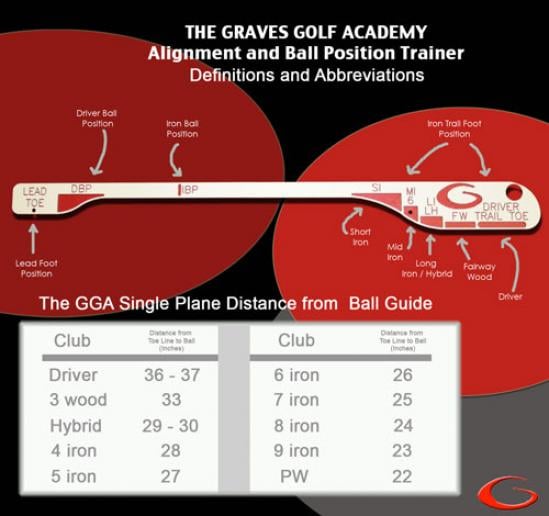
Was putting in a little practice time today (before watching the last round of the U.S. Open (btw – congrats – Brooks Koepka) and had a golfer next to me on the range ask me about my practice station (yardstick and ABT..). Thought it might be a good time to rerun the set up and ball position article using the ABT and yardstick.

Many times, after our school day ends, myself (Tim) and a few of my assistants (typically Chandler…) will practice a little before we call it a day. After our school this past weekend, Chandler and myself stepped outside our academy and hit a few balls. During our practice session, I set up my normal practice “station”. A couple of our students stayed after the school and were watching us. After a few minutes, one of them commented how much I used the yardstick (with my Alignment and Ball Position Trainer (ABT)) while practicing….. it seemed unusual to me that he didn’t know how important the combination (yardstick and ABT) were – so I thought I’d write this practice tip on using the ABT with a Yardstick.

Here are 6 ways to I use the ABT and Yardstick:

getPart

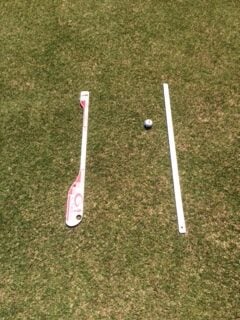
1. Checking iron ball position and distance to the golf ball. If you are going to hit the ball from this position, make sure the ball is at least 3 inches away from the edge of the yardstick.

4969055ec06d1_ABT10

** Distances form Toe (foot) Line to the Golf Ball (inches) **

getPart-2

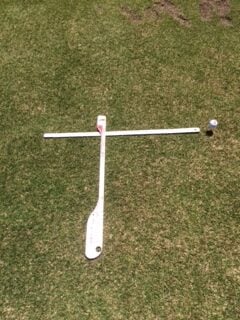
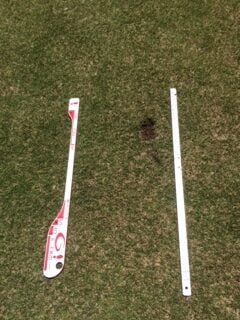
2.  Checking driver ball position (DBP) and distance to the golf ball.

getPart-3

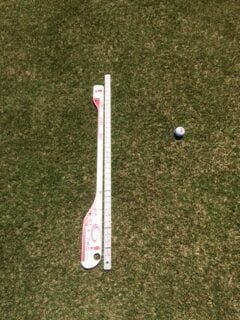
3. Laying Yardstick next to ABT to help square face of golf club. When setting up, make sure grooves on clubs are lined up with the markings on the yardstick. It is also an easy way to slide the ABT up and down the yardstick so you can make many divots at the IBP position and keep the ABT square to the target.

getPart-4

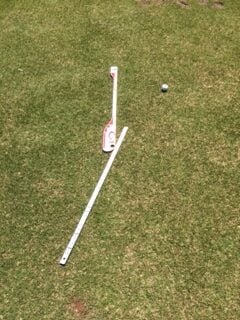
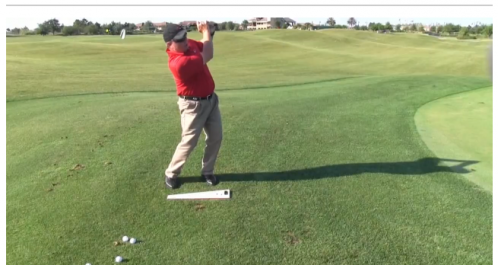
4. Setting Yardstick at angle at back end of ABT to check the club angle at position #3 in the downswing. (Review to PVC/Single Plane Position Trainer drill).

getPart-5

5. Setting Yardstick parallel to the ABT forming “railroad” tracks. Will help square the face of the club at set up and help as additional reference when setting up.

getPart-6

6. Divot check. When practicing with the “railroad” tracks – make sure divots are aligned with the yardstick.

Obviously, you are not going to use these set ups “all at once”. I routinely adjust and change the placement of my yardstick checking different positions/areas of my swing. Divot angle, club face alignment, etc.

I can guarantee you, if you ever see me in person with my golf bag, you will find my ABT and yardstick tucked inside.

Again – a few easy ways to maximize your practice.

To review ABT training:  CLICK HERE

In Season Practice

Thought I ‘d write a little about in season practice. For those that have studied our instructions, it is what we call Practice Type A.

There are basically two different types of practice:

Practice Type A – practicing like you are about to play or practicing for playing.

&

Practice Type B – practicing to build your game, creating new habits in your swing, short game, etc. Working on changing your swing.

Practice Type A is the type of practice you need to be working on when you are “in season” or playing important rounds of golf. For the professionals, practice type A is the type of practice they perform in season, practice type B is the type of practice they perform in the off season.

Here is a good schedule and suggestions for your Practice Type A sessions.

I will use an “hour” practice session (can also break down in percentages if are practicing for less than an hour).

15 minutes (25%) Practice Putting. Start with this so you don’t skip and great way to “stretch” a little before you get on the range.

Lag Putt (30 – 40 footers – lag to a few feet (as close as possible – work on speed).

Work on making 3 and 4 footers, using 1 or 2 golf balls (no more than 2 balls), lining up the putt, setting the T on the ball toward the break and putting as if you had one putt on the course. Mimic being on the golf course. Work on your pre-shot, set up and rhythm. Work on getting comfortable over the putt.

Work on different breaks (pick one hole with break and work around it like a clock).

Work on 10 to 15 foot putts – trying to make, if miss keeping with 2 feet past the hole.

Don’t forget to hit a few putts off the edge of the green (from the fringe).

10 minutes (about 20%) Practice Chipping and Pitching

Chip and Pitch (if possible) with the same golf balls you play with. (Work on the feel, spin, the way the ball reacts when hitting the green and out of the rough).

Chip with 2 golf balls – hitting different shots to different holes. Don’t get stuck on one hole. Work around to get different chips.

Pitch the same if possible. If not, do a few minutes on the range before you work on full swing. Work on pitch shots that will roll out a little and some flop type shots with as minimal roll as possible.

5 minutes (about 5%) Practice Sand / Bunker

Work on first getting the ball out of the bunker (being aggressive enough).

Next, work on getting on green.

Finally, work on getting close to the hole (spin control).

This is not the time to “create” your bunker game – this is the time to get the feel for the sand and “remind” yourself how aggressive you need to be out of the bunker.

If you do not have a bunker for practice – use this time for additional chipping and pitching practice.

15 minutes (about 25%) Practice All Clubs in Your Bag Except Your Driver

Start with the wedge(s) and work through the irons to the longer clubs (hybrids, fairway woods, etc.)

Use an alignment aid to check alignment (whether in a Practice A or Practice B setting always use an alignment aid).

Do not get “stuck” on one club. Work through all clubs working on tempo and alignment.

Work on different shots (low, high, etc..) as you would have on the golf course (into the wind, downwind, cross wind.)

Hit a targets, check distances (to the best of your abilities hitting range balls).

15 minutes (about 25%) Practice with Your Driver

Use an alignment aid to check alignment.

Work on different shots (high, low, etc.)

If you hit a lot of fairway woods / hybrids off the tee – give them some time during this session.

Do not “shot gun” this practice. Pick a target, tee up a golf ball, check alignment, and hit. Do again as if you were on the golf course.

Work on tempo, check alignment (and ball position).

Work on different tee heights and ball positions for different shots (high vs. low) – down wind us into wind.

*******

As you see, this type of practice (Practice A) is not the practice to build or change your swing. This type of practice is again the practice to get ready to play or to keep your game in “playing mode”.

If you are one that wants to perform Practice Type B and Practice Type A in season, you must give yourself enough time for the Practice B sessions to take effect (typically about 3 weeks of continual practice to create a new habit) and also give yourself enough Practice A time to get ready / comfortable for those upcoming rounds.

It is difficult to mix Practice Type A and Practice Type B in the season. We recommend if possible – perform Practice A in those months you are playing a lot of “important” rounds and Practice Type B when those rounds don’t “matter as much….” or even better – those months when you aren’t playing.

Rare Opportunity for Students

Rare Opportunity for Students

We just completed our first two schools at our new Oklahoma City facility, Rose Creek Golf Club. The schools could not have gone any better and we are extremely excited to be calling this amazing golf course home!

d5e7c4f1-9713-4892-829e-2c6e29758f80-thumbnail

It’s great to be in Oklahoma City. Most of the year our Premier School Staff is traveling to the different locations across the United States conducting the 3 and 5-day schools we offer. Due to the amount of schools we host, our full team is rarely together anymore.

For instance, half of the team would be teaching a school in Orlando while the other half is in Phoenix doing the same.

But… Oklahoma City is the exception. There are a couple rare opportunities coming up where you can work with our entire Premier School Team (including both Todd and Tim Graves).

If you’re looking to maximize your time with the entire Premier Team, your best option is coming to Oklahoma.
Why? Because Oklahoma City is our headquarters. It is where Todd, Tim, and the rest of the Premier School Staff call home.

Screen Shot 2015-10-17 at 8.53.57 PMdc3b8ae5-be58-4f4e-a0ba-7de83bc2da70

Did I mention that since our team does not have to travel we pass the savings onto our students? Our Oklahoma Golf Schools are priced $300 – $500 cheaper than any other location.

Now, onto the opportunity to work with the entire team…

The two schools below will have Todd, Tim, and the entire premier team as coaches.

July 14-16th, 3-Day Golf School – ($300 Savings)

September 6-10th, 5-Day Camp – ($500 Savings) – *Only 5 Day Camp in OKC*

These couple schools are limited on availability and are approaching rather quickly. We hope you can join us at our new home facility.

To see list of premier schools (including OKC schools):  CLICK HERE

A great experience is guaranteed for all!

It’s Not Rocket Science

By:  Todd Graves

Forever it makes me wonder the extent to which golf instruction has become so difficult that golfers now believe that good players hold some secret.   While the secret is nothing more than good solid mechanics.  There is no secret other than the secret is “get the club to impact in the easiest way possible”.  The golf swing is not rocket science.

I don’t play much golf anymore.  Today I played my fourth round for the year.  Here are my scores for this year – 74,66,73,68. I’m seven under for the year and I don’t practice, I don’t worry about it.  I just step up and play – occasionally.  I don’t hit it perfect, as a matter of fact here are today’s statistics: 11 Fairways, 13 Greens, 1 Sand Save, and 26 putts.  Golf is like riding a bike to me – it just comes back to me even when it don’t feel that well.  Sometimes I feel a bit quirky over a shot – but overall I manage to play well enough to have fun.  Here are some of my secrets to making the game low maintenance.

Learn how to “feel great” at address

The main way to play well is that once you have a swing, you must learn to use it.  The best way to do this is to learn how to feel really good at address when you aim at a target.  This is my key to playing well. If if feel good at address, then it is easy to pull the trigger.  If I don’t feel right at address, then thoughts can creep in.  When weird thoughts creep in, I find it difficult to pull the trigger and I lose confidence.  I practice on the range like I am playing because I am really practicing on how and when to pull the trigger.

Aim at targets as often as you can and be aggressive

Aiming at targets is the key to learning how to pull the trigger. When you aim at targets, you learn to eventually stop all thoughts and you develop the timing of “when” to pull.  This is the key to developing consistency and aggressiveness in your playing.  I hate not being aggressive in my ball-striking.  As a matter of fact, I rarely ever “ease up” on a shot.  If I need to hit a small 8 iron or take something down a notch, I will usually just choke down and still swing full.  I like aggressive swings, not tentative ones.

Have confidence (or act like you do) even if you don’t

Paradoxically, this is one of my keys to playing well even if I don’t feel like it.  Sometimes I don’t feel like I am playing that well or I haven’t played in awhile – say two or three months.  Usually I get invited to play at really great and hard golf courses so playing poorly is not fun.  So what I do is act as though I have been playing every day.  I act as though I am sharp and ready as though I just walked off of a major tournament and played well.  I act as if I am playing well.  By acting as if I am playing well, my physiology changes and I actually start believing it.  Then, when I hit a few good shots, my confidence builds and I start playing better and better.  If find that acting like I am playing well gets me playing well.  Just think of the alternative.  What if you act as though you are not playing well.  This prophecy fulfills itself and soon, after you hit a few bad shots, you start to make excuses.  Don’t make excuses, just act as though you are playing well.

Focus on the best outcomes for all shots

Another thing that keeps me playing well is that, other than feeling great at address, my only other conscious effort is to focus on the best outcome on every shot.  I constantly ask myself, “what do I want on this shot?” or “What would be a perfect shot here?”.  By focusing on the best outcome, I stay aggressive and positive.

Read em and Roll em

One of the places that is easy to get discouraged is on the greens – putting.  One way that I stay focused and positive on putting is what I call “read em and roll em”.  What I mean by this is that if I read the putt well, my only expectation is to roll it where I read it.  There is nothing else I can do.  Therefore, the key to putting well, for me, is to read the putt well.  Once I get a good read – let her roll.

Love every shot you hit

The final and toughest part of playing “part-time” is enjoying every shot even the bad ones.  But I think loving every shot you hit is one of the secrets to great golf.  If I hit a bad drive, I simply try to recall what the swing felt like.  Then, I attempt to recall what a good swing feels like and I can appreciate learning from the bad swing.  Just like that – I loved the bad swing too because I learned something from it.

These are just a few keys that I use to play well all the time – especially when I am not playing regularly.  They keep the game fun.

LEARN

THE

SWING

Join 1M+ Subscribers to get your FREE Video Quick Start Guide that reveals how to hit the ball farther and straighter more consistently from now on…

START YOUR NEW GOLF SWING