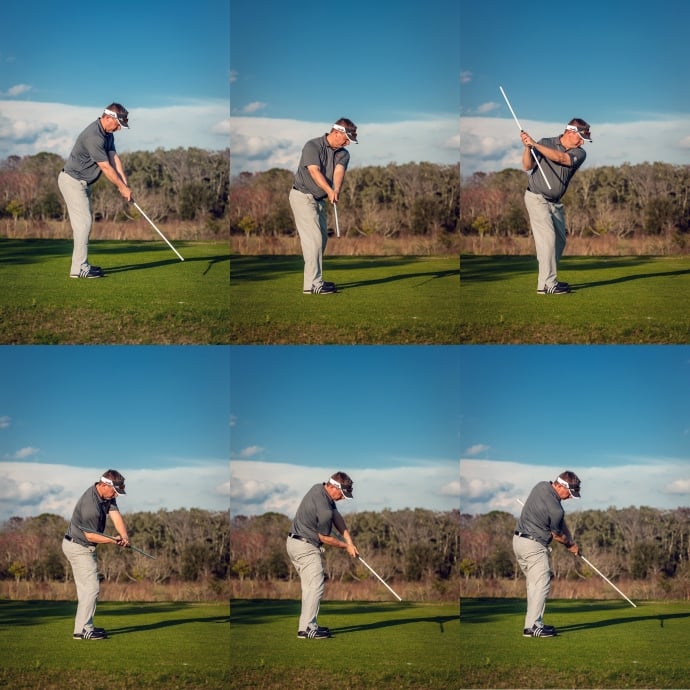
Moe Norman’s Single Plane Backswing – Inner Circle Members Exclusive

Moe Norman’s Single Plane Backswing – Inner Circle Members Exclusive

Live broadcast webinars are one of our favorite teaching platforms. Since we started the webinars in 2009, Tim and I have presented well over two thousand one-hour shows ranging from basic single plane instruction to new product launches. For the webinar last Wednesday, Tim and I were more excited than usual. Why – because we were teaching our Single Plane Inner Circle Members.

Why did this excite us more than usual? Let me explain.

Depending on the subject matter we often have a few thousand viewers. To be frank, it is often difficult to teach to these very large public broadcast audiences. Why? Because the audience experience with the Single Plane is enormously varied. Knowing your audience, the golden rule of presentations, is impossible. Some are brand new to the Single Plane swing while others have years of knowledge and experience. This diversity makes it difficult to know how “far” to take our instruction. It alters our message. Tim and I hold back.

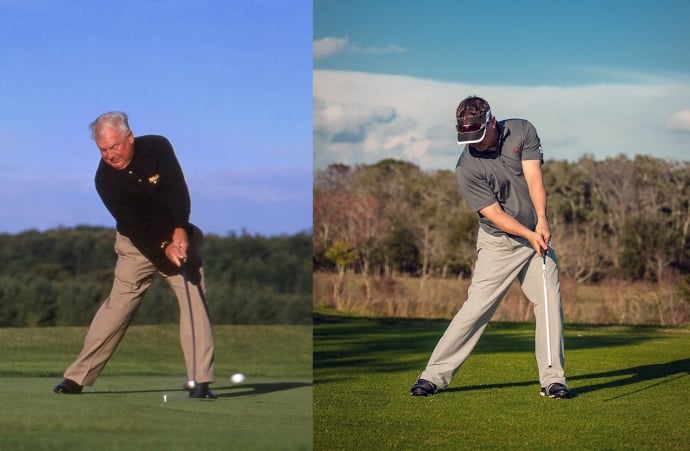
Yes, the Single Plane Golf Swing is simple but teaching its elements can often hyper-focus on a subject – making something simple seem overwhelmingly complicated. For example, to make a proper Single Plane backswing you must turn your shoulder blades 80 degrees and your pelvis 40 degrees. Sounds simple right? What if I told you that many golfers have difficulty with these rotations because of their hip flexors and that hip-flexor mobility is a critical factor in proper rotations and positioning of the spine? Suddenly a simple backswing sounds like I tore a page from a medical journal.
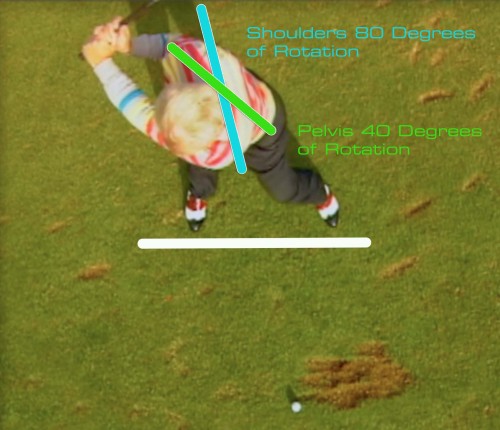
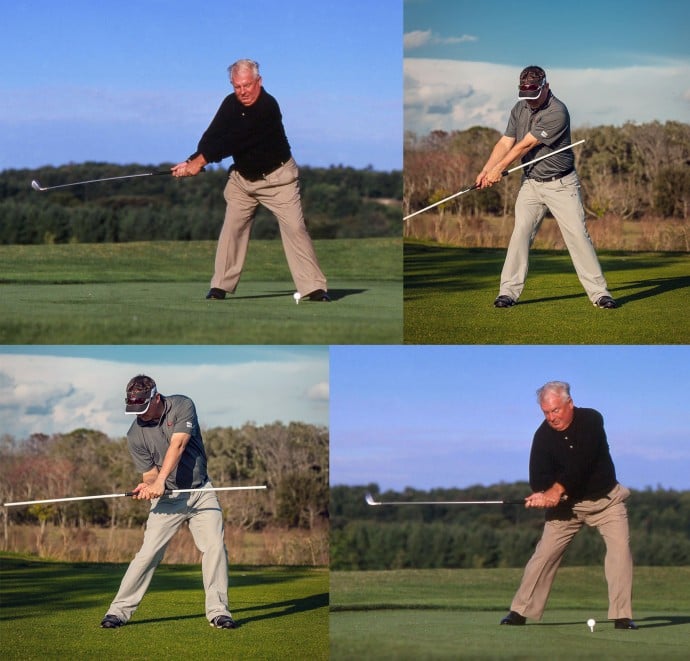
Moe Norman Backswing Turn Top View
Moe Norman Shoulder Turn vs. Hip Turn

Ironically, the audience is watching the show for instruction yet if it becomes an anatomy class, many will tune out conclude that the Single Plane Swing is too implicated.

Tim and I are caught between keeping the message of the Single Plane simple for the beginners and sharing our extensive knowledge that could help the advanced students – afraid of reaching the point of TMI (Too much information).

So what is the solution?

Answer: Create a Private Membership called the Single Plane Inner Circle.

When the GGA Team decided to start separate out the “serious” Single Plane golfers Tim and I sighed with relief. We no longer have to “hold back” our instruction. We can speak the Single Plane language without feeling like we might overwhelm a newbie.

Personally, I am super excited about the Inner Circle webinars this year. It opens the door for me to share my knowledge and research without feeling like I might be reaching the point of TMI.

As many of the Inner Circle Members know, my passion for Moe’s swing has connected me with Dr. Robert Neal – of Golf Biodynamics. His proprietary software and systems have allowed me to study the Single Plane Swing 3-Dimensionally. Those of you know me understand that putting me in a room with motion capture technology and Dr. Neal is more fun than winning the lottery. I love learning. Seeing the swing motion from a 3-Dimensional perspective sheds new light on what is possible for our ability to help our students.

In 1994 when I saw Moe swing for the first time I remember thinking “I just want to feel his swing one time”. With the help of 3-D technology and the ability to measure the inside of the swing so we can understand what Moe was feeling inside his body. Take for example discovering that in the backswing the lead arm rotates in the same relationship to the torso and that the trail hand doesn’t rotate at all.

Moe described this backing motion as “In and Up”

Moe’s description perfectly describes how the body rotates the club inward in the backswing rotation. Then approximately midway back the trail arm folds moving the hands and arms upward. In this motion you can 3-Dimensionally see the pelvis and torso rotate together as the arms move inward in the first moment. Then the pelvis slows down and the torso continues. As the torso slows the arms then move up to the top of the backswing. The differential between the pelvis and torso is called the “X” Factor a term used by Dr. Neal to show the “Separation” of the torso and pelvis. The reason that the “X” Factor is important is because in order to produce speed in the forthcoming downswing you must move the pelvis first – separating it from the turn of the torso.

The X-Factor is the ability to separate and produce speed. Without separation, the pelvis can’t pull the torso causing the arms to move too quickly into the downswing. This is what teachers call “over the top” causing the ball to slice or worse.

A good Single Plane Swing will have approximately 40 degrees of Separation between pelvis and shoulder rotation in the backswing. My research of my students shows a lack of both torso and pelvis rotation where students seeking help from our academy. One recent student had less than 65 degrees of shoulder rotation. Interestingly to compensate for lack of torso rotation, he moved his pelvis incorrectly to 55 degrees creating and X-Factor of less than 10 degrees. With only 10 degrees of rotational separation, it made it impossible for him to move the pelvis in the proper sequence (first) and give the Torso time to lag behind (separate) to accumulate speed.

Have I reached TMI yet? This stuff is important and it is what Inner Circle Members are looking for. This is the exact cause and effect issues that real students are solving.

With this type of data it makes it easy for me to understand mechanically what is happening from the inside of a student’s swing so we can find the exact solutions and not waste time with fruitless practice. In this particular instance, the student’s trial leg was straightening forcing his pelvis backward too far. The pelvis shifted laterally (not rotationally) inhibiting torso rotation. No wonder he was only able to produce 60 mph of club speed.

Measuring a student 3-Dimensionally is great for my research and teaching but interestingly enough, you don’t really need it. I perfectly matched Moe’s swing over 20 years ago with a video camera matching my movement with Moe’s. Having 3-D technology is just a way to quantify the movement and measure the results bringing a new depth to our instruction.

I want to invite all of you become Inner Circle Members where Tim and I can uninhibitedly teach by sharing our knowledge and insights from years of experience and research. You can find more information about becoming an Inner Circle Member here:

http://singleplaneacademy.com

If you are already a member, I look forward to seeing you each month for our Exclusive Member Only content. Next week’s show is PART 3 of Moe’s Feelings vs. Real. Stay tuned.
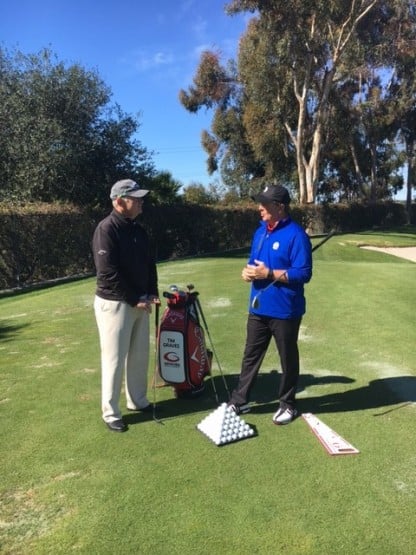
Callaway, Graves Golf, Moe Norman and Roger Cleveland

How about these names together….

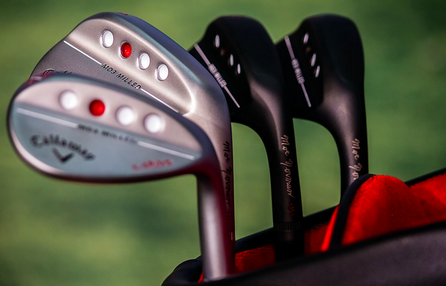
This past week I had the wonderful opportunity to spend some time at Callaway Golf with Roger Cleveland discussing the new Moe Norman Signature wedge(s) we created with Callaway Golf.

getPart-1
Roger and me (Tim) at Callaway Performance Center talking wedges

As some of you know, about a year ago, Callaway Golf Corp. contacted me and we discussed creating a Moe Norman Signature wedge line in conjunction with their wedge system designed by Roger Cleveland. Of course we agreed, and about 9 months later, the “Moe Norman Signature” wedge was born.

First a little back ground about the partners in the group:

Callaway Golf – Assume everyone knows about Callaway Golf. Rated as the top golf club manufacturing company in the golf industry and at this time has the # 1 rated Driver, Fairway wood, hybrid, irons and putter (Odyssey). The Mac Daddy wedge created by Roger Cleveland is rated the #2 wedge in the golf industry and is projected to be #1 by the middle to end of this year (2017). Callaway Golf is the leader in the golf industry in R & D (Research and Development) and is known for their innovative standards and the extremely high quality in their products.

Graves Golf Academy / Moe Norman – The Graves Golf Academy teaches the Moe Norman single plane golf swing (has done so for the past 20 years) and is the leader in the golf industry in teaching the single plane swing. The Graves Golf Academy also holds the trade mark and intellectual property rights of Moe Norman in which we are responsible for protecting all rights / trademarks, etc. of Moe Norman and his estate.

Roger Cleveland – Roger founded the Cleveland Golf Company in 1979, and quickly become one of the leaders in the golf manufacturing and equipment in the golf industry. In the 1980’s he produced at that time, the top selling wedge (588) and was rated as the top wedge in the golf industry. He sold the company in the mid-80s at which time he was asked to join Callaway Golf by Ely Callaway. He has been with Callaway for 21 years in which time he has helped design and implement many of Callaway’s clubs and in particular their highly rated wedges. Roger Cleveland is known in the golf industry as a master wedge designer, creator and builder.

Anthony Taranto – Anthony is the “artist” at Callaway. Some of you might have seen all the different color schemes and designs Callaway has put in their wedges for different individuals. Anthony helped us design the look and color scheme for the Moe Signature Wedge.

Specifics about the Moe Norman Signature wedges:

Screen Shot 2017-03-05 at 7.27.08 PM

It is a Callaway Mac Daddy wedge designed with Moe’s characteristics (what he liked) in a wedge. In other words, it has the highest technology in the wedges (grooves, face, etc…) with the characteristics that make it the perfect single plane wedge(s).

Grooves – the grooves of the wedge(s) were created and designed by Roger Cleveland to give the wedges optimal spin and feel in the short game. Each different wedge (pitch vs. gap vs sand vs lob, etc..) are designed with different grooves as each club is used in different circumstances and requires different spin. This is called Progressive Groove Optimization System.

Grind – the grind of the sand and lob wedges are a C type grind. This grind allows the leading edge of the club to remain close to the ground when ball position is adjusted back, to mid to forward in the stance. In particular with the lob wedge – when lob / flop type shots are played forward in the stance, the leading edge of the wedge must stay close to the ground. If not, you will thin, blade or even top these type of shots. (Moe used to grind the leading edge of his wedges to create this C-grind in his wedges before this technology existed). The grind of the gap wedge is an S-grind.  A grind that has a “straighter” leading edge on the club.

Shaft – The shaft is a steel shaft that is on the “heavier” end of the scale of steel shafts. This is because all wedges are short clubs in comparison to the other clubs in the bag. As Roger said, you must have the feel in the wedges to have a great short game and the only way to keep feel in the wedges is to keep weight in the shafts. Moe always had steel shafts in wedges and often discussed the feel in his wedges with these shafts.

Length – This was topic I discussed a lot with Roger. We discussed Hagen, Sneed, Mickelson, Hogan, Trevino, Speith, (Moe of course) and a few others. One very common similarities between all these great players who all had great short games is they played their short game shots by using different heights in their different shots. I remember asking Moe about this and his response was I don’t play by distance, but rather by “height”. In other words, the higher you hit the shot, the more spin you can create, the lower you hit the shot, the more roll you will have, etc. etc. When discussing with Roger this issue, he talked about how all great players play by height and these different heights and distances are not only created by ball position and loft of the clubs, but by choking up and down on the grip. The more you choke down, the shorter the club, the shorter you will hit the shot, etc. In fact, this was so important to Moe in his short game, his wedges were slightly longer than conventional wedges so he could choke up and down on the club for maximum feel and optimal height/distance control in his wedges. We have added this to the Moe Wedges – making them slightly longer for each individual fittings to accommodate for this characteristic.

Leading Edge of the Wedges – Moe liked having a slightly rounded leading edge in his sand and lob wedges and a “flatter” leading edge in his pitch and gap wedges. Reason is he wanted a leading edge that would “cut” through the grass/ ground / sand, etc. in his shorter type shots (sand and lob wedges) and a leading edge that would be a little more “square to the target” in his longer wedge shots (gap and pitch). This is exactly the way the Mac Daddy C grind (lob and sand) and S grind (gap and pitch) wedges are designed.

Screen Shot 2017-03-05 at 7.31.08 PM

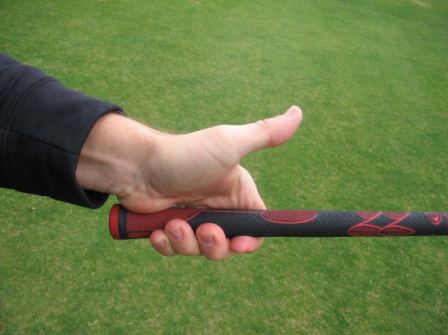
Grip – The Graves Golf Academy Moe Norman specialty grip in on all the wedges. This grip is fit to an individual’s hand size to optimize feel and release in the wedge. Roger absolutely loved our grip. For two particular reasons. 1. It has marking in which you can choke down on the grip and keep your trail hand in the proper rotation when choking down. And 2. The grip has a mark for the lead hand grip thumb position. He discussed how critical it was to have the lead hand thumb in the correct position on the grip to have the wedge “work properly”. He also discussed how some many average golfers have the lead hand thumb in the wrong position and can’t work the wedges properly. An improper hand position will not allow for proper club head movement which leads to bad mechanics and obviously a poor wedge game.

Lie angle – The lie angles of good player’s wedges (Moe’s included) are slightly flatter than the rest of their clubs (set). Reason is as you choke down on the club and / or drop your hands slightly to create more loft on the club, the wedge needs to be a little flatter to accommodate. The Moe Signature line wedges when custom built are set to these standards for each individual (in particular in the sand and lob wedges).

Screen Shot 2017-03-05 at 7.26.48 PM

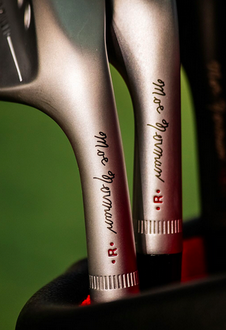
Signature – Each wedge has Moe’s signature laser etched on the neck of the club. This signature is unique to only these wedges and signifies the wedge was designed with Moe’s uniqueness and characteristics of his wedges.

As you see there was a lot of detail and specifics put into these wedges. We are extremely excited to now have the wedges available to anyone interested. They are available in the following lofts:

48, 50, 52, 56, 58, 60 and 64 degree.

They are also available in Chrome or Matte Black finish.

Each wedge will be customized for an individual’s fittings for length, lie angle, shaft flex (steel), grip size with the GGA specialized grip, etc. using the individual’s size in conjunction with the wedge’s unique characteristics (listed above).

I recommend including the lob (58, 60 or 64*) and sand wedge (56) in everyone’s bag to maximize their short game. Many should also add the gap wedge (50 or 52) if they do not already have one with their current set.

As Roger said (and is our (GGA) core believe) – everyone should have a GREAT short game. And with the correct equipment, correct fundamentals and practice everyone can have a great short game. As 75% of scoring occurs in the short game, this will eventually lead to a great golf game.

The introductory price of the Callaway MD Moe Norman Signature wedge(s) is $149 per wedge.

This includes all customization, etc…

Please contact me timg@gravesgolf.com if interested or if you have any questions.

As each wedge is custom built to each individual, it takes about 2 weeks for the wedges to be complete from time of order to shipment.

getPart-3

PS. I filmed about 1 ½ hours of video with Roger Cleveland at the Callaway Performance Center in Carlsbad, CA. Discussing the Moe wedge(s), his philosophy of wedge design, all the great players he has worked with, Moe and Moe’s wedge game and wedges (had some with me for Roger to see, etc..), etc.. I will be releasing this video for all to see shortly.

New Single Plane Inner Circle

The NEW Single Plane Inner Circle

The Single Plane Academy (SPA) is getting a Renovation!!!

Screen Shot 2017-02-19 at 1.36.52 PM

We are in the process of building something new for your Single Plane Academy membership AND it will be getting a new name.

Discover the Single Plane Golf Swing and join thousands of others dedicated to mastering Moe Norman’s golf swing.

The ALL NEW Single Plane Inner Circle will include:

• Exclusive Instructional Content
• Exclusive Video Content
• Exclusive Private Webinars
• Exclusive Q & A Sessions
• Exclusive Discounts & FREE Gear
• An ALL NEW rewards program

The biggest benefit is knowing that you have friends and connections around the country, and the world, on the same journey to mastery of the Single Plane Swing

Screen Shot 2017-02-19 at 1.36.27 PM

We are currently rearranging the furniture and working out the details on this exciting NEW membership. Watch your email for details and how to signup, login and continue your quest for a better game, and the Feeling of Greatness, the Moe Norman way.

We will be releasing a lot more / additional details soon!

Feeling Moe’s swing with the Single Plane Trainer (SPT)

Jokingly I asked Moe if he would sell me his swing.  He said “Sure, for ten thousand dollars but you can’t buy talent” he said. If I could have purchased Moe’s golf swing without having to work at it I would have happily paid him. I don’t like to reinvent the wheel. That’s why the next best thing to buying Moe’s swing was to match him.

I have one word that describes how I learned Moe’s swing: Modeling. I don’t know what that word means to you but it means “copy”. Yes, I admit it. I copied Moe’s swing. He was the notes scribbled on my hand during a test – my cheat sheet.

To be more exact, I picked out various aspects of Moe’s swing positions and movements and I mimicked them, starting at the address position. Once I understood the positions of the swing I put them together and using video and pictures, I mirrored his movements. Eventually, through repetition, I could feel what he felt. Practice wasn’t about hitting balls, it was about learning how to move like Moe.

EVENTUALLY, I starting hitting the ball with pinpoint accuracy. My misses became great!

Moe Norman Said, “You’re only as good as your misses”.

A good on-plane golf swing that can repeat impact consistently is what simplifies the game because the bad shots it produces are still pretty good. That’s the point of putting in the effort to build a solid Single Plane Swing. It breeds consistency, repeatability and the ability to be good when you are average.

Feeling Moe's Swing

Feeling Moe's Swing.jpg

I matched Moe’s swing by observing his movements and then matching what I saw. By matching his movements, I began to feel how he achieved his golf swing. Then I developed training tools that helped me feel it so I could eliminate mistakes when I practiced because I quickly learned that what you feel you do and what you actually do are very different.

Here is a word of caution: If you think you are matching Moe – you probably aren’t unless you have video proof or a coach to watch your movements. Personal feelings are unreliable. The goal is to match your movement exactly to Moe’s movement making sure you hit all of Moe’s positions.

“Hit your positions, always hit your positions” – Moe Norman

Moe Match DTLMoe Match DTL.jpg

Moe had a Club to Body Relationship

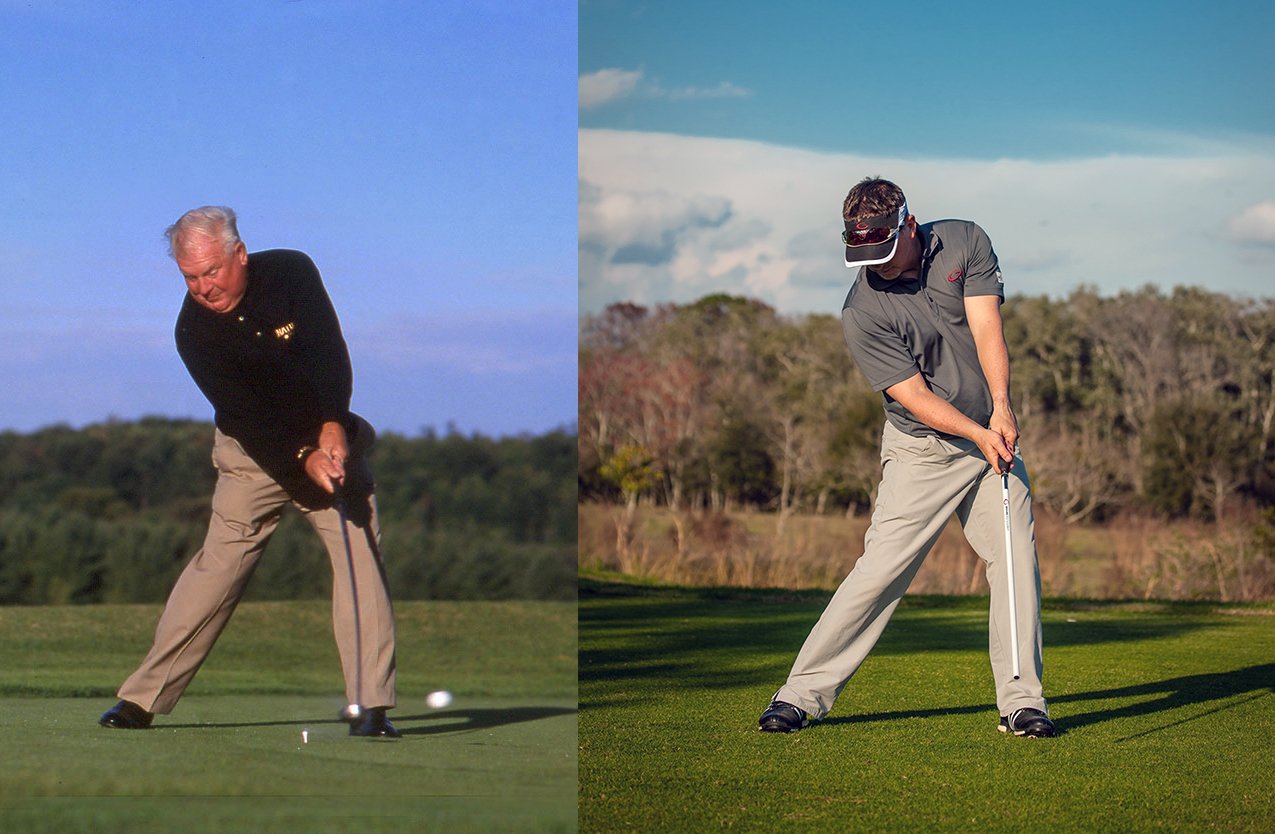
I always have difficulty describing what I mean by “club to body” (C2B) relationship. I’ll give it another try here. At impact there is an ideal position of the club shaft as it relates to the rotation of the body. Think of it as a single spoke of a bicycle wheel.  When you turn the wheel in one direction, the spoke maintains its relationship to the hub or center of the wheel. When you turn the wheel back, the spoke returns back to the exact position it started.

Moe Norman had the same sort of “hub and spoke” relationship with the golf club.

If Moe didn’t hinge the hands, the lead arm and club would act exactly like the hub and spoke of the wheel. The only difference is that he had a hinge where his hands meet the club. The center of Moe’s “wheel” was what I call the “pivot point”, a point above the lead hip. When Moe moved into the backswing and then into the downswing, the club always had a reference to the pivot point allowing him to return the club to the same relative spot – producing a consistent impact point.

Impact SPT Match Moe

Impact SPT Match Moe.jpg

Swing Plane is a product of the C2B relationship

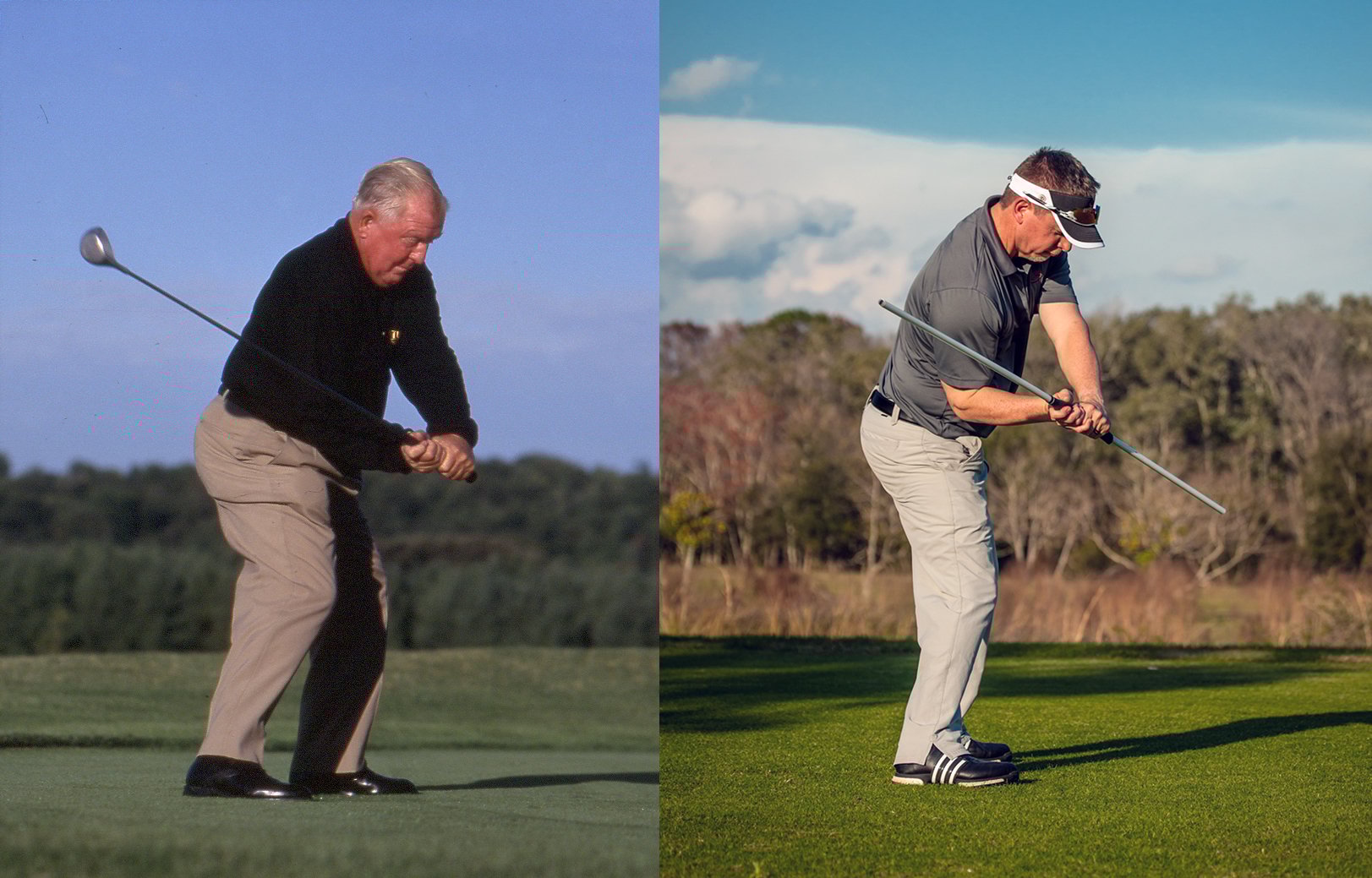
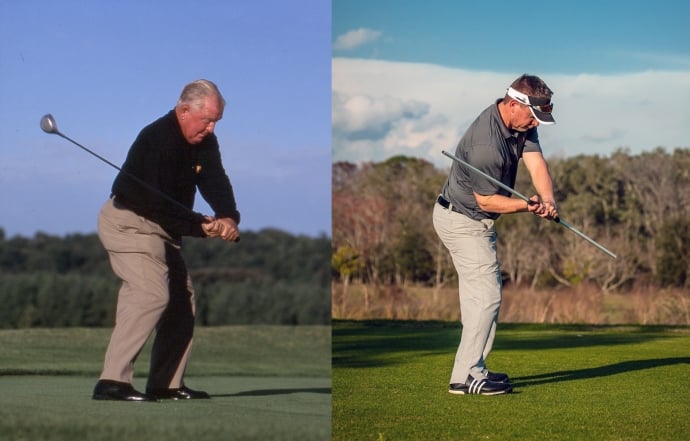
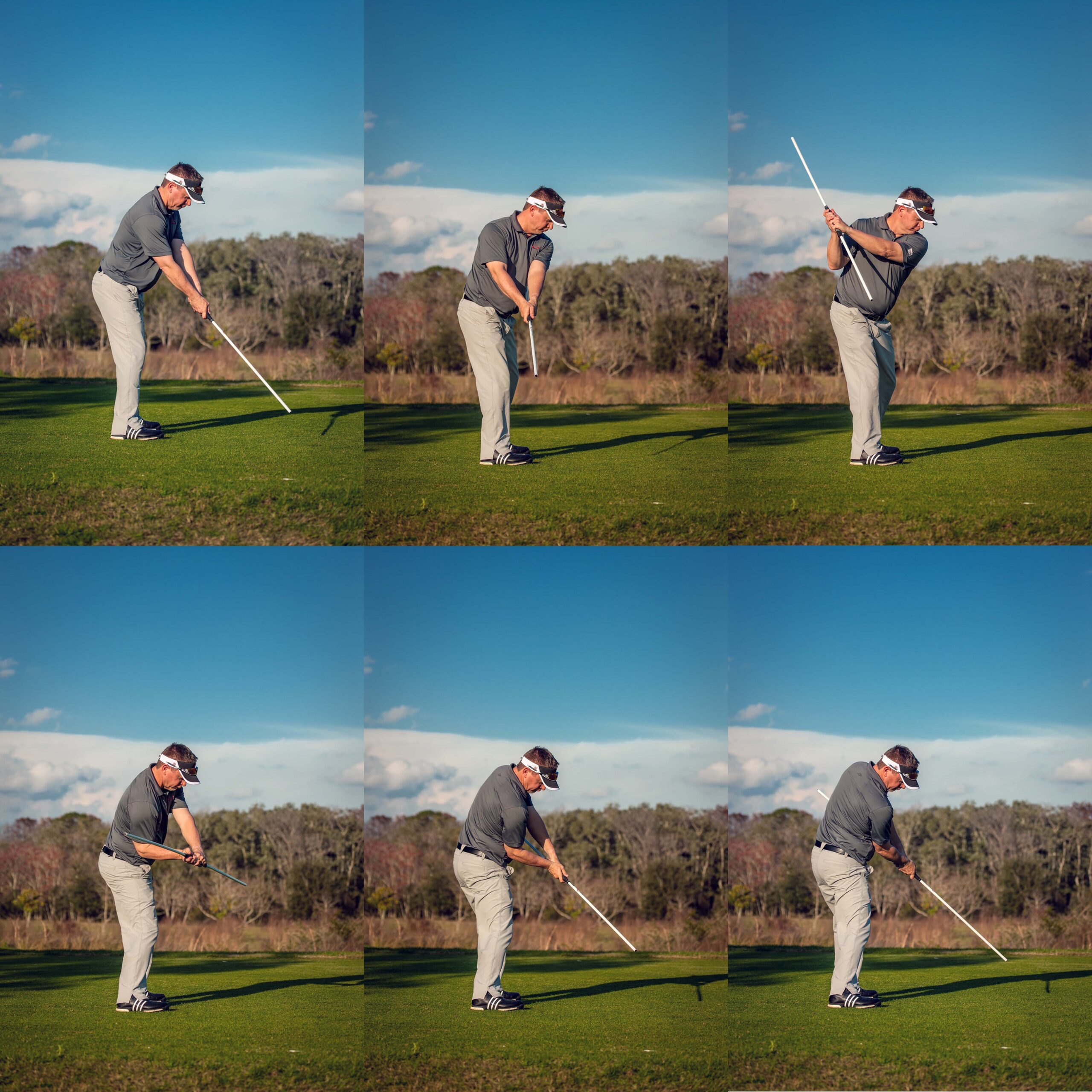
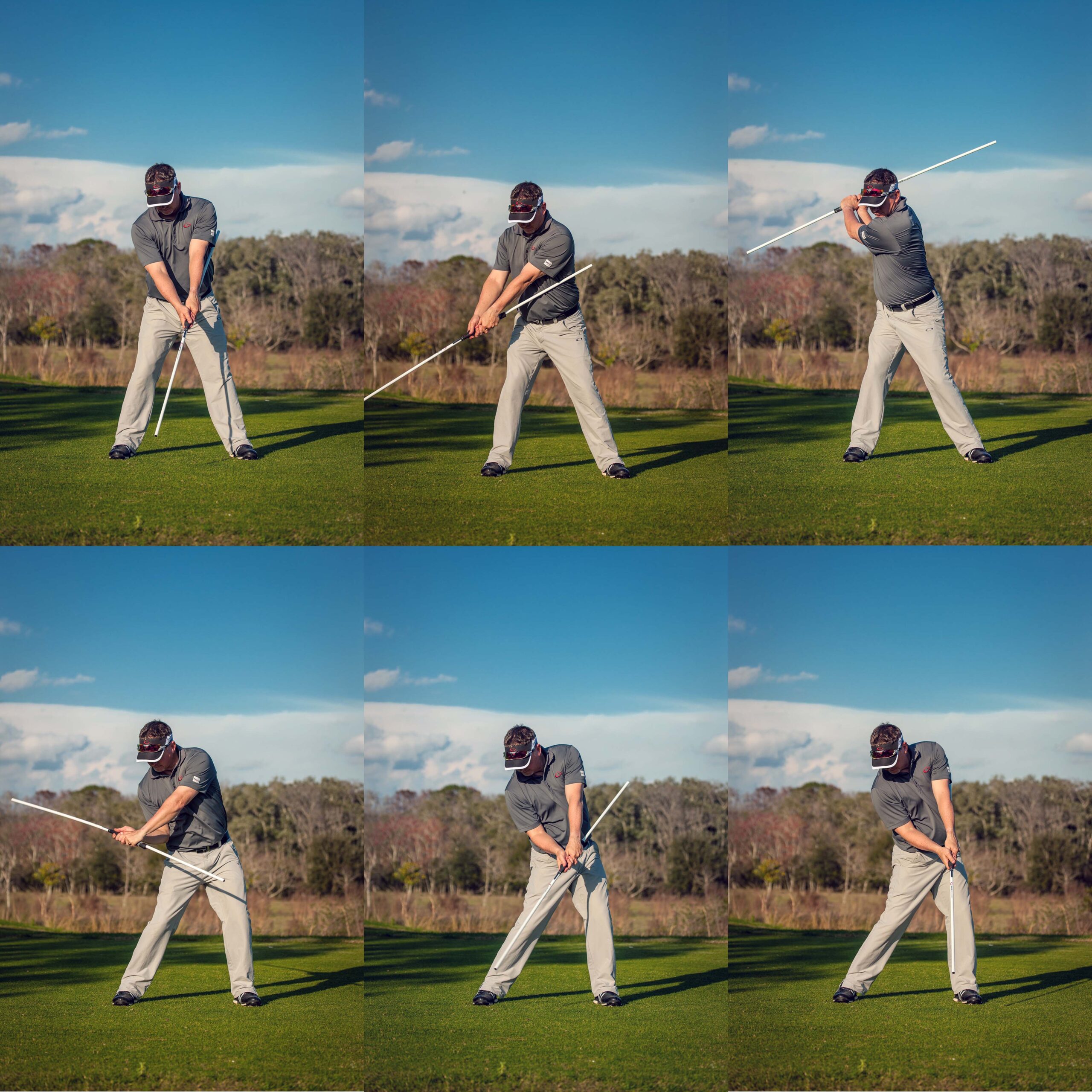
One way that I practice Moe’s club-to-body relationship is by practicing with the Single Plane Trainer. The Single Plane Trainer (SPT) aligns the club and lead arm forming a relationship to the lead side of the body. As you take the club into the backswing, the extended SPT maintains this relationship (staying against the body)

Moe Norman Single Plane
Todd Graves demonstrating Moe Norman’s swing with Single Plane Trainer
FO Sequence.jpg
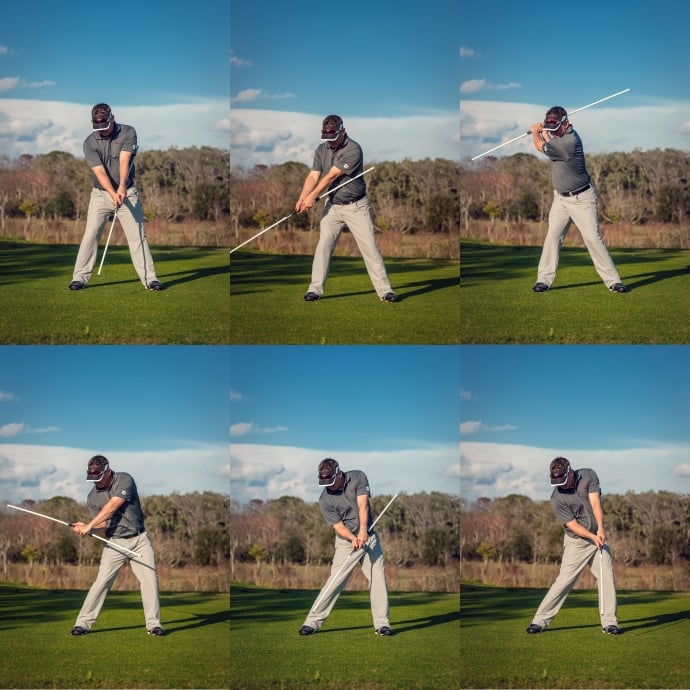
Midway back the hands hinge and the SPT comes away from the body moving up to the swing plane. Then in the downswing the hands move down the plane and unhinge allowing the hands to return to the lead side of the body at impact.
Moe Norman's Single Plane Swing
Todd Graves Demonstrating Moe Norman’s Single Plane swing
DTL Sequence.jpg

The hub of the wheel, Moe’s pivot point, is NOT the center of the body. It is forward on the lead side above the lead hip joint. The Since the body is more forward at impact that at address, the pivot point has moved forward but throughout the entire swing the C2B relationship has remained.

To maintain the C2B relationship, you must maintain the tilt of your back throughout the golf swing. Think of the wheel and the spoke analogy. You must keep the wheel rotating on the same angle.  If you altered the tilt of the wheel, by standing up lifting your back, you would change the plane of the golf club. Maintaining your tilt keeps the club moving around the pivot point on plane.

The GGA SPT

Notice in the photographs that the spine tilt is maintained from address to impact. The GGA SPT has a Feeling of Greatness Single Plane training grip installed to perfect your hand position. With the hands correctly placed on the trainer, it is designed to help you monitor the “connection” of the club to the pivot point throughout the swing motion.

You can find out more about the GGA SPT here:  GGA Single Plane Trainer.

You can find Single Plane Training Videos here: Single Plane Trainer Instructions.

10 Percenter

Email from GGA Alumnus (Feb. 2nd, 2017)

Tim & Todd,

As I reflect on my recent experience at your Orlando 3-day school, I recognize that I am more confident and enthusiastic about my golf game than ever. As a former 90 percenter who’s received instruction from various teachers over the years, why do I feel this way? Simply put, I have been armed with an action plan, and I can assure you this has been absent from my prior experiences.

Your school was organized, thoughtful, thorough, professional, personal and passionate. This type of excellence is not easily found in the world today and I appreciated everything from your depth of knowledge of the swing, equipment, technology, training aids and even the travel arrangements and food. In addition, your team to a man was equal to the standard that you’ve set. Your school was first class and worthy of my time away from work, family and the expense incurred.

I’ve set some stretch goals this year that are important to me. Thank you for providing a very realistic opportunity to achieve them as a result of my enrollment in the school and coaching program.

It’s my move.

Sincerely,

Don 10

Single Length Clubs / Irons

Single Length Clubs

We have begun to receive many calls and emails in the past couple of months about single length clubs. Whether the increase in curiosity is from Bryson DeChambeau, Cobra Golf’s new single length irons, Edel Golf’s new single length irons, or a combination, many people tend to associate the single plane golf swing with single length clubs.

Thought I’d write an article about single length clubs, where we currently “stand” and maybe debunk some misinformation and some misunderstandings about the clubs.

Some general facts about distance related to clubs. The distance you hit a golf ball is due to many factors. The biggest factors are club head speed at impact (the longer the club, in general the faster you will swing the club) and launch of the golf ball (primarily due to loft of the club).   Yes, there are many other factors such as spin of the golf ball, type of club you are hitting, launch angle, etc.. etc.. But the primary factors are how fast the ball is hit and the club loft that is hitting the ball. So, the golf industry for 100s of years, has set distance between clubs by either decreasing or increasing loft in combination with adding or subtracting length of the shaft. If you compare the two, it has been shown, the loft of the club has a 3x + greater influence on distance then the length of the shaft.

So, with that background, let’s talk about Single Length Clubs.

First – Single Length Clubs – At this time I do not recommend any single length clubs.  As I believe there is some validity to the concept, at this time there is not a set on the market that works as claimed.  We have tried many single length club sets (from new one’s just released, to one’s that have been out for years, to one’s that were produced 30+ years ago) and nothing really works as claimed.  There is not the distance difference between the irons as claimed (in combination with the needed height / ball flight) and those that get the clubs are typically disappointed.   Typically, most can hit all the irons in the set, but as the iron has less loft (higher irons) – the needed height for proper ball flight is not there.

Second – A point of issue everyone considering single length clubs should understand – those that play / played single length clubs (i.e. Bryson DeChambeau) have numerous lengths of clubs in the bag. There is NOT one length for all clubs. In a “single length club set” there is typically a driver length, fairway wood length, hybrid length, iron length, wedge length and putter length… Meaning, do not confuse single length with all clubs in bag being one length.

Third – Many have claimed, and even stated, they played with Moe and he was using single length irons.

All the years Todd and myself spent with Moe, watching Moe preform demonstrations and play golf, and all the video and pictures of Moe participating in tournaments, we can not find any evidence he ever played single length irons.

But, even if he did, Moe was known to choke down on his clubs to the suitable length, etc.. that then fit him and his shot. So in other words, if Moe ever played single length irons, it can be almost guaranteed they were all long and he choked down on the different clubs in different spots to in essence create the proper length of each club.

Fourth – There is a company working on making a single length iron (with graphite shafting) that has the proper distance difference between the irons. They are working on a system in which you are fit for every iron individually (club head weight, head size, shaft weight, shaft flex, shaft kick, etc..).   I believe this will be the only way to truly have an iron system of single length that works. From preliminary information – these clubs (when available) will be very expensive (as each iron is fit individually) and only available in graphite. When looking at the fit system for this company, there are 90 shafts to choose from, 4 different club heads comprising of 8 different weighting in each head….   In other words, every iron will be fit individually with a different shaft (flex, kick point, weight, etc..), different weighted head, etc.. so that it is set to go a particular distance and height.

(FYI – this is EXACTLY how Bryson created his irons to work for him. In fact, he stated each iron took him between 30 and 40 hours to build to the specifications he needed. Ten irons in his bag – that’s 300 to 400 hours of work getting the clubs to fit…. )

Finally – With that being said, I would strongly recommend getting a set of clubs (multiple lengths) that are fit to you perfect for length, lie angle, shaft flex, grip size, set make up, etc..  A perfect fit set of clubs allows you to work on your swing without having to worry about what is in your bag.  You will only get to a point with improperly fit clubs – it is impossible to reach ideal (or close to ideal) impact with an improperly fit club.

We are happy to help you get a perfect fitted set of clubs for your single plane swing.

We offer a free single plane individualized club fitting and assessment at:  CLICK HERE

http://moenormangolf.com/clubs/free-club-fittings/

An informational club fitting webinar was produced about the importance of a proper fit:  CLICK HERE
I would also suggest reading the single plane swing article on proper club fitting:  CLICK HERE

Please feel free to contact me at timg@moenormangolf.com with additional questions, comments, etc..

LEARN

THE

SWING

Join 1M+ Subscribers to get your FREE Video Quick Start Guide that reveals how to hit the ball farther and straighter more consistently from now on…

START YOUR NEW GOLF SWING