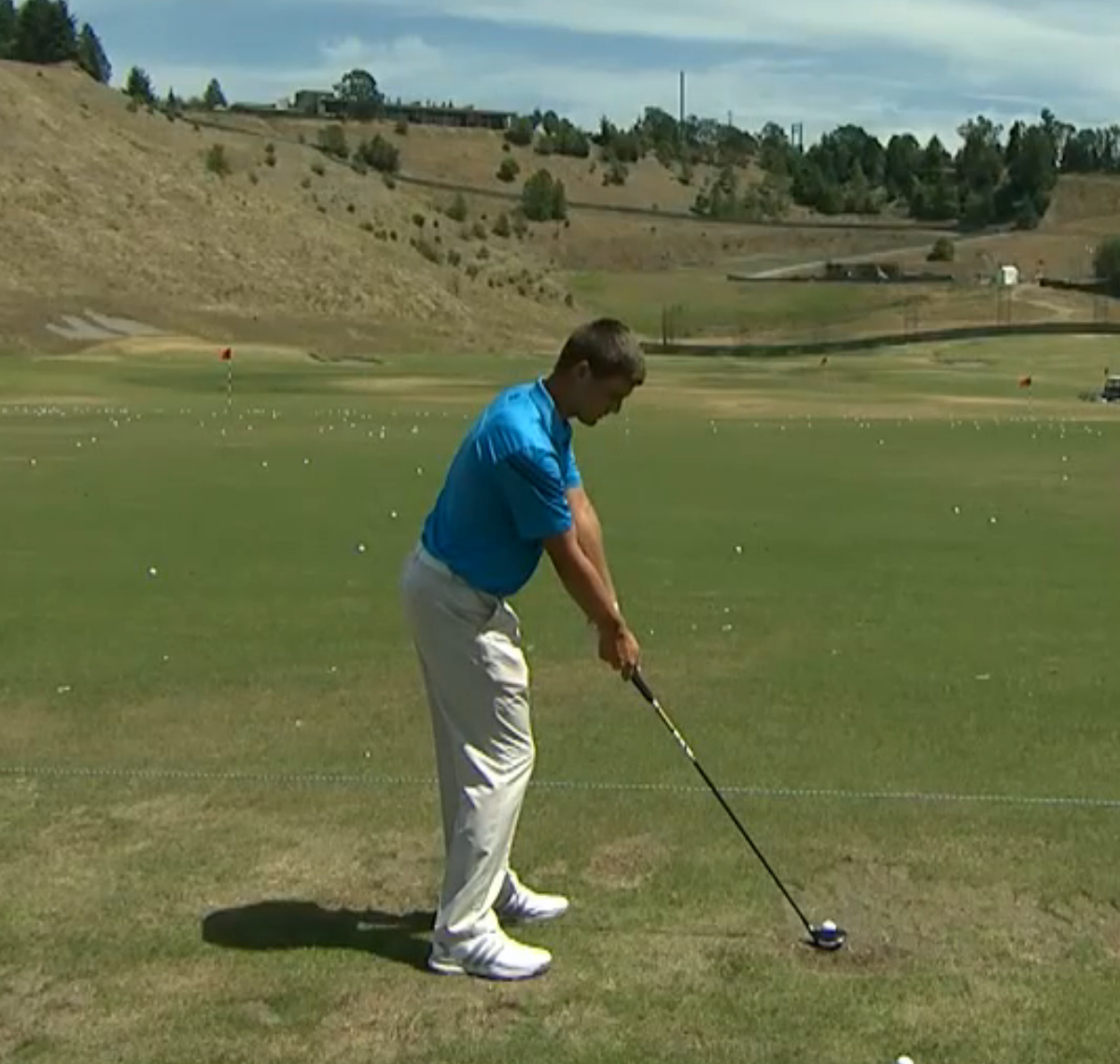
The 4 Cs of a Great Short Game

The 4 Cs of a Great Short Game

With our upcoming Short Game School (first week of November) (very excited about having our first short game school since 6 years ago…) wanted to remind everyone about my 4 Cs of a GREAT Short Game. These are/will be covered “in depth” during our short game school and covered in all different areas (putting, chipping, pitching, bunker, specialty shots… especially those specialty short game shots).

In our schools, camps and clinics (and pretty much anytime you’re around me), you will continually hear how important the short game is for scoring. In this article I’m going to compare the long game vs. short game then give you my 4 Cs that you must follow to have a great short game.

First, you must be convinced that the short game is the most important part of scoring. Here are a couple facts about the short game.

Fact: The difference between a 30 handicap golfer and a scratch golfer (0 handicap) is associated with 7 to 10 shots in the long game (shots over 50 yards) and 20 to 23 shots in the short game (shots under 50 yards). Meaning, if you are a 30 handicap golfer and only work on your long game you will only improve 7 to 10 shots toward scratch golf. The best you will ever reach is a 20 handicap. The difference between a 15 handicap golfer and scratch golfer is associated with 3 to 5 shots in the long game, and 10 to 12 shots in the short game. In other words, if you are a 15 handicap golfer wanting to reach scratch, if you only work on the long game, you will basically never improve beyond a 10 handicap.

Fact: No professional (or scratch golfer) has an advantage in their short game over yours. In other words, the short game is not associated with strength, working out or athletic ability. It is a part of the game that is associated with practicing the correct fundamentals and putting those fundamentals into play at the right time. Ever notice how many young players (talking about 10, 11, 12-year-old juniors) have a great short game. In fact, many compare to the professional’s short games. Don’t you wonder how someone who is 75 pounds soaking wet can compete with the best players in the world? This shows it is not strength, but rather what matters are things like finesse and feel. This is what I call the 4 Cs to the short game: Creativity, Confidence, Commitment and Critique.

4 Cs

CREATIVITY: The first thing you must do when confronted with a short game shot (pitch, chip, etc.) is create the shot. Part of the teaching we give our students during their short game instruction is to pick a shot around the green and ask the group to name 5 different ways to play the shot. Most of the time the group is able to name 2 or 3, but almost never 5. An example would be a shot that is 20 to 25 yards off the green with minimal rough between the ball and the hole.

You could:

  1. Pitch the shot to the hole,
  2. Chip the shot into the fringe around the green and roll to the hole,
  3. Putt through the entire rough and fringe,
  4. Hit a flop shot all the way to the hole, or
  5. Hit a 3 wood chip that will have more over spin and roll to the hole???

The point here is you need to be creative over the shot. I like to call it the “artistic” part of the game.

A good rule of thumb: “Putt when you can, Chip when you can’t putt, Pitch when you have too…”  (Aka – the “PCP Rule” – refer to past articles on the PCP Rule). Yes, this is a very basic “rule”, but a good one to fall back on.

COMMITMENT: Once you have created the shot, you must commit to the shot that is the lowest risk for error FOR YOU. If you have a good pitch shot and feel it is the most likely to get the ball close to the hole with the least room for error, hit the pitch shot. Many will feel the chip from the fringe or even the putt will be their lowest risk shot. DON’T think you have to hit a shot in a particular manner because the pros on TV hit it that way, but rather execute the shot YOU feel you can hit with the most confidence.

CONFIDENCE: So now that you have created and committed to the shot, you must play the shot with confidence. This means that if you have chosen to chip the shot, tell yourself you will chip it close, pick your spot you want to hit, use good fundamentals, and with 100% confidence, hit the shot. If you don’t feel confident over the shot, BACK OFF and commit to something different or swing a couple practice swings/chips until you have gained the confidence back. The last of the 4 Cs is:

CRITIQUE: You must critique your short game shots after you have executed them. This is not to say, “I can’t hit a particular shot”, but rather “I had 4 chip and run shots today and only hit 1 good. Therefore, I need to put more practice in the chip and run shot”. Look back at each shot and determine if you need more practice in that area. Here’s a question you can ask yourself and see how well you currently critique your short game: How many of you practice chipping short of the green (maybe into the fringe) and then roll the ball onto the green close to the hole or how many of you when practicing putting, putt balls from off the green (from the fringe or low rough) to the green? I believe that these are the shots that, after you critique your short game, will probably be the shots that need the most practice.

Finally, I believe that EVERYONE can have a GREAT short game. In fact, everyone can have a short game that is as good or better than any professional. But, to get this GREAT short game, you must first learn the proper fundamentals and practice these fundamentals. Then you can use the 4 Cs – Creativity, Commitment, and Confidence and then Critiquing to bring that short game to the course.

Good Luck and Remember – ALWAYS PRACTICE WITH A PURPOSE!
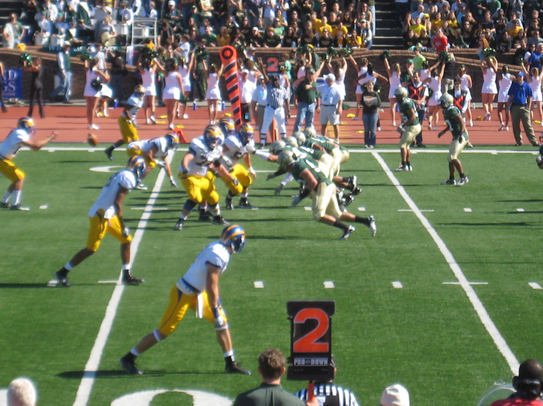
Improve Your Golf Game While Watching Football Games!

How many of you watched football this past weekend? How many of you know you can now watch football basically every day of the week? (Yup, I know it… and honestly guilty of watching at least 3 to 4 nights/days a week…) 

Whether you are watching football games, just watching TV, sitting in front of your computer, sitting at your desk or just sitting on your couch…. how many of you know you can dramatically improve your golf game at the same time?? 

Good players know this…

GGA alumnus know this….

Professionals know this…

Before I give you a drill you can do now (indoor), I am going to tell you about a training program we have performed the past few winters with EXTREME success. 

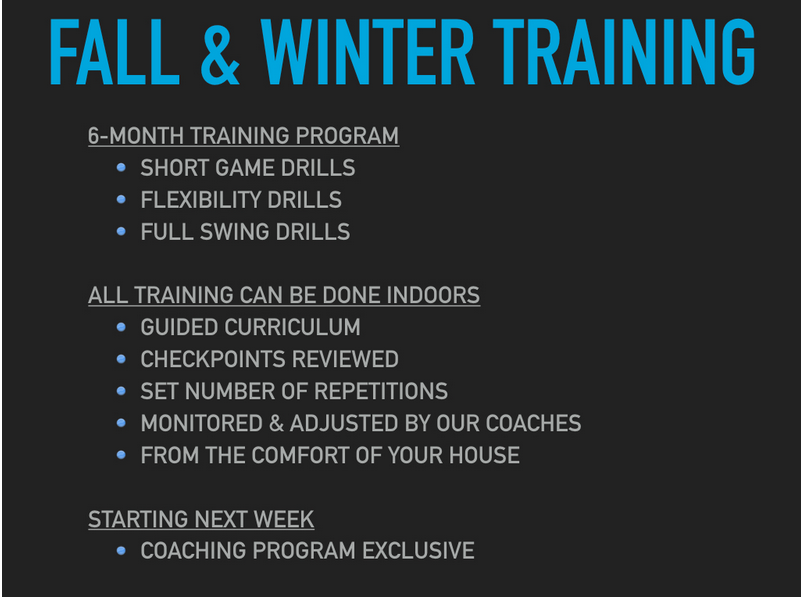
This week we are starting our Fall/Winter Training Program. This program includes the following:

  1. Drills, Training that can all be done INDOORS.
  2. 27 weeks of Training / Drills / Fundamentals (Sept, Oct, Nov, Dec, Jan and Feb)
  3. 9 weeks of short game, 9 weeks of long game and 9 weeks of flexibility.
  4. First week Short Game Training/Drills, 2nd week Flexibility training/Drills, 3rd week Long Game Training/Drills, 4th week Short Game continues, 5th week flexibility continued, 6th week Long game continued….
  5. Personal contact/one on one with GGA master instructors helping you with your training/drills, etc.
  6. All 27 weeks will be recorded. As a week is complete, it will be stored and you can view anytime during the 27-week program. Meaning, if you miss a week or two, you can review and catch up anytime.
  7. The ability for you to record your training and send to the coaches for review (ANYTIME). This is optional (up to you) – but included in the training program.
  8. When you finish the 27 weeks your short game will be greatly improved, your long game and fundamentals will be greatly improved and your flexibility will be increased / improved resulting in making it much easier to hit the correct positions in the golf swing, less stress on the body and potentially more distance.

Here are some facts that we know about fall/winter golf.

  1. Very few practice much (especially over the fall and winter).
  2. Everyone wants to be better/improve.
  3. Very few know how to improve over the fall/winter.
  4. The best time to improve your game is over the fall / winter as most play less this time of year.
  5. Very few understand that improvement exponentially increases when you are NOT hitting golf balls.
  6. Practice must involve the long game, short game and flexibility (especially for our typical age group).
  7. Very few know how to practice properly.
  8. Improvement is GUARANTEED if you train / practice properly and GREATLY ACCELERATED if you check / monitor and have someone check / monitor for you. 

Again – this fall / winter training is starting this week (First week of September).

Before get into a great indoor short game drill, if you would like to see the webinar on this fall/winter training program: CLICK HERE

Indoor Training (Sneak Peak) (as seen in webinar)

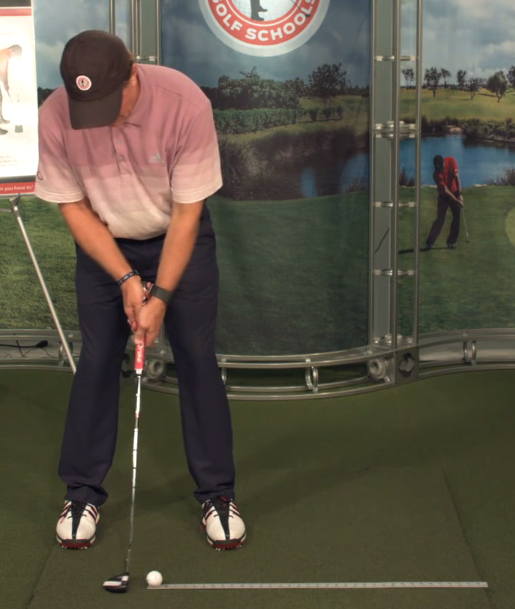
  1. Set up a yard stick on the floor
  2. Set up over a putt with a ball on the yardstick

Set up properly – hands leading, eyes over the ball, putter face square, etc.

Now:

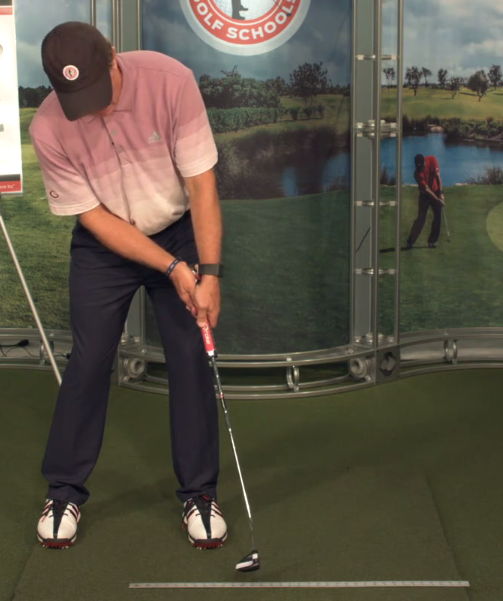
  1. Stoke the putt
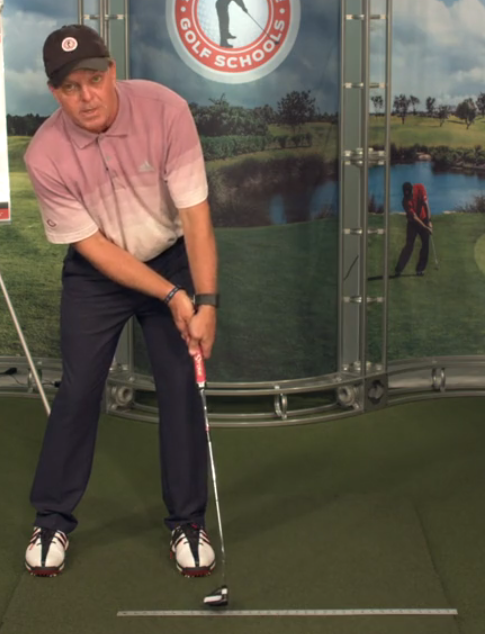
  2. Hold the finish
  3. Check the finish position

Check:

  1. Face/leading edge should still be square to the yardstick and still centered over the yardstick. 
  2. Butt end of putter should have pointed at the lead hip
  3. There will be no movement in body except the shoulders (arms and hands)

Now… Watch your game on TV (lol…)

Think you get my point…. I typically do this drill inside during commercials…. 

Repeat with a golf ball and without a golf ball.

Repeat 10 to 15 times SLOWLY without a golf ball. Hold finish every time and check

Repeat 10 to 15 times with a golf ball. Hold finish every time and check. Ball should go down the yardstick and off the end…

This is 1 of many drills during the training we will give you in the next 27 weeks. As you see this can be done inside (recommended) in front of the TV, in your office, in your “man/woman cave”, in your garage… think you get my point. All can be done inside and we will give you the fundamental, checkpoints, drill(s) and follow up. You can then video a send to us (if you choose – included in program). If you send in video of yourself, we will follow up with recommendations for you and an email with those same recommendations/additional training.

This is the best thing you can do for your golf game for the next 6 months! 

Last question – Again – how much do you want to improve over this fall / winter….? 

Questions about program – please feel free to contact Trent White (Coaching Program Director) at Trentw@moenormangolf.com

or myself (Tim Graves) at timg@moenormangolf.com or timkgraves@aol.com

For more information: CLICK HERE

If you question the program, can’t decide if it’s for you or not, get in for a month… if you don’t think it’s for you – give me (Tim) or Trent an email – we will discontinue your membership immediately (no questions asked).

Again – this is where we put our focus on training for our students over the fall and winter.  We STRONGLY suggest all those who want to have a much better golf game next spring to be part of this program with us. 

We look forwarded to helping you improve your golf game DRAMATICALLY over the next 6 months…. sit back (watching football……) and watch the improvement!!!

Finally: 

  • All those currently in coaching program – you are already included (don’t need to do anything additional). Watch you email inbox this week for your first training session.
  • All those currently in our Single Plane Inner Circle (and not the coaching program) – you can upgrade for the additional $ and be part of the coaching program (which included the Inner Circle membership).

More information, enrollment, and details about the SPECIAL:  CLICK HERE

This SPECIAL pricing will end next week. 

Drop Your Expectations

A Special Message from Tim:

In today’s blog, it is my pleasure to introduce GGA Performance Mindset Coach Paul Monahan, the newest member of our team:

Paul is a performance mindset coach who helps his clients – elite level leaders, musicians, and athletes – to access the performance energy necessary to lead, perform and play their best.

His passion is helping his clients to realize their potential. And his mission at Graves Golf Academy will be to help you to cultivate a more productive golf mindset – one that allows you to practice and play your best every time you pick up your clubs.

Paul first came to us in 2015 as a student at a 3-day school in Chicago – and quickly distinguished himself as a valuable coaching resource for us after working with one of our master instructors.

His dedication to the Single Plane Swing journey is dark – he has attended numerous 3-day and 5-day schools over the past two years and has even spent time with us here in Edmond, OK. So he knows exactly what you are working on.

Todd and I appreciate the energy and insights Paul brings to our team – and that he will bring to you, our committed students. We are excited to be able to offer his valuable perspective in this space.

Please join me in welcoming Paul to our team.

(Paul Monahan, PCC is a member of the International Coach Federation and is a certified COR.E Performance Dynamics™ Specialist. He resides in Cleveland, Ohio with his wife Paula and is the proud dad to three young men.)

***********

DROP YOUR EXPECTATIONS

My guess is that you expect a lot. Don’t you?

You expect your kids to behave, your coworkers to respect you, your customers to pay you and the driver in the lane next to you NOT to cut you off while exiting the highway.

And you also expect that you will master the single plane swing. Sooner than later. (I mean c’mon, Todd, Tim, and the rest of the guys make it look easy!!)

Expectations are a regular part of your everyday experience. It’s part of the way you’ve learned to challenge yourself and others. And it’s even part of your language: “I expect that you will complete the report for me by tomorrow morning.”

It’s completely normal to have expectations. However, they can cause a lot of frustration and unhappiness for you – especially on the golf course – if you are not careful.

As a performance coach, I am constantly tuning into my clients so that I can understand what expectations they may be holding tightly to…and which may be the cause of frustration, fears, or poor performances.

Recently, I attended the Bridgestone Invitational at Firestone Country Club in Akron, Ohio near where I live.

I went there to observe…To see if I could notice how expectation(s) impact the best players on the PGA Tour.

And it was fascinating.

First, I walked the back nine with Jordan Spieth, Rory McIlroy, and Jason Day. (This mega-star grouping started their day at #10.) I saw some great shots – and even better performance management.

For example, on the 18th, Jordan (I guess I’m on a first-name basis!) pulled his tee-shot well into the left rough, about 112 yards from the hole.

Remarkably, he arrived at his ball chatting and bantering with an on-course official and was all smiles. He quickly assessed his shot options and said to his caddy Michael (Greller) “We’re just playing for par here…”

He wasn’t going to try and get too cute. He was going to accept the lie that was offered to him, give it his best effort and move on. It was all matter-of-fact, calm and without a lot of emotion on Jordan’s part.

He hit a wedge a little chunky into the green-side rough…not an ideal result. But he took that in stride as well, explaining to Michael while they walked toward the green that the rough had grabbed a little more of his club head than he had hoped. No problem, though. He seemed confident he could still get up and down.

Sure enough, he chipped to three feet and made the par putt. No big deal.

So, how did expectation show up for Jordan on the 18th hole?

Well, my sense is that his expectations didn’t come. His expectations were not a factor for him, which is exactly the way you want it on the course.

In other words, Jordan didn’t see his experience on the golf course through the lens of his expectations. He wasn’t looking to align his reality with his EXPECTATIONS (or story) about what SHOULD have been happening. Rather, he was merely observing without a lot of judgment. And so his thinking and decision-making were clear and uncluttered. And thus, his ability to perform at his best (hitting the shots the way he intended to) was not limited.

He went on to shoot a three-under par 67 and tied for third place after the first round. Not bad.

Todd (Graves) likes to say: “Stuff happens. The rest is just story.”

What does this mean really? It means that events in your life are NEUTRAL. They just happen. It’s not until you add your story or expectations that you begin to perceive events to be good (or bad).

Your stories and expectations shape your perceptions.

Jordan was anchoring to stories that helped him to stay in a productive frame of mind.

But this is not always easy to do.

Case in point: after leaving the Spieth threesome behind, I caught up with Bryson DeChambeau who was teeing off on #10 and completing his back nine. As a single-plane golfer myself, I was looking forward to watching him play.

(And yes, it meant walking the back nine again…but I was committed to watching him and seeing how expectations might have shown up for him.)

It was a real treat to see such a talented, creative tactician navigate his way around the Firestone course. You can tell that he is a real thinker. And while his swing has distinct differences from the Moe Norman Single Plane Swing that you and I are learning, it was fascinating to see. I hope you get a chance to see him play…he is fun to watch.

And now the tough part: Bryson had a very rough day. And not just mechanically. From what I could tell, he struggled with his expectations the entire back nine…And I believe that it impacted both his decision-making, as well as his capacity to execute the shots he wanted to.

How could I know that? Well, of course, I don’t know for sure…But here are a couple of examples of what I saw:

After pushing his drive on the par 4 # 10, Bryson caught a couple of bad breaks and was in the greenside rough hitting four. From there he chipped to about 8ft and promptly scolded himself: “That was a terrible shot!” (Classic judgment. He expected to hit a better shot.)

Frustrated, he stepped up to his bogey putt and missed. Double Bogey. Ouch. Everyone could see that he was not having fun. (Why not? It appeared to me he was interpreting his reality through the lens of his expectations.)

On the par 3 15th, after a bogey 5 at 14, he pulled his tee ball into the left bunker. He stood on the tee exasperated…struggling to believe that he had just hit the ball there.

And when his next shot – a sand wedge from the bunker – left him 8 feet short of the hole, he put his head in his hands and slumped his shoulders. (The gap between his reality and his expectations was becoming huge for him at that moment.)

He had some great shots over the nine holes. But the ones that did NOT go as planned seemed to create a lot of frustration and pain for him.

That’s what happens – in life, and on the golf course – when you hold tightly to your expectations.

So drop them, play without them. And you will play with a lot less pain. A lot less frustration.

Dropping your expectations (On the golf course – or ANYWHERE!) means that you are freer to experience each moment as it is…Not weighed down by your presuppositions about what the moment SHOULD be. It allows you to experience each moment as it is…and not worse than it is.

So the next time you go to the course to play, drop your expectations, about your score, the number of putts, you will hit, and whether you will birdie the par 5 7th hole!

Just forget about them. And notice how much freer you are to play the game you enjoy so much!

The Single Plane Golf Swing

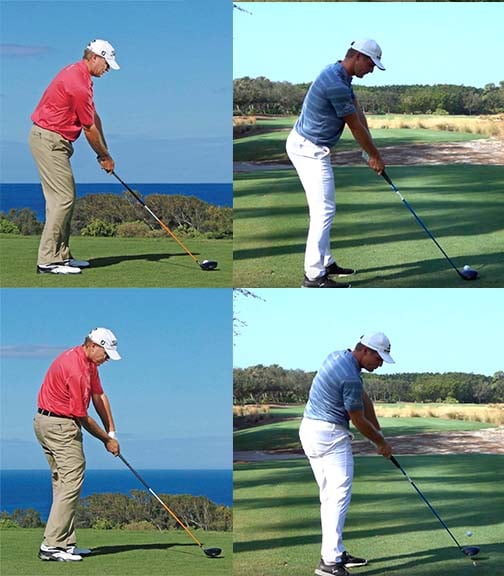
Moe isn’t the only player to swing on a Single Plane.Today, there are numerous players that I consider Single Plane Golfers. Bryson Dechambeau and Steve Stricker are the main players that resemble what I consider Single Plane golfers on tour while I find Moe Norman as the ideal Single Plane model.

Address To impact.jpg

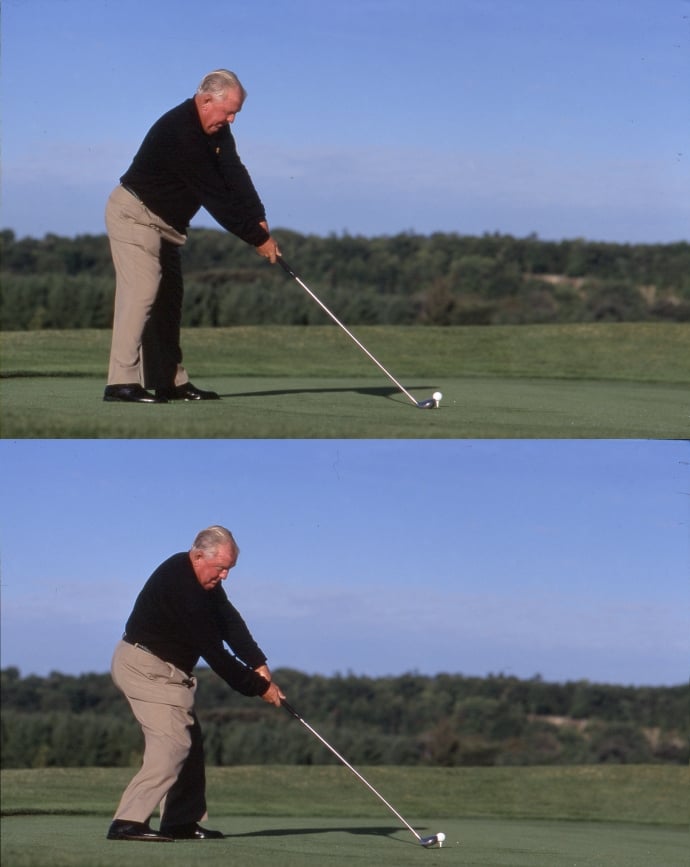
I find Moe Norman’s golf swing model. He simplified the Single Plane even further with a few changes in his address position. Moe adjusted his spine a bit more the address to resemble the spine angle at impact.

Moe address to impact.jpg

These placed the trail shoulder closer to the plane at address, removing rotation in the backswing and simplifying the entire swing. Notice that Moe stands a bit further from the ball. These allow him to move more downward to reach impact rather than a lifting action.

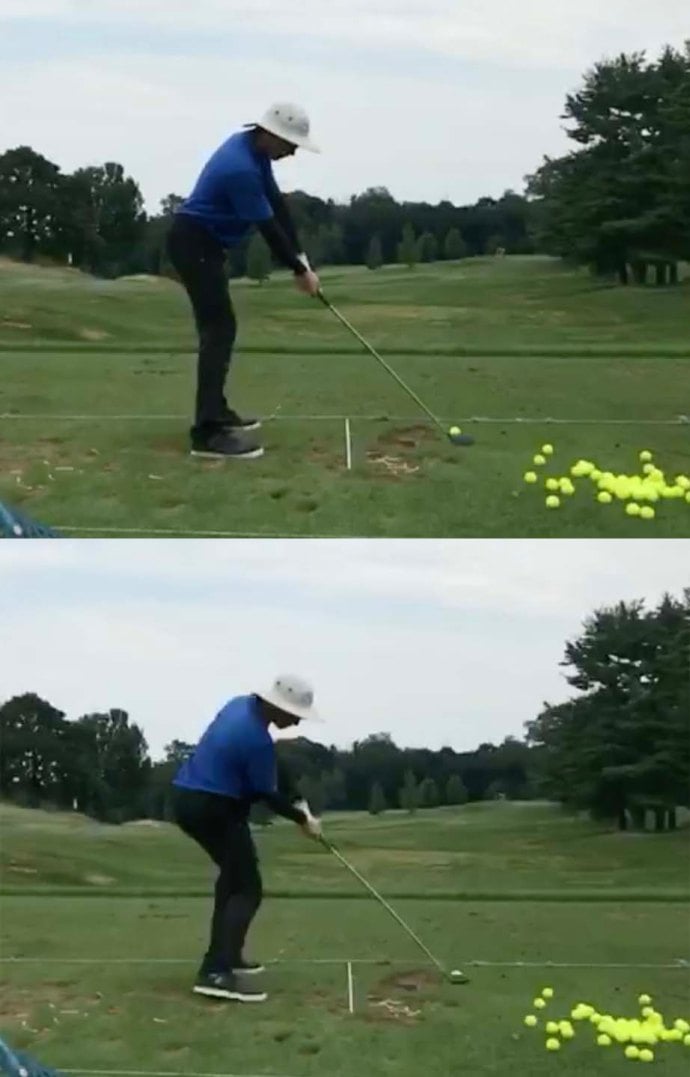
Here is Reed Howard, one of my students from address to impact.

Reed Address to impact.jpg

Reed has mastered Moe’s movement to keep the spine stable and reduce the stress on the back. When I met Reed, he had high rotations in his hand’s positions and over rotation of his body as a result.

Reed’s over-rotation of his body helped his hands lead through impact – however, the club lagged behind the rotation causing an extreme de-lofting of the golf club.  My first question was “Do you always hit it that little?”. The first thing I changed was to neutralize his lead hand position, making it neutral so he could place the club face. The swing starts from the grip. Your hands determine the rotation of the lead arm and clubface.  By changing Reed’s hand position, it simplified the motion of the first arm. From there, I could begin focusing on the rotation of his torso.

Due to his firm grip and over-rotation of his body, Reed had developed a “late hand action” in his backswing. Why is this a problem? The backswing also has a sequence where you turn your body and then the upper torso continues to turn as the lower body stabilizes. As you turn and the lower body stops, the hands hinge as the chest becomes. Having a late hook of his hands is usually a result of too much turn of the torso. Too much turn makes it difficult to time the downswing into impact.

Learning the Single Plane Golf Swing

I believe that with Bryson’s and Reed’s continued success, the light will begin to shine on the Single Plane swing mechanics. The Single Plane swing will become a household conversation and an accepted way to play golf. The golf world will analyze it and compare it to the tradition of conventional golfers.

The simplicity of the swing has its roots in biomechanics. When it comes to the Single Plane Swing, I claim and profess that the swing is easier than every method that exists and I feel compelled to prove it.

I am not saying that golf is easy nor am I saying that swinging the golf club is easy to learn.  What I am saying is that the Single Plane Golf Swing has fewer variables – making it an easier way to play golf.

Graphite makes the Game MUCH Easier

This past weekend I was watching a little of the Women’s Open (British Open) and then looked at a few holes of the PGA tournament (World Golf Championship – Bridgestone Invitation).

As I watched the game, I was impressed with the increasing number of graphite shafts in the irons of different players.

The Women’s Open – a majority of the women had graphite in their irons.

The PGA event – many of the golfers, are now using graphite in their irons

I wanted to rerun an article I had written about graphite shafting a few years ago (even more prevalent today).

******

During the club fitting session at our schools, we get a lot of questions about club shafting, in particular – graphite vs. steel shafts.

When answering I like always to tell a story from personal experience.

Many years ago (just over 20) I was playing in a “major” amateur event – the Ping National Amateur.

During a practice session, Karsten Solheim’s son was watching me hit golf balls and quickly realized there was something “not right” with the way I was swinging the club…. At that time, I had developed severe tendonitis in my elbow and wrist (trail) and had a sore shoulder. Reason – hitting golf balls off of the hard ground and as my elbow, wrist, and shoulder started hurting, I didn’t rest as the doctor recommended, but rather practiced even more because of the upcoming tournament.

Mr. Solheim watched me hit golf balls and saw me “short stroking” the swing (limiting the back swing) and not wanting to take a divot (because of the pain at impact).

After a few shots, he introduced himself, asked me what was going on and then asked me if I had ever hit graphite shafts in my irons. Now, remember, this was over 20 years ago – I’m not sure if I had ever seen graphite in irons. I replied no, I had not tried graphite in irons. He suggested I tried them and told me it was highly likely that the graphite would take care of a lot of my problems.

Long story shortened, I went on to play in the tournament – played okay, but played in a lot of pain. The week after the event, I went on the search for a set of graphite shafted irons. The only ones I could find were the Wilson Firestick clubs (some of you might remember – the Wilson irons with the red and black graphite shaft).

I decided to try the irons when my elbow’s pain did not subside. When I received them, I kept practicing, keep up my pace and amount of practice.

Two months passed (playing the new graphite shafted irons) and I was at another event (the U.S. Amateur). Mr. Solheim saw me at the range again, recognized and remembered me, looked in my bag and asked me how I was feeling.

I remember telling him, all was good. In fact, all my “pains” were gone. No more elbow pain, wrist pain, and no more shoulder pain. In fact, the pain subsided so fast after changing to graphite; I had already forgotten about it when I saw Mr. Solhein the 2nd time….

So, when talking to students (almost 50 years old +), most want to protect their body, most wanting longevity in their game, etc. you can imagine what type of shaft is recommended for 95% of the – graphite.

Here are the major issues behind graphite shafting in irons:

Graphite is much more forgiving

Graphite will help you hit the ball farther (it is lighter than steel – you will swing graphite faster).

Graphite is MUCH easier on the body, absorbing much of the shock of impact.

Graphite will prevent injury and will help current “injuries”/problems from getting worse.

In conclusion – if you are hitting steel shafts in your irons and hybrids currently and any of the issues above apply to you – you should consider changing to graphite.

We are more than happy to help you get the right graphite shaft for you (for flex, length, type, etc.).

If you are interested in discussing / recommendations for graphite shafting – please fill out and submit

I told you so – Bryson DeChambeau

Originally published 2 years ago…. Now even more pertinent with Bryson’s first PGA Tour win yesterday.

Congratulations Bryson!!!

Dear conventional golfers and teachers, I’m having an “I told you so” moment. I have to admit it feels pretty good. For over 20 years I have been answering your questions and your doubts regarding the Single Plane Swing and its validity. Questions such as: “Why isn’t anyone on tour swinging this way?” or “If this is so great why isn’t everyone swinging this way?” Some even question Moe the best ball-striker to ever play the game – asking “If Moe was so great why didn’t he win a major championship”. There have been times when presenting my research and science of the Single Plane, people have attacked me saying that Moe was autistic and a savant. That nobody could swing like Moe.

Now that a Single Plane Golfer, Bryson DeChambeau is now a major champion winning the U.S. Amateur – it feels pretty good to see science (and Moe) prevail. They claim Bryson is the best ball-striker in college golf. I am not surprised one bit.

Now, I want to say something before the golf teachers start justifying that what they have been teaching for 100 years is possibly well, wrong. I want to say to conventional teachers you can’t have it both ways. You can’t claim all successful golfers as another “variation” of conventional swing mechanics. Golf swings are different – because they are mechanically and physically different. Bryson’s swing IS different, in the ways you have been doubting and questioning.

Bryson Dechambeau
Bryson DeChambeau at address

Please, don’t try explaining his Single Plane swing with another predictable “variation of traditional golf mechanics”. Stop painting a broad brushstroke over all golf swings. Let’s face it, conventional golf mechanics don’t explain his swing starting from the beginning – his address. Bryson’s swing is biomechanically superior to conventional swings because of the way he grips the club into the hands not the fingers. Bryson aligns the club with the arms into a straight line. From the start, he has violated two basic tenants of conventional teaching; “grip the club in the fingers and hang the arms below the shoulders in an athletic position”.

Conventionally, with Bryson’s address position, there is nowhere for your instruction to go from here. You can’t explain his swing with traditional methods and how he starts and impacts on the same plane eliminating the need to move the club from two planes into impact when you claim that golfers should start with their hands low.

Oh by the way, just so you know, we have been explaining the alignment of the hands and arms for years. This is the basic principle of the Single Plane Swing. It comes down to simplifying the golf swing and eliminating much of the unnecessary movement of conventional golf swings. You must eliminate the angles at address to simplify the golf swing – exactly what Bryson is doing. You simply can’t simplify the swing from the conventional Two-plane address.

I can’t wait to read the stories of how every conventional golf instructor will try to explain Bryson’s swing. David Leadbetter and Hank Haney will probably publish a book about. Bryson winning a tournament makes it is “safe” to talk about it. I am sure that students will ask about it and many instructors in the PGA will probably change their teaching throwing away everything they have taught for the last 100 years. Just remember that Moe Norman figured this out over sixty years ago. And even though he never won a major championship like Bryson, his ball-striking make it very clear that there is an easier way to swing. It’s called a SINGLE PLANE.

LEARN

THE

SWING

Join 1M+ Subscribers to get your FREE Video Quick Start Guide that reveals how to hit the ball farther and straighter more consistently from now on…

START YOUR NEW GOLF SWING