Archives for November 30, 2025

Practice Slower, Play Faster

By Paul Monahan, Graves Golf Mental Game Coach

Sounds like a directive. Right?

Actually I think of it as a mental game approach. Here’s why:

At almost every Graves Golf school I attend, lots and lots of students are doing their level-best to achieve the Single Plane Swing model. But many, if not most suffer because of two important missteps.

They practice too quickly. And they PLAY the game too slowly.

Interestingly, these are not execution missteps (caused by lack of focus or an inability to understand a strategy)…they are mental game failures.

Let me explain, first with the concept of Practicing Slower.

The Single Plane Swing curriculum that Todd and Tim Graves and their instruction team have refined over the years is based on the very latest in skill development research: that we learn best from slow, deliberate and proper practice movements. (Not beating balls over and over again.)

One simply cannot groove and assimilate new body positions without this kind of work.

Moe Norman famously said to Todd and Tim that he once spent an entire day holding what we call position five. Why? Moe said he wanted to “…make it stronger.”

Just last week I heard Todd tell the story that when one of their Master Instructors was converting from conventional to the Single Plane Swing, he was known to spend hours on the practice range working on one thing: perfecting his move into position one.

Why won’t most students spend their practice time like this? One word: Their EGO.

It’s more satisfying to the EGO to hit ONE great shot every once in a while rather than spend the time needed to master a position or two.

In other words, even though it is a rational-enough concept (practicing slowly during your swing development), it is much harder to do because a part of your brain wants to “show the world” what you are capable of.
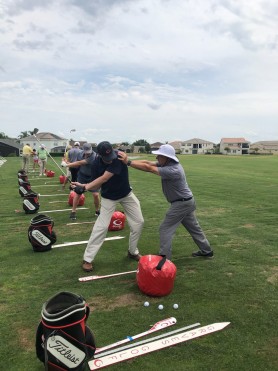
The harsh reality in all of this is: Until you SLOW DOWN and develop a deliberate practice regimen that includes far MORE correct body movement and far LESS actual shots with a ball, you will continue to delay the mastery of the Single Plane Swing. (Sorry. That’s just the way it is.)

This requires cultivating the awareness that your EGO will try to sabotage a regimen like this. It requires that you learn to tune into your mental and emotional tendencies…and be disciplined enough to stay on track with the deliberate, deep practice that will yield the changes you are looking for.

Dan Coyle wrote about this in  The Talent Code…and Todd and Tim refer often to the research and insights from Coyle’s work. Skill development comes from deep, deliberate, proper practice.

Now let’s address Playing Faster:

When it comes to playing the game, most players play too slowly. Specifically, they tinker and hover too long over the ball when they are hitting their shots. This causes paralysis by analysis – and yes…this is an actual technical term.

Sian Beilock, in her book Choke chronicles the trouble we get into when we linger over a golf shot too long. Basically, she explains that the part of our brain that is responsible for moving the body in space (procedural memory) switches off in those moments, and then our working memory takes over. This causes over-thinking and less-than-optimal muscle movement. (And yes, often is causes: The Choke)

The antidote? Play faster. Stop lingering. Pull the trigger over your shots sooner. This will prevent over-thinking and will allow you to play golf more as a reactionary sport…and you will be able to execute shots up to your talent level, not BELOW your talent level.

So if you want to get better this year, do yourself a favor and tune up your Mental Game skills: create a discipline to practice slower when off the course, and to play faster when on it.

Have Fun!

FWPC … Fundamental / Why / Practice / Check

By Tim Graves, PGA

The first morning of our schools and camps I (Tim) talk to the students about what they are about to go through. One of the topics is the process of learning and how to get the most out of the school. This process is the same we all need to go through to create new habits – I wanted to discuss a little in this e-tip. Here is what all need to do to create new habits:

1.  Learn the Fundamental

You must first learn the fundamental(s) that you need to work on. Whether a long game, short game, mid game, etc… fundamental such as the grip, set up, etc…  you need to study the fundamental you want to work on. Learning doesn’t mean doing at first, it means understanding what is correct and what is not. You are trying to create a new habit with a good fundamental foundation.

2.  Learn the Why

As you are working on creating a new habit, you need to know the why of the fundamental. More than, because we said so, but rather, why the fundamental is important. As you are making the change(s), you will feel uncomfortable at first. If you don’t know the specifics of why you need to make the change, your brain will “give up” when it becomes uncomfortable. (Very common). If you know why – you will be more likely to get through the uncomfortable stage. This is the conscious thought eventually transforming to the unconscious thought. It takes time, but your conscious thought must know the “whys” at first to continue with the change.

3.  Learn How to Practice to Create the New Habit

You can know what fundamental you need to work on, you can know the whys… but if you don’t know how to practice toward creating the new habit, your improvement will be limited, or at least slowed considerably. Whether performing drills, using training aids, or both, it is absolutely critical you learn how to practice toward creating the new habit.

4.  Check Points

During your practice, you must have check points. The check points are set up so you can make sure you are creating the fundamentals correct. The more check points you have, the better. Check many, check often, don’t forget to check. As many already realize, it is much easier to make yourself worse than better – you can prevent this by having check points and checking often while practicing and working toward the new habits.

Always Remember:

  1. Fundamental (What do I need to work on?)
  2. Whys of the fundamental (Why is that fundamental important?)
  3. How to practice the fundamental
  4. Check points to make sure practicing correct

Brighten Our Day – “Holy Crap” Email

By Tim Graves, PGA

From: D A J. <j…..40@msn.com>
Date: Mon, Nov 17, 2025 at 10:18 AM
Subject: Progress
To: Tim Graves <timg@gravesgolf.com>

Level 3 member here.  I was energized about my game after attending the Short Game and Mental Game Schools this past June.  As I worked on my game this summer, my subconscious brain told me to move on to the next part of the swing twice.  It was interesting that I was working on one part of the swing but my brain just yelled at me to move on.    I remember you saying more than once that a person may not be ready to move on for any number  of reasons.  I have had instructors move my hips into the correct position during a few schools that I have been to over the last few years.  The importance of this help finally hit me at the Short Game School this year.  When I began grooving this part of the swing, I began to take appropriate divots without thinking about it.  Ball striking became more consistent throughout the bag all summer and fall.  

Recently, as I was working on my trail hip movement, my brain told me to work on a little more wrist hinge at the top of the backswing.  Again, the brain was saying, “ok time to move on”.  Holy crap.  Ball striking just jumped to a whole new level.  Over the last two years I decided to golf more.   My driving distances moved from 220yds to 230-240.  In my last round this year, using the correct hip turn with a little more wrist leverage angle, I was driving the ball 270 yds the whole round.  My seven iron which was my 145-150 yd club went 165 yds every time.  My 100-105 yd gap wedge went 115 yds multiple times.  

I selected the single plane swing because I have had lead knee ACL reconstruction surgery, am living with a lead knee torn MCL and have had a compression fracture in my lower spine.  I have not had any knee or back issues using the Single Plane Swing.  I have been working on flexibility for range of motion this year as you talk about regularly.  

I was so excited after the last round that I had to write to you.  Graves Golf does a fantastic job of coaching people up.   Some people like me might be a little slow on the uptake, but tremendous progress is possible.  I will be 72 next spring and plan on my best season yet with more to come.

I hope that hearing from one of your students with positive results brightens your day a little. 

Many Thanks,

Dean J.

LEARN

THE

SWING

Join 1M+ Subscribers to get your FREE Video Quick Start Guide that reveals how to hit the ball farther and straighter more consistently from now on…

START YOUR NEW GOLF SWING