Golf stroke mechanics

The Perfect Student

By: Tim Graves, PGA

With all the students signing up for the schools lately, I like to review an article I wrote what makes a “perfect student”.

In this instructional article I want to write about the student … What do we expect / “hope” from our students. This includes students of our schools, camps, our Single Plane Academy Members, or maybe just students who are studying our video instruction and/or watching our webinars or maybe just reading these practice tips.

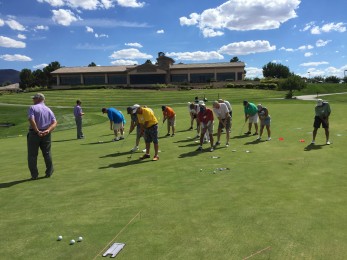
The first morning of our camps, I like to go around the room and ask our students what they want out of the week, the next 6 months of their golf game, and maybe the next year. What are their goals? What are their expectations?

We typically get the same responses… Wanting to improve their scores, cut their handicaps in half, learn fundamentals better, not have so many “blow up holes”, work on short game, etc.. etc…

After hearing their responses – it typically falls into about 3 catagories (all related):

  1. They want to learn how to improve (score better).
  2. They want to learn how to make less mistakes on the golf course.
  3. They want to be more consistent when they play golf.

What I hear is them saying “I want to learn how to practice and become a better student.”

With that being said – I want to describe the “perfect student” … or someone we believe has the best chance for improvement.  The closer the student is to the “perfect student” the faster he/she will improve.  There is no question there is a direct correlation in this area.
1. The student is open to EVERYTHING being said.

In other words, everything being taught, he/she is receptive too. Too many times, students have heard (or learned) things different before and they put up a mental “road block” when hearing something new. Playing good golf starts by understanding a method of solid fundamentals. The fundamentals don’t have to be complicated or difficult, but the student must learn the fundamentals within the method. Mixing and matching fundamentals of different methods does not work.

2.  The student understands is takes TIME to make changes.

This is a big one… To many want things too fast (me included). I once heard a saying, “If you get something fast, you’ll probably lose if fast”.  Cannot be more true when learning a new move, a new fundamental, etc… If you have patience, give it time, understand it will take a little while to figure out, etc. the change will “stick” and most of the time will be something you won’t have to consistently work on again and again. Rushing the process never works, or at least work for a period of time… Quick fixes are just those…. here today, gone tomorrow.
3.  The student understands you can not break a bad habit, but rather you CREATE a new habit.

This is a big one. I guarantee you if I interviewed golfers and asked them what they thought they needed to work on in their golf swing, a majority would say they need to break this habit, or that habit, etc… To start, it is basically impossible to “break” anything when it comes to a physical movement you have learned or acquired from the past. What is needed, is to determine what you need to work on and then work on doing it perfect (or as close to perfect) every time you practice. In other words, your body and brain are working together to create something that is good, it is not working “against” each other. How many times have you heard (or maybe said to yourself), “My brain says to do one thing, but my body does another”. We need to work on creating new/perfect habits that are much stronger than the old/bad habits which will in essence get our “body and brain to work together”.

4.  The “perfect” student will ASK questions.

This sounds like something you heard in school doesn’t it. But, you’d be surprised how many students will sit in a group, nod their head like they understand everything being said, and then after the presentation is over, will come up to the instructor and ask a “ton” of questions. We love the questions, problem is, if one student has a question, chances are, so do a majority of the other students. So, if you are sitting in one of our schools or camps, please don’t hesitate to ask any question ANY time. If you are watching our videos, webinars, reading e-tips, etc. email us with questions any time. We promise we will do our best to get back to you with answers asap. Please don’t go forward not knowing the answer or “confused” about something.
5. The student understands learning, especially an athletic move / moves, is a PROCESS.

It can be a fun process and the process can be sped up with proper practice, etc. but it is always a “process”. Enjoying the process is the key! Looking forward to making changes and working on those changes is a key! Ultimately understanding there really isn’t anything that is a “quick fix” (as stated before), but rather a process to change and a process to good and eventually, great golf. Understanding the process, looking forward to working through the process, getting help when necessary, will ultimately lead to the golf game the student wants.

Again – As the golf school season begins again (as many of you read this, my staff will be teaching at our academy in Orlando) – thought it would be a good time to list what we would love to see from every one of our students in order that they can improve their golf games to levels they can only imagine now.

Remember – A little improvement every day, will lead to a lot of improvement over time.

Please reply to timg@gravesgolf.com and let me know what you think of this article

Tim Graves, PGA
Playfullness

By Paul Monahan, Graves Golf Mental Game Coach

The reflection below is Chapter 2 from my book: The Most Important Game: Play Better. Struggle Less. Enjoy More. 

I thought I’d spiral back to it now as more and more golfers – especially in the more northern climates – begin to step back into regular practice and play.

I love this chapter for a couple reasons. First, it is a simple story reminding us to reconnect with the joy and playfulness we brought to our experiences when we were kids. Second, two terrific characters are involved. Tom Lagos was a fellow Ohioan who attended many GGA schools over the years and was a joy to golf with. Sadly, he passed away a year or so after this article was published. Gary Gustafsonanother perennial GGA 5-Day school guyhas a great attitude and an incredible work ethic.

Playfulness

Recently, I heard a celebrity speaking about golfing with his buddies. He mentioned one person in his circle of golf friends whom he particularly admired because of the playfulness the person brought to the course.

The celebrity said his buddies wished they could be more playful, especially on the golf course. He said that the guy he admired almost always played well, seemingly without a lot of effort.

Playfulness is one of those things that eludes most adults.

If you think about it, it’s not anyone’s fault; it’s a product of the society and culture in which we grew up, which rewards serious, adult-like, responsible behavior.

But studies show that the more we can tap into our childlike playfulness, the better we perform—particularly when it comes to skills-based, physical endeavors.

Last spring, Tim Graves invited me to teach at a 5-Day Build Your Game Alumni Camp in Orlando. If you ever get a chance to visit a 5-day camp, do it. The camps offer a fantastic experience. Teaching at one of the camps allowed me to teach performance mindset concepts to the attendees and work on my Single Plane Swing.

Among the many fantastic learning dynamics Todd and Tim create in the 5-day camps are live scenarios designed to replicate competitive situations and related pressure we may encounter in our weekly games at home.

One of the scenarios is a bracketed putting contest called “21” that lasts from Wednesday to Friday. The winner earns lots of cool swag and bragging rights for a whole year.

I played in the contest that week, facing the eventual winner in the semi-final round, the virtual putting buzzsaw, Gary Gustafson.

After an incredible hour-long quarterfinal match against Tom Lagos, an excellent competitor, Gary crushed me, 25–2 in about fifteen minutes!

After our match, I asked him about the secret to such a fantastic performance. Gary shared that, while watching the game between Tom and me, he noticed a five-year-old boy putting on the other end of the practice green. The boy was with his mom, goofing around on the putting green. We had seen him, too. He was a pretty cute kid and a tremendous little putter!

Gary noticed two things about the boy’s putting. First, he was putting remarkably well for his age, and second, he was putting rather quickly.

Gary equated the boy’s speed with playfulness. In other words, the boy didn’t overthink each putt. Gary noticed the boy’s joy and ease each time he stepped up to the ball, took a look at the hole, and pulled the trigger.

So, Gary approached his upcoming match in a spirit of playfulness akin to the little boy’s. He stepped into his putts carefully and deliberately, trusted his line, and pulled the trigger, resisting the urge to overthink the setup.

Man, did his strategy work. His putting was amazing!

Throughout our (very short) match, Gary made a bunch of long putts and plenty of shorter ones. When he wasn’t making putts, he came super close, so he picked up points. His strategy was impressive. I had a pretty good seat for that show.

I think Gary’s approach is a good lesson for all of us, regardless of the level of competition or the situation. The strategy is good whether playing golf, in critical leadership moments or negotiating a sale.

We nearly always perform better when we trust our ability to do the thing and step into it without much overthinking. Todd Graves calls it “playing empty.”

While multiple dynamics determine success in a skills-based performance such as golf, a spirit of fun and playfulness goes a long way to enhance one’s performance.

So, try this the next round you play or the next time you practice. Be intentional about not overthinking. Adopt a playful mindset and step into your shots.

Play the game. Have fun. Don’t overthink it.

There’s a reason we call it playing golf, right?

Paul Monahan, an author, speaker and Peak-Performance coach. He recently published: The Most Important Game. Play Better. Struggle Less. Enjoy More  … a collection of essays designed to inspire fresh thinking and more fun playing the game you love. He resides in Cleveland, Ohio with his wife Paula and is the proud dad to three young men.

Common Fault & Fix: Shaft Alignment at Set Up

By: Tim Graves, PGA

Fault 1

The Fault – Not establishing the “Rod” Position

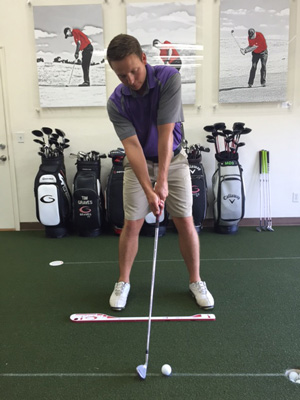
When the club shaft is out of alignment with the lead arm at address, we consider this an incorrect position. This alignment is very important when it comes to the Single Plane Swing because it puts the body in a position to move into a perfect takeaway every time.

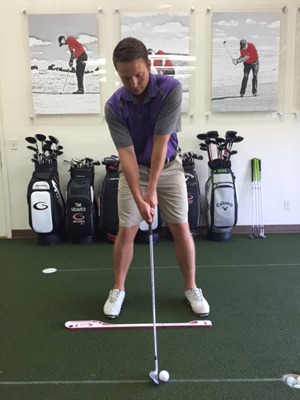
As seen in the photo above, note the following:

  1. The club shaft is not in alignment with the lead arm.
  2. The hands are behind the golf ball as opposed to ahead.
  3. The club head is directly behind the golf ball
  4. The lead hand wrist is cupped as opposed to being flat

With this incorrect alignment, here are some compensations that golfers will develop:

  1. Improper takeaway due to the hands being behind the ball at address
  2. Early release of the golf club
  3. Hitting behind the ball at impact
  4. Hitting the top of the ball at impact

Ultimately leading to:

  1. Loss of Distance
  2. Loss of Accuracy
  3. Inconsistency
Fix 1

Checkpoints, and Correction for not establishing the “ROD” position

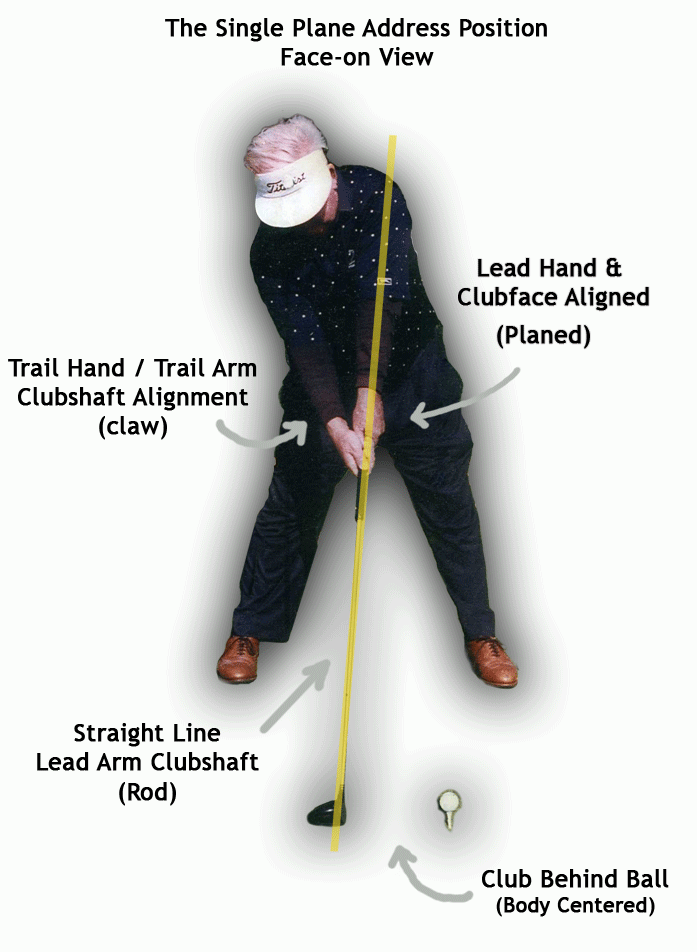
  1. Facing a mirror, get in your set up position.
  2. Place the club head directly beneath your nose, and look at the alignment of the club shaft and lead arm.
  3. The club shaft should be in a direct line with the lead arm, which points to the lead shoulder.
  4. The hands will be ahead of the club head
  5. The butt end of the grip will point towards the lead side of the body

With this correct alignment, golfers will develop:

  1. Proper takeaway due to the hands being ahead of the ball at address
  2. Hitting the ball first at impact
  3. Being able to create a divot (with irons, hybrids and fairway woods) past the golf ball
  4. Solid impact with proper and good compression of the golf ball
  5. Proper and full release of the golf club

Ultimately leading to:

  1. Maintaining and increasing distance
  2. Increase in accuracy
  3. Consistency

Expectations (Replay)

By Paul Monahan, Graves Golf Mental Game Coach

Replay:

It is fascinating to me how MUCH our expectations can negatively impact our experiences…as well as our ability to perform at our best.

While watching the last round of the Waste Management Phoenix Open, I heard one of the CBS announcers – I think it was Peter Kostis – comment on the challenging day that John Rahm was having.

After three solid rounds, Rahm began his final series in second place, with a chance to win another event this year after a phenomenal previous year in which he earned his first victory as well as ten top ten finishes.

But after 16 holes, Rahm was at two-over par when he probably needed to be a 3 or 4 under parto be in contention to win. Rahm’s frustration was pretty evident.

At that point, Kostis commented that he thought Rahm’s biggest challenge would be managing his expectations.

What did he mean? Simply that Rahm had such an incredible previous year, that he would have to be careful not to create expectations in his mind about the results he would be able to achieve in any given week.

We perform best when we drop our expectations when we metaphorically leave our expectations in the car. These allow us to see our reality (the game, the shots, the putts…etc.) more objectively…and not have our perspective clouded by our stories.

A little over a week ago I had the chance to attend the Graves Golf Academy 3-Day School in Orlando…

During this first day of the school, Tim Graves and his staff emphasize the importance of starting the Single Plane Swing process with the shortest of golf moves possible – the putt – by leading a putting lesson.

As I interacted with some students during the putting lesson, I noticed how many were struggling with their mental game. And I know it sounds strange…we were practicing putting.

The guidance from Tim was this: work on matching the putting stroke model and don’t worry about sinking putts. We don’t care about sinking putts; we want to make sure that we are hitting “checkpoints.” If we get good at executing the checkpoints, we will make putts, for sure.

But here’s what I saw: guys were getting frustrated because they weren’t sinking putts. (And some guys were extremely frustrated.)

These were brilliant, accomplished people. They know how to listen and follow direction. But …they were stuck in their expectations.

When we get stuck in our expectations, when we view reality through the lens of hope, the only way we can be satisfied is if those expectations are met. (Makes sense…right?)

But if our expectations are not met then what happens? You guessed it: disappointment – or even worse: apparent frustration.

The guys on the putting green were missing putts they expected to make. And so, they experienced those misses as disappointment and frustration. (They even forgot about the purpose of the practice, to begin with.)

But what if they had been able to set their expectations aside?

They likely would have been able to perform better throughout the exercise and would have:

  • Remembered the purpose of the practice session
  • Not worried about the result
  • Focused on process
  • Worked on matching the putting model
  • Enjoyed the experience
  • Learned
  • …and maybe even been a little more fun to be around

I often tell my clients, the tighter your grip on your stories or expectations about what should happen, the more difficult it is to experience your reality in productive ways…especially when things don’t go as you think they should.

If you want to get better at this game, (or anything) you must learn to drop your attachment to results and instead, stay focused on the elements that produce the desired results. Like; gripping the club correctly, starting with a proper address, and matching the swing model.

When you miss a putt or hit a ball poorly, remember: that is a neutral event. It is neither good nor bad…it is. Learn to see the things that happen in your environment as they are…and not worse than they are. Learn to see them as a chance to learn something and master a new skill. No matter what happens.

Like John Rahm or the participants of our GGA Schools, we all would benefit by loosening our grip on our expectations…or dropping them altogether.

Paul Monahan, PCC is a Peak-Performance coach, member of the International Coach Federation and a certified COR.E Performance Dynamicsä Specialist. He resides in Cleveland, Ohio with his wife Paula and is the proud dad to three young men. He works with elite-level performers and leaders, helping them to expand their awareness so that they perform at their best more consistently.

It’s About the Journey

By Paul Monahan, Graves Golf Mental Game Coach

A few years ago, I realized that I had visited nearly all 50 states in America….all except Idaho and Montana. It occurred to me that I would be turning 50 years old that year – and I had this idea that if I got a little intentional, I could complete the 50 States x 50 Race” (…I think I made up) by visiting all 50 states before I turned 50. What an incredible accomplishment that would be! Right?

I worked through the logistics: I would fly to Spokane, WA then drive to Coeur d’Alene, ID. While there, I could play some golf, and then make my way over to Montana…only a short distance from Coeur d’Alene. My buddy Jon from high school, – always up for an adventure – would come with me. The trip was on.

So, in May of that year, Jon and I hopped on a flight and we headed out on our adventure. On day one we travelled to Idaho (#49…check!). On day two, we played golf at the Coeur d’Alene Resort (…famous for its moveable island green. Yes…I got the certificate!). And on day three we drove an hour or so East to the Montana border. (#50…check!) The race was over. I won!

Cue the big celebration, right? The elation. The pure joy. The confetti.

Well… what I experienced was a bit different. And frankly it was a bit of a letdown.

There was no there there. I can’t even tell you how ridiculous I felt. I said to myself “ You did what? Travelled all this way just to be able to tell your friends you travelled to 50 states!?”  (… this whole essay is starting to feel like a giant humble brag.)

But the truth is that I had an amazing three days with a life-long buddy who enjoys many of the things I do. Golf, adventure, great conversations about the meaning of life…etc. That was where the joy and happiness was for me. And if I reflect on my journey through the other 48 states, I can think of tons of great memories and experiences as well.

So, by the time I got to the Montana border, the “prize” didn’t matter as much.

The point is this: it’s not about the destination – it’s about the journey. Always has been. Always will be.

When I was younger, I thought that was just another platitude. Pure garbage. A phrase invented by people who were too afraid or too timid to do what it took to get themselves across the finish line.

I don’t believe that anymore. I believe that I am most energized when I am working toward something – engaged purposefully in pursuit of a goal, dream, or defined outcome. On the path. On the journey.

I am immensely satisfied when I arrive at my goals… and even happy or elated sometimes. (Ask me about my experiences walking across the Grand Canyon’s Rim-to-Rim route the next time you see me.) But looking back, it really WAS the journey that mattered most. And looking ahead, I believe it really IS the journey that matters most.

The journey is what points you. It is what energizes you, challenges you, and puts you into the kind of productive struggle that creates growth. (Thank you, Dan Coyle.)

Learning to play golf at a higher level the way you are doing it IS a journey. Remember to enjoy it. Relish it. Know what it is – and what it is not. It IS an amazing adventure of learning and growth. It is NOT your identity. It is NOT an obstacle to be overcome – but an experience to move through that will change you forever.

In Jordan Petersons’ book Beyond Order, he says that “You are not only something that is. You are something that is becoming…”

Humans are teleological… we must have purpose. We must have targets. We must be aimed at a destination…and be traveling in that direction. It is how we are wired. But what truly brings joy, satisfaction and happiness to a life is not necessarily arriving at some pre-ordained goal, but rather what we experience along the journey itself.

The next time you are in struggle, experiencing frustration about your game or about that shot that just went sideways, stop. Take a deep breath and remind yourself:  “It’s the journey.” Then consider the gift inherent in that moment …how that moment will make you stronger, smarter, and more able to complete the journey you are on. Remember that you are becoming… one little step at a time.

Safe travels!

-Paul

Heard It a Thousand Times … The Grip…

By Tim Graves, PGA

From: jay@log….
Subject: The GRIP!
To: Tim Graves <timg@gravesgolf.com>

I’ve heard it more than a thousand times

I finally figured out just how the grip ‘feels’.  And now I am able to  confirm that I have the grip correct.

Positioning on the handle…

Correct overlapping of the trail hand little finger…

Lead hand thumb comfortably in the crease of the palm pad of the trail hand…

I was amazed when I finally ‘felt’ the proper fit of my hands on the club handle.  I always fidgeted with my grip before coming to address—and thought it was correct.  But when I accidentally did it right, I ‘felt’ it immediately.

After all the hands-on instruction, I never really got it.  And I just sort of stumbled into it while fidgeting.  The result was immediate transformation and much improved direction, distance and accuracy with all clubs—especially my driver.

Thanks for harping on the importance of the Grip.

Merry Christmas to You and Yours!

Jay C. / Pie Town, NM

*****
Additional Grip Help / Instruction: Go to: https://gravesgolf.com/product-support/

Click on GGA Grips (2 Instruction Videos about proper grip / hold of club)

LEARN

THE

SWING

Join 1M+ Subscribers to get your FREE Video Quick Start Guide that reveals how to hit the ball farther and straighter more consistently from now on…

START YOUR NEW GOLF SWING