Advice From a Few Alumni

Advice From a Few Alumni

Every so often, I like to have our students teach our students / future students. I believe there is no better advice to a student than advice from an alumnus who is well into their process of improvement. So, it’s that time again. Here are a few emails I have received in the past few weeks I’d like to share with you. I hope you enjoy them as much as we have.

**********

Email #1:

Good Day Tim,

Hope your family is doing well and that your son continues to progress with pitching; keep watching him to make sure he stays balanced.

What I love about this (GGA program) as a busy surgeon, is that I can practice daily without hitting a ball.

I do use the 6 iron training club to make sure grip is right and hit the impact bag; continue the PVC drill.

The coaching program is invaluable for feedback; I am just behind in getting a new video clip in.

I added the “7 Principles of Golf Improvement” DVD set to my library; a great adjunct to the coaching program, like having someone with me at all times.

I would recommend that every GGA student have this set in their library.

I have not gotten to play as much as I would like but hitting balls every week; short game as well-hitting crisp shots and putts.

I can tell you I am hitting some of most solid shots I have ever hit; just have to keep after it.

It is a matter of time before I put it all together.

I have never felt so good about the direction my game is heading.

Thank you GGA, will keep working.

I will do a 5-day school either later this year or early next year.

Stay well and keep up the great work.

Dr Vic K.

*******************

Email #2

Hello Gentlemen,

Jay C. here, to give some honest feedback.

First off, Tim, the irons are better than expected [Callaway XR OS Irons]. Your calculations are unreal in the results of my new clubs. I’m not taking a very big divot, but getting great height and distance with the ball. I’ve never hit a hybrid before and felt intimidated, but I put 3 shots to 200 with the #4, and 3 shots about 215-220 with the #3… 🙂 very nice.

Trent, your communications have been above normal of what the common business practices are today. I see why such a young man has a high, demanding position as you do. You’ve proven your integrity and professionalism.

Bart [Barnard/Phoenix Arizona], my analyzing coach! Your advice has made me want to invest into getting the enjoyment out of this great sport again. Seriously, before this year, may have golfed 30 times in the last 15 years, and 6 of those, not at all.

I always got stoked when I hit a nice drive, landed on the green with an approach shot, and of course a nice one putt. Bart, you’ve shown me with the video feedback what is necessary to practice on so I can maximize my game, and it works. I usually do not like homework/practice, etc., but this is very satisfying.

The reason I’m writing this is I was going to give up golf, and just convince myself it’s too expensive, takes too long, and blah, blah, blah. Then I saw a clip of Todd Graves with this easy to maintain swing for us guys in our 50s…and beyond. Todd, well if I had your email, really, thanks man. The webinar on August 2nd had a question come in about: “is this easy to switch from a conventional style swing?” Well from my brief experience with this swing change, no…BUT…the explanation Todd gave when he answered…When you implement all the stages, and practice the less moving parts, so to speak, as I found out today on the range with these new awesome clubs….YES, it works. It’s not that hard. It’s just like Todd, Tim, Trent, and Bart show you!

Not looking forward to being critiqued with my chipping and pitching I submitted today, (because I already seen some of my flaws, LOL), but I know any input instructions I receive will be totally beneficial to me enjoying this sport for the rest of my days. Also, one day soon, to be INVITED to play along with my 4 handicap son without him feeling like he has to. (LOL again!).

Stay informative, and don’t lose the drive to want to teach so many of us who were/are ready to give up this game because the OLD WAY only works for a small percentage of weekend golfers. Or as I was calling this game, “swing and swear”!

Sincerely,

Jay C.

********

Email # 3

My name is Damion H. C…. and I recently attended the SPE in Denver, CO with Scott Renfrow, Shannon and Chris.

I started looking into the single plane swing two years ago and thought I was doing pretty well with the mechanics; however, one does not know what one does not know until they are in front of a coach, which the SPE provided.

I learned a great deal from Scott, Shannon and Chris and am thankful to your organization for bringing this school to Denver. Scott, Shannon and Chris definitely are subject matter experts and provided me with real-time feedback, body position and swing adjustment suggestions that helped me understand the mechanics of the single plane swing more in depth.

I also appreciated the tips on chipping, pitching and putting and have implemented what I learned just last night! Shot an improved round of golf last night and feel more confident in know where my shots are going, knowing what to look at as far as adjusting when my most do not go straight and feel better about chipping, pitching and putting.

I also appreciated the customized measurements Scott took, as this will help get into a set of clubs that are customized for me.

Thanks again to entire the GGA staff and personnel for making these SPEs possible.

Sincerely,

Damion H. C….

**********

Again, hope you enjoyed these emails from some of our GGA alumni.

As always, we encourage emails from you anytime – whether it’s a little advice, some help, or just to answer a few questions, we are always happy to help your golf game with whatever you need.

Hybrids vs. Irons – When to Hit

When do you hit hybrids, when do you hit irons?

Here are a few scenarios of when it is recommended to hit a hybrid and when it is recommended to hit an iron.

First – A Hybrid is best thought of as a long / mid iron replacement.  It is a club with a wider sole and typically more weight on the bottom / sole of the club which makes it much easier to hit the longer shots (with the hybrid vs. the mid to long iron).   And it is much easier to hit the longer shots with height (due to lower center of gravity in the club) which typically allows the golf ball to “hold” on the green easier.

Screen Shot 2016-07-16 at 11.08.18 PM

Scenario #1: Ball in Rough

Depends how ball is sitting in the rough.  If the ball is sitting on the top or middle of the rough, can use a hybrid.

If the ball is sitting at the bottom of the rough (or in deep rough) – use an iron.  Might need iron with a lot of loft (wedge, etc.) if rough is deep enough need to get the ball up quick to get out of rough and back in fairway.

General Recommendation from the rough (when not buried in deep rough):

When distance is more important – hybrid.

When accuracy is more important – iron.

Always remember – if there is a question if hybrid will get ball out of rough or not, use an iron and get back into fairway.  Hybrids are great clubs from “mild” rough, but can get you in trouble if rough is too deep.

Scenario #2:  Ball in Fairway Bunker

A hybrid is a great club to hit out of fairway bunkers.  If you are hitting out of bunker and there is a minimal lip on bunker (don’t have to hit up fast) use the hybrid.

If the ball is sitting down in sand (buried type lie) or you have to get up quick (high lip on the bunker) – use an iron.

Scenario#3:  Hitting into the Wind

If it is minimal wind and you can account for the wind vs. added height of the hybrid – hit the hybrid.

If very windy and must keep shot down / low – use an iron.  It is relatively difficult to keep hybrids low and not very good clubs into a lot of wind.

Scenario #4:  Hitting below a Tree / Punch Type Shot

If you are hitting a low shot (punch type shot) below a tree, etc.. it is recommended to hit an iron.  Hybrids are built to get height fast, they are not good clubs to punch shots out below trees.  Would recommend hitting your longest (least lofted) iron vs. hitting an hybrid in these situations.

Scenario #5:  Chipping when ball is sitting into the Grain

Many times when a shot comes up short of a green and is on an uphill slope to the green, it is sitting “into the grain”.  Grain of the grass typically goes the way the water would roll off the hill.  In other words if your ball is sitting on a spot the water would roll away from the hole, your ball is probably sitting into the grain.

To test this, take a couple of practice strokes with an iron and “feel” the grass / grain.  If it feels “sticky” – like the club will not cut through the grass clean and with ease, your ball is sitting into the grain.  This type of shot, many times will be hit fat or “chunky” because the club will not get through the grass clean.  Use your hybrid for chipping in these situations.  The wider sole of the club will glide across the grass and will not get “stuck” into the grain.

Like any “specialty” shot – they require some practice.  Using the proper “tool” (hybrid vs. iron) is the first key to hitting the specialty shot.  The more you practice with the proper club in each scenario, the easier it will become.

If you can think of other scenarios of a hybrid vs. iron, let me know – happy to give recommendations in upcoming practice tips.


New locations for GGA schools!

Exciting news! GGA is expanding into 2 new locations with our 1 & 2 day Single Plane Experience school programs.

I’m pleased to announce that we now have schools in:

  • Denver, Colorado
    • Our licensed instructor, Chris DeKorte, is now up and running in the Denver area at Green Valley Ranch in Aurora.  This course has hosted GGA Premier schools in years past, and boasts a top notch practice facility along with Colorado’s largest 1st tee program.
    • Our first Single Plane Experience schools in Denver start on July 16th & 17th, Click HERE for registration information.
  • Chicago, Illinois
    • We are pleased to announce that after a 2 year search, we have finally found an instructor worthy of representing the Single Plane swing and GGA brand in the Chicago area. PGA professional Bob Sloan has joined the GGA team, and will be conducting Single Plane experience programs in Lansing, just south of Chicago.
    • Schools will begin on August 2nd & 3rd in Chicago, and run throughout the remainder of this season. Click HERE for more scheduling information.

In addition, we have Single Plane Experience schools running throughout the country, including:

  • Norwich, CT – it’s the perfect time of year for our friends in New England. July 21st & 22nd are next available dates, and will be led by GGA Master Instructor Clay Farnsworth, PGA. He will be joined by GGA Instructor Shannon Friday, PGA.  2 for the price of 1 in the instructor department!
  • Phoenix, AZ – GGA Instructor Bart Barnard has a great indoor location set up in the desert! The heat is easy to beat this summer at The Legacy Golf Club.
  • Orange County, CA – Southern California, is it ever a bad time weather wise for golf? GGA Instructor Pat Pohlen has 2 schools in July.
  • NE Ohio – GGA Instructor Paul Tessler owns his own facility in Newton Falls, and it’s a great place to attend a school, and a great facility for practice around your school.

Come out this month and join us at our new locations at a Single Plane Experience. It’s an excellent way to grasp the core fundamentals of the Single Plane swing and short game. We look forward to seeing you!

Scott


The Geometry of Moe Norman’s Swing

I recently had the privilege of spending a day with Dr. Rob Neal, the CEO of Golfbiodynamics. Dr. Neal has analyzed thousands of golfers to discover the key body movements that produce ideal swing mechanics.

To quote Dr. Neal, “Its all about getting to impact and reaching your potential speeds”. Understanding biomechanics is to understand what parts of your body move, how do they move and when, in the sequence of the golf swing, do they move.

Dr. Neal goes on. “All good players get to impact where the club has produced speed because of the proper sequence of movement beginning with the lower body, then the torso, then the arms and finally the hands bring the club through impact. This chain reaction allows the golfer to produce the maximum speed on the club.”

The Single Plane Swing, according to Dr. Neal’s comparison the the Conventional swing has three main components that simplify the movement; Spine Tilt, Pelvis Movement and Hand Rotation.

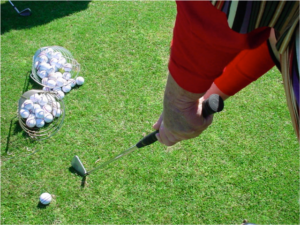
I recently acquired video of Moe Norman hitting balls in 1991. This video shows Moe from a top view – where a cameraman stood on a cherry-picking machine so he could get above Moe while he hit balls. I love this video. Here is a picture of Moe, at address, from the top view.

Moe OVERHEAD

I have drawn a few lines to show some great geometry where you can see that Moe’s lower back (sacrum) is forward of his upper spine (neck). The ball is positioned at the lower back. I think this is critical for a few reasons. 1) His hands can lead into impact because his body is tilted and lower body can move in front of the ball. 2) The club shaft is also leaned forward toward the lower spine. This shows that the hands are already in front of the club head.

Notice the squareness of the clubhead even though it is behind the ball a few inches. Also notice that the shoulder blades (not front of the shoulders) are parallel to the target line and perpendicular to the club face.

To find out more about the Science of Moe’s Swing – stay tuned. Dr. Neal and I have produced a video to explain Moe’s geometry in detail and you can see the Top View of Moe’s swing in this upcoming “The Laws of Simplicity” DVD product.

Moe’s Set Up – Single Plane

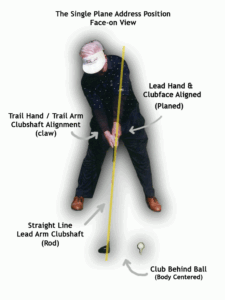
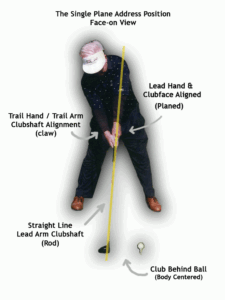
Here are a few “unique” characteristics of the Single Plane (Moe’s) Set Up:

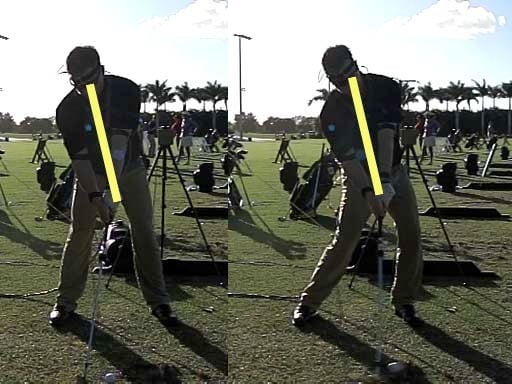
1. Moe’s Legs Were Straight

This builds a stable foundation – or what is called an A-frame – for the swing day after day. One of the issues with the traditional swing is how much to bend the knees? On day it might be a little, another day a player may flex them more depending on his emotional and physical state, which lead to inconsistency. Starting with straight legs means there is no variance in the degree of knee flex from day to day.

Do not confuse straight with “locked”. Moe’s knees were not locked, but straight at set up.

Secondary Spine Tilt Address FOSPS

2. Upper Spine Tilted Away From The Ball

The lead shoulder is higher than the trail shoulder.  The tilt happens naturally because of Moe’s wide stance and straight arms and his right hand was lower on the grip then his left hand.

Pictures_from_Canada_July_31_035

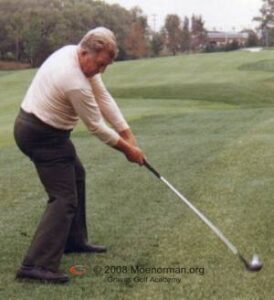
3. Moe’s Arms Were Straight – Pointing Directly At The Ball

This is a natural position for holding a club to hit a golf ball; it is similar to a child holding a stick that he’s going to use to hit a rock on the ground.

moe impacting

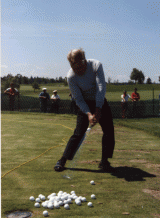
4. His Club Shaft Began The Swing On The Impact Plane

Starting with the club on the same plane that you are going to hit the ball makes sense. (How come no one figured this out before?)

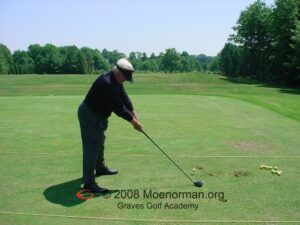
5. He Placed The Clubhead Five To Twelve Inches Behind The Ball

This allows the body to move laterally into the impact, and it allows the relationship between the club and the upper body to remain consistent. (The distance behind the ball depends on the club.)

moe-front-grip

6. His Lead Hand Was Neutral And Trail Hand Non-Rotational

This allowed for perfect club face movement and minimal arm rotation.

Taken together, these elements of Moe’s address made his swing incredibly simple, certainly relative to the conventional swing.

It’s Not Rocket Science

It’s Not Rocket Science

Todd Graves

Forever it makes me wonder the extent to which golf instruction has become so difficult that golfers now believe that good players hold some secret. While the secret is nothing more than good solid mechanics. There is no secret other than the secret is “get the club to impact in the easiest way possible”. The golf swing is not rocket science.

I don’t play much golf anymore. Today I played my fourth round for the year. Here are my scores for this year – 74,66,73,68. I’m seven under for the year and I don’t practice, I don’t worry about it. I just step up and play – occasionally. I don’t hit it perfect, as a matter of fact here are today’s statistics: 11 Fairways, 13 Greens, 1 Sand Save, and 26 putts. Golf is like riding a bike to me – it just comes back to me even when it don’t feel that well. Sometimes I feel a bit quirky over a shot – but overall I manage to play well enough to have fun. Here are some of my secrets to making the game low maintenance.

Learn how to “feel great” at address

The main way to play well is that once you have a swing, you must learn to use it. The best way to do this is to learn how to feel really good at address when you aim at a target. This is my key to playing well. If if feel good at address, then it is easy to pull the trigger. If I don’t feel right at address, then thoughts can creep in. When weird thoughts creep in, I find it difficult to pull the trigger and I lose confidence. I practice on the range like I am playing because I am really practicing on how and when to pull the trigger.

Reverebanner1

Aim at targets as often as you can and be aggressive

Aiming at targets is the key to learning how to pull the trigger. When you aim at targets, you learn to eventually stop all thoughts and you develop the timing of “when” to pull. This is the key to developing consistency and aggressiveness in your playing. I hate not being aggressive in my ball-striking. As a matter of fact, I rarely ever “ease up” on a shot. If I need to hit a small 8 iron or take something down a notch, I will usually just choke down and still swing full. I like aggressive swings, not tentative ones.

Moe_1984_approaching_impact

Have confidence (or act like you do) even if you don’t

Paradoxically, this is one of my keys to playing well even if I don’t feel like it. Sometimes I don’t feel like I am playing that well or I haven’t played in awhile – say two or three months. Usually I get invited to play at really great and hard golf courses so playing poorly is not fun. So what I do is act as though I have been playing every day. I act as though I am sharp and ready as though I just walked off of a major tournament and played well. I act as if I am playing well. By acting as if I am playing well, my physiology changes and I actually start believing it. Then, when I hit a few good shots, my confidence builds and I start playing better and better. If find that acting like I am playing well gets me playing well. Just think of the alternative. What if you act as though you are not playing well. This prophecy fulfills itself and soon, after you hit a few bad shots, you start to make excuses. Don’t make excuses, just act as though you are playing well.

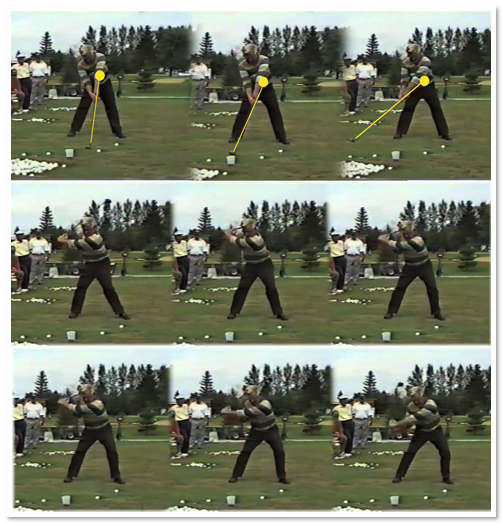
Moe Overlapping Finish

Focus on the best outcomes for all shots

Another thing that keeps me playing well is that, other than feeling great at address, my only other conscious effort is to focus on the best outcome on every shot. I constantly ask myself, “what do I want on this shot?” or “What would be a perfect shot here?”. By focusing on the best outcome, I stay aggressive and positive.

putting_systempic5

Read em and Roll em

One of the places that is easy to get discouraged is on the greens – putting. One way that I stay focused and positive on putting is what I call “read em and roll em”. What I mean by this is that if I read the putt well, my only expectation is to roll it where I read it. There is nothing else I can do. Therefore, the key to putting well, for me, is to read the putt well. Once I get a good read – let her roll.

jumping

Love every shot you hit

The final and toughest part of playing “part-time” is enjoying every shot even the bad ones. But I think loving every shot you hit is one of the secrets to great golf. If I hit a bad drive, I simply try to recall what the swing felt like. Then, I attempt to recall what a good swing feels like and I can appreciate learning from the bad swing. Just like that – I loved the bad swing too because I learned something from it.

These are just a few keys that I use to play well all the time – especially when I am not playing regularly. They keep the game fun.

LEARN

THE

SWING

Join 1M+ Subscribers to get your FREE Video Quick Start Guide that reveals how to hit the ball farther and straighter more consistently from now on…

START YOUR NEW GOLF SWING