Moe’s Legacy: Persona or Perfection

Moe’s Legacy: Persona or Perfection

The Moe Norman Legacy

What will be the Legacy of Moe Norman? Will he be remembered for his quirky and eccentric personality and his failure to exploit his talent on the PGA Tour. Or will he be remembered for his contribution to golf – his amazing golf swing and what I consider the discovery of an easier way to play golf. This is a topic of conversation I often have with my brother and our team at Graves Golf Academy. I recently discussed this with David Carver, and entrepreneur and producer, developing a movie about Moe.

Moe was great character. His personality and relationships left a trail of great stories and exploits. It seems that every golfer from his era has a Moe story, even the ones who never met him.

Webster’s Dictionary defines Legacy as:

1) A gift by will especially of money or other personal property : bequest or

2) Something transmitted by or received from an ancestor or predecessor or from the past.

So what personal property did Moe leave us? Better yet, what can we receive from him even if he is no longer with us?

Yes, there is no doubt that Moe will be remembered for his quirky and eccentric appeal. His stories help us understand his character. They make us laugh and sometimes wince. But since Moe didn’t leave you with any money or the contents from the back seat of his car, Moe will be remembered his contributions to the sport of golf if we are willing to take advantage of what he left.

I believe that Moe discovered his legacy in the grassy fields at Rockway Golf club in Kitchener Ontario. That’s where his hands bled as he worked through his human insecurities to develop the greatest golf swing to ever hit a ball. I believe Moe’s inability to fit in to society fueled his passion for golf. He outworked everyone. “It’s hard work, you can’t buy it” he remarked when I asked him about how he learned his golf swing.
Moe Norman
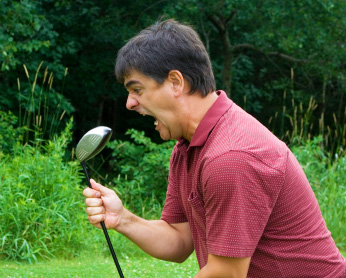
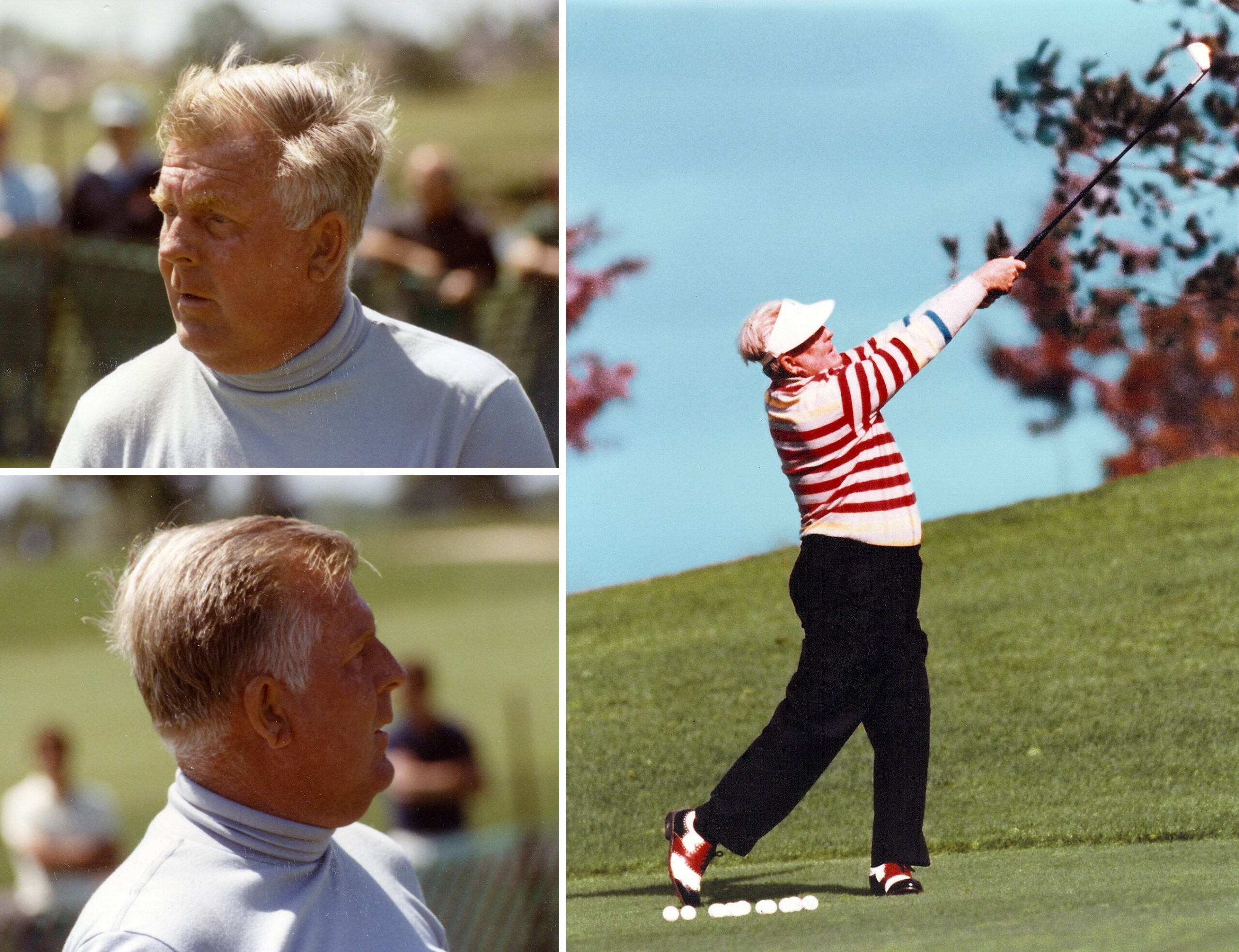
Moe Norman, Left: 1984 Canadian Open. Right: Classic Moe Finish.

I agree with Moe. You can’t buy a great golf swing. However, You can copy it. And so began my relationship with Moe Norman – the legendary 64 year old who was a, before I met him, nothing more than a myth. He was not a young man but he was childlike and passionate about golf. We often talked about life, his tribulations on and off of the course. I always pushed and prodded him for more “secrets” to help me become a better golfer. At first it was a selfish endeavor. I wanted Moe to give me his secrets.

I was full of questions: “How did you learn that?”,” Where do you place your left hand?”,” How do I get my club-face more on plane?”,” Why do you place the club so far behind the ball?”. I soon learned that Moe didn’t have any secrets. His swing was as paradoxical as his life. On one hand he could explain his golf swing with cryptic adjectives making me wonder if I was stupid or he was crazy. “I play into my legs and let my swing balance me”, “I swing like a pendulum, no twisting or turning”. On the other hand, Moe was a genius describing his swing with feelings. I think he developed his explanations out of necessity and the fact that all these types of questions too complex to be answered simply. “I squeeze the club like I’m drawing blood with my left hand, my right hand is along for the ride” and “I have a vertical drop in my downswing, I feel like the club is going behind me, way behind me”. He even stole some of his feelings from others like his longtime PGA teacher and friend Paul Bertholy; “Buckle, Sit, Slide and Bump” – a description for his lower body movement. And Rod and Claw to describe his lead arm and trail arm position. Eventually Moe would sum it all up calling his swing “The Feeling of Greatness”.

The problem with Moe’s “Feeling of Greatness” is that asking Moe to describe it would be similar to asking Pavarotti how he sings. There is really no way to describe it, not in any sensible way that makes it applicable to the average person. Over the ten years of practicing and playing with Moe, I learned that Moe didn’t have any secrets. He was the secret. He was the researcher, entrepreneur and developer of a technology. He was the product – an easier golf swing that could be copied.

This is where I came in and the Graves Golf Academy was born with the mission to bridge the gap between Moe’s feelings and the science of his swing. I consider myself the interpreter of Moe’s feelings into an understandable formula, based on the science physiology and movement. But Moe’s swing is not rocket science. It is easily transferred to anyone who wants to try it. It is simple once understood.

Today I teach the Single Plane Swing – a system to teach Moe’s golf swing mechanics that every golfer can apply to, and simplify his game. Moe’s swing defies the established methods and thinking and mechanics. It defies convention.

Today we have over 1,000,000 golfers who have contacted us for help. Sixty percent of the students who attend our golf schools are desperate – some without hope. They often express their frustration – “This is my last chance, I am going to quit the game”, is often the sentiment. As interesting as they may be, these students don’t care about my relationship and stories with Moe. They want what I wanted when I met Moe – help and hope for themselves. Seeing how his swing technology helps them improve and enjoy their lives takes Moe’s contributions to an entirely new level.

Moe’s Legacy is more than his character or his golf swing. His legacy also includes how knowing Moe Norman can help our lives so that each one of us can take what he left us into the future and enjoy our own Moe-ments.
Overwhelming but Amazing – Tips for Improving

Got an email last week from a recent student. Thought I’d share with you and some tips that I have written before – but think will be a GREAT reminder for all again.

From Ken S. (GGA Alumnus / Jan. ’16 School):

I spent my 2h drive back to JACKSONVILLE on Sunday processing my experience this past weekend. As you stated at the onset of the school, the quantity of information was overwhelming, but amazing. The explanation, demonstration, and instruction of the basic mechanics of Moe’s swing really make it feel achievable. Your staff were great and I always felt that there was someone watching to help. I have a new appreciation for what a previous instructor told me but I was never sure how to achieve it, that being “Perfect Practice Makes Perfect”.

I realize that I have begun my journey and look forward to achieving the process, with your help.

Many thanks, Ken

**********

With this email, I thought it would be a good idea to cover 5 tips for improving your skills and relate them to you learning/working on your single plane swing and golf game. We have discussed in the past (described in The Little Book of Talent by Daniel Coyle).

dc3b8ae5-be58-4f4e-a0ba-7de83bc2da70

1.  Each Day, Try to Build One Perfect Chunk

A “chunk” is viewed a new habit or part of a new habit you are trying to create.

Many regard practicing as a success. But, the goal is not merely practicing, but rather progressing. As John Wooden put it, “Never mistake mere activity for accomplishment”.

The Talent Code recommends setting a daily S.A.P: smallest achievable perfection. In this technique, you pick a single “chunk” that you can perfect – not just improve, not just “work on”, but get 100 percent consistently correct. Break down what you are working on into small enough chunks that you are able to improve little by little, piece by piece, rep by rep.

As Wooden also said, “Don’t look for the big, quick improvement. Seek the small improvements one day at a time. That’s the only way it happens – and when it happens, it lasts.”

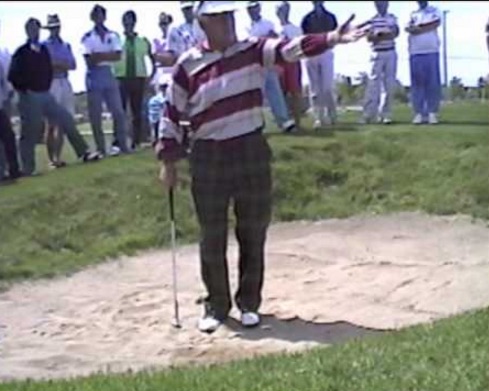
Moe Norman (down the line)

2.  Embrace Struggle

When we discuss “deep practice”, the emotion/feeling most think of is struggle.

Most of us instinctively avoid struggle, because it is uncomfortable. It feels like failure.

However, when it comes to developing your talent, new habits, struggle isn’t an option – it’s a biological necessity.

The struggle and frustration you feel is at the edges of your ability…. the edges of your ability when pushed – feel uncomfortable.

The struggling/uncomfortable sensation you are feeling is your brain/body constructing new “neural connections”, in other words, the precursors to the new habits.

Dr. Robert Bjork (UCLA psychologist) calls this phenomenon “desirable difficulty”. Your brain works just like your muscles: no pain, no gain.

Embrace the uncomfortable feeling as this is a sign of change – change in your habits which in turn will eventually create a positive/desired outcome.

golf_wall_clocks-r94024d97f49745839e23aa2b2e106e16_fup13_8byvr_324

3.  Choose Five Minutes a Day Over an Hour a Week

With deep/intense type practice, small daily practice is much more effective than once-a-week type practice binges. This is the way our brains grow – a little each day.

Daily practice, even if for just five minutes a day, nourishes this process, whereas long, intense practices spaced far apart makes the brain play catch up.

The key is total focus during the practice session which most can do for short periods of time.

The other advantage of practicing daily is that this type of practice becomes habit forming in itself.

Practice can be indoors, outdoors, with/without training equipment, working on positions, PVC drill, leverage bag, mirror work, Perfect Impact Trainer, etc… etc… The key is short practice sessions with “intense” type focus building “chunks” at a time.

According to research, establishing a new habit takes about 30 days (as short as 21 and typically around 30 days) working on the new habit every day. “Working on” meaning short, deep, intense type sessions.

moe-sandy-andy

4.  Don’t Always Do “Drills.”  Instead – Sometimes, Play Small, Addictive Games

This is about the way you think about your practice. The term “drill” evokes a drudgery and meaninglessness. Mechanical, repetitive and boring – as the saying goes, “drill and kill”.

Games on the other hand, are the opposite. Fun, “connectedness” and passion. Skills improve faster when looked at this way.

As you are doing your “drills” – turn them into games.

For example – if you are doing the PVC drill – count how many times in a row you perform it perfect. Count out loud the different positions and see if you can “hit” those positions in and out of sequence…

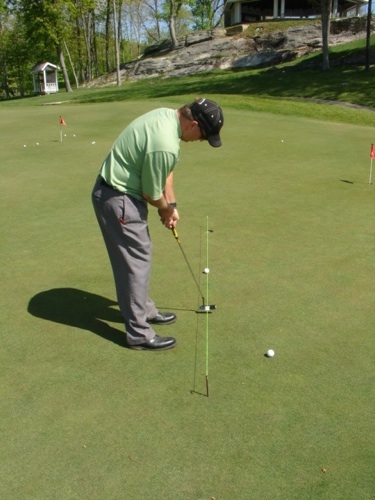
Chipping drills – count how many you can get inside 3 feet out of 10. See how many you can get up in down in a row (chip up and one putt in), etc…

Perfect Impact Trainer Club – when hitting balls, see how many in a row you can hit “clean”, crisp and get good flight. This will show you how many times in a row your hands lead properly at impact with good club head angle at impact.

In our camps (Build Your Game Camps) quite a bit of time is spent teaching “games” to our students so they can better enjoy working on their drills and this enjoyment will and does greatly enhance their learning process.

putting_systempic5

5.  Practice Alone

Practicing alone works because it’s the best way to:

1. See out the sweet spot at the edge of your ability, and

2. Develop discipline, because it doesn’t depend on others. If you aren’t worried about what others think, what others are looking at (you), what others are doing, etc… you won’t be worried about making mistakes, feeling uncomfortable, trying to find your sweet spot…

Changes are MUCH easier to make when you are only concerned about yourself. Golfers get too worried about what others are thinking about them, what others are looking at…. It doesn’t matter. If you are trying to create new habits, the only thing that matters are you are making positive progress.

Small “bites” at a time – but going forward with positive progress is the key. Have enough to worry about with the changes you are trying to make, then be concerned with others around you.

Thanks for the email Ken – love the saying you heard from your past teacher…

My saying I end every practice tip or practice session:

“Remember – Always Practice with a Purpose” & “A Little Improvement Every Day, Leads to a Lot of Improvement Over Time”

Pressure – Your Friend or Foe – Studying Heart Rates

Two weeks ago, I (Tim) played in the PGA Winter Series Event in Port Saint Lucie Florida. It was the National Junior/Senior Championship. A tournament consisting of PGA professionals from across the US and abroad, making up 2 man teams – one junior (less than 50 years of age) and one senior (50 years and older). Yup, I’m the “old guy” – I turned 50 a couple of months ago. BTW – I don’t feel “old” – but my 41-year-old partner let me know that I was the “old” guy in our pair many times.  The 2 man teams play a best ball type format (both play the hole, and you take the best score on the hole).

Anyway – I wanted to write a little about the event and a very interesting issue I dealt with during the event – pressure.

Yes, I have played in hundreds of golf tournaments in my life…  Everything from PGA events, to USGA majors to local club championships and everything in between. In fact, up to a couple of years ago, I would play in 20 to 25 events every year. I love playing in tournaments, I love the challenge, I love the competition, to me there is no better challenge then taking your game and testing it against the course in competition. I don’t care if it is a tournament I am teeing it up against Tiger (and I’ve done that a few times) or against your local buddies for a few $, the feeling of the challenge and competition is what I truly enjoy.

But…. to be honest, the past couple of years have been “down time” for me… I have been traveling across the U.S. with my son following his baseball, knowing I only have a couple more years until he is in college (or the pros) and him playing away from home. Yup, wouldn’t change it for a second – it has been absolutely AWESOME and something I would wish everyone could experience (those who have experienced watching their children’s successes (and failures) understand) …

So, during this down time the situations I have been in have been completely different. A completely different type of pressure. Is there pressure watching my son – no doubt. But a pressure I had NO control over. (And as many of you know, that might be the worst type of pressure). But, pressure none the less.

This tournament, a big tournament is considered a PGA “major” for use PGA professionals that work for a living. This is where I found myself 2 weeks ago. I have been looking forward to this event for a few months. Practicing inside (my academy) and out, trying to get on the course as much as you can in the winter, trying to get my game back to where it was a couple of years ago when I was playing in my 20+ events for the year. When I left for the event, I felt pretty good. I felt like I was ready to tee it up.

My partner and I went down to Pt. St. Lucie and had practice rounds on the three courses the event was held. One round on the Wanamaker, one round on the Dye, and one round on the Ryder courses. Then the final round (after the cut) was on the Ryder course. All three practice rounds went well, the courses were wet from the rain, greens were very good (not too fast or hard) and I felt like we had a really good chance to play well.

Day #1

Tee time – 9:30 – Ryder Course

Windy, rained the night before… Course was very wet, playing long and fairly tough conditions. JUST LIKE I WANT IT! I consider myself a “mudder” – the worse the conditions (wind, rain, wet, etc..) the more I like it. I feel like with my short game I will have a big advantage on the field when the course is playing long and hard. The tougher the better – especially when you have a couple hundred teams and almost all are good players. The tougher the conditions, the more the field will separate.

So, I begin my round and hit it pretty well (for the conditions). Give you an example – Hole # 1 is a 430-yard par 4 that is normally driver and then an 8 or 9 iron. This day it played Driver and then 4 hybrid. Straight into the 30 mph wind and really, really wet. The 2nd hole is a 410-yard par 4 that you can cut the corner a little and typically a driver and wedge. This day it played Driver and then a 4 hybrid (again). Like I said – a tough day was in front of us…

As I started down # 1, I hit a good drive and a really good 4 hybrid about 20 feet left of the hole. My partner hit his drive and a 3 iron a few feet short of the green (actually a pretty good 2nd shot). As I approached the green to mark my ball… something unusual for me happened. I felt VERY uncomfortable. In fact, I felt really NERVOUS.

My partner had chipped up to about 8 or 9 feet for par – not an easy par by any stretch. In fact, probably going to be tough to make par for him. So I’m setting up over a 20-foot birdie putt and my heart feels like it is in my throat. As I was waiting for another gentleman (in our group) to play, I happened to look down at my “Fit Bit” I was wearing (an apparatus that records heart rates, # of steps you’ve taken in a day, miles you’ve walked, calories burned, etc..) and my heart rate (beats per minute BPM) was running about a 110 to 115. For those that don’t know about heart rates, that is pretty high in that circumstance. A reference – for me – resting heart rate is around 58 BPM, when I sleep it is around 50 BPM, when I walk briskly (exercise), it is about 80 to 90 BPM, when I exercise light it is around 100/110 BPM and when I run hard (very hard) it is around 140 BPM.

I’m looking at my Fitbit and it is registering like I am in exercise state (called Fat Burn Range). And I’m only about to hit a putt…Wow!

Result of the putt – I hit it about 2 feet short of the hole, and made my next putt for par.

I have to be honest with you, I was not comfortable during the round on the greens. I consider myself a good/in fact, sometimes a great putter, and very good short game – but I was uncomfortable with the pressure. It was not a “place” I wanted to be.

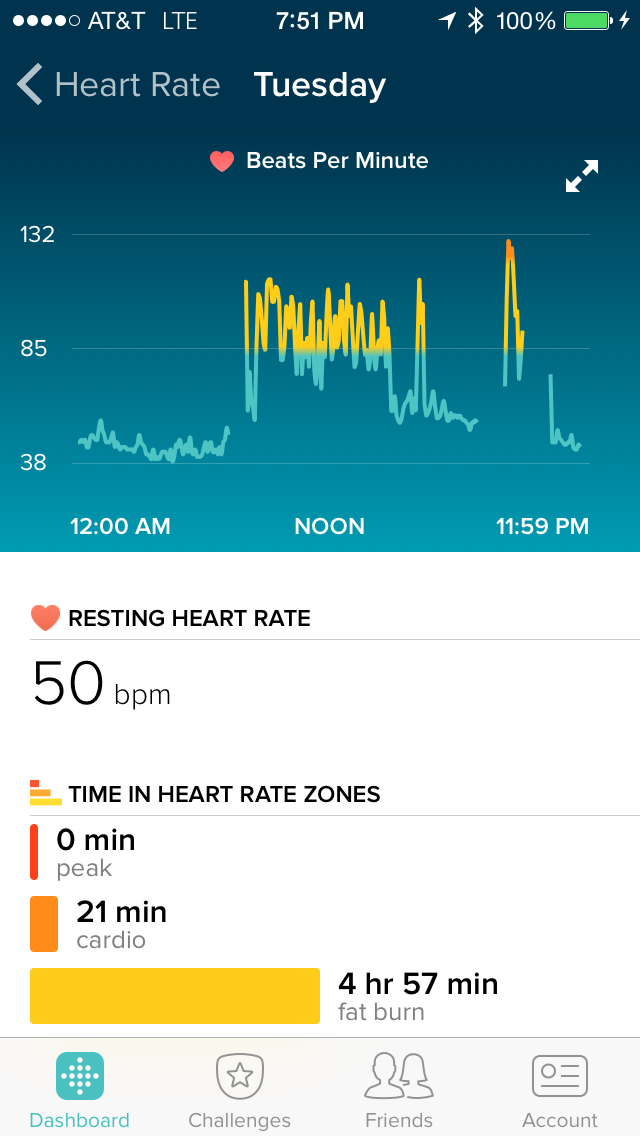
I want to show you a chart (recorded during the round on my Fitbit) of what I was dealing with:

IMG_2333-2

Want to know something interesting – look at the chart above… Count the number of peaks between 10 am and 2 pm…. Yup – you guessed it – 18. 18 times I was on the green putting and my heart rate was way too high. Way too uncomfortable. The 2 peaks you see after the round was a short run I took after the round and a work out I did that night. My heart rate during the round was just as high as during my workouts and it was while I was putting. (I checked my heart rate when I was on the tee and during 2nd shots, etc… it ranged between 75 and 85 bpm. It was 20 to 30 bpm higher when I was on the green putting).

So why??? Why was I dealing with this? By the way – my partner and I shot 8 under that day. I made 6 birdies, my partner made 3 (we made one on the same hole) – no bogies. After day #1 we were tied for the lead. 8 under on those conditions – was a REALLY good round.

But, again – why?? Why was I so uptight and nervous when I was standing over my putts or about to putt…? It was something I knew would catch up to me during the event if I didn’t figure it out. It was only a matter of time until my nerves caused a few 3 putts or a few missed short putts for birdie, etc…

Here are the answers I came up with (from thinking about the past, about working with past sports/athletic trainers, mental game coaches, etc..).

1. Reason I felt more pressure on my putts was because of my level of expectation. It is/was much lower than when I’m over a full swing shot. When I’m over a driver – I never expect to hit it perfect. It doesn’t happen that often. It the nature of the game. A good drive is one with average to good distance for me on the correct side of the fairway. I never think I’m going to hit a “particular blade of grass” in the fairway when I stand over my driver. I try, in fact, try hard to hit it “perfect” – but the outcome can be a “slight” miss hit and if in the fairway with pretty good distance, I am not disappointed.

When I’m over an approach shot into the green, I pretty much have the same expectation as I do over my driver. I want to hit the ball close, in fact, I want to make it, but I know in reality, if I get the ball within a certain distance from the hole, I am happy. In fact, many times, if I hit the correct side of the green, I am happy (long shots, etc…) I understand, even for the best professionals in the world, a 7 iron hit from 160 yards will end up on average 20 to 25 feet from the hole. That is far from “perfect”.  And I understand and am happy with that…

Now – over my short game…. that is COMPLETELY different. I expect, EVERY time whether I am over a chip or pitch shot, I will get the ball up and down or even make it. I will hit the chip or pitch shot and one putt for birdie or save par… every time. And with that expectation, I expect to make the putt. Whether I hit the green with a shot from the fairway, have chipped/pitched up to the hole, if that ball is within 15 to 20 feet from the hole or less, I expect to make it. My expectation is to make the putt. Outside of 15 to 20 feet, or maybe a severe green, etc… I want to lag the ball close to the hole for an easy 2nd putt, and if the first putt goes in, great, if not, as long as the 2nd putt is a few inches… I am good and happy with the outcome.

I think you see the difference here. Level of Expectation.

2. Reason # 2.  Now, top that with playing with a partner/on a team. Not only are you doing it for you, you are playing for the team. I am not saying I don’t want to let my partner down, but I guarantee all those who have played on a team know there is some added pressure when you are playing for someone else.

(I once talked to Chad Campbell about his Ryder Cup experience… he said he was so nervous before he teed it up at Medina, that he threw up on the way to the first tee…. Why, because it was for his team and country – not for himself.) Now, I’m not talking that much pressure or nerves of course… but pressure is pressure and nerves are nerves… And I can tell you during this round, the pressure was definitely getting to me on the greens and I didn’t like it.

So, that night (after the first round), I thought about this. Even talked to my partner (a good friend of mine) about it. I even pulled out some old notes on my computer (from previous years play during events) and tried to recall how I handled pressure in the past.

2nd Day – Tee Time – 10:30 Wanamaker Course –

Here we go again. This day it was still wet (from the previous rain), but not as windy. In fact, turned out to be a very nice day. But the Wanamaker Course is probably 3 to 4 shots harder than the Ryder Course (in most opinions). We teed off and started our round. As I approached the first green, I began to think about the differences I was going to do this day.

#1 – I was telling myself to have Moe’s attitude on the green – “An Alert Attitude of Indifference”. To me, meaning, I want to give it my best shot, best putt, etc… but what happens after I hit the shot is what it is… It is out of my control when the ball leaves the putter face. Give it 100% effort and then see what happens. I am not going to judge the outcome as good or bad, but rather as I gave it my best effort.

#2 – I was NOT going to think about the “making” the putt (visualize the make) until it was my turn to putt. I would line it up, read it, watch the other balls on the green (watching break, speed, etc..), but I was not going to visualize the putt going into the hole until I stepped up to my putt for a couple practice strokes and then the putt. I realized I was sitting on the green waiting for everyone else to play and was worrying myself to the point of WAY too much pressure. I was sitting there watching everyone else worrying about making my putt. There was not good reason for that. I would “think about making it” when it was my turn.

#3 – For me – talking really helps me calm my nerves. In fact, when I talk my heart rate goes down significantly. (Probably for many – breathing out during talking, etc…) So, I decided, when my partner and I were getting to the green and waiting for the others to play up to the green, I would talk to him – like a caddie. Not about things like “We have to make this putt” or “We are playing good/or bag” – but rather, things that were not related to the moment. This was “down” time – time we were waiting for our turn. We have plenty of time when it is our turn to discuss the line, the speed, the putt, etc… but while we were waiting, we would talk about something else (our dogs, my son, the “birds and bees, flowers and trees” as Moe would say). You all think that when the professionals talk to their caddies on the course it is all business…. it is anything but. In between shots, it is about anything except golf. There is no way a player can handle 4 to 4 1/2 hours of stress like that. A caddie’s job is to take off the stress.

I have a good friend that plays golf overseas. She has a caddie travel with her. She told her caddie – her only expectation was for her caddie to keep up, keep her clubs clean, give her yardages and have good jokes on every hole. When she ran out of jokes, she was out of a job….

#4 – If at any time I started to think about the upcoming putt (or short game shot) and it was not my time/turn to play – I would STOP. And stop by thinking about something else. In fact, I thought about being at home, sitting on my couch, talking to the dog….  yup the dog…. talking to my teenage son or wife…. too much pressure. So I pictured sitting on my couch talking to my dog….

Guess What…..

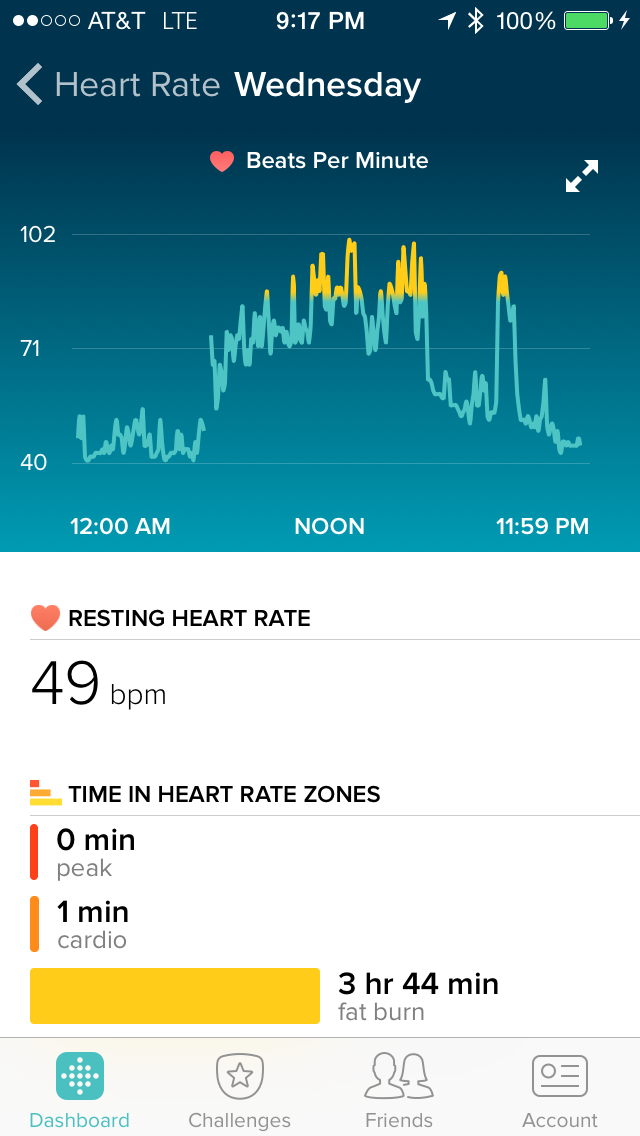
Here is my chart from Day # 2:

IMG_2334-1

Look at the difference. My heart rate still the highest on and around the greens. Yes, but when comparing the amount of peaks and the rate (bpm) it is significantly lower and less frequent. SIGNIFICANT. In fact, as you see, the highest my heart rate got this day was 102 – that was the highest, and only a couple of times for a short duration. The overall average was much lower and much less frequent. Looked like I had figured something out.

And as a side note, of course I was watching my Fit bit during the round. And was working on these same decreasing pressure techniques on all my shots. Not only putting, but over the driver, over the 2nd shots, etc… Why not?  I believe the more calm, the less stress, etc… the better you will hit it any time…

2nd day results: Another 8 under (64). This day I made 5 birdies, my partner made 4 (again, one on the same hole). No bogies. Being this course was more difficult in general – we were happy with the 64. We ended the 2nd day tied for 2nd.

Day # 3 – Tee Time – 10:00 – Dye Course

Needless to say, I was pretty excited to get on the course the 3rd day… Only issue was we were about to step up on the Dye Course. For many, they really like this course… Me – it is my least favorite of the three. Not because of difficulty, but because of “fairness”. You can hit the drive down the middle of the fairway and end up in a pot bunker the size of an eye of a needle that you have to it backwards out of. And another person in your group and blow it 50 yards right of the fairway and have an easy shot into the green…. Little too “gimmicky” for me (think that is a word… you get my point). (If you ever see me in person, ask me the story some time about how I told this to Pete Dye himself – accidentally… oops)

We played the round and I used the same pressure coping techniques as the 2nd round.

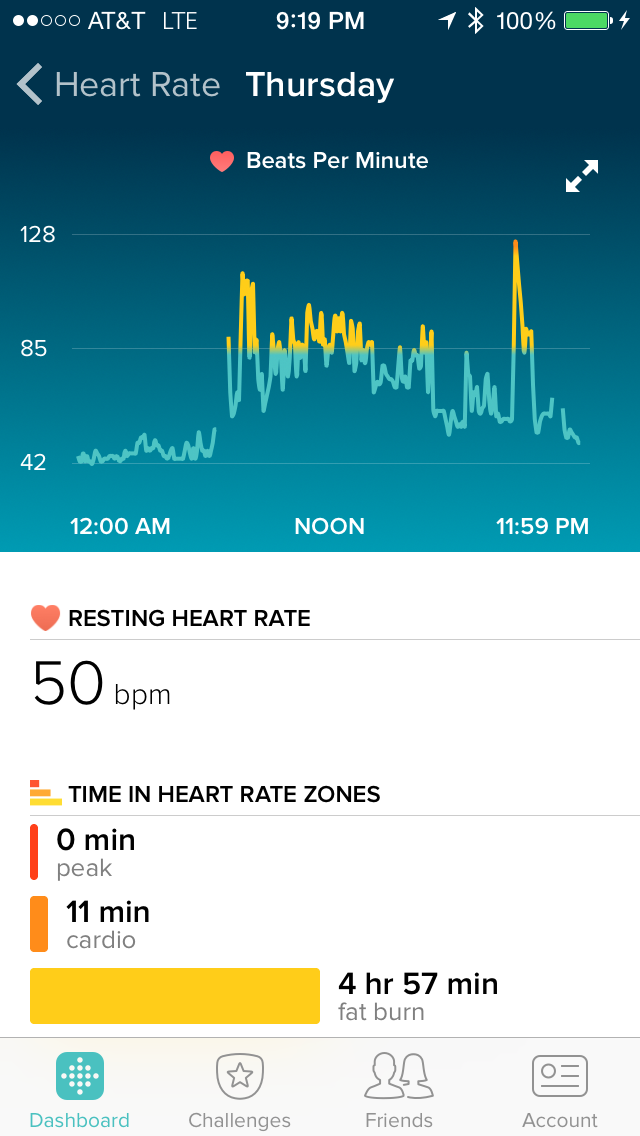
Here are my results:

IMG_2335-2

I’ll be honest – not quite as good as I wanted – but still better than the first day. And I can tell you – I definitely felt MUCH more comfortable around and on the greens this day.

Want an interesting side note… Look at the graph and the two peaks early in the round. Guess what, my partner was out of the hole on those holes. He had played great the entire tournament – but he went a little sideways on a couple early holes. Needless to say, my heart rate reacted accordingly. When you are as we call it “naked” on the hole – your partner is in his pocket… it’s a completely different pressure again. I think I did a pretty good job dealing with it – but that is the peak you are seeing early.

3rd Day Results – 3 under 69. I made 4 birdies, my partner made 1, and we made bogies on 2 holes. (Again, the Dye is my LEAST favorite course…) After Day # 3 – We have fallen to 9th place (out of about 200…)

Long story made short – we obviously made the cut. Going into Day # 4 we were very excited. Day # 4 was on the Ryder and I felt like we could go deep – and guess what – it was another windy, rainy day.

We teed off in one of the last groups, birdied the 2nd hole, birdied #3 and…… wash out…. We were called in and round/tournament was ended. Too much rain – tournament results after Day # 3 finalized. We ended up tied for 9th overall.

It was a great tournament. Not only because of getting the “juices flowing again” – but because it was a lot of fun to get the pressure feeling again. And I had never had a way to monitor it, check it, work on it like I did with the Fitbit heart rate monitor I was wearing. Did it help me during the round…? not really.  But, it gave me great analysis after and a lot to work on now to help me lessen my pressure during upcoming tournaments and upcoming rounds (as you saw above).

Hopefully, this experience and the way I dealt with the pressure will give you some good ideas/hints on how to deal with your “pressure moments” on the course.

Trust me – I’ll keep you updated on my future events and how I deal with the circumstances then. Now that I’m a “senior” and will start playing in a few more senior events, I expect to try and put myself in many of these pressure moments. To me, that makes the game fun and a challenge I’m looking forward to.


Common Fault and Fix #2: Casting the Club Into Impact

In our golf schools, one of the most common faults we see in our golfers is casting the club into impact with the ball. For reference, we define “casting” as any time the hands are behind the club head at the moment of impact. You may of also heard this as early release or flipping the club.

Casting has many negative effects on your game, some of which are:

1 – Inability to make solid contact with the ball. All shots are hit slightly “thin”

2 – Inability to compress the golf ball, or use the energy of the golf ball.

3 – Significant loss of potential distance on all clubs

4 – Almost impossible to hit hybrids and fairway woods

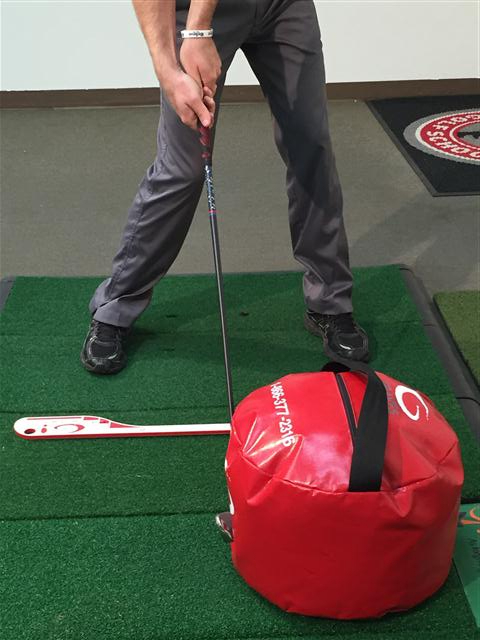
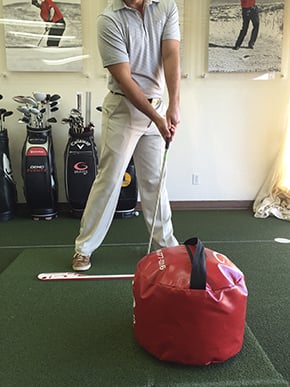
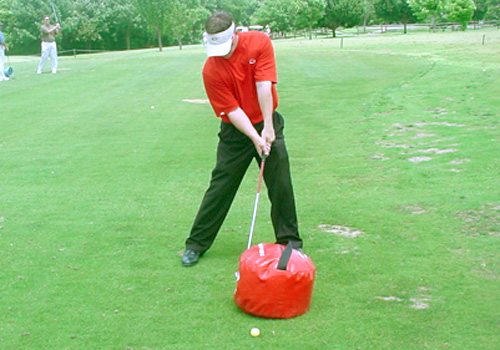
Here is a picture of casting:

image2655493

As you see in this picture, at impact position (club head against the leverage bag), the hands are behind the club head, the shaft is leaning away from the target, in other words – the club head is ahead of the hands at impact. This is casting.

Corrections and Checkpoints for Casting the Club Into Impact

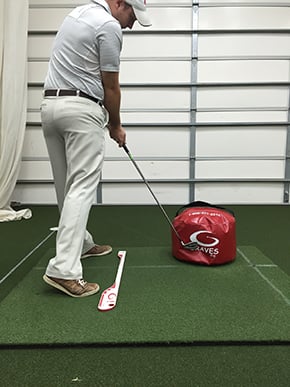
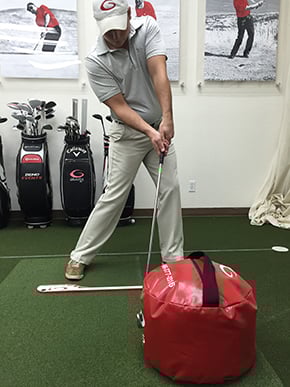
As seen in the image above, the ideal Single Plane impact position shows that at the moment of impact, the hands are leading the club head into impact.

image2655496

To check and train the ideal impact position:

  1. Use a GGA Leverage Bag and Alignment Trainer. To view leverage bag and Alignment trainer training:  CLICK HERE
  2. As demonstrated in the picture above, set the edge of the bag 4 inches behind the “IBP” (Iron Ball Position). The phone number on the Leverage Bag should be at “IBP”.
  3. Using a mid-iron, hover the club above the ground so that you will impact the center of the Leverage Bag.
  4. From your Single Plane Address, take a small backswing, and then move into the impact position, hitting the Leverage Bag. HOLD your impact position.

While holding your impact position, check the following:

  1. Your hands should be at the black handle of the ball.
  2. The club face should be square into the center of the bag
  3. Your trail arm should still be slightly bent
  4. Your trail foot should still be on the ground, and your lead knee flexed

If you notice while practicing into the Leverage Bag that your hands are not getting to the black strap, or any of the other checkpoints are not correct, we suggest training slowly using the Leverage Bag without hitting balls to train yourself to get into the ideal impact position.

We recommend swings at 15-20% speed to start, so you can check each of the checkpoints. As your position improves, you can speed up.

Good Luck – be watching future e-tips for more tips and more common faults and their fixes.

Common Fault and It’s Fix – Straight Leg at Impact

One fault many students struggle with is straightening the lead leg during the downswing. This fault typically results in an over the top (slice) path of the golf club.

As seen in the pictures of impact:

IMG_1048  IMG_1050

1. The lead leg is straight

2. The spine was unable to maintain the correct posture

3. The lead shoulder is pulling up and out forcing the hands to come across the target line.

4.  The trail foot heal is off the ground because of the lead shoulder pulling up and out.

5.  Excess stress on the back.

Corrections & Checkpoints for Flexed Lead Leg

The proper movement of the lower body in the downswing allows the path of the club to come from the inside, the club to be on plane, and relieves stress from the low back.

As seen in the in these pictures:

IMG_1054  IMG_1052

1. The lead leg is flexed (braced)

2. The hips are rotated

3. Spine is still in posture

4. The hands are going down the target line and leading at impact

5.  The trail foot heal is on the ground.

A good drill to work on the flexed lead leg is the leverage bag drill. To see this drill: CLICK HERE

Winter Indoor Practice Drill – Hands Down the Line

Weather is changing. Seems like 60* one day and then freezing the next here at home (Oklahoma). I am sure for most reading this are getting a little of the same this time of year. Soon, most of us will be inside looking for ways to practice indoors to get ready for the next season.

Here is a very simple winter indoor practice tip that is VERY important and something everyone should work on in the winter, spring, summer and fall…. think you get my point.

Chipping drill working on getting your club face square at set up, proper take away and hands leading down the target line with a square club face.

Interesting thing is it is the same in the full swing – hands leading. This is a great drill to work on those hand leading.

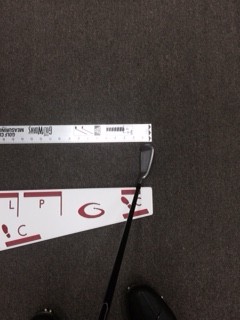
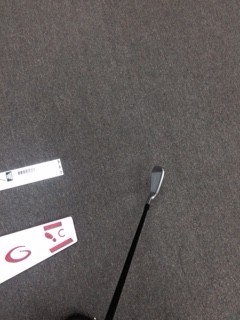
First – set up the station below.

getPart

As you see above, I took the picture just as you would see the set up (from your perspective).

The Short Game Board is set down with a yardstick parallel to it. I have set up with a 9 iron in the chipping position with a correct chipping stance and set up. You can see the leading edge of the club face is square – you can check as the grooves in the club are parallel to the marks on the yardstick and perpendicular to the edge of the Short Game Board (parallel to the back edge of the board – aka Face Alignment Technology).

To see details on how to use the Short Game Alignment Trainer:  CLICK HERE

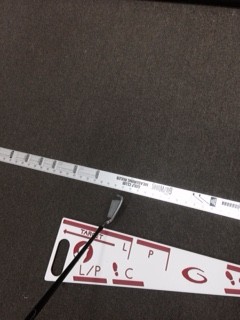
Second – Start Your Backswing

getPart-1

As you see the club head is turning with the shoulders in the backswing and starting to come slightly inside. It is NOT going straight back. This picture is again taken as if you are looking at the club head from your perspective. As you see, the club head is no longer square to the Short Game Trainer and Yardstick.

Next – Chip/Hit Through the Shot (simulate a chip and hold your finish)

getPart-2

Again – taken from your view.

As you see – the club head is down the target line – and club face is still square to the target.

Check:

1.  Hands are leading – as you see in the picture – there is still shaft lean forward – the hands are still ahead of the club head.

2.  The club face is still square to the target (perpendicular to edge of the Short Game Board and marks on yard stick).

3.  The club face is still in the middle (in between the Short Game Trainer and yardstick). This shows YOUR HANDS ARE DOWN THE TARGET LINE. In other words, if your club head is still in the middle of the SGT and Yardstick – your hands (and hence your club head) went toward the target with a square face.

If you would like to see chipping review and how to use the Short Game Trainer (click on Short Game Trainer):  CLICK HERE

Perform this drill over and over. Check the face angle at set up, take away and follow through. Don’t follow through too far past the edge of the trainer…  this will allow you to check the face angle, etc… at finish.

If you like, you can do this with a plastic/foam golf ball (inside) and check the same positions.

Again – refer to the links above if you are having difficulty hitting the different positions.

Good Luck –

Please look in the next e-tip newsletters for more winter practice tips.

LEARN

THE

SWING

Join 1M+ Subscribers to get your FREE Video Quick Start Guide that reveals how to hit the ball farther and straighter more consistently from now on…

START YOUR NEW GOLF SWING