Tips for Improving – Fall / Winter Practice

Tips for Improving – Fall / Winter Practice

Thought it was about time to start talking about fall / winter practice. I know for most of us it is time we are inside, and when inside, some of us try to figure out ways to practice to get ready for the spring.

Before we get into any details – wanted to review a little about practice (especially when working on new habits over the fall / winter).

It is essentially impossible to break bad habits (our mind/body is not set up that way) … but we are set up to be able to create new habits and ultimately make changes/create new movements, etc.  we want.

Sustaining Progress

Developing your skills (and talent) is like taking a cross-country hike. You will encounter challenges, you will hit snags, plateaus and steep paths; motivation will ebb and flow. To sustain progress, it’s necessary to be FLEXIBLE one moment and STUBBORN the next, to deal with immediate obstacles while staying focused on the horizon (or your ultimate goals).

Don’t Waste Time Trying to Break Bad Habits – Instead Build New Ones

I bet I talk about this so many times in our schools, many of our students probably get “sick” of hearing it.

When it comes to dealing with bad habits, many of us attack the problem head-on, by trying to break the habit. This tactic, of course, doesn’t work. And we are left with the old truth – habits are tough (if not impossible) to break.  The blame lies with our brains.  While we are really good at building circuits (creating habits), we are awful at quitting them. Trying as you might to break a bad habit, it is still there, waiting patiently for a chance to be used.

So, what do we do?

The solution is to ignore the bad habit and put your energy toward building a new habit that will override the old/bad habit.

To build new habits, start slowly. Expect to feel stupid, clumsy, uncomfortable, and even frustrated at first…. after all, the new “wires” in your brain haven’t been built yet. Your brain still wants to follow the old “comfortable” pattern. Build the new habit by gradually increasing the difficulty, little by little. It takes time, but it’s the ONLY way new habits are created and grow.

To Learn It More Deeply, Teach It

Here is the issue. Every good golfer, every golfer who learns something new/reaches a goal, etc… must be their own best teacher. If you cannot teach yourself, your ability to make changes, create new habits, reach goals, etc… will occur in a much slower rate.

This is not saying you must create everything yourself, but it is saying you must take what you learn and translate into self-teaching.

Think about it – how much time to you spend practicing, and how much of that practice time is with someone teaching you?

If you are like most, 90% + of your practice time is on your own, trying to create new habits, etc… on your own. Meaning, you must be able to make sure you are doing things correct, must be able to make sure you are “going down the correct path”.

A great way to determine if you can teach yourself it ask yourself “Could I teach this (new habit I am trying to learn) to someone else?”

This works because when you communicate a skill to someone, you come to understand it more deeply yourself. Also, when you see someone struggle, and help them through it, you improve your ability to deal with your own struggles.

The saying “Those who can’t do, teach” should be rewritten as “Doers who teach do better!”

Give a New Skill a Minimum of Eight Weeks

When it comes to growing/creating/developing new skills, eight weeks seems to be an important threshold. It’s the length of many top-level training programs around the world, from the Navy SEAL’s physical – conditioning program to the mission training for the Mercury astronauts. A recent study at Massachusetts General Hospital showed the practicing meditation for twenty-seven minutes a day created lasting brain changes in (you guessed it) eight weeks.

Of course, this doesn’t mean that you can be proficient in any skill in eight weeks. Rather, it underlines two more basic points:

1)  Constructing and honing new habits takes time, no matter who you are, and

2) Resilience and grit are vital tools, particularly in the early stages of learning. Don’t make judgements too early.

Keep at it, even if you don’t feel immediate improvement. Give your talent (your brain) the time it needs to grow and create new habits.

Please watch upcoming etips for more fall / winter practice tips.

Being Different is Good

We have discussed this before, but I am constantly reminded and want to bring up again and again and again when I watch “typical” golfers practice at local ranges and golf courses…. the importance of being DIFFERENT than the typical/average golfer.

First – want to remind you of a few stats.

1. The average male golfer shots a 97, female average is 107.
I assume everyone wants to be different than this – wants to shoot better scores….

2. Less than 20% of golfers get some type of “formalized” instruction, whether a lesson, clinic or school. And 75% of these 20% are ladies or juniors.
Meaning – most golfers are trying to improve on their own.

3. Of all golfers who purchase video type instruction, less than 10% ever watch the video(s). (Not just true for golfers, but video instruction in general.)

4. A very small percent (unknown exact percent) have a particular “model” they follow in their golf instruction.
Meaning – a majority of golfers are GUESSING when they are trying to improve.

5. Fifty percent of golfers who practice will get no better, 40% will get worse.
Meaning – only 10% of golfers who practice will improve.  90% will see no improvement or make themselves worse.
Meaning – a high majority of golfers have no idea how to practice.

6. The typical golfer spends 95% of their time practicing their long game, and less than 5% of their time practicing their short game.

If you ask me, I want to be different than the “average” golfer listed above and want to make sure every time I practice I am getting better – EVERY TIME!!

So – What do we need to do to be different?

MN-Slider-1

1. Have a model you study, have a model you practice. 

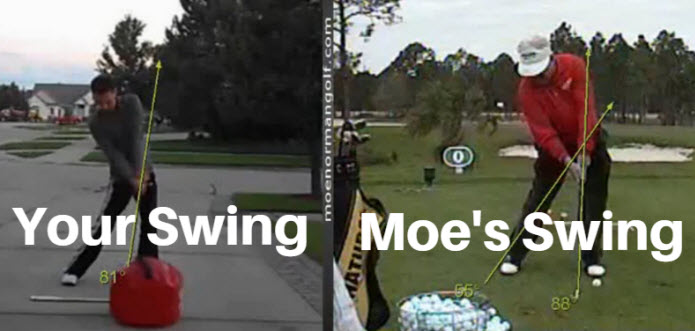
Hopefully every one of you is dedicated to the Moe Norman Single Plane theory. That is a BIG start…. being dedicated to this system – you are starting to be different than most golfers who are guessing on trying to improve.

The model/theory can be studied/learned by watching our Single Plane Solution DVD.

(And be one of the ten “percenters” – actually watch the DVD – LEARN something, study the model, get a good picture in your head what you are working on/towards.)

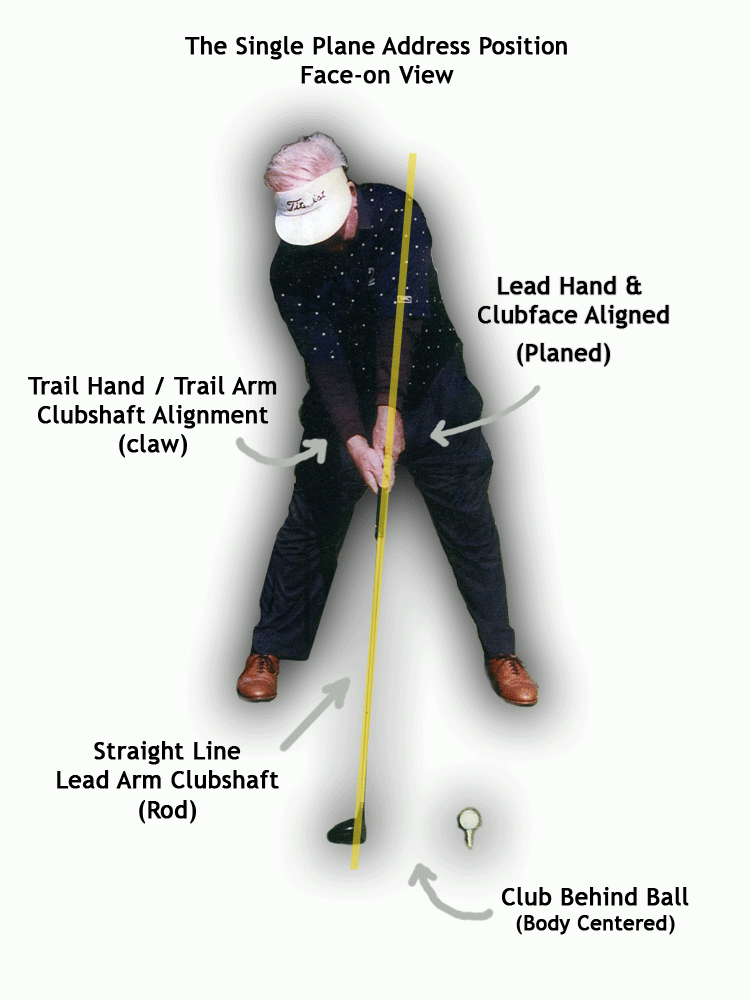
Understand and learn (everything can be found in the single plane solution) the:

  • Grip
  • Single Plane Address Position
  • The Pivot Point™
  • The Mid-Spine Intersect™
  • The Seven Positions and Movements of the Single Plane Golf Swing
  • The Transition Moe – Moe’s Vertical Drop

2. Work on positions in the swing, short game, etc… Don’t guess on what you are working on.                     

Many times, if not most of the time, working on these positions can and should be done with drills that don’t involve hitting golf balls.

Learn / study the following:

  • How Moe addressed the ball and why a bad foundation causes inconsistency and poor ball-striking.
  • How to feel and master the perfect address position.
  • How to learn the ideal positions the golf swing.
  • How to make the proper swing positions with the PVC Drill.
  • How to know what ideal positions feel like with a golf club.
  • How to work on the proper lower body, leg and knee movement during the swing.
  • How to feel the proper shoulder and club plane.
  • The importance of proper spine positioning.

Consider the GGA Coaching Program (at home) – Watch the upcoming webinar (November 30th) for details.

DrillsKit

3. Every time you practice – make sure you are practicing CORRECTLY. 

As stated above, 90% of golfers when they practice, get on better or make themselves worse. Do not be in the 90%.

When you practice – use training aids, check your practice with these training aids and check positions of the training aids.

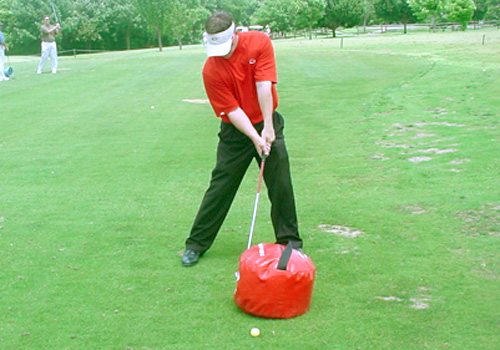
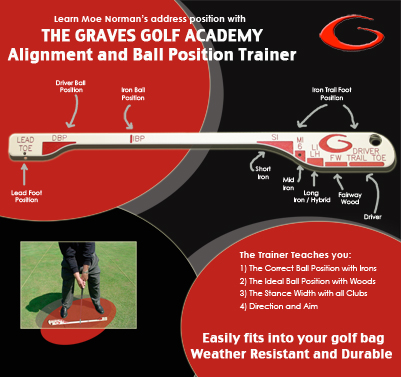
These training aids include the Alignment and Ball Position Trainer, Grip Training Club, Leverage Bag, Short Game Trainer, and a few others.

2083607567_comp

4. Set Goals for Yourself

I would guess that less than 1% of golfers have ever sat down and listed a set of goals for themselves and their golf game. You might think this is only for the good / great players – UNTRUE. It is/should be for everyone.

Maybe you’ve never broken 100 – write down that goal and then list how you are going to do it.  Write down 5 or 10 things that will help you reach that goal. Maybe working on your short game more, maybe working on a certain fundamental flaw you have, etc. etc…  Maybe just practicing a little more during the week on CORRECT fundamentals … write down how you think you can reach these goal(s).  Try and make a plan for yourself.

SGAT 1

5. Actually practice your short game.

Practice your putting, your chipping and your pitching.

70% of your scoring occurs within 100 yards of the green. But a majority of golfers spend less than 5% of their time practicing this part of their game…. If you want to improve, you MUST spend time practicing the scoring part of the game.

Remember my saying – “I have never seen a good player with a bad short game, and I have never seen a bad player with a good short game.”

Long story made short… (as they say) – Please, please, please be different than the “typical” golfer. And that is a REALLY good thing. If there is anytime you want someone to think you are “different” – it is in your golf game.

“Different” golfers break 90, “different” golfers have a plan, “different” golfers know how to practice, “different” golfers will get better every time they practice, “different” golfers know they are getting better – they have a plan, “different” golfers actually practice their short game.

So, I am telling you to be DIFFERENT when it comes to golf…. and yes, that is a VERY good thing.

Playing Winter Lies

It’s getting that time of year again (or at least close to that time of year again for most…)

As always with this time of year, it is a much different game than that in the summer or even spring. The main difference is the lies you get. Yes, some of you might play winter lies (moving the ball to a “favorable” lie when the grass is dormant) – and to be honest, I am not totally opposed to that…. I would rather you enjoy the game in the winter, than struggle with lies that you would never see professionals play or even big “amateur” events being played on.

But… there are times you will need to know how to hit shots off these “tight” lies. Whether you are playing the ball down on the dormant grass that is “beat down” or as at a lot of Florida courses in the winter, the fairways are green (over seeded) – but mowed extremely tight. The fairways, the first cut around the greens, etc. can have extremely short grass this time of year. If you don’t understand how to play shots off these type of lies, it can become very frustrating.

A golfer who finds his ball on such a lie can be helped by knowing some of the “tricks” in playing these shots.

27d88cbe-f469-49b0-8d33-93ff1fe15a2d

First: If the distance to the green is within chipping or pitching range, it is wise to take a less-lofted club than normal and play a chip-and-run type shot. This is the safest choice for two reasons:

  1. The flange on the club will be narrower and tend not to “bounce” into the ball.
  2. More importantly, the club head speed for the less lofted iron will be slower than for the deep-faced, wider-flanged pitching club, so that if the ball is miss hit the error will be less severe.

Chipping, or even putting, from areas with “tight grass” from off the green is generally good advice.

md3-advanced-shape

If the ground is “rock hard”, and the player must use a sand  or lob wedge, be sure the minimum bounce from the sole is presented. This is accomplished by squaring the face up at address. Play the ball back in the stance so the contact point for the clubface will be at the very base of the ball where it meets the ground. Make no attempt to lift the ball. Instead, maintain the shaft angle that was established at address. It takes considerable trust to execute this shot because the margin for error is close to zero.

For full shots off of hard ground or ground with very little grass or even fairways with very “tight” lies, follow these tips:Play the ball back a little further in the stance than normal. Maybe a ball or two (length) further back.

  1. Playing the ball back a little bit will take a little of the “effective” bounce off the club and will help you hit the ball on a slightly more descending blow. You will need the “increased descending” angle to catch the ball clean as it is very easy to “bounce” the club off the ground and into the ball off the tight lie. Adding a little more “downward angle” on the shot will help.
  2. Take a club or two more than you need and choke down slightly. Swing “smooth” rather than “hard” at the shot. Swinging hard will cause excess movement in the body and with minimal room for error – it is much more important to swing “smooth” and steady rather than “hard”.
  3. Many times on very tight fairways, or “hard pan” type shots, it is easier and more “reliable” to hit a “punch” type shot or even a hard “chip” type shot. The reason is you are more likely to keep your lead wrist firm through the shot in a punch or hard chip type shot – which will make is easier to hit through the shot. If you are swinging a full swing type shot off of a “tight” lie and cup the wrist (or breakdown) prior to impact, you are very likely to either miss the ground all together or hit behind the ball and the club will bounce off the ground into the ball. Either one of these misses will lead to a “bladed” or “thin” type shot
  4. A good drill to work on hitting through the shot:

Place a tee in the ground just ahead of the ball (like the golf ball feel backward off the tee). You should hit the ball and the divot should take the tee out of the ground.  The divot should start where the tee is in the ground. The divot (at worst) should start at the lead side of the golf ball – the back end of the divot should be ahead of the golf ball.  Or paint a line on the ground perpendicular to your target. Place golf balls on the line. Hit the golf balls.  The club should enter the ground on the leading edge of the line or ahead of the line and the divot will be in front of the line.  At worse, the back end of the divot will be on the front edge of the line painted on the ground.

dc3b8ae5-be58-4f4e-a0ba-7de83bc2da70

Ultimately, being able to hit shots off of “tight” lies comes down to how well you can hold your proper angles through impact. In other words, those that keep a “firm lead wrist” through impact will have a much easier time than those that cup or break down their lead wrist prior to impact. Working on leverage angles, leverage bag, etc. will help master the correct positions and angles at impact.

Good Luck!!

The Lob Wedge

The Lob Wedge – Making Your “Worst Enemy” Your “Best Friend”

First, I want to say, I believe the lob wedge is one of your most important clubs in your bag.

In fact, I believe it is the 3rd most important club in your bag (refer to past e-tips for #1 (Putter) and # 2 (Driver).

Besides your putter and your driver, this is probably the club you will use the most in a given round… if you know how to use it and use it correctly…

md3-advanced-shape

The perfect Lob Wedge: The perfect lob wedge (in my opinion) has the following characteristics:

  1. 58* of loft or more
  2. Forged type club (the softest material in a wedge that helps create spin and a very soft feel at impact – allows for the ball to land soft on the green).
  3. Proper bounce on the sole of the club (bounce is the angle on the sole of the club from the back to the club to the front).   The more bounce on the club, the easier it is to hit off of “fluffy”/deep grass lies. The lower the bounce, the easier it is to hit off of tight/no grass lies.
  4. Medium to Wide sole on club – the wider the sole – the easier it is to “slide” across tight lies.
  5. Needs to have swing weight heavier than most clubs in bag besides the sand wedge (swing weight typically between D-4 and D-6) – most lob wedges are built this way as the added weight helps cut through many surfaces (high grass, sand, etc..) and helps create better “feel” around the greens.
  6. Steel shafted – (if possible). Again – the weight helps as described.
  7. Slightly rounded leading edge on the club – only slight, but this slight rounding also helps cut through different surfaces.

Screen Shot 2015-10-17 at 8.53.57 PM

How to play the Lob Wedge:

For a full shot, (for many ranges from 30 to 60 yards, maybe slightly longer) – the ball is placed in the middle of the stance and swung with a good on plane single plane swing. (Like any other club in the bag – ball position center of stance).

For a short pitch or high lofted shot (not lob or flop shot yet..):

  1. The ball is placed slightly forward in the stance (forward of center). As higher you want the ball – the more forward you put in the stance.
  2. The weight (body’s weight distribution) is 50/50. You do not put more weight on the lead foot. 3. Stance is slightly open – about 10 to 20* at max.
  3. The hands are slightly ahead of the ball at set up.
  4. Choke down slightly for more control and better feel.
  5. You swing the club with VERY soft hands. This means light grip pressure on the club.
  6. You work on the fold/fold type swing. Meaning you fold your trail arm in the backswing and lead arm in the through swing. Nice and easy…..
  7. You accelerate through the shot – your hands should finish at shoulder level or above. If you think the swing is too long for the shot – shorten the back swing, but still keep a solid and extended through swing.
  8. Swing toward the hole – as Moe said “Try to pull the flag out with the head of the club”. This was his analogy of making sure the club is swung down the line toward the hole.
  9. Make sure the weight is evenly distributed throughout the shot and the feet stay down throughout the shot.

For a flop shot (high lofted short shot): Follow the points above except the following:

  1. Ball position – as forward in stance as comfortable. Off lead heel or further forward is good.
  2. The weight distribution is still 50/50 or slightly toward the back foot. Keep weight balanced throughout the shot.
  3. The club slides under the ball… Think of sliding under the ball rather than hitting down on the shot.

To be honest, after teaching 1,000s of students in the past, this is always a difficult shot to master – it takes time, but once you get the “feeling” it actually becomes pretty easy and a great “shot saver” in the round. Here are a few faults many students have difficulty with while they are trying to learn the flop shot:

  1. Weight transfer – you need to keep your weight back to center during the shot – exaggerate this as much as possible. It is almost impossible to get the club to slide under the ball if you are transferring your weight to much forward.
  2. SOFT HANDS – if you think you have lightened the grip pressure enough – do it some more. The softer the grip pressure the easier it is to fold/fold in the shot which brings consistency and great feel with this shot.
  3. Acceleration – shorten the backswing enough that you feel you need to be pretty aggressive in the through swing. A back swing that is too long creates deceleration in the through swing which leads to fat and/or thin shots.
  4. Swing toward the hole – great area to practice on swinging toward the target. Chances are if you are coming across your full shots (cut/slice) you are also doing the same in your pitching/flop shots.

In a good high pitch/flop shot the ball should land relatively soft on the green with minimal roll. In fact, if you listen to the shot, you will hear a “thud” when it hits the green. A good shot comes in soft, has minimal roll… many pros call it landing like a “butterfly with sore feet”.

Hopefully this helps those who are looking to help their short game – especially that all needed lob shot around the green.

Please feel free to contact me at timg@gravesgolf.com with any short game questions, questions about your wedges or any other club fitting questions.

Remember my saying: “I’ve never seen a good player with a bad short game and have never seen a bad player with a good short game.”

10 Tips to Help You Make Swing Changes

Thought I’d give a little review of some tips we believe will help when trying to make swing changes.

1You must ENJOY the process of making changes and you must COMMIT to the process.

If I had a nickel for every time someone told me they “weren’t sure” if this swing would work for them or not… If you want to make changes and want to be successful with the changes you make, you must first enjoy the process of making changes and must commit to the process. I will tell you the same thing I tell all those that “aren’t sure” … don’t change. If there is a doubt, it won’t work. You will always have an “out”, if you don’t give yourself and “out” – you will be successful. We have seen 1,000s of students who have made incredible changes and seen incredible success – and without a doubt, they enjoy the process and are committed to making changes.

2Know what you need to change.

Don’t guess. If you guess, you will probably guess wrong. You need to do some research, study the instructional video(s), compare to your swing, etc… etc. before you start to make changes. It is not that hard. The best start is to study/watch our Single Plane Solution instructional DVD and compare to what you are currently doing. If you get a chance to see us in person – even better. I guarantee you will have many areas to work on and to make changes.
But, whether working on yourself, or seeing us in person, you need to be specific about areas to work on… know what you need to change.

golf_wall_clocks-r94024d97f49745839e23aa2b2e106e16_fup13_8byvr_324

3Take time making changes.

Give it time. Don’t rush it.  Relax. Understand it takes time. If you relax, take your time, allow time to make changes, the changes will “stick” and it will seem MUCH easier…. Those that rush the changes tend to revert back to their old habits. You have time… give it time, some changes will take more time than others. For example, grip changes tend to take a lot more time than other changes….  Set up changes tend to happen a little faster… Again, give it time. If you don’t “rush” yourself, you won’t have to repeat the change again…

final image

4Create a new habit, don’t break a bad habit.

Over years of teaching (over 30 combined be Todd and myself), we have definitely come to this conclusion. If you want to make changes, you must work on creating new habits, not breaking bad habits. Your brain must focus on the new habit (new move/position) you want, not the one you are trying to “break”. Think of a “giant eraser” – erase the bad habit and replacing with a new habit. Don’t focus on the bad/old habit, but rather the good/new habit/position. Focus on what you want, not what you don’t want. This is a form of positive vs. negative thinking…. Focus on the positive good/new habit… the changes will occur much faster.

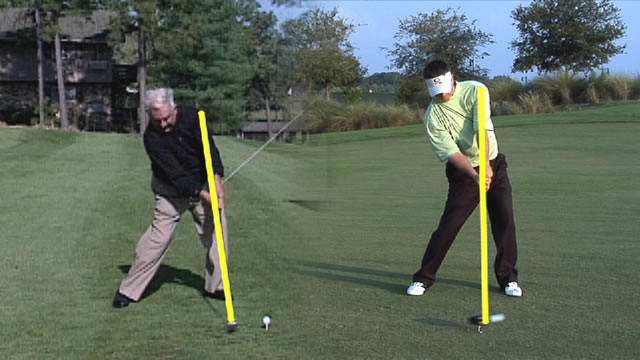
Moe Norman and Todd Graves face-on at impact

5Exaggerate…

Pretty much explanation enough…. Exaggerate every change you are trying to make. The old saying, “you must feel like you are giving a mile to give an inch” is SO TRUE…. If you want to make changes, and make them fast (or as fast as you can…) – exaggerate the changes. When you make changes, they should be uncomfortable, which leads us to:

golfer-mad

6. Changes will and should feel uncomfortable (for a while).

If you are making changes in your golf swing/positions, these changes SHOULD and WILL feel uncomfortable for a while. If you are making a change and it doesn’t feel uncomfortable at first, chances are you did not make a change. Uncomfortable does not mean hurt… please understand this. So many think uncomfortable means hurt/pain. That is very far from correct. Uncomfortable means different, not the same, unusual, etc. not associated with pain, hurt, etc… If there is “pain”, chances are the changes you are making are not correct. Feeling different or unusual is good and this is something you are looking for as to make certain changes are being made. Over time, as you work on the same change, it will become less and less uncomfortable.

Moe_with_club_over_shoulder

7. Be persistent/stubborn.

I am always looking for a good word for this… Persistent, stubborn, “hard headed”, tenacious, unrelenting, constant, fixed, etc… Sure you can think of a few… Those with these characteristics and work on making changes in their golf swing definitely have the most success. Some call it being “tough on yourself” … but still having fun while making the changes. There will be some changes that are tougher than others. Keep working, stay positive and understand in time the changes will pay off big time in your golf game.

Alignment_Trainer1_

8. Check, check again and again…

When making changes in your golf swing, continually check to make sure those changes “stick”. So many don’t give it enough time and tend to revert back to the “old habits/positions”. If you have a “check system” with the changes you are making, you can make sure the changes are sticking… It is not that difficult…. in fact, in most of our instruction we cover many “check points” to different areas of the swing and short game. Check, check and check again (something you will do forever… but that is a good thing… nothing builds confidence like checking your changes and realizing they are perfect!)

putting_systempic9

9. Do in short segments.

When you are working on creating new habits, do in short segments. It is much better and easier to focus in “short segments”. In other words, work on something for 15 minutes, give yourself a break, and then work on it some more. If you “overdo” it, you will lose focus, you will “revert” to the old habit, etc. Short segments, maintain focus, check your changes, etc…

th

10. Take notes.

When you figure something out, when you know you have made a change, when you have an “aha” moment – write it down. It is amazing what you will remember when you write it down. I have said this to my students over and over and over and over again…. If you don’t want to have to repeat, do it again, write it down. Make note of it. You can always review the notes and if necessary, will definitely help you through the process MUCH FASTER the next time. When we talk to our alumni of our schools this is always a point they recommend to tell new students. Make sure and take notes on EVERYTHING you are working on…

Many of you have read articles I have written about this topic in the past. But, as we always tell our students the first part of every school, the fundamentals of Moe’s swing really aren’t that hard (and are definitely much easier than most other golf swings). The difficult part is trying to get adults to make changes. Once a student “allows changes to happen” – it really is a pretty easy process….

As Moe said when asked what we should tell our students, he replied: “Tell them to get out of their own way.”

These 10 tips will help you get out of your own way as Moe said.

Short Game Rules

I wrote this this article a while back – surprised me how many students at our schools don’t remember or use. Thought I’d publish again for all those who haven’t seen before – and definitely won’t hurt to read again.

When you are around the green and determining what type of shot to hit, use the following guide:

P – Putt when you can

C – Chip when you can’t putt

P – Pitch when you have too.

First – let’s define the different shots.

Putt – obviously a putt is any shot hit with your putter whether on the green or not. It is a shot that should be considered when off the green in short grass (fairway or low rough) no matter the distance to the green.

Chip – A chip is a shot that has minimal fly and maximum roll. It can be a shot that hits just on the edge of the green and rolls to the hole, or a shot that hits short of the green (i.e. the first cut of rough) and rolls on the green toward the hole. A good reference is a chip is typically a shot that has less than 80% fly and more than 20% roll.

Different clubs are recommended for a chip shot. For example, a shot with 50% fly, and 50% roll may require a pitching wedge, whereas a shot with 70% fly and 30% roll may require a lob wedge. (Club selection will vary depending on type of golf ball you play, type of clubs you hit (soft vs. hard metal wedges), etc…)

Pitch – A pitch shot is a shot that has maximum fly and minimum roll. Typically, more than 80% fly and less than 20% roll. It can vary from a shot that hits and rolls a few feet to a shot that stops very fast (a flop type shot). A pitch shot is typically hit with your wedges, and many times with your most lofted wedge (lob type wedge).

Many average golfers select the improper type shot to hit when around the green.

An average putt will typically be closer to the hole than a good chip, and an average chip will be closer than a good pitch. Statistics show for an average golfer (one who shoots around a 90 or has a 20 handicap) from 50 feet, an average putt will be 10 feet from the hole, an average chip will be 15 feet from the hole and an average pitch will be 20+ feet from the hole.

Plus, when you factor in the variance of a “miss hit”, you will quickly see why you want to follow the PCP guide.

Let’s take for example a green side shot in which the ball is sitting 20 feet off the green (in the first cut of rough that is cut relatively low) and 80 total feet to hole. Using the PCP guide, you would putt this type of shot.

If you consider miss hits in the scenario above – a miss hit putt might leave you 10 to 15 feet short or long of the hole. A miss hit chip might leave you 20 to 25 feet short of long of the hole, and a miss hit pitch might only go a few feet (fat type shot) or blade over the green (blade type shot).

In summary – most average golfers make mistakes which cost them shots on the golf course by selecting the incorrect shot to play in their short game (around the green).

When factoring the percentage of hitting a good shot vs. the result of an errant shot, a good rule of thumb to follow is: Putt when you can, Chip when you can’t putt, Pitch when you have too.

In other words, anytime you are selecting a shot to hit around the green, whether on the green or not, determine first if you can putt the shot, if not, can you chip the shot, if not, you will have to pitch the shot.

Following the PCP guide will improve your short game and decrease your scoring……guaranteed.

LEARN

THE

SWING

Join 1M+ Subscribers to get your FREE Video Quick Start Guide that reveals how to hit the ball farther and straighter more consistently from now on…

START YOUR NEW GOLF SWING