Why, Why, Why…

Why, Why, Why…

Another “Oldie but Goodie” – actually wrote about 8 years ago. To be honest, even more relevant today (as we teach more and more and more…)

This past week, I played (for the first time) in the South Central PGA Senior/Junior Championship in Ponca City, OK. It is an annual tournament in which a senior member of the PGA (over 55 years) partners with a junior member (myself) and you play 27 holes – 9 best ball, 9 alternate shot, 9 scramble. I partnered with George Glen of Tulsa, OK – George ran one of the largest pro shops and courses in Tulsa for many years and recently retired to teach full time. With his “new” career in teaching taking shape, we had a very nice talk (had a lot time being on the course most of the day) about our teaching methods… what we teach, how we teach, etc… George was very curious to what and how we teach as he has been in the business for many years and knows our academy well…. (by the way, we won the tournament with a total of 13 under par….).

As my conversation went along with George, it became very obvious a common theme was emerging. There is no question, the GGA teaches in what I call the “Why”. Not y, but rather, W… H… Y…. our philosophy and model of Moe Norman’s swing revolves around Why…

Let me explain – hopefully this will help you with your swing and your work toward mastering the swing. As I explain, I will also try and help you with references and if possible “short cuts” Todd and I have created to “speed up the process”.

I believe a person (any person) will start with good intentions or a very positive attitude toward change if he/she believes it will deliver a better outcome. In other words, (in golf), if you think a change will help you hit the ball better and ultimately score better – you will want to make the change.

The “kicker” is when the change is hard, or in other words, isn’t comfortable when you first start to change. And if you don’t hit the ball better right away – most will very quickly doubt the change. As humans (human nature) I believe if you don’t understand WHY you are making the change, you will not continue and will revert back to your “old ways”.

Thinking to yourself, “I am making the change to hit it better” isn’t good enough…. you need to define more explicitly WHY you are making the change and WHY that particular change is so important.

Let’s get into some detail (and “short cuts” if possible).
Pictures_from_Canada_July_31_035

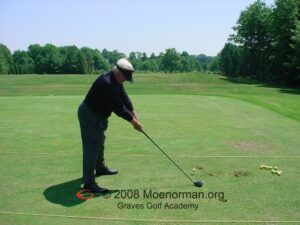
WHY is Moe’s single axis swing method simpler than other methods. There are many reason, but I want to focus on one in particular that is what we call Position #3, or the “Golden” position, or “Money” position or whatever you want to call it. In other words, all golfers, yes ALL golfers (conventional, single axis and everything in between) who hit the ball well will get into this position. You can see this position in the following pictures on our online instruction:

As you see, this position #3 is defined in the downswing as when the club is parallel to the ground, your trail elbow is in front of you and the club is down the target line or INSIDE that line. It is not and SHOULD not be outside that line – if the club is outside the target line you will come over top of the ball (in other words outside in path (slice), top, cut, etc.)

WHY is Moe’s Single Axis Swing a simpler method to hit that position?

Because we stand further from the ball at set up. Because we stand further from the ball, it gives us more room for our forearm to get into position #3 without having to twist and turn our back too much. Yes, we definitely clear our hips, but we can keep square with our feet, knees and shoulders and “hit” this position a LOT easier and more consistently than all other golfers who stand closer to the ball than we do.

WHY do so many cut the ball or come over the top when this position seems “simple” to hit. As Moe said when performing demos, “Most golfers swing at the ball like they are playing hardball (baseball), whereas I swing at the ball like I’m playing softball”. What did Moe mean by this? I want you to take a ball (any ball) and throw it at something (overhand) with some speed/velocity. As you do this, watch what your lead shoulder does. You will see it pulls out as you throw the ball. In other words, it is pulling to the left (for right handers, opposite for left handers) and the faster you throw it the more it will pull out. You have created this “habit” since you were very young. It is the habit created to create speed on a ball and get from position A to B.

Now you are playing golf. And as you are swinging at the ball, you want to create speed toward the ball. The problem is, your body is used to creating speed on a ball by pulling your lead shoulder out which in turn pulls your trail should across your body. This is NOT what you want to happen in your golf swing.
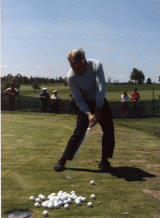
Moe_1984_approaching_impact

In your golf swing, you want your trail shoulder to drop (Moe called this his “vertical drop”) toward the ball from the top of your backswing. If your lead shoulder pulls past square prior to impact, you WILL come over the top of the ball – or in other words, you will slice, cut, top the ball as 90%+ of golfers do.

With that said, what do we need to do…. and how can we “short cut” the process to changing this habit/behavior.

The absolute, no doubt about it, best way to create new positions is WITHOUT a golf club in your hand. Yes, without a golf club in your hand.

WHY – You already have habits formed around a golf club, feelings you have created with that club in your hand, you need to change the BEHAVIOR and then put the club in your hand once the new behavior is created. We have seen INCREDIBLE success with 1,000s of students using the following:

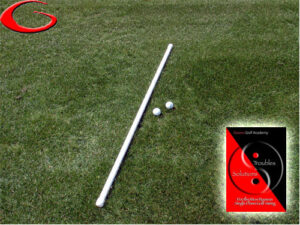
PVC Drill –
Training Club with Extension

Training-Club3

WHY is this important. There are two primary reasons:

#1 – If you are working on getting to position #3 and don’t have a good/proper grip on the club, you are COMPLETELY wasting your time. Never forget, the path of the club is important, but not even close to the face angle at impact. The #1 affect on face angle at impact is having a good grip on the club. If you want a percentage – you can estimate face angle affects the flight of the ball 75%, path/spin affects 25%. If your face angle at impact isn’t good – don’t even worry about path – it won’t matter. The training grip club will GUARANTEE a good grip and will take the face angle/grip issue out of the equation.

#2 – The extension will allow you to check Position #1, #2, #3 and #4 (please see Troubles and Solutions for more explanation), and will be the transition from the PVC to your golf club. Read very carefully what I just wrote – a TRANSITION from the new movement/behavior you are learning/feeling to the golf club. And you MUST do in this order.

WHY not skip the PVC drill?

Reason – because as stated above, you have developed habits around the golf club, or habits as to how to hold/swing/feel the golf club. I have written about this before – calling it the “Trigger” as you hit a golf ball. To change those new / better habits, you must completely change even the tools you are working with. You have no behavior to swinging a piece of PVC (or broom handle, or stick, whatever you want to use), so getting into the critical positions won’t be a big deal… in fact, it might see easy as you have no preconceived “feel” or thoughts as to how to swing a stick…. then as you start to check and master those positions with the PVC/stick – you will then transition into the training grip club with the extension.

Finally, after using the extension, take it out and practice just with the training grip club. Hit balls with the training grip club – acquire more/new feeling around hitting balls with the new on plane positions.

Lastly, go to your own club and work on the same positions.

So, here is what you need to think about. How serious are you about making changes in your golf swing? And if you want to swing like Moe, how and WHY are you making those changes?

We believe once you figure out the WHY, no matter how uncomfortable, how “different” it might seem, etc… you WILL make the changes for the better.

We see it everyday, those who have figured out WHY and have become SIGNIFICANTLY better at this game.

Remember – Always Practice with a Purpose. Good Luck!!

OKC Premier schools new pricing structure

OKC Premier school pricing change.001.png.001

As most of you likely know, the core of the GGA Instruction Team resides in and around Oklahoma City, OK. It’s been home to Todd and Tim for over 40 years, and the rest of the team all have homes in the OKC area. Earthquakes, tornadoes and all, it’s home.

Oklahoma City also is the home for GGA’s World Teaching Headquarters – a 3,000 square foot teaching center fully equipped with video instruction bays, putting carpet, conference room, offices and much more. Below is a short 3-minute video tour of the Academy; I walk you through the academy, showing you the layout and how the facility functions. Take a look!

As you may have seen in recent emails, our team has set a goal of making our OKC Academy the “go to” spot for Single Plane Golfers. The mecca of Single Plane if you will. In setting this goal, we made the decision to do something that we haven’t done in the past 5 years; lower prices.

As you see in the graphic above, we have lowered the pricing of our 3-day schools and 5-day Build Your Game Camps here at the OKC Academy by just at 40%. Other than the obvious financial savings, what does this mean for you when picking a location to attend a school?

  1. Regardless of where you attend a GGA Premier school, the programs are identical. A 3-day school in Phoenix is the same as a 3-day school in Orlando or Oklahoma City. The curriculum doesn’t change with the location. Just because OKC schools are priced lower doesn’t mean the quality of the program decreases. You’ll get the same team here as you would at any of our other locations.
  2. Todd and Tim Graves will be at all OKC Premier schools. While we have started conducting schools across the country that Todd and Tim are not at together, should you come to OKC, you will get them both.
  3. A small, convenient airport that’s easy to navigate. Will Rogers World airport isn’t a hub for any airline, so you won’t experience long security lines, long waits for car rental shuttles, etc. While you will most likely have to connect someplace to get into OKC, once you are here, you’ll find it simple to navigate the airport and brand new car rental center.
  4. A wealth of hotel and restaurant options. The hotels we recommend for our students are in an area where you could dine at a different restaurant each meal for 5 straight days and never eat at the same place twice. In addition, OKC has some great “local” eateries that we can recommend for you.
  5. A wonderful downtown area. Downtown OKC, called Bricktown, is a great place to walk and unwind after a school day. A riverwalk lined with shops, bars, and one of a kind restaurant offers a lot for you, or your spouse if he/she comes with you to OKC.
  6. The locals. Oklahoma folks are some of the kindest people you will ever come across. People here are neighborly all the time.

Bottom line for you as an aspiring Single Plane Golfer; you won’t find another location like Oklahoma City for a school. As our team doesn’t have to travel, we are passing our savings directly on to you. Join us in OKC. You’ll save some $’s, and fall in love with a city that most consider “fly over” country!

See you here!

Scott

Wax On / Wax Off – An “Oldie but Goodie”

Was reminded of a practice tip I wrote close to 10 years ago. Assume most of you either hadn’t “seen” us yet, or if you had, a good one to read again.

Want to talk in this practice tip about how we learn the golf swing. We have discussed many times before, but it was of interest Todd, myself, Brent, Ken Martin and the Director of Golf at the Cowboy Club (Ft. Worth) (previously the director of instruction at the Byron Nelson Golf Academy) sat down to dinner last night and discussed how our students learn. Those that are effective learners and those that have a little more difficulty mastering what we are teaching them. It was interesting that the conversation seems to always come back to what Todd and I call the “Wax On / Wax Off” theory. We didn’t term this phrase (in fact, I think we may have heard it on the golf channel years ago) – but it is SO TRUE it seems to fit all golfers trying to learn any methodology.

Let me explain.

Do you remember the movie “Karate Kid”? (I know I’m going to mess up the names, so I’ll apologize early).

695075f4-d82a-316e-8572-eecc707b1659

Ralph Maccio (Daniel LaRusso/the karate kid) is getting beat up at his new school by a bunch of kids that know karate. (At that time he had known nothing about martial arts). The gentleman and resident handyman Mr. M (a master of martial arts) decides to help him learn to defend himself.

One of the first scenes is the karate kid showing up at Mr. Miyagi house and looking at all his awards, prizes, martial arts material, etc… He is “pumped up” … (Sounds like one of our students coming to our school or getting our instructional material, right….)

After talking to Mr. Miyagi for a while, the karate kid (novice right now…) states is willingness to learn.

The next scene, you see Mr. Miyagi handing the karate kid a bucket and sponge and tells him to wash all his collection of cars (about 6 sitting outside his house).

MV5BMTk1MDMzNDg2Nl5BMl5BanBnXkFtZTgwODg5MzA4MTE@._V1_UY100_CR25,0,100,100_AL_

As he is washing the cars, there is a VERY SPECIFIC way he is supposed to use the sponge to wash the cars (a circular motion to the right with the right and to the left with the left hand).

The karate kid finishes washing the cars. Now he is ready to LEARN KARATE!!

The next scene you see, Mr. Miyagi is handing him a pail of wax and a wax sponge and cloth. Mr. Miyagi very specifically tells him to put the wax on the cars with the right hand in a right circular motion and to take the wax off with the left hand in a left handed circular motion. He is VERY SPECIFIC with the directions.

The karate kid starts waxing. As he is on the 2nd car, Mr. Miyagi comes out and corrects his waxing – he has lost focus and is just “rubbing” the wax on the car. Mr. Miyagi describes in VERY DETAIL of how to put wax on the car and how to take wax off the car. He calls it WAX ON (right hand) / WAX OFF (left hand). Wax on, wax off, wax on, wax off, repeating over and over as he walks away.

(Hopefully most of you remember the scene as I am butchering the description…)

The next scene, it is now dark and the karate kid is mad. His arms, hands, elbows, shoulders are very obviously sore. In fact, he can hardly lift them. He has washed and waxed cars all day and learned nothing about karate. Mr. Miyagi says good night to him and they part ways…

The next day, the karate kid shows up again to Mr. Miyagi’s house. He is a little bit sarcastic this time and not sure he wants to be there. Mr. Miyagi takes him out to his large wooden deck/path and describes the process of sanding the deck by hand. Circular motion to the right with the right hand, and then circular motion to the left with the left hand. During the day, Mr. Miyagi again comes out many times to check on the sanding and to correct the sanding motion of the karate kid.

The 2nd night is now there. The karate kid is furious. He has spent two days washing, waxing and sanding this “old man’s” (as he says) car and deck and has learned nothing about karate. And he is about to go to school again and get beat up by those who do know something.

Mr. Miyagi comes out to say good night again and the karate kid lets him have it. “What are you doing?” “You’re a nothing, you only have me here doing your dirt work!” “I wasted my time for two days for absolutely nothing!”

Mr. Miyagi walks over to the karate kid (very calm) and has the karate kid show him the motions he has learned the previous two days. The circular to the right with the right hand and circular to the left with the left hand. Karate kid shows him the motions.

Now, Mr. Miyagi stands in front of him and says, you have just learned the fundamental blocks of karate – the core/basics of all martial arts, the key to success.

th

The final scene (of what we’ll talk about) Mr. Miyagi stands in front of the karate kid and punches at his head numerous times – with each blow, the karate kid using the WAX ON / WAX OFF technique and blocks every punch thrown at him. Mr. Miyagi backs off, bows and says the lessons will continue tomorrow.

To me, this is one of the coolest scenes in a movie – think of what went on and think of what you are trying to do to learn your golf game.

It is ABSOLUTELY a WAX ON/WAX OFF scenario. And all good golf instructors you talk to will tell you “I can explain the swing until I am blue in the face, over and over and over again, but it ultimately comes down to the student repeating the PROPER MOVES over and over and over and over again until it becomes a habit. And once you think it has become a habit – go sand the porch – do it again and again and again and again.

Let’s compare the story I just talked about to what we are trying to accomplish.

1st – Karate kid is getting beat up at school by the “bullies” – maybe your buddies are beating you at golf, maybe not. Maybe you are just frustrated with your golf game – maybe you just want to get better for a personal goal, whatever the reason, you have made a decision to get better at golf.

2nd – Karate kid asks for help from the local handyman… call the GGA your “golf handyman” …

3rd – Karate kid goes to his house and sees all his awards, etc… – Come to our academy, we’d love to show you all our awards, but more importantly, our Moe “stuff” (videos, pictures, clubs, etc…)

4th – The karate kid is given a task by the “master” teacher. He is not explained why he is doing the task, but he told VERY SPECIFICALLY how to perform the task. When he is doing wrong he is corrected. What are your tasks/drills? We have many. We have listed them often and “preach” them again and again and again. Examples – PVC drill, leverage bag drill, etc… You can see these on our past eTips on our website. EVEN BETTER – these drills and motions can be seen on our instructional material – Single Plane Solution, 7 Principles of Golf Improvement, Improve Your Move, Troubles and Solutions. This is a perfect example of how 1 picture is worth a 1,000 words, but one moving picture (seeing in action) is worth 1,000+++ pictures. This is your reference, how you see the WAX ON / WAX OFF.

5th – Mr. Miyagi has him do the task over and over and over again. Until it what – becomes a subconscious habit. You need to focus on particular areas of your swing. You will have weak areas and strong areas. For example – maybe your grip is not very good, but your take away is. You need to FOCUS on a correct grip – maybe get a grip training club, look in a mirror OFTEN, check the grip every time AFTER you hit a shot… there are many ways to check and drill over and over and over again on all areas of the swing.

6th – During the process, many times the karate kid thought Mr. Miyagi (the master teacher) was crazy. “Why is he having me do this?” “I am wasting my time”. Let me give you a hint – there is a method to our madness. We are not here to waste your time. We are here to teach you the fundamentally correct positions of Moe Norman’s Golf Swing – some ways may seem “very unusual” – but guess what – we have seen dramatic positive results with these drills and methods in MANY students and ourselves in the past – and better than that – it is what Moe taught us… trust us, there is a method to our madness.

Would you have ever imagined swinging a piece of PVC to learn the golf swing???? And it works – WAX ON/WAX OFF!!

7th – Finally to the amazement of the karate kid – when put to the test, he has learned some basic fundamentals of karate. He is amazed… Question for you is how much time to you think you need to spend doing a particular drill/movement over and over and over until it becomes a habit for you??

I can tell you from experience, it is more time than you think. Remember Ben Hogan’s theory – working on the same movement every day (one thing) for 21 days starts to create a habit….

Here’s your homework:

1. Figure out what you need to work on in your swing. Study our video(s), ask us a lot of questions, call/email anytime, use our coaching program, come to a school/camp/lesson – do whatever it takes to figure out what you need to work on.

2. Set a goal or two on what you want to accomplish. Can be very specific or not (depends on what you want to do…) and time period can be short or long – again depends on you… but at least set a goal.

3. Start working on the “fix” – figure out how to “Wax On” / “Wax Off” properly. It is not hard – JUST DO IT RIGHT. That is what we are here for – ask us, use our instructional material….

Last hint/suggestion – I would rather you do NOTHING – THAN DO IT WRONG. It is not hard, but you need to learn to do it correctly. Make it easy on yourself….

Please let us know what else we can do for you,

Thanks for reading.

Remember – Always Practice with a Purpose

Exciting Updates for the Coaching Program

The beginning of May has been an exciting time for the Coaching Program with the addition of a new team member and the release of a new feature.

Chandler Rusk and I spent last week in Phoenix Arizona setting up another indoor teaching facility for one of our single plane instructors Bart Barnard, PGA. Bart has been a Graves Golf Academy instructor for almost two years and is located at Legacy Golf Resort. With the completion of the indoor studio, Bart will now be part of the coaching program team working on video analysis lessons. We’re proud to have Bart onboard, he’ll be a great asset for our members.

On May 5th for the first time ever, we released the Coaching Program Stat Cards. This new feature allows our members to have their golf rounds analyzed by our premier team. Analyzing your performance on the course will allow us to tailor our instruction to lower your score. The round analysis will break down your entire golf game into the following categories:

  1. Fairways Hit
  2. Tee Shot Distance
  3. Green in Regulation
  4. Pitch Up & Down
  5. Chip Up & Down
  6. Sand Save
  7. Penalty Shot
  8. Putts
  9. Score

Each category will be assed and assigned a handicap equivalent based on your statistics. For example: You might be equivalent to a 10 handicap with your tee shot distance but only a 30 handicap with your putting. Most golfers only look at their overall handicap, which does a good job at classifying their current skill level as golfer, but does nothing to help them improve. Knowing where you stand on each category will allow us to pinpoint the areas where the largest improvement can be made. An hour worth of practice on the weakest area of your game will statistically improve your score drastically compared to the same amount of practice time on your strongest category.

As a coaching program member, all you have to do is fill out four stat tracker cards and then submit the information to our coaches online. We’ll take care of the rest. We’re eagerly awaiting the first round of stat tracker submissions and look forward to the improvement this addition will make on our student’s golf games!

To find out more about the Coaching Program and the new Stat Tracking feature, email: trentw@moenormangolf.com

Trent

The First Time Ever

There’s a first time for everything. The first time we pick up a club, the first time we make a birdie, our first hole in one. It is these first times that scare us and excite us at the same time. They get our adrenaline flowing.

For students at our schools, there are many firsts as well. I am always excited for our golf school students; I’ve seen enough to know that for those who are willing to go through the process, there are some really fun and exciting “firsts” that await them in their golf games.

So with all this talk of firsts, our team decided to create a first of our own this summer – we will be conducting our very first 5-day Single Plane Build Your Game Camp in Chicago, Illinois on June 27th-July 1st.

Prairie Landing Chicago

For the entire history of GGA, we have always conducted our Single Plane Build Your Game Camps at our “home” locations like Orlando, Fl., Oklahoma City, OK, or Las Vegas, NV. It’s been rare, nearly nonexistent that we have tried to conduct our most in-depth schools at satellite locations.

However, this year we decided to branch out. To take a risk and bring the Camp to the Chicago area.

The 5-day Single Plane Build Your Game Camp in Chicago will be held at Prairie Landing Golf Club in West Chicago. Prairie Landing is one of our team’s favorite stops for several reasons, including:

  • Private instruction tee box on the range that will hold up to 30 people. This is a massive range with plenty of room to spread out and get some great work done. It’s away from the hustle and bustle of a normal range, so distractions are at a minimum.
  • Great range balls. Prairie Landing is serious about their practice areas, and they keep the golf balls in very, very good condition. In fact, most years we’ve done schools there, they open brand new balls just for our students.
  • Three practice holes completely separate from the course. This is the only course we visit that has such amenities.
  • An amazing practice green. The practice green could easily hold 30 people, and is kept in top notch condition.
  • A dedicated pitching/bunker area. Unheard of in most locations, Prairie Landing offers a dedicated green to practice longer wedge shots (pitching) and your bunker game. It’s amazing.
  • 18 holes of Trent Jones, Jr. links style design. Bottom line; the course is a blast to play.

I’m so excited to bring the Camp to Chicago, it’s going to be an absolute wonderful week! The only problem is this:

There will only be this ONE Single Plane Build Your Game Camp in that region of the U.S. in 2016. Once it’s done, it will be at least another year before we will realistically get back to the Chicagoland area.

Join us for this first, and let’s get some positive results for your game!

Scott

Chipping Fundamentals and the 4 Cs Review

In our schools, camps and clinics (and pretty much anytime you’re around me), you will continually hear how important the short game is for scoring. In this article I’m going to compare the long game vs. short game then give you my 4 Cs that you must follow to have a great short game and then give you a couple links to review chipping fundamentals.

First, you must be convinced that the short game is the most important part of scoring. Here are a couple facts about the short game.

Fact: The difference between a 30 handicap golfer and a scratch golfer (0 handicap) is associated with 7 to 10 shots in the long game (shots over 50 yards) and 20 to 23 shots in the short game (shots under 50 yards). Meaning, if you are a 30 handicap golfer and only work on your long game you will only improve 7 to 10 shots toward scratch golf. The best you will ever reach is a 20 handicap. The difference between a 15 handicap golfer and scratch golfer is associated with 3 to 5 shots in the long game, and 10 to 12 shots in the short game. In other words, if you are a 15 handicap golfer wanting to reach scratch, if you only work on the long game, you will basically never improve beyond a 10 handicap.

Fact: No professional, not even Tiger Woods, has an advantage in their short game over yours. In other words, the short game is not associated with strength, working out or athletic ability. It is a part of the game that is associated with practicing the correct fundamentals and putting those fundamentals into play at the right time. Ever notice how many young players (talking about 10, 11, 12 year old juniors) have a great short game. In fact, many compare to the professional’s short games. Don’t you wonder how someone who is 75 pounds soaking wet can compete with the best players in the world? This shows it is not strength, but rather what matters are things like finesse and feel. This is what I call the 4 Cs to the short game: Creativity, Confidence, Commitment and Critique.

CREATIVITY: The first thing you must do when confronted with a short game shot (pitch, chip, etc.) is create the shot. Part of the teaching we give our students during their on course instruction is to pick a shot around the green and ask the group to name 5 different ways to play the shot. Most of the time the group is able to name 2 or 3, but almost never 5. An example would be a shot that is 20 to 25 yards off the green with minimal rough between the ball and the hole.

You could:

  1. Pitch the shot to the hole,
  2. Chip the shot into the fringe around the green and roll to the hole,
  3. Putt through the entire rough and fringe,
  4. Hit a flop shot all the way to the hole, or
  5. Hit a 3 wood chip that will have more over spin and roll to the hole???

The point here is you need to be creative over the shot. I like to call it the “artistic” part of the game.

A good rule of thumb: “Putt when you can, Chip when you can’t putt, Pitch when you have too…” Yes, this is a very basic “rule”, but a good one to fall back on.

COMMITMENT: Once you have created the shot, you must commit to the shot that is the lowest risk for error FOR YOU. If you have a good pitch shot and feel it is the most likely to get the ball close to the hole with the least room for error, hit the pitch shot. Many will feel the chip from the fringe or even the putt will be their lowest risk shot. DON’T think you have to hit a shot in a particular manner because the pros on TV hit it that way, but rather execute the shot YOU feel you can hit with the most confidence.

CONFIDENCE: So now that you have created and committed to the shot, you must play the shot with confidence. This means that if you have chosen to chip the shot, tell yourself you will chip it close, pick your spot you want to hit, use good fundamentals, and with 100% confidence, hit the shot. If you don’t feel confident over the shot, BACK OFF and commit to something different or swing a couple practice swings/chips until you have gained the confidence back. The last of the 4 Cs is:

CRITIQUE: You must critique your short game shots after you have executed them. This is not to say, “I can’t hit a particular shot”, but rather “I had 4 chip and run shots today and only hit 1 good. Therefore, I need to put more practice in the chip and run shot”. Look back at each shot and determine if you need more practice in that area. Here’s a question you can ask yourself and see how well you currently critique your short game: How many of you practice chipping short of the green (maybe into the fringe) and then roll the ball onto the green close to the hole or how many of you when practicing putting, putt balls from off the green (from the fringe or low rough) to the green? I believe that these are the shots that, after you critique your short game, will probably be the shots that need the most practice.

Finally, I believe that EVERYONE can have a GREAT short game. In fact, everyone can have a short game that is as good or better than any professional. But, to get this GREAT short game, you must first learn the proper fundamentals and practice these fundamentals. Then you can use the 4 Cs – Creativity, Commitment, and Confidence and then Critiquing to bring that short game to the course.

To see Chipping Video Fundamentals Review – please go back to practice tip and click on video links.

Good Luck and Remember – ALWAYS PRACTICE WITH A PURPOSE!

LEARN

THE

SWING

Join 1M+ Subscribers to get your FREE Video Quick Start Guide that reveals how to hit the ball farther and straighter more consistently from now on…

START YOUR NEW GOLF SWING