5 Reasons You Don’t want to Miss Las Vegas!

5 Reasons You Don’t want to Miss Las Vegas!

As you may know, GGA Premier schools are held at locations all across the country, but there’s 1 location that GGA looks forward to every year – Las Vegas in the Fall.

While Premier schools are similar regardless of location, here are 5 Reasons you don’t want to miss out on Las Vegas this year:

  1. Location – Las Vegas is easy to get to from about every corner of the planet. Also, the weather in the fall is just about as good as you will find anywhere, mild temps, lots of sun, very little wind. Couple those factors with the ease of finding anything  you want in Las Vegas, and it’s the perfect golf get away location.
  2. It’s the end of golf season – There is absolutely no better time to attend instruction and make changes to your game than in the off season. Bar none. Let’s be completely frank here, you will leave instruction with things to work, full swing, putting, & wedge game. There is no better time to focus on making changes than when you aren’t under the pressure to put a score on the card. It’s why you see the pros working on their games this time of the year!
  3. Facility – The Revere at Anthem Golf club that hosts are schools is ideal. You will be treated to awe inspiring views of the Vegas strip and surrounding mountains from the private range, you’ll experience 1st class treatment when the course shuts down the short game practice facility for you, and the staff at Revere are true professionals all the way.
  4. Only Once – Unfortunately, GGA Premier schools are only in Las Vegas for one brief stint each year. Then you have to be frustrated with your game for an entire year before the schools are back. Don’t waste another year!
  5. You work one on one with the GGA owners – As the Single Plane continues to spread around the country, no the world, opportunities for you to work directly, one on one, with Todd and Tim Graves will be come harder and harder to come by. The Premier schools are filling fuller and faster than ever before in GGA’s history, and time with Todd and Tim is becoming more and more of a rare commodity.

See you in Vegas!

Scott
 

Putter Fitting – Make More Putts…

Putter Fitting –

There are 4 areas to consider when being fit for a new putter (or when considering a new putter).

1. Length of the putter.

Your putter needs to be short enough that you can get your eyes over the golf ball at set up (putting line) and long enough that it does not put excess stress on your back.

The average length putter (not counting belly or chest putters) on the PGA tour is 34 inches, where the average height of a PGA tour player is 6 ft. 1 inches.

The average length putter (short putter) sold in golf stores is 35 inches, whereas the average height of recreational golfers is 5 ft. 10 inches.

Looking at these numbers doesn’t make sense. A majority of PGA tour players are able to get their eyes over the ball at set up because of using a putter with proper length for them. Whereas, the average player has a putter that is too long making it very difficult to set up properly.

2. Lie angle of putter.

When setting up over a putt, the leading edge of your putter should be even with the ground. In other words, the toe and heel of the putter should be level with the ground (one should not be higher than the other).

The lie angle of the putter is directly related to the length of the putter. Most often the lie will not have to be adjusted if the length of the putter is correct for the golfer, and the golfer has a good set up. If minor lie adjustments are needed, most often they can be made fairly easy.

If the putter doesn’t sit even with the ground, it can cause the putter to “twist” at impact, thus causing pushed or pulled putts.

3. Grip Size

In the past couple of years, it has become much more popular to have a “larger” grip on the putter.

The larger grips tend to help golfers decrease being “wristy” during their putts (breaking down the wrists during the stroke) and for many, it helps them keep the putter down the line (toward the intended target) longer.

There are many different size putter grips, the Super Stroke 3.0 is recommended for the golfer with average size hands.

4. Putter Type

There are basically two different “types” of putters to choose from. The face balanced putter and the non-face balanced putter. A face balanced putter is one that is evenly balanced between the heel and toe of the putter.

You can check you putter by balancing the shaft of the putter on your finger. When doing this, if the face of the putter is level with the ground, the putter is face balance. If the toe of the putter turns down, the putter is not face balanced.

For most, they are able to create a better stroke (one that stays square to the target longer) with a face balanced putter.

Of course the type of putter one chooses is a personal decision (based on looks and feel), but by dynamics, if you are looking for a putter that will stay square to the target the longest during the putting stroke, a face balanced putter should be considered.

At the Graves Golf Academy, we are more than happy to help you with your putter fitting and suggestions. A properly fit putter will give you your best chance to make the most putts and obviously then score your best.

As putting counts for close to 45% of scoring for the average golfer, it only makes sense the club that accounts for this much of your golf game is fit to you perfect.

I told you so – Bryson DeChambeau

Dear conventional golfers and teachers, I’m having an “I told you so” moment. I have to admit it feels pretty good. For over 20 years I have been answering your questions and your doubts regarding the Single Plane Swing and its validity. Questions such as: “Why isn’t anyone on tour swinging this way?” or “If this is so great why isn’t everyone swinging this way?” Some even question Moe the best ball-striker to ever play the game – asking “If Moe was so great why didn’t he win a major championship”. There have been times when presenting my research and science of the Single Plane, people have attacked me saying that Moe was autistic and a savant. That nobody could swing like Moe.

Now that a Single Plane Golfer, Bryson DeChambeau is now a major champion winning the U.S. Amateur – it feels pretty good to see science (and Moe) prevail. They claim Bryson is the best ball-striker in college golf. I am not surprised one bit.

Now, I want to say something before the golf teachers start justifying that what they have been teaching for 100 years is possibly well, wrong. I want to say to conventional teachers you can’t have it both ways. You can’t claim all successful golfers as another “variation” of conventional swing mechanics. Golf swings are different – because they are mechanically and physically different. Bryson’s swing IS different, in the ways you have been doubting and questioning.

Bryson Dechambeau
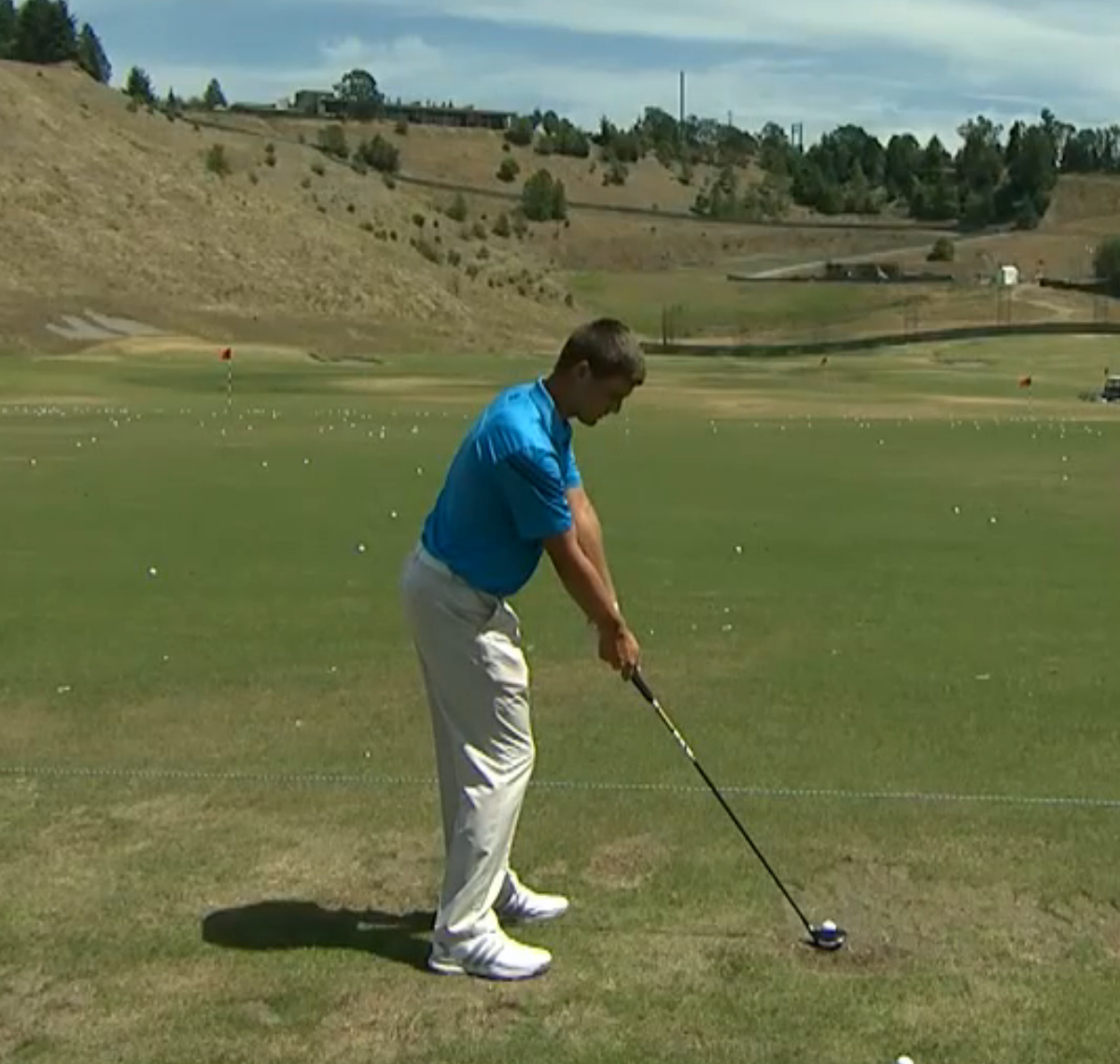
Bryson DeChambeau at address

Please, don’t try explaining his Single Plane swing with another predictable “variation of traditional golf mechanics”. Stop painting a broad brushstroke over all golf swings. Let’s face it, conventional golf mechanics don’t explain his swing starting from the beginning – his address. Bryson’s swing is biomechanically superior to conventional swings because of the way he grips the club into the hands not the fingers. Bryson aligns the club with the arms into a straight line. From the start, he has violated two basic tenants of conventional teaching; “grip the club in the fingers and hang the arms below the shoulders in an athletic position”.

Conventionally, with Bryson’s address position, there is nowhere for your instruction to go from here. You can’t explain his swing with traditional methods and how he starts and impacts on the same plane eliminating the need to move the club from two planes into impact when you claim that golfers should start with their hands low.

Oh by the way, just so you know, we have been explaining the alignment of the hands and arms for years. This is the basic principle of the Single Plane Swing. It comes down to simplifying the golf swing and eliminating much of the unnecessary movement of conventional golf swings. You must eliminate the angles at address to simplify the golf swing – exactly what Bryson is doing. You simply can’t simplify the swing from the conventional Two-plane address.

I can’t wait to read the stories of how every conventional golf instructor will try to explain Bryson’s swing. David Leadbetter and Hank Haney will probably publish a book about. Bryson winning a tournament makes it is “safe” to talk about it. I am sure that students will ask about it and many instructors in the PGA will probably change their teaching throwing away everything they have taught for the last 100 years. Just remember that Moe Norman figured this out over sixty years ago. And even though he never won a major championship like Bryson, his ball-striking make it very clear that there is an easier way to swing. It’s called a SINGLE PLANE.

Fun On Course Games

This time of year I like to get on the course as much as I can. Many times I get out after work, before work, late evenings, pretty much any time I can squeeze in a few holes. Most of the time I am playing by myself as I like to “sneak” out and get in a little practice when I can.

When I’m out there (on my own), I sometimes play a few games that have helped my game over the years. Thought I’d share a few of these games with you.

1.  Two Ball Worse Ball Game

Moe told me one time, this was one of his favorite on course games.

It is played with 2 golf balls. Tee off with one ball, then a 2nd ball. Go to the worse shot of the two. Play that ball and another from that position. Again, go to the worse shot and play two balls from there. (This game is typically played the easiest with 3 golf balls). Play the worse of the two shots, and another, then pick up the good shot from before…. Do this with every shot, no matter whether it is a driver, second shot, chip or putting – always play two and go to the “worse” ball for the next.

In other words, you are always playing your worse shot of the two. When you hole two putts from the same location you are done with the hole.

Keep score – see what you can do…. It is not an easy game, but a very fun game and a “test of your consistency” game.  It is also a great game to help you deal with pressure. After you have hit a good shot, you have to hit another…

Moe told me shooting under par in the Two Ball Worse Ball Game was a great goal…

2.  Plus Two Game

This on course game involves taking two more clubs every time you have a shot into the green.

In other words, tee it up like normal. Then when you get over your 2nd shot, if you can get to the green, take 2 more clubs. Example – say you need an 8 iron for the 2nd shot, hit a 6 iron. If you need a 7 iron, hit a 5 iron/hybrid, etc… Every time you have a shot into the green, take two more clubs. On the par 3s – this will be off the tee, etc…

This is a great game to teach you feel, and for many, helps with your swing. When you have more club then you think you need, you will “ease up”, swing smooth, etc. and actually gives you a chance to get to the hole every time…

3.  “I Wouldn’t Want That Shot” Game

This is my favorite on course game. It’s a “short game” game of course….

It’s pretty simple and a great game to work on your short game and different shots in your short game.

Play a hole like normal. After you complete the hole, take your golf ball and walk to the front edge of the green.

Look at the green and the surrounding edge of the green (the bunkers around the green, hills around the green, rough around the green, etc.) Look for a spot that you would say to yourself “I wouldn’t want that shot” …  Maybe it’s a deep bunker. Maybe it’s high grass short side of the pin, etc… A difficult up and down shot.

Then, roll your ball into that spot. Roll it into the spot like a golf shot that rolled into that spot.

Try to get it up and down. If you don’t, try again. I keep trying until I get it up and down. (If you want to “cheat” a little and put a 2nd or 3rd ball in your pocket to drop in the spot… that is okay).

This game is a great game to work on your short game and put you in on course short game situations. These are very difficult to practice at most golf course practice areas as they don’t have areas like this to practice.

I actually try and keep count as to how many I can get up and down in the number of holes I am playing.

Don’t make this ridiculously hard on yourself, but situations that are a “little difficult” – if you can manage these situations, the normal ones will seem easy….

These games are somewhat challenging, but great games to work on course and help your golf game.

Have fun and keep up the good work!

Check out this training aid for more on Course Fun… The Throw-A-Hole.  The Throw-A-Hole (TAH) allows you to simulate holes anywhere on the green. http://moenormangolf.com/store/products/throw-a-hole/

The Important Clubs

This time of year I (Tim) typically get a chance to play in a few tournaments. Seems each time I play those rounds that “mean a little more”, it always reminds me of what is really important in the bag. Meaning – what is really important to scoring.

Thought I’d talk a little about these “important” clubs, how much you should be practicing with these clubs and some general fitting facts about these clubs.

1.  The most important club in the bag….. The Putter.

Most of you probably already knew this, but how many of you really put this in to practice.

For the average golfer, over 40% of your scoring is with your putter. In fact, it can be close to 50% for many golfers.

25% of your practice time should be with your putter. I suggest practicing it first (during practice sessions) as to not forget or “short change” your practice time with this most important club.

Use a putting string/mirror, etc. during your practice B sessions (sessions working on fundamentals).

When practicing before playing (warming up) I suggest practicing first (before hitting balls) (for speed/feel) and last (just before going to first tee) (for speed/feel and accuracy).

A perfect putter fit will be a length and lie that will allow you to get your eyes over the ball (creates ideal stroke) and does not hurt/stress your back. Example: 34-inch putter for a 6 ft tall individual on average with “good” back.

2.  Second most important club in the bag….  The Driver.

You hit your driver up to 14 times a round (on average). It is hit more than any other club in your bag besides your putter.

If you are hitting your driver poorly, golf is not fun and obviously negatively affects your scoring.

Driver is not only a distance issue, but as important, an accuracy issue.

25% of your practice time should be with your driver. You should practice your driver after you are warmed up and not too tired.

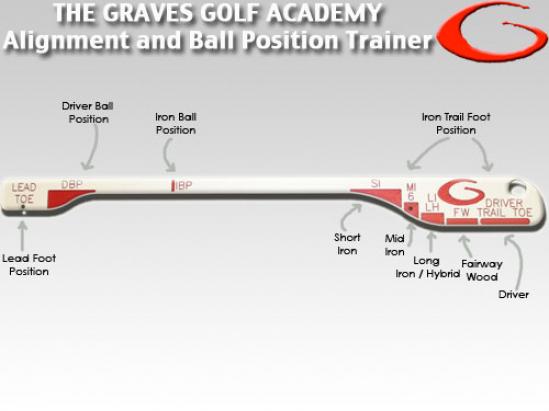
Use an alignment aid every time you practice for not only alignment, but ball position. Many of the times golfers have difficulty with their driver – it is an improper ball position issue.

When practicing before playing (warming up) I suggest practicing after hitting a few wedges, irons, etc. giving yourself enough time after warming up to hit a few drivers “good”. Do not hit too many, before playing is not the time to “fix” the driving – if you are struggling with the driver, find the longest club in your bag that you have confidence in that day. Maybe your fairway wood, etc…  If struggling, maybe only use the driver on the “open” holes, and the “confident” club on the tighter/harder holes.

Do not be a “hope” player with the driver. A “hope” player sets up over the shot and “hopes” it will be hit well. If you are “hoping”, hit a club you have more confidence in. Work on the driver later… The driver will always show your “swing faults” the most – as it is the longest club you will swing the fastest. It is a club that can be hit very well with a good single plane swing and a club, that when you have confidence in, can be the funnest club to hit…. (When Moe was asked what his favorite club was – he never hesitated and answered – “My Driver” – every time!)

A driver should be fit for length (depending on your height vs. arm length), shaft flex (gives you proper ball flight), loft (gives you maximum fly and roll), and grip size (allows for maximum speed and optimal feel).

3.  Third most important club in your bag – The Lob Wedge (Your Most Lofted Wedge).

The lob wedge is typically a 58* or higher lofted wedge. For some, they might only carry a 54 or 56* wedge in the bag. The most lofted wedge is critical for good scoring.

For most, this wedge is used within 50 yards of the green (some up to 75 or 80 yards) – depending on swing speed.

This wedge gives maximum spin and feel and is the club that will “save” you many shots if you know how to use it.

It is used for chipping (maximum fly, minimal roll), pitching and flop shots. It is used from all different lies (tight, medium and thick grass), etc…

When practicing, it should be the first club you practice after the putter.

You should practice with this wedge (and your other wedges) 25% of your practice time.

When practicing before a round, this is the club you use to “loosen up” with. Just after putting, hit his club to warm up – start short and work up to maximum distance with this club. A few short shots, then a little longer, little longer, etc. until full swing. After a few full swings – work into the rest of your clubs.

Your most lofted wedges (sand and lob wedges) should be steel shafted (for weight and feel) and a forged type head (for maximum feel and spin). It is very difficult to score well without forged type steel shafted sand and lob wedges.

All wedges should be fit for length, shaft flex, grip size and lie angle (lie angle is critical). If the lie angle is not fit properly in your wedges you can and will dig the heel or toe of the wedge into the ground and the club head will twist at impact. Making hitting these clubs with accuracy very difficult.

You should NEVER purchase these clubs (or any) “off the shelf”. They must be fit to you to maximize and optimize their use.

4.  Fourth most important club – The Rest of the Bag

Yup – everything else in your bag, is the 4th most important club(s).

Think about it, if you add your putting, most lofted wedge play and your driver together, you are talking about close to 60% of your shots. If you include all your wedges – you are typically talking about 65 to 70% of your scoring.

Meaning – all the other clubs add up to about 30% of your scoring.

Believe it or not, you can actually be a poor iron (and hybrid) player and score pretty well. In other words, have a great short game and hit it pretty well off the tee, you will score pretty well… Not necessarily what we want, but because of the way golf is scored (putting counting as much as a full swing, etc..) – those with good short games typically score well. Those with a good short game and driver the ball well – can score very good.

Practice these clubs (the rest of the bag) 25% of the time.

When practicing fundamentals always use an alignment and ball position aid for the different clubs.

When practicing before a round – start warming up with the clubs after putting and the most lofted wedge. Many (including myself) like to work through these clubs in an “even” or “odd” system. Even system, hit a wedge a few times, 8 iron a few times, 6 iron a few times, 4 hybrid a few swings, etc…  Working up and making sure you give the driver enough in your warm up session. Don’t get “stuck” on one club. There are always good and bad days…  Keep working up through the bag in your warm up session.

All clubs in “the rest of the bag” should be fit for length, lie angle, shaft flex and grip size. (Some hybrids and fairway woods are fit for lie angle, not all). ALL irons must be fit for proper length and lie angle for your height and arm length or it is impossible to hit these clubs with accuracy and maximum distance. Proper shaft flex gives you optimal height and distance and proper grip size maximizes your release to optimize distance and accuracy.

Hopefully this will give you a guide to the “important” clubs in your bag and some guidelines to practicing with these clubs.

If you have additional questions about these clubs, fitting of these clubs, etc… please don’t hesitate to contact me at timg@moenormangolf.com or timkgraves@aol.com

I am always happy to help everyone to make sure they have a perfect fit for all your equipment.

Little Things That Are Big Things

It is always interesting to talk to our students after the schools. Often we get a common response from the student(s) – they come to the school expecting to have “Big Things” to work on in their swing and it really comes down to what they consider the “Little Things”.

The issue is what they consider “Little Things” cause major issues in the golf swing. These issues when “incorrect” can quite often lead to a series of compensations in the golf swing that may seem to be the “Big Things”.

Let’s talk about a few of “The Little Things”:

1.  Face Angle.

Having a square face to the target at set up is CRITICAL. This is something you need to check every time you practice. In fact, I check every shot I hit during practice. It is relatively simple using the Alignment and Ball Position trainer with a yard stick.

https://gravesgolf.com/wp-content/uploads/2022/01/4969059f5479b_ABT13.jpg

Most students we see error having an open club face. With an open club face, you will hit the ball right with a “glancing blow”. To make up for this, most will not square the face at set up (since they don’t know they have a problem), but rather pull their lead shoulder out causing an outside to in (across the ball) path to try and square the face.

In other words, a “little thing” – not squaring the face at impact can cause a BIG problem – an outside to in path.

2.  Distance to the Ball 

Having the proper distance to the ball is CRITICAL for a proper swing. It allows for the proper spine tilt at set up which allows for the proper movement of the club on the single plane.

Too close to the ball will cause you to stand to upright, not allowing the club to swing “under you”, but rather “around you”.

In other words, too close to the ball will cause you to come across the shot (or outside to in) and for many a “too steep” swing.

The “little thing” – distance to the ball – easy to check, can check often… can cause a BIG problem – improper spine tilt, which doesn’t allow the club to run through the pivot point throughout the swing.  Inconsistent results and typically an outside to in path.

https://gravesgolf.com/wp-content/uploads/2022/01/4969055ec06d1_ABT10.jpg

3.  Stance Width

Having proper stance width is CRITICAL for a good balanced swing. It allows for balance and speed production. Without these balance golfers have difficulty getting the club in proper positions in the swing. Many times causing a “reverse pivot”, “early release/casting” in the golf swing, etc…

https://gravesgolf.com/wp-content/uploads/2022/01/4969043cbcaae_ABT1.jpg

The “little thing” – stance width (too narrow a stance) can cause BIG problems leading to loss of balance, loss of distance, reverse pivot, etc…

Would recommend taking some advice from your fellow student(s) – look at the “little things” …

Typically fixing the “little things” will affect and fix what most consider the BIG issues of the golf swing – or at least give you a better chance to fix those issues.

Order your Alignment and Ball Position Trainer HERE

LEARN

THE

SWING

Join 1M+ Subscribers to get your FREE Video Quick Start Guide that reveals how to hit the ball farther and straighter more consistently from now on…

START YOUR NEW GOLF SWING