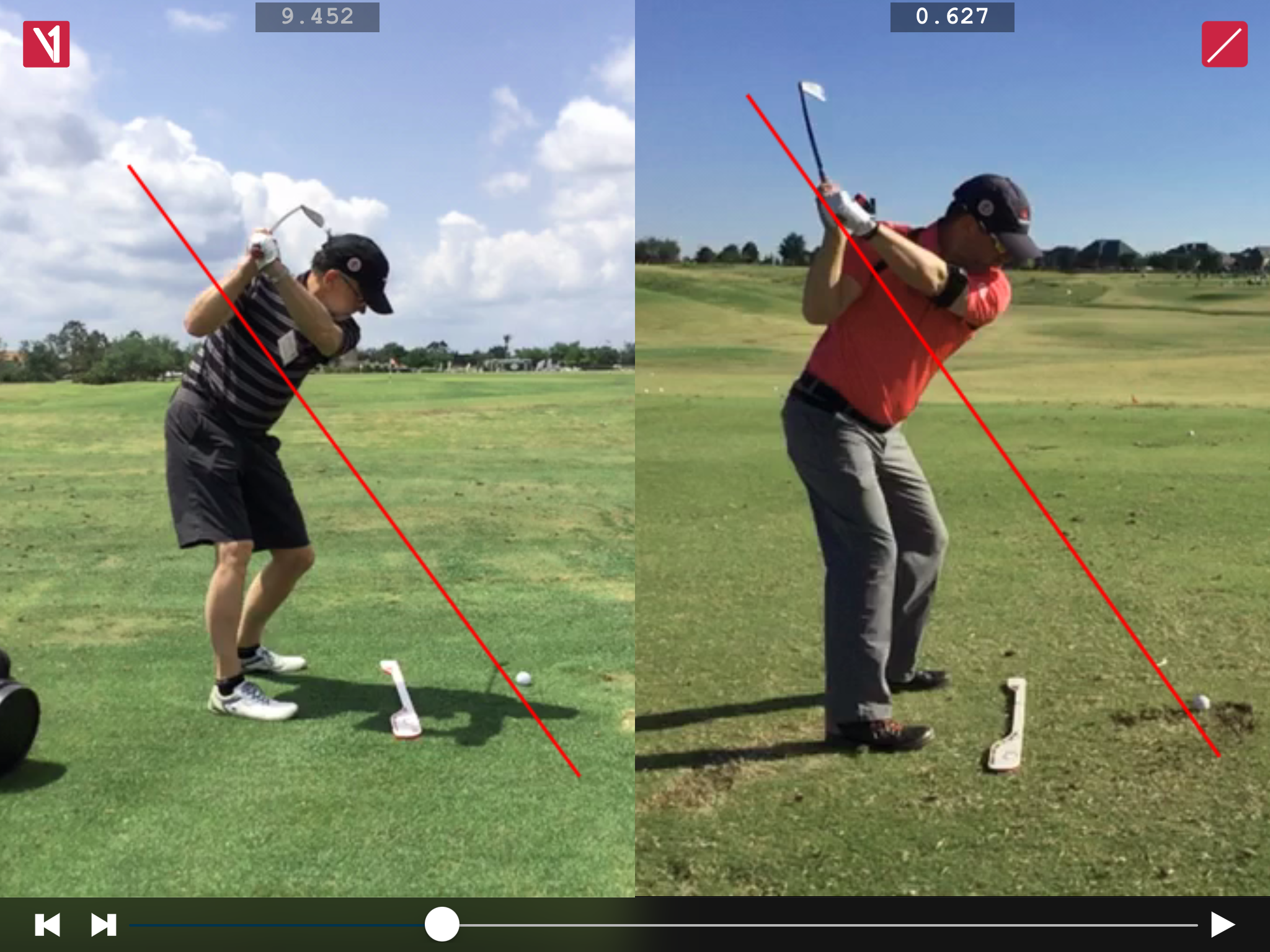
Single Plane

Miss It Fast

Moe Norman – through his brilliance, his pursuit of excellence, and his perspective on life and golf  –  said a lot of memorable things the course of his life.

One of my favorites is: “Miss it fast.”

What does it mean? And how does it relate to your golf game?

Turns out that the concept: Miss it Fast is amazingly simple, and yet rooted in the complex dynamics of the human brain. You see, even if Moe was not aware of it, the knowledge of what “Miss if Fast” yields for athletes like golfers is supported by the latest research and science in human performance.

And it has surprising implications for your mental game.

Last weekend, at the 2-Day Mental Game Playing School at Prairie Landing Golf Club in West Chicago a whole group of Single Plane Swing golfers had the opportunity to gain a much deeper understanding of what Moe meant by Miss it fast.

One of the key concepts we spent a lot of time on was this: The golf swing is a physical movement. There is a part of your brain that is dedicated to replicating the physical movements you repeat over and over again …it’s called procedural memory.

When you rely on procedural memory to execute a golf shot you give yourself the best chance of pulling off the shot the way you intend to. However, when another important part of your brain – the thinking and analytical part – gets involved, you can often struggle to create high-quality shots.

What to do?

Create routines or distractions so that you prevent too much thinking and analysis (… produced in the part of the brain associated with Working Memory.) Hitting the ball relatively quickly is a perfect example of this kind of distraction.
One super-effective portion of the instruction last weekend was dedicated to teaching a tightly-rehearsed 5-7 second pre-shot routine based on the fundamental concept that dwelling over your shot for 10-15 seconds is a sure-fire way to take you out of Procedural Memory and into Working Memory (where analysis, fear and anxiety lurk.)

Tim Graves led the group through an exercise that allowed the guys at the school to see first-hand how much a short, crisp pre-shot routine can impact the mental game.

Elite-level golfers know that a routine like this supports great shots – but they may not know exactly why.

The reason is that when you keep your pre-shot routine short and structured you prevent the over-analysis, anxiety and resulting tightness in the swing that comes from THINKING TOO MUCH about the shot you are about to hit.

When Tim talks about “playing empty” they are talking about hitting shots when you are operating from Procedural Memory…and not Working Memory. They know – as did Moe – that if you dwell and linger over shots before you hit them – your capacity to hit great shots is significantly diminished.

So if you want to enhance your mental game, consider practicing your pre-shot routine. See if you can build a deliberate – but not rushed – routine that allows you to step into the ball and pull the trigger within 5-7 seconds. I think what you will find is that you won’t get “stuck” in your thinking nearly as often as you may be getting stuck today.

Miss it fast!

-Paul

Paul Monahan, Graves Golf Mental Game Coach

The Grand Illusion

By, Paul Monahan, Graves Golf Mental Game Coach

Famous author C.S. Lewis wrote an article in 1948 about how to cope successfully in an “Atomic age.” It was only a few years since the emergence of the first atomic bombs –  the entire world was nearly paralyzed with fear over what the future would be like – and whether the human race could survive.

Lewis’ message in his article was meant to help people to gain a little CONTEXT in the midst of a fearful time so that they could live more satisfying lives. He had noticed that the anxiety people were experiencing was debilitating. And so, he urged the reader to think in more objective ways (and ultimately more productive ways) about risk and mortality.

He pointed out that there were lots of risks that people had accepted in their lives – driving in automobiles, living in cites with high crime, coping with sickness and diseases…etc.  – and these did not paralyze them. They went on living.

He reminded people that they likely did not have control over whether or not they died in an atomic bomb blast…so why worry about it?

He asked: “Why should living in the atomic age be any different than what they had already been experiencing? Why not just live your life the way you wanted to in the first place?” He implored the reader to: play with your kids, engage in your work and your passions, enjoy your family, and focus on the things you can control. This is what Lewis said would allow you to live life to the fullest.

Easier said than done sometimes. (Like in pandemics, maybe?) But it makes complete rational sense – does it not?

In my experience spending time with performance experts from all over the world and in multiple domains – US Navy Seals, Corporate CEOs, Major League Baseball teams, the NHL, the NBA, Aussie Rules Football, New Zealand Rugby League, Big Wave Surfing, Country Music and even Electronic Gaming just to name a few –  I have learned that one of keys to performing at your best in any moment lies in your ability to contextualize.

If you can put your challenges into proper perspective as you move through the day today – engaged in your work, interacting with your spouse, practicing your single plane swing, or playing a round of golf – you will have a much better chance of staying connected to your potential and performing at your best.

Yes. It actually is that simple.

What does contextualizing look like on the golf course?

Instead of berating yourself for the wayward drive off the number one tee box, you accept that miss-hits will happen for you – especially on the first hole. Instead of getting mad about your ball hitting the cart path and bouncing out-of-bounds, you laugh at the unpredictability and variability inherent in the game. And instead of steaming over a missed five-footer, you accept that you may have not yet mastered a successful putting formula from that distance.

But why do we struggle mentally and emotionally on the golf course anyway?

Because we want to WIN. (Or because we just don’t want to LOSE. Same coin, different side.)

I know many who would say – “I play golf for fun. I don’t need to win.” I get that… But let me tell you: you ARE playing to win… or to NOT lose. You just label it differently. Winning for you is mastering the bunker shot. It’s launching a 4 hybrid to 8 feet on that long par 4. It’s sinking a 30 foot double-breaker. It’s driving past your friends in the center of the fairway.  And losing is hitting it out of bounds off the tee box three holes in a row. Losing is three-putting six greens. Losing is hitting a bucket of balls and not hitting ONE ball pure.)

Struggle is technically biological – it shows up when we think we won’t get what we want. (“If I miss this putt, I will lose the momentum going into the last hole…and lose the match!”)  Then our survival brain kicks in and the wheels come off of our game. (Amirite?)

So, how’s this for some contextualizing the next time you are in struggle…and stuck on winning/not losing:

There is no such thing as winning or losing.  They are illusions. Constructs of our imagination… brought to life through language.

Winning and Losing is what I call The Grand Illusion.

That’s right. And here’s the good news – you never have to worry about winning or losing ever again. Instead, just go play the game the best way you know how today …and accept (even embrace) what happens. Chances are that you will stay much more aware, present and playful …and shoot a lower score because of it.

Think of your golf experiences as just one more step on your journey to single plane swing mastery…without the baggage and meaning of terms like winning and losing. How much calmer mentally and emotionally would that make you?

“But wait, Paul,” you say. “You mean to tell me I should stop thinking about winning? Are you crazy? How am I ever going to win anything with that strategy!!??”

In the world of elite performance, there is AWARENESS of winning and losing, for sure. But the best performers can continually and quickly put all their challenges or disappointments into context. And while inside of their performances they can separate their identity from the concept of winning or losing. Why…because they know that they cannot completely control whether they win or lose.

(One possible exception in golf was Tiger Woods. In the first fifteen years he played on the PGA tour, Tiger Wood’s skills were so far above his peers, that he actually got away with focusing on winning in nearly every moment. He was known to be singularly focused on winning …and he talked about it all the time. But he got away with that because his skills were so much better than his competitors. Read The Big Miss by Hank Haney for more insight into Tiger’s mental game during the 2000’s )

 In the past ten years, as his skills have waned, you may have noticed Tiger talking a lot more about the journey – and contextualizing more often. Which is a good thing for him – it keeps him in the game. Otherwise, he would self-destruct due to the struggle that comes from not getting what he wants. These days I believe that Tiger is playing a mental game that more closely matches the rest of the PGA Tour field than at any time in his career. Just a guess…I could be wrong.)

So what is left? Show up and do your best in that moment. Focus on what you can control.

When I played in my club championship earlier this year, I drew a much better player from my flight in the first round. On paper, advancing past this player was a long shot, so I set aside my attachment to winning and focused on what I could control – like how I showed up mentally and emotionally. And how I reacted to what was happening in front of me.

(Yes, for those that have worked with me and heard me talk about this – I DID pour out LOTS of love and positive intentions toward my competitor that day!)

The result: I played 4 strokes better than my handicap, and was tied thru 17 when my opponent pulled off an amazing shot to win on the 18th hole. Losing was not what I wished for. But I was proud that I realized my full potential that day because of how I showed up. And I am a better player today because of what I experienced: focusing on the things I can control – and letting go of the things I cannot.

High performers understand that the thing they want is more likely to show up when they loosen their mental and emotional grip on it. When they “want it a little less.” (Sounds counter-intuitive – I know.)

Moe Norman was very intentional about achieving this level of calm, often saying that his goal was to play with an “alert attitude of indifference.” (At Graves Golf Academy, we conduct an entire two-day playing school based upon this concept!)

As you start a new year – full of promise and potential – I want to encourage you to keep in mind that success in golf and in life comes – in part – from being great at contextualizing…from putting your challenges and setbacks (and achievements) into proper perspective.

And keep in mind that winning and losing is an illusion that you need not fall prey to!

-Paul

Quantum – Why So Many Positive Testimonials

A “Quantum Leap” in greens hit in regulation…

By Tim Graves, PGA

We’ve been talking with Patrick Davis (Callaway Engineer whose team was responsible for designing the Quantum clubs) about the new Quantum Golf Clubs with the Modern 360 Undercut that gives you 6 to 10 extra yards on mishits ...

But there’s a second technology in these irons that’s just as important.

It’s called the Tri-Sole Design.

And when Patrick explained it to me, I immediately thought, “This is why players are going to feel more confident over the ball” and “Why getting so many positive testimonials already“.

The Tri-Sole is a progressive keel and chamfer that runs down the front half of the sole. It changes through the set—your 4-iron has a different sole design than your 9-iron.

The key feature? It lifts the leading edge off the ground.

Patrick told me, “We noticed players having better games than we anticipated, which doesn’t always happen. We’re excited when it happens, but as engineers, we’re gonna go, why?

So Patrick and his engineers interviewed the players who tested these irons.

Here’s what the players said: I feel like I can get down on the ball more because I’m not catching as much turf.

I feel like I can swing harder because my divot pattern’s just a little bit cleaner and I’m making better contact.

I’m building confidence.”

The irons made them feel like they could be more aggressive.

And here’s the data that backs it up …

Patrick’s team saw impact locations rise about one full score line during testing.

One full score line.

That means more center-face contact. More of those “crisp” feeling shots. Fewer thin hits off the leading edge.

Meaning – if you hit the irons a little thin (minimal divot) you will not lose much distance…. much less then before with other clubs.

Patrick said, “We can put all the AI at face. But if the consumer doesn’t perceive the club as easier to hit, easier to launch, they’re never gonna have the confidence when they pick it up.

This is where perception meets performance.

The Tri-Sole makes the club FEEL easier to hit. And when you feel confident, you play better.

Now here’s the question everyone asks me, Tim, which Quantum iron model should I get?

Callaway makes three models. Let me break them down for you.

1. Quantum Max

Patrick described it as “kind of smallest, most compact” of the three models.

It’s got a medium-width sole. 

Who it’s for: Players who take a divot and want forgiveness without a huge, chunky look.

2. Quantum Max OS

The “OS” stands for Oversized.

Patrick told me, “This is the Big Bertha vibe. It’s got a wider sole. It’s got more offset. It’s got a bigger head. It’s got a thicker top line.”

He also said, “Everything’s about confidence and launch in this club.”

The wider sole helps you get the ball in the air even if you don’t take a divot or minimal divot. You can bounce it. You can skip it. You don’t even need to use the turf—you’re still going to benefit from this design.

Who it’s for: Players who make minimal to no divots and need help getting the ball in the air. This is the model I recommend for most Single Plane golfers who don’t make a divot.

3. Quantum Max Fast

This is the lightweight iron. The entire platform is 20% lighter.

Why does this matter?

If you’ve lost swing speed over the years—and let’s be honest, we all do—this iron helps you get that speed back.

Patrick said, “That doesn’t mean they’re a beginner golfer. It’s maybe somebody that’s lost speed over the years that’s trying to find that back.”

Who it’s for: Senior players, lady golfers, or anyone who’s lost 5-10 mph of swing speed and wants to regain distance.

Here’s the key …

If you make NO divot or a very minimal divot, we’re going to recommend the Max OS or Max Fast (depending on your swing speed).

If you make a divot, we’re going to recommend the Max.

The sole width, the offset, the weight distribution—it all matters based on how YOU interact with the turf.

Go watch video with Patrick

Patrick holds up all three iron models and shows you the sole differences, the top line thickness, and exactly who each model is designed for.

If you are interested in the new Quantum clubs (Irons, Hybrids, Fairway woods or Driver) please contact me at timg@gravesgolf.com

To get your personalized single plane custom club fit: CLICK HERE

It is a free service set up for you.

The Short Cut

By Tim Graves, PGA

Do you know the most common question golfers ask us?

“Is there a shortcut to making swing changes and improving my game?”

The simple answer to the question is “Yes!”

The short cut – are you ready for it?…..  is all about FEEDBACK.

Most think it is about practice….  but does practice actually help??

Should instructors encourage you to practice?

You might not believe it, but golf instructors debate about this all the time. Many golf instructors believe that you should avoid the idea of teaching the importance of practice – that it takes away from the enjoyment of the game.  They argue that the game is about teaching golfers how to play not about teaching them how to swing.

Our position is that you really can’t have fun and play well if you don’t have a good swing. Furthermore, building a great golf swing is part of the fun. We also believe that teaching the golf swing is about helping golfers “shortcut” the learning process (practice), not avoiding it. Let’s explain in two sentences.

Golfers struggle and get frustrated (and score badly) because they are unskilled.  

Skill is acquired through practice.

All skills require practice and we can’t think of a game that requires more practice than golf. This might explain so many are frustrated with the game and why in recent years, more have quit the game then started new.  It simply takes too long to get good.   The question we should be asking is not whether we should be teaching golfers to practice but rather how can we help them learn to practice correctly and effectively and get better faster…

Don’t take my word for it, listen to Dan Coyle, author of the book The Talent Code.  Dan, who researched talent hotbeds describes the acquisition of talent in three important processes:

• Deep Practice–Everyone knows that practice is a key to success. What everyone doesn’t know is that specific kinds of practice can increase skill up to ten times faster than conventional practice.

• Ignition–We all need a little motivation to get started. But what separates truly high achievers from the rest of the pack? A higher level of commitment—call it passion—born out of our deepest unconscious desires and triggered by certain primal cues. Understanding how these signals work can help you ignite passion and catalyze skill development.

• Master Coaching–What are the secrets of the world’s most effective teachers, trainers, and coaches? Discover the four virtues that enable these “talent whisperers” to fuel passion, inspire deep practice, and bring out the best in their students.

These three elements work together within your brain to form myelin, a microscopic neural substance that adds vast amounts of speed and accuracy to your movements and thoughts. Scientists have discovered that myelin might just be the holy grail: the foundation of all forms of greatness, from Michelangelo’s to Michael Jordan’s. The good news about myelin is that it isn’t fixed at birth; to the contrary, it grows, and like anything that grows, it can be cultivated and nourished.

The way we see it is that you don’t need to practice harder, you need to practice smarter get help along the way.  We can relate to these three factors in my experience as well.

In our experience the students who are the most willing to practice and enjoy the process have the most success. 

Deep practice is getting into the place where real learning occurs.  This is where feedback happens and feelings are well….felt.  Let me give you an example.

In a recent school, we had been sitting in the meeting room for about an hour.  One student asked “when are we going to hit some balls on the range?”  We responded with a question, “We will let you hit balls on the range when you can reassure me that you are measuring and getting feedback on every swing.  Are you able to do that?”

The reason we have a great golf swings is not because we are more talented than any of our students.  We have simply spent more quality time working on my golf swing.  It come down to the quality of your practice, now how much you practice.

We put in the quality then I made is stronger with repetition.  Most students put in the repetition but not the quality.

Our teaching habits have changed over the years. We find it almost impossible to watch people practice ineffectively.  We start to get nervous and we usually jump in and stop it.  We then ask “what are you working on” and “how do you know if you are getting it?”.

We are now heading into 2025.  You have a choice.  You can go another year wishing your golf game improved and guessing at the outcomes or you can make a transformation in your approach.  This is what we are suggesting is that you take a giant leap by making some major changes. You can do this by understanding Dan Coyle’s three principles of talent.  Learn how to Deep Practice, Get Passionate about it and Get Help from a Master Coach. 

Now take some action on these principles and get practicing – correctly.

To find out more about how to practice correctly, deep practice and your short cut to improvement – please see:  CLICK HERE

The Man With the Perfect Swing – Reader’s Digest Article

Reprint

By: Bruce Selcraig

“His game was close to genius, but could he find acceptance”

On a warm morning at a country club near Orlando, a stocky gentleman with wispy gray hair makes his way past the crowd gathered for today’s exhibition. To those who don’t know better, the impish old fellow could be just another sunburned senior dreaming of bogey golf.

He wears a black turtleneck despite the heat. The left pocket of his neon-lime slacks bulges, as always, with two golf balls – never more, never fewer. All three watches on his left wrist are set to the same time.

Taking his position at the tee, he quickly lofts a few short wedge shots about 70 yards. At first, the spectators seem unimpressed. Then they notice that the balls are landing on top of one another. “Every shot same as the last,” chirps the golfer, as if to himself, “Same as the last.”

Moving to a longer club, a seven iron, he smoothly launches two dozen balls, which soar 150 yards and come to rest so close to each other you could cover them with a bedspread. He then pulls out his driver and sends a hail of balls 250 yards away – all clustered on a patch of grass the size of a two-car garage. Astonished laughter erupts from the crowd. “Perfectly straight,” says the golfer in a singsong voice. “There is goes. Perfectly straight.”

Those who have followed Moe Norman’s career are no longer surprised by his uncanny displays of accuracy. Many professionals and avid players consider the 70-year-old Canadian a near-mythical figure. But few outside the sport have ever heard his name. Fewer still know the story of his struggle to find acceptance in the only world he understands.

One cold January morning in 1935, five-year-old Murray Norman was sledding double with a friend on an ice-packed hillside near his home in Kitchner, Ontario. Speeding downhill, the sled hurtled into the street and skidded under a passing car.

Both boys survived and ran home crying. But the car’s right rear tire had rolled over Moe’s head, pushing up the cheekbone on one side of his face. His parents, unable to afford medical care, could only pray he did not suffer serious brain damage.

As Moe grew older he developed odd behavioral quirks and a repetition, staccato speech pattern. His older brother Ron noticed that Moe seemed unusually frightened of unfamiliar situations. At night, Ron often heard his little brother sobbing in bed, devastated by some real or imagined slight.

At school Moe felt glaringly out of place among other kids. Desperate for friends and acceptance, he tried to be playful, but his efforts often backfired-pinching people too hard or bear-hugging them until they pushed him away. He heaped ridicule on himself and even coined his own nickname: Moe the Schmoe. He became known as a slow student in every subject-except one. At math no one could touch Moe Norman. He astounded his classmates by memorizing complicated problems and multiplying two-digit numbers in his head almost instantly.

When he wasn’t acting the clown, Moe walled himself off from others. Over time he plunged deeper into isolation, and yet, ironically, it was loneliness that led him to his greatest happiness.

In the years following his accident, Moe spent hours atop the same winter sledding hill, hacking around an old golf ball with a rusty wood-shafted five iron he found at home. Here in the solitary and magical world of golf, he found a reason to wake up each morning.

Kitchner, Ontario, in the 1940’s was a gritty factory town where working-class teenagers had little desire or money to play the “sissy”, upper -class game of golf. Moe was spellbound, often skipping meals, school and chores to head off by himself in a field to hit balls-500 or more a day. He practiced until dark, sometimes until the blood from his hands made the club too slippery to hold.

In his early teens, Moe got a job as a caddie at a country club only to be fired when he hurled the clubs of a low-tipping local mogul into some trees. Soon he gave up caddying to concentrate on playing, honing his skills at a nearby public golf course. He quit school in tenth grade, and by the time he was 19, he knew he was blessed with a rare talent: he could hit a golf ball wherever he wanted it to go.

Moe left home in his early 20s, hitching rides to compete in amateur golf tournaments all over Canada, supporting himself with a succession of low-paying jobs. At his first few tournaments in the late 1940s, fans didn’t know what to make of the odd little fellow with the garish, mismatched outfits, strawlike red hair and crooked teeth.

He manner was playful, almost childlike, his self-taught technique wildly unorthodox. Legs spread wide, he stood over the ball like a slugger at the plate, clutching the club not with his fingers, as most golfers are taught to do, but tightly in his palms, wrists cocked, as if he were holding a sledgehammer. Many spectators dismissed him as an amusing sideshow. Some giggled when he stepped up to the tee. Soon though, Moe Norman was turning heads for reasons other than his personal style.

Recognized as a gifted player who could hit a golf ball with breath-taking precision, he quickly became a sensation on the amateur golf circuit. In one year alone he shot 61 four times, set nine-course records and won 17 out of 26 tournaments.

Even as his fame grew, Moe remained painfully shy and could not shake the sense that he was undeserving of the attention. Rather than bask in the spotlight, he avoided it. In 1955, after winning the Canadian Amateur Open in Calgary, Moe failed to show for the awards ceremony. Friends later found him by the nearby Elbow River, cooling his feet.

The victory qualified Moe for one of golf’s most prestigious events: the Masters. When he got the invitation to the tournament, he was only 26 and spending his winters setting pins in a Kitchner bowling alley. This was his chance not only to represent his country but to show skeptics he wasn’t just some freak on a run of beginner’s luck.

But his old demons would give him no rest. Moe felt like an intruder among some of golf’s brightest lights. He played miserably in the first round and even worse on day two. So he fled to a nearby driving range to practice.

While hitting balls, Moe noticed someone behind him. “Mind if I give you a little tip?” asked Sam Snead. The Hall of Famer merely suggested a slight change in his long-iron stroke. But for Moe it was like Moses bringing an 11th commandment down from the mountaintop.

Determined to put Snead’s advice to good use, Moe stayed on the range until dark, hitting balls by the hundreds. The next day, unable to hold a club, he withdrew from the Masters, humiliated.

But Moe climbed right back up the ladder to win the Canadian Amateur again a year later. A string of victories followed. In time, he had won so many tournaments and collected so many televisions, wristwatches and other prizes that he began selling off those he didn’t want.

When the Royal Canadian Golf Association charged him with accepting donations for travel expenses, which was against regulations for amateurs, Moe decided to turn professional. His first move as a pro was to enter, and win, the Ontario Open.

As a newcomer to professional golf, Moe approached the game with the same impish lightheartedness of his amateur years. When people laughed, he played along by acting the clown. An extremely fast player, he’s set up and make his shot in about three seconds, then sometimes stretch out on the fairway and pretend to doze until the other players caught up.

Fans loved the show, but some of his fellow competitors of the U.S. PGA Tour did not. As the Los Angeles Open in 1959, a small group of players cornered Moe in the locker room. Stop goofing off, they told him, demanding that he improve his technique as well as his wardrobe.

Friends say a shadow fell across Moe that day. Some believe the episode shattered his self-confidence and persuaded him to back out of the American tour, never to return. More than anything, Moe had wanted to be accepted by the players he so admired. But he was unlike the others, and he was being punished for it.

The laughter suddenly seemed barbed and personal. No longer could he shrug it off when some jerk in the galleries mimicked his high-pitched voice or hitched up his waistline to mock Moe’s too-short trousers.

Because Moe never dueled the likes of Americans Jack Nicklaus or Arnold Palmer, he achieved little recognition beyond Canada. At home, though, his success was staggering. On the Canadian PGA Tour and in smaller events in Florida, Moe won 54 tournaments and set 33-course records. While most world- class golfers count their lifetime holes-in-one on a few fingers, Moe has scored at least 17.

Despite his fame and the passing years, Moe was continually buffeted by the mood swings that tormented him in childhood. Even among friends, he could be curt, sometimes embarrassingly rude.

At other times he was charming, lovable Moe, bear hugging friends and tossing golf balls to children like candy-the happy-go-lucky clown from his amateur days.

Through the 1960’s and ’70s Moe racked up one tournament victory after another. But in the early 1980’s his enthusiasm for competition began to wane. His winnings dwindled, and he slipped into depression. Not being wealthy, he seemed to care very little for money, lending thousands to aspiring golfers and never bothering to collect.

Broke and all by forgotten, he drifted from shabby apartments and boardinghouses to cut-rate roadside motels, often sleeping in his car. Had it not been for the generosity of friends-and a stroke of good luck- he might have faded entirely into obscurity.

Moe has never had a telephone, a credit card or owned a house. Few people know where he might be living on any given day, and he seldom talks to strangers. Little wonder it took Jack Kuykendall two years to track him down.

Kuykendall, founder of a company called Natural Golf Corp., finally caught up with him in Titusville, Fla. He told Moe that, trained in physics, he had worked for years to develop the perfect golf swing-only to discover that an old-timer from Canada had been using the same technique for 40 years. He had to meet this man.

Moe agreed to demonstrate his swing at clinics sponsored by Natural Golf Corp. Word spread quickly through the golfing grapevine, and before long, sports magazines were trumpeting the mysterious genius with the killer swing.

Among those following Moe’s story was Wally Uihlein, president of the golf-ball company Titleist and Foot-Joy Worldwide. Hoping to preserve one of golf’s treasures, Uihlein announced in 1995 that his company was awarding Norman $5000 a month for the rest of his life. Stunned, Moe asked what he had to do to earn the money, “Nothing,” said Uihlein. “You’ve already done it.”

Two weeks later, Moe Norman was elected to the Canadian Golf Hall of Fame. Even today, however, he remains largely unknown outside his native country except among true disciples of the game. For them, Moe is golf’s greatest unsung hero, the enigmatic loner once described by golfer “Lee Trevino as “the best ball-striker I ever saw come down the pike.” Many agree with Jack Kuykendall-had someone given Moe a hand 40 years ago, “we would know his name like we know Babe Ruth’s.”

In a parking lot of a Florida Country Club, Moe Norman is leaning into his grey Cadillac, fumbling through a pile of motivational tapes. He seems nervous and rushed, but as he slides behind the wheel, he pauses to reflect on his life, his family and his obsession.

Moe never had a real mentor or a trusted adviser. “Today’s kids,” he says, “are driven right up to the country club. Nice golf shoes, twenty-dollar gloves, nice pants. “Have a nice day, son.” I cry when I hear that. Oooh, if I’d ever heard that when I was growing up…”

He squints into the sun and cocks his head. “Everyone wanted me to be happy their way,” he says. “But I did it my way. Now, every night I sit in the corner of my room in the dark before I go to bed and say, “My life belongs to me. My life belongs to me.”

With that, he shuts the door and rolls down the window just a crack. Asked where he’s going, Moe brightens instantly, and a look of delight spreads across his face.

“Gone to hit balls,” he says, pulling away. “Hit balls.” It is and forever will be, the highlight of his day.

Reprinted from the December 1999 Issue of Reader’s Digest @ 1999 the Reader’s Digest Association, Inc., Pleasantville, N.Y. 10570 Printed in U.S.A.

It’s About the Journey

By Paul Monahan, Graves Golf Mental Game Coach
A few years ago, I realized that I had visited nearly all 50 states in America….all except Idaho and Montana. It occurred to me that I would be turning 50 years old that year – and I had this idea that if I got a little intentional, I could complete the 50 States x 50 Race” (…I think I made up) by visiting all 50 states before I turned 50. What an incredible accomplishment that would be! Right?

I worked through the logistics: I would fly to Spokane, WA then drive to Coeur d’Alene, ID. While there, I could play some golf, and then make my way over to Montana…only a short distance from Coeur d’Alene. My buddy Jon from high school, – always up for an adventure – would come with me. The trip was on.

So, in May of that year, Jon and I hopped on a flight and we headed out on our adventure. On day one we travelled to Idaho (#49…check!). On day two, we played golf at the Coeur d’Alene Resort (…famous for its moveable island green. Yes…I got the certificate!). And on day three we drove an hour or so East to the Montana border. (#50…check!) The race was over. I won!

Cue the big celebration, right? The elation. The pure joy. The confetti.

Well… what I experienced was a bit different. And frankly it was a bit of a letdown.

There was no there there. I can’t even tell you how ridiculous I felt. I said to myself “ You did what? Travelled all this way just to be able to tell your friends you travelled to 50 states!?”  (… this whole essay is starting to feel like a giant humble brag.)

But the truth is that I had an amazing three days with a life-long buddy who enjoys many of the things I do. Golf, adventure, great conversations about the meaning of life…etc. That was where the joy and happiness was for me. And if I reflect on my journey through the other 48 states, I can think of tons of great memories and experiences as well.

So, by the time I got to the Montana border, the “prize” didn’t matter as much.

The point is this: it’s not about the destination – it’s about the journey. Always has been. Always will be.

When I was younger, I thought that was just another platitude. Pure garbage. A phrase invented by people who were too afraid or too timid to do what it took to get themselves across the finish line.

I don’t believe that anymore. I believe that I am most energized when I am working toward something – engaged purposefully in pursuit of a goal, dream, or defined outcome. On the path. On the journey.

I am immensely satisfied when I arrive at my goals… and even happy or elated sometimes. (Ask me about my experiences walking across the Grand Canyon’s Rim-to-Rim route the next time you see me.) But looking back, it really WAS the journey that mattered most. And looking ahead, I believe it really IS the journey that matters most.

The journey is what points you. It is what energizes you, challenges you, and puts you into the kind of productive struggle that creates growth. (Thank you, Dan Coyle.)

Learning to play golf at a higher level the way you are doing it IS a journey. Remember to enjoy it. Relish it. Know what it is – and what it is not. It IS an amazing adventure of learning and growth. It is NOT your identity. It is NOT an obstacle to be overcome – but an experience to move through that will change you forever.

In Jordan Petersons’ book Beyond Order, he says that “You are not only something that is. You are something that is becoming…”

Humans are teleological… we must have purpose. We must have targets. We must be aimed at a destination…and be traveling in that direction. It is how we are wired. But what truly brings joy, satisfaction and happiness to a life is not necessarily arriving at some pre-ordained goal, but rather what we experience along the journey itself.

The next time you are in struggle, experiencing frustration about your game or about that shot that just went sideways, stop. Take a deep breath and remind yourself:  “It’s the journey.” Then consider the gift inherent in that moment …how that moment will make you stronger, smarter, and more able to complete the journey you are on. Remember that you are becoming… one little step at a time.

Safe travels!

-Paul

LEARN

THE

SWING

Join 1M+ Subscribers to get your FREE Video Quick Start Guide that reveals how to hit the ball farther and straighter more consistently from now on…

START YOUR NEW GOLF SWING